

HY-FI, MUSHROOM BRICKS!
Mushroom bricks, created by The Living, are eco-friendly construction materials made from agricultural waste and mycelium, used to build the sustainable Hy-Fi pavilion.
 Begüm Şardan10 January 20203 Mins read451
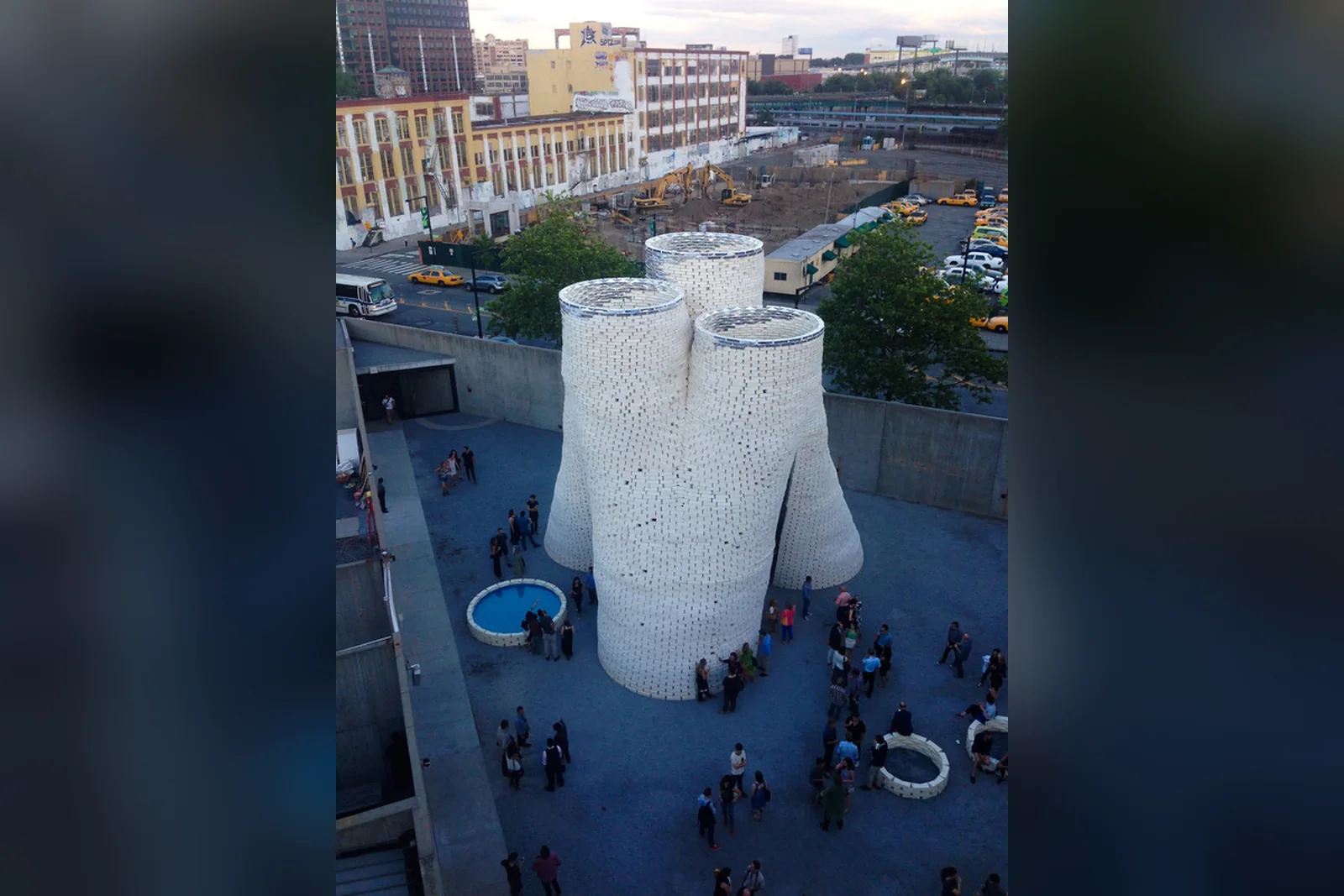
Table of Contents Show
Day by day, our world is getting damaged depending on ecological causes. However, as human beings, our role can’t be ignored in that case. Do you recognize the mega structures around you? How are day acting in city? Okay, let’s say it’s the urban scale, hard to do but just for this time, let’s put it aside and focus on another thing.

Can you imagine the amount of the energy which has been wasting, structural elements, materials and their amount which has been putting… Imagine concrete, panels, plaster, steel etc… I believe that you have already started to think like ‘I wish would be other way to make it sustainable.‘ Well yes! Here it comes!
NY based studio, The Living, created a pavilion which was made by mushroom bricks! Probably you wonder how it can be possible, here is the video about the process.
As you can understand, it is cheap, eco-friendly, also sustainable. So, The Living created 10,000 bricks in that way and constructed 13 meters tall tower.

Pavilion hosted for cultural events for three months at courtyard of MoMA PS1, NY, end of its journey, they dissembled the structure and bricks went back to the earth they belong. As far as I am concerned it can be the best way to prove sustainability.

Founder of The Living, David Benjamin, explains his journey with these words; “We were interested in saying, ‘Could we create a new material and a new kind of ecosystem of design and manufacturing, and construction that was sustainable in new ways’ , and we pushed and tested the limits of what sustainability could be.”

You can also find more information and other works of The Living at
What Mushroom Bricks Actually Are
Mushroom bricks are grown rather than manufactured. They are made by packing a mold with agricultural waste, such as corn stalks or chopped husks, then introducing mycelium, the thread-like root network of fungi. Over several days the mycelium digests the waste and binds the loose material into a solid mass. Once the brick reaches the desired density, it is dried or lightly baked to stop the growth, leaving a lightweight, rigid block. The process needs little energy and no high-temperature kilns, which is one of the main reasons it appeals to architects looking for low-carbon materials.
How the Hy-Fi Tower Was Built
Hy-Fi was the winning entry of the 2014 Young Architects Program organized by MoMA and MoMA PS1. The Living combined the organic mushroom bricks at the base with reflective bricks near the top that bounced daylight down into the courtyard. The tower was assembled from the ground up, with the lower section carrying the structural load and the upper section managing light and air. Because the bricks were grown to shape, the team could control each unit before construction began, which reduced waste on site and made the assembly straightforward.
Benefits and Current Limitations
The advantages are clear. The material is compostable, made from cheap and abundant feedstock, and grown at near room temperature. At the end of its life it can be broken down and returned to the soil, closing the loop that conventional concrete and steel cannot. The limitations are just as important to understand. Untreated mycelium materials are sensitive to prolonged moisture and have lower compressive strength than fired brick or concrete, so they suit temporary pavilions, insulation panels, and interior elements more than permanent load-bearing walls. Ongoing research is focused on coatings and hybrids that improve durability without losing the compostable quality.
Why It Matters for Sustainable Architecture
Construction is responsible for a large share of global carbon emissions, much of it tied to cement production and material transport. Projects like Hy-Fi are valuable because they test what a genuinely circular building material could look like at full scale, not just in a laboratory. Even if mushroom bricks never replace concrete outright, they push the wider field to ask better questions about embodied energy, end-of-life waste, and the difference between materials we extract and materials we grow. For students and practitioners, the takeaway is to treat experimental biomaterials as a real part of the design toolkit rather than a novelty.



Interior Design for Commercial Spaces: Enhancing Functionality and Brand Identity
Commercial interior design has to serve brand, function and regulation at once....
 Begum Gumusel4 Mins read
Designing Exterior Concrete That Survives Freeze-Thaw Winters
Freeze-thaw cycles, not one long cold spell, are what break exterior concrete....
 illustrarch Editoral Team9 Mins read
Groupwork Completes 10-Storey Loadbearing Granite Flats in London
Groupwork's Petra Heights on Finchley Road is a 10-storey block of 22...
illustrarch Editoral Team2 Mins read
What Architecture Students Should Know About Structural Glass and Guardrail Code
Glass guards look minimal, but structural behavior, safety glazing, connections and guardrail...
illustrarch Editoral Team6 Mins read


Leave a comment