

Architect Resume Examples: Templates and Design Tips
A look at architect resume examples that work, with a section-by-section breakdown, the software skills to list, and design principles for a resume that reads well.
 Elif Ayse Sen25 April 20226 Mins read619

Table of Contents Show
Strong architect resume examples share a clear structure, a legible layout, and a design sense that matches the portfolio behind them. The best versions state your focus in seconds, list the software you actually use, and keep everything to one or two pages so a hiring team can read your background at a glance.
A resume for architects carries real weight in a hiring or admissions decision. While architectural portfolios often include a CV page, employers and schools still want a standalone document that lays out your experience, competencies, and academic history without hunting through project spreads. Your resume should hold enough detail to describe your career, and it should be designed with the same care you give any drawing set.
Thinking like an architect means designing like one across every deliverable, and your resume is no exception. The samples below come from architects working in different styles, so you can adapt the approach that fits you. Much like an architectural presentation, a resume reflects your design approach, the offices or institutions you are targeting, and the balance it strikes with the portfolio you send alongside it.

This first example keeps things straightforward and minimalist. A layout like this is clear and explanatory, and it does its job well. Since most job and school applications already include a portfolio, a restrained resume lets your project work stand out while your core information stays easy to read.
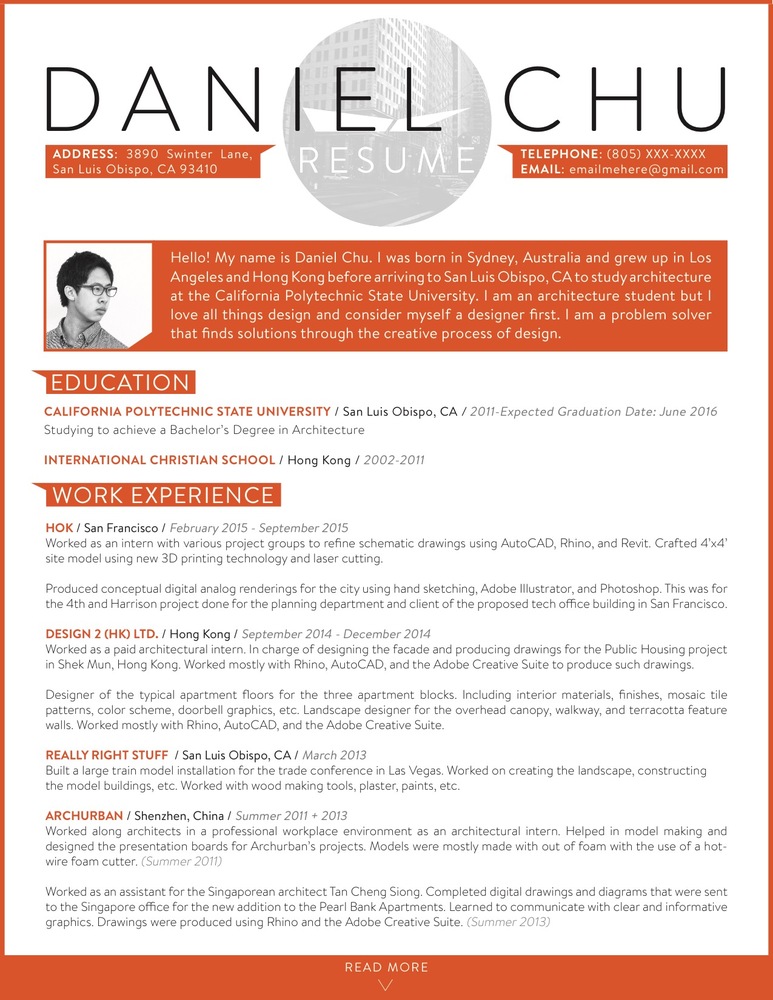
Because architects differ from many other professions, you can bring graphic design into a resume that reflects your own style. Some designers include a photo, while others keep the document purely informational. The key is not to contradict your other work: follow basic design principles and build a balanced page that sits comfortably next to your portfolio and cover letter.
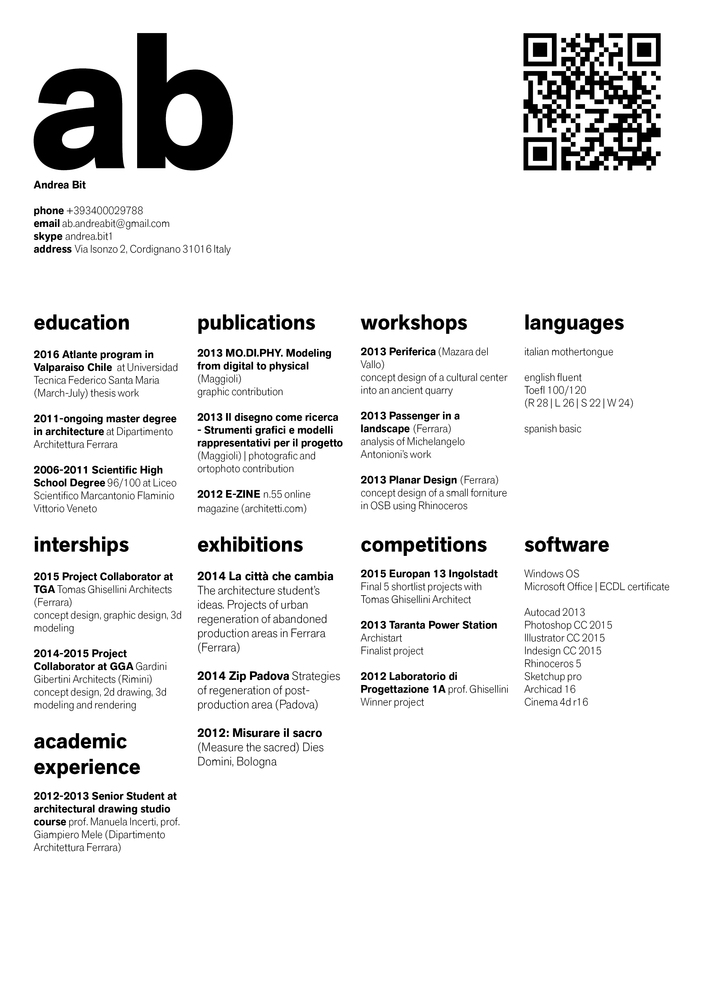
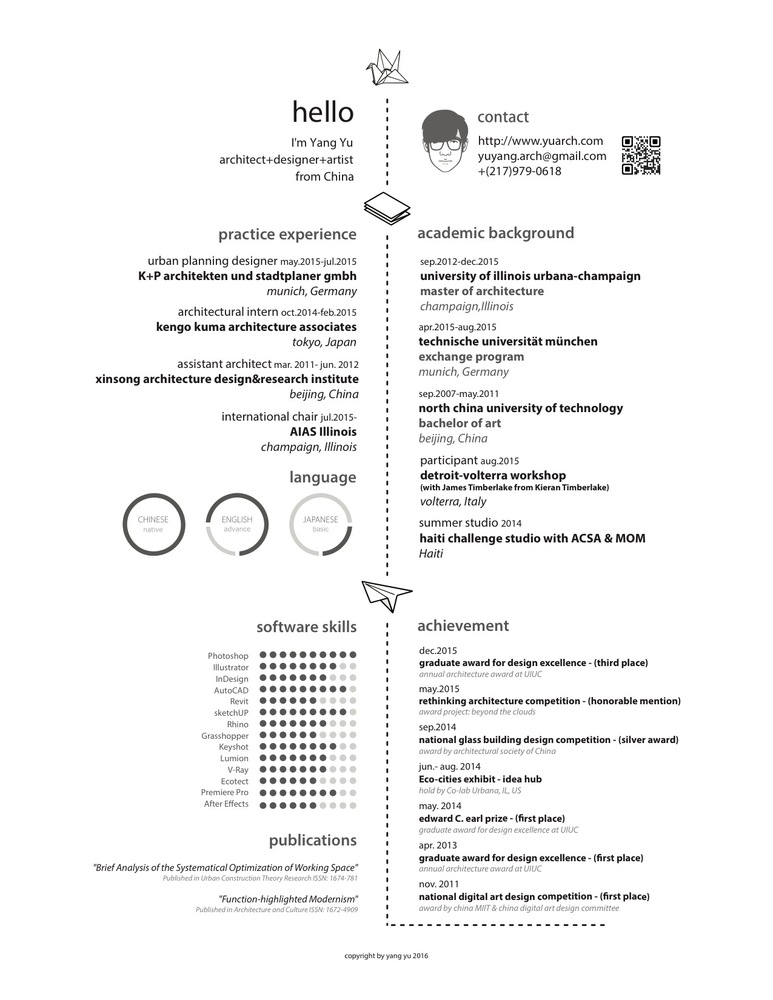
Another strong approach turns your own name into a small logo and adds a QR code that links straight to your portfolio. You can also personalize the page with simple illustrations that represent you and support the skills you want to highlight. For more inspiration, the resume examples collected under the ArchDaily resume tag show how practicing architects handle these choices.
What to Include in an Architecture Resume
No matter which visual style you choose, a strong architecture resume covers a consistent set of sections. Start with clear contact details and a short professional summary that states your focus, whether that is residential design, urban planning, or visualization. Follow with education, listing your degree, institution, and graduation year, then work experience presented in reverse chronological order with concrete responsibilities. A dedicated software skills section matters in this field: list tools such as AutoCAD, Revit, Rhino, SketchUp, the Adobe suite, and any rendering engines you know. Round it out with relevant projects, awards, languages, and a link to your portfolio.
The table below breaks down the core sections most architect resume examples share, what belongs in each one, and a quick tip to make it stronger.
| Resume Section | What to Include | Tip |
|---|---|---|
| Header and summary | Name, contact details, portfolio link, one-line focus | Name your specialty so reviewers place you fast |
| Education | Degree, school, graduation year, honors | Lead with this if you are a student or new graduate |
| Experience | Roles in reverse order, action verbs, project scope | Quantify results, such as building area or team size |
| Software skills | AutoCAD, Revit, Rhino, SketchUp, Adobe, rendering tools | List only tools you can actually use on the job |
| Extras | Awards, competitions, languages, publications | Keep this short and cut anything unrelated to the role |
📐 Technical Note
Export your resume as a compressed PDF and keep the file under a few megabytes so it opens quickly and passes email attachment limits. Embed your fonts, or convert headings to outlines, so the typography looks the same on a recruiter’s machine as it does on yours.
Which Resume Style Fits Your Application?
The examples above point to three broad directions, and the right one depends on where you are applying. A minimalist, text-led layout works when your portfolio does the visual heavy lifting or when a large firm screens applications through software. A graphic-forward page, with a name logo, color accents, or a QR code, suits creative studios and competitions where design personality helps you stand out. A hybrid keeps a clean structure but adds one or two considered details, such as a subtle grid or a single accent color, which is often the safest choice for graduate school and mid-size practices.
Free tools make it easy to test a direction before you commit. Template libraries such as Canva’s resume templates give you a starting grid, while designers on Behance post finished architecture resumes you can study for layout ideas. Treat these as references, then rebuild the page in your own type and spacing so it reads as your work rather than a stock file.
💡 Pro Tip
Build one clean master resume, then save tailored copies for each type of role. Reviewers spend only a few seconds on a first pass, so put the section that matters most for that job, software skills for a production role or studio work for a graduate program, at the top of page one.
Matching the Resume to the Application
One resume rarely fits every opportunity. A graduate school application often values academic achievement, studio work, and research interests, so those sections deserve prominence. A practice hiring for production work will look first at software fluency, construction knowledge, and hands-on project involvement. Read each listing carefully and reorder your content so the most relevant material appears near the top. Tailoring the wording to echo the language of the role also helps your resume pass the automated screening systems that many larger firms now use.
Licensing status is worth calling out when it applies. If you are logging hours toward a license, a short line referencing your progress through the NCARB path to licensure signals where you are in your career. For roles in the United States, checking the AIA Career Center also helps you read the language firms use in listings, which you can then mirror in your own resume.
Design Principles for a Resume That Reads Well
Because reviewers will judge your design sense from the document itself, apply the same discipline you bring to a project. Use a clear typographic hierarchy with one or two complementary typefaces, generous white space, and a consistent grid. Restrained use of color can guide the eye without overwhelming the content. Keep the file to one or two pages and export a compressed PDF so it opens quickly and prints cleanly. Above all, ensure the resume is still readable in grayscale, since some recruiters print in black and white.
📌 Did You Know?
Many mid-size and large practices run resumes through applicant tracking software before a human ever reads them. Heavily graphic layouts with text baked into images can confuse these parsers, which is one reason a clean, text-based version of your resume is worth keeping alongside a designed one.
Common Mistakes to Avoid
A few recurring errors weaken otherwise good resumes. Overloading the page with dense paragraphs makes it hard to scan, so favor concise bullet points that lead with action verbs. Decorative layouts that sacrifice legibility can backfire, as can broken portfolio links or an oversized file that fails to send. Proofread carefully, since typographic and spelling errors undermine the precision employers expect from an architect. Finally, keep the resume current and align its style with your portfolio and cover letter so your whole application reads as one coherent body of work.
Frequently Asked Questions
How long should an architect resume be?
One page is the standard for students and early-career architects, while experienced professionals can extend to two pages. If you need more room to show projects, put that work in your portfolio rather than stretching the resume, and keep the document tight enough to read in under a minute.
What software skills belong on an architecture resume?
List the tools you can use without supervision, usually AutoCAD, Revit, Rhino, SketchUp, and the Adobe suite, plus any rendering engines such as V-Ray or Enscape. Group them by category and be honest about your level, since interviewers often test the software you claim to know.
Should an architect resume include a photo?
It depends on the region and the employer. A photo is common in parts of Europe and Asia but discouraged in the United States and United Kingdom, where hiring rules steer away from it. When in doubt, leave the photo out and let your layout and content carry the page.
What file format works best for sending a resume?
A compressed PDF is the safest choice because it holds your layout across devices and prints consistently. Name the file clearly with your full name and the word resume, and keep the size small enough to clear email attachment limits and any online application uploader.
Where to Go From Here
Your Next Step: Pull your current resume next to one of the examples above and mark every section a reviewer would reach in the first ten seconds. Rebuild that top third first, tighten the wording, and export a grayscale test print before you send it with your portfolio.







Best Presentation Tools for Architecture Portfolios: A Practical Guide
A breakdown of the top presentation tools used by architects and architecture...
 Sinan Ozen8 Mins read
Architecture Portfolio for Internship: 8 Steps to Stand Out and Get Hired
A focused guide to building an architecture portfolio for internship applications. Covers...
Elif Ayse Sen15 Mins read

Architectural Portfolio Visibility on Pinterest: A Practical Guide for Architects
Pinterest operates less like a social network and more like a visual...
Sinan Ozen7 Mins read

10 Things You Need To Do To Create a Successful Architectural Portfolio
Discover 10 essential steps to create a successful architecture portfolio. From cover...
 Furkan Sen10 Mins read


Leave a comment