

Iconic Architecture in Spain: Landmarks That Define a Nation
A guided tour of iconic architecture in Spain, covering the Alhambra, Gaudi's Sagrada Familia and Casa Mila, Gehry's Guggenheim Bilbao, Calatrava's Valencia complex, and Seville's Metropol Parasol, with architects, eras, and design ideas.
 Elif Ayse Sen28 June 20235 Mins read476

Table of Contents Show
Iconic architecture in Spain spans more than a thousand years, from Moorish palaces and Gothic cathedrals to the sculptural forms of Antoni Gaudí and Frank Gehry. These famous buildings in Spain draw millions of visitors each year and continue to shape how architects think about ornament, structure, and the relationship between design and landscape.
Spain rewards anyone who studies buildings for a living. Few countries pack so many distinct periods into such a small map: Roman aqueducts sit near Islamic fortresses, medieval cathedrals share cities with fluid modern museums. This guide walks through the landmarks that define Spanish design, the architects behind them, and the ideas that make each one worth studying. For a related look at another European design capital, see our companion piece on iconic architecture in France.
What Makes Spanish Architecture So Distinctive?
Spanish architecture stands apart because of layering. Successive cultures, Roman, Visigothic, Islamic, Christian, and modern, built on top of one another rather than erasing what came before. The result is a design language where a single city block can hold a horseshoe arch, a Gothic vault, and a titanium curtain wall. That density of influence is why so many architects treat Spain as a working reference library.
🎓 Expert Insight
“The straight line belongs to men, the curved line belongs to God.”, Antoni Gaudí, Catalan architect
Gaudí’s preference for curves over rigid geometry explains much of what feels distinct about Barcelona’s landmarks, where columns branch like trees and facades ripple like water.
The Great Landmarks of Iconic Architecture in Spain
The buildings below cover roughly seven centuries of design. Each one solved a different problem, whether that meant cooling a desert palace, honoring a saint, or putting a fading industrial city back on the cultural map.
Alhambra, Granada
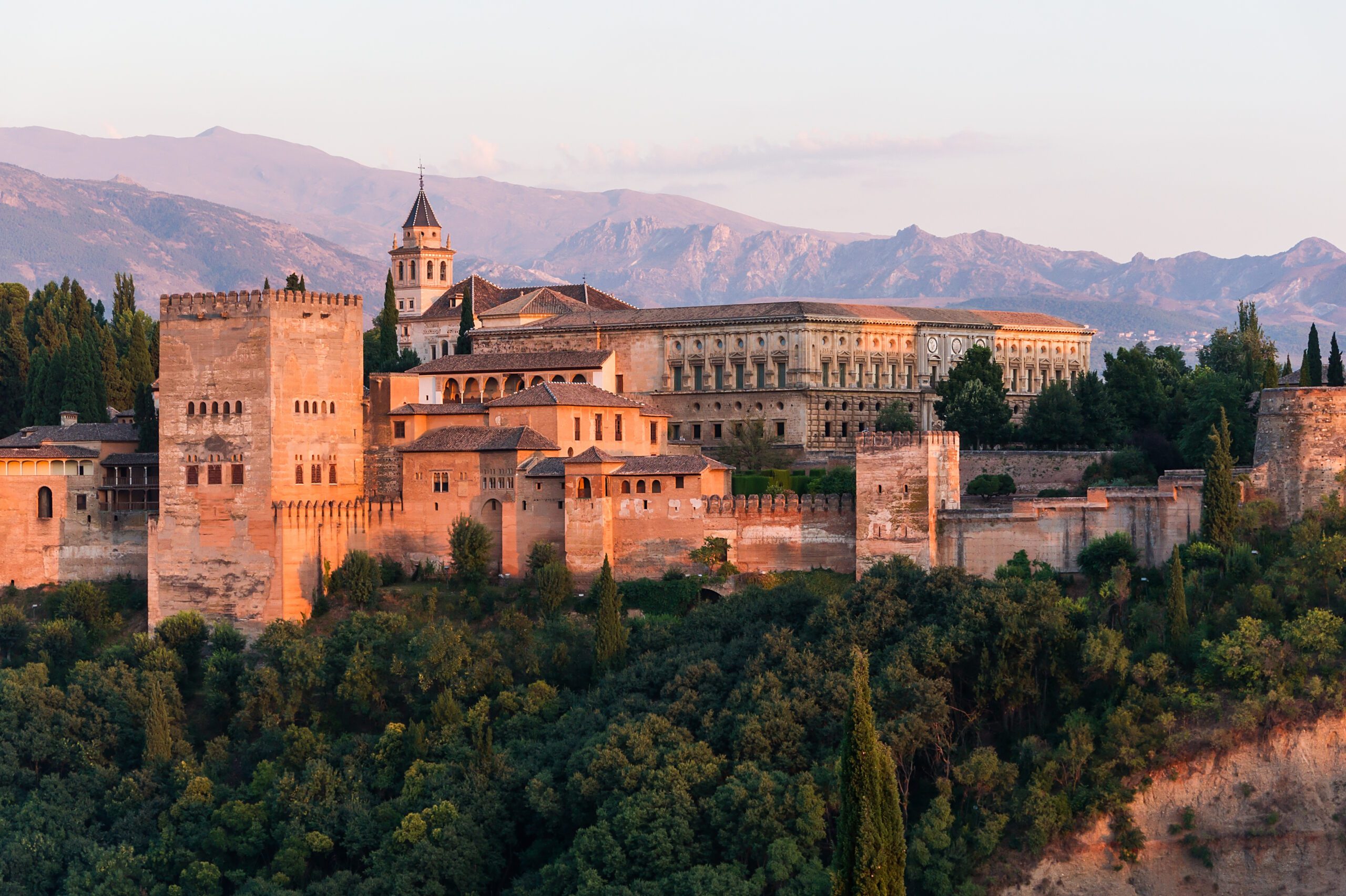
The Alhambra is the finest surviving example of Nasrid architecture in Europe. Built mainly through the 13th and 14th centuries, this hilltop fortress and palace complex uses water, light, and geometry as building materials in their own right. Reflecting pools double the apparent size of courtyards, while carved stucco and tile turn plain walls into fields of pattern. Its handling of architectural styles rooted in Islamic art still guides designers who want ornament to carry meaning rather than decoration alone.
Sagrada Família, Barcelona
No account of famous buildings in Spain skips Gaudí’s basilica. Begun in 1882 and still unfinished, the Sagrada Família merges Gothic verticality with forms borrowed directly from nature. Its columns split like tree trunks to spread the roof load, a structural idea Gaudí tested with hanging chain models decades before computers could calculate such geometry. The building blends Gothic and Art Nouveau sensibilities into something entirely its own.
📌 Did You Know?
According to the Sagrada Família’s official construction board, the basilica has been under construction for over 140 years and its central Tower of Jesus Christ, once topped out, will make it the tallest religious building in Europe at around 172.5 meters. Gaudí deliberately kept it just below the height of Barcelona’s Montjuïc hill.
Casa Milà and Park Güell, Barcelona
Two more Gaudí projects show his range beyond the basilica. Casa Milà, known locally as La Pedrera and completed in 1912, is an apartment block with a rippling stone facade and no straight load-bearing walls inside, an early use of a free plan. Park Güell, built between 1900 and 1914, wraps gardens, viaducts, and a serpentine tiled bench across a Barcelona hillside. Both sites belong to the UNESCO listing for the works of Antoni Gaudí and remain studied for how they fold structure into art.
Guggenheim Museum, Bilbao
Frank Gehry’s Guggenheim Museum, opened in 1997, changed how cities think about culture-led renewal. Its titanium-clad, sculptural volumes were modeled with aerospace software so the curved panels could be built accurately. The museum drew millions of visitors within a few years and gave planners a shorthand term, the “Bilbao effect,” for a single building that lifts an entire regional economy.
🏗️ Real-World Example
Guggenheim Museum Bilbao (Bilbao, 1997): Gehry used a titanium skin because it reads warmly under Bilbao’s often grey skies, unlike steel. The building helped convert a declining port city into a cultural destination, and its success is still cited in urban planning courses worldwide.
City of Arts and Sciences, Valencia
Santiago Calatrava, working with Félix Candela on the oceanographic park, gave Valencia a futuristic cultural district built between 1998 and 2005. White concrete shells, long reflecting pools, and skeletal ribs recall the forms of bones and marine life, hallmarks of Calatrava’s engineering-driven style. The complex holds an opera house, a planetarium, and a science museum.

Alcázar of Seville and Santiago de Compostela Cathedral
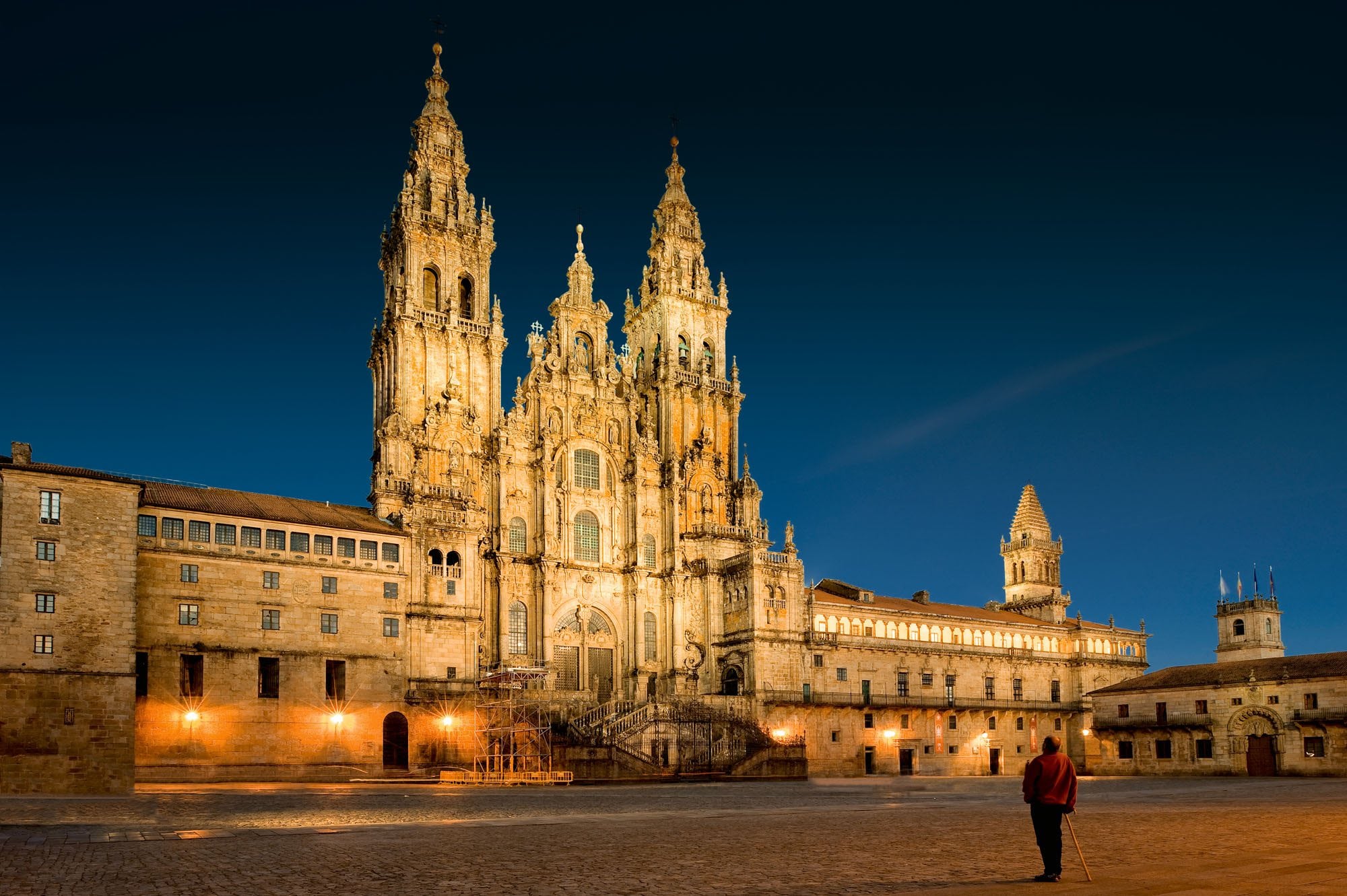
Seville’s Royal Alcázar mixes Mudéjar, Gothic, and Renaissance work across centuries of royal use, with carved arches, tiled patios, and gardens that still function as a working palace. Far to the northwest, the Cathedral of Santiago de Compostela closes the medieval pilgrimage route with a Romanesque core and a later Baroque facade. Its Botafumeiro, a giant swinging censer, remains one of the most theatrical objects in any European church. Both sites deepen the study of Spain’s architectural heritage.
Metropol Parasol, Seville
The newest entry on many lists is the Metropol Parasol, designed by German architect Jürgen Mayer and completed in 2011. Its waffle-like timber canopy is among the largest wooden structures in the world and hovers over a Roman archaeological site, a market, and a rooftop walkway. Locals nicknamed it “Las Setas,” the mushrooms, and it shows how contemporary design can sit over ancient ruins without hiding them.
Spanish Landmarks at a Glance
The table below groups the main landmarks by their architect and period, a quick reference for comparing styles across eras.
| Landmark | Architect | Year / Style |
|---|---|---|
| Alhambra, Granada | Nasrid dynasty builders | 13th-14th c. / Moorish |
| Sagrada Família, Barcelona | Antoni Gaudí | Begun 1882 / Catalan Modernisme |
| Casa Milà (La Pedrera), Barcelona | Antoni Gaudí | 1906-1912 / Modernisme |
| Guggenheim Museum, Bilbao | Frank Gehry | 1997 / Deconstructivism |
| City of Arts and Sciences, Valencia | Santiago Calatrava, Félix Candela | 1998-2005 / Contemporary |
| Alcázar of Seville | Successive royal builders | 14th c. onward / Mudéjar |
| Metropol Parasol, Seville | Jürgen Mayer | 2011 / Contemporary timber |
How to Study These Buildings on a Visit
Reading about iconic architecture in Spain is one thing; standing inside these spaces teaches lessons that photographs miss. A few practical habits make a design-focused trip more useful.
💡 Pro Tip
Book timed entry for the Alhambra and Sagrada Família weeks ahead, since both cap daily numbers and sell out fast. Visit the Alhambra’s Nasrid Palaces early or late in the day, when low sun rakes across the stucco carving and reveals depth that flat midday light washes out.
Sketch rather than only photograph. Drawing a column base or an arch profile forces you to notice proportion and joint detail. Where sites offer rooftop access, as the Sagrada Família, Casa Milà, and Metropol Parasol all do, take it; the view from above often explains the plan better than any floor drawing. Pair each visit with the building’s official record, which usually publishes construction dates and dimensions worth citing accurately.
Where to Go From Here
Spain’s landmarks reward repeat study because each one answers a different design question, whether that is climate, faith, civic pride, or urban revival. Start with one architect or one city rather than trying to cover everything at once, and let the details, a tile pattern, a branching column, a titanium seam, lead you toward the ideas behind them. For deeper reading, the official sources for these buildings, from the Sagrada Família and the Guggenheim Bilbao to the City of Arts and Sciences, publish detailed histories, while UNESCO documents the Alhambra, Generalife and Albayzín and the works of Antoni Gaudí. Architect-led records at Calatrava’s studio and design coverage on ArchDaily round out the picture, along with the visitor site for Casa Milà.






Futuro House Production Revived in Finland After Decades-Long Hiatus
A Facebook listing for abandoned moulds led to the first new Futuro...
 illustrarch Editoral Team3 Mins read

Building Your Dream Home in NSW: What You Should Know About Montgomery Homes
Montgomery Homes has been building across Sydney, Newcastle, the Hunter, Wollongong and...
illustrarch Editoral Team4 Mins read

Designing a Home Theater: Where Drapery Fits Into the Plan
In a media room the curtains are a performance layer, not decoration....
illustrarch Editoral Team3 Mins read
Oscar Niemeyer’s Cathedral of Brasília: The Hyperboloid Concrete Hymn
The Cathedral of Brasília reads as a single gesture, yet it stood...
 Furkan Sen7 Mins read


Leave a comment