

Best Midjourney Architecture Examples #2
Midjourney architecture refers to the design and architecture of spaces that travelers encounter during their journeys. These spaces can include airports, train stations, bus terminals, and other transportation hubs that people pass through on their way to their final destination
 Elif Ayse Sen20 March 20235 Mins read474

Table of Contents Show
Midjourney architecture examples show how text-to-image AI turns written prompts into detailed building concepts, from organic facades to surreal carved interiors. The strongest results come from prompts that name a clear style, material, lighting setup, and camera angle, giving architects fast visual references during early-stage design exploration.
This second set of Midjourney architecture examples looks at the designers pushing the tool furthest and breaks down how their images were likely built. Instead of treating these renders as finished buildings, read them as concept sketches produced in seconds, useful for testing a mood, a material logic, or a formal idea before any modeling begins. If you are new to the tool, start with our Midjourney architecture guide and the first round of best Midjourney architecture examples, then come back here for the prompt logic behind each look.
What Makes a Strong Midjourney Architecture Example?
A strong example reads as a believable space, not just a pretty texture. The form has a clear structural idea, the materials behave consistently across the image, and the lighting tells you where you are and what time of day it is. Weak outputs usually fail on one of these: melted geometry, materials that change mid-surface, or flat lighting that kills depth.
The architects featured below get past those problems by writing specific prompts. They name a material such as fluted concrete or weathered copper, set a lens and a perspective, and lock the mood with lighting cues. That specificity is what separates a usable concept image from generic AI noise.
💡 Pro Tip
When you find a render you like, append the same seed value with the –seed parameter on your next runs. This keeps the lighting and composition stable while you swap out one variable, such as the cladding material, so you can compare options on equal footing instead of starting from scratch each time.
Standout Midjourney Architecture Examples Worth Studying
Each designer below has a recognizable visual signature. Study what stays consistent across their work, because that consistency comes from repeatable prompt structures you can adapt for your own boards.
Hassan Ragab: Organic, Sculptural Facades
Ragab is one of the most copied names in AI architecture, and for good reason. His images fold fabric-like and feather-like textures over recognizable building masses, so the result still reads as a structure rather than an abstract blob. The trick in his work is contrast: soft, flowing surface against hard urban context and strong directional sun.
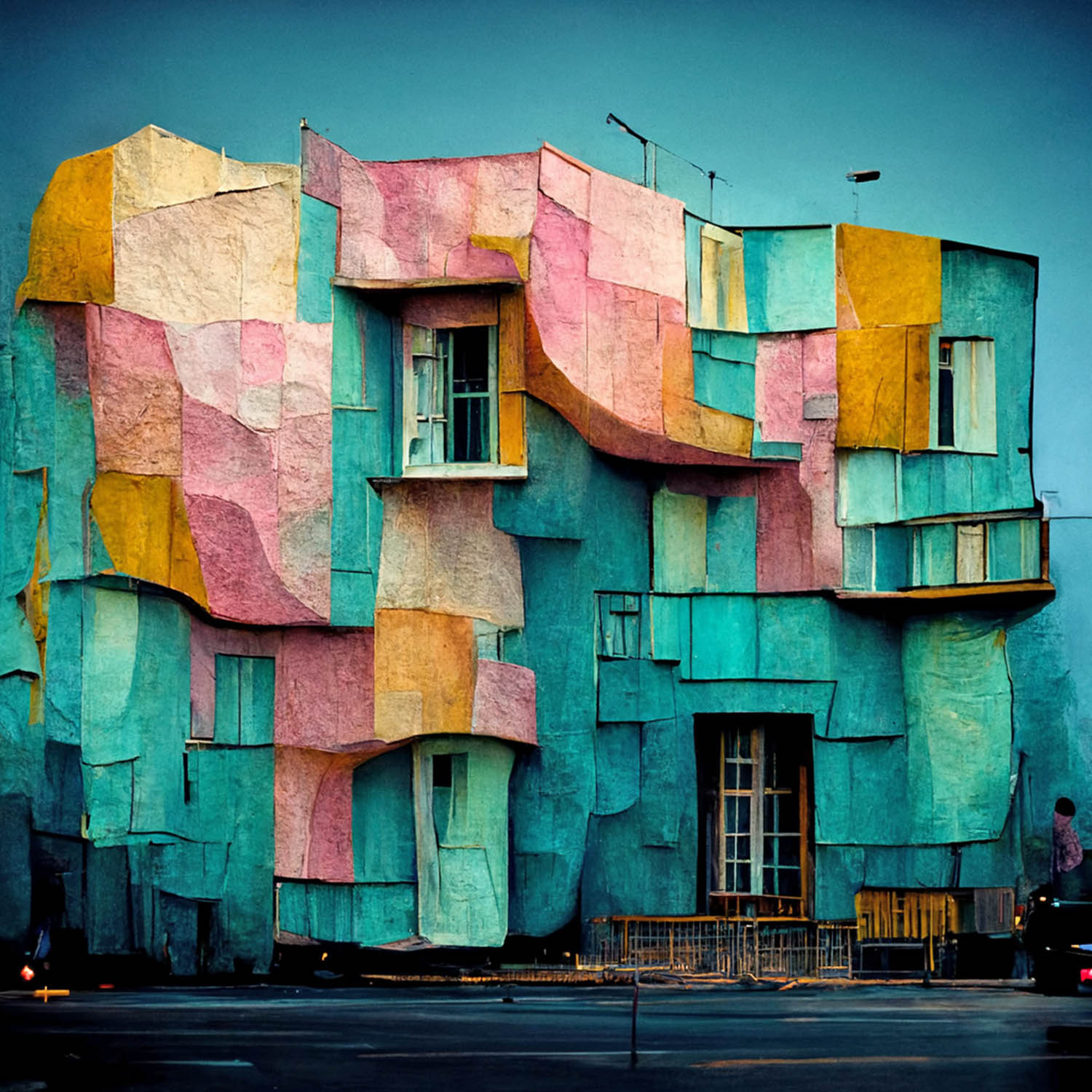

To get close to this style, pair an organic material descriptor with a grounded setting and a clear light direction, for example: ornate feather-textured residential facade, dense Cairo street, late afternoon sun, 35mm, architectural photography. The street context and lens keep the form anchored.
Arturo Tedeschi: Computational Forms Meet AI
Tedeschi comes from a computational design background, and it shows. His AI work carries the smooth, parametric logic of algorithmic modeling, with surfaces that look engineered rather than purely sculptural. He often treats Midjourney as one step in a longer pipeline that also includes 3D tools, which is why his outputs feel buildable.
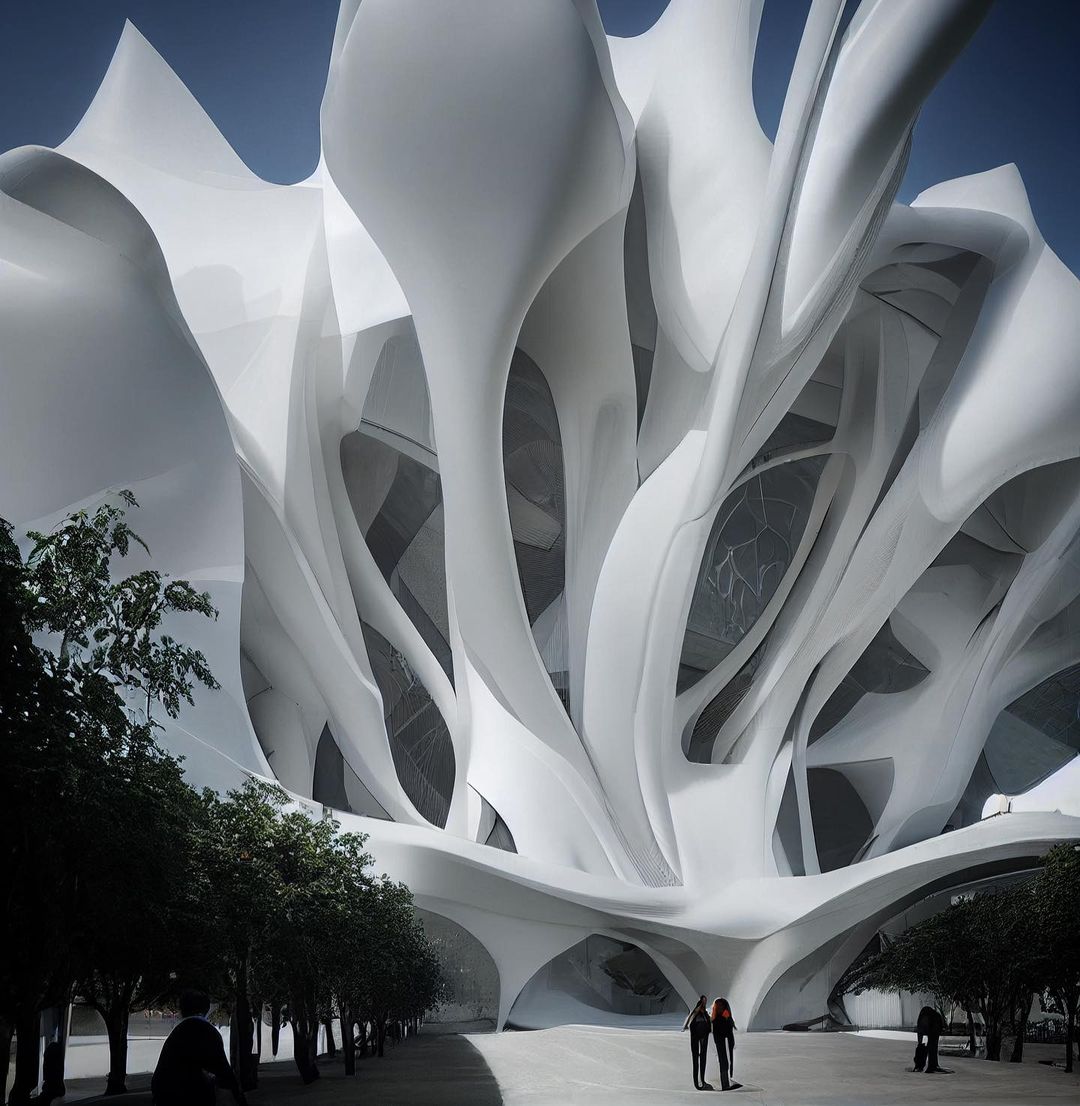
You can see more of his AI and computational design experiments on the architect’s own portfolio at arturotedeschi.com. For prompts in this direction, lean on terms like parametric, ruled surface, smooth white composite, studio lighting, product render to push the output toward clean, fabricated geometry.
📌 Did You Know?
According to the Wikipedia entry on Midjourney, the tool launched in open beta on July 12, 2022 and was originally driven entirely through Discord bot commands before adding a web interface. Many of the architecture images that went viral in early 2023 were generated inside Discord channels rather than a dedicated app.
William Garner: Data-Driven Surfaces
Garner’s images sit at the meeting point of data visualization and architecture. His surfaces often look generated by a field of points or a flow simulation, which gives them a restless, animated quality. This is a good reference if you want concept imagery for pavilions, installations, or skins rather than full buildings.

Bolojan Daniel: Neural Rendering Aesthetics
Daniel works directly in neural rendering and AI-assisted design research, so his outputs have a refined, almost academic precision. The forms read as studies in continuity and topology rather than one-off visuals, which makes them strong references for facade systems and continuous-surface concepts.

Rock-Carved and Contextual Concepts
Beyond named artists, some of the most shared Midjourney architecture examples are environmental: houses carved out of rock faces, structures that grow from cliffs, or buildings that read as geology. These work because the prompt fuses a building program with a strong landscape, forcing the AI to resolve the two.
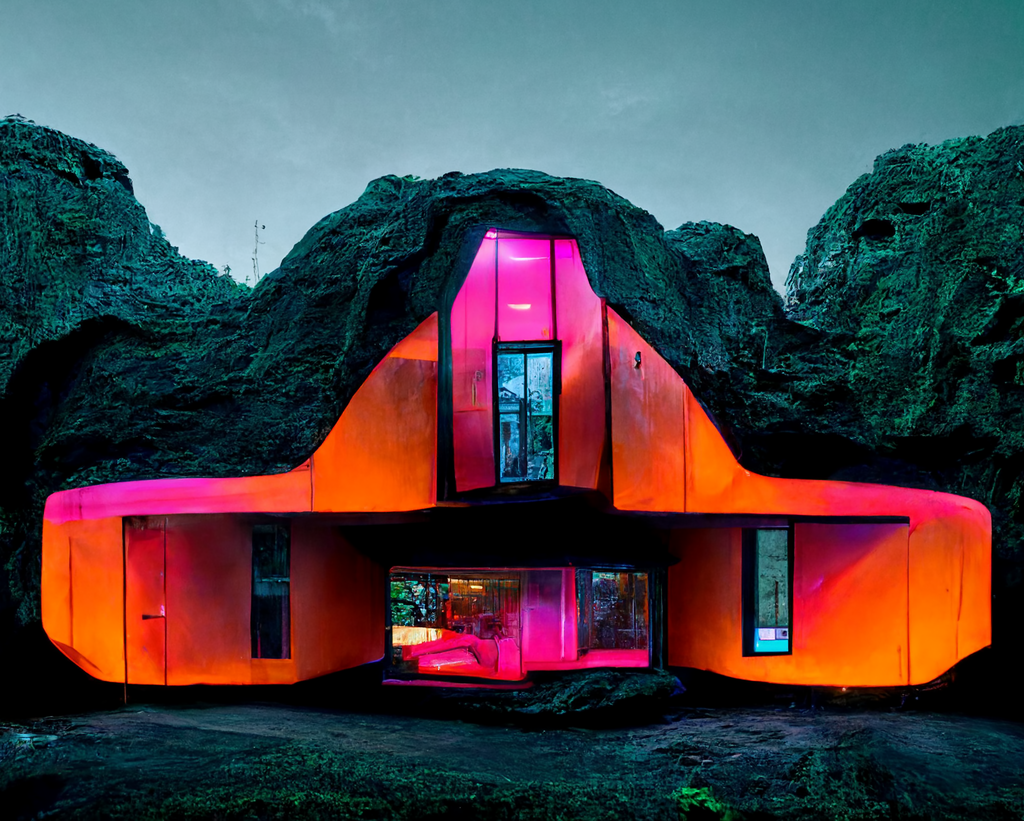
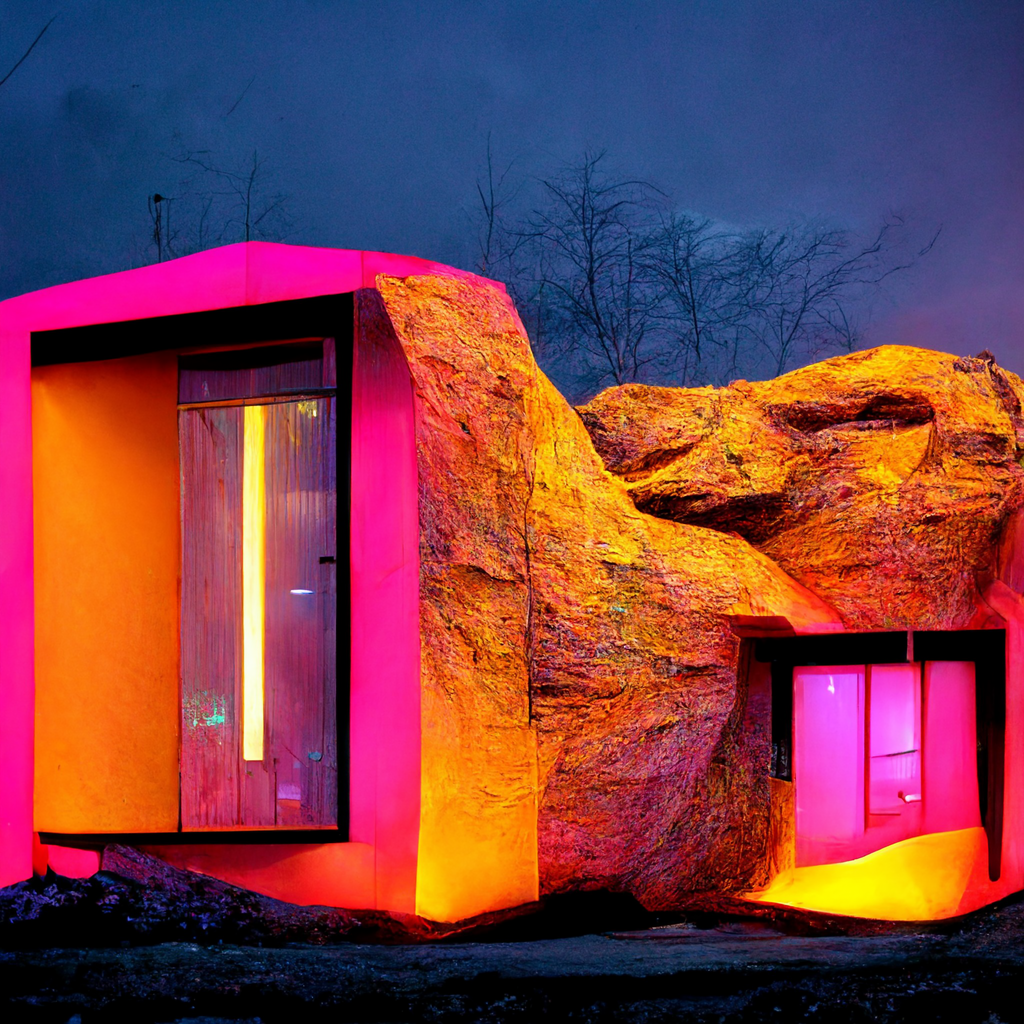
ArchDaily keeps an ongoing archive of how the profession is reading these results, which is worth scanning for critical context. See their collected coverage on the Midjourney tag at ArchDaily.
How to Write Prompts That Produce These Results
Every example above follows the same underlying recipe. Once you see the pattern, you can rebuild any of these looks and then steer them toward your own project. Think of a prompt as five stacked decisions rather than one sentence.
The Five-Part Prompt Structure
A reliable architecture prompt names, in order: the subject and program, the architectural style or reference, the primary material, the lighting and time of day, and the camera or render type. A worked example: concert hall, brutalist sculptural mass, board-formed concrete, overcast diffuse light, wide-angle architectural photography. Each clause does one job, so when an output misses, you know exactly which clause to edit.
Parameters That Actually Change the Output
Midjourney parameters do the heavy lifting once the words are right. The aspect ratio flag –ar 16:9 or –ar 3:2 sets a cinematic frame suited to buildings. The –style raw flag reduces the default painterly bias and gives you cleaner, more photographic geometry, which most architects want. Lower –stylize values keep the AI closer to your literal prompt, while higher values give it more artistic freedom. Use –chaos only when you want wilder variation on the first grid.
⚖️ Pros & Cons at a Glance
✔️ Pros: Fast concept iteration, strong mood and material studies, low cost per image, useful for client conversation starters.
✖️ Cons: No real dimensions or structure, inconsistent details on repeat elements, limited control over exact plans, ongoing questions around authorship and copyright.
From Image to Workflow
The architects who get the most out of this treat Midjourney as the front of a pipeline, not the whole job. A common loop: generate a concept grid, pick the strongest frame, use it as a reference image for a modeling tool, then bring the massing back into a real render engine for accurate light and scale. For a wider look at how studios fit AI into practice, see our piece on AI for architects and small studios, and for advanced prompt craft, the breakdown of micro-bionic prompts in Midjourney v6.
💡 Pro Tip
Build a personal prompt library in a simple spreadsheet, one row per look you like, with the full prompt and seed saved. After a few weeks you stop guessing and start composing prompts from proven parts, which is how the artists above keep a consistent style across dozens of images.
Where to Go From Here
These Midjourney architecture examples are most valuable as a study set, not a gallery. Reverse-engineer the looks you respond to, save the prompts that work, and feed the best frames into a real modeling workflow. To go straight to the source and check the current model version and feature set, visit the official site at midjourney.com.
Your Next Step: Pick one image from this set, rebuild its prompt using the five-part structure, then run it twice, once with –style raw and once without, and keep the version that reads more like architecture you would actually draw.



Seedance 3.0 for Home and Garden Concepts: Making a Renovation Story Easier to Discuss
Seedance 3.0 can turn a renovation idea into a short concept video....
 illustrarch Editoral Team5 Mins read

From SketchUp View to Client-Ready Render: A Hands-On Look at Vizbase
Vizbase co-founder Mikus Zarāns shows how the browser-based AI renderer turns SketchUp...
illustrarch Editoral Team4 Mins read
Best AI Interview Assistant for Architects: 9 Tools Compared
We compare nine AI interview assistants for architects on speed, drawing awareness,...
illustrarch Editoral Team12 Mins read

OpenAI’s Astra Model Aims to Turn AI Into an Architecture Workflow Operator
OpenAI's Astra model, launched Sept. 3, 2026, runs multi-step tasks across software,...
illustrarch Editoral Team3 Mins read


Leave a comment