

Travel Essentials for Architects: 10 Must-Have Tools & Items
Essential travel gear for architects and designers who work on-site. Professional tools, digital solutions, and practical items for seamless project visits.
 Begum Gumusel11 February 202611 Mins read251

Table of Contents Show
For architects and designers, travel isn’t just about reaching a destination, it’s about arriving prepared to work, document, and collaborate effectively. Whether you’re visiting a construction site, meeting clients, or conducting site analysis, having the right travel essentials can make the difference between a productive trip and a frustrating experience. This comprehensive guide covers the 10 must-have items that every architecture professional should pack for their next project visit.

| # | Category | Key Items | Priority | Est. Budget (USD) |
|---|---|---|---|---|
| 1 | Digital Measuring & Documentation | Laser distance measurer, 360° camera | ⭐⭐⭐⭐⭐ | $150-$500 |
| 2 | Portable Laptop / Tablet | iPad Pro, Surface Pro, lightweight laptop | ⭐⭐⭐⭐⭐ | $800-$2,500 |
| 3 | Traditional Drafting & Sketching Kit | Mechanical pencils, scale ruler, sketchbook | ⭐⭐⭐⭐ | $50-$150 |
| 4 | Power Solutions & Connectivity | Power bank, WiFi hotspot, travel adapter | ⭐⭐⭐⭐⭐ | $80-$300 |
| 5 | Professional Camera & Documentation | Mirrorless camera, drone, 360° camera | ⭐⭐⭐⭐ | $400-$2,000 |
| 6 | Project Management Tools | Cloud storage, PM platforms, note-taking apps | ⭐⭐⭐⭐ | $0-$50/mo |
| 7 | Safety Equipment & PPE | Hard hat, safety vest, steel-toe boots | ⭐⭐⭐⭐⭐ | $100-$350 |
| 8 | Presentation & Client Tools | Pocket projector, scanner, design apps | ⭐⭐⭐ | $100-$600 |
| 9 | Protective Cases & Organization | Professional backpack, Pelican cases, cable organizers | ⭐⭐⭐⭐ | $150-$500 |
| 10 | Emergency Backup & Redundancy | Spare cables, USB drives, travel insurance | ⭐⭐⭐⭐ | $50-$200 |
| Estimated Total Investment for a Complete Kit | $1,880-$7,150 | |||
1. Digital Measuring and Documentation Tools
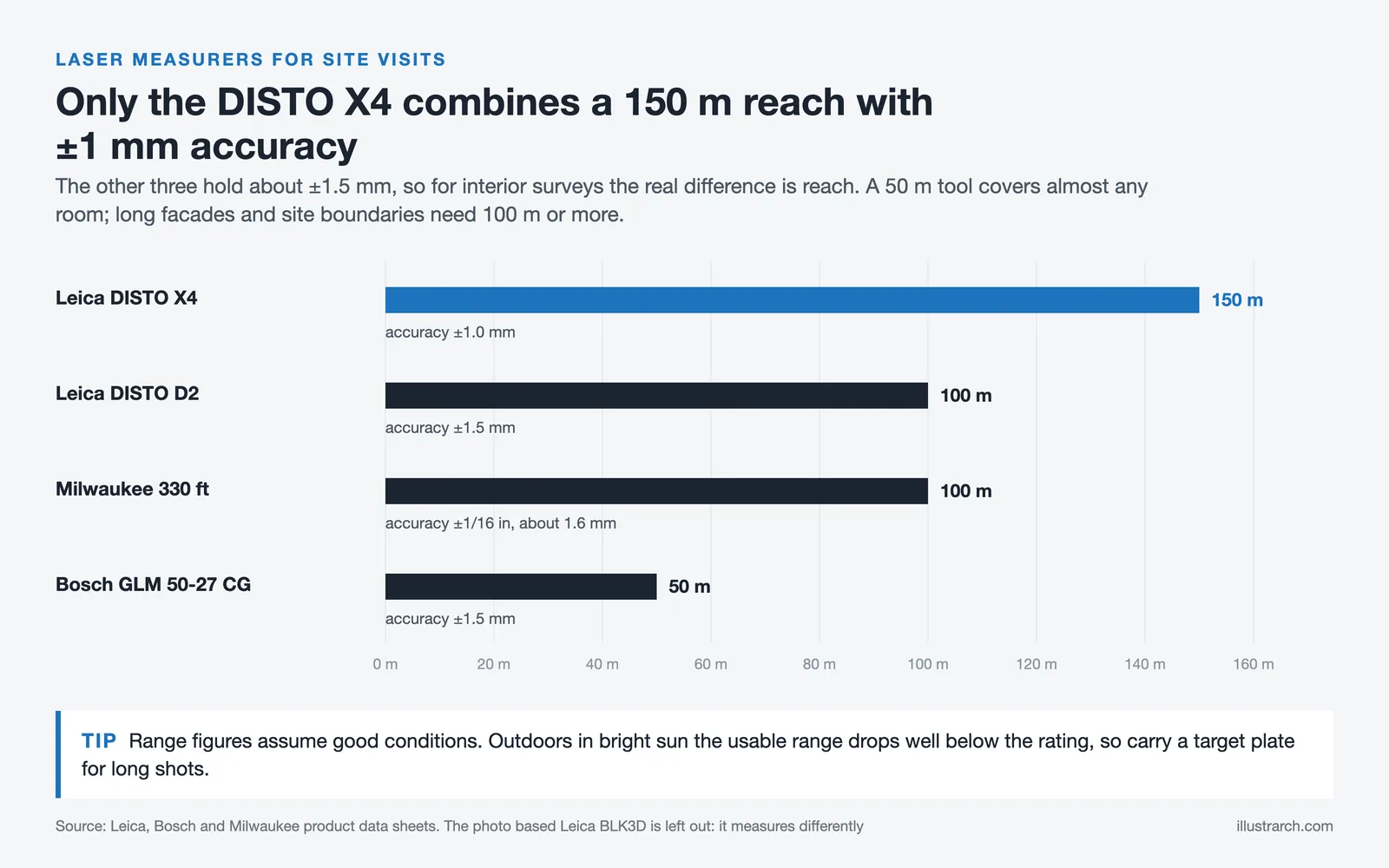
An architect measuring tool is non-negotiable for site visits. Laser distance measurers have replaced traditional tape measures for most professionals, offering accuracy within millimeters while fitting in your pocket. Devices like the Leica DISTO or Bosch GLM series provide Bluetooth connectivity, allowing instant transfer of measurements to your tablet or smartphone. These tools are invaluable when documenting existing conditions or verifying construction progress against plans.
Pair your measuring device with a high-quality camera, your smartphone often suffices, but consider a dedicated camera for detailed documentation. Many architects now use 360-degree cameras to capture comprehensive site conditions, which can be reviewed later or shared with team members who couldn’t attend the visit. Learn more about effective documentation methods that save time and improve accuracy. The modern architect tools for measurement have revolutionized how we capture spatial data on-site.
| Device | Range | Accuracy | Bluetooth | App Integration | Price Range |
|---|---|---|---|---|---|
| Leica DISTO D2 | 100 m (330 ft) | ±1.5 mm | ✅ Yes | Leica DISTO Plan | $180-$220 |
| Leica DISTO X4 | 150 m (490 ft) | ±1.0 mm | ✅ Yes | Leica DISTO Plan, AutoCAD | $400-$480 |
| Bosch GLM 50-27 CG | 50 m (165 ft) | ±1.5 mm | ✅ Yes | Bosch MeasureOn | $130-$160 |
| Milwaukee 330 ft | 100 m (330 ft) | ±1/16 in (about 1.6 mm) | ✅ Yes | Milwaukee Tool App | $150-$200 |
| Leica BLK3D | Photo-based 3D | ±3 mm at 10 m | ✅ Yes | BLK3D App, CAD export | $1,500-$1,800 |

2. Portable Laptop or High-Performance Tablet
A lightweight laptop or high-performance tablet forms the backbone of your mobile workstation. The iPad Pro with Apple Pencil or Microsoft Surface with stylus enables real-time design modifications during client meetings and provides access to essential ai tools for architects that transform on-site productivity.

These devices allow you to access cloud-based CAD programs like Autodesk AutoCAD Web or OnShape, providing full design capabilities from any location. Modern architect ai tool platforms like Autodesk Construction Cloud, BIM 360, and Procore enable real-time collaboration, allowing you to review RFIs, approve submittals, and mark up drawings directly from the field.
Understanding what tools do architects use for mobile work is crucial, your tablet or laptop should run professional-grade software while remaining portable enough for comfortable all-day carry. AI-powered design assistants can help generate quick alternatives during client meetings, making tools like AI design platforms essential for modern practice. According to the American Institute of Architects (AIA), mobile computing has become the cornerstone of contemporary architectural practice.
| Device | Weight | Display | Battery Life | Stylus Support | Best For |
|---|---|---|---|---|---|
| iPad Pro 13″ (M4) | 0.58 kg | 13″ Liquid Retina XDR | ~10 hrs | Apple Pencil Pro | Sketching, markup, presentations |
| Microsoft Surface Pro 11 | 0.90 kg | 13″ PixelSense Flow | ~14 hrs | Surface Slim Pen 2 | Full CAD, BIM on-site |
| MacBook Air 15″ (M3) | 1.51 kg | 15.3″ Liquid Retina | ~18 hrs | : | Rendering, heavy software |
| Lenovo ThinkPad X1 Carbon Gen 11 | 1.12 kg | 14″ 2.8K OLED | ~14 hrs | : | Windows CAD, Revit, BIM |

3. Traditional Drafting and Sketching Kit
While digital tools dominate modern practice, traditional architect drawing tools remain essential for quick on-site sketches and client communication. A compact sketching kit bridges the gap between concept and digital documentation, offering immediacy that technology sometimes lacks.
Your travel drawing kit should include quality architect drafting tools that don’t sacrifice professional standards for portability:
- Mechanical pencils with various lead weights (0.5mm and 0.7mm)
- Professional-grade erasers and eraser shields
- A portable architectural scale ruler
- Fine-line technical pens for inking important details
- A small triangle set for quick orthogonal sketches
- Hardbound sketchbook with quality paper
The architect lettering tool tradition has largely been replaced by digital annotation, but many professionals still appreciate the clarity of hand-lettered notes during client presentations. These traditional tools used by architect professionals complement digital workflows perfectly. For more insights on traditional techniques, explore this comprehensive guide from ArchDaily on architectural sketching. Don’t forget to check out advanced sketching techniques for architects.
| Item | Recommended Product | Use Case | Approx. Price |
|---|---|---|---|
| Mechanical Pencil (0.5mm) | Rotring 600 / Pentel GraphGear 1000 | Fine detail sketching | $15-$30 |
| Mechanical Pencil (0.7mm) | Staedtler 925 / Rotring 800 | General sketching, notes | $15-$40 |
| Technical Pens (set) | Sakura Pigma Micron (0.1-0.5mm set) | Inking, permanent details | $10-$20 |
| Eraser & Shield | Tombow Mono Zero / Staedtler eraser shield | Precision corrections | $5-$12 |
| Architectural Scale Ruler | Alvin 6″ pocket scale / Staedtler Mars | On-site scale verification | $8-$25 |
| Triangle Set | Alvin 6″ 30/60 & 45/90 set | Quick orthogonal lines | $5-$15 |
| Sketchbook | Moleskine A5 / Leuchtturm1917 Hardcover | Concept sketches, notes | $15-$25 |
| Marker Set (optional) | Copic Sketch (gray tones set of 5) | Shading, quick renders | $25-$40 |

4. Portable Power Solutions and Connectivity Devices
Modern architectural tools depend on reliable power and internet connectivity. Dead batteries or spotty connections can derail productive site visits, making backup solutions one of the most critical architects tools in your travel kit.
High-capacity power banks (20,000mAh or greater) can recharge smartphones, tablets, and even small laptops multiple times. Look for models with multiple ports and fast-charging capabilities to minimize downtime. Solar-powered chargers provide backup for extended field work in remote locations.
Universal travel adapters are essential for international projects, while a portable WiFi hotspot ensures connectivity even when site conditions lack reliable internet. Many architects now use mobile connectivity solutions that include cellular data plans specifically designed for professional equipment. According to research from Dezeen, mobile connectivity has become one of the top concerns for architects working across multiple project sites.
| Power Bank | Capacity | Ports | Laptop Charging | Weight | Price |
|---|---|---|---|---|---|
| Anker 737 Power Bank | 24,000 mAh | 2× USB-C, 1× USB-A | ✅ 140W PD | 630 g | ~$110 |
| Ugreen 25000mAh 200W | 25,000 mAh | 2× USB-C, 1× USB-A | ✅ 200W PD | 594 g | ~$100 |
| Baseus Blade 100W | 20,000 mAh | 2× USB-C, 1× USB-A | ✅ 100W PD | 500 g | ~$70 |
| Zendure SuperTank Pro | 26,800 mAh | 4× USB-C | ✅ 100W PD | 570 g | ~$150 |

5. Professional-Grade Camera and Documentation Equipment
Visual documentation is fundamental to architectural practice, making camera equipment one of the essential drafting tools for architects in the digital age. While smartphones have impressive cameras, dedicated equipment offers superior quality for professional documentation.
Consider a mirrorless camera system for the best balance of quality and portability. These cameras provide interchangeable lenses, allowing wide-angle shots for interiors and telephoto options for detail work on tall buildings. A 360-degree camera like the Ricoh Theta or Insta360 captures comprehensive site conditions in a single shot, proving invaluable for documenting spatial relationships.
Drone photography has become standard for many projects, compact drones like the DJI Mini series provide aerial documentation while remaining travel-friendly and legally compliant in most jurisdictions. Always verify local regulations before flying. These modern architect tool options transform how we document and analyze sites. Explore more about architectural photography techniques that elevate your documentation quality.
| Equipment Type | Recommended Models | Key Feature | Weight | Price Range |
|---|---|---|---|---|
| Mirrorless Camera | Sony A7C II, Fujifilm X-T5, Canon EOS R8 | Interchangeable lenses, RAW quality | 400-600 g (body) | $1,300-$2,200 |
| Wide-Angle Lens | Sony 20mm f/1.8, Fuji 16mm f/1.4 | Interior documentation | 200-375 g | $500-$900 |
| 360° Camera | Insta360 X4, Ricoh Theta Z1 | Full spatial capture, VR tours | 180-250 g | $350-$1,000 |
| Compact Drone | DJI Mini 4 Pro, DJI Air 3 | Aerial photography, site surveys | 249-720 g | $760-$1,100 |
| LiDAR Scanner (Mobile) | iPad Pro LiDAR + Polycam / 3d Scanner App | 3D point cloud scanning | Already in tablet | Free: $40/mo (app) |

6. Project Management and Information Architecture Tools
For professionals managing complex projects, information architect tools are essential for maintaining organized documentation during travels. Digital organization prevents valuable insights from being lost and ensures seamless integration with office workflows.
Cloud storage solutions like Dropbox, Google Drive, or OneDrive provide automatic synchronization across all devices. Project management platforms such as Asana, Monday.com, or Trello keep task lists accessible and updated regardless of location. Note-taking applications like Notion, Evernote, or Microsoft OneNote allow you to create templated site visit reports that include photos, voice memos, and typed observations.
The question of how many tools for architect work are truly necessary often arises. While the number varies by specialty, a core set of 15-20 digital applications typically covers most situations. Implementing consistent naming conventions and folder structures across all devices ensures information remains accessible whether you’re on-site or back at the office. Many firms use specialized project management platforms designed specifically for architecture and construction. The National Council of Architectural Registration Boards (NCARB) provides resources on professional practice standards including documentation management.
| Category | App / Platform | Platform | Offline Mode | Free Tier |
|---|---|---|---|---|
| Cloud CAD / BIM | AutoCAD Web / Mobile | iOS, Android, Web | Limited | ❌ |
| BIM 360 / Autodesk Construction Cloud | iOS, Android, Web | ✅ Yes | ❌ | |
| Project Management | Procore | iOS, Android, Web | ✅ Yes | ❌ |
| Asana / Monday.com | iOS, Android, Web | Limited | ✅ Yes | |
| Notes & Documentation | Notion | iOS, Android, Web, Desktop | ✅ Yes | ✅ Yes |
| Microsoft OneNote | iOS, Android, Web, Desktop | ✅ Yes | ✅ Yes | |
| Sketching & Markup | Morpholio Trace | iOS | ✅ Yes | ✅ Limited |
| Concepts App | iOS, Android, Windows | ✅ Yes | ✅ Limited | |
| Cloud Storage | Google Drive / Dropbox / OneDrive | All platforms | ✅ Sync | ✅ Yes (limited GB) |
| Scanning | Adobe Scan / Microsoft Lens | iOS, Android | ✅ Yes | ✅ Yes |

7. Safety Equipment and Personal Protection Gear
Construction sites present real hazards that demand proper protective equipment. Understanding what tools does an architect use for safety is just as important as knowing design tools, your health and safety enable all other professional activities.
Essential safety gear includes a properly certified hard hat (ANSI Z89.1 compliant), high-visibility safety vest, and steel-toe boots suitable for active construction zones. Safety glasses protect against flying debris, while work gloves prevent cuts and abrasions when handling materials or navigating rough surfaces.
Consider additional items based on specific project conditions: hearing protection for loud environments, respiratory masks for dusty conditions, and sun protection including sunscreen and a wide-brimmed hat for outdoor sites. A compact first-aid kit addresses minor injuries immediately. Pack weather-appropriate clothing in layers, construction sites often lack climate control, and conditions can change rapidly throughout the day. Learn more about comprehensive site safety protocols that protect architectural professionals.
| Safety Item | Standard / Certification | Active Construction | Renovation / Fit-out | Pre-construction Survey |
|---|---|---|---|---|
| Hard Hat | ANSI Z89.1 / EN 397 | ✅ Required | ✅ Required | ⚠️ Recommended |
| High-Visibility Vest | ANSI/ISEA 107 Class 2+ | ✅ Required | ✅ Required | ⚠️ Recommended |
| Steel-Toe Boots | ASTM F2413 | ✅ Required | ✅ Required | ⚠️ Recommended |
| Safety Glasses | ANSI Z87.1 | ✅ Required | ✅ Required | ❌ Optional |
| Work Gloves | EN 388 / ANSI Cut Level | ✅ Required | ⚠️ Recommended | ❌ Optional |
| Hearing Protection | ANSI S3.19 (NRR 25+) | ✅ Required | ⚠️ Situational | ❌ Optional |
| Respiratory Mask | N95 / P100 (NIOSH) | ⚠️ Situational | ✅ Required (dust/demo) | ⚠️ If dusty |
| First-Aid Kit (compact) | : | ✅ Required | ⚠️ Recommended | ⚠️ Recommended |

8. Portable Presentation and Client Communication Tools
The role of business architect tools extends beyond technical documentation to include client relationship management and presentation capabilities. Professional client interactions can occur anywhere, making portable presentation equipment essential.
A pocket projector or screen-casting device enables presentations in varied locations, modern pocket projectors offer HD resolution in devices smaller than a smartphone. Apps like Morpholio Trace or Concepts allow real-time sketching and design exploration on tablets, facilitating collaborative design sessions with clients on-site.
Portable document scanners capture client sketches, existing drawings, or inspiration materials discovered during travels. While apps like Adobe Scan transform smartphones into capable scanners, dedicated portable scanners like the Fujitsu ScanSnap offer superior quality when precision matters. Professional business cards with QR codes linking to your digital portfolio provide seamless sharing of past work examples. These presentation tool architect options ensure you’re always ready for impromptu client opportunities. Explore advanced presentation techniques that enhance engagement and approval rates.

9. Protective Cases and Organizational Systems
The best tools are worthless if damaged during transport. Professional-grade protective equipment safeguards your investment while maintaining organization, making storage solutions critical components of your travel essentials.
A well-designed professional backpack or briefcase distributes weight comfortably while protecting sensitive equipment. Look for bags with dedicated compartments for electronics, padded sections for tablets and laptops, and weather-resistant materials. Brands like Peak Design, Think Tank, and Waterfield Designs create bags specifically designed for creative professionals.
Pelican cases or similar hard-shell protection work perfectly for delicate instruments like laser measurers, cameras, or specialized measuring devices. Cable organizers prevent tangled charging cords, simple solutions like cable rolls or tech pouches maintain order. SD card cases protect valuable documentation photos, while small parts organizers keep batteries, adapters, and accessories sorted and immediately accessible.
Investment in quality organizational systems pays dividends through reduced stress and increased efficiency. When considering what are the tools of an architect for travel, don’t overlook these supporting items that protect your primary equipment. Learn about professional organization strategies that streamline your entire workflow.
| Product | Type | Capacity | Weatherproof | Best For | Price |
|---|---|---|---|---|---|
| Peak Design Everyday Backpack V2 (30L) | Backpack | 30L | ✅ Water-resistant | Camera + laptop + tools | ~$280 |
| Think Tank Airport Essentials | Backpack | 25L | ✅ Rain cover included | Camera-heavy kits | ~$220 |
| Waterfield Designs Pro Executive | Briefcase | Medium | ✅ Waxed canvas | Client meetings | ~$400 |
| Pelican 1510 Carry-On Case | Hard case | 22L | ✅ IP67 rated | Delicate equipment | ~$190 |
| Peak Design Tech Pouch | Organizer | Compact | ✅ Weather-sealed | Cables, adapters, SD cards | ~$60 |

10. Emergency Backup and Redundancy Solutions
Despite careful planning, equipment failures and unexpected situations occur. Experienced architectural travelers maintain contingency plans for common problems, making backup solutions the final essential category of travel tools.
Carry spare cables for all devices, USB-C, Lightning, and HDMI cables should have duplicates in your kit. Extra batteries for cameras and measuring tools prevent work stoppages. A small USB drive with PDF versions of critical drawings provides access even if cloud services fail or internet connectivity is unavailable.
Establish relationships with local equipment rental companies in cities you visit frequently. Knowing where to quickly rent a projector, laser measurer, or other specialized equipment reduces the pressure to carry everything on every trip. Maintain automated cloud backup services that sync files whenever you connect to WiFi, ensuring measurements, photos, and notes aren’t lost if a device is damaged or stolen.
Consider travel insurance that covers professional equipment, standard travel policies often exclude expensive electronics and specialized tools. Keep serial numbers and photos of all equipment for insurance claims. These backup strategies represent the often-overlooked aspect of what tools do architects use, not just the primary equipment, but the systems that ensure continuity when primary tools fail. The Royal Institute of British Architects (RIBA) publishes resources on professional practice management including equipment protection strategies.
| Backup Item | Purpose | Qty Recommended | Approx. Cost |
|---|---|---|---|
| USB-C Cable (extra) | Charging & data transfer | 2 | $10-$20 |
| Lightning Cable (extra) | Apple device backup | 1 | $10-$15 |
| HDMI Cable (compact) | Presentations backup | 1 | $8-$15 |
| USB Flash Drive (128GB+) | Offline access to critical drawings | 1-2 | $15-$30 |
| Spare Camera Battery | Extended shooting time | 1-2 | $30-$70 |
| Extra SD Cards (64GB+) | Photo/video storage overflow | 2 | $15-$30 |
| Universal Travel Adapter | International power access | 1 | $20-$40 |
| Travel Insurance (equipment) | Financial protection for gear | 1 policy | $50-$200/yr |

Conclusion: Building Your Personalized Travel Kit
These 10 essential categories encompass everything traveling architects need for productive, professional site visits. By thoughtfully assembling a kit that includes reliable measuring devices, portable computing equipment, traditional drafting tools, AI-powered software platforms, safety gear, presentation equipment, organizational solutions, and backup systems, you ensure success regardless of location or project conditions.
Remember that the best travel kit evolves with your practice and the changing demands of architectural work. Regularly assess which items prove most valuable and which rarely leave your bag. Invest in quality tools that withstand frequent travel, and maintain them properly to ensure longevity. Start with these 10 essential categories, then customize based on your specialization and typical project types.
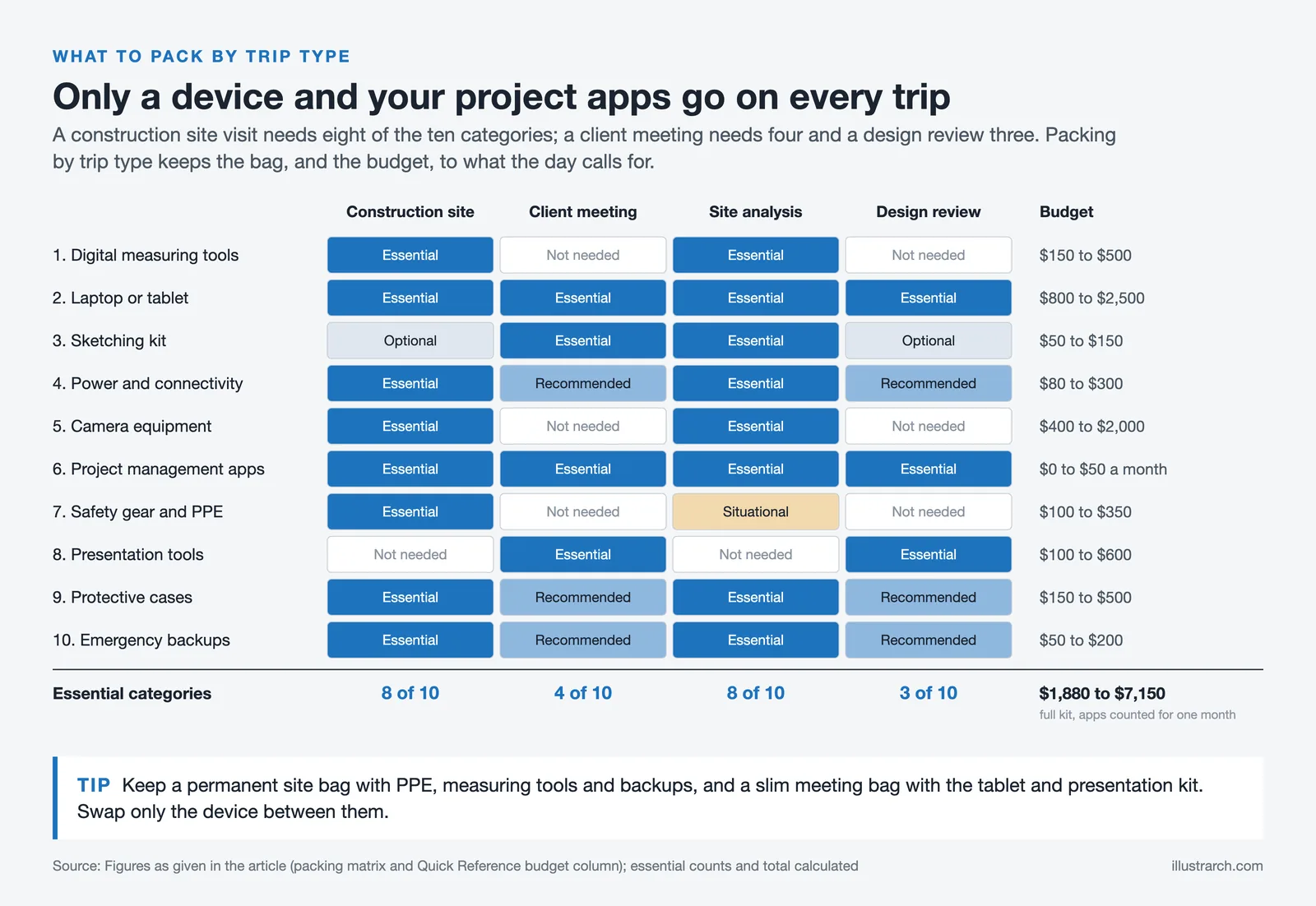
| Essential Category | 🏗️ Active Construction Site | 🤝 Client Meeting | 📐 Site Analysis / Survey | 🏢 Design Review |
|---|---|---|---|---|
| 1. Digital Measuring Tools | ✅ Essential | ❌ Not needed | ✅ Essential | ❌ Not needed |
| 2. Laptop / Tablet | ✅ Essential | ✅ Essential | ✅ Essential | ✅ Essential |
| 3. Sketching Kit | ⚠️ Optional | ✅ Essential | ✅ Essential | ⚠️ Optional |
| 4. Power & Connectivity | ✅ Essential | ⚠️ Recommended | ✅ Essential | ⚠️ Recommended |
| 5. Camera Equipment | ✅ Essential | ❌ Not needed | ✅ Essential | ❌ Not needed |
| 6. Project Management Apps | ✅ Essential | ✅ Essential | ✅ Essential | ✅ Essential |
| 7. Safety / PPE | ✅ Essential | ❌ Not needed | ⚠️ Situational | ❌ Not needed |
| 8. Presentation Tools | ❌ Not needed | ✅ Essential | ❌ Not needed | ✅ Essential |
| 9. Protective Cases | ✅ Essential | ⚠️ Recommended | ✅ Essential | ⚠️ Recommended |
| 10. Emergency Backups | ✅ Essential | ⚠️ Recommended | ✅ Essential | ⚠️ Recommended |
As architectural practice continues to embrace remote collaboration and mobile work, the professionals who master the art of traveling efficiently while maintaining full capabilities will find themselves at a distinct advantage. Start building your essential travel kit today, and transform every site visit into an opportunity for exceptional architectural work.






How to Book a Helicopter from Athens to Folegandros
Folegandros has no commercial airport, so ferries can make a short trip...
 illustrarch Editoral Team4 Mins read

Sedona Oak Creek Cabins for Family Vacations: 7 Kid-Friendly Retreats Compared
Seven kid-friendly cabins along Oak Creek Canyon, scored and ranked on amenities,...
illustrarch Editoral Team11 Mins read

Architectural Wonders by Country: An Interactive Map Guide
A continent-by-continent breakdown of the world's most iconic architectural wonders, organized by...
 Furkan Sen11 Mins read

Cultural Architecture Destinations: 8 Stunning Places to Visit Around the World
A focused look at the world's most stunning cultural architecture destinations, covering...
Furkan Sen12 Mins read


Leave a comment