

Free Online Staircase Calculator
Free online staircase calculator for architects, builders and DIY enthusiasts. Calculate riser height, tread depth, stair angle, stringer length and verify compliance with international building codes including IRC, IBC, UK Building Regulations, European (DIN 18065) and Australian BCA.
Dimensions
Stair Layout
Enter the Stair Width (Optional Settings) to draw the plan.
Optional Settings
Headroom & Floor Opening
Construction
Handrail & Balusters
Building Code
Alternative Riser Counts
Select a row to use that riser count.
Layout
Headroom & Floor Opening
Comfort Rating (Blondel's Formula)
Formula: 2R + T = -
Ideal range: 600-650 mm
Building Code Compliance
Enter dimensions and click Calculate
Stringer Details
Layout: running measurements
Distances along the top edge of the board, from the point where the edge meets the floor. Mark each notch corner, then draw the riser and tread lines with a framing square set to the unit rise and unit run.
Cut List
Handrail & Balusters
Concrete
Quick Reference: Building Code Requirements
| Code | Riser | Tread (going) | 2R + T | Nosing | Max Angle | Min Headroom | Min Width |
|---|---|---|---|---|---|---|---|
| IRC (USA residential) | max 196.85 mm | min 254 mm | Not set | 19.05-31.75 mm* | ~38° | 2032 mm | 914.4 mm |
| IBC (USA commercial) | 101.6-177.8 mm | min 279.4 mm | Not set | max 31.75 mm | ~33° | 2032 mm | 1117.6 mm** |
| UK Part K | 150-220 mm | 220-300 mm | 550-700 mm | Not set | ~42° | 2000 mm | Not set |
| DIN 18065 (Europe) | 140-190 mm | 260-370 mm | 590-650 mm | Not set | ~38° | 2000 mm | 1000 mm |
| Australia NCC (BCA) | 115-190 mm | 240-355 mm | 550-700 mm | Not set | ~38.5° | 2000 mm | Not set |
| Türkiye (Zoning Regulation) | max 180 mm | min 270 mm | 600-640 mm | no projection | Not set | Not set | 1200 mm |
* IRC (USA residential): nosing required only where the tread is under 279.4 mm.
** IBC (USA commercial): 914.4 mm where the occupant load is under 50 (IBC 1011.2).
Max Angle: UK Part K sets 42° for private stairs; the other values are derived from the riser and tread limits. The table shows each code's default use type. Select a row to use that code.
Staircase Calculator: Complete Guide to Stair Dimensions & Design
Designing a safe and comfortable staircase requires precise calculations that balance building code compliance, structural integrity, and ergonomic comfort. Whether you’re planning a straight staircase, an L-shaped staircase with landing, a winder staircase, or a spiral staircase, understanding the fundamental measurements is essential for any successful construction project. Staircases play a critical role in shaping the flow of interior design and can serve as stunning architectural features when designed correctly.
Our free online staircase calculator simplifies this process by automatically computing riser heights, tread depths, stringer lengths, and total run based on your floor-to-floor height and available space.
How to Calculate Stair Dimensions
The staircase calculation process begins with two critical measurements: the total rise (the vertical distance between floors) and the total run (the horizontal space available for your stairs). From these values, you can determine the number of steps, individual riser heights, and tread depths that will make your staircase both functional and comfortable to use. Understanding these proportions is similar to how architects use the Golden Ratio in architecture to create visually pleasing and harmonious designs.
Step 1: Measure the Total Rise
The total rise is the vertical distance from the finished floor at the bottom to the finished floor at the top. For accurate staircase measurement, always measure from finished floor to finished floor, not from subfloor to subfloor. A typical residential floor-to-floor height ranges from 2.5 to 3 meters (8 to 10 feet).
Step 2: Determine the Number of Risers
Divide your total floor-to-floor height by your target riser height. For residential stairs, the ideal riser height is approximately 17-18 cm (7 inches).
300 cm ÷ 17 cm = 17.6 risers → Round to the nearest whole number: 18 risersThe calculator rounds the same way, then adjusts the count if needed to stay within the limits of the building code you select.
Step 3: Calculate the Exact Riser Height
Once you’ve determined the number of risers, recalculate to find the precise riser height:
300 cm ÷ 18 risers = 16.67 cm per riserThis ensures uniform riser heights throughout your staircase, a critical requirement in all building codes. According to the International Code Council (ICC), variations between risers cannot exceed 9.5 mm (⅜ inch).
Step 4: Calculate Tread Depth Using Blondel’s Formula
Apply Blondel’s comfort formula to determine the ideal tread depth:
T = 63 – (2 × R)T = 63 – (2 × 16.67) = 63 – 33.34 = 29.66 cmA tread depth of approximately 28-30 cm (11 inches) provides optimal comfort and code compliance.
Step 5: Calculate the Staircase Length (Total Run)
The total run is the horizontal distance your staircase will occupy:
Total Run = Number of Treads × Tread Depth17 treads × 28 cm = 476 cm total runFor more complex configurations like staircases with landings, calculate each flight separately and add landing dimensions. Planning these relationships is similar to using bubble diagrams in architecture to visualize spatial connections before finalizing designs.
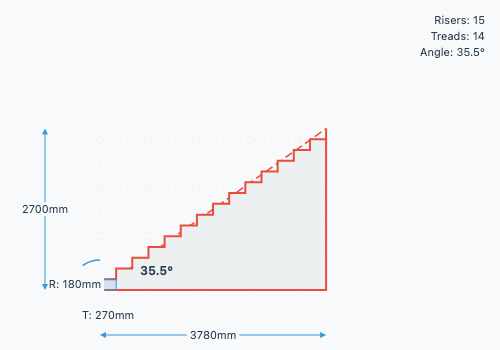
Understanding Building Codes for Stairs
Building codes establish minimum safety standards for staircase construction. These requirements vary between residential and commercial applications, and compliance is mandatory for all construction projects. The two primary codes in the United States are the International Residential Code (IRC) for residential buildings and the International Building Code (IBC) for commercial structures.
Residential Building Codes (IRC)
The International Residential Code governs staircase requirements for single-family homes, duplexes, and townhouses up to three stories. Key requirements include:
| Dimension | IRC Requirement |
|---|---|
| Maximum Riser Height | 7¾ inches (197 mm) |
| Minimum Tread Depth | 10 inches (254 mm) with nosing; 11 inches (279 mm) without |
| Minimum Stair Width | 36 inches (914 mm) clear |
| Maximum Variation | ⅜ inch (9.5 mm) between risers/treads |
| Minimum Headroom | 6 feet 8 inches (2032 mm) |
| Handrail Height | 34-38 inches (864-965 mm) |
| Maximum Flight Rise | 12 feet 7 inches (3835 mm) before landing required |
| Maximum Nosing Projection | 1¼ inches (32 mm) |
For the most current residential stair code requirements, consult the official 2024 IRC Section R311.7 on stairways.
Commercial Building Codes (IBC)
The International Building Code applies stricter requirements for commercial, institutional, and multi-family buildings. These standards prioritize high-traffic safety and accessibility:
| Dimension | IBC Requirement |
|---|---|
| Maximum Riser Height | 7 inches (178 mm) |
| Minimum Riser Height | 4 inches (102 mm) |
| Minimum Tread Depth | 11 inches (279 mm) |
| Minimum Stair Width | 44 inches (1118 mm) for occupant loads over 50 |
| Minimum Headroom | 80 inches (2032 mm) |
| Handrails | Required on both sides |
The IBC Section 1011 provides comprehensive stairway requirements for commercial buildings.
Metric and European Limits
The figures above are the US model codes. Most of the world designs stairs in millimetres, and the
limits are different enough to change a layout, a going that satisfies the IRC can be short for a
UK general access stair, and a rise that passes in a UK dwelling would fail the IBC by a wide margin.
| Code and stair category | Rise | Going | Notes |
|---|---|---|---|
| UK Approved Document K: private stair (dwellings) | 150-220 mm | 220-300 mm | Maximum pitch 42° |
| UK Approved Document K: utility stair | 150-190 mm | 250-400 mm | |
| UK Approved Document K: general access stair | 150-170 mm | 250-400 mm | Schools: 150 mm rise and 280 mm going preferred |
| DIN 18065 (Germany): buildings with up to two dwellings | 140-200 mm | 230-370 mm | Step formula 2R + G = 590-650 mm |
| US IRC (residential, for comparison) | Max 197 mm (7¾″) | Min 254 mm (10″) | |
| US IBC (commercial, for comparison) | Max 178 mm (7″) | Min 279 mm (11″) |
The trap in the private-stair row: you cannot pair the maximum 220 mm rise with
the minimum 220 mm going. That combination is a 45° pitch, which breaks the 42° limit in the
same table. Approved Document K lets you use any rise with any going inside the ranges, but the pitch
note still governs.
Whichever code applies, the comfort check is the same. Approved Document K states the normal
relationship as 2R + G between 550 and 700 mm; DIN 18065 tightens the same
idea to 590-650 mm. A 175 mm rise with a 275 mm going gives
625 mm, which sits inside both and is legal under every row above. On headroom, Approved Document K
asks for 2 m measured vertically from the pitch line, relaxed for loft conversions
to 1.9 m at the centre of the stair width and 1.8 m at the side.
Figures checked against Approved Document K, 2013 edition (England), Table 1.1 and the published summaries of DIN 18065. Codes are revised and vary by jurisdiction, so confirm against the edition that applies to your project before issuing drawings.
ADA Accessibility Requirements
For public buildings, stairs must also comply with the Americans with Disabilities Act (ADA) Standards. The U.S. Access Board’s stairway guidelines specify:
What Is a Staircase Calculator?
A staircase calculator is an essential digital tool that helps architects, builders, contractors, and DIY enthusiasts determine the precise dimensions needed to construct safe, comfortable, and code-compliant stairs. Our staircase calculator online computes critical measurements including rise, run, tread depth, riser height, stringer length, stair angle, and the total number of steps based on your floor-to-floor height and available space. Whether you’re designing a simple straight staircase, a space-saving spiral staircase, or an elegant L-shaped staircase, this staircase construction calculator eliminates guesswork and reduces costly errors.
Understanding how staircases influence interior design flow begins with proper calculation. A well-designed staircase balances safety requirements, comfort standards, and aesthetic considerations, making precise mathematical planning essential before any construction begins.
Essential Staircase Terminology
Before diving into calculations, understanding key terminology ensures accurate communication and proper measurements throughout your project.
Rise and Riser
The rise refers to the vertical distance between two consecutive treads, while the riser is the vertical board that closes the gap between steps. Building codes typically limit maximum riser height to 7.75 inches (196mm) for residential construction. Our staircase rise and run calculator helps you determine optimal riser dimensions based on your total floor-to-floor height.
Run and Tread
The run is the horizontal depth of a step, measured from the face of one riser to the face of the next. The tread includes the run plus any nosing overhang. Building codes generally require minimum tread depth of 10 inches (254mm). The relationship between rise and run determines stair comfort and safety.
Stringer
Stringers are the diagonal structural members that support treads and risers. Our staircase length calculator determines the exact stringer length using the Pythagorean theorem: Stringer Length = √(Total Rise² + Total Run²). Properly calculated stringers ensure structural integrity throughout the staircase’s lifespan.
Nosing
Nosing is the portion of the tread that projects beyond the riser below, typically 0.75 to 1.25 inches (19-32mm). Nosing improves safety by providing additional foot space and must be consistent throughout the staircase.
Landing
Landings are horizontal platforms that break up flights of stairs, provide resting points, and enable direction changes. Our staircase with landing calculator accounts for landing dimensions when determining total run and material requirements.
Stair Stringer Calculator
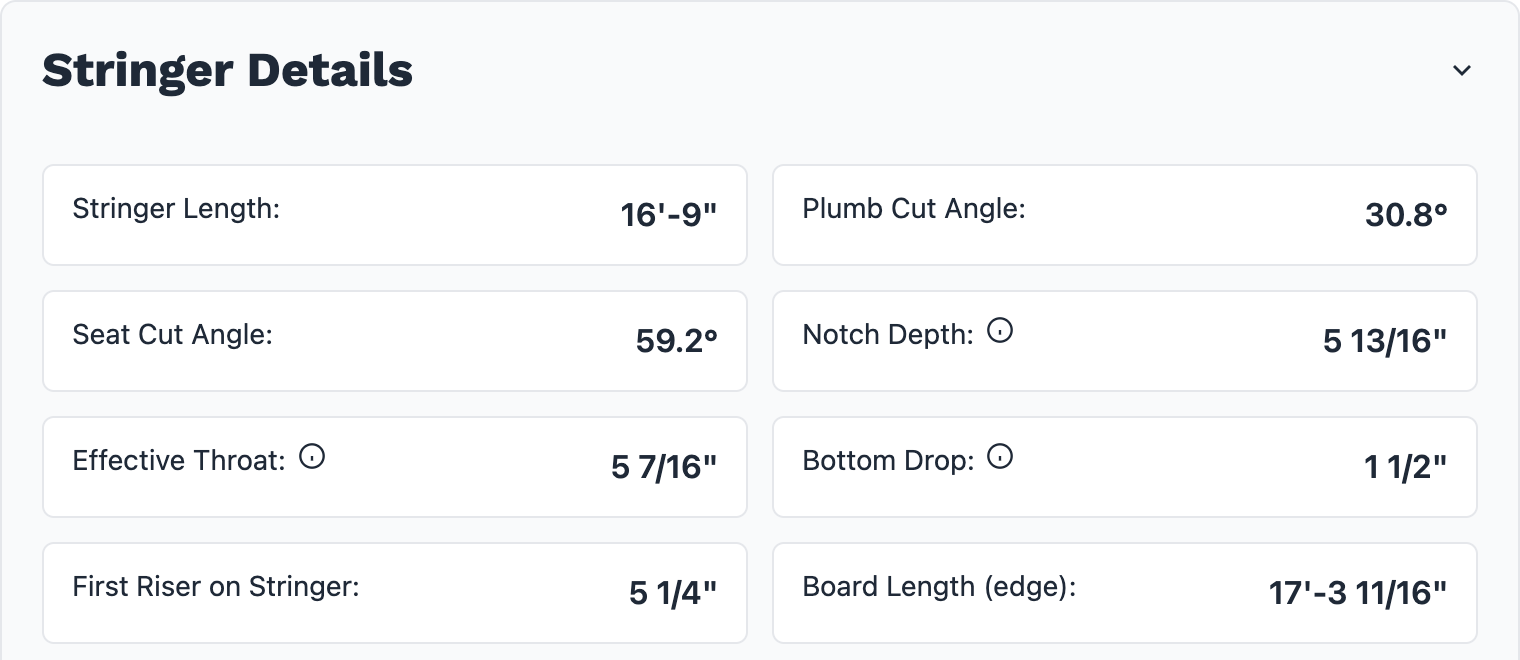
For a timber stair, set Structure to Timber stringers and choose the stringer board: 2×10 (9 1/4 in actual width), 2×12 (11 1/4 in) or a custom width. The calculator then fills in Stringer Details, the cut list for a notched stringer:
- Stringer length and the plumb and seat cut angles for the top and bottom of the board.
- Notch depth, from the board edge to the inside corner of each notch, square to the edge.
- Effective throat, the board width left under the notches (board width minus notch depth).
- Bottom drop, the tread thickness cut off the bottom of the stringer so the first step is as high as the others, and the first riser on the stringer that results.
- Board length along the edge and a table of running measurements: distances along the top edge from the point where it meets the floor, so you can mark each notch corner and draw the riser and tread lines with a framing square set to the unit rise and unit run.
Worked Example: A 9 ft Rise on 2×12 Stringers
With a floor to floor rise of 108 in (9 ft), the IRC limits, 1 1/2 in treads and a 2×12 stringer, the calculator gives 16 risers of 6 3/4 in and treads of 11 5/16 in, a 30.8° stair:
| Stringer Details | Value |
|---|---|
| Stringer length | 16′-9″ |
| Plumb cut / seat cut | 30.8° / 59.2° |
| Notch depth | 5 13/16″ |
| Effective throat (2×12) | 5 7/16″ |
| Bottom drop | 1 1/2″ |
| First riser on the stringer | 5 1/4″ |
| Board length along the edge | 17′-3 11/16″ |
The same stair on a 2×10 would leave an effective throat of only 3 7/16 in, which is why the board choice matters as much as the step sizes. Enter the stair width and the maximum stringer spacing and the calculator also counts the stringers: width divided by spacing, rounded up, plus one. For deck stairs its tip follows AWC DCA 6, with cut stringers at most 18 in apart and at least three of them.
Full-Size Stringer Template
Print stringer template (1:1) prints either one notch to trace and repeat along the board, or, once a board is selected, the whole stringer at full size across several landscape A4 or Letter pages. Print at 100% with no scaling and check the 100 mm control square before you mark the board.
The Blondel Formula: Foundation of Staircase Design
The renowned Blondel formula, developed by French architect François Blondel in the 17th century, remains the gold standard for designing comfortable stairs. The formula for staircase calculation states:
2 × Riser Height + Tread Depth = 63 cm (approximately 25 inches)
This formula corresponds to the average human stride length, ensuring that stairs feel natural to climb. A staircase with a 7-inch rise and 11-inch run satisfies this formula: 2(7) + 11 = 25 inches. Our staircase formula calculator automatically applies this principle to generate comfortable step dimensions.
Alternative Comfort Rules
Several other formulas guide comfortable stair design:
Rise + Run = 17 to 18 inches: Another comfort guideline suggesting the sum of one riser and one tread should fall within this range.
Rise × Run = 70 to 75: The product of riser height and tread depth should fall within this range for optimal comfort.
Types of Staircases and Their Calculations
Straight Staircases
Straight stairs run in one direction without turns, making them the simplest to calculate and construct. Enter total rise (floor-to-floor height) and target riser height, and our calculator determines the number of steps, actual riser height, total run, and stringer length. These calculations form the basis for understanding how to calculate staircase dimensions in any configuration.
L-Shaped Staircases
An L shaped staircase calculator handles quarter-turn stairs that change direction 90 degrees at a landing or through winder treads. L-shaped stairs efficiently fit corner spaces while breaking up long flights. The calculation divides the total rise between two flights and accounts for landing or winder dimensions in the total footprint.
U-Shaped Staircases
U-shaped or switchback stairs make a 180-degree turn, typically with an intermediate landing. These stairs occupy more width but less length than straight stairs, making them suitable for compact stairwells. Our staircase layout calculator accounts for the parallel flights and connecting landing.
Winder Staircases
A winder staircase calculator addresses stairs with pie-shaped treads that create turns without landings. Winders save space but require careful calculation to ensure adequate tread depth at the walking line, typically measured 12 inches (305mm) from the narrow end. Building codes require minimum tread depth of 6 inches at the narrow end and 10 inches at the walking line.
Spiral Staircases
Our spiral staircase calculator handles the unique geometry of helical stairs that rotate around a central pole. Key inputs include total rise, staircase diameter, and rotation angle. The calculator determines tread dimensions (inner and outer arc lengths), riser height, and handrail length. Spiral stairs must typically maintain minimum clear width of 26 inches and maximum riser height of 9.5 inches for residential applications.
Building Code Requirements
Understanding building codes ensures your staircase passes inspection and provides safe passage. While codes vary by jurisdiction, the International Residential Code (IRC) provides widely-adopted standards:
Dimensional Requirements
The dimensional limits are set out in full in the residential building codes table above, which also covers handrail height, maximum flight rise and nosing projection.
Handrail and Guard Requirements
Stairs with four or more risers require handrails on at least one side. Handrails must be positioned 34-38 inches above the stair nosing. Guards (protective barriers) are required when stairs rise more than 30 inches above the floor below, with minimum guard height of 34 inches.
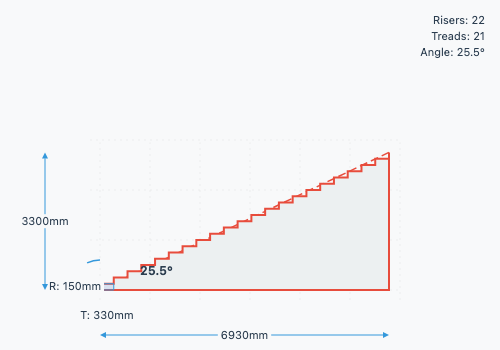
Concrete Staircase Calculations
A concrete staircase calculator estimates the volume of concrete needed for cast-in-place stairs. The calculation accounts for treads, risers, the waist slab (the inclined slab beneath the steps), and any landings. The basic formula calculates the cross-sectional area of the stair profile multiplied by the stair width.
Concrete Volume Formula
Total Volume = (Tread Area + Riser Area + Waist Slab Area) × Stair Width × Number of Steps
The waist slab thickness (typically 4-6 inches for residential, 6-8 inches for commercial) significantly affects concrete quantity. Our calculator adds appropriate waste factors (typically 5-10%) to ensure adequate material for your project.
Reinforcement Considerations
Concrete stairs require steel reinforcement to resist bending forces. The staircase calculation formula PDF guides from engineering resources detail rebar sizing and spacing based on span length, loading conditions, and concrete strength. Typical residential stairs use #4 rebar at 6-8 inch spacing in the waist slab with distribution bars perpendicular.
Steel Spiral Staircase Structural Design
Steel spiral staircase structural design calculation involves determining member sizes for the center column, treads, and handrail to safely support anticipated loads. Key considerations include:
Center Column: Must resist combined axial loads from all treads plus any applied horizontal forces. Typical residential spiral stairs use 3-4 inch diameter steel pipe columns.
Tread Brackets: Welded or bolted to the center column, these must resist bending moments from eccentric loading. Steel plate thickness and weld sizing follow structural engineering principles.
Handrail: Serves both safety and structural functions, often contributing to overall stiffness. The continuous helical rail helps distribute loads and stabilize the assembly.
Staircase Railing and Spindle Calculations
Our staircase railing calculator determines handrail length and the staircase spindle spacing calculator ensures code-compliant baluster placement. Building codes require that openings between balusters not exceed 4 inches (102mm) to prevent children from passing through or becoming trapped.
Handrail Length Formula
Handrail Length = √(Total Rise² + Total Run²) + Extensions
Handrails must extend horizontally at least 12 inches beyond the top riser and continue the stair slope for the depth of one tread beyond the bottom riser.
Baluster Quantity
A general rule estimates three balusters per linear foot of railing or three balusters per tread on stairs. The precise formula divides total railing length by (baluster width + maximum allowed spacing), rounding up to ensure code compliance.
Staircase Measurement Calculator Applications
Square Footage Calculation
Our staircase square feet calculator determines the floor area occupied by stairs, essential for space planning and cost estimation. The calculation multiplies total run by stair width, adding landing areas for multi-flight configurations. This measurement helps architects optimize functional living spaces around staircases.
Slope and Angle
The staircase slope calculator determines stair angle using: Angle = arctan(Total Rise / Total Run). Comfortable residential stairs typically range from 30° to 37°. Steeper angles (up to 45°) may be acceptable for secondary stairs or space-constrained applications but reduce comfort and safety.
Size and Dimensions
The staircase size calculator and staircase dimensions calculator compile all critical measurements into a comprehensive specification: total rise, total run, number of risers, number of treads, stringer length, stair angle, individual riser height, individual tread depth, and overall footprint dimensions.
Staircase Cost Estimation
A staircase cost calculator estimates material and labor expenses based on stair type, materials, and complexity. Key cost factors include:
Materials: Wood species, steel grade, concrete mix, and railing materials significantly affect cost. Premium hardwoods or custom metalwork can multiply material costs several times over standard options.
Complexity: Straight stairs cost less than curved or spiral designs. Winders and custom configurations increase labor requirements and cost.
Finishing: Painted versus stained wood, powder-coated versus polished metal, and decorative versus utilitarian railings all influence final pricing.
Step-by-Step: How to Calculate a Staircase
Follow this process to calculate staircase length and all related dimensions:
Step 1: Measure Total Rise: Measure the vertical distance from finished floor to finished floor (not floor to ceiling). This determines how much height the stairs must climb.
Step 2: Determine Number of Risers: Divide total rise by target riser height (typically 7-7.5 inches). Round to the nearest whole number. Example: 108 inches ÷ 7.5 inches = 14.4, round to 14 risers.
Step 3: Calculate Actual Riser Height: Divide total rise by number of risers. Example: 108 inches ÷ 14 = 7.71 inches per riser.
Step 4: Determine Number of Treads: For standard stairs, treads = risers − 1. Example: 14 risers − 1 = 13 treads.
Step 5: Set Tread Depth: Select tread depth meeting code (minimum 10 inches) and comfort (10-11 inches typical). Verify with Blondel formula.
Step 6: Calculate Total Run: Multiply number of treads by tread depth. Example: 13 treads × 10.5 inches = 136.5 inches total run.
Step 7: Calculate Stringer Length: Apply Pythagorean theorem: √(108² + 136.5²) = √(11,664 + 18,632) = √30,296 = 174.1 inches.
Step 8: Verify Headroom: Ensure minimum 80 inches (6’8″) clearance above all treads.
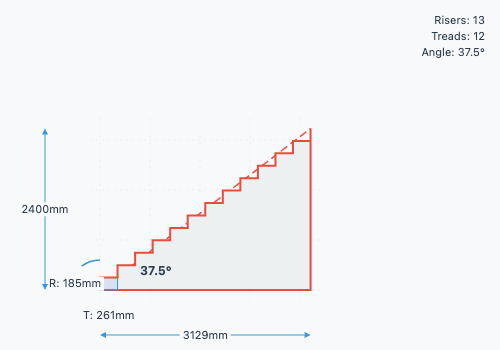
Common Staircase Calculation Mistakes
Avoid these frequent errors when using any staircase measurement calculator:
Measuring to Subfloor: Always measure to finished floor levels, accounting for flooring thickness at both top and bottom landings.
Forgetting the First Riser: The first step rises from the lower floor to the first tread. Don’t count the upper floor as a tread.
Inconsistent Risers: Building codes limit riser height variation to 3/8 inch. Uneven risers cause trips and falls.
Ignoring Headroom: Stairwell opening must provide adequate clearance throughout the entire stair run, not just at the bottom.
Neglecting Nosing: Nosing projects beyond the riser but doesn’t add to the run. Account for this when calculating total run and stringer layout.
Staircase Calculator App Features
A comprehensive staircase calculator app offers several advantages over manual calculation:
Real-Time Validation: Instant feedback on code compliance as you adjust dimensions.
Visual Diagrams: Generated drawings showing stringer layout, step profiles, and overall configuration.
Material Lists: Automatic generation of cut lists and material quantities for ordering.
Unit Flexibility: Support for both imperial and metric measurements with automatic conversion.
Multiple Stair Types: Dedicated calculators for straight, L-shaped, U-shaped, winder, and spiral configurations.
Professional Resources
For detailed engineering calculations, professional resources provide comprehensive guidance. Calculator.net’s stair calculator offers thorough explanations of terminology and building code requirements. Omnicalculator’s stair tool provides extensive background on comfort formulas and safety standards.
For specialized calculations, Perpendicular.pro’s 3D spiral staircase calculator generates detailed drawings and material estimates for helical stairs. Their concrete stair calculator helps estimate material quantities for cast-in-place construction.
Why Use Our Staircase Calculator?
Our comprehensive staircase calculator serves architects, contractors, and homeowners planning stair construction or renovation projects. Whether you need a basic staircase measurements calculator for a simple straight run or advanced tools for winder staircase and spiral staircase configurations, our calculator delivers accurate, code-compliant results.
The tool integrates all essential calculations, from basic staircase rise and run calculator functions to comprehensive staircase construction calculator outputs including stringer dimensions, material quantities, and cost estimates. Combined with clear diagrams and building code references, our calculator transforms complex stair design into a straightforward process accessible to professionals and DIY builders alike.
Rate this tool
Was Free Online Staircase Calculator useful? One tap, no sign-up.

