

Architecture School Supplies List: What to Buy in First Year and What Can Wait
A printable shopping list of physical supplies for architecture students, built from real school lists: what to buy before week one, what to add when a project asks, what can wait for later years, and how to spend less.
 Elif Ayse Sen7 October 20228 Mins read452

Table of Contents Show
Quick AnswerThe architecture school supplies you need in week one are few: a sketchbook, pencils and fineliners, a scale ruler, set squares, trace, a cutting mat, a craft knife with spare blades, a steel ruler and glue. Board materials, special tools and books can wait until a project or your school’s list asks for them.



New architecture students tend to buy too much too early. Shops sell “architecture kits” in August, relatives offer to help, and it is tempting to arrive with every tool in the catalogue. Then the first studio brief asks for something no one mentioned, while half the kit stays in its packaging until second year.
This list is built the other way round. It starts from what schools actually ask first year students to bring, splits physical supplies into what to buy now, what to buy when a project needs it and what can wait for later years, and gives a reason and a quantity for each item. It covers physical items only. For the laptop and software side, see our guide to the best software in architecture school and what to learn first, and for devices, our roundup of tech gadgets that make architecture school easier.
How This Architecture School Supplies List Works
Every school publishes its own list, and they disagree on details. Cal Poly’s 2025 welcome letter for first year architecture students offers a ready-made kit from a local store or the option to assemble the same list yourself, and says the kit should last the whole first year. Oxford Brookes University’s 2016-17 year one equipment list tells students they do not need everything at once and names only five things for week one: technical pens, a scale rule, a small amount of A3 tracing paper, a sketchbook and a measuring tape.
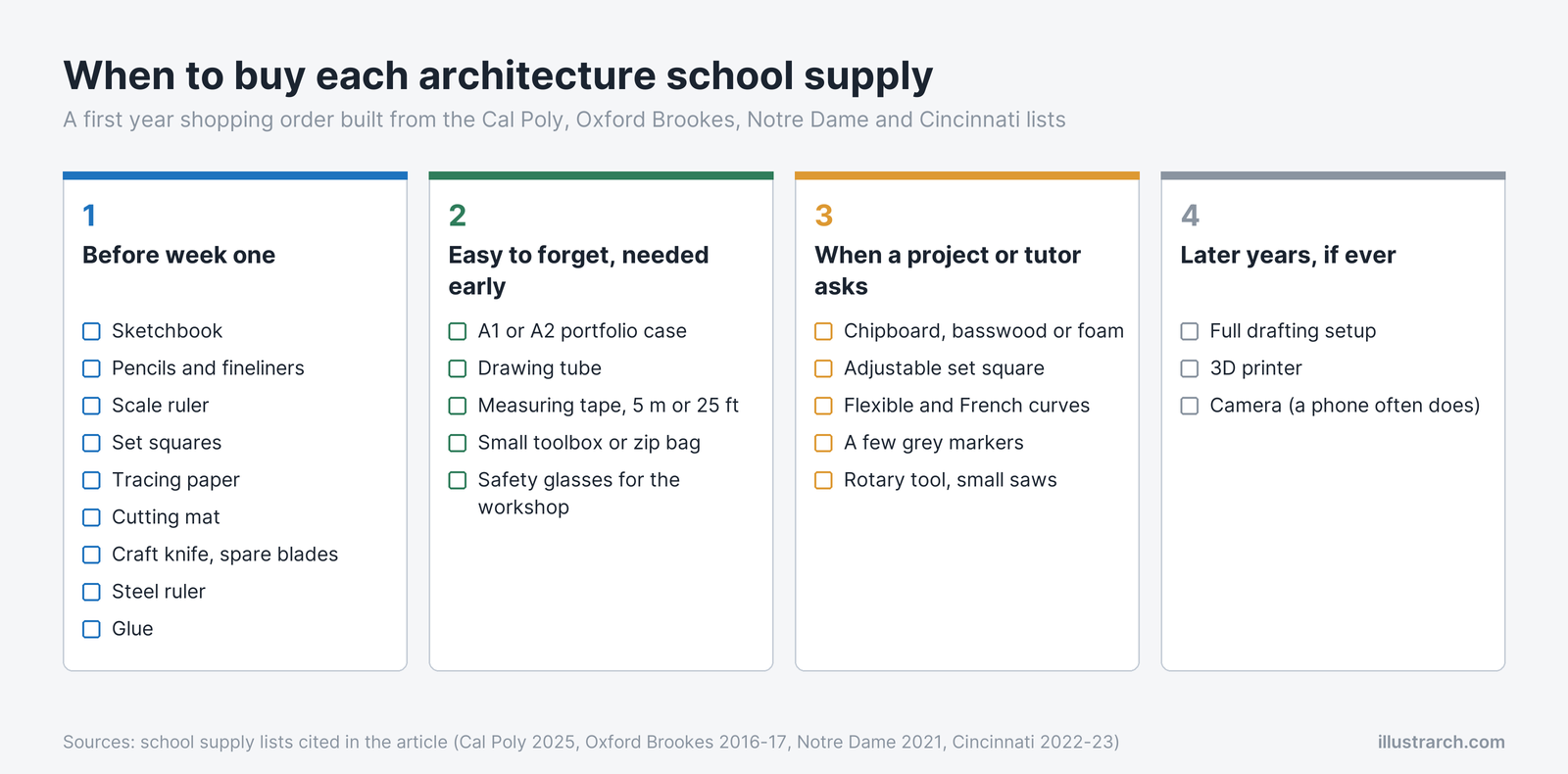
The lists below combine those school lists with the University of Notre Dame’s fall 2021 Design I supply list for its second year studio and the University of Cincinnati’s DAAP foundations supply kit for 2022-23. Where all of them agree, an item is in the first year list. Where only one asks for it, it moves to “when a project asks” or “later”.
💡 Pro Tip
Wait for your own school’s list before spending on anything beyond the week one items. Lists name specific sheet sizes, scale units and even brands, and buying the wrong scale or board size is the most common wasted purchase. Ask second year students which items they never used; they will tell you honestly.
First Year Drawing Supplies
Drawing tools are where schools agree most. The table gives each item, why you need it and a sensible quantity to start with.
Drawing Supplies Checklist
| Item | Why you need it | How many |
|---|---|---|
| Sketchbook, hard cover, lies flat | Site sketches, ideas, crit notes | 1 to 2 |
| Graphite pencils, hard to soft | Sketching and shading | 5 to 6 grades |
| Lead holder with pointer, or mechanical pencil | Precise drafting lines | 1 to 3, plus leads |
| Fineliners or technical pens | Ink drawings in set line weights | 3 widths |
| Scale ruler (triangular) | Drawing and reading at scale | 1 |
| Set squares, 45 and 30/60 | Verticals and standard angles | 1 of each |
| Tracing paper roll | Overlays and quick iterations | 1 roll to start |
| Kneaded and vinyl erasers, erasing shield | Clean corrections in small areas | 1 of each |
| Drafting tape or dots | Holds sheets without tearing them | 1 roll or box |
| Compass | Arcs, curves and door swings | 1 |
Notes on the Drawing Items
Sketchbooks are personal, and the older version of this article gave the best advice on them: try a few small, cheap ones before settling on a favourite. Notre Dame adds one practical rule worth following: choose a hard-cover book with unlined paper that lies flat, so you can draw across both pages.
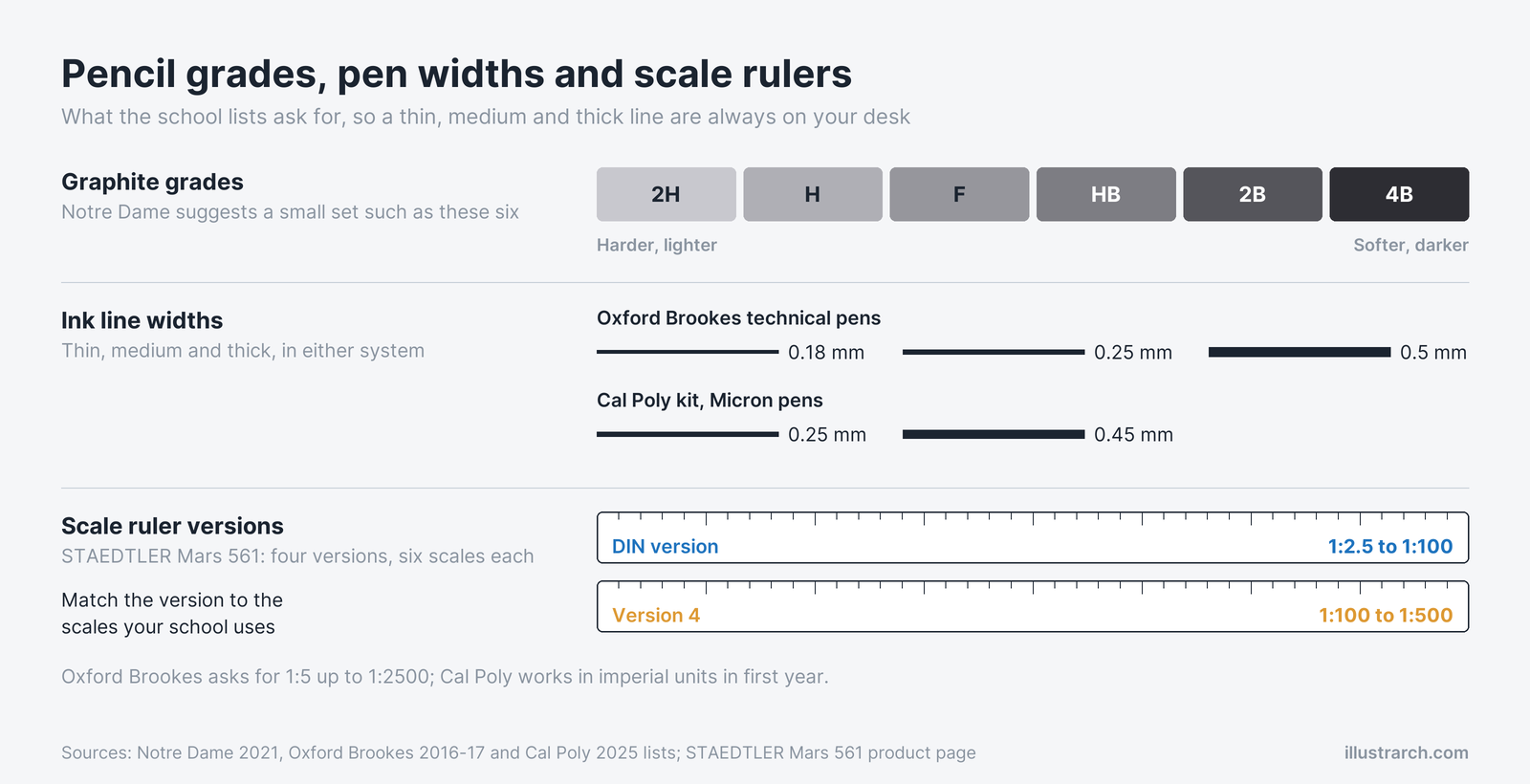
For pencils, Notre Dame suggests a small set of graphite grades such as 2H, H or F, HB, 2B and 4B, and recommends 2 mm lead holders with a rotary pointer for drafting, noting that mechanical pencils are not a satisfactory substitute for drafting work. The Cincinnati kit includes three lead holders with 2H, H and HB leads. For ink, Oxford Brookes lists technical pens in 0.18, 0.25 and 0.5 mm, while Cal Poly’s kit uses disposable Micron pens in 0.25 and 0.45 mm. Either approach gives you a thin, medium and thick line.
The scale ruler is the item to check most carefully. STAEDTLER’s Mars 561 reduction scale ruler, for example, comes in four versions with six scales each; the DIN version reads 1:2.5 to 1:100, while version 4 reads 1:100 to 1:500. Match the version to the scales your school uses. Our guide to architectural scale explains which ratios suit which drawings.
📌 Did You Know?
Scale rulers are not interchangeable between countries. Cal Poly’s 2025 letter tells incoming students that all drafting and modelling in first year is in imperial units, so an imperial architectural scale is essential even if they already own metric ones. Oxford Brookes, working in metric, asks for a scale rule reading from 1:5 up to 1:2500.
First Year Model Making Supplies
Model making is where a cheap tool costs you the most, because a blunt blade tears card and a flexible ruler wanders. The good news is that the list is short. For more on materials themselves, see our guide to affordable model making materials and where to find them.
Model Making Checklist
| Item | Why you need it | How many |
|---|---|---|
| Self-healing cutting mat, A2 or larger | Protects desks and keeps cuts clean | 1 |
| Craft knife with #11 style blades | Fine cuts in card and thin wood | 1 knife, many blades |
| Snap-off utility knife | Thick board and foam | 1 |
| Steel ruler, cork backed | Cutting edge that does not slip | 1, 45 to 60 cm |
| PVA or tacky glue and a glue stick | Card, paper and wood joints | 1 of each |
| Pins and masking tape | Holding parts while glue sets | 1 box, 1 roll |
| Safety glasses | Required in most workshops | 1 |
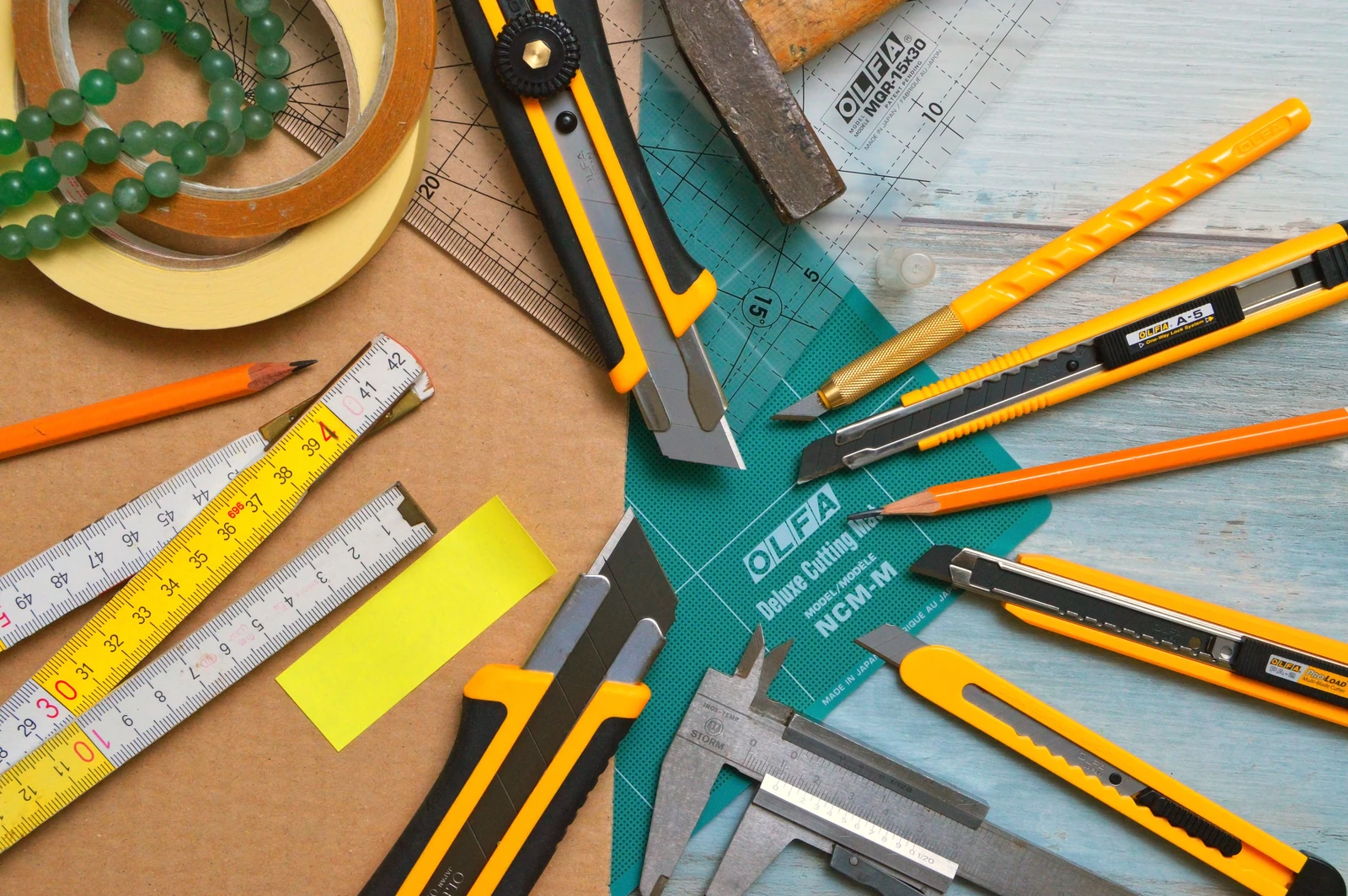
Schools take the cutting mat seriously. Oxford Brookes asks for an A2 mat and states plainly that cutting on tables and floors is not acceptable. Cal Poly and Cincinnati both list an 18 by 24 inch mat, and both kits include safety glasses, because workshop access often depends on them. Cal Poly’s kit also includes a hot glue gun, long-nose pliers and sandpaper in three grits.
Buy blades in packs. A fresh blade cuts cleaner card than any amount of care with a blunt one, and #11 blades are cheap compared with the board they spoil. The older version of this article had a good point on materials too: you do not need expensive board for study models. Keep clean packaging card and paper through the year and use it for early, rough models; buy chipboard, basswood or foam only when a project asks for a specific finish.
⚖️ Pros & Cons at a Glance
✔️ Pros of a school-approved kit: matches the course list exactly, often discounted, saves hours of comparing brands
✖️ Cons: includes items you may already own, little choice of brand, still not everything a project will need
Carrying, Storing and Measuring
The items in this group are easy to forget until the first review. Oxford Brookes requires an A1 portfolio, a secure case that keeps drawings flat rather than rolled, for submitting work at the end of each studio module. Cal Poly’s kit includes mesh bags in two sizes and a cardboard tube for rolled drawings.
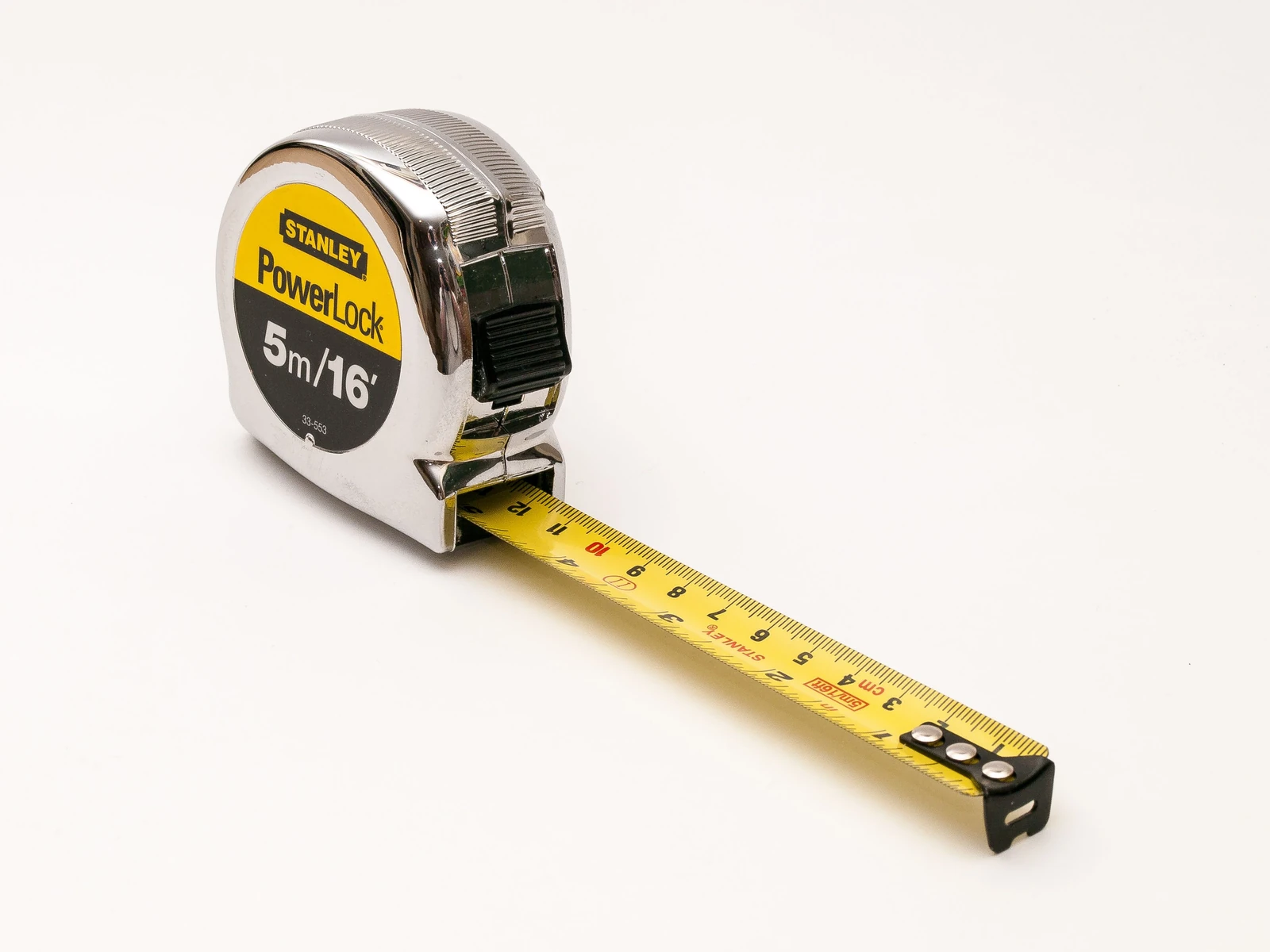
A measuring tape belongs here as well. Oxford Brookes asks for a 5 m steel tape in week one, and Notre Dame asks for one of at least 25 feet for site documentation and measuring around campus. A tape that shows metric on one edge and imperial on the other avoids conversion mistakes. A small toolbox or tackle box stops blades, pins and leads from rattling loose in your bag.
Label everything with your name before the first week. Studios are shared rooms, and scale rulers, steel rulers and set squares look identical on every desk. A strip of coloured tape or a paint pen mark on each tool saves arguments and lost kit, and it makes borrowed items easier to return after a late night before a review.
- A1 or A2 portfolio case (1): carries boards flat to reviews.
- Drawing tube (1): for rolls of trace and plots.
- Measuring tape, 5 m or 25 ft (1): site visits and measured drawings.
- Small toolbox or zip bag (1 to 2): keeps sharp items capped and together.
Supplies That Can Wait Until Later Years
Several items appear on lists as optional, or only in second year. Buy them when a project or a tutor asks, not before.
- Adjustable set square, flexible curve and French curves: Oxford Brookes marks these as optional, and Cal Poly lists a flexible curve and an adjustable triangle only as recommended.
- Full drafting setup: Notre Dame’s second year list includes a 42 or 48 inch parallel rule, a 36 by 48 inch drafting board with a vinyl cover and clamp-on lamps. That is a second year studio desk, not a first year bedroom purchase; our guide to desk selection for architects covers the furniture side.
- Marker sets and watercolour: useful for presentation, though Cal Poly’s first year kit does include a watercolour set. Start with a few grey markers rather than a full colour range.
- Rotary tool, small saws and heavier model tools: worth it once projects move to wood and larger models. See our overview of model making equipment.
- 3D printer: almost never a first year purchase, since most schools run a fab lab. If you are curious, read our guide to 3D printers for architectural model making.
- Camera: Oxford Brookes lists one as optional, and Notre Dame notes that many students simply use their phones.
Books Worth Owning
Books are physical supplies too, and some schools list them. Cincinnati’s kit names two by Francis D.K. Ching, Architecture: Form, Space and Order and Architectural Graphics, and allows new or used paperback copies. The earlier version of this article recommended Matthew Frederick’s 101 Things I Learned in Architecture School and a building data reference such as Neufert. All four are books students keep long after first year. For a longer list, see our pick of the best architecture books for students.

How to Spend Less on Architecture School Supplies
The faculty letters themselves admit the cost is significant. A few habits keep it under control:
- Ask about the school kit first. Cal Poly and Cincinnati both work with local stores that assemble the official list.
- Ask for a student discount wherever you shop; Notre Dame’s list reminds students to do exactly that.
- Check that cheap online listings are the same item. Notre Dame warns that not all drafting supplies are equal and that students must be sure they are buying a professional tool, not a knock-off.
- Share bulky items such as a large cutting mat or a glue gun with a desk neighbour in the first weeks.
- Reuse: card from packaging for study models, old sheets as trace backing, offcuts for the next model.
For a broader view of the tools architects use across a career, our article on essential tools for architecture students and the list of must-have architect tools for drafting and design are good next reads.
The Bigger Picture
✅ Key Takeaways
- Buy only the week one items before term: sketchbook, pencils, pens, scale ruler, set squares, trace, cutting mat, knife, steel ruler and glue.
- Check your school’s list for scale units and sheet sizes before buying a scale ruler or a drawing board.
- A good blade, a steel ruler and a proper cutting mat matter more for models than expensive board.
- A flat portfolio and a measuring tape are easy to forget and needed early.
- Drafting setups, rotary tools, marker sets and 3D printers can wait for later years.
The supplies you buy in first year are less important than the habits you build with them: capping blades, keeping trace overlays in order, labelling every sheet with a scale. Buy small, buy what your school asks for, and let the projects tell you what to add next.
Architecture Students Hub
This guide is part of School Life and Learning, stage 6 of our student roadmap from the first diagram to the first internship. Next stage: Concept and Diagrams, or browse every free tool and guide in the Architecture Students Hub.





Interior Design for Commercial Spaces: Enhancing Functionality and Brand Identity
Commercial interior design has to serve brand, function and regulation at once....
 Begum Gumusel4 Mins read

What Architecture Students Should Know About Structural Glass and Guardrail Code
Glass guards look minimal, but structural behavior, safety glazing, connections and guardrail...
 illustrarch Editorial Team6 Mins read

Futuro House Production Revived in Finland After Decades-Long Hiatus
A Facebook listing for abandoned moulds led to the first new Futuro...
illustrarch Editorial Team3 Mins read

Building Your Dream Home in NSW: What You Should Know About Montgomery Homes
Montgomery Homes has been building across Sydney, Newcastle, the Hunter, Wollongong and...
illustrarch Editorial Team4 Mins read





Leave a comment