

Why Scale Matters in Architecture
Why Scale Matters in Architecture: see how human, building, and urban scales shape comfort, inclusivity, performance, and context with practical tools.
 Sinan Ozen28 December 20254 Mins read252
Table of Contents Show
We talk about scale every day in practice because it’s the quiet force that organizes how spaces feel, perform, and belong. Why Scale Matters in Architecture isn’t just a theory point: it’s a decision we make with every door height, column spacing, and skyline move. When we get scale right, buildings become intuitive to use, efficient to run, and genuinely rooted in their context.
What Architects Mean By Scale
Human, Building, And Urban Scales
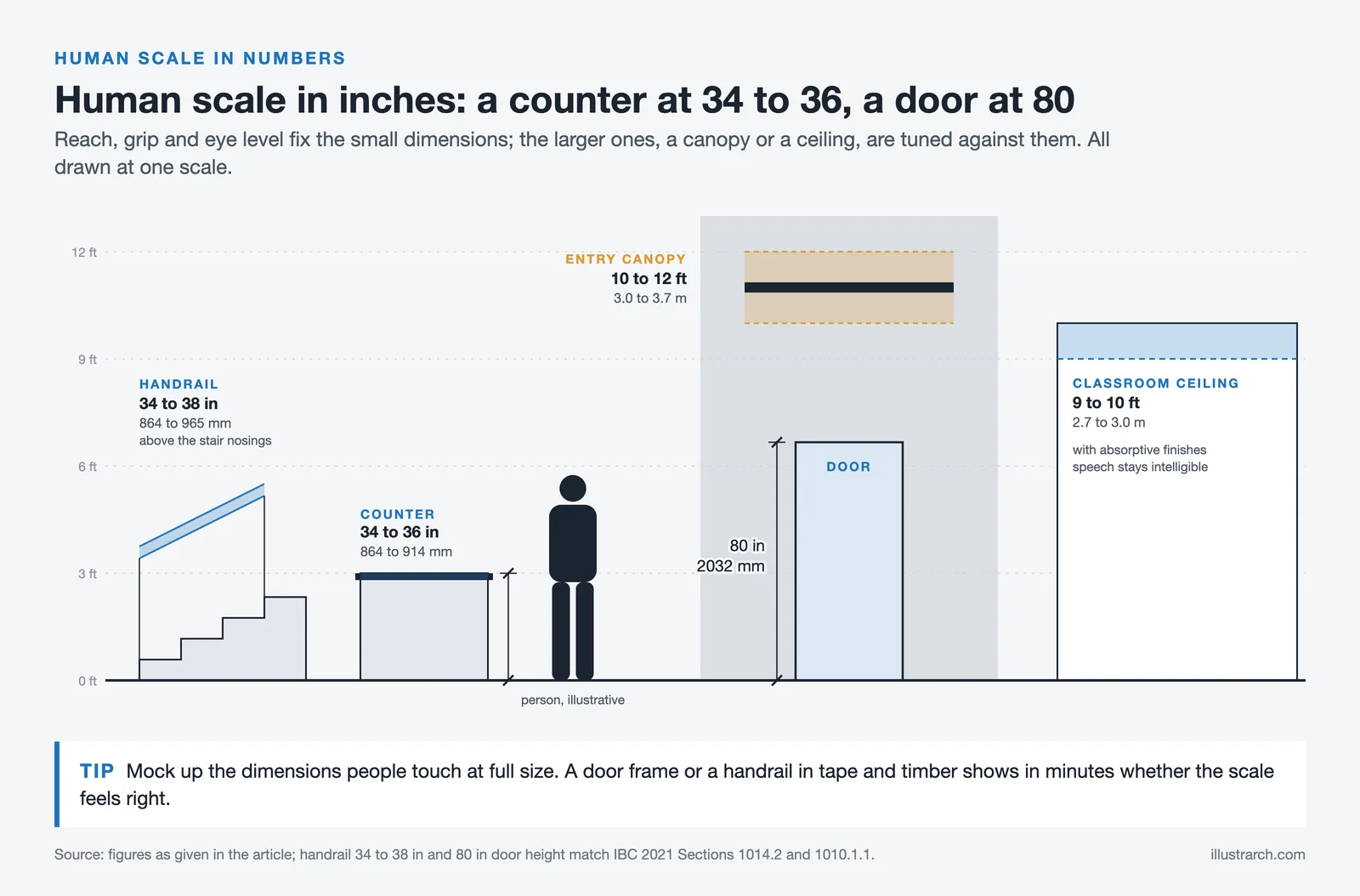
We design across nested layers of scale. At the human scale, we’re dealing with reach, eye level, grip, and gait, things like a 34-36 inch counter height or a 34 to 38 inch handrail height that make rooms feel calm and usable. At the building scale, it’s the rhythm of bays, floor-to-floor heights, and facade modules that set character and cost. Urban scale zooms out to block length, street width, and skyline steps: these moves influence walkability, shade, and how a project meets the city.

Scale vs. Proportion vs. Size
Size is absolute, an 80-inch door is a measurement. Proportion is the relationship between parts, say, a 1:2 window ratio. Scale is interpretive: how the size and proportions read against people, neighboring elements, and context. A large lobby can still feel intimate if the details (lighting cones, furniture clusters, soffits) pull the human scale forward. Conversely, a small facade can feel monumental with tall, sparse articulation. We constantly juggle the trio: size for function, proportion for harmony, and scale for perception.
How Scale Shapes Experience
Comfort, Perception, And Wayfinding
Scale guides how we understand space at a glance. Lower ceilings over entries give a “threshold” and make a big hall feel welcoming. Repeating structural bays help us anticipate what’s next, aiding wayfinding. Even small cues, a doorway recessed by a foot, a canopy at 10-12 feet, signal where to go. If the elements are too oversized or too fine-grained, users feel either dwarfed or lost in visual noise.

Accessibility And Inclusivity
Designing at the right scale is equity in practice. Clear widths that truly accommodate mobility devices, tactile wayfinding at hand height, lever handles operable with limited grip, these aren’t extras. They’re the human scale made explicit. We also consider neurodiversity: lighting levels, acoustic absorption, and readable signage that reduce cognitive load. When the scale of interfaces matches the range of bodies and brains, spaces invite everyone in.
Free Online Architectural Scale Converter
Convert a measurement taken off a drawing into a real-world dimension, or the other way round.
Imperial input accepts feet and inches, for example 12' 6 1/2".
You measured something on a drawing and you know what it is in reality. This works out the scale the drawing was produced at.
Straight metric to imperial conversion for lengths, areas and volumes.
Give the real size of what you are drawing and the sheet you are plotting on; this picks the largest standard scale that still fits.
Reprinting a drawing at a different scale, or dropping a sheet down a size? These are the percentages to type into the plotter or copier.
Scale to scale
Sheet to sheet
Real dimensions in, model dimensions out, plus the area and volume factors that catch everyone out.
Sanity check
- Person (standing) —
- Door height —
- Storey height —
- Stair riser —
- Car (length) —
What one unit on the sheet stands for at every common drawing scale.
| Scale | Ratio | 1 mm on paper | 1 m in reality | Typically used for |
|---|---|---|---|---|
| 1:1 | 1:1 | 1 mm | 1 m | Full size: component and mock-up drawings |
| 1:2 | 1:2 | 2 mm | 50 cm | Half size: joinery and fabrication details |
| 1:5 | 1:5 | 5 mm | 20 cm | Construction details, connections |
| 1:10 | 1:10 | 1 cm | 10 cm | Details, wall build-ups, furniture |
| 1:20 | 1:20 | 2 cm | 5 cm | Enlarged plans: kitchens, bathrooms, stairs |
| 1:25 | 1:25 | 2.5 cm | 4 cm | Enlarged plans (metric alternative to 1:20) |
| 1:50 | 1:50 | 5 cm | 2 cm | Floor plans, sections and elevations |
| 1:75 | 1:75 | 7.5 cm | 1.3333 cm | Large residential plans |
| 1:100 | 1:100 | 10 cm | 1 cm | General arrangement plans, sections, elevations |
| 1:125 | 1:125 | 12.5 cm | 8 mm | Large building general arrangement |
| 1:200 | 1:200 | 20 cm | 5 mm | Large buildings, roof plans |
| 1:250 | 1:250 | 25 cm | 4 mm | Large building blocks, site layouts |
| 1:500 | 1:500 | 50 cm | 2 mm | Site plans, landscape layouts |
| 1:1000 | 1:1000 | 1 m | 1 mm | Site and masterplan drawings |
| 1:1250 | 1:1250 | 1.25 m | 0.8 mm | Location plans (UK planning) |
| 1:2000 | 1:2000 | 2 m | 0.5 mm | Urban design, district plans |
| 1:2500 | 1:2500 | 2.5 m | 0.4 mm | Location and context plans |
| 1:5000 | 1:5000 | 5 m | 0.2 mm | City-scale mapping |
| 1:10000 | 1:10000 | 10 m | 0.1 mm | Regional and territorial mapping |
| 12" = 1'-0" | 1:1 | 1 mm | 1 m | Full size |
| 6" = 1'-0" | 1:2 | 2 mm | 50 cm | Half size details |
| 3" = 1'-0" | 1:4 | 4 mm | 25 cm | Large construction details |
| 1-1/2" = 1'-0" | 1:8 | 8 mm | 12.5 cm | Details and sections |
| 1" = 1'-0" | 1:12 | 1.2 cm | 8.3333 cm | Details, wall sections |
| 3/4" = 1'-0" | 1:16 | 1.6 cm | 6.25 cm | Enlarged plans, millwork |
| 1/2" = 1'-0" | 1:24 | 2.4 cm | 4.1667 cm | Enlarged plans, interiors |
| 3/8" = 1'-0" | 1:32 | 3.2 cm | 3.125 cm | Small building plans |
| 1/4" = 1'-0" | 1:48 | 4.8 cm | 2.0833 cm | Standard residential floor plans |
| 3/16" = 1'-0" | 1:64 | 6.4 cm | 1.5625 cm | Larger floor plans |
| 1/8" = 1'-0" | 1:96 | 9.6 cm | 1.0417 cm | Commercial floor plans |
| 3/32" = 1'-0" | 1:128 | 12.8 cm | 7.8125 mm | Very large floor plans |
| 1/16" = 1'-0" | 1:192 | 19.2 cm | 5.2083 mm | Overall building / key plans |
| 1/32" = 1'-0" | 1:384 | 38.4 cm | 2.6042 mm | Site and campus plans |
| 1" = 10' | 1:120 | 12 cm | 8.3333 mm | Detailed site plans |
| 1" = 20' | 1:240 | 24 cm | 4.1667 mm | Site plans, grading |
| 1" = 30' | 1:360 | 36 cm | 2.7778 mm | Site plans |
| 1" = 40' | 1:480 | 48 cm | 2.0833 mm | Large site plans |
| 1" = 50' | 1:600 | 60 cm | 1.6667 mm | Subdivision layouts |
| 1" = 60' | 1:720 | 72 cm | 1.3889 mm | Large site and civil plans |
| 1" = 100' | 1:1200 | 1.2 m | 0.8333 mm | Masterplans |
| 1" = 200' | 1:2400 | 2.4 m | 0.4167 mm | Regional and civil mapping |
No scales match your filter.
Scale, Context, And Proportion
Fitting The Street, Skyline, And Landscape
Buildings converse with their surroundings. Street walls that pick up adjacent cornice lines, step-backs that preserve sky views, and ground floors scaled to the pedestrian (transparent glazing, frequent doors) stitch projects into place. In landscapes, berms, canopies, and tree spacing set micro-scale rooms outdoors, taming wind and sun while framing routes and pauses.

Cultural Cues And Identity
Scale carries cultural meaning. A civic stair sized for gatherings says “this is for the public.” A porch scaled for conversation signals hospitality. We tune window heights to respect privacy norms, or vary facade cadence to echo local craft. Proportion systems, golden section, tatami modules, or contemporary parametrics, become a shared language that ties new work to local memory without imitation.
Performance, Systems, And Sustainability
Structure, Spans, And Building Systems
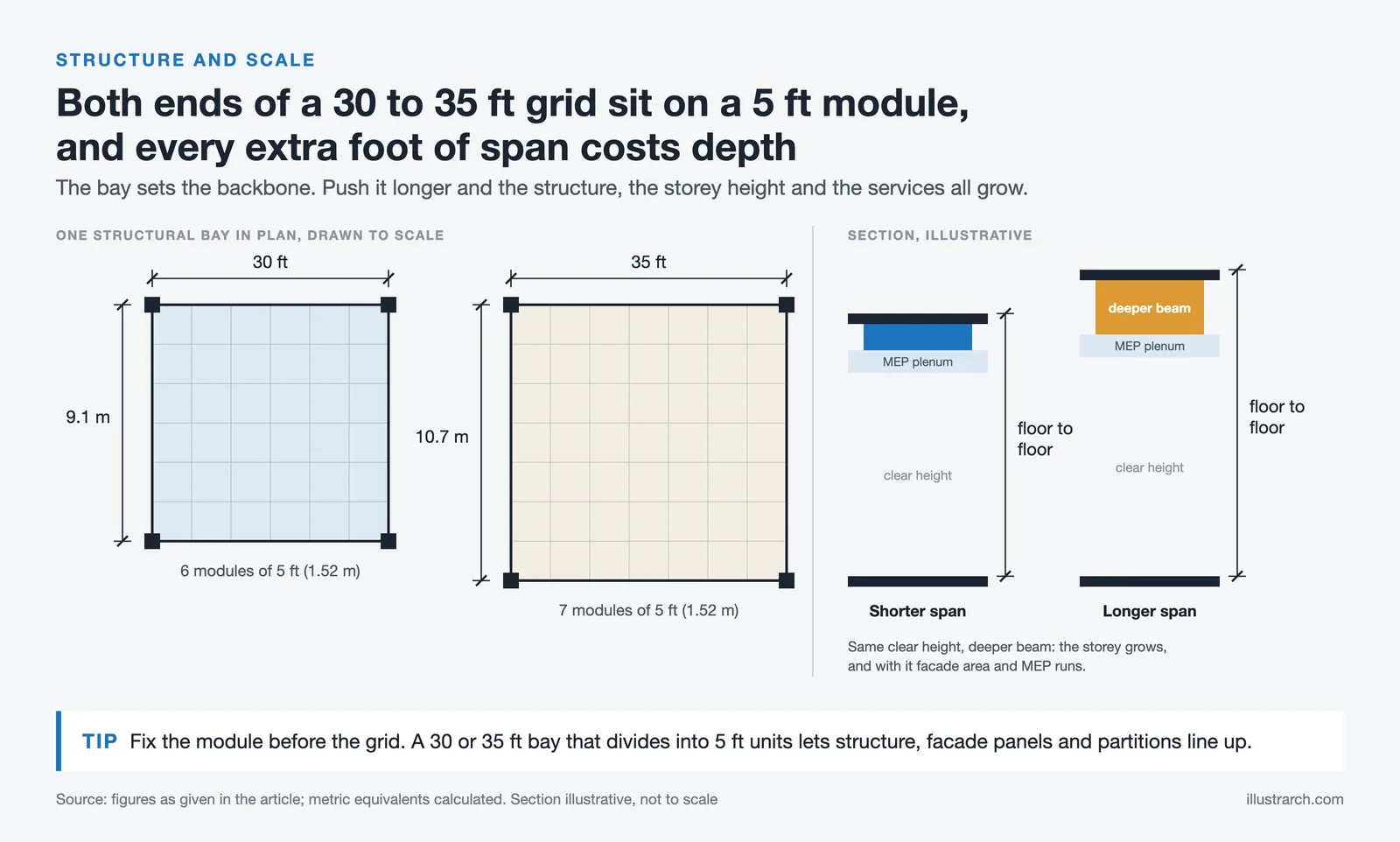
Span decisions set the project’s backbone. A 30-35 ft structural grid can balance program flexibility with material efficiency: push spans longer and structure deepens, increasing floor-to-floor heights, curtain wall area, and MEP runs. Scale ripples through cost and carbon. Right-sizing shafts, plenum depths, and equipment rooms avoids oversized systems that waste energy and space.
Envelope, Daylight, And Energy Behavior
Facade scale governs comfort and performance. Window-to-wall ratio, mullion spacing, and exterior shading must align with orientation and climate. Finer-grained facades with vertical fins or deep horizontal shades can cut cooling loads while preserving views. Daylight apertures tuned to task areas reduce electric lighting and improve well-being, oversized glass without shading does the opposite, driving glare and HVAC demand.

Microclimate, Acoustics, And Comfort
At the site scale, building massing can block winter winds or channel summer breezes. Courtyard proportions influence air movement and daylight reach. Inside, ceiling heights and surface materials shape reverberation time: a 9-10 ft ceiling with absorptive finishes can make classrooms intelligible, while double-height volumes need targeted acoustic treatments. Comfort emerges when these scales are coordinated rather than treated as afterthoughts.
Designing For Scale In Practice
Models, Mock-Ups, And Simulation Workflows
We test scale with tools that let us feel it: quick physical models to study massing, full-size door and stair mock-ups to check ergonomics, and VR walk-throughs to validate eye-level experiences. Simulation adds evidence, daylight autonomy, glare probability, airflow, and crowd movement, so scale choices aren’t guesses.

Detailing, Modules, And Tolerances
Details either reinforce or fight the intended scale. A 5-foot module can align structure, facade panels, and interior planning to reduce waste and clashes. We set tolerances early, movement joints, sealant widths, and adjustability, so built reality matches design intent. The hand scale matters too: edge radii, hardware placement, and reveal depths that look good on paper but also feel right.
Coordination, Codes, And Stakeholder Alignment
Scale lives in constraints. Codes fix egress widths, headroom, and accessibility clearances: utilities dictate equipment footprints. We align stakeholders with side-by-side options showing how scale affects cost, schedule, carbon, and experience. When teams see the trade-offs clearly, decisions come faster and projects stay coherent.
Conclusion
Scale is the architect’s quiet lever. When we calibrate it across human, building, and urban realms, spaces become legible, inclusive, and efficient, and they belong to their place. Why Scale Matters in Architecture is simple: it’s how we turn measurements into meaning. If we stay attentive to scale from sketch to punch list, the rest tends to click into place.







Overlapping Concrete Walls and One Roof Shape a House in Okinawa
IGArchitects built Overlapping Spaces in Okinawa from reinforced concrete walls, columns and...
 illustrarch Editoral Team1 Mins read

Futuro House Production Revived in Finland After Decades-Long Hiatus
A Facebook listing for abandoned moulds led to the first new Futuro...
illustrarch Editoral Team3 Mins read

Building Your Dream Home in NSW: What You Should Know About Montgomery Homes
Montgomery Homes has been building across Sydney, Newcastle, the Hunter, Wollongong and...
illustrarch Editoral Team4 Mins read

Designing a Home Theater: Where Drapery Fits Into the Plan
In a media room the curtains are a performance layer, not decoration....
illustrarch Editoral Team3 Mins read


Leave a comment