

Woolworth Building: The Cathedral of Commerce and Its Lasting Legacy in New York City
A look inside the Woolworth Building in New York City, from its 1913 origins as the tallest skyscraper on earth to its neo-Gothic terracotta facade, ornate lobby mosaics, and 21st-century transformation into luxury residential apartments. Key architectural facts and history included.
 Sinan Ozen28 February 20266 Mins read311

Table of Contents Show
Standing at 792 feet on Broadway in Lower Manhattan, the Woolworth Building has shaped the New York City skyline for over a century. Completed in 1913, this neo-Gothic tower held the title of the world’s tallest building for 17 years. Commissioned by retail magnate Frank W. Woolworth and designed by architect Cass Gilbert, the Woolworth Building NYC earned the nickname “Cathedral of Commerce” at its grand opening, when Reverend S. Parkes Cadman marveled at its ornate interior. Today, the Woolworth Building in New York City stands as a National Historic Landmark, bridging 20th-century commercial architecture and 21st-century luxury living.

Who Built the Woolworth Building and Why?
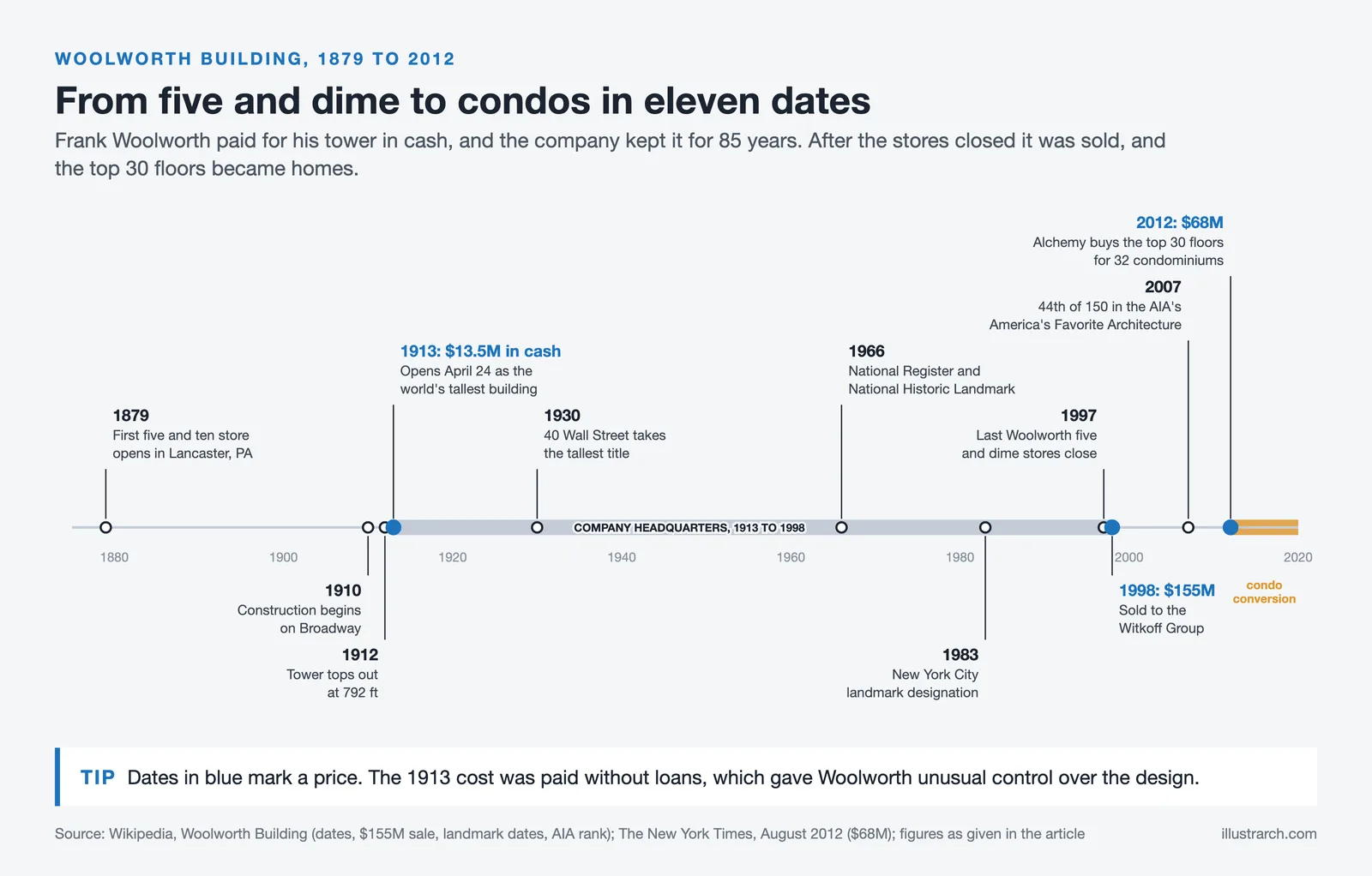
Frank Winfield Woolworth opened his first five-and-ten-cent store in Lancaster, Pennsylvania, in 1879. By 1910, he had merged his company with four competitors to form the F.W. Woolworth Company, operating hundreds of stores across the United States. Woolworth wanted a corporate headquarters that would serve as a monumental advertisement for his retail empire. He later admitted he originally “had no desire to erect a monument that would cause posterity to remember me,” yet the building’s scope grew dramatically during its planning phase.
Woolworth hired Cass Gilbert, who had trained at the Massachusetts Institute of Technology and worked at McKim, Mead and White. Gilbert had recently designed the nearby Broadway-Chambers Building and 90 West Street, both of which impressed Woolworth. The initial brief called for a modest 12- to 16-story office building, but Woolworth pushed the height to 750 feet. Gilbert eventually settled on 792 feet to achieve proper proportions.
One of the most remarkable aspects of the project: Woolworth financed the entire $13.5 million construction cost in cash, with no mortgages or developer loans. According to records cited by the Council on Tall Buildings and Urban Habitat (CTBUH), this gave Woolworth unprecedented freedom over the design and construction process.

Neo-Gothic Design: Cass Gilbert’s Architectural Vision
Woolworth admired the Palace of Westminster in London and requested a Gothic-inspired design. Gilbert drew additional inspiration from French abbeys, including Mont Saint-Michel and Saint-Ouen in Rouen. The result was a building that translated medieval Gothic vocabulary into a modern steel-frame skyscraper, with pointed arches, ribbed vaulting, gargoyles, and finials scaled large enough to be visible from street level.
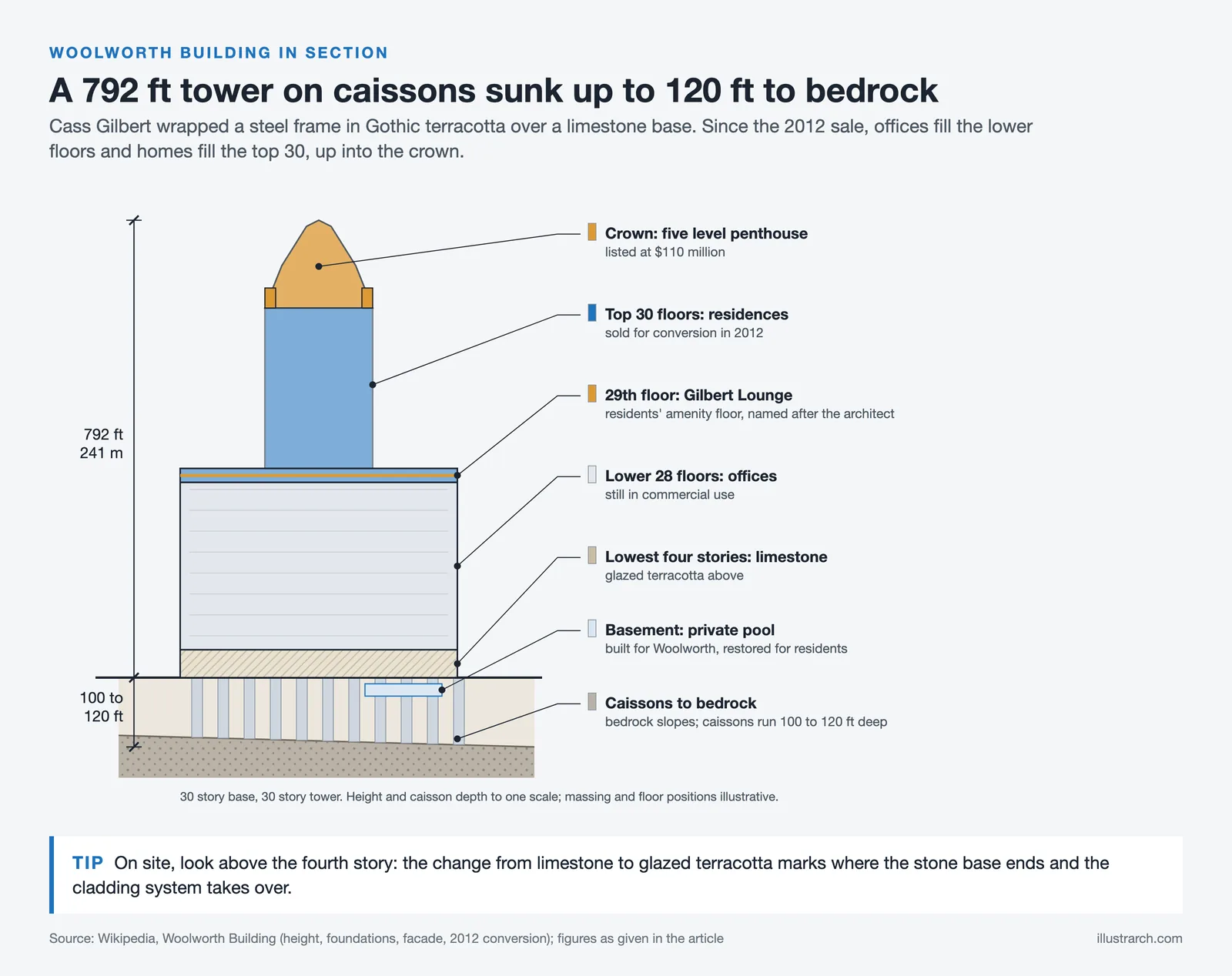
The structure consists of a 30-story base topped by a 30-story tower. Its steel frame, engineered by Gunvald Aus, required sinking 69 pneumatic caissons to bedrock approximately 100 to 120 feet below grade. The facade was clad in glazed architectural terracotta panels produced by the Atlantic Terra Cotta Company. The lowest four stories use limestone, while upper sections feature cream-colored terracotta with polychromatic accents that create subtle variation as the eye travels upward.
Terracotta was chosen over granite and limestone for the upper portions because it offered both fireproof qualities and ornamental flexibility. Each panel was individually crafted and slightly varied in hue, a detail that facade designers today still study as a masterclass in material expression.
Inside the Woolworth Building: The Famous Lobby
The ground-floor lobby remains one of the most spectacular interior spaces in New York. A two-story barrel-vaulted ceiling covered in shimmering glass mosaic tiles creates a cathedral-like atmosphere. Stained glass, marble walls, and gold-leaf decorations fill every surface. The space was described by a writer for The Baltimore Sun in 1984 as having a “church-like atmosphere” with a “touch of irreverence” provided by the sculptural grotesques.
Among the lobby’s most charming details are caricature sculptures on the ceiling beams. These include depictions of Woolworth himself counting nickels and dimes, Cass Gilbert cradling a model of the building, and other figures involved in the project. A grand staircase at the lobby’s west end originally led to the headquarters of the Irving National Bank, which co-occupied the building.
The Woolworth Building also featured remarkably advanced systems for its time. Its power station generated enough electricity to serve a town of 50,000 residents, according to the Skyscraper Museum. The building included the world’s fastest elevators at the time, with tapered shafts designed to cushion air pressure in case of a free fall. A private swimming pool in the basement, measuring 15 by 55 feet, was built for Woolworth’s personal use.

The Woolworth Building as the World’s Tallest Skyscraper
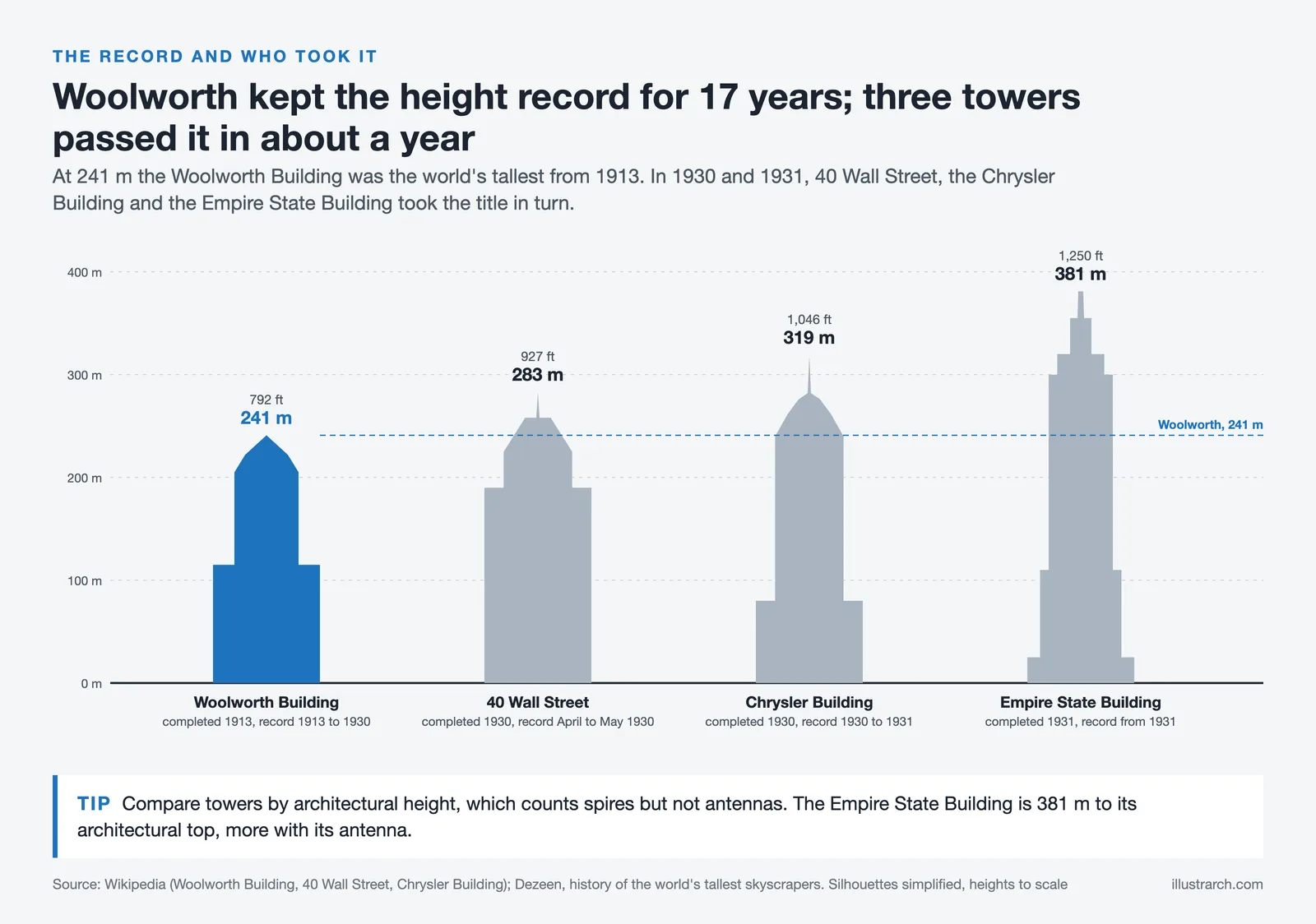
When the building opened on April 24, 1913, President Woodrow Wilson pressed a button at the White House that illuminated the entire facade with floodlights, a new innovation at the time. The Woolworth Building held the world’s tallest title from 1913 until 40 Wall Street surpassed it in 1930, followed shortly by the Chrysler Building and the Empire State Building.
Key Dimensions of the Woolworth Building
The following table summarizes the building’s essential specifications:
| Feature | Detail |
|---|---|
| Height | 792 feet (241 m) |
| Floors | 58 above ground, 3 basements |
| Architect | Cass Gilbert |
| Structural Engineer | Gunvald Aus |
| Completed | 1913 |
| Construction Cost | $13.5 million (approx. $425 million in 2024) |
| Facade Material | Glazed architectural terracotta, limestone base |
| Tallest in the World | 1913 to 1930 |
The building’s engineering set construction speed records that foreshadowed the rapid techniques of the 1930s. Its tower form, rising above a wider base, established a prototype that influenced later American skyscrapers, including many Art Deco towers of the following decades.
Woolworth Building Apartments: From Office Tower to Luxury Residences
The Woolworth Building’s story took a major turn in the 21st century. The F.W. Woolworth Company closed its last five-and-dime stores in 1997 and, renamed Venator Group, sold the building to the Witkoff Group in 1998 for $155 million. In 2012, developer Alchemy Properties purchased the top 30 floors for $68 million and began a seven-year conversion project.
French architect Thierry W. Despont led the residential design, creating 32 luxury condominium units now known as the Woolworth Tower Residences at 2 Park Place. The renovation preserved the building’s historic Gothic details while introducing modern amenities. Alchemy Properties spent approximately $22 million restoring the terracotta facade alone, recasting about 3,500 tiles using original molds found from the Atlantic Terra Cotta Company’s successor firm, as reported by Designboom.
Woolworth Building apartments feature ceiling heights of up to 22 feet, arched windows, herringbone floors, and custom Dada cabinetry with Calacatta marble countertops. Amenities include Woolworth’s restored basement swimming pool, the Gilbert Lounge on the 29th floor, a fitness center, a wine cellar and tasting room, and 24-hour concierge services. The five-story penthouse inside the copper-clad crown was originally listed at $110 million.

Landmark Status and Cultural Legacy
The Woolworth Building was added to the National Register of Historic Places on November 13, 1966, and was designated a New York City landmark in 1983. In 2007, the building ranked 44th among 150 structures in the American Institute of Architects (AIA) list of America’s Favorite Architecture.
The building’s cultural footprint extends well beyond architecture. It has appeared in films including Enchanted (2007) and Fantastic Beasts and Where to Find Them (2016), and a Woolworth Tower Residences apartment was featured in HBO’s Succession. Artists like John Marin created cubist-inspired watercolors of the building in the 1910s.
The lower 28 floors remain in commercial use, with tenants including the New York City Law Department and architecture firm ShOP Architects, which occupies the entire 11th floor.
Visiting the Woolworth Building in New York City
The Woolworth Building is located at 233 Broadway in the Tribeca neighborhood of Lower Manhattan, directly across from City Hall Park. While the ornate lobby is not regularly open to the public, guided tours are available through authorized operators and offer access to the lobby’s mosaics, sculptures, and architectural details. The building’s exterior, with its towering terracotta-clad form visible from Broadway and the surrounding streets, remains one of the most photographed structures in the city.
For architecture enthusiasts visiting New York, the Woolworth Building sits within walking distance of the Municipal Building, City Hall, and the Oculus at the World Trade Center.
Note: Woolworth Building apartments at the Woolworth Tower Residences are private residences and not accessible to the general public. Tour availability for the historic lobby may vary seasonally.


1 Comment


Futuro House Production Revived in Finland After Decades-Long Hiatus
A Facebook listing for abandoned moulds led to the first new Futuro...
 illustrarch Editoral Team3 Mins read
Building Your Dream Home in NSW: What You Should Know About Montgomery Homes
Montgomery Homes has been building across Sydney, Newcastle, the Hunter, Wollongong and...
illustrarch Editoral Team4 Mins read
Designing a Home Theater: Where Drapery Fits Into the Plan
In a media room the curtains are a performance layer, not decoration....
illustrarch Editoral Team3 Mins read
Oscar Niemeyer’s Cathedral of Brasília: The Hyperboloid Concrete Hymn
The Cathedral of Brasília reads as a single gesture, yet it stood...
 Furkan Sen7 Mins read


I loved learning about the Woolworth Building’s history! It’s amazing that Woolworth financed the entire construction in cash. It really shows his commitment to creating something monumental. The lobby sounds stunning with its glass mosaics and gold-leaf details; I can’t wait to visit and see it for myself!