

Top 10 Iconic Buildings Designed by Norman Foster
Norman Foster has shaped skylines on every continent with buildings that merge structural daring, ecological responsibility, and high-tech precision. This guide profiles 10 of his most celebrated works, covering design strategies, structural innovations, and the sustainability principles behind each project.
 Elif Ayse Sen1 March 202610 Mins read279


Table of Contents Show
Norman Foster buildings have redefined city skylines across six continents. Born in Manchester in 1935 to a working-class family, Foster studied architecture at the University of Manchester and later earned a Master’s degree at Yale University. He founded Foster + Partners in 1967, and over nearly six decades the practice has grown into one of the largest and most awarded architecture firms on the planet. Foster received the Pritzker Prize in 1999, was knighted in 1990, and was elevated to the peerage as Lord Foster of Thames Bank in the same year as his Pritzker win.
What sets Foster apart from his contemporaries is a relentless focus on three principles: structural clarity, environmental performance, and the wellbeing of building occupants. His projects consistently push conventional limits while remaining rooted in pragmatic engineering. The ten buildings by Norman Foster profiled below represent the breadth and ambition of that approach, from his career-defining Hong Kong skyscraper to the ring-shaped Apple headquarters in California.
1. HSBC Headquarters, Hong Kong (1986)
The Hongkong and Shanghai Banking Corporation headquarters was the project that turned Foster + Partners from a respected British practice into a global powerhouse. Completed in 1986, the 47-storey tower was the most expensive building in the world at the time of its construction. The brief from the bank was simple and bold: create the best bank headquarters on earth.
Foster responded with a structure that moved its core services, including elevators and staircases, to the exterior. This freed the interior for open-plan office floors bathed in natural light. Eight groups of four steel columns, arranged in two rows along the building’s edges, carry suspension trusses from which the floors hang. A system of motorized mirrors at the top of the atrium, known as a “sunscoop,” reflects daylight down through the atrium and into the public plaza below. The result is a workspace that feels surprisingly airy and connected to the outdoors, despite sitting in one of the densest urban environments in Asia.
For architects and students of high-tech architecture, the HSBC building remains a landmark case study in externalized structure, modular construction, and the integration of daylight strategies into tall buildings.
2. The Reichstag, Berlin (1999)
When Germany reunified in 1990, the government launched an international competition to renovate the Reichstag as the new home for the Bundestag. Foster + Partners won against 94 competing entries. The renovation, completed in 1999, balanced the weight of the building’s turbulent history with a forward-looking vision for democratic transparency.
The centrepiece is the glass dome that sits atop the original 1894 structure. Visitors climb a spiral ramp along the dome’s inner wall, gaining panoramic views of Berlin while looking down into the parliamentary chamber below. A cone-shaped light reflector at the dome’s centre bounces daylight into the plenary hall, reducing artificial lighting needs. An electronic sun shield tracks the sun’s movement throughout the day to limit glare and solar heat gain.
The Reichstag renovation stands as one of the most successful examples of adaptive reuse in modern architecture. Its transparent dome has become a symbol of open governance and is one of Berlin’s most visited landmarks, attracting millions of visitors annually.
3. 30 St Mary Axe (The Gherkin), London (2003)
No list of famous Norman Foster buildings is complete without 30 St Mary Axe, commonly known as The Gherkin. Completed in 2003 for Swiss Re, this 41-storey tower quickly became one of the most recognizable structures on the London skyline. The site previously held the Baltic Exchange, which was severely damaged by an IRA bomb in 1992.
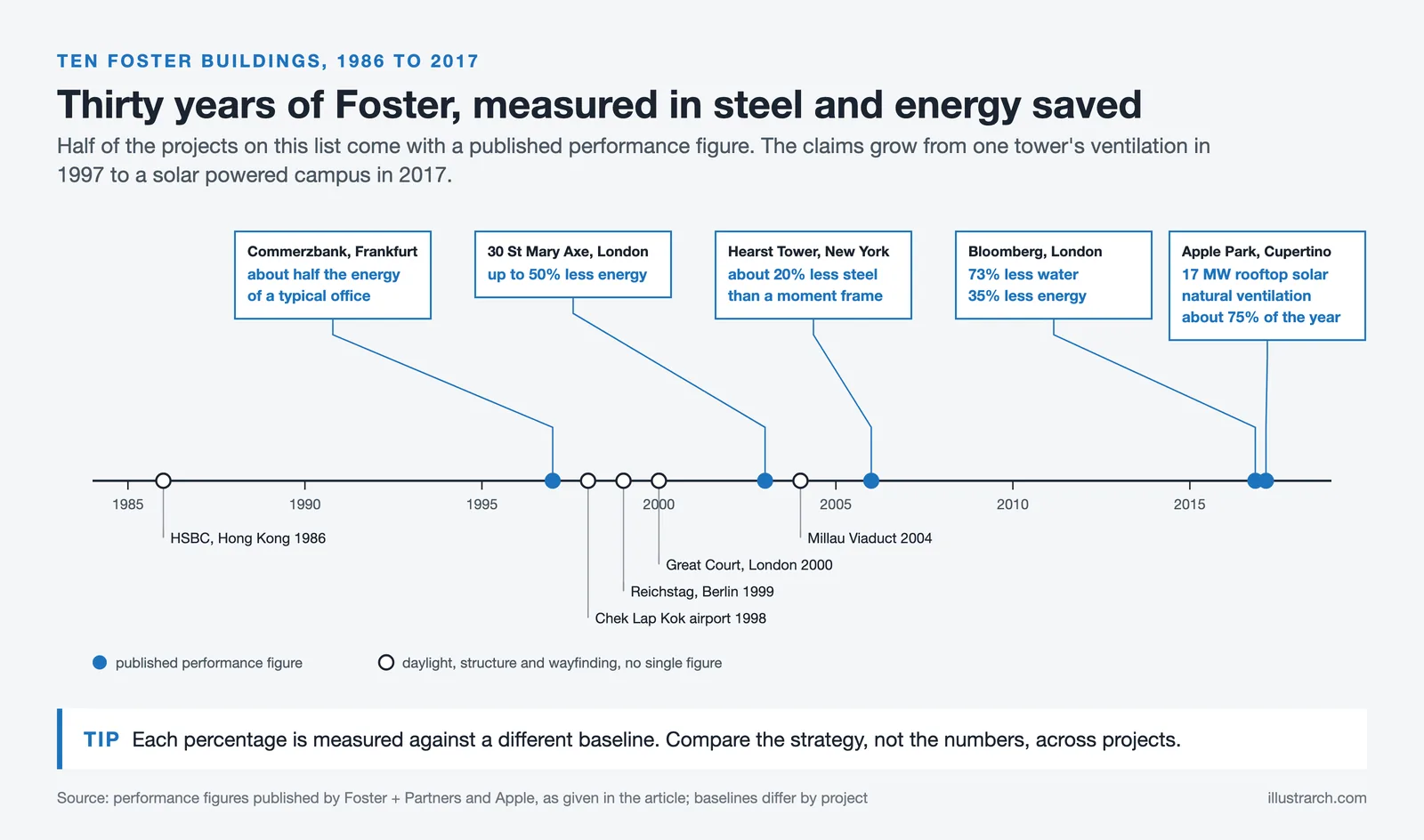
The Gherkin’s tapered, curved form was not chosen purely for visual impact. Its aerodynamic profile reduces wind loads at street level, creating a more comfortable pedestrian environment around the base. The diagrid (diagonal grid) exoskeleton distributes loads efficiently, using less steel than a conventional rectangular tower of comparable size. Between the office floors, six spiralling light wells allow natural ventilation and daylight to penetrate deep into the building’s core. According to Foster + Partners, this passive ventilation strategy helps reduce the tower’s energy consumption by up to 50 percent compared to a typical office building of similar scale.
Foster took design cues from nature when shaping the tower. The structural pattern draws from the skeletal geometry of the Venus flower basket sponge, a marine organism whose lattice structure has evolved to withstand deep-sea water currents with minimal material. This biomimetic approach is a vivid example of how studying natural systems can inform innovative structural design.
4. Millau Viaduct, Southern France (2004)
The Millau Viaduct is not a building in the traditional sense, but it is arguably the most visually stunning piece of infrastructure Foster has ever designed. Spanning the Tarn Valley in southern France, the cable-stayed bridge carries the A75 motorway and provides a direct route from Paris to the Mediterranean coast and onward to Barcelona.
At its tallest point, the viaduct’s mast reaches 343 metres above the valley floor, making it taller than the Eiffel Tower. The deck sits at approximately 270 metres above the river. Seven slender concrete piers topped by steel pylons support the roadway using a fan arrangement of stay cables, giving the bridge a remarkably light and elegant profile against the surrounding landscape. The entire deck was constructed on-site and pushed out incrementally from both ends using hydraulic rams, a method that minimized disruption to the valley below.
Millau’s mayor, Jacques Godfrain, called the finished structure a “model of art.” For Foster, the challenge was to cross the valley without overwhelming it. The result is a bridge that appears almost weightless from a distance, its thin profile disappearing into the morning mist. It remains one of the finest examples of how engineering and architectural vision can work together to produce infrastructure that enhances rather than dominates its setting.
5. The Great Court, British Museum, London (2000)
The Great Court at the British Museum is a masterclass in how a single intervention can transform an institution. Before Foster’s redesign, the two-acre courtyard at the museum’s centre had been closed to the public for over 150 years, occupied by book stacks for the British Library. When the library relocated in 1997, an opportunity emerged to reclaim this space.
Foster covered the courtyard with a tessellated glass-and-steel roof composed of 3,312 individually shaped triangular glass panels. No two panels are exactly the same, and the geometry was computed to flow smoothly between the circular Reading Room at the centre and the rectangular perimeter of the courtyard. The roof structure is supported by the existing museum walls and the drum of the Reading Room, without any columns touching the courtyard floor. The result is Europe’s largest covered public square, flooded with natural light.
The Great Court demonstrates a principle that runs through many of Foster’s iconic buildings: letting light define the character of a space. By opening up this hidden courtyard, Foster gave the 250-year-old museum a new heart and a gathering point that connects its disparate wings. It turned a logistical problem into one of London’s finest public interiors.
6. Commerzbank Tower, Frankfurt (1997)
The Commerzbank Tower in Frankfurt was the world’s first ecological office tower when it completed in 1997. Standing at 259 metres (300 metres including its antenna), it was also the tallest building in Europe at the time. For Foster, the project presented a chance to rethink the conventional sealed-box skyscraper from the ground up.
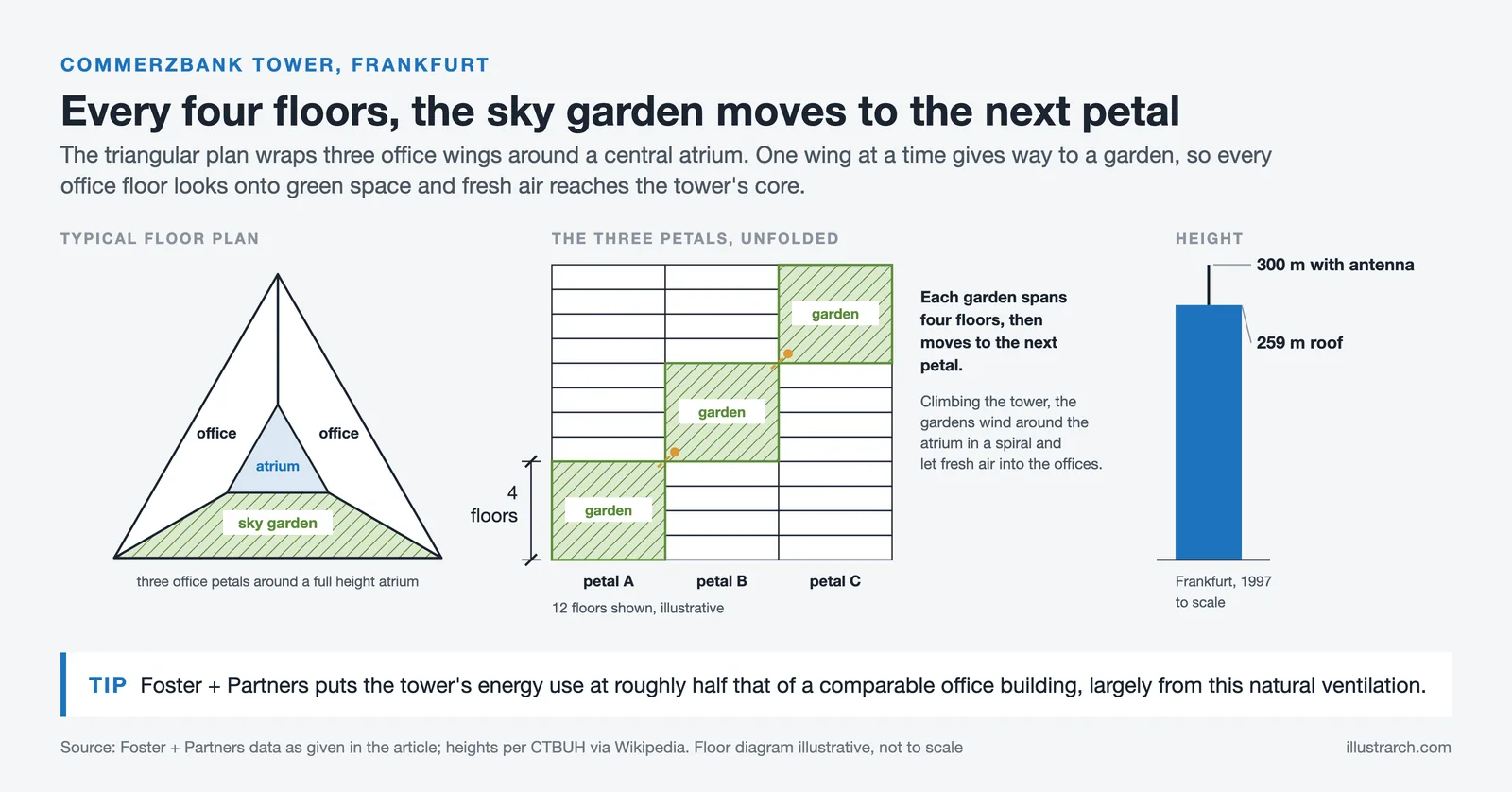
The tower uses a triangular floor plan with three “petals” of office space arranged around a central atrium that rises the full height of the building. At every fourth floor, one of the three petals is replaced by a four-storey sky garden, creating a spiral of green spaces that wrap around the atrium. These gardens serve as breakout spaces for office workers and, more critically, as sources of natural ventilation. On moderate days, the building’s operable windows allow fresh air to circulate through the offices without mechanical air conditioning.
According to data published by Foster + Partners, this passive ventilation system means the tower uses roughly half the energy of a conventional office building of comparable size. The Commerzbank Tower proved that tall buildings could be both environmentally responsible and commercially viable, a lesson that influenced skyscraper design worldwide in the decades that followed.
7. Apple Park, Cupertino, California (2017)
Apple Park is one of the most ambitious Norman Foster architect buildings of the 21st century. The project began when Steve Jobs personally contacted Foster in 2009, and the two worked closely together until Jobs’s death in 2011. Apple’s board and design team continued the collaboration, and the campus opened to employees in April 2017.
The main building, known as The Ring, is a circular structure spanning approximately 461 metres in diameter. It covers 260,000 square metres of floor space across four storeys and accommodates around 12,000 employees. The campus sits on 71 hectares of land, 80 percent of which is given over to landscaped parkland planted with roughly 9,000 trees, many of them species native to the Cupertino region.
Apple Park runs entirely on renewable energy. One of the largest on-site solar installations in the world covers the roof of The Ring, generating 17 megawatts. Natural ventilation is used for approximately 75 percent of the year, with the building’s curved glass panels sliding open to allow airflow. The level of finish and material precision mirrors Apple’s product design philosophy: panels of curved glass up to 14 metres tall, custom-milled concrete, and seamless terrazzo floors throughout.
8. Bloomberg European Headquarters, London (2017)
The Bloomberg European Headquarters, located between the Bank of England and St Paul’s Cathedral, opened in 2017 and quickly earned a reputation as the world’s most sustainable office building. It achieved the highest-ever BREEAM Outstanding score at the time of its assessment, and it won Foster + Partners the 2018 RIBA Stirling Prize, the third Stirling for the practice.
The building occupies a full city block of 3.2 acres and is clad in Derbyshire sandstone and hand-patinated Japanese bronze fins. A pedestrian walkway cuts through the site along the route of an old Roman road, restoring a lost section of Watling Street to the public realm. Beneath the building, the remains of a Roman temple are preserved and accessible to visitors.
Inside, a spiralling ramp connects the two main office volumes. The building uses 73 percent less water and 35 percent less energy than a standard UK office. Ceiling-mounted “petal” panels combine LED lighting, heating, cooling, and acoustic absorption into a single integrated unit. Fresh air enters through the bronze fins on the facade, is filtered and tempered, and rises naturally through the building’s central void. Bloomberg’s headquarters demonstrates that high performance and high design quality are not competing goals but complementary ones.
9. Hong Kong International Airport, Chek Lap Kok (1998)
Hong Kong International Airport at Chek Lap Kok is one of the most ambitious construction projects of the modern era. The island on which it sits was engineered from scratch: a mountainous terrain with a 100-metre peak was levelled to just 7 metres above sea level, and the island’s footprint was expanded to four times its original size. The airport opened in 1998 and is designed to handle up to 80 million passengers per year by 2040.
Foster’s design philosophy was to create a terminal that could be understood immediately. The Y-shaped plan organizes departures, arrivals, and transit flows intuitively across a single level, avoiding the confusing multi-level layouts common in airports built piecemeal over decades. All baggage handling and transit systems are placed below grade, freeing the terminal level for a vast, daylit concourse sheltered beneath an undulating steel roof.
The roof’s vaulted form is both structural and environmental: its curves channel natural light deep into the terminal while its overhangs shade the glass walls from direct sun. At the time of its opening, the terminal was the largest enclosed space ever constructed. For anyone interested in modern architecture at an infrastructure scale, Chek Lap Kok remains a benchmark for clarity, scale, and user-centred design.
10. Hearst Tower, New York City (2006)
The Hearst Tower on Eighth Avenue in Manhattan is a striking example of Foster’s skill at layering new architecture onto historic fabric. The original six-storey Hearst building, designed by Joseph Urban in 1928, was always intended as a base for a future tower. The Great Depression delayed those plans by nearly 80 years.
Foster’s addition rises 46 storeys above the preserved Art Deco podium. The tower’s defining feature is its diagrid structural system, a triangulated external frame that gives the building its distinctive faceted appearance. This system uses roughly 20 percent less steel than a conventional moment frame. The tower earned LEED Gold certification, becoming the first commercial office tower in New York City to achieve that rating.
Rainwater is collected from the roof and stored in a basement tank, where it supplies the building’s cooling systems and irrigates the lobby’s garden. The lobby itself is a dramatic six-storey atrium that bridges the gap between Urban’s 1928 interiors and Foster’s contemporary steel-and-glass addition. The Hearst Tower proves that adaptive reuse and bold contemporary design can coexist successfully, producing a building that respects its past while looking firmly toward the future.
Norman Foster’s Design Legacy: What Connects These Buildings?
Looking across these ten projects, several themes emerge. Foster consistently prioritizes natural light and ventilation, whether in a 47-storey bank tower in Hong Kong or a covered courtyard in central London. Structural innovation serves environmental goals: the diagrid frames of the Gherkin and Hearst Tower reduce material use, while the sky gardens of the Commerzbank Tower enable passive ventilation at altitude.
There is also a consistent interest in making buildings legible to their users. The Reichstag’s transparent dome invites citizens to look in on their parliament. Chek Lap Kok airport is designed so a first-time visitor can navigate it without signage. Apple Park’s circular plan means every corridor eventually brings you back to where you started. This focus on human experience, not just engineering performance, is what elevates Norman Foster’s best buildings from technically impressive to genuinely beloved.
Key Facts About Norman Foster’s Career
| Detail | Information |
|---|---|
| Born | June 1, 1935, Manchester, England |
| Education | University of Manchester; Yale University (Master’s) |
| Firm Founded | Foster Associates (1967), now Foster + Partners |
| Pritzker Prize | 1999 |
| RIBA Royal Gold Medal | 1983 |
| AIA Gold Medal | 1994 |
| Knighted | 1990; Life Peerage granted 1999 |
| Architectural Style | High-tech, sustainable, structurally expressive |
Foster’s influence extends far beyond his own portfolio. His early commitment to ecological performance, visible in buildings like the Willis Faber & Dumas headquarters in Ipswich (1975) and the Commerzbank Tower, helped normalize sustainable design as a mainstream expectation rather than a niche concern. The next generation of architects working on sustainable buildings owes a considerable debt to the standards his projects helped establish.
Note: Specific performance figures cited in this article (energy savings, material reductions) are based on data published by Foster + Partners and may vary depending on measurement methodology and baseline comparisons. Always verify project-specific data with the original design team for academic or professional use.



Futuro House Production Revived in Finland After Decades-Long Hiatus
A Facebook listing for abandoned moulds led to the first new Futuro...
 illustrarch Editoral Team3 Mins read
Building Your Dream Home in NSW: What You Should Know About Montgomery Homes
Montgomery Homes has been building across Sydney, Newcastle, the Hunter, Wollongong and...
illustrarch Editoral Team4 Mins read
Designing a Home Theater: Where Drapery Fits Into the Plan
In a media room the curtains are a performance layer, not decoration....
illustrarch Editoral Team3 Mins read
Oscar Niemeyer’s Cathedral of Brasília: The Hyperboloid Concrete Hymn
The Cathedral of Brasília reads as a single gesture, yet it stood...
 Furkan Sen7 Mins read


Leave a comment