

Beautiful Exteriors with Lumion 12
Exterior renderings are one of the most powerful tools for architectural representation, and Lumion 12 offers advanced features to achieve realistic results. This article highlights the key factors behind successful exterior rendering, including camera views, materials, lighting, effects, and detailing. These principles are essential for both professional architects and architecture students aiming to improve presentation quality.
 Elif Ayse Sen4 March 20268 Mins read1.1k
Table of Contents Show
Quick Answer: Beautiful exteriors in Lumion come from getting light, materials and landscaping right. Using real-sky settings, quality textures, and added trees, people and reflections turns a basic model into a realistic architectural render, even on the free version of the software.
Lumion 12 exterior rendering combines real-time visualization with advanced material, lighting, and effects tools to help architects produce photorealistic outdoor scenes. By adjusting camera angles, applying high-quality PBR textures, and building a well-structured effects stack, you can turn a basic 3D model into a polished architectural presentation in a fraction of the time traditional renderers require.
Renderings are one of the most important representation tools in architecture, and Lumion 12 made significant improvements to exterior visualization. To get realistic and high-quality exterior renders, you should pay close attention to the effect sets and features that Lumion 12 introduced. Quality rendering directly impacts how your project is perceived, both in professional practice and for architecture students building their portfolios. Below, we break down the key areas that separate average exterior renders from truly convincing ones.
How to Set Camera Views for Exterior Renders in Lumion 12

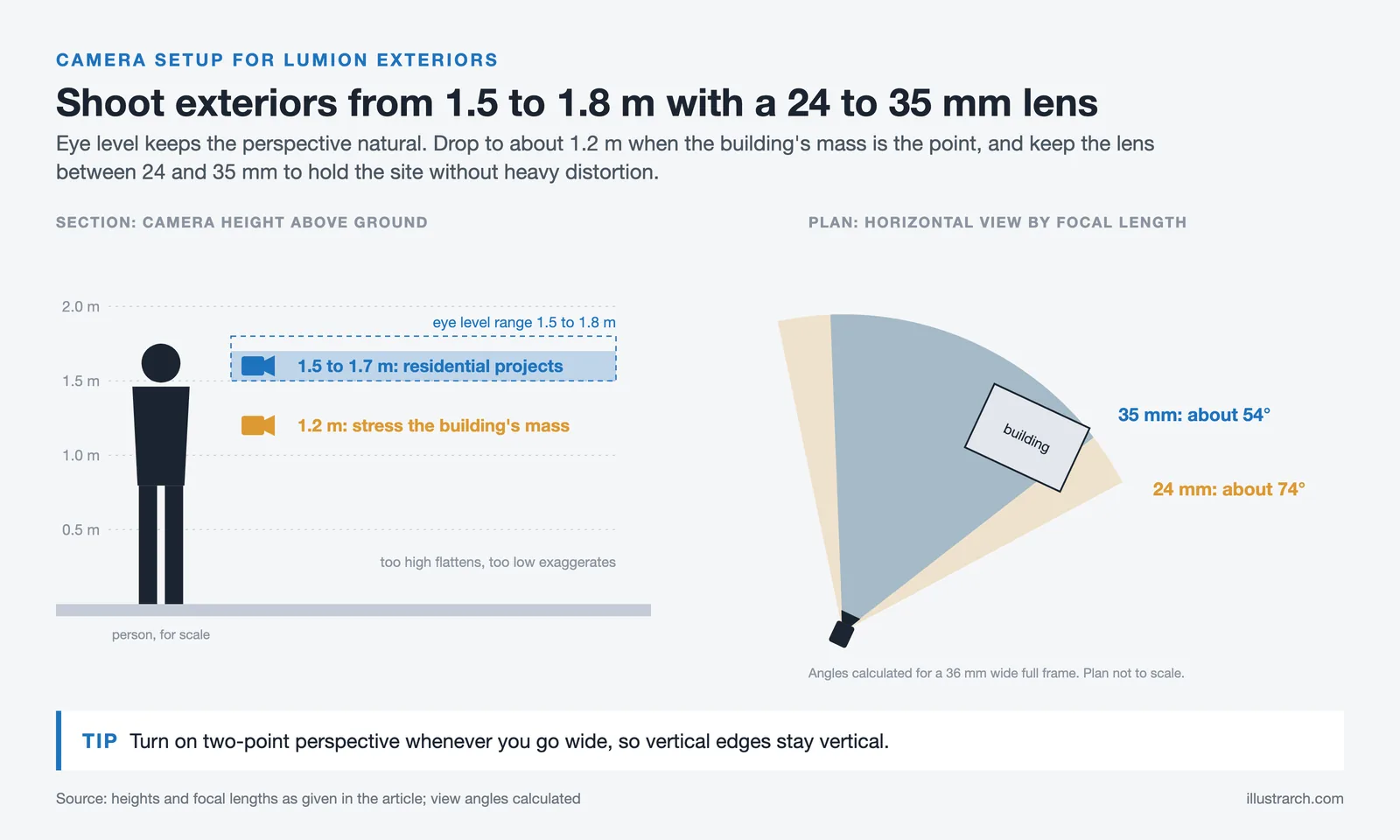
Before you hit the render button, the scene you have built in Lumion 12 needs to contain every element you want to communicate. Camera placement is the first decision that shapes the viewer’s experience. You can set the camera angle at human scale (typically 1.5 to 1.8 meters above ground) for a natural eye-level perspective, or go with an aerial viewpoint for broader site context.
A focal length between 24mm and 35mm works well for most exterior shots because it captures enough of the building and its surroundings without introducing heavy distortion. The two-point perspective effect in Lumion straightens vertical lines that tilt at wide angles, giving your renders a cleaner, more professional look. Use the grid overlay in Photo Mode to apply the rule of thirds and create balanced compositions.
💡 Pro Tip
Set your camera height between 1.5m and 1.7m for residential projects and around 1.2m for scenes where you want to emphasize building mass. Placing the camera too high flattens the perspective, while placing it too low exaggerates vertical proportions and can make a building look imposing in an unintended way.
Material Settings That Improve Render Quality
Materials affect render quality everywhere in your scene, from the ground plane to the façade of the building. Editing materials with high-resolution textures and appropriate colors is what separates a quick test render from a presentation-ready image. A render without proper material details will never represent an outdoor environment convincingly.

Lumion 12 uses a Physically Based Rendering (PBR) workflow that supports up to eight maps per surface, including albedo, normal, roughness, and displacement. Adjusting the roughness slider is one of the fastest ways to improve realism: increase it slightly beyond default values, because perfectly smooth surfaces almost never exist outdoors. Displacement maps add real depth to ground textures, stone walls, and concrete, but keep the values subtle to avoid an exaggerated, artificial appearance.
Every element in your scene needs material attention, including landscape elements, pathways, water features, and the building facade itself. Lumion 12 also introduced surface decals, which let you add surface imperfections like cracks, stains, and moss to materials without creating separate texture maps. These small details accumulate into a more convincing overall image.
⚠️ Common Mistake to Avoid
Many users import models with default materials and only adjust the building facade, leaving ground planes, fences, and landscape elements untouched. The result is a building that looks detailed floating on generic, flat surfaces. Always assign and customize materials for every visible surface in your scene before rendering.
Lighting
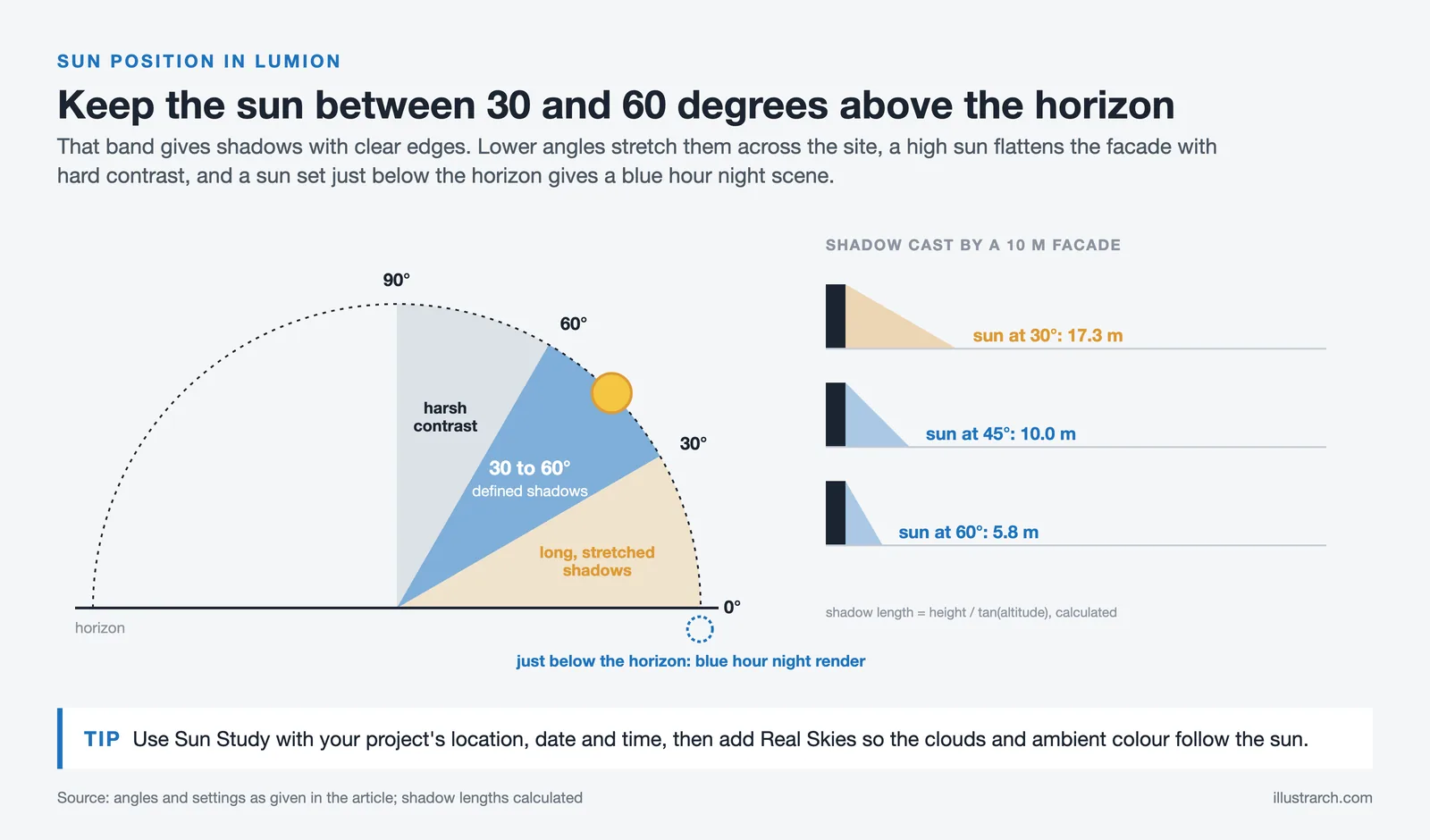
Proper lighting, especially natural sunlight, is the single most impactful factor in exterior rendering success. Good lighting reveals the texture of your materials, defines the relationship between landscape and building, and sets the overall mood of the image. Position the sun angle between 30 and 60 degrees above the horizon for the most flattering results. This range creates defined shadows without the harsh contrast of noon or the extreme stretching of sunrise and sunset angles.
Lumion 12’s Sun Study effect allows you to simulate the exact lighting conditions of your project’s location at a specific date and time. This is especially useful for projects where shadow patterns and solar exposure matter for the design, such as outdoor seating areas or south-facing facades. Combine the Sun Study with Real Skies to add realistic cloud formations and ambient color that respond to the sun position.
For more techniques on setting up outdoor visualization scenes, the Lumion exterior scene building guide covers the full workflow from camera setup through final effects.
How to Light Night Renders in Lumion
Night renders require a different approach. Set the sun position just below the horizon to preserve a faint glow on the sky, creating the “blue hour” effect that photographers value for its rich contrast between cool ambient light and warm artificial sources. Interior lights should spill convincingly through windows using area lights and omni lights. Soft, warm-toned lighting from the interior combined with exterior accent lights on walkways and landscape features will make the project atmosphere feel lived-in and inviting.
Lumion 12 introduced volumetric spotlights and a light color temperature slider for each placed light source. These tools let you fine-tune the warmth and visible light beams in your night scenes without relying on post-production editing.
💡 Pro Tip
When working on night exterior renders, start with a single strong interior light source visible through the largest window opening, then layer additional accent lights one at a time. Adding all lights at once makes it hard to judge which source is contributing what effect, and you often end up with an overexposed, flat image.
Effects
Lumion 12 comes with a range of sky effects, atmospheric tools, and post-processing options that can significantly improve the quality of your exterior renders. Building an effect stack is where you move from a technically correct image to one that tells a story.
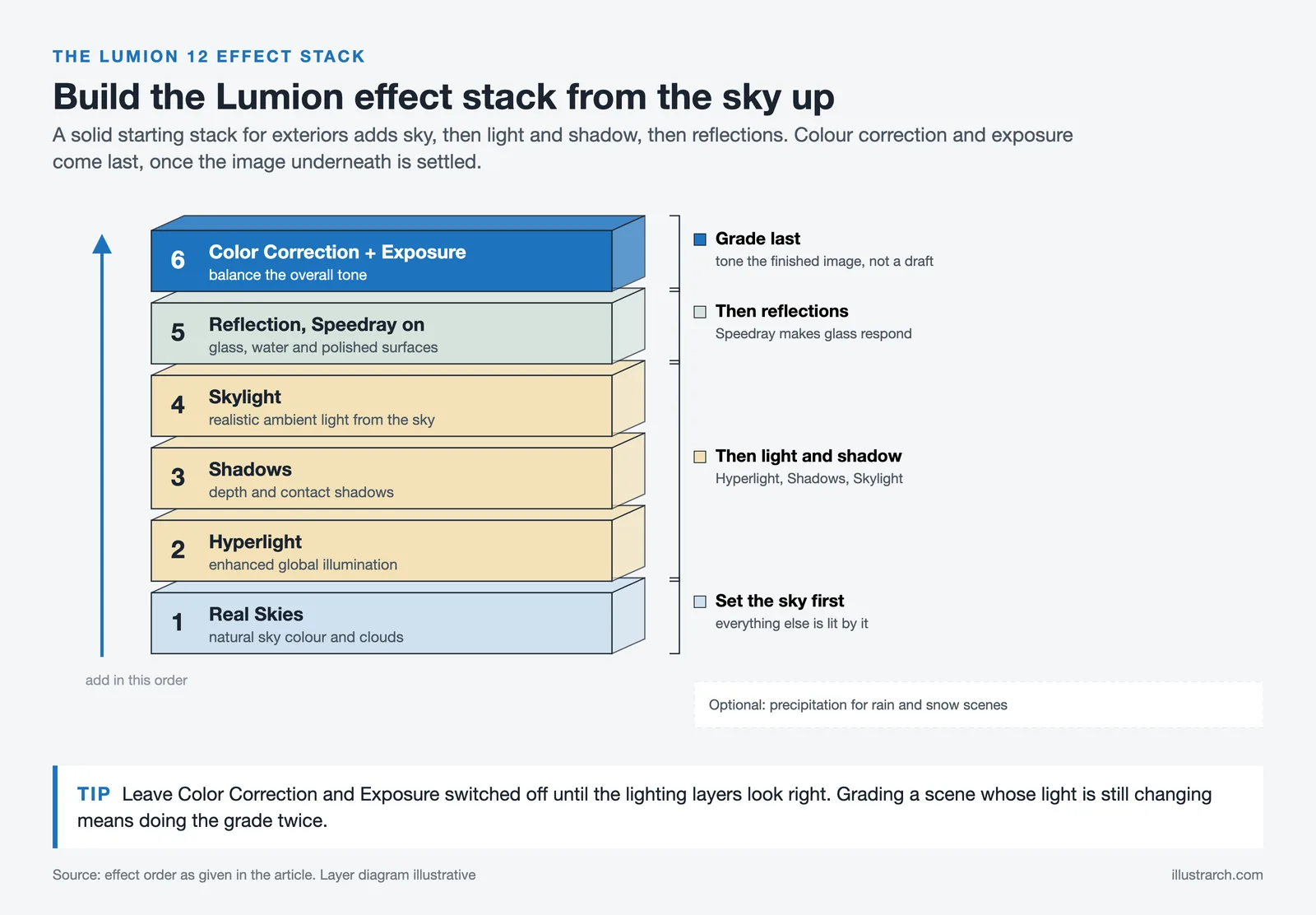

A solid starting effect stack for exterior scenes in Lumion 12 typically includes Real Skies for natural sky coloring, Hyperlight for enhanced global illumination, Shadows for depth, and the Skylight effect for realistic ambient lighting. Adding a Reflection effect with Speedray enabled will make glass, water, and polished surfaces respond more convincingly to their surroundings. Color Correction and Exposure adjustments should be applied last to balance the overall image tone.
For much more varied outdoor atmospheric conditions, Lumion also provides precipitation effects for rain and snow scenes. Check the Lumion tips and guides page for additional effect packs and community examples.
Why Do Details Matter in Exterior Rendering?
Detailed models and renders consistently outperform minimal ones because the viewer’s brain is looking for evidence that a space could actually be inhabited. People, cars, bicycles, street furniture, potted plants, and even imperfections like leaves on the ground all contribute to this sense of plausibility.

Lumion 12’s content library includes thousands of objects and 110 animated plants that add movement and life to your scenes. Work on the details of objects and materials that match the context of your project. A Mediterranean villa needs different landscape elements than a Scandinavian housing block. Use the weathering feature on surfaces and the edge tool on building corners to break up the “too clean” look that gives renders away as computer-generated.
If you are looking for more rendering techniques and software-specific guidance, you can explore the 10 essential Lumion tips for architecture students or learn about the best features of Lumion 12.5. For a broader perspective on rendering software options, the Lumion rendering software overview covers the platform’s strengths and use cases. You might also find the 5 common Lumion mistakes guide helpful for troubleshooting typical issues with texture mapping and LiveSync.
📌 Did You Know?
Lumion 12 introduced 110 animated plant species that move with simulated wind. Adding even a few animated trees or bushes near the camera position significantly increases the perceived realism of still renders, because the displacement effect creates subtle texture variation on leaves and branches that static models lack.
Lumion 12 vs. Newer Versions: What Has Changed?
Lumion 12 remains a capable platform for exterior rendering, but the software has evolved considerably since its release. Understanding what newer versions offer can help you decide whether upgrading makes sense for your workflow.
| Feature | Lumion 12 | Lumion 2025/2026 |
|---|---|---|
| Rendering Pipeline | Rasterization only | Ray tracing + rasterization |
| AI Upscaler | Not available | 2X and 4X modes (up to 16K) |
| Nature Placement | Manual and cluster | Area placement (5,000 items at once) |
| LiveSync PBR | Geometry sync only | Real-time PBR material sync |
| Cloud Integration | Not available | Lumion Cloud for review and approvals |
| Photogrammetry Assets | Limited | 73+ photogrammetry nature assets |
The core rendering principles covered in this article (camera placement, material quality, lighting, effects, and detailing) apply across all Lumion versions. If you are currently on Lumion 12 and producing professional work, the techniques above will still serve you well. For those considering an upgrade, the Lumion Pro 2025 overview covers the key differences in more depth. You can also explore how AI rendering tools are changing the visualization workflow alongside traditional engines like Lumion.
Recommended Workflow for Exterior Rendering in Lumion
Following a consistent workflow saves time and reduces the chance of missing important steps. The table below outlines a practical order of operations that applies to Lumion 12 and newer versions.
| Step | Task | Key Action |
|---|---|---|
| 1 | Import and check model | Verify scale, fix UV mapping issues |
| 2 | Place camera | Set height (1.5-1.8m), focal length (24-35mm) |
| 3 | Assign materials | Apply PBR maps, adjust roughness, add displacement |
| 4 | Build landscape | Add vegetation, terrain, water, hardscape |
| 5 | Set lighting | Sun angle (30-60°), Real Skies, interior lights |
| 6 | Add entourage | People, vehicles, furniture, animated plants |
| 7 | Build effect stack | Real Skies, Hyperlight, Shadows, Reflections, Color Correction |
| 8 | Final render | Render at target resolution, review, adjust |
✅ Key Takeaways
- Set camera height at eye level (1.5-1.8m) and use a 24-35mm focal length for balanced exterior compositions
- Customize PBR materials on every visible surface, not just the building facade, and use surface decals for weathering
- Position sun angles between 30-60 degrees for natural shadow definition, and use Real Skies for atmospheric depth
- Build your effect stack in layers: start with Real Skies, Hyperlight and Shadows, then add Reflections and Color Correction
- Populate scenes with contextual entourage elements (people, vehicles, animated plants) to create a sense of habitation
- Night renders require layered artificial lighting; start with one interior source and build outward
Final Thoughts
Lumion 12 exterior rendering is about getting five core areas right: camera placement, material quality, lighting, effects, and environmental detail. Each of these areas reinforces the others. Strong materials look flat without proper lighting, and great lighting loses its impact without scene details that give the viewer’s eye something to explore. The techniques in this guide apply whether you are preparing a client presentation, building a portfolio, or entering a design competition.
For those looking to go deeper into 3D rendering for architectural design, studying real-world reference photographs and analyzing how light behaves at different times of day will improve your renders faster than any single software trick.
FAQ
What are the best camera settings for Lumion 12 exterior rendering?
For most exterior renders, set camera height between 1.5 and 1.8 meters and use a focal length of 24 to 35mm. Enable two-point perspective to straighten vertical lines, and use the rule of thirds grid in Photo Mode to create balanced compositions.
How do I improve material quality in Lumion 12?
Use the PBR material editor to apply roughness, normal, and displacement maps to all visible surfaces. Increase roughness slightly above default values for outdoor materials. Add surface decals for imperfections like cracks and stains to break up overly clean surfaces.
What effect stack should I use for exterior renders?
Start with Real Skies for natural sky coloring, then add Hyperlight, Shadows, and Skylight as your base. Layer in Reflection with Speedray for glass and water surfaces. Apply Color Correction and Exposure adjustments last to balance the overall image.
Is Lumion 12 still good for professional rendering in 2026?
Lumion 12 remains capable for professional exterior rendering. The rendering principles (camera, materials, lighting, effects, details) are the same across all versions. Newer versions like Lumion Pro 2026 add ray tracing, AI upscaling to 16K, and expanded asset libraries, but the fundamentals covered here still apply.
Frequently Asked Questions
Use real-sky and good lighting settings, quality materials, and add landscaping, people and reflections for realism.
Lumion offers a free trial and a limited free version, while full features require a paid licence.
Lumion is used for fast, realistic 3D rendering and animation of architectural models.
Last updated:




Python or Grasshopper: Which Should Architecture Students Learn First?
Grasshopper teaches parametric logic through visual feedback, while Python handles data, repetition,...
 Sinan Ozen6 Mins read
Notion Alternatives for Architects: 7 Tools That Fit Studio Work
Notion works until a studio needs fee tracking, phase budgets and timesheets....
 Furkan Sen7 Mins read

Why Every Practice Ends Up With Five Versions of the Same Revit Family
Let’s learn why Revit family libraries accumulate duplicates, break schedules and slow...
 illustrarch Editoral Team5 Mins read
Visualizing Renovation Projects From Photographs: A Workflow for Existing-Building Work
Photo-based visualization turns a photograph of a building that already exists into...
illustrarch Editoral Team7 Mins read


Leave a comment