

Coachella 2026 Installations: Architecture, Light, and Desert Art at the Empire Polo Club
The 25th edition of the Coachella Valley Music and Arts Festival features an ambitious art program curated by Public Art Company. Four new commissions by Sabine Marcelis, Kyriakos Chatziparaskevas, The LADG, and Are You Mad join six permanent desert installations, exploring how architecture, material, and light shape festival experiences across the California desert.
 Elif Ayse Sen18 April 202611 Mins read264




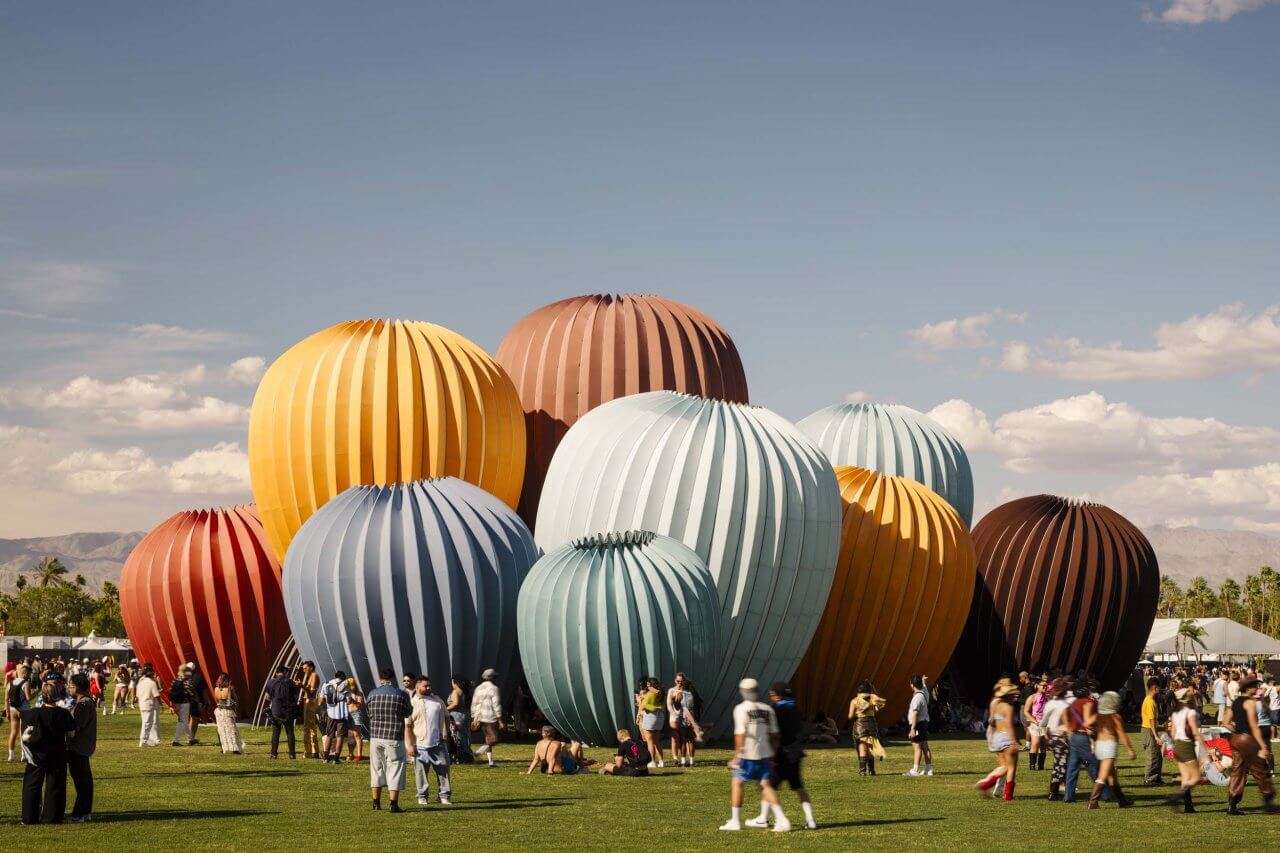
Table of Contents Show
Coachella 2026 features four new large-scale art installations at the Empire Polo Club in Indio, California, designed by Sabine Marcelis, Kyriakos Chatziparaskevas, The Los Angeles Design Group (LADG), and Are You Mad. Curated by Public Art Company (PAC), the works respond to the desert’s shifting light and open terrain, creating immersive spaces that function as both architecture and art.
The 25th edition of the Coachella Valley Music and Arts Festival returned to the California desert on April 10-12 and April 17-19, 2026, drawing over 100,000 visitors across two weekends. While headline acts filled the stages, the festival’s art program operated at a different register entirely. Curated by Raffi Lehrer of Public Art Company (PAC) and Goldenvoice Art Director Paul Clemente, the Coachella 2026 installations treated the Empire Polo Field not as a gallery but as a landscape to be inhabited. Each piece was conceived as an architectural intervention: a structure you could walk through, sit under, or look up inside.
This year’s curatorial theme centered on generosity. Lehrer described the intent as designing for the body as much as the eye. Every commission offered shade, framed views of the sky, or created micro-environments where festivalgoers could step away from the sonic intensity of the main stages. Three new temporary works and one returning installation joined six permanent pieces already embedded across the Coachella Valley, making the art program one of the most spatially ambitious in the festival’s history.
Maze by Sabine Marcelis: An Inflatable Desert Mirage
Rotterdam-based designer Sabine Marcelis headlined the Coachella 2026 art program with Maze, a sprawling landscape of soft, inflated PVC arcs. The curving forms varied in height and were inspired by the natural contours of the Coachella Valley mountain range. Their colors shifted from pale yellow at the edges to a deep, pulsing red at the center, creating a gradient terrain that visitors could enter, wander through, and rest inside.
By day, Maze filtered both sound and sunlight. Its inflated walls absorbed bass frequencies from nearby stages while casting wide bands of shade across the ground. Marcelis, who is known for her work with light and material transparency, described the piece as an environment that evolves with the day. Nooks and clearings alternated throughout the structure, offering both solitude and social spaces. At night, the installation took on a second life. Internal lighting turned each inflated arc into a glowing volume, and the entire maze became a warm, radiant landscape against the black desert sky.
💡 Pro Tip
When designing inflatable structures for outdoor festivals, PVC wall thickness and internal air pressure must be calibrated for the specific wind conditions of the site. In the Coachella Valley, where gusts can exceed 30 mph, designers typically specify reinforced seams and continuous blower systems rather than sealed chambers, as puncture from wind-driven debris is a constant risk.
What set Maze apart from typical festival backdrops was its spatial logic. Rather than creating an object to photograph from the outside, Marcelis designed a space you had to move through to understand. The gradient color scheme only became apparent once you were deep inside the structure, where the warm amber thickened into a bodily red. This kind of atmospheric design, where the sensory experience itself becomes the function, is a hallmark of Marcelis’s broader practice in product and spatial design.
Starry Eyes by Kyriakos Chatziparaskevas: Cactus Geometry Scaled to 40 Feet
London-based architect Kyriakos Chatziparaskevas presented Starry Eyes, a cluster of towering pleated forms that drew their geometry from the golden barrel cactus. This squat, ribbed succulent grows across the Coachella Valley floor by the thousands, and Chatziparaskevas scaled it up to nearly 40 feet using steel ribs wrapped in brightly colored translucent fabric. The structures tilted and leaned like cactuses seeking the sun, and their arrangement across the polo field created an architectural landscape visitors could walk between, sit beneath, and look up through.
Each structure had a star-shaped oculus at its crown that framed a precise disc of sky. Chatziparaskevas cited John Lautner’s Bob Hope House in nearby Palm Springs as a reference. That building’s central dome opening creates a similar relationship between interior space and the desert sky above. Inside the Starry Eyes forms, colored ribs arched overhead, saturating the enclosed space with shifting tones of terra-cotta, mustard, and seafoam green. Light and shadow played across the ground in rhythmic patterns determined by the rib spacing and fabric translucency.
🎓 Expert Insight
“It can’t just be an alien object. It must belong to the place, and to the joy of the people beneath it.” — Kyriakos Chatziparaskevas, Architect, AR-K-C
This approach captures what separates strong site-specific installation design from purely sculptural work. The best festival architecture draws from the local environment, whether in material, form, or climate response, and produces spaces that feel grounded rather than imposed.
By dusk, the Starry Eyes structures shifted into lanterns. Their translucent fabric skins glowed from within, revealing the ribbed skeleton beneath, and the entire cluster pulsed with quiet, warm light against the twilight sky. The day-to-night transformation demonstrated a principle that runs through much of the Coachella art program: each installation must work twice, once in the harsh desert daylight and again under artificial illumination after sunset.
Visage Brut by The LADG: A Brutalist Totem in the Desert
The Los Angeles Design Group (The LADG), led by Andrew Holder and Claus Benjamin Freyinger, contributed Visage Brut, a soaring steel totem assembled from modular boxes. Each box was folded, rolled, cut, or torqued to the point where a standard industrial form began to suggest something figurative. Portholes became eyes. A cantilevered panel jutted out like a jaw. The architects referred to each module as an anthropomorphic “character,” and the stacked procession read as a vertical lineup of hybrid geometries, part structural member, part face.
The piece was born from a collaboration with software-assisted steel fabricator Stud-IO Construction. The material itself, a type of steel commonly used in retail construction, was pushed into expressive territory through computational design and precise fabrication. Translucent burgundy and orange skins were applied selectively across certain modules, catching the sun and throwing colored light through the interior like stained glass in an industrial chapel.
As dusk settled over the valley, Visage Brut’s mesh and metal surfaces shifted from sculptural mass to a filigreed lattice. Interior illumination animated each character, and the tower glowed green against the darkening sky. Holder, who chairs Graduate Architecture, Landscape, and Urban Design at Pratt Institute, and Freyinger, who lectures at UCLA’s graduate architecture program, described the piece as a continuation of LADG’s investigations into urban form and historical ideas about the tower as architectural landmark.
⚠️ Common Mistake to Avoid
Many festival organizers treat art installations as decorative afterthoughts placed between stages for visual interest. The Coachella art program takes the opposite approach: installations are designed at architectural scale, with structural engineering, material testing, and climate analysis comparable to a permanent building project. Treating a 40-foot steel tower as “festival decor” rather than a real construction project is how structural failures happen.
Desert Drifters Kite Club and Network Operations: Sky and Satire
Two additional commissions rounded out the 2026 Coachella installations program. Desert Drifters Kite Club, a collaboration between London- and Los Angeles-based collective Are You Mad (James Suckling and Nadeem Daniel) and French kite artist Jeanne Harignordoquy (SPF50), filled the sky above the polo field with eight oversized kites. Each kite was a “character” with bold, graphic faces designed to read from 60 meters in the air, with names like I See You and North Star. Their 30-foot tails spiraled and flickered against the desert mountains.
The kites’ patchworked skins were stitched entirely from deadstock textiles: ripstop nylon, Gore-Tex offcuts, and repurposed rain jackets. This material choice aligned with a broader sustainability agenda within the Coachella art program. Several pieces across the program’s history have been designed with defined afterlives. Following past editions, modular components have been repurposed or permanently relocated to public parks within the Coachella Valley.
Dedo Vabo’s Network Operations returned as the latest chapter in the collective’s long-running Hippo Empire series, which has appeared at Coachella since 2013. This three-story “command center” bristled with satellite dishes and red-painted radio towers, its glass-fronted rooms staffed by costumed hippo performers. The installation blended sculpture with absurdist theater, functioning as a satirical mirror held up to content-driven culture.
What Is the Coachella Art Program and How Are Installations Selected?
The Coachella art program is managed by Public Art Company (PAC), founded by curator Raffi Lehrer. PAC has operated at architectural scale for about a decade, consistently selecting architects and designers alongside visual artists. The selection process involves global scouting for creators whose work can function at festival scale, meaning structures large enough to serve as landmarks across the 78-acre Empire Polo Field while also creating intimate spatial experiences at close range.
The curatorial brief for Coachella 2026 centered on luminance, transparency, and lightness of form. Lehrer and Clemente sought works that could mediate between the harsh California sun during the day and the festival’s electric atmosphere at night. Every commission had to provide functional value: shade, shelter, or framed views. This requirement pushed the installations firmly into the territory of pavilion architecture rather than static sculpture.
💡 Pro Tip
If you’re designing for a desert festival context, plan for two entirely different lighting conditions. The Coachella Valley receives over 300 days of direct sunlight per year, and daytime surface temperatures on dark materials can exceed 70°C. Materials that read well at night under LED illumination (translucent fabrics, mesh panels) may bleach out or overheat during the day without proper UV-resistant coatings.
SPECTRA by Newsubstance: The Permanent Beacon
Among the returning works, SPECTRA stands as the Coachella art program’s most recognizable icon. Designed by UK-based studio Newsubstance and first installed in 2018, this spiraling tower of translucent panels has become a permanent fixture on the festival grounds. Visitors ascend an air-conditioned walkway inside the structure, and each turn reveals a new palette shaped by the desert light: burning reds at dawn, vivid greens at midday, deep blues and violets at dusk.
Patrick O’Mahony, Newsubstance’s founder, has noted that repeat visitors consistently describe SPECTRA as something that changes their perspective on the festival itself. At night, thousands of LEDs animate the tower, producing millions of colors that ripple across its surfaces. The structure bridges analog design and advanced lighting control, mirroring the shifting Coachella sky while generating its own luminous world. Its 360-degree observation deck at the top offers panoramic views across the flat desert terrain, making it both a wayfinding landmark and an architectural experience.
📌 Did You Know?
SPECTRA has transcended its physical presence at Coachella. The installation has been digitally recreated in partnerships with Meta, Fortnite, Minecraft, and even appeared in the Family Guy animated series. It also featured prominently in Coachella’s official documentary, making it one of the rare festival art pieces to achieve cultural recognition beyond the event itself.
Six Permanent Installations Across the Coachella Valley
Beyond the festival grounds, six permanent art installations remain embedded in the broader Coachella Valley landscape. These works were originally commissioned as temporary festival pieces but have since been relocated to public parks and streetscapes in and around Indio, California. They represent an unusual model in which festival art finds a lasting civic role.
Sarbalé Ke by Francis Kéré (Dr. Carreon Park, Indio, installed 2021) is the most architecturally significant of the permanent pieces. Designed by the Pritzker Prize-winning architect from Burkina Faso, the installation features 12 baobab-inspired towers constructed from steel frames and colorful triangular wooden panels. The three tallest towers form a central gathering space, and their radial openings allow breezes to flow through while filtering daylight. Kéré, who founded Kéré Architecture in Berlin, drew on building traditions from his hometown of Gando, where the baobab tree serves as a communal landmark. After its Coachella debut in 2019, Sarbalé Ke was moved to its current location where it functions as a public gathering pavilion.
Etherea by Edoardo Tresoldi (Cesar Chavez and Sixth Streets, Coachella, installed 2018) consists of transparent wire mesh structures inspired by neoclassical and baroque architecture. The 54-foot sculpture creates an ethereal, ghost-like presence that shifts depending on the viewer’s angle and the quality of light. The remaining permanent works include Colossal Cacti by Office Kovacs (Andrew Kovacs, installed 2022 in Indio), The Messengers by Kumkum Fernando, Monarchs: A House in Three Parts by studio HANNAH, and Mutts by Oana Stănescu.
🏗️ Real-World Example
Sarbalé Ke by Francis Kéré (Indio, 2019/2021): Originally a temporary Coachella commission, this 12-tower installation was relocated to Dr. Carreon Park in East Coachella Valley, where it now serves as a permanent public gathering space. The project demonstrates a viable model for festival-to-civic transition, where large-scale temporary commissions can be designed from the start with materials and connections that allow future relocation and long-term public use.
How Architecture Shapes the Festival Experience at Coachella
The Coachella installations program stands apart from most festival art in its deliberate use of architectural thinking. The pieces are not objects placed on a field. They are spaces designed to be entered, inhabited, and moved through. This distinction matters because the Empire Polo Field is vast, flat, and offers almost no natural shelter. Without the installations, the festival landscape would be a featureless plain of grass, stages, and tents. The art program creates topography where none exists.
Each installation serves a dual function. By day, they provide shade and rest. The inflated walls of Maze, the fabric canopy of Starry Eyes, and the observation deck of SPECTRA all offer physical relief from the desert heat. By night, they become luminous landmarks that help over 100,000 people orient themselves across the sprawling grounds. This functional dimension is what pushes the Coachella pavilions into genuine architectural territory. They must perform structurally, thermally, and spatially, not just visually.
The curatorial approach also mirrors the music festival’s genre-fluid spirit. Lehrer and Clemente pair sculptors with architects, digital artists with experimental designers, and satirical performers with industrial fabricators. The result is a program where an inflatable PVC maze sits alongside a brutalist steel totem, and oversized kites stitched from deadstock textiles share the sky with a 40-foot cactus made of pleated fabric. This range of material, scale, and intent creates a rich spatial experience that rewards exploration, something closer to an open-air architectural exhibition than a traditional festival decoration scheme.
Comparison of Coachella 2026 Installations
The following table summarizes the key characteristics of the four new Coachella 2026 commissions:
| Installation | Designer | Material | Day Function | Night Effect |
|---|---|---|---|---|
| Maze | Sabine Marcelis | Inflated PVC | Shade, sound filtering | Glowing gradient landscape |
| Starry Eyes | Kyriakos Chatziparaskevas | Steel ribs, translucent fabric | Shade, sky-framing oculus | Lantern field |
| Visage Brut | The LADG | Modular steel, mesh | Shaded niches, visual landmark | Green-glowing filigreed tower |
| Desert Drifters Kite Club | Are You Mad + SPF50 | Deadstock textiles, ripstop | Kinetic sky sculpture | LED-lit aerial constellation |
Where Is Coachella 2026 and When Does It Take Place?
The Coachella Valley Music and Arts Festival takes place at the Empire Polo Club in Indio, California, located approximately 130 miles east of Los Angeles in the Coachella Valley. The 2026 edition, the festival’s 25th, ran over two weekends: April 10-12 and April 17-19, 2026. The festival was co-founded by Paul Tollett and Rick Van Santen in 1999 and is organized by Goldenvoice, a subsidiary of AEG Presents. The 2026 Coachella music festival sold out within a week of its lineup announcement.
The Coachella 2026 location offers a specific environmental context that shapes every aspect of the art program. The valley sits below sea level, surrounded by the San Jacinto and Little San Bernardino mountain ranges. Daytime temperatures during the April festival dates regularly exceed 35°C (95°F), and the flat, open terrain of the polo field provides virtually no natural shade. These conditions make climate-responsive design a necessity rather than an option for any Coachella installation.
The desert architecture challenges of the Coachella Valley have made the festival a testing ground for material innovation. PVC inflatables, translucent membranes, mesh steel panels, and fabric-wrapped steel ribs have all been deployed in recent editions specifically because they perform well under intense solar radiation while remaining lightweight enough for rapid assembly and disassembly between weekends.
✅ Key Takeaways
- Coachella 2026 features four new large-scale installations curated by Public Art Company, including works by Sabine Marcelis, Kyriakos Chatziparaskevas, The LADG, and Are You Mad.
- Every installation serves a dual function: providing shade, shelter, or sky-framing by day and becoming a luminous landmark by night.
- The curatorial theme of generosity emphasizes installations designed to be entered and inhabited, not just viewed from a distance.
- Six permanent installations, including Francis Kéré’s Sarbalé Ke and Edoardo Tresoldi’s Etherea, demonstrate how temporary festival commissions can transition into lasting public architecture.
- The Coachella Valley’s extreme desert conditions have made the festival a testing ground for innovative materials including inflatable PVC, translucent membranes, and fabric-wrapped steel.
Final Thoughts
The Coachella 2026 installations illustrate a broader shift in how festivals approach art and architecture. Rather than treating visual art as a backdrop to music, the Coachella fest 2026 program positions installations as primary spatial experiences. Sabine Marcelis’s Maze, Kyriakos Chatziparaskevas’s Starry Eyes, and The LADG’s Visage Brut each demonstrate that temporary structures can carry the same architectural ambition as permanent buildings. They respond to site, climate, and human behavior with the precision of a well-designed pavilion commission.
The festival’s model of transitioning temporary works into permanent public art, as seen with Sarbalé Ke and Etherea, also offers a replicable framework for cities looking to build public art infrastructure through cultural events. The Coachella installations prove that architecture built for a weekend can, with the right design intent, serve a community for decades.



Groupwork Completes 10-Storey Loadbearing Granite Flats in London
Groupwork's Petra Heights on Finchley Road is a 10-storey block of 22...
 illustrarch Editoral Team2 Mins read
Ai Weiwei Installs 500 Cast-Iron Helmets Outside Sydney Museum
Ai Weiwei's 500 cast-iron helmets opened outside Sydney's MCA on 25 September,...
illustrarch Editoral Team2 Mins read
Isamu Noguchi at Lever House Traces Sculptor’s Decades-Long Collaboration with Bunshaft
Lever House's new exhibition pairs Noguchi sculptures with unbuilt garden designs made...
illustrarch Editoral Team2 Mins read
Relocated Maya Structures at Mexico’s Balam Tun Memory Park Face Legal Challenge
INAH archaeologists have filed a complaint against 26 officials over Balam Tun...
illustrarch Editoral Team2 Mins read


Leave a comment