

Floating Architecture: How Floating Buildings Save Cities
Explore how floating architecture is transforming urban resilience worldwide. From floating buildings in Lagos to hovering architecture in the Maldives, discover construction methods, real-world examples, and why architecture on the water is the future of climate adaptation.
 Elif Ayse Sen22 January 20238 Mins read634
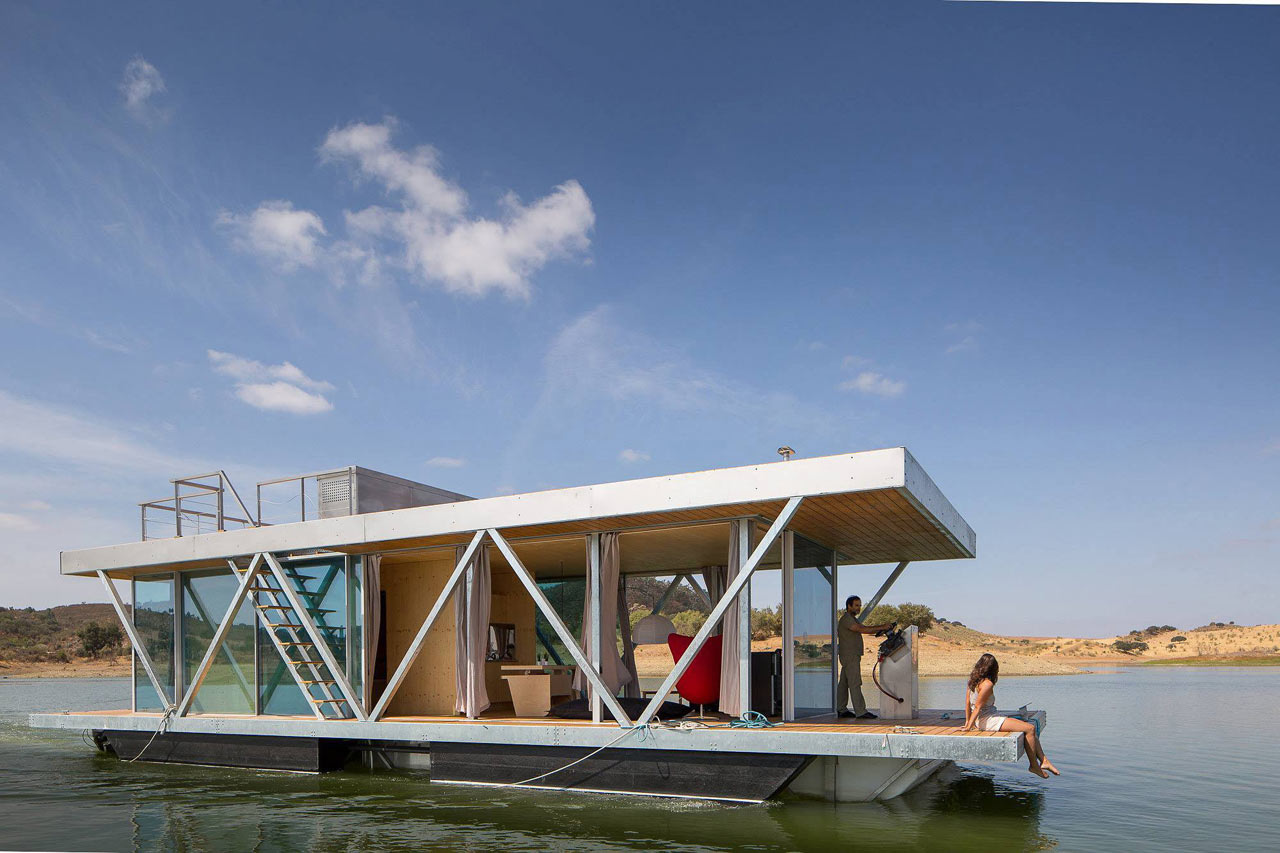
Table of Contents Show
Quick answer: Floating architecture is the design of buildings and structures that rest on water rather than land, supported by buoyant platforms or pontoons. It answers rising sea levels and land shortages, letting communities adapt to flooding while making use of rivers, lakes, and coastlines.
How Floating Architecture Could Help Save Cities from Rising Seas
Climate warming raises an important issue: how can our cities adapt with increasing sea levels? Floating architecture is emerging as one of the most innovative solutions, and architects worldwide have created a broad range of concepts to demonstrate this: from basic prefab dwellings to completely amphibious towns. As global sea levels continue to rise, these floating structures offer a way to live with water rather than against it. In 2025, this form of architecture on the water has moved from experimental concept to a viable urban planning strategy, with several landmark floating buildings now completed or under construction worldwide.
Lagos, Nigeria, has a higher danger of flooding than most other cities. Kunlé Adeyemi, a pioneering float architect, has created a variety of floating buildings, including a school and a radio station, to address the issues posed by increasing tides. Given the consequences of climate change, we might begin to think about the possibility of living with water rather than battling it. Adeyemi’s work is one of the most cited examples of hovering architecture, designs that appear to defy gravity by sitting above or on water surfaces.

Floating School in Lagos
Some of the architects regard floating buildings as a means of facilitating travel. A team from the University of Coimbra in Portugal has developed a prefabricated floating house that can be sent anywhere in the globe, allowing its residents to live on some of the world’s most isolated rivers and lakes. This kind of modular, transportable architecture on the water represents a growing trend in climate-adaptive design.
What Is Floating Architecture?
Floating architecture is a building system that sits on water and offers contextual space for humans utilizing a special structural system. What is floating architecture in practical terms? It is a design approach that responds to the rising depletion of available land and aims to reduce deforestation by moving construction onto water. Floating architecture also allows for the application of natant knowledge to guarantee that structures float securely. The buoyant force of water is a fundamental element of floating architecture.
This concept has been developed with global warming in mind. When the weight force on an object is balanced by the upward push of water on the object, the thing floats. The upward push of the water rises with the volume of the item submerged in water; it is unaffected by water depth or volume. According to the Intergovernmental Panel on Climate Change (IPCC), sea levels could rise by up to 1.1 meters by 2100, making floating structures an increasingly critical adaptation strategy.
Floating Structures vs. Amphibious Buildings
Understanding the difference between floating structures and amphibious buildings is essential for anyone exploring architecture on the water. True floating buildings are permanently situated on water, supported by pontoons or buoyant foundations. Amphibious buildings, on the other hand, are elevated above the water and engineered to float only when water levels rise.
Amphibious buildings are often supported by concrete foundations and connected to flexible mooring poles. They may travel upwards and float if the water level rises. The mooring post fastenings minimize the motion generated by the water. Both types represent innovative approaches to disaster-resilient architecture in an era of climate uncertainty.
Hovering Architecture: When Buildings Defy Gravity Over Water
A closely related concept is hovering architecture, structures that appear to float or hover above the water’s surface without being fully submerged. Unlike traditional floating buildings that rest directly on water, hovering designs use elevated platforms, stilts, or cantilevered structures to create the illusion of weightlessness. This design philosophy merges aesthetics with function, providing flood protection while creating visually striking forms.
Notable examples of hovering architecture include the cantilevered homes along Scandinavian fjords and pier-based cultural centers in Southeast Asia. These structures are particularly effective in tidal zones where water levels fluctuate dramatically, offering an alternative to fully buoyant floating buildings for regions where permanent water placement is not practical.
How To Build Floating Structures
Building floating structures requires a combination of marine engineering, architectural design, and environmental science. There are three primary construction systems used by today’s leading float architect professionals:
Pontoon-based systems use hollow, watertight platforms, typically made of concrete, steel, or recycled plastic, to keep the structure buoyant. These are the most common foundation type for permanent floating buildings.
Amphibious foundations allow a building to rest on the ground during normal conditions but rise with floodwaters. According to recent industry research, amphibious foundations can reduce flood insurance premiums by up to 40% while costing only about 20% more than conventional basement construction.
Modular pontoon systems, like those developed by MAST studio, use recycled plastic cages filled with locally sourced flotation material. These systems can cut construction timelines by 30-50% compared to traditional methods.
Key engineering considerations include structural integrity against wave pressure, infrastructure connectivity for water supply and energy, material durability in humid and salty environments, and regulatory compliance, since many cities still lack clear zoning laws for floating structures.
Let’s see the examples of floating architecture around the world and understand more about this concept.
Examples of Floating Buildings Around the World
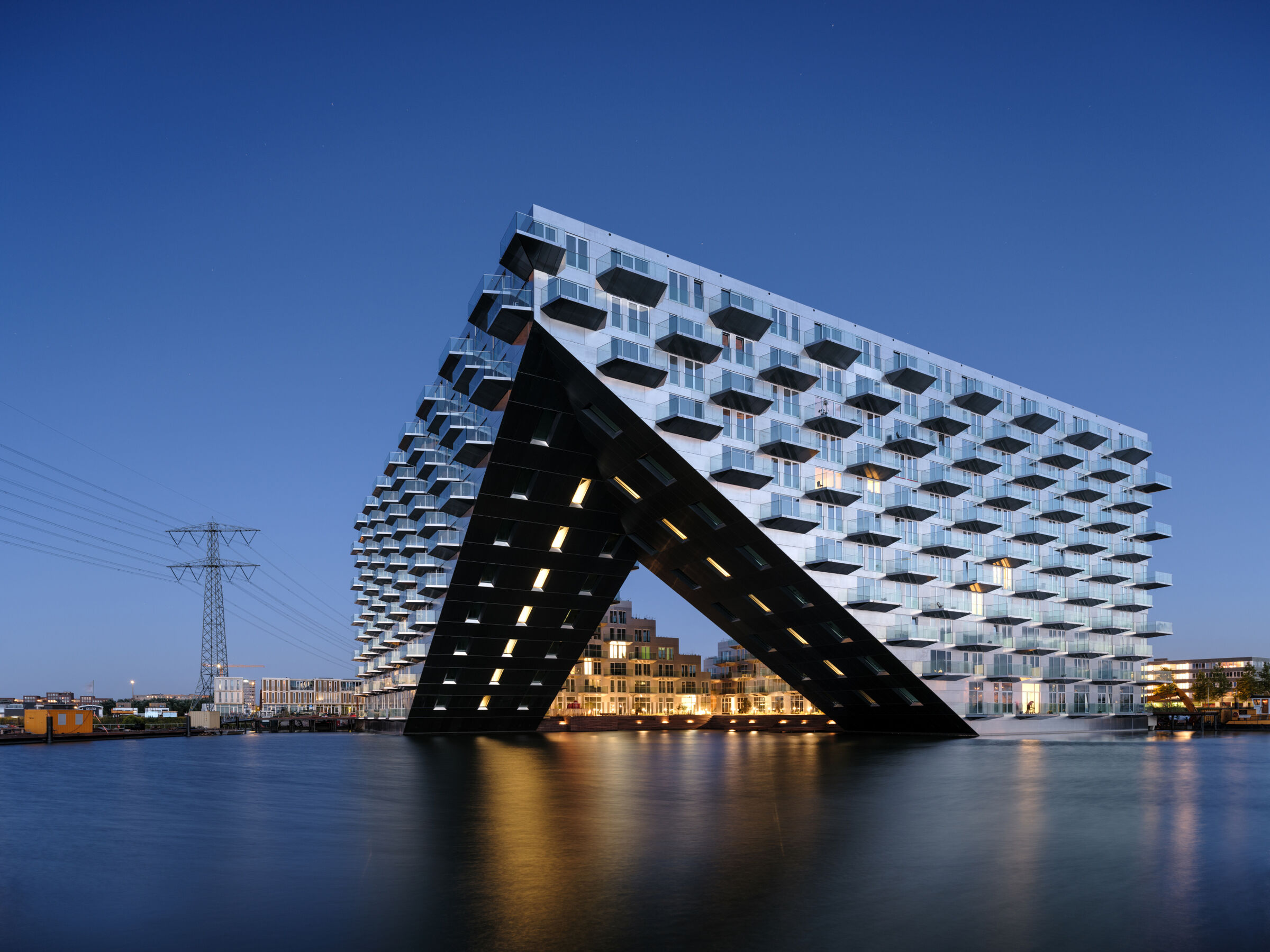
Sluishuis by BIG
BIG promotes floating architecture in its home city as well, having created a student housing project made of shipping containers in Copenhagen’s port. The project highlights how affordable floating architecture can be, demonstrating that architecture on the water is not limited to luxury developments.
Floating House by Friday
This residential construction was designed by Friday SA and stands on water. The principle of modularity and mobility is used in the construction of this dwelling. This home is outfitted with two little engines that allow it to travel at a speed of three knots. Furthermore, this home is built using ecologically beneficial elements such as carbon prints. This home also features a wastewater treatment system for waste treatment, a key feature for any self-sustaining floating building.
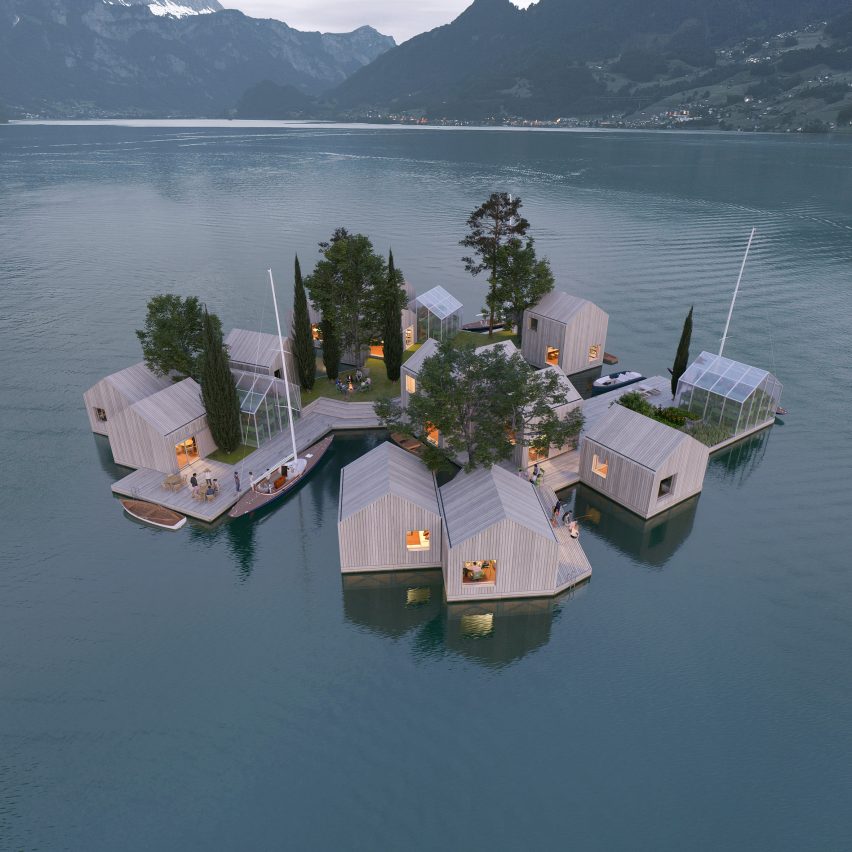
Land on Water by MAST
When compared to traditional industry methods such as plastic pontoons, steel pontoons, or concrete foundations filled with polystyrene, Land on Water provides a number of advantages.
Steel and concrete floats are difficult to carry and are frequently covered in harmful anti-fouling coatings, whilst plastic floats are limited to smaller constructions. The concept comprises of recycled plastic cages that may be filled with flotation material acquired locally. MAST’s system is intended to be filled with locally obtained flotation material, making it one of the most sustainable approaches to building floating structures.

How Floating Architecture Could Help Save Cities from Rising Seas
As sea levels rise, more than 500 coastal cities could face flooding by the end of the century, potentially affecting 1.5 billion people worldwide. Traditional flood defenses like seawalls are expensive and often temporary. Floating architecture offers a fundamentally different approach, one that adapts to water levels rather than resisting them.
Several pioneering projects demonstrate how floating architecture could help save cities from rising seas. The Oceanix Busan project in South Korea, developed in partnership with the United Nations, is designed as a prototype floating city that can house up to 12,000 residents across interconnected platforms using renewable energy and closed-loop waste systems. The Maldives Floating City features 5,000 homes on hexagonal floating platforms, addressing the existential threat faced by this low-lying island nation.
Dutch architect Koen Olthuis of Waterstudio has been at the forefront of this movement, transforming floating architecture from a niche concept into a practical solution for climate resilience and sustainable urban expansion on water.
In 2025, CRA, Carlo Ratti Associati designed AquaPraça, a floating gathering space for global climate dialogue, which debuted at the Venice Architecture Biennale before making a transatlantic journey to Brazil for COP30, further demonstrating the growing role of floating structures on the world stage.
Advantages and Challenges of Floating Buildings
Benefits of Architecture on the Water
Floating buildings offer numerous advantages over conventional construction in flood-prone areas. They provide climate resilience by naturally adapting to changing water levels. They create new usable space without encroaching on scarce land resources. Many designs incorporate solar power, rainwater harvesting, and innovative sustainable technologies from the ground up. Additionally, floating platforms can create artificial reefs beneath them, supporting marine biodiversity rather than harming it, unlike land reclamation, which often destroys coral ecosystems.
Challenges Facing Float Architects
Despite the promise, floating architecture faces significant hurdles. Structural integrity must account for wave pressure, currents, and extreme weather. Infrastructure connectivity, providing reliable water supply, sewage, and energy without land-based systems, remains technically complex. Material durability in saltwater environments requires specialized coatings and marine-grade components. Regulatory frameworks in many cities have not yet caught up, with few clear zoning laws for floating structures. The American Society of Civil Engineers (ASCE) notes that broader adoption will require rethinking cultural perceptions and scaling up funding for research and implementation.
The Future of Floating Architecture and Architecture on the Water
The future of floating architecture looks increasingly promising. The United Nations has been holding Round Table on Sustainable Floating Cities meetings since 2019, signaling high-level international support. Projects like the FloatHub! community in Sweden demonstrate that floating living can also address housing affordability crises, not just climate adaptation.
As materials science advances and modular construction techniques become more refined, the cost of building on water is expected to decrease. With 71% of the Earth’s surface covered by water, floating structures represent an enormous untapped frontier for architectural innovation. The question is no longer whether floating buildings are possible, but how quickly cities will embrace them as a mainstream climate adaptation strategy.
Key Floating Building Projects to Watch in 2025-2026
The momentum behind floating buildings continues to grow. Here are some of the most significant architecture on the water projects shaping the future of urban resilience:
The Oceanix Busan prototype in South Korea remains the most closely watched floating city initiative, with its first habitable modules expected to be operational by 2026. In the Netherlands, long a global leader in water-based living, the Schoonschip neighborhood in Amsterdam now serves as a fully functioning floating community powered by solar energy and smart grid technology. Meanwhile, the Maldives Floating City has moved into active construction, aiming to deliver its first residential units as a direct response to the existential sea-level threat facing the island nation.
These projects prove that floating architecture is no longer theoretical, it is an active, scalable solution for disaster-resilient urban development. Whether through fully buoyant platforms or elevated hovering architecture, the built environment is adapting to a world where water is not an obstacle, but a foundation.
Frequently Asked Questions
What is an example of floating architecture?
Notable examples include the floating homes of IJburg in Amsterdam, the Schoonschip community in the Netherlands, and proposed floating city projects in the Maldives and Busan. They show how homes, public buildings, and whole neighborhoods can sit on water.
How do floating buildings stay in place?
Floating buildings rest on buoyant concrete or pontoon foundations and are held by mooring piles or anchored to the seabed. The piles let the structure rise and fall with the water while keeping it from drifting sideways.
Is floating architecture sustainable?
Floating architecture can be highly sustainable when it pairs buoyant foundations with solar power, rainwater capture, and local materials. Its main strength is adaptability, since floating structures rise with water levels instead of flooding.


3 Comments




Futuro House Production Revived in Finland After Decades-Long Hiatus
A Facebook listing for abandoned moulds led to the first new Futuro...
 illustrarch Editoral Team3 Mins read
Building Your Dream Home in NSW: What You Should Know About Montgomery Homes
Montgomery Homes has been building across Sydney, Newcastle, the Hunter, Wollongong and...
illustrarch Editoral Team4 Mins read

Designing a Home Theater: Where Drapery Fits Into the Plan
In a media room the curtains are a performance layer, not decoration....
illustrarch Editoral Team3 Mins read

Oscar Niemeyer’s Cathedral of Brasília: The Hyperboloid Concrete Hymn
The Cathedral of Brasília reads as a single gesture, yet it stood...
 Furkan Sen7 Mins read


I think floating buildings are an interesting idea. It might help with flooding in some places.
Floating architecture sounds new. I wonder how it works in real life.
It’s nice to see different types of buildings. Floating homes could be useful for some people.