

Hamtramck Algae Farm
The Hamtramck Algae Farm is a community-driven facility that transforms algae into renewable energy and products while revitalizing an abandoned urban site.
 illustrarch Editoral Team10 May 20202 Mins read426


The Hamtramck Algae Farm is a community-owned algae-harvesting center and research lab designed by Joe Mihanovic on the site of an abandoned parking lot in Hamtramck, Michigan, a small economically depressed township within the Detroit area that is well known for being one of the only majority-Muslim towns in the United States. The project pairs a working production facility with experimental science, treating an unloved industrial parcel as the starting point for renewal.
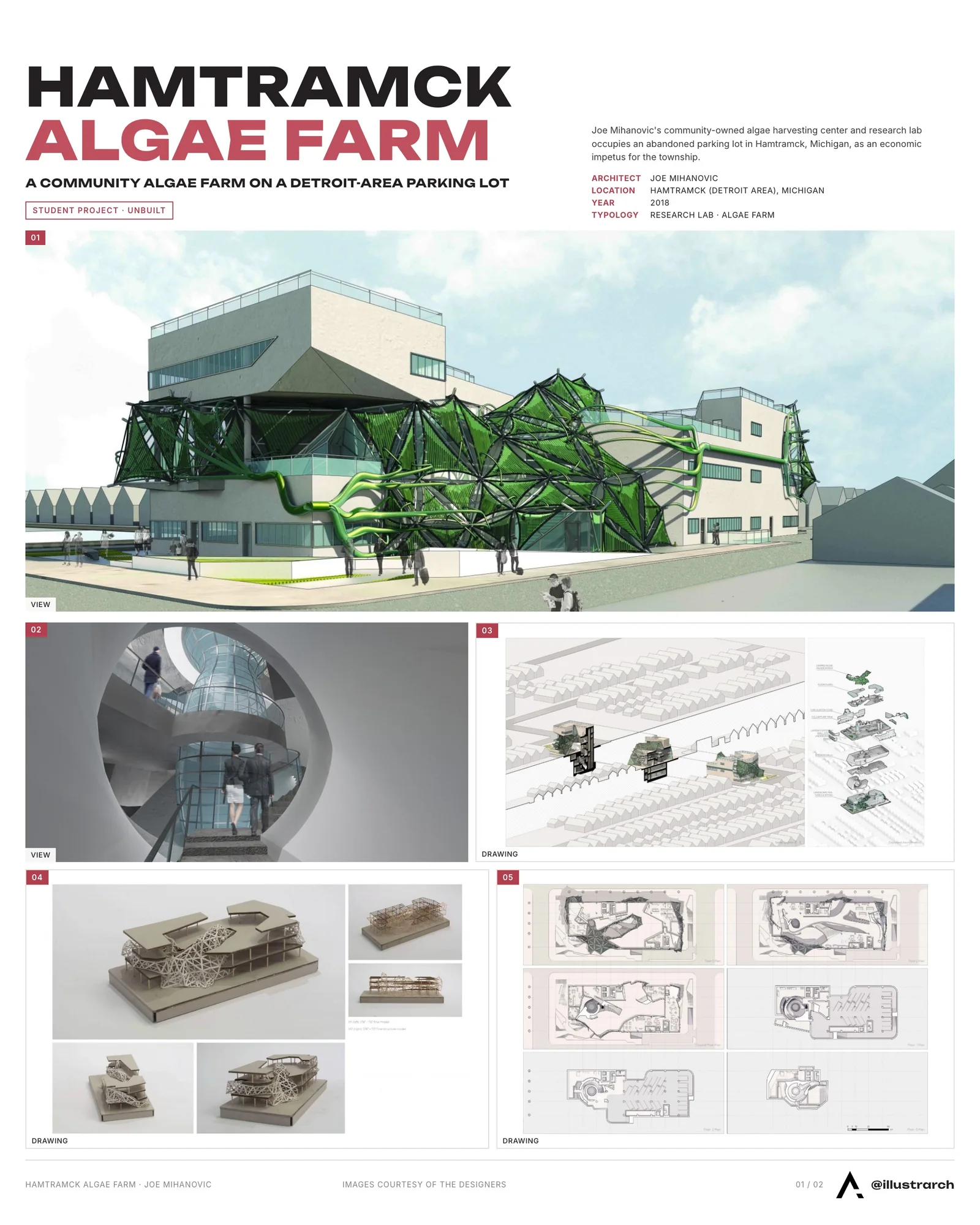
The farm is intended as an economic impetus for the area. It harvests algae in ETFE bags set into its facade and converts the biomass into a potential cleaner-burning energy source, as well as cooking oils and other experimental products that show promise. By placing cultivation on the building skin rather than hiding it indoors, the design lets the act of growing become the public face of the work, and it ties the structure directly to ideas of renewable bioenergy and local economic recovery.
A Facade Driven by the Idea of Waste
The form is driven by the common conception of algae as a dirty, unwanted waste product. That reading is mirrored by a triangulating, tessellated “virus” that latches onto the building and ruptures its facade on each face. Interior walls deform to accommodate this disruption, and the internal organization is driven by the centrality of the CO2 capture tank and a circulatory apparatus that connects diagonally across the building to link different points of interest. The result reframes contamination as a generative force rather than something to be cleaned away.
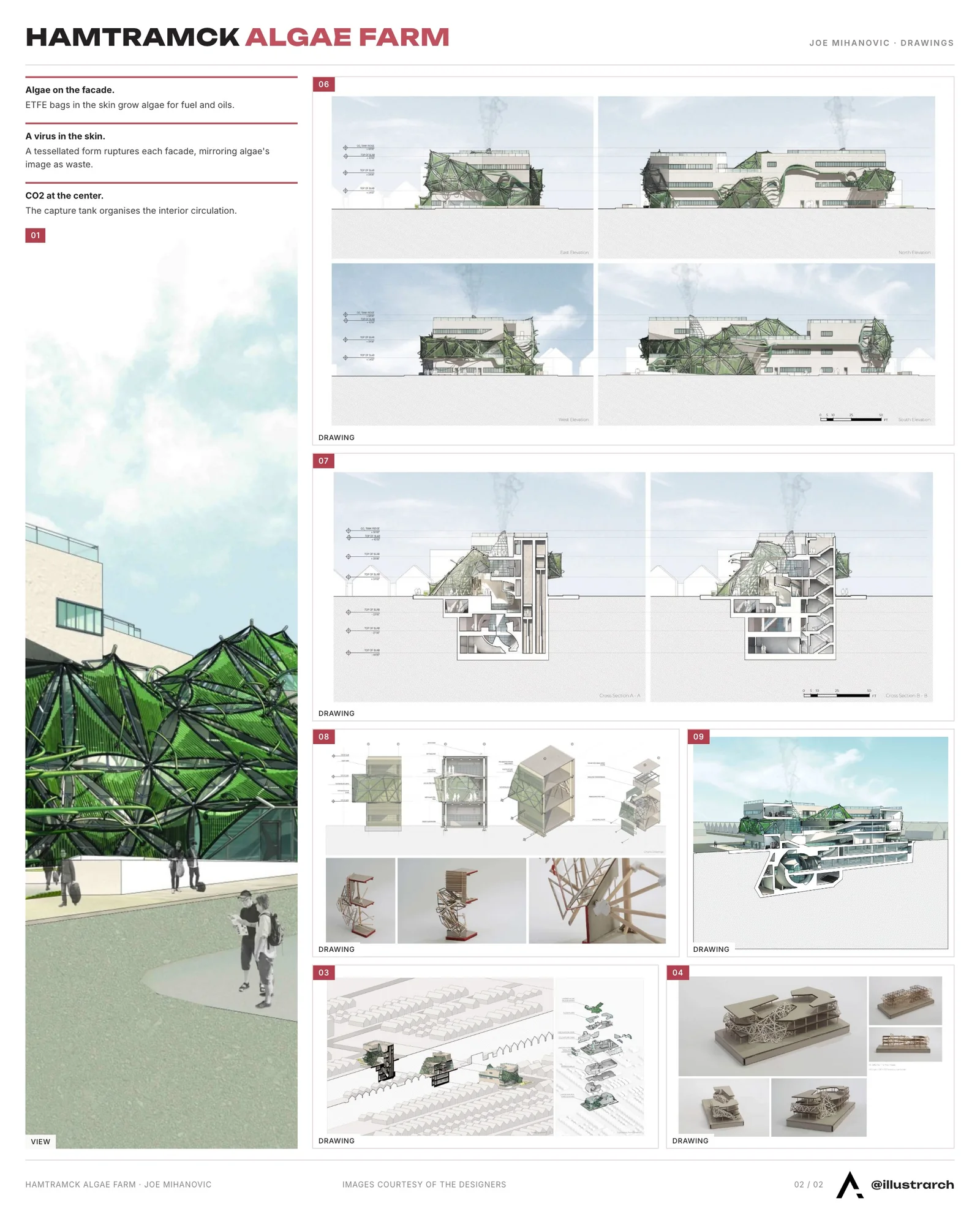
Buildings of this hybrid kind, part laboratory and part production plant, carry design demands that pure offices or galleries do not. They must move fluids, gases, and biomass through the plan while keeping research and public functions legible, and they have to manage carbon, light, and temperature so that living cultures stay productive. Mihanovic answers these pressures by making the technical systems visible, so the circulation of CO2 and algae reads as architecture rather than buried infrastructure.
For a place like Hamtramck, where vacant lots are a familiar sight, a project that converts an unwanted material into fuel and food offers a hopeful template. The Hamtramck Algae Farm suggests that the qualities a community tends to reject, whether a derelict site or a slimy green organism, can be reorganized into the basis of a new local economy.




Tidsmaskinen After-School Center by BBP Arkitekter
BBP Arkitekter add a heptagonal tower and a greenhouse to a 1918...
illustrarch Editoral Team2 Mins read

The Entwine Confluence by Sara Fernandes
The Entwine Confluence is Sara Fernandes's unbuilt community center for Gresham: meeting...
illustrarch Editoral Team3 Mins read
Savan House by Nobico Studio
Savan House is Nobico Studio's unbuilt concept for a forested hillside in...
illustrarch Editoral Team3 Mins read

KAFD Metro Station by Zaha Hadid Architects
Zaha Hadid Architects' KAFD Metro Station ties three Riyadh Metro lines together...
illustrarch Editoral Team4 Mins read


Leave a comment