

Be-Serio(us)
Be Serio is a hybrid building proposal in Milan that integrates public and private spaces through flexible design, responding to urban transformation and co-living trends.
 illustrarch Editoral Team27 March 20192 Mins read402


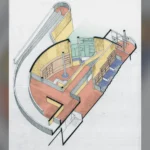
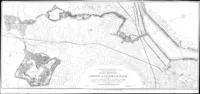
Be Serio[us] is a hybrid building proposal by architect Giulia Cerone for the new “Smart District” rising in the south-west quadrant of Milan, where six monofunctional volumes cluster around the old Vettabbia canal and dissolve the line between public and private life. The project reads the great urban transformations of the last thirty years that have reshaped the DNA of the city, turning once marginal areas into centres of creative production, industrial innovation, culture and business incubators. On a site of 4,900 square metres, the design treats this shifting context as an invitation to experiment with building type itself.
The six buildings are arranged in clusters and wrapped by a fluid, flexible space that connects them. Hybridization emerges from the interaction between each single-function volume and the ground around it: boundaries are no longer fixed, and the everyday actions of inhabitants stay unpredictable. Public spaces meet private ones in a co-living logic, so that the building works less as a closed object and more as an open framework for shared life. In the residences, the deliberately minimal apartments push daily life outward, prompting people to search for space beyond their own front door and to invent new forms of spatial sharing.
Hybrid buildings and the future of the dense city
Mixed-use and hybrid buildings respond to a problem that defines contemporary urban design: how to pack housing, work, leisure and public life into a single dense footprint without producing rigid, lifeless zoning. By layering programs and keeping the connective space flexible, a hybrid structure can adapt as the needs of its inhabitants change, which is exactly the condition Cerone foregrounds here. The reference to co-living reflects a wider movement in which residents trade private square metres for generous shared rooms, courtyards and circulation.
Milan offers fertile ground for this kind of experiment. The city’s recent regeneration of former industrial districts has made it a European laboratory for mixed-use development, and projects sited near historic water infrastructure like the canals carry an added layer of memory into new construction. By siting clustered volumes along the Vettabbia and threading them with a continuous public realm, the scheme links the texture of old Milan to the smart, adaptable district it imagines. Be Serio[us] argues that when cities transform this quickly, the spaces we build must learn to stay changeable, ready to be rewritten by the people who move through them.


Savan House by Nobico Studio
Savan House is Nobico Studio's unbuilt concept for a forested hillside in...
illustrarch Editoral Team3 Mins read

Renaatus Irumathi
Renaatus Irumathi Residence features 69 spacious apartments designed with contemporary aesthetics, maximizing...
illustrarch Editoral Team2 Mins read
White Khamovniki
White Khamovniki is a residential tower project in Moscow that combines urban...
illustrarch Editoral Team1 Mins read
Millennium Horizon
Millennium Horizon is an innovative architectural project in the UAE that uses...
illustrarch Editoral Team2 Mins read


Leave a comment