

10+ Best Tiny Home Communities in Virginia: Costs, Locations & Zoning Guide
Virginia hosts over a dozen tiny home communities with costs ranging from $550 to $1,800 monthly, and zoning regulations vary significantly by county.
 Bahattin Duran16 March 202621 Mins read315

Table of Contents Show
Virginia provides a uniquely diverse landscape for tiny home living, stretching from the bustling suburbs of Northern Virginia just outside Washington D.C. to the serene valleys and ridgelines of the Shenandoah and Blue Ridge regions. If you are exploring tiny home communities in Virginia, you will find a state that has been gradually warming to alternative housing options, with several counties updating their zoning codes to accommodate tiny homes on foundations and, in some cases, on wheels.
Virginia appeals to a broad range of tiny home seekers, including government employees seeking affordable housing near D.C., retirees looking for mountain retreats, and remote workers drawn to the beauty and affordability of the Piedmont and Coastal regions. This guide covers everything from the latest zoning updates to detailed community reviews and cost comparisons across different regions of Virginia. If you are also considering options beyond Virginia, our guide to the top tiny house communities in the USA provides a nationwide overview.

Watch: Tiny Home Communities in Virginia
Before diving into the details, watch this overview of tiny home community life in Virginia to get a feel for what different regions and communities offer.

What Are the Zoning & Legal Requirements for Tiny Homes in Virginia?
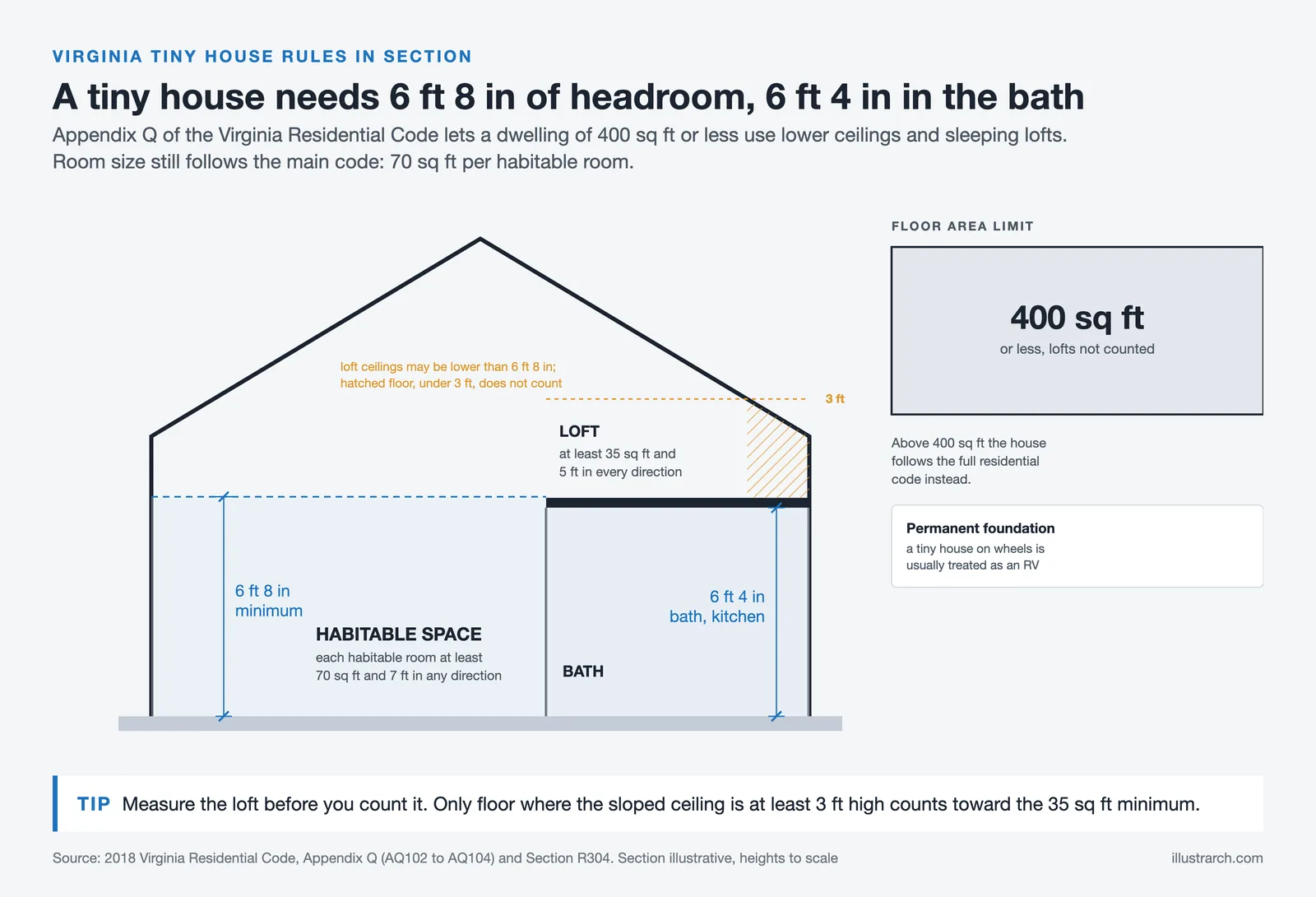
Virginia does not have a statewide tiny home code. Zoning rules are set at the county level, which means regulations for minimum square footage, foundation type, and whether tiny homes on wheels (THOWs) are allowed vary significantly by locality. Tiny homes on permanent foundations must comply with the Virginia Uniform Statewide Building Code (VUSBC), which adopts IRC Appendix Q. THOWs are classified as recreational vehicles in most jurisdictions.
Understanding tiny home zoning Virginia regulations is the single most important step before purchasing or building a tiny home in the state.
What Is the Virginia Building Code Framework for Tiny Homes?
Virginia follows the Virginia Uniform Statewide Building Code (VUSBC), which adopts the International Residential Code (IRC) with state-specific amendments. Under IRC Appendix Q, which the 2018 Virginia Residential Code includes statewide as an alternative compliance path (Section R333), tiny houses need a ceiling height of at least 6 feet 8 inches in habitable spaces (lofts are permitted to be lower), while the 70 square foot minimum for habitable rooms comes from Section R304.1 of the same code. Tiny homes on wheels (THOWs) are generally classified as recreational vehicles and face more restrictions regarding permanent residency. The DHCD’s technical memo on tiny houses provides additional clarity on how Appendix Q applies in Virginia.
Virginia Tiny Home Building Requirements at a Glance:
- Maximum floor area under Appendix Q: 400 sq ft (excluding lofts)
- Minimum habitable room size: 70 sq ft, at least 7 ft in any horizontal direction (VRC R304)
- Minimum ceiling height: 6 ft 8 in (habitable), 6 ft 4 in (bathrooms)
- Loft minimum area: 35 sq ft, minimum 5 ft in any horizontal direction
- Foundation follows the general VRC provisions, as Appendix Q has no separate foundation rule (THOWs classified as RVs)
- Must comply with VUSBC and local zoning ordinances
County-by-County Zoning Overview
| County / City | Tiny Homes on Foundation | THOWs Allowed | Min. Sq Ft | ADU Permitted | Notes |
|---|---|---|---|---|---|
| Fairfax County | Yes | Limited | None specified | Yes | ADU-friendly since 2021 zoning update |
| Arlington County | Yes | No | None specified | Yes | Expanded ADU provisions in 2023 |
| Loudoun County | Yes | No | 200 sq ft | Yes (Rural zones) | ADUs allowed in AR and TR zones |
| Albemarle County | Yes | Limited | 200 sq ft | Yes | Near Charlottesville, progressive zoning |
| Augusta County | Yes | Yes (A-1 zones) | None specified | Yes | Shenandoah Valley, flexible rural zoning |
| Nelson County | Yes | Yes | None specified | Yes | Blue Ridge area, most flexible county |
| Richmond City | Yes | No | 200 sq ft | Yes | Urban infill opportunities |
| Virginia Beach | Yes | No | 200 sq ft | Limited | Coastal flood zone restrictions apply |
| Floyd County | Yes | Yes | None specified | Yes | Popular with off-grid tiny home seekers |
| Rockbridge County | Yes | Yes (A-1 zones) | None specified | Yes | Near Lexington, scenic mountain setting |
Source: Individual county zoning ordinances and the Virginia Department of Housing and Community Development (DHCD). Regulations change frequently; always verify with your local building department before purchasing land or beginning construction.

Best Tiny Home Communities in Virginia (Top 10 Compared)
The best tiny home communities in Virginia span four regions and range from $300 to $1,100 per month in lot rent. The most affordable options are in Floyd County and the Shenandoah Valley area, starting at $300/month for lot rent and $40,000 for home purchase. Northern Virginia communities offer the highest proximity to D.C. jobs but carry the highest costs, with lot rents of $800 to $1,100/month. Communities accepting tiny homes on wheels (THOWs) are concentrated in the western mountain counties.
Below is a comparison of the best tiny home communities Virginia has to offer. For a broader perspective on communities across the country, see our guide to the top tiny house communities in the USA.
| Community Name | Location / Region | Lot Rent / Month | Home Price Range | Avg. Sq Ft | THOWs? | Key Amenities |
|---|---|---|---|---|---|---|
| Shenandoah Tiny Home Village | Shenandoah Valley | $450 – $600 | $55,000 – $95,000 | 250 – 400 | Yes | Community garden, hiking trails, clubhouse |
| Blue Ridge Tiny Living | Blue Ridge Mountains | $500 – $700 | $65,000 – $120,000 | 200 – 450 | Yes | Mountain views, shared workshop, Wi-Fi |
| NoVA Micro-Village | Northern Virginia | $800 – $1,100 | $90,000 – $150,000 | 300 – 500 | No | Metro access, co-working space, parking |
| Piedmont Tiny Estates | Charlottesville Area | $400 – $550 | $50,000 – $85,000 | 200 – 380 | Yes | Farm-to-table garden, dog park |
| Coastal Haven Tiny Community | Hampton Roads | $550 – $750 | $60,000 – $110,000 | 250 – 420 | No | Beach access, kayak storage, outdoor kitchen |
| Richmond Urban Tiny Lots | Richmond Metro | $600 – $800 | $70,000 – $125,000 | 280 – 500 | No | Walkable to restaurants, shared laundry |
| Mountain Hollow Eco-Village | Floyd County | $300 – $450 | $40,000 – $75,000 | 180 – 350 | Yes | Off-grid options, solar, composting toilets |
| Rappahannock Riverside Tiny Park | Rappahannock Area | $400 – $550 | $55,000 – $90,000 | 220 – 400 | Yes | River access, fire pits, nature trails |
| Skyline Tiny Homes | Shenandoah / Luray | $350 – $500 | $48,000 – $80,000 | 200 – 380 | Yes | Skyline Drive proximity, stargazing deck |
| Tidewater Tiny Village | Norfolk / Virginia Beach | $550 – $700 | $65,000 – $105,000 | 250 – 400 | No | Military-friendly, near naval base |
Note: Pricing and availability are approximate and subject to change. Contact each community directly for the most current information.

Best Tiny Home Options Near Washington D.C. in Northern Virginia
Northern Virginia tiny home communities offer D.C. commuters monthly lot rents of $800 to $1,100 and home prices from $90,000 to $150,000. Total monthly housing costs of $1,200 to $1,800 represent 30% to 50% savings compared to the average one-bedroom apartment rent of $2,100+ in the region. Fairfax and Prince William counties provide the best balance of affordability and Metro access, with commute times of 30 to 60 minutes into D.C.
Northern Virginia is one of the most expensive housing markets on the East Coast, making it a natural fit for tiny homes near Washington DC. Government employees, military personnel, and commuters priced out of traditional housing are increasingly turning to tiny living as a practical alternative in Fairfax, Arlington, Loudoun, and Prince William counties.
Why Northern Virginia Works for Tiny Home Living
The region offers Metro rail access, proximity to federal employment centers, and a growing number of ADU-friendly zoning updates. Fairfax County revised its zoning ordinance in 2021 to allow accessory dwelling units by right in most residential zones, which opened the door for tiny home ADUs on existing properties. Arlington County followed with expanded ADU provisions in 2023. Prince William County has also developed a step-by-step guide to tiny house construction on its official site.
How to Find Commuter-Friendly Tiny Home Options Near D.C.
For those working in D.C., the key is finding a community or lot within a reasonable distance of a Metro station or VRE (Virginia Railway Express) stop. Communities in the Fairfax and Prince William areas offer the best balance of affordability and commute time, typically ranging from 30 to 60 minutes door-to-door into the District.
Lot rental in tiny home communities northern Virginia ranges from $800 to $1,100 per month, which is still significantly less than the average one-bedroom apartment rent of $2,100+ in the region. When paired with a tiny home purchase in the $90,000 to $150,000 range, total monthly housing costs often land between $1,200 and $1,800, representing savings of 30% to 50% compared to traditional rentals.
| Housing Option | Avg. Monthly Cost | Savings vs. Apartment |
|---|---|---|
| 1-BR Apartment (NoVA avg.) | $2,100 – $2,800 | Baseline |
| Tiny Home Community (lot rent + utilities) | $1,200 – $1,800 | 30% – 50% |
| ADU on Own Land (mortgage + utilities) | $900 – $1,400 | 40% – 60% |

Best Tiny Home Communities in Shenandoah Valley & Blue Ridge
The Shenandoah Valley and Blue Ridge region is the most affordable and flexible area for tiny home living in Virginia. Monthly lot rents range from $300 to $700, home prices start at $40,000, and land can be purchased for as little as $3,000 per acre in remote areas. Augusta, Rockbridge, and Nelson counties allow tiny homes on wheels in agricultural zones with minimal restrictions, making this the top region for off-grid tiny home setups.
The tiny home communities Shenandoah Valley and Blue Ridge region offer an entirely different lifestyle from the D.C. suburbs. This is where Virginia’s tiny home movement truly thrives, with lower land costs, more flexible zoning, and some of the most scenic backdrops in the eastern United States.
What Makes This Region Ideal for Tiny Living?
Augusta, Rockbridge, and Nelson counties have some of the most permissive tiny home regulations in the state. Agricultural zoning (A-1) in many of these counties allows tiny homes on wheels with minimal restrictions, and land prices can dip below $3,000 per acre in more remote areas. This makes the region especially popular for off grid tiny homes Virginia seekers looking for self-sufficient living surrounded by national forest land.
Community Spotlight: Shenandoah Valley
Shenandoah Valley communities typically cluster near towns like Staunton, Lexington, and Luray, providing access to essential services while maintaining a rural character. Residents enjoy four-season outdoor recreation, including hiking on the Appalachian Trail, kayaking on the Shenandoah River, and skiing at nearby Massanutten Resort.

Best Blue Ridge Tiny Home Communities
Tiny home communities Blue Ridge Virginia options lean toward the eco-conscious and artistic. Floyd County, in particular, has earned a reputation as a hub for alternative living, with communities that emphasize sustainability, permaculture, and creative collaboration. Community events like potlucks, skill-shares, and music nights are a staple in this region.
Land and lot costs in the Blue Ridge region typically run 40% to 60% lower than Northern Virginia, with monthly lot rents ranging from $300 to $700 depending on amenities and proximity to towns.
Coastal Virginia & Hampton Roads Tiny Home Options
Coastal Virginia tiny home communities in the Hampton Roads area offer lot rents of $550 to $750/month and home prices between $60,000 and $110,000. All homes must be on permanent foundations due to flood zone requirements, and FEMA compliance adds $5,000 to $15,000 in construction costs. The region is especially popular with military families stationed at Naval Station Norfolk and other nearby installations.
Virginia’s coastal region, stretching from Virginia Beach through Norfolk and up to the Northern Neck, offers a distinctive tiny living experience shaped by waterfront access, military culture, and a moderate maritime climate.
Hampton Roads Area
The Hampton Roads metropolitan area, home to Naval Station Norfolk and several other military installations, has a large transient population that benefits from flexible housing options. Tiny home communities in this area cater to military families and veterans who want affordable, low-maintenance housing close to base.
Homes in coastal communities are typically built on permanent foundations to meet flood zone requirements. FEMA flood zone compliance adds approximately $5,000 to $15,000 to construction costs, depending on the required elevation and foundation type. Lot rents range from $550 to $750 per month, with home prices between $60,000 and $110,000.
What to Know About Coastal Building Requirements
Virginia Beach and Norfolk enforce strict wind load and flood elevation standards. Any tiny home in a V-zone (coastal high hazard area) must be elevated on pilings, while A-zone homes require a minimum elevation above the base flood level. Salt air corrosion is also a factor, so builders in this region typically specify marine-grade hardware, galvanized or stainless steel fasteners, and corrosion-resistant exterior cladding.
Best Tiny Home Options in Richmond & Charlottesville (Central Virginia)
Central Virginia provides the best balance of urban accessibility and affordability for tiny home living. Richmond permits ADUs in most residential zones and has active infill tiny home projects in the East End and Southside neighborhoods. Lot rents range from $400 to $800/month, and home prices fall between $50,000 and $125,000. Charlottesville and Albemarle County offer progressive zoning with Blue Ridge Mountain access.
Central Virginia offers a compelling middle ground between the high costs of Northern Virginia and the remoteness of the mountain communities. Tiny homes Richmond Virginia and the surrounding metro area benefit from a revitalized urban core, growing job market, and relatively progressive zoning for alternative housing.
Richmond Metro
Richmond has emerged as one of Virginia’s most tiny-home-friendly cities. The city’s updated zoning code permits ADUs in most residential zones, and several neighborhoods in the East End and Southside have seen infill tiny home projects on formerly vacant lots. Richmond’s lower cost of living compared to Northern Virginia, paired with its arts scene, food culture, and proximity to the James River, makes it attractive for younger tiny home buyers.
Charlottesville & Albemarle County
Charlottesville and surrounding Albemarle County combine university-town amenities with Blue Ridge Mountain access. Albemarle County’s zoning allows tiny homes on foundations in most residential and agricultural zones, and the county has been receptive to planned tiny home communities as part of its affordable housing strategy. Lot rents near Charlottesville range from $400 to $550 per month.

How Much Does It Cost to Live in a Virginia Tiny Home Community?
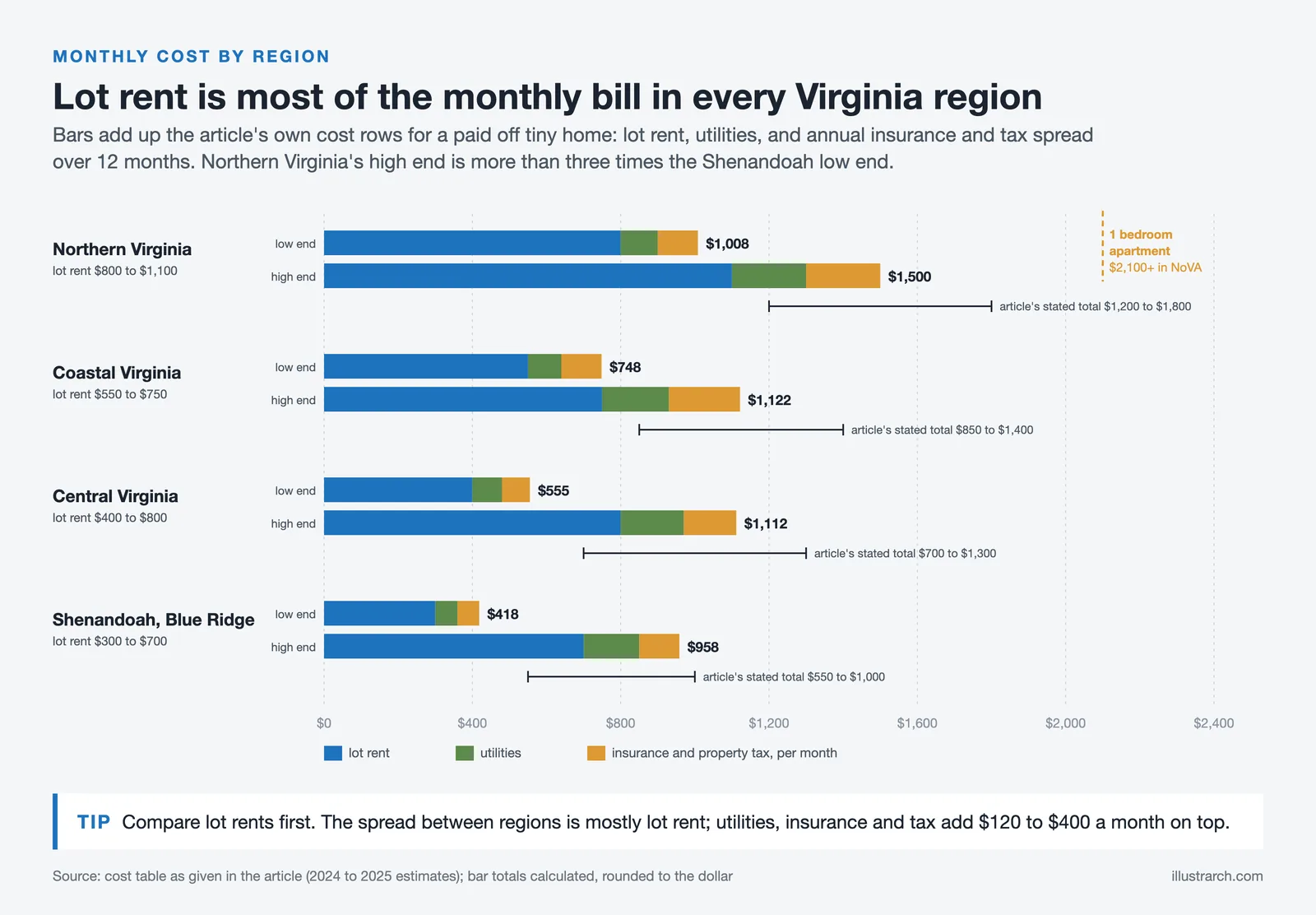
The total monthly cost of living in a Virginia tiny home community ranges from about $418 to $1,500, depending on the region. Northern Virginia is the most expensive at $1,008 to $1,500/month, followed by Coastal Virginia at $748 to $1,122, Central Virginia at $555 to $1,112, and the Shenandoah/Blue Ridge region at $418 to $958. These totals include lot rent, utilities, and prorated insurance and property tax, and assume a paid-off tiny home with no mortgage.
Understanding the full tiny home community cost Virginia involves more than just the purchase price of the home. Below is a comprehensive cost comparison across Virginia’s main regions.
| Cost Category | Northern VA | Shenandoah / Blue Ridge | Central VA (Richmond) | Coastal VA |
|---|---|---|---|---|
| Tiny Home Purchase | $90K – $150K | $40K – $95K | $50K – $125K | $60K – $110K |
| Monthly Lot Rent | $800 – $1,100 | $300 – $700 | $400 – $800 | $550 – $750 |
| Utilities (Monthly) | $100 – $200 | $60 – $150 | $80 – $170 | $90 – $180 |
| Insurance (Annual) | $800 – $1,200 | $500 – $800 | $600 – $1,000 | $900 – $1,500 |
| Property Tax (Annual) | $500 – $1,200 | $200 – $500 | $300 – $700 | $400 – $800 |
| Land Purchase (per acre) | $50K – $200K+ | $3K – $25K | $10K – $50K | $15K – $75K |
| Est. Total Monthly Cost | $1,008 to $1,500 | $418 to $958 | $555 to $1,112 | $748 to $1,122 |
Estimates based on 2024-2025 market data and community listings. Actual costs vary depending on home size, finishes, and specific community fees. Monthly totals assume a paid-off tiny home (no mortgage) and include lot rent, utilities, and prorated insurance/tax.
What Are the Hidden Costs of Tiny Home Living in Virginia?
| Hidden Cost | Typical Range | Notes |
|---|---|---|
| Site Preparation (own land) | $15,000 – $40,000 | Well drilling, septic, driveway, utility hookups |
| FEMA Flood Compliance (coastal) | $5,000 – $15,000 | Foundation elevation, pilings, engineering |
| Transport & Delivery (THOW) | $3,000 – $8,000 | Oversize load permits, professional hauling |
| Permit & Inspection Fees | $500 – $3,000 | Varies by county and scope of work |
| Crane Placement (foundation homes) | $1,500 – $5,000 | Required for modular/factory-built delivery |

What Are Virginia’s ADU Laws for Tiny Homes?
Virginia localities set their own rules for accessory dwelling units (ADUs), and many allow them in areas zoned for single-family use. ADUs must be on permanent foundations, comply with the Virginia Uniform Statewide Building Code, and meet local setback and lot coverage requirements. Maximum ADU sizes typically range from 600 to 900 square feet. The most ADU-friendly Virginia counties for tiny homes are Fairfax (35% of primary dwelling floor area), Arlington (attached and detached permitted), Albemarle, Richmond, and Loudoun.
ADU laws Virginia have evolved significantly in recent years, creating new opportunities for tiny home placement on existing residential properties. An Accessory Dwelling Unit (ADU) is a secondary housing unit on a single-family lot, and tiny homes that meet building code requirements can often qualify as ADUs.
How Has Virginia’s ADU Legislation Changed?
Virginia has debated significant ADU-related legislation in recent years. House Bill 2100 sought to establish statewide authority for ADU development but failed in the 2023 session, and the Virginia Housing Commission’s ADU policy brief has provided detailed research and recommendations for localities. These legislative efforts aim to require localities to allow ADUs in areas zoned for single-family use, though localities retain authority over specific regulations such as size limits, owner-occupancy requirements, and parking standards. This ongoing legislative momentum has been a turning point for tiny home placement across the state.
How Do ADU Rules Apply to Tiny Homes?
To qualify as an ADU, a tiny home typically must be on a permanent foundation (not on wheels), meet the Virginia Uniform Statewide Building Code, and comply with local setback and lot coverage requirements. Maximum ADU sizes vary by locality but generally range from 600 to 900 square feet, well within the range that includes most tiny homes.
Best Counties for ADU Tiny Homes in Virginia
| County / City | ADU Types Allowed | Max Size | Permit Type |
|---|---|---|---|
| Fairfax County | Interior (attached) | 35% of primary dwelling | Administrative permit |
| Arlington County | Attached & detached | Varies by zone | Streamlined since 2023 |
| Albemarle County | Attached & detached | Up to 35% or 1,200 sq ft | Zoning / special use |
| City of Richmond | All single-family zones | Varies by zone | Simple zoning permit |
| Loudoun County | AR & TR zones | County design standards | Zoning approval required |
For the most current ADU regulations, refer to the Virginia Legislative Information System and your local county zoning office.

How to Build a Tiny Home for Virginia’s Climate
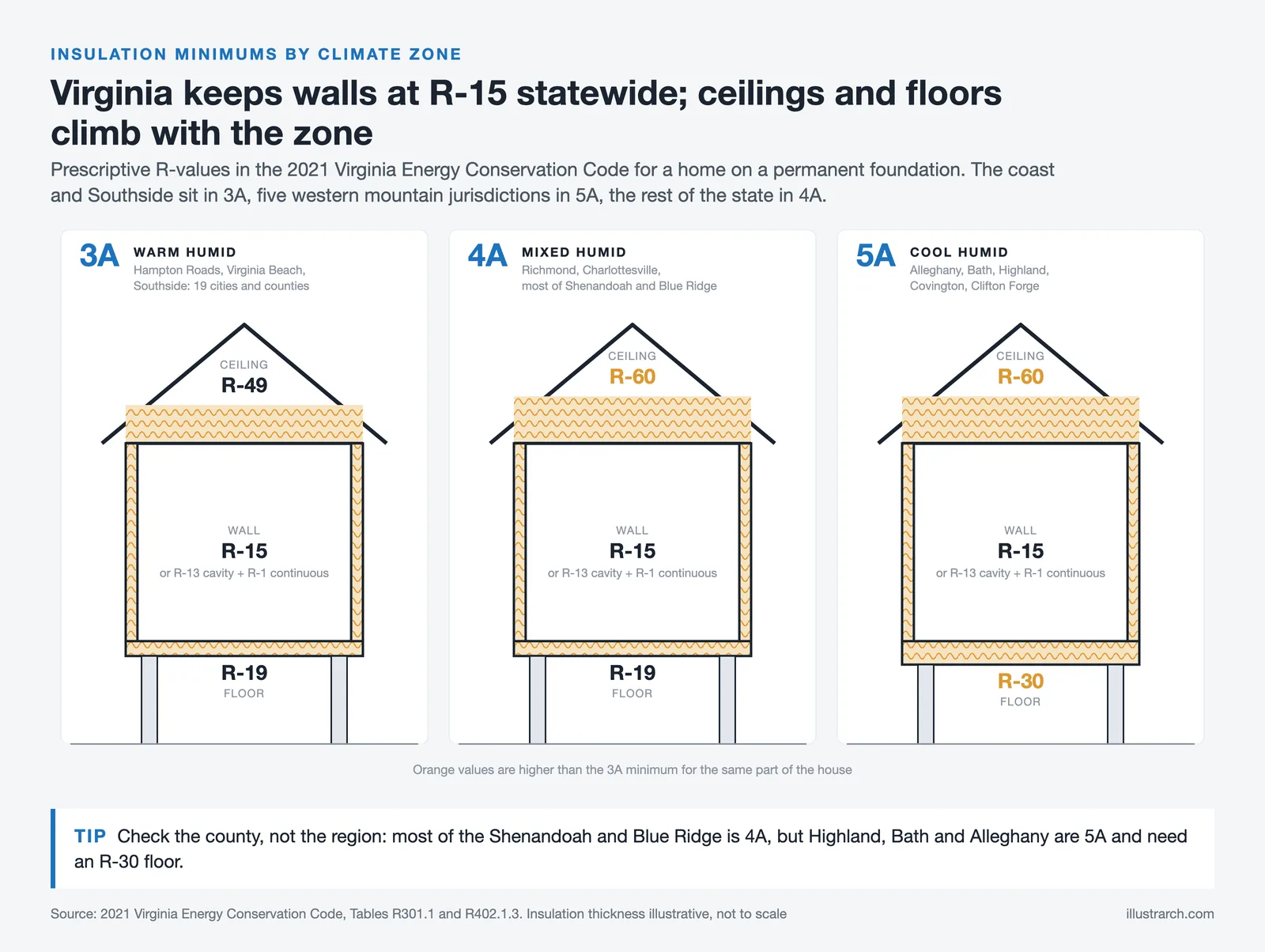
Virginia spans Climate Zones 3A (southeast coast) through 4A and 5A (the highest western counties), requiring different insulation and building strategies by region. Under the 2021 Virginia Energy Conservation Code, mountain tiny homes need R-15 walls, an R-60 ceiling, and R-19 floor insulation (R-30 floors in zone 5A), with triple-pane windows. Coastal homes need a lower ceiling value (R-15 walls, R-49 ceiling) but must meet FEMA flood elevation standards and use corrosion-resistant materials. Mini-split heat pumps are the most efficient HVAC solution for tiny homes across all Virginia regions.
Virginia’s four-season climate presents specific challenges and opportunities for tiny home construction. The state spans USDA Hardiness Zones 5b through 8a, meaning temperatures can range from well below freezing in the mountain regions to mild and humid along the coast.
What Insulation Is Required by Region?
| Region | Climate Zone | Wall Insulation | Roof Insulation | Floor Insulation | Key Concern |
|---|---|---|---|---|---|
| Mountain (Shenandoah, Blue Ridge) | 4A (5A in Alleghany, Bath, Highland, Covington) | R-15 (or R-13 + R-1 continuous) | R-60 | R-19 (R-30 in 5A) | Cold weather, condensation |
| Central (Richmond, Charlottesville) | 4A | R-15 (or R-13 + R-1 continuous) | R-60 | R-19 | Humidity + cold snaps |
| Coastal (Hampton Roads, Virginia Beach) | 3A | R-15 (or R-13 + R-1 continuous) | R-49 | R-19 | Moisture, hurricane wind load |
Mountain areas require dual-pane or triple-pane windows and a vapor barrier on the warm side of the wall assembly to prevent condensation. Coastal Virginia has milder winters but higher humidity and hurricane risk. Homes in this region benefit from dehumidification systems and proper ventilation to prevent mold growth. Central Virginia falls between these two extremes, and a mini-split heat pump system is the most common and efficient HVAC solution.
Best Foundation Types for Virginia Tiny Homes
For tiny homes on permanent foundations in Virginia, the most common options include concrete slab-on-grade, pier-and-beam, and helical pile systems. Slab-on-grade works well in Central Virginia’s clay soils when properly prepared, while pier-and-beam is preferred in mountain areas for drainage and slope adaptation. Coastal areas often require elevated foundations to meet flood zone requirements.
How to Set Up Solar for a Virginia Tiny Home
Virginia tiny homes benefit significantly from solar energy, particularly in the western mountain regions that receive an average of 4.5 to 5.0 peak sun hours per day. A 2kW to 4kW solar array is typically sufficient to power a well-insulated tiny home, with battery storage systems becoming increasingly popular for off grid tiny homes Virginia setups. Virginia’s net metering program (§56-594) allows grid-connected tiny homes to receive credit for excess solar production. The Virginia Energy solar resource page provides additional details on state incentives and programs for residential solar installations.

How to Move to a Tiny Home Community in Virginia (Step-by-Step)
Moving to a tiny home community in Virginia involves eight key steps: define your priorities (location, cost, lifestyle), research county-specific zoning regulations, visit communities in person across different seasons, secure financing through personal loans or credit unions (traditional mortgages rarely apply), choose a NOAH-certified builder, arrange site preparation or lot confirmation, handle transport logistics, and set up utilities and your official address.
Relocating to a tiny home community in Virginia requires careful planning. Here is a step-by-step checklist to guide your transition.
Step 1: Define Your Priorities
Determine whether proximity to employment, natural beauty, community culture, or cost is your primary driver. This will narrow your search to the right region of Virginia.
Step 2: Research Zoning in Your Target Area
Contact the county or city zoning office directly. Ask specifically about tiny home regulations, minimum square footage requirements, foundation requirements, and whether THOWs are permitted for permanent residency.
Step 3: Visit Communities in Person
Online research only goes so far. Visit your top two or three communities during different seasons if possible. Talk to current residents about their experience, the community culture, and any issues they have encountered.
Step 4: Secure Financing
Traditional mortgages rarely cover tiny homes. Explore personal loans, RV loans (for THOWs), builder financing programs, and credit union options. Some Virginia credit unions, including Virginia Credit Union and Navy Federal, offer specific programs for alternative housing.

Step 5: Choose Your Builder or Home
Virginia has a growing network of tiny home builders Virginia residents trust. Look for builders certified by the National Organization of Alternative Housing (NOAH) or those who build to ANSI 119.5 standards for park model homes. Request references from previous clients and inspect completed builds when possible.
Step 6: Arrange Site Preparation
If placing on your own land, coordinate utility hookups, foundation work, and access roads before your home arrives. If moving into a community, confirm the lot is ready and review the community rules and lease agreement thoroughly before signing.
Step 7: Handle Logistics
For THOWs, hire an experienced tiny home transport company that understands Virginia’s oversize load regulations. For foundation homes, coordinate with your builder on delivery and crane placement. Obtain any required permits for transport and placement from your local municipality.
Step 8: Set Up Utilities and Address
Register your address with the USPS, set up utility accounts, update your driver’s license, and register to vote at your new address. If you are in an unincorporated area, you may need to coordinate with the county to establish a 911 address for emergency services.

Frequently Asked Questions About Tiny Homes in Virginia
Are tiny homes legal in Virginia?
Yes, tiny homes on permanent foundations are legal in Virginia when they meet the Virginia Uniform Statewide Building Code (VUSBC). However, specific regulations vary by county and city. Tiny homes on wheels (THOWs) are generally classified as recreational vehicles and face more restrictions for permanent residency. Always check with your local zoning office before purchasing or placing a tiny home.
What is the minimum square footage for a tiny home in Virginia?
Virginia does not set a statewide minimum square footage for residential homes. Under IRC Appendix Q, part of the 2018 Virginia Residential Code statewide, tiny houses follow the code’s general habitable room minimum of 70 square feet (Section R304.1). However, individual counties may impose their own minimums, typically ranging from 150 to 200 square feet.
Can I put a tiny home on wheels in Virginia?
THOWs are classified as recreational vehicles in most Virginia jurisdictions. Some rural counties, including Augusta, Nelson, and Floyd, allow THOWs on agricultural land for permanent or semi-permanent use. In more urbanized areas, THOWs are generally limited to temporary placement and cannot serve as a primary residence without a special use permit or variance.
How much does it cost to live in a Virginia tiny home community?
Monthly costs vary widely by region. In Northern Virginia, expect total monthly costs of about $1,008 to $1,500 including lot rent, utilities, insurance, and property tax. In the Shenandoah Valley and Blue Ridge areas, total costs can be as low as $418 to $958 per month. Central Virginia falls in between at $555 to $1,112 per month.

What are the best counties for tiny homes in Virginia?
Nelson County, Floyd County, and Augusta County in the mountain regions are considered the most tiny-home-friendly due to flexible agricultural zoning. For urban tiny living, Fairfax County and the City of Richmond have the most progressive ADU regulations. Albemarle County (Charlottesville area) offers a good balance of accessibility and regulatory flexibility.
How do I build an ADU tiny home on my property in Virginia?
Many Virginia localities allow ADUs in areas zoned for single-family use, and each locality sets its own rules regarding ADU size, setbacks, owner-occupancy requirements, and design standards. Contact your local zoning office for specific requirements, or review the Virginia Housing Commission’s ADU brief for a statewide overview.
What permits do I need for an off-grid tiny home in Virginia?
Off-grid homes still need to meet building code requirements, including provisions for water supply and waste disposal. If you plan to use a well and septic system, you will need permits from the Virginia Department of Health. Solar and rainwater harvesting systems may require additional permits depending on your locality. Some rural counties are more flexible than others regarding off-grid setups.
What financing options are available for tiny homes in Virginia?
Financing options include personal loans, RV loans (for THOW models certified as recreational vehicles), builder financing, and credit union loans. Traditional mortgages typically do not apply to tiny homes unless the home is on a permanent foundation and meets appraisal requirements. Navy Federal Credit Union and Virginia Credit Union offer loan products that can be used for alternative housing.
How do Virginia’s property taxes work for tiny homes?
Tiny homes on permanent foundations are assessed as real property and taxed at the local property tax rate, which varies by county. THOWs may be taxed as personal property (similar to vehicles) rather than real property, often resulting in lower annual taxes. Property tax rates in Virginia range from approximately $0.50 to $1.20 per $100 of assessed value.
Is Virginia a good state for tiny home living compared to other East Coast states?
Virginia ranks among the better East Coast states for tiny home living due to its regional diversity, moderating zoning trends, strong ADU legislation, and range of established communities. The state offers options for nearly every lifestyle preference, from urban commuter-focused living in Northern Virginia to fully off-grid homesteading in the Blue Ridge Mountains. Compared to neighboring states like Maryland and West Virginia, Virginia provides a broader range of community options and a more structured legal framework for tiny homes. For a comparison with communities in other states, check out our guide to the top tiny house communities in the USA.
- are there any tiny home communities in virginia
- best tiny home communities in virginia
- best tiny home communities in west virginia
- tiny home communities in northern virginia
- tiny home communities in virginia
- tiny home communities in virginia for sale
- tiny home communities in west virginia
- tiny home community in virginia
- tiny homes communities in virginia







Tiny House Water Systems: Your Complete Guide to Plumbing, Rainwater Harvesting and Off-Grid Solutions
A practical guide to designing a tiny house water system, covering PEX...
Bahattin Duran14 Mins read
Off-Grid Tiny House Living: Complete Setup Guide for Beginners
This guide walks you through every stage of setting up an off-grid...
Bahattin Duran15 Mins read

Tiny House with Loft: Design Ideas, Plans and Building Tips for Vertical Living
A complete guide to designing and building a tiny house with loft,...
Bahattin Duran15 Mins read
8+ Best Tiny Home Communities in Michigan: Great Lakes Tiny Living Guide
Explore tiny home communities in Michigan. Great Lakes lifestyle, affordable land, and...
Bahattin Duran18 Mins read


Leave a comment