

Kengo Kuma Milan Design Week 2026: Faces Collection Guide
Inside Kengo Kuma's Milan Design Week 2026 debut: a 16-piece rug collection called Faces, created with Jaipur Rugs and shown at the Crespi Bonsai Museum. The collection translates the facades of buildings such as the Suntory Museum of Art and the Albert Kahn Museum into handwoven wool and viscose carpets crafted by artisans in Rajasthan.
 Elif Ayse Sen28 April 202611 Mins read104

Table of Contents Show
Kengo Kuma Milan Design Week 2026 marks one of the week’s most quietly radical collaborations: the Japanese architect has worked with Indian carpet maker Jaipur Rugs on Faces, a 16-piece rug collection that translates the facades of his buildings into handwoven textiles, shown across Salone del Mobile, the brand’s Via Marco Minghetti showroom, and the Crespi Bonsai Museum from 20 to 26 April 2026.
For an architect whose practice is built around the careful weaving of timber, stone, and bamboo into building skins, the leap from facade to floor is shorter than it sounds. The Faces collection isn’t an exercise in reproducing buildings as decorative motifs. It is a deliberate attempt to capture how Kuma’s architecture feels underfoot, and Milan was chosen as the stage because design week here remains the place where ideas about material, surface, and craft are tested in front of the world.
This article looks at what’s actually on display in Milan, how the rugs reference specific Kengo Kuma & Associates projects, what the partnership says about where rug design is heading, and where to see the collection during design week in Milan 2026.
What is the Kengo Kuma Faces Collection at Milan Design Week 2026?
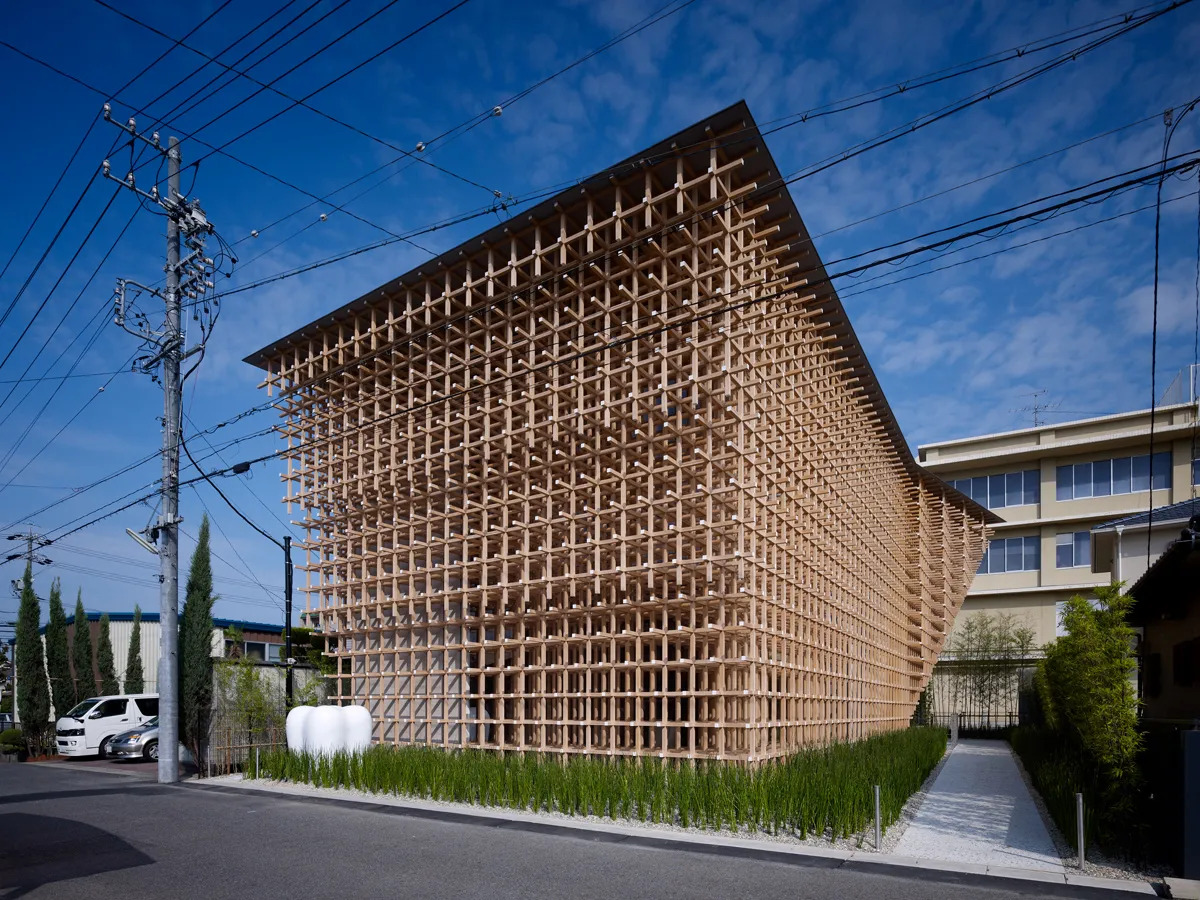
The Kengo Kuma Faces collection is a 16-piece handwoven rug series produced with Jaipur Rugs and presented for the first time at Milan Design Week 2026. Each rug interprets the facade of a specific Kengo Kuma & Associates building, translating layered timber, ceramic, or lattice patterns into wool and regenerated viscose at floor scale. The collection is exhibited at three Milan venues during the week.
The premise is direct: Kuma’s buildings are widely recognised for their facades, screens, slats, and modular surfaces that filter light and break the visual mass of a wall. Faces takes those vertical compositions and lays them flat. Some pieces are more literal, with grids and bands that recall a specific building’s exterior. Others are atmospheric, working with the gradients of shadow and tone that you find in the deeper layers of a Kuma facade rather than its outline.
Crucially, the collection is named for traditional Japanese construction techniques rather than for the buildings themselves. Pieces such as Sukima, Bokashi, Chirashi, Kasane, and Kiguma carry names that describe joining, layering, scattering, and gradient methods used in Japanese architecture and interior craft. That naming choice signals what Kuma and Jaipur are after: not architectural souvenirs, but a textile vocabulary that shares roots with the buildings.
💡 Pro Tip
If you are visiting Milan to study the collection, see it at the Crespi Bonsai Museum first and the Salone stand second. The Crespi installation places the rugs inside a Japanese garden context that explains the design language, and once your eye is trained, the trade-fair pieces at Salone read as a much more ordered material study.
Where to See the Collection During Design Week Milan 2026
The Faces collection is shown in three locations across Milan during design week 2026. The choice of three very different venues is deliberate and tells you something about how Jaipur Rugs and Kengo Kuma & Associates wanted the work read. One venue is commercial, one is brand-focused, and one is contextual.
Crespi Bonsai Museum (21–24 April 2026)
The most photographed venue. Founded in 1991, the Crespi Bonsai Museum sits in San Lorenzo di Parabiago, just outside Milan, and houses around 200 bonsai specimens, some of them more than a century old. It also includes a reconstructed tokonoma alcove, antique Japanese furnishings, and a Zen garden, which makes it a natural cultural fit for a Japanese architect’s first Milanese rug debut. According to Wallpaper*, this is the first time the Crespi Bonsai Museum has hosted a Milan Design Week presentation, and the rugs are placed in dialogue with the living bonsai collection.
Jaipur Rugs Showroom, Via Marco Minghetti
The brand’s permanent Milan showroom hosts the full Faces line in retail context, alongside Jaipur Rugs’ wider production. This is where buyers, interior designers, and specifiers spend the most time, and it’s the right venue for understanding how the rugs scale to actual interiors rather than installations. The location is central, near the Duomo, and stays open beyond the official design week dates.
Salone del Mobile, Hall 22
Jaipur Rugs presents the collection on its stand at Salone del Mobile, in Hall 22, alongside other major rug exhibitors including Amini, GAN, Golran, Mariantonia Urru, and Nanimarquina. If you only have a single day at the fair, this is the most efficient way to see Faces in the wider context of contemporary rug design. For the wider fair programme, see our overview of the Salone Internazionale del Mobile 2026.
🎓 Expert Insight
“Rather than translating the facades directly, we were more interested in capturing the sensory memory of architecture. What remains in our memory is not the exact form or geometry, but the atmosphere it creates, the way light touches a surface, the depth of layers and the subtle textures that we perceive almost unconsciously.”, Kengo Kuma, Kengo Kuma & Associates
Kuma’s framing here is the key to reading Faces. The rugs are not facsimiles of buildings, they are records of the impression a facade leaves once you’ve stopped looking at it directly, which is closer to how most people actually experience architecture in everyday life.
How the Faces Rugs Reference Specific Kengo Kuma Buildings
Several pieces in the collection reference identifiable Kengo Kuma & Associates buildings, and the references work at the level of pattern, palette, and rhythm rather than literal depiction. Knowing the source projects sharpens what you see in the rugs.
Sukima and Bokashi: The Suntory Museum of Art, Tokyo
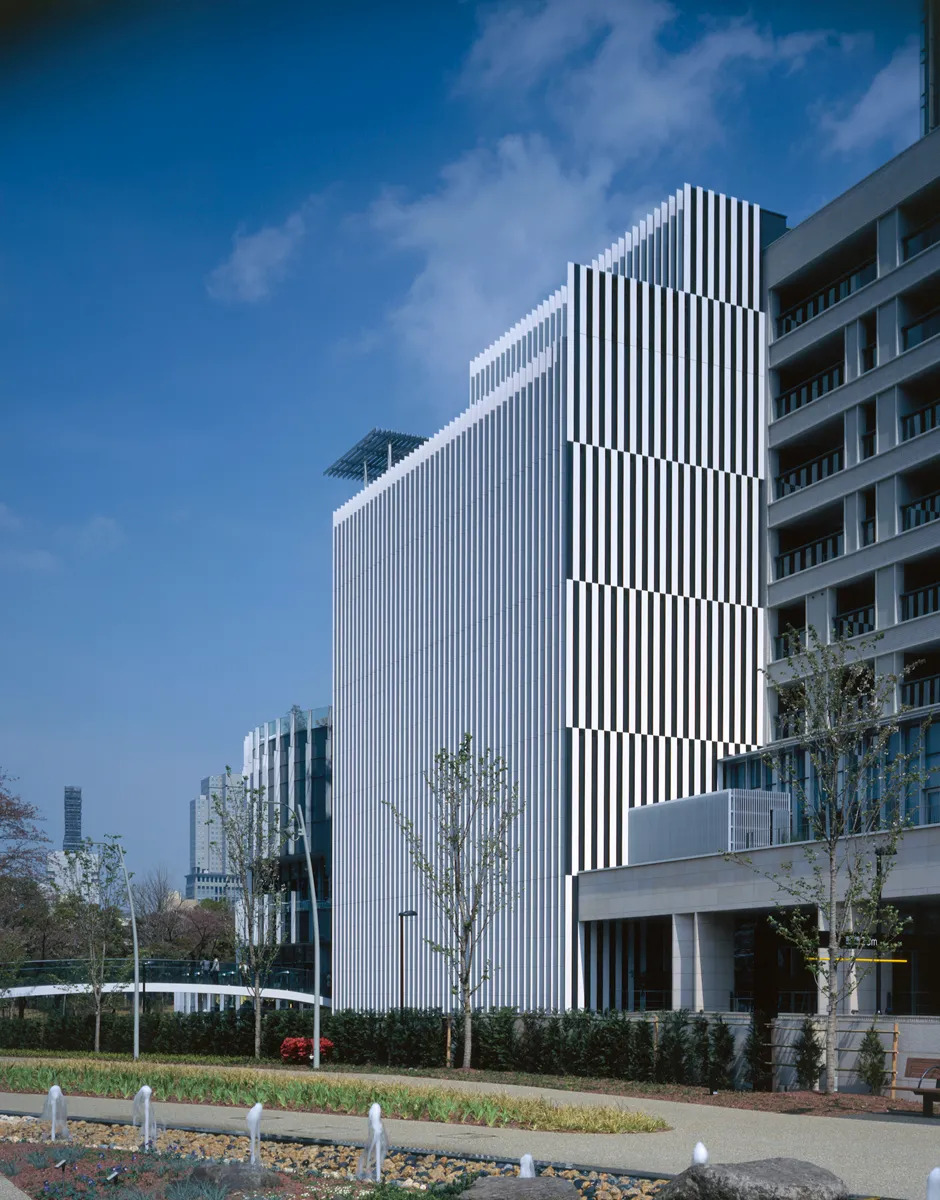
The Suntory Museum of Art, located in Tokyo Midtown, is wrapped in vertical timber louvres that play on the traditional Japanese musō-gōshi lattice. The Sukima rug picks up that vertical rhythm at floor scale, with linear intervals that recreate the way the louvres carry light across the building. Bokashi, also drawn from the museum, focuses on tone rather than line, working through subtle colour gradations that read as soft transitions of shadow. According to Dezeen’s coverage, the rug names refer to traditional Japanese construction techniques used by Kuma’s practice and seen in the source buildings.
Kiguma: GC Prostho Museum Research Centre, Aichi
The GC Prostho Museum Research Centre in Kasugai, Aichi Prefecture, is one of Kuma’s most studied buildings, an entire structure built from a system of small interlocking timber rods stacked into a three-dimensional grid using the chidori joinery technique. Kiguma translates the open lattice of that wooden structure into a dense, gridded textile face that reads as woodwork seen from a distance.
Chirashi: Kanayama Community Centre, Gunma
The Kanayama Community Centre in Gunma is a low-slung public building defined by scattered, irregular cladding patterns that break up its visible mass. Chirashi, a Japanese term that suggests scattering or dispersal, takes that distributed rhythm and applies it to the rug as a softened, broken pattern.
Albert Kahn Museum, Boulogne-Billancourt
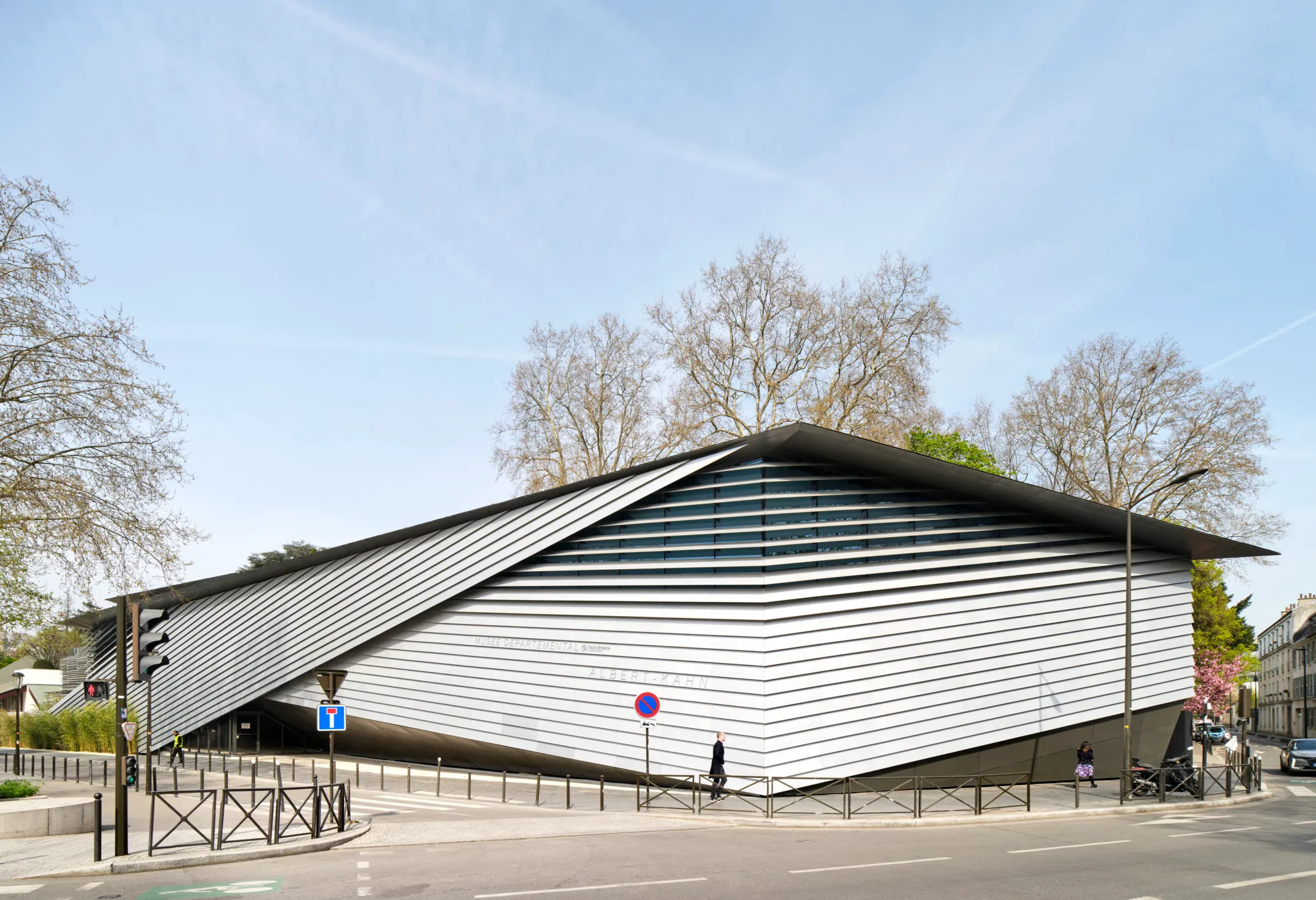
The redesigned Albert Kahn Museum in the Paris suburb of Boulogne-Billancourt sits behind a layered bamboo facade that filters light into the gallery interior. According to Design Anthology UK, several pieces in the collection use earthy, neutral tones with graphic patterns that mimic light falling on the three-dimensional planes of facades such as the bamboo louvres of this museum. If you want to see the Boulogne-Billancourt facade and its translation into textile in the same week, this is the rug to look for.
Anyone unfamiliar with these projects may want to read our overview of Kengo Kuma’s architectural work before visiting Milan. The rugs become much richer to look at once you can recognise the source buildings.
How is each rug actually made?
Each piece in the Faces collection is handwoven in Rajasthan, using a combination of wool and regenerated natural-fibre viscose. Wool gives the rug its softness and warmth of touch, in line with Kuma’s preference for natural materials. The viscose provides the structural rigidity that holds the more graphic, three-dimensional patterns sharp, especially in the pieces that recreate facade lattices. The combination is what allows a rug to read as architecture rather than as soft furnishing.
📐 Technical Note
Hand-knotted Persian-style rugs are typically classified by knot density (knots per square inch, KPSI), and contemporary high-end designer rugs in this category generally fall between 100 and 200 KPSI, with finer silk-blend pieces exceeding 400 KPSI. Wool-and-viscose constructions like those used in the Faces collection are well-suited to graphic, three-dimensional pile work because viscose holds shorn relief edges more cleanly than wool alone.
Why Milan Design Week 2026 Matters for Architects
Milan design week has become the place where architects test product ideas in public, in front of an audience that includes interior designers, manufacturers, journalists, and other architects. Salone del Mobile alone draws hundreds of thousands of visitors and exhibitors from dozens of countries every April, and the parallel Fuorisalone programme spreads design events across the entire city.
For architects, design week in Milan 2026 is a working observatory of where the field is heading. Three currents have been particularly visible this year: deep collaborations between architects and craft brands, a renewed focus on natural and regenerated materials, and the use of historic and unusual venues to frame product launches. The Kengo Kuma–Jaipur Rugs partnership sits squarely in all three.
Other architect–brand collaborations on view during Milan Design Week 2026 include Zaha Hadid Architects on a mindfulness installation, Kelly Wearstler’s debut furniture line for H&M, the Lucia Eames rug collection for Nanimarquina, and Fornasetti’s new fifteen-rug collaboration with cc-tapis. The Faces collection enters this conversation as one of the most architectural in language, because it is the one most explicitly tied to a body of built work.
For more on this year’s installations, the dedicated Salone del Mobile.Milano programme is the official source, and Fuorisalone.it covers the city-wide events outside the fair grounds. To see how previous editions have framed similar partnerships, our coverage of Milan Design Week 2025 standout installations is a useful reference point.
📌 Did You Know?
Jaipur Rugs was founded in 1978 with two looms and has grown to a global handmade carpet brand working with more than 40,000 artisans across 7,000 looms. Women represent around 85% of its weaving network, most of them based in rural villages in Rajasthan, where Faces was produced.
What the Faces Collection Says About Architecture and Craft
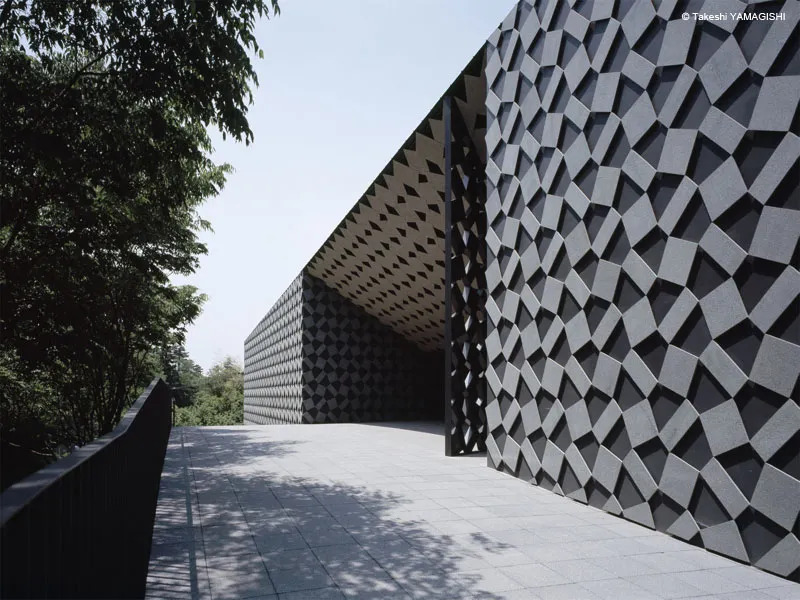
The most interesting thing about the Faces collection is not that an architect has designed rugs. Architects design rugs all the time. What makes this collaboration worth paying attention to is the directness with which it treats facade design as a transferable language, something that can move from a building exterior to a 2 by 3 metre piece of woven wool without losing its reasoning.
For readers who follow facade work, this is a useful prompt to look back at how Kuma builds his exteriors in the first place. His practice is recognisable for screens, grids, and layered surfaces in wood, stone, bamboo, steel mesh, or ceramic tile, each chosen for the way it filters light and responds to climate. The Faces rugs reduce those choices to a quieter palette of natural earthy tones with black-and-white graphic accents, but the logic is the same: a surface as a tool for filtering perception.
This is also a moment worth noting in the wider conversation about facade design in architecture. The Kuma collection effectively argues that a facade is not just a building’s outermost surface but a pattern logic that can travel into other media. That is a less common claim than it sounds, and it shifts the rug from a backdrop into a critical object.
🏗️ Real-World Example
Japan National Stadium (Tokyo, 2019): Kuma’s Olympic stadium was constructed using timber from all 47 Japanese prefectures, integrated into the eaves and facade as a deliberate continuation of traditional Japanese building practice at urban scale. The stadium’s layered timber surfaces give a clear example of the same vertical, fragmented logic that drives the Faces rugs at floor scale.
How does the partnership compare with Kuma’s other recent work?
The Faces collection lands in a year that already includes Kuma’s first Scandinavian art-centre exhibition, Earth | Tree at Copenhagen Contemporary, an installation built from Douglas fir timber, Petersen Tegl bricks, and natural light filtered to recreate the Japanese concept of komorebi. The Copenhagen project and the Milan rugs are doing related work in different media, both treating Kuma’s signature facade ideas (filtering, layering, atmosphere) as portable rather than fixed to the language of the building. For more on that side of the practice, see our coverage of the Earth | Tree installation at Copenhagen Contemporary.
How to Visit Milan Design Week 2026
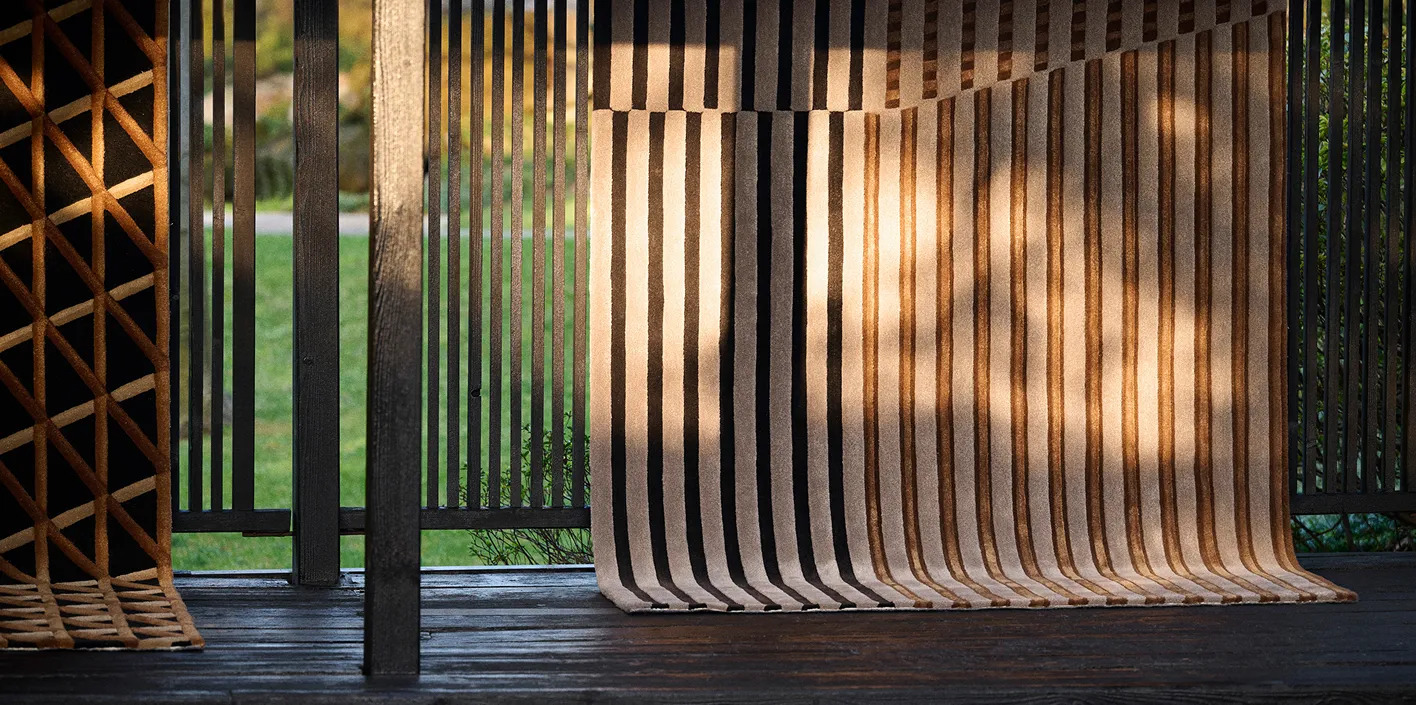
Milan design week 2026 takes place from 20 to 26 April 2026, with Salone del Mobile running for part of that window at Fiera Milano in Rho. Most Fuorisalone events are free to attend, while Salone itself requires a ticket, and the city becomes very busy during the week, especially in the Brera, Tortona, 5VIE, and Isola design districts.
If your priority is the Faces collection, plan around the three venues above. The Crespi Bonsai Museum is outside the city centre, in Parabiago, and reaching it requires either a regional train and short connecting trip or a car. The Jaipur Rugs showroom on Via Marco Minghetti is walkable from the Duomo, and the Salone stand requires a fairground ticket and around half a day to reach via the M1 metro to Rho Fiera.
Press preview days at Salone are typically narrower than the public days. Trade visitors and the press should check the official accreditation pages well in advance, especially given how much the rug presentations attract dedicated coverage. For practical information on visiting the city as a design student or young architect, our piece on Milan Design Week impressions covers the rhythm of the week from a critical vantage point.
Other Milan design week 2026 highlights worth combining with Faces
If you are visiting for one or two days, the most efficient pairings with the Kengo Kuma collection are: the cc-tapis showroom (for the Fornasetti collaboration and a useful comparison with Faces in rug design), the Crespi Bonsai Museum’s wider Japanese garden (which justifies the journey out to Parabiago on its own), and the Hall 22 cluster of major rug brands at Salone del Mobile. Aesop’s first lighting collection Aposē is also worth catching for those interested in how product brands are using design week as an architectural debut.
🔢 Quick Numbers
- 16 rugs in the Kengo Kuma Faces collection (Jaipur Rugs press materials, 2026)
- 40,000+ artisans across 7,000 looms in the Jaipur Rugs network (Jaipur Rugs corporate profile, 2026)
- Around 200 bonsai specimens in seasonal rotation at the Crespi Bonsai Museum (Wallpaper*, 2026)
- Milan Design Week 2026 runs 20–26 April across multiple Milan locations (Dezeen, 2026)
The Wider Milan Design Week News: Why Faces Matters
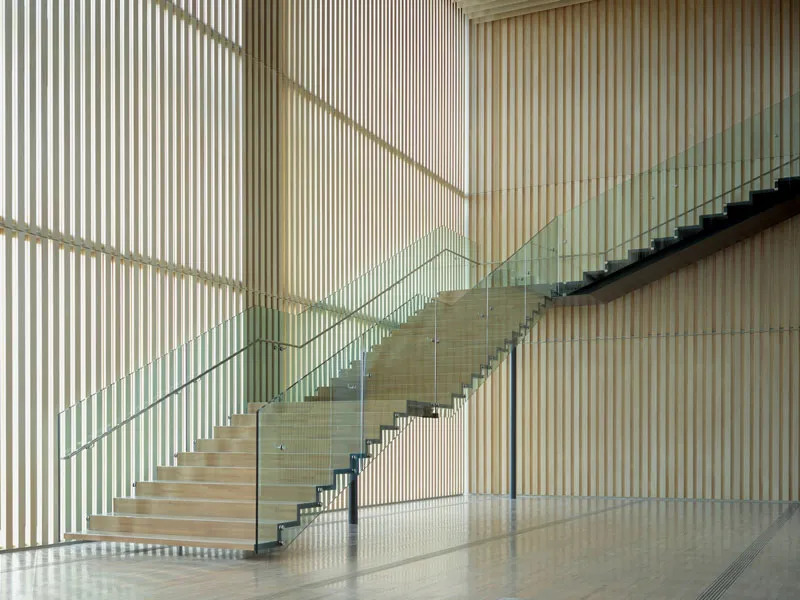
Within the broader Milan design week news cycle, the Kuma–Jaipur Rugs collaboration has been picked up by Dezeen, Wallpaper*, Galerie Magazine, COVER magazine, and Tatler Asia, each placing it among the most notable architect-led product launches of the 2026 edition. What sets it apart from a more typical signature collection is the depth of the collaboration with Jaipur Rugs’ artisans, which the brand’s leadership has described as one of the deepest collaborations they have undertaken with any external designer.
Greg Foster, Artistic Director at Jaipur Rugs, framed the project as architecture as textile, with the carpets immediately recognisable as the facades of some of Kuma’s most famous buildings. That positioning sets a useful expectation for visitors. You are meant to recognise the source. This is an architectural collection that happens to be made of wool.
✅ Key Takeaways
- Faces is a 16-piece handwoven rug collection produced by Jaipur Rugs with Kengo Kuma & Associates, debuting at Milan Design Week 2026 across three Milan venues.
- The rugs translate the facades of specific Kengo Kuma buildings (Suntory Museum of Art, GC Prostho Museum Research Centre, Kanayama Community Centre, Albert Kahn Museum) into wool-and-viscose textiles.
- The collection is named for traditional Japanese construction techniques (Sukima, Bokashi, Chirashi, Kasane, Kiguma) rather than for the buildings themselves.
- The Crespi Bonsai Museum installation is the most contextual venue and the most worthwhile if your time is limited.
- Faces is a clear example of facade design treated as a transferable language, with implications for how architects approach collaborations beyond the building scale.
Final Thoughts
The Kengo Kuma Faces collection is a rare case where an architect’s product collaboration genuinely expands the way you read their architecture. After looking at the rugs in Milan, the facades they reference start to look slightly different too, more like fields of pattern, and slightly less like solid walls.
If you are in Milan during design week, the collection is one of the strongest architectural reasons to make the trip out to the Crespi Bonsai Museum and to spend time at Hall 22 of Salone del Mobile. If you are not, the published images, the named techniques, and the source buildings are worth a longer reading list on their own. The Faces collection is, ultimately, the kind of work design week in Milan exists for: a careful, specific, materially intelligent translation that opens up an architect’s practice to a wider audience without diluting it.







MVRDV Brings the Vertical Village to Shenzhen: Inside the Bihailou Art Village
MVRDV is building the Bihailou Art Village in Shatoujiao, a 6,500 m2...
Elif Ayse Sen9 Mins read
Peter Zumthor on Film: Wim Wenders Captured in “From Inside Out”
Wim Wenders spent six years filming Peter Zumthor's buildings in 3D, and...
Elif Ayse Sen9 Mins read

Aalto Works on the UNESCO World Heritage List
Aalto Works joined the UNESCO World Heritage List in July 2026 as...
Elif Ayse Sen9 Mins read

World Capital of Architecture 2029: Why UNESCO and the UIA Chose Beijing
UNESCO named Beijing the fourth World Capital of Architecture on 5 August...
Elif Ayse Sen9 Mins read


Leave a comment