

Art Deco vs Bauhaus: Luxury Aesthetics vs Functional Purity in Architecture
A side-by-side comparison of Art Deco and Bauhaus architecture covering origins, design philosophy, materials, ornamentation, and iconic buildings. Includes a detailed feature comparison table and practical insights for architects studying both movements.
 Sinan Ozen3 March 20266 Mins read272

Table of Contents Show
Art Deco vs Bauhaus represents one of the most striking contrasts in 20th century architecture. Both movements emerged in Europe during the interwar period, yet they took radically different positions on what buildings should look like and who they should serve. Art Deco celebrated ornamentation, luxury, and visual drama. Bauhaus stripped everything back to function, simplicity, and industrial efficiency. Understanding how these two movements diverged helps architects appreciate the philosophical roots behind many styles we see today.
While Art Deco drew from ancient Egyptian motifs, Aztec geometry, and Jazz Age glamour, Bauhaus architecture was born in a German design school that sought to unify art, craft, and industrial production. Their shared timeline (roughly 1919 to the late 1930s) makes the comparison even more fascinating, because the same historical forces produced two opposite architectural responses.

What Is Art Deco Architecture?
Art Deco architecture takes its name from the 1925 Exposition Internationale des Arts Decoratifs et Industriels Modernes held in Paris. The style quickly spread across Europe and the United States, becoming synonymous with glamour, progress, and commercial ambition. Art Deco style architecture is defined by bold geometric patterns, rich color palettes, and lavish surface decoration using materials like marble, brass, chrome, and terracotta.
What is Art Deco architecture at its core? It is a visual language of optimism. Vertical lines, stepped silhouettes, chevron patterns, sunburst motifs, and stylized reliefs dominate facades. Buildings such as the Chrysler Building in New York (1930, designed by William Van Alen) and the Hoover Building in London showcase this blend of structural ambition and decorative exuberance. Art Deco drew freely from Egyptian, Mayan, and East Asian visual traditions, combining them with machine-age imagery.
The movement thrived during the economic prosperity of the 1920s. Its decline began with the Great Depression in 1929, when the opulence it celebrated started to feel tone-deaf. By the outbreak of World War II, Art Deco had largely faded from mainstream practice, though its influence persists in cities like Miami Beach, Mumbai, and Shanghai.

What Is Bauhaus Architecture?
What is Bauhaus architecture? It is the architectural legacy of the Bauhaus school, founded by Walter Gropius in Weimar, Germany, on April 1, 1919. The word “Bauhaus” translates to “building house,” and the school’s mission was to merge fine art with applied craft and industrial design. The school operated across three cities (Weimar, Dessau, and Berlin) before the Nazi regime forced its closure in 1933.
Bauhaus architecture rejects ornamentation in favor of functional clarity. Flat roofs, smooth white facades, asymmetrical compositions, ribbon windows, and the honest expression of steel, glass, and reinforced concrete define the style. The Bauhaus Dessau building, designed by Gropius and completed in 1926, remains the most iconic example. Its glass curtain wall on the workshop wing was revolutionary, eliminating the boundary between interior and exterior space.
Faculty members including Wassily Kandinsky, Paul Klee, Marcel Breuer, and Ludwig Mies van der Rohe shaped the movement’s philosophy. Mies, the school’s final director, popularized the phrase “less is more,” which encapsulates the Bauhaus movement’s approach. After the school’s closure, many educators emigrated to the United States, where they profoundly influenced American architectural education and the International Style.
Bauhaus vs Art Deco: Core Design Philosophy
The bauhaus vs art deco debate ultimately comes down to disagreement about architecture’s purpose. Art Deco treated buildings as vehicles for visual pleasure, cultural expression, and commercial prestige. A building’s surface was an opportunity to dazzle and communicate wealth. Bauhaus believed that form should follow function, where every element justified its existence through practical purpose rather than decorative appeal.
This philosophical split extended to industrial production. The Bauhaus movement embraced mass production as a democratic tool. Affordable, well-designed objects and buildings could improve the lives of ordinary people. According to the Bauhaus overview on The Art Story, the school placed practical crafts on equal footing with painting and sculpture. Art Deco, on the other hand, often used industrial materials in service of luxury. Chrome and stainless steel appeared alongside exotic hardwoods and hand-applied lacquer, creating objects designed to signal status.
Both movements rejected the heavy historicism of 19th century architecture, but they replaced it with opposing visions. Art Deco said: “The future is glamorous.” Bauhaus said: “The future is rational.”

Art Deco vs Bauhaus Architecture: Materials and Construction
Materials tell the story of art deco vs bauhaus architecture as clearly as any design principle. Art Deco architects favored decorative surfaces: polished granite, terracotta tile, ornamental metalwork in brass and bronze, stained glass, and colorful ceramic mosaics. Interior spaces featured lacquered wood, inlaid marble, and elaborate lighting fixtures.

Bauhaus architecture embraced industrial materials honestly. Reinforced concrete, steel framing, and large expanses of plate glass formed its structural vocabulary. Surfaces were typically rendered in white or neutral plaster. The Fagus Factory (1911, by Gropius and Adolf Meyer), often cited as a proto-Bauhaus building, used a steel frame with floor-to-ceiling glass panels that made the structure appear weightless. As detailed by Dezeen’s guide to Bauhaus, these material choices reflected a belief that beauty emerges from structural honesty rather than applied decoration.
The cost implications were significant. Art Deco buildings, with their hand-crafted ornament and premium materials, were expensive to construct and often commissioned by wealthy patrons or corporations. Bauhaus buildings aimed for economy and replicability, with standardized components manufactured at scale. This difference made Bauhaus principles particularly influential in post-war social housing programs.
Comparison of Art Deco and Bauhaus Architecture
The following table highlights the key differences between these two movements across several architectural dimensions:
| Feature | Art Deco | Bauhaus |
|---|---|---|
| Time Period | 1925 to late 1930s (peaked in the 1920s) | 1919 to 1933 (school era), influence ongoing |
| Origin | Paris, France (spread to USA, Asia, South America) | Weimar, Germany (spread globally after 1933) |
| Design Philosophy | Decorative luxury, visual drama, cultural eclecticism | Form follows function, minimalism, social purpose |
| Ornamentation | Highly ornate: chevrons, sunbursts, zigzags, reliefs | Minimal to none; beauty through structure and proportion |
| Materials | Marble, brass, chrome, terracotta, exotic woods | Steel, glass, reinforced concrete, white plaster |
| Color Palette | Bold, rich colors: gold, emerald, deep blue, black | Neutral and restrained: white, gray, beige, primary accents |
| Key Figures | William Van Alen, Eileen Gray, Emile-Jacques Ruhlmann | Walter Gropius, Mies van der Rohe, Marcel Breuer |
| Iconic Buildings | Chrysler Building (NYC), Hoover Building (London) | Bauhaus Dessau, Fagus Factory, Villa Tugendhat |
| Target Audience | Wealthy patrons, corporations, commercial buildings | Broader public, social housing, institutional buildings |
Bauhaus Movement vs Art Deco: Cultural and Political Context
The bauhaus movement vs art deco split cannot be understood without their political backdrops. Art Deco flourished during the Roaring Twenties, a period of economic expansion and consumer optimism. It aligned naturally with capitalism and commercial spectacle, finding its preferred building types in skyscrapers, department stores, and cinemas.
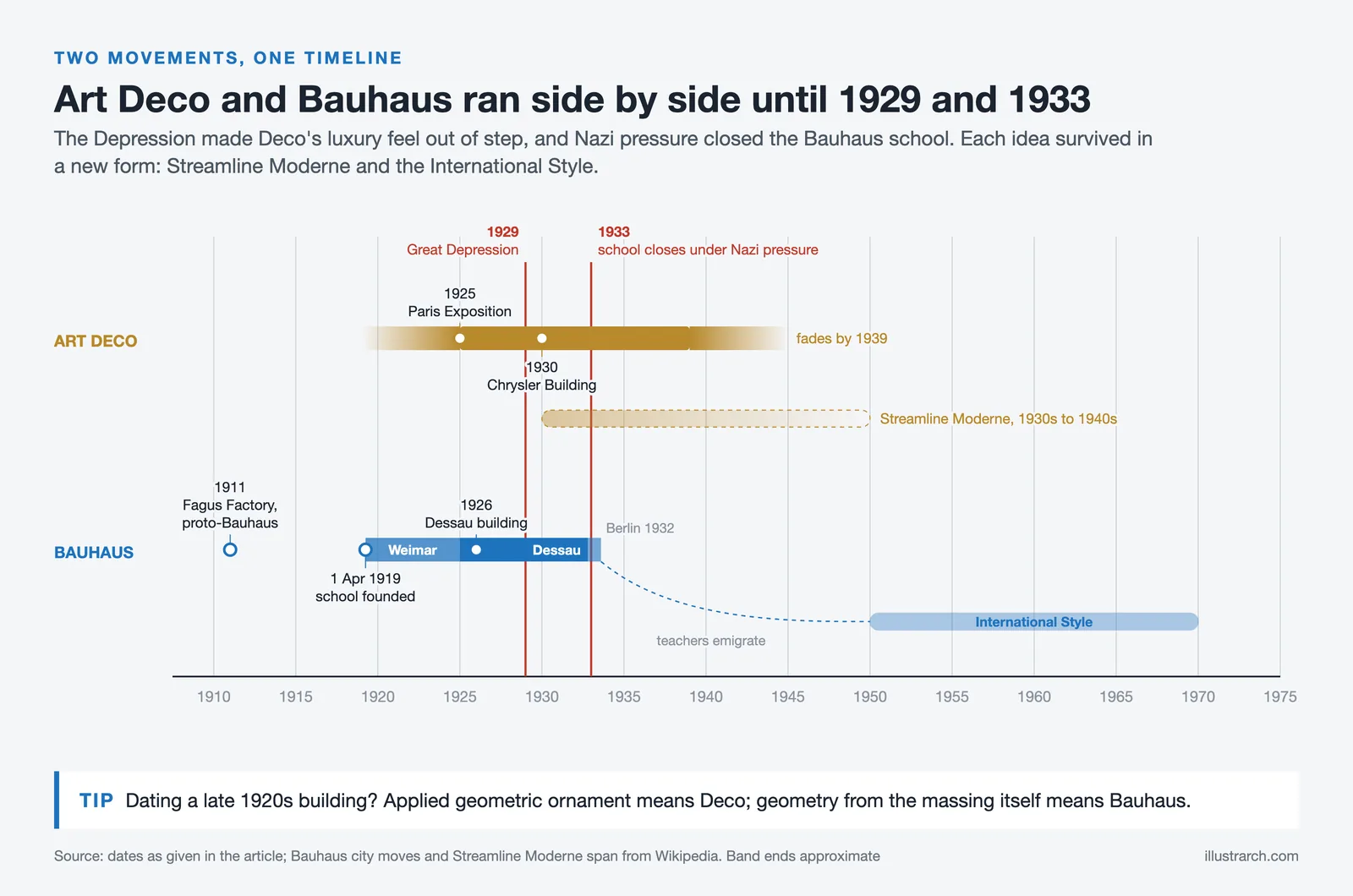
Bauhaus emerged from a very different reality. Post-World War I Germany faced economic devastation and social unrest. Gropius envisioned the school as a force for social reconstruction, training designers who could create affordable, functional environments for ordinary citizens. The school attracted students from over 29 countries, cultivating an internationalist ethos that placed it at odds with rising nationalism. The school closed in 1933 under pressure from the Nazi regime.
Art Deco’s decline also had political roots. The Great Depression of 1929 made its extravagance feel inappropriate. The transitional style known as Streamline Moderne softened Art Deco’s sharp angles into aerodynamic curves, bridging the gap toward mid-century modernism.

Shared Ground Between Art Deco and Bauhaus
Despite their differences, Art Deco and Bauhaus shared several important characteristics. Both rejected 19th century revival styles (Victorian, Gothic Revival, Beaux-Arts) in favor of forward-looking design. Both embraced geometry as a fundamental organizing principle, and both were enthusiastic about modern materials and industrial technology, even if they applied these to different ends.
Both movements influenced fields beyond architecture, including furniture, graphic design, and typography. Art Deco shaped skylines in Mumbai, Shanghai, and Buenos Aires, while Bauhaus principles took root in Tel Aviv (a UNESCO World Heritage Site for its Bauhaus buildings), Chicago, and cities across Latin America.

How Art Deco and Bauhaus Influence Modern Architecture
Both movements continue to shape contemporary practice. Bauhaus principles directly informed the International Style that dominated corporate architecture from the 1950s through the 1970s. Glass-and-steel towers, open-plan interiors, and modular construction systems all trace their lineage to Gropius and Mies. Today, modern interior architecture still relies on Bauhaus ideas about spatial openness and functional zoning.
Art Deco’s influence is more intermittent but equally persistent. Postmodern architecture of the 1980s borrowed Art Deco’s love of surface decoration. Contemporary luxury hospitality and residential projects frequently incorporate Art Deco motifs such as geometric tilework and metallic accents. Cities that preserved their Art Deco heritage, particularly Miami’s South Beach and Mumbai’s Marine Drive, now benefit from cultural tourism.
For architects today, the Art Deco vs Bauhaus debate offers a useful framework for fundamental design choices. How much ornamentation serves the user? When does minimalism become cold? Can luxury and function coexist? These questions, first posed in the 1920s, remain relevant in a profession constantly balancing aesthetics, budget, and cultural meaning.





Florence Renaissance Architecture: How Building Became an Authored Art
Florence Renaissance architecture is usually told as a list of buildings. The...
 Furkan Sen6 Mins read
Architectural Styles History: Why Some Styles Fail and Others Endure
A look at architectural styles history through the decisions that actually keep...
Furkan Sen6 Mins read
Architectural Styles: Why Some Endure and Others Fade
Some architectural styles last for centuries while others are demolished within a...
Furkan Sen5 Mins read
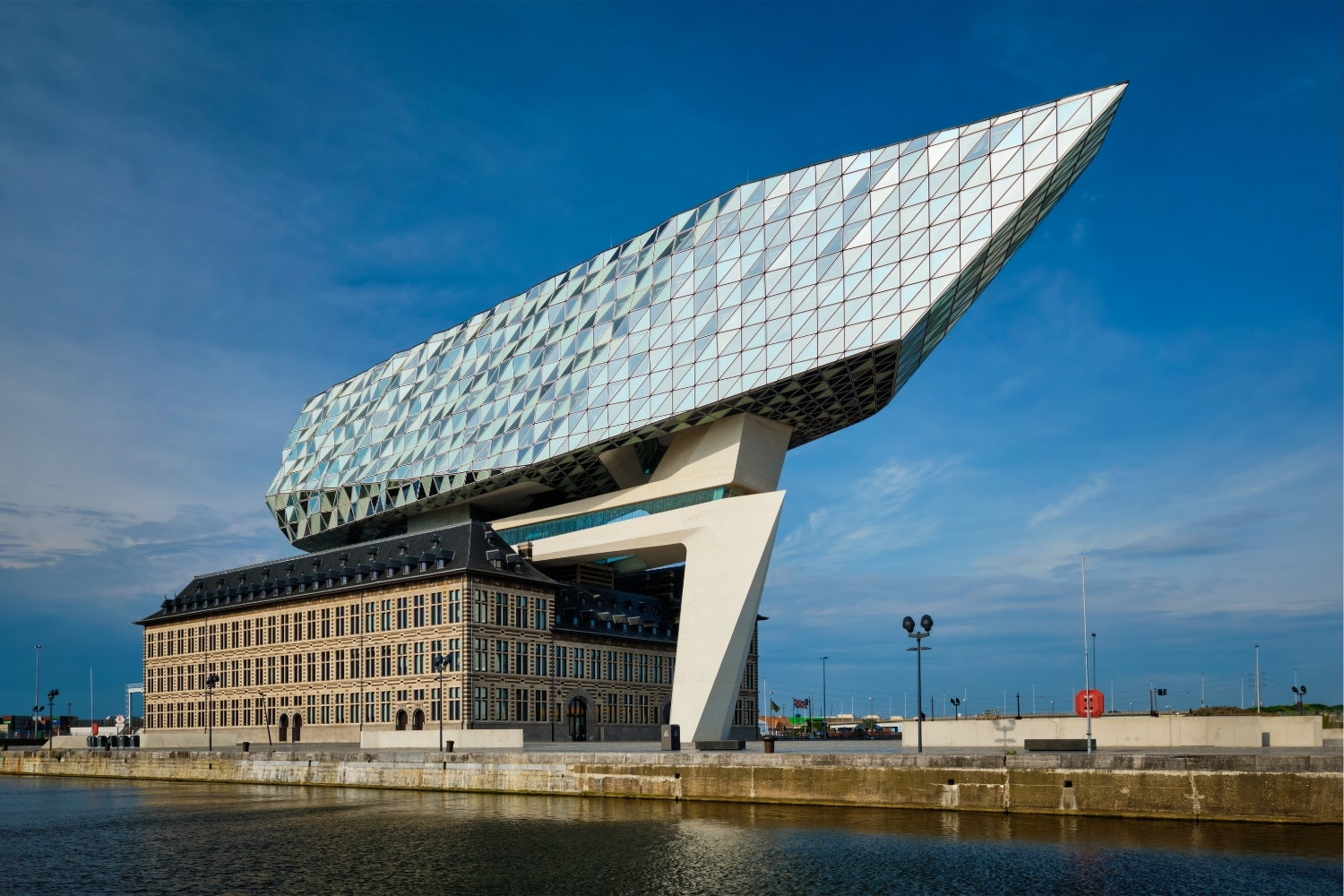
Postmodern Architecture vs Deconstructivism: Playful Irony or Radical Disruption?
Postmodern architecture and deconstructivism both rejected modernism but took opposite paths. This...
Sinan Ozen5 Mins read


Leave a comment