

History of Architecture: Timeline from Ancient to Modern
Trace the complete evolution of architecture from prehistoric shelters and ancient Egyptian pyramids to Gothic cathedrals, modern skyscrapers, and sustainable design in 2025. Explore every major architectural period, style, and innovation.
 Elif Ayse Sen18 November 202514 Mins read2k

Table of Contents Show
Quick Answer: The history of architecture spans thousands of years, from prehistoric shelters and ancient temples to Gothic cathedrals, Renaissance palaces and modern skyscrapers. Each era reflects its culture, technology and materials, and together they trace how human building has evolved over time.
The history of architecture spans over 10,000 years of human civilization, from the megalithic monuments of prehistoric cultures to the parametric skyscrapers of 2025. Each era reflects the materials, beliefs, and ambitions of its time, making architectural history one of the most direct records of how human societies have developed and changed.
The history of architecture covers every major building tradition from prehistoric stone monuments and ancient Egyptian pyramids to Gothic cathedrals, Renaissance symmetry, industrial-era steel frames, Modernist minimalism, and the sustainable, digitally driven designs of 2025. Understanding this timeline helps architects, students, and enthusiasts trace how structural innovations, cultural values, and available materials shaped the built environment across continents and centuries.
What Is Architecture History and Why Does It Matter?
Architecture history is the study of how buildings and structures have evolved across civilizations, climates, and centuries. It examines the chronology of architecture, from ancient buildings constructed with mud brick and stone to modern structures that use an arch and dome system alongside advanced materials like steel, glass, and engineered timber. Learning about the historical styles of architecture helps us appreciate how each era’s values, technologies, and beliefs shaped the spaces people lived and worked in.
The purpose of learning about the history of architecture extends beyond academics: it informs today’s architects and urban planners, guiding sustainable design choices and preserving architectural heritage for future generations. Organizations such as the International Council on Monuments and Sites (ICOMOS) and the World Monuments Fund work to protect historically significant structures worldwide, a task that depends on understanding how and why those buildings were designed.
🔢 Quick Numbers
For the full picture, see our complete guide to architectural styles that shaped history.
- Göbekli Tepe (c. 9500 BC) is the oldest known monumental structure on Earth, predating Stonehenge by roughly 6,500 years (source: Smithsonian Institution, 2023)
- The Roman Pantheon’s unreinforced concrete dome, spanning 43.3 meters, remained the world’s largest for over 1,300 years until the Florence Cathedral was completed in 1436 (source: Encyclopaedia Britannica)
- According to the World Green Building Council (2023), buildings and construction account for 37% of global CO2 emissions, driving today’s shift toward net-zero architectural design
- The UNESCO World Heritage List includes over 900 cultural sites, many of them architectural landmarks that document the full scope of building history across every inhabited continent (source: UNESCO, 2024)
The Origin of Architecture: Where Building Became Design
The origin of architecture is not the first shelter. Shelter is older than our species and it is construction rather than architecture. Architecture begins at the point where a structure is built to mean something beyond keeping the weather out, and the archaeological record puts that moment much earlier than the traditional account allowed.
Göbekli Tepe changed the timeline. Built from roughly 9500 BC in what is now south-eastern Turkey, it is monumental, carved, deliberately arranged, and it predates agriculture, pottery and the wheel. The old sequence held that farming produced settlement, settlement produced surplus, and surplus produced monuments. Göbekli Tepe reverses it: the monument came first.
What separates architecture from building. Three things recur wherever the line is drawn. The structure does more than it functionally needs to. Its form is chosen rather than dictated by material. And it is meant to be read by people who did not build it.
Why the origin question matters now. Every period after this one is arguing with the same problem: how much of a building is necessity and how much is statement. The eras below are successive answers to that question rather than a sequence of decorative fashions.
Documentation of the earliest sites is held by bodies such as ICOMOS and the World Monuments Fund, whose conservation records are the primary sources behind most of what follows, alongside the research published by the Getty Conservation Institute.
Prehistoric and Ancient Architecture (Before 400 AD)
Architecture in Prehistoric Times
The evolution of architecture begins long before recorded history. During prehistoric times, early humans built simple shelters from natural materials: wood, animal hides, and stone. Architecture in prehistoric times progressed from cave dwellings to more permanent structures as communities settled. Megalithic monuments such as Stonehenge (c. 3000 BC) and Göbekli Tepe (c. 9500 BC) represent early humanity’s ambition to create ceremonial and communal spaces, marking the prehistoric period architecture that laid the groundwork for all subsequent architectural eras.
Ancient Architecture Styles and Famous Buildings
The story of ancient architecture truly begins with the great civilizations of Mesopotamia, Egypt, and the Indus Valley, where the first cities and monumental structures were built. Mesopotamian ziggurats and Egyptian pyramids, such as the Great Pyramid of Giza, stand as testaments to these ancient architects’ ingenuity and their desire to connect with the divine. These ancient famous architecture examples remain among the most recognizable ancient buildings in the world. For a broader look at how these early traditions continue to shape design practice, see our overview of influential ancient architectures and their impact on modern design.
Ancient Greek architecture introduced the concepts of proportion, harmony, and order, principles encapsulated in the Doric, Ionic, and Corinthian orders. The Parthenon in Athens exemplifies these ideals, influencing Western architectural styles for millennia. Ancient Greek architects established a design language that remains central to architectural education today. The mathematical precision of Greek temples, including subtle optical corrections like entasis (a slight swelling of columns to counteract the illusion of concavity), reveals how deeply ancient builders understood human perception. The golden ratio in architecture, often associated with the Parthenon’s proportions, continues to guide design thinking.
Roman architecture brought innovations such as the arch, the vault, and the dome, enabling the construction of expansive and durable structures like the Colosseum and the Pantheon. Among the most important Roman architectural innovations were the widespread use of concrete, the perfected arch-and-dome system, aqueducts, and bridges. The Pantheon, in particular, remains a celebrated structure that uses an arch and dome system first perfected in ancient times. You can explore a detailed breakdown of these achievements in our guide to top Greek and Roman architectural innovations.
📌 Did You Know?
Roman concrete (opus caementicium) was mixed with seawater and volcanic ash, a combination that actually strengthens over time when submerged. Modern materials scientists studying ancient Roman harbor structures have found that this mix outperforms many contemporary concretes in marine durability, a discovery published in American Mineralogist (2017) that continues to influence sustainable materials research today.

Medieval Architecture: Architectural Eras from 400 AD to 1500 AD
Byzantine and Romanesque Architectural Periods
The fall of the Roman Empire led to the Byzantine and Romanesque styles, which saw the evolution of religious architecture. The Hagia Sophia in Constantinople (now Istanbul), completed in 537 AD, exemplifies Byzantine architecture with its magnificent central dome. Romanesque architecture, characterized by thick walls, rounded arches, and sturdy pillars, served as a critical transitional phase in this architectural styles timeline.
What Made Gothic Architecture So Revolutionary?
The Gothic style emerged in the 12th century, characterized by pointed arches, ribbed vaults, and flying buttresses. These structural innovations worked together to redirect weight outward and downward, freeing interior walls from load-bearing duties. The result: taller structures and far more natural light, as seen in cathedrals like Notre-Dame in Paris and Chartres Cathedral. Gothic cathedrals remain among the finest examples of old world architecture that continues to inspire visitors and architects alike.
💡 Pro Tip
When studying Gothic cathedrals for design research, pay close attention to how flying buttresses function as an external structural skeleton rather than decorative elements. This logic of externalizing structural systems to maximize interior flexibility is one that contemporary architects still apply in long-span and high-rise buildings today.

Islamic Architecture: A Missing Chapter in the Western Timeline
While European architectural history often moves directly from Romanesque to Gothic, the Islamic architectural tradition was producing some of the most sophisticated buildings in the world during the same centuries. Mosques, madrasas, caravanserais, and palaces across the Middle East, North Africa, Central Asia, and the Iberian Peninsula developed a distinct design vocabulary rooted in geometry, light control, and courtyard planning.
The Great Mosque of Cordoba (begun 784 AD) introduced the horseshoe arch and the hypostyle hall to the Iberian Peninsula, while the Alhambra in Granada (13th-14th century) brought muqarnas vaulting and tessellated tilework to a level of mathematical precision that still fascinates researchers. Across the Ottoman Empire, architects like Mimar Sinan pushed dome construction to new limits. His Selimiye Mosque in Edirne (1575) features a central dome that exceeds the Hagia Sophia’s span while resting on a far more elegant octagonal support system. For more on this tradition, our detailed guide to the legacy of Ottoman architecture traces how these innovations shaped cities from Sarajevo to Cairo.
Islamic architecture’s influence on the Western tradition is significant. Pointed arches, which became the hallmark of Gothic cathedrals, were used in Islamic buildings centuries earlier. Geometric tile patterns, sophisticated hydraulic systems, and the courtyard typology all traveled from Islamic contexts into European design practice through cultural exchange in medieval Spain, Sicily, and the Crusader states. You can explore more about how these traditions interact with contemporary practice in our article on the dialogue between Islamic architecture and modern design.
🎓 Expert Insight
“The physician can bury his mistakes, but the architect can only advise his clients to plant vines.”
Frank Lloyd Wright, Architect
Wright’s observation captures a truth about architecture that runs through every era covered in this timeline: buildings outlast their makers and carry their decisions, good and bad, into the future. This permanence is exactly why studying the history of architecture matters for anyone who designs or commissions buildings today.
Renaissance and Baroque Architecture (1400 AD to 1800 AD)
Renaissance: A Return to Classical Architectural Periods
The Renaissance marked a return to the classical ideals of Greek and Roman architecture, emphasizing symmetry, proportion, and geometry. Architects like Filippo Brunelleschi and Andrea Palladio designed buildings that embodied these principles, such as the dome of Florence Cathedral and the Villa Capra “La Rotonda.” This period is a pivotal chapter in the history of architectural styles, bridging medieval traditions with the scientific precision that would define later eras of architecture.
The Renaissance also introduced a new professional identity for architects. For the first time, individual designers like Leon Battista Alberti published architectural treatises that codified design theory, separating the architect from the craftsman. This shift had lasting implications for how buildings were conceived and credited, a distinction that persists today.
Baroque: Bold Ornamentation in the Architectural Styles Timeline
The Baroque period followed, known for its dramatic use of light, bold ornamentation, and expansive scale. The Palace of Versailles in France exemplifies Baroque architecture‘s grandeur. This architectural era represented a peak in European artistic ambition. The Neoclassical movement that followed in the 18th century pulled back from Baroque excess, returning to the restrained geometry of Greek and Roman precedents. Buildings like the Pantheon in Paris and the Brandenburg Gate in Berlin reflect this shift. For a closer look at how Neoclassical design compares with later movements, see our detailed analysis of Neoclassical architecture vs Modern architecture.
🏗️ Real-World Example
Palace of Versailles (Versailles, France, 1682): Designed under Jules Hardouin-Mansart for Louis XIV, the palace covers over 63,000 square meters of floor area and originally housed around 20,000 courtiers and staff. Its Hall of Mirrors, spanning 73 meters, used 357 mirrors strategically placed opposite arched windows to amplify candlelight, a Baroque mastery of light manipulation that remains a studied precedent in spatial design today.

The Evolution of Architecture: Industrial Revolution to Modernism (1800-1950)
The Origin of Modern Architecture
The Industrial Revolution introduced new materials like iron, steel, and glass, fundamentally changing how architecture evolved. This period saw the development of skyscrapers, factories, and bridges, a pivotal shift in the evolution of materials in architecture. Architectural movements such as Art Nouveau, which embraced organic forms and decorative details, and later, Art Deco, which celebrated modernity, technology, and luxury, defined this transformative era.
The early 20th century marked the rise of Modernism, the true origin of modern architecture, characterized by a departure from historical styles, a focus on function, and the use of modern materials. Architects like Le Corbusier, Mies van der Rohe, and Frank Lloyd Wright pushed the boundaries of design, emphasizing simplicity, open space, and integration with the natural environment. The Bauhaus movement, founded in 1919, became a cornerstone of the history of modernism architecture, promoting the idea that form should follow function. Free educational resources like the MIT OpenCourseWare architecture program continue to use Bauhaus-era principles as a foundation for teaching design theory today.
⚠️ Common Mistake to Avoid
Many students confuse Art Nouveau and Art Deco as variations of the same movement. They are distinct responses to the same industrial era: Art Nouveau (1890-1910) drew from organic, natural forms and hand-crafted ornament, while Art Deco (1920-1940) embraced geometric abstraction, machine production, and the glamour of modern technology. Conflating them misrepresents two fundamentally different design philosophies.
How Did Ancient Egyptian Architecture Influence Modern Day?
Ancient Egyptian architecture influenced modern day design through its emphasis on monumental scale, axial planning, geometric precision, and durable materials. The Egyptian focus on symmetry and proportion echoed through Renaissance and Neoclassical revivals, and the concept of post-and-lintel construction remains foundational in modern architecture. Even contemporary monuments and civic buildings draw inspiration from the ceremonial grandeur of this old style architecture. You can see a broader picture of this influence in our overview of ancient architectural styles that shaped our world.
Contemporary Architecture and the Architectural Evolution (1950 to Present)
Postmodernism and Architecture Through the Ages
Postmodernism emerged in the latter half of the 20th century as a reaction against the perceived austerity of Modernism, reintroducing ornament and embracing historical references and eclectic styles. The Sydney Opera House (Jørn Utzon, opened 1973), with its expressive form and innovative concrete shells, is a modernist landmark that predates this shift rather than an example of it. This movement reminded designers that architecture through history has always drawn from the past to create something new. For a deeper look at how postmodernism reshaped built environments worldwide, our article on famous examples of postmodern architecture covers the key buildings and designers.
The Deconstructivist movement of the late 1980s and 1990s pushed further, fragmenting conventional forms and challenging structural expectations. Architects like Frank Gehry, whose Guggenheim Museum Bilbao (1997) triggered a wave of iconic museum commissions, and Zaha Hadid, whose fluid parametric forms redefined what buildings could look like, became defining figures of this era. You can read more about these architects’ approaches in our article on Constructivism vs Deconstructivism in architecture.

How Is Architecture Evolving in 2025?
Today, sustainable architecture and digital design technologies are at the forefront of the architectural evolution. The focus is on energy efficiency, environmental impact, LEED-certified green building practices, and the use of computer-aided design (CAD), Building Information Modeling (BIM), and 3D printing. Contemporary architects like Zaha Hadid Architects and Norman Foster are known for their dynamic, futuristic structures that blend aesthetics, functionality, and sustainability.
As of 2025, trends such as biophilic design, mass timber construction, parametric architecture, and net-zero energy buildings are redefining the latest chapter in the evolution of architecture. Projects like Dubai’s Jebel Ali Beach development show how the future of architecture continues to push boundaries. 3D-printed architecture is also accelerating, with completed houses, bridges, and commercial structures demonstrating that additive manufacturing can reduce construction waste by up to 60% compared to conventional methods (source: McKinsey Global Institute, 2023). For a deeper look at this shift, the Royal Institute of British Architects (RIBA) and the American Institute of Architects (AIA) both publish annual research on emerging design priorities. The Getty Conservation Institute also produces valuable research on how to balance heritage preservation with forward-looking design.
Our guide to futuristic architecture and the cities of tomorrow covers many of these emerging trends in greater detail, from smart building envelopes to net-zero skyscrapers.
💡 Pro Tip
If you are studying architectural history for design research, organize your reading chronologically but cross-reference by material: trace how the arch traveled from Rome to Byzantium to the Gothic period and then reappeared in 19th-century Neoclassical civic buildings. Tracking a single structural idea across eras will give you a far sharper analytical framework than reading period by period in isolation.
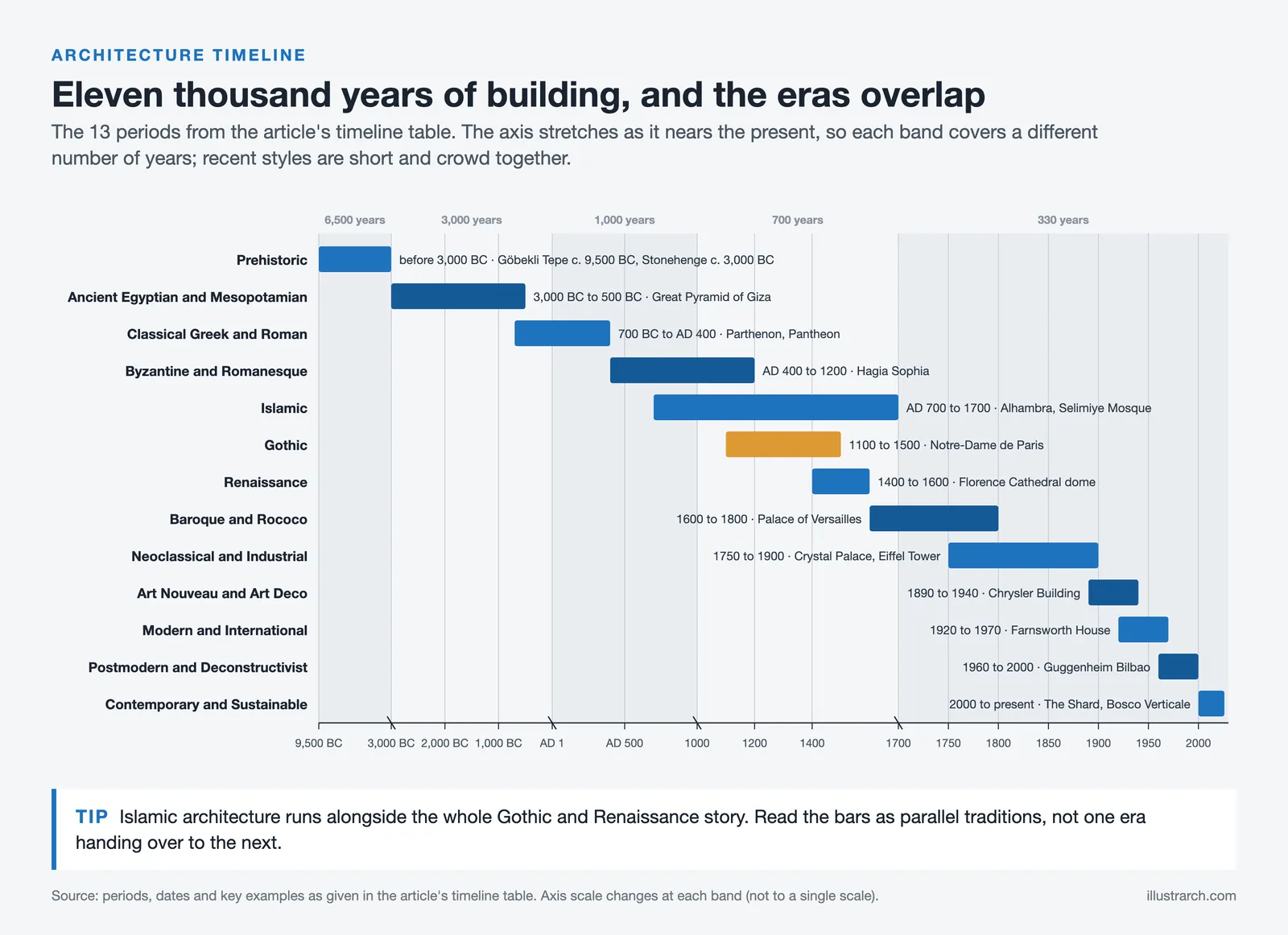
Complete Architecture Timeline: Key Eras and Styles at a Glance
| Period | Dates | Defining Characteristics | Key Example |
|---|---|---|---|
| Prehistoric | Before 3000 BC | Megalithic monuments, communal shelters | Stonehenge, Göbekli Tepe |
| Ancient Egyptian & Mesopotamian | 3000-500 BC | Pyramids, ziggurats, post-and-lintel | Great Pyramid of Giza |
| Classical Greek & Roman | 700 BC: 400 AD | Column orders, arches, domes, concrete | Parthenon, Pantheon |
| Byzantine & Romanesque | 400-1200 AD | Central domes, thick walls, rounded arches | Hagia Sophia |
| Islamic | 700-1700 AD | Geometric pattern, courtyards, muqarnas, minarets | Alhambra, Selimiye Mosque |
| Gothic | 1100-1500 AD | Pointed arches, flying buttresses, stained glass | Notre-Dame de Paris |
| Renaissance | 1400-1600 AD | Classical revival, symmetry, proportion | Florence Cathedral dome |
| Baroque & Rococo | 1600-1800 AD | Dramatic ornamentation, grand scale | Palace of Versailles |
| Neoclassical & Industrial | 1750-1900 AD | Classical forms, iron and steel innovation | Crystal Palace, Eiffel Tower |
| Art Nouveau & Art Deco | 1890-1940 | Organic curves, geometric patterns | Chrysler Building |
| Modern & International Style | 1920-1970 | Functionalism, minimalism, glass-and-steel | Farnsworth House |
| Postmodern & Deconstructivist | 1960-2000 | Historical references, eclectic forms | Guggenheim Museum Bilbao |
| Contemporary & Sustainable | 2000: present | Green building, parametric design, biophilic elements | The Shard, Bosco Verticale |
What Are the Most Important Architectural Innovations in History?
Certain structural and material breakthroughs changed the course of architecture permanently. Understanding them helps explain why the built environment looks the way it does today.
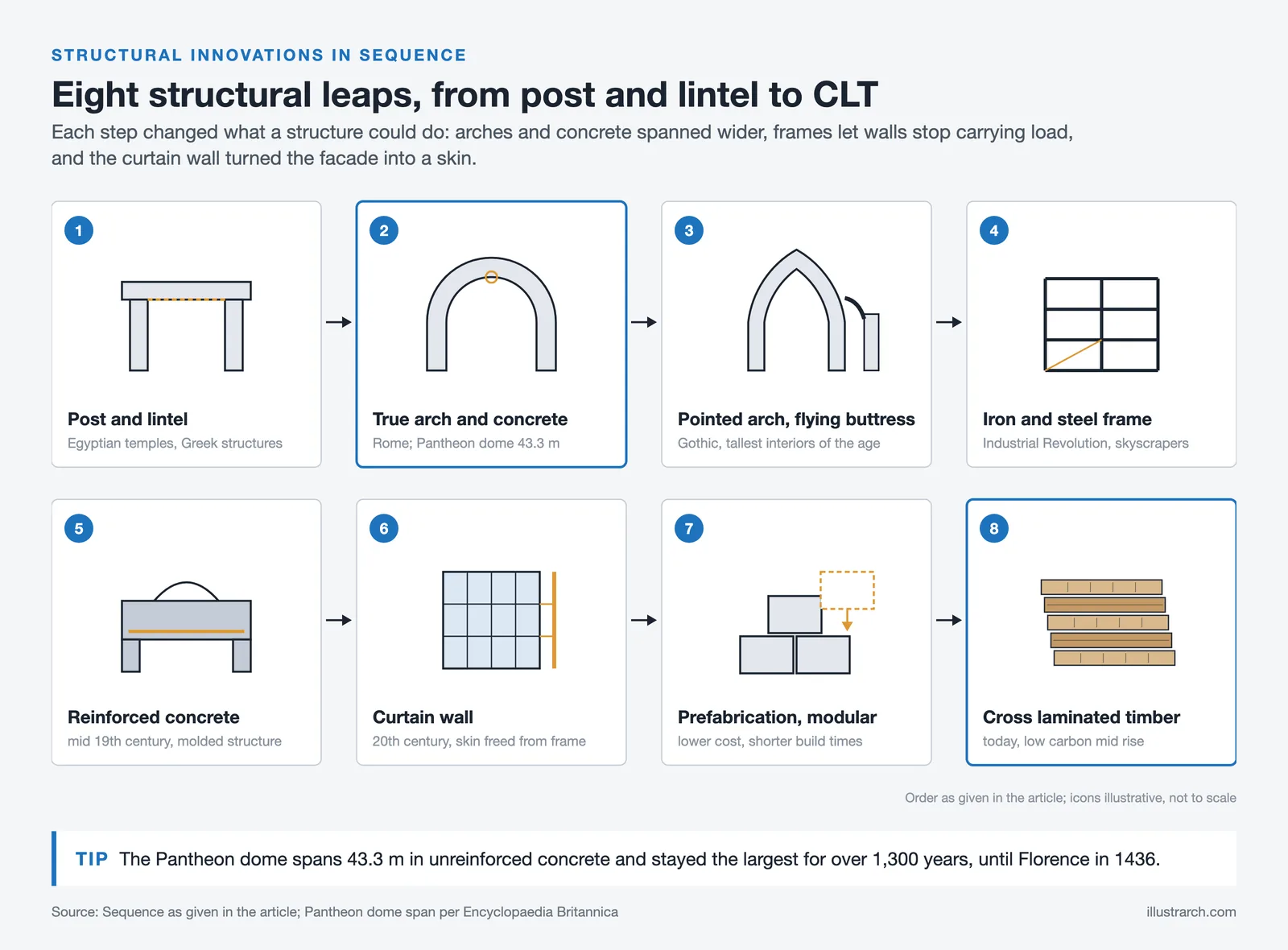
The post-and-lintel system, used in Egyptian temples and Greek structures, was the dominant construction method for millennia. Roman engineers then introduced the true arch and concrete, allowing them to span wider spaces and build more freely. Gothic builders refined pointed arches and flying buttresses to create the tallest interior spaces Europe had seen. The Industrial Revolution brought iron and steel framing, which made skyscrapers possible. Reinforced concrete, developed in the mid-19th century, gave architects the ability to mold structural shapes rather than stack blocks or beams.
In the 20th century, curtain wall systems separated the building skin from its structural frame, freeing facades to become almost entirely glass. Prefabrication and modular construction reduced costs and build times. Today, computational design tools allow architects to optimize structures for performance, material efficiency, and aesthetics simultaneously. Mass timber products like cross-laminated timber (CLT) offer a low-carbon alternative to steel and concrete for mid-rise buildings, and biophilic design principles are changing how architects think about occupant well-being.
✅ Key Takeaways
- The history of architecture spans over 10,000 years, from prehistoric megalithic structures to today’s net-zero buildings
- Each major architectural period was shaped by the materials, technology, and cultural values of its era
- Roman innovations in concrete and the dome system influenced buildings for over 1,300 years after they were first developed
- Islamic architecture contributed pointed arches, geometric patterning, and courtyard planning that influenced Gothic and later European styles
- Gothic architecture’s structural logic of externalizing load-bearing systems still resonates in contemporary long-span and high-rise design
- Modern and sustainable architecture respond to climate and resource constraints in ways that parallel how ancient builders adapted to their own environmental limits
- Studying the architectural timeline is not just a historical exercise; it actively informs better design decisions today
The history of architecture is a mirror to the human condition, reflecting our aspirations, beliefs, and technological advancements. From ancient architectural styles to futuristic skyscrapers, the built environment tells the story of our journey through time, evolving to meet the needs and dreams of each era. As we look to the future, architecture will continue to play a vital role in shaping our world, guided by the lessons of the past and the possibilities of innovation.
Frequently Asked Questions
What are the main periods in the history of architecture?
The main periods include Prehistoric (before 3000 BC), Ancient Egyptian and Mesopotamian (3000-500 BC), Classical Greek and Roman (700 BC-400 AD), Byzantine and Romanesque (400-1200 AD), Islamic (700-1700 AD), Gothic (1100-1500 AD), Renaissance (1400-1600 AD), Baroque (1600-1800 AD), Neoclassical and Industrial (1750-1900 AD), Modern (1920-1970), Postmodern (1960-2000), and Contemporary/Sustainable (2000-present). Each period introduced new structural systems, materials, and design philosophies that built upon earlier traditions.
How did the arch change the history of architecture?
The arch allowed builders to span openings wider than a single stone or beam could cover, distributing weight along a curved path rather than pushing straight down. Roman engineers perfected the semicircular arch and combined it with concrete to build domes, vaults, aqueducts, and amphitheaters on a scale that post-and-lintel construction could not achieve. Variations of the arch, including the pointed arch used in Islamic and Gothic architecture, continued to expand what was structurally possible for centuries.
Why is sustainable architecture important in 2025?
Buildings and construction account for approximately 37% of global CO2 emissions, according to the World Green Building Council (2023). Sustainable architecture addresses this by reducing energy consumption through passive design strategies, using low-carbon materials like mass timber and recycled steel, and incorporating renewable energy systems. In 2025, net-zero building codes, biophilic design, and digital optimization tools are accelerating this transition, making sustainability central to how the next generation of buildings is designed and built.

Frequently Asked Questions
Key periods include ancient, classical, medieval (Romanesque and Gothic), Renaissance, Baroque, and modern and contemporary.
Prehistoric and ancient architecture, such as megalithic structures and early temples, are the oldest known forms.
It evolved with culture, technology and materials, moving from heavy load-bearing structures to light, engineered modern buildings.
Last updated:



2 Comments



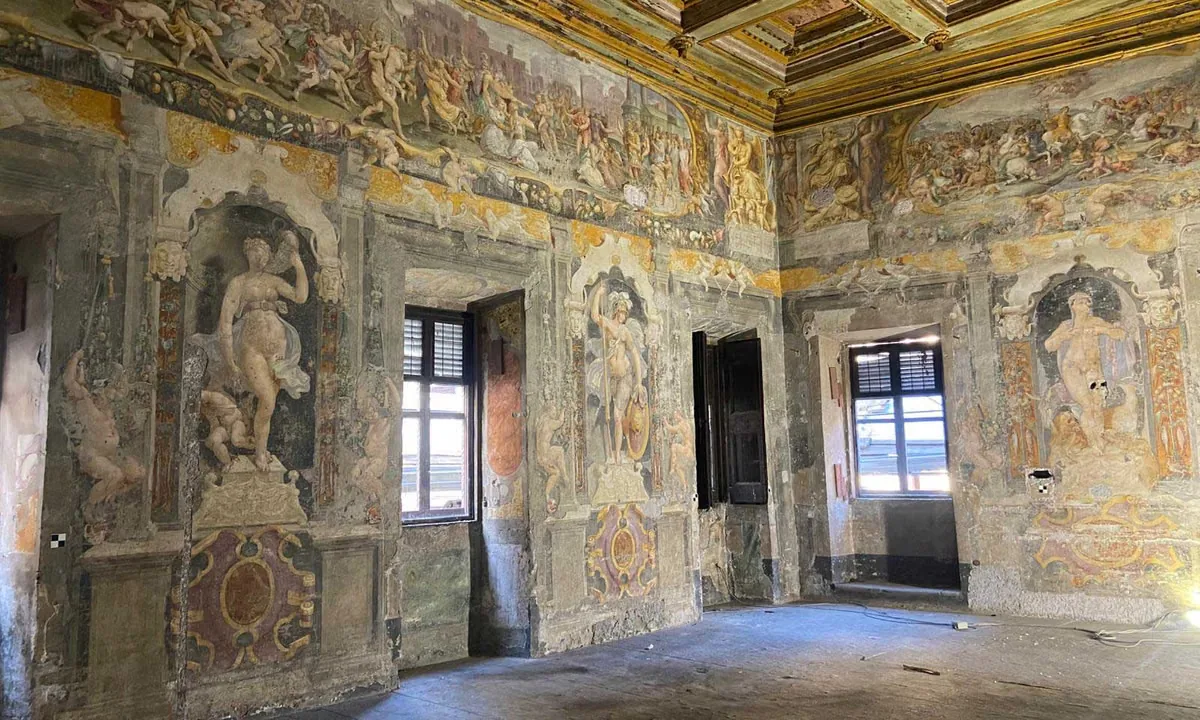
Restorers Uncover 16th-Century Murals Hidden by Nuns in Villa Silvestri Rivaldi
Conservators in Rome are uncovering 16th-century murals hidden for 300 years inside...
 illustrarch Editoral Team3 Mins read

A 2,500-Year-Old Solar Observatory in Puebla Is the First Group E Complex Found Outside the Maya Area
Archaeologists working for Mexico's INAH have confirmed that two platforms at Teteles...
illustrarch Editoral Team2 Mins read

Donald Insall, the Conservation Architect Who Led Windsor Castle’s Restoration, Dies at 100
Donald Insall, the British architect who turned conservation into a planning discipline...
illustrarch Editoral Team2 Mins read
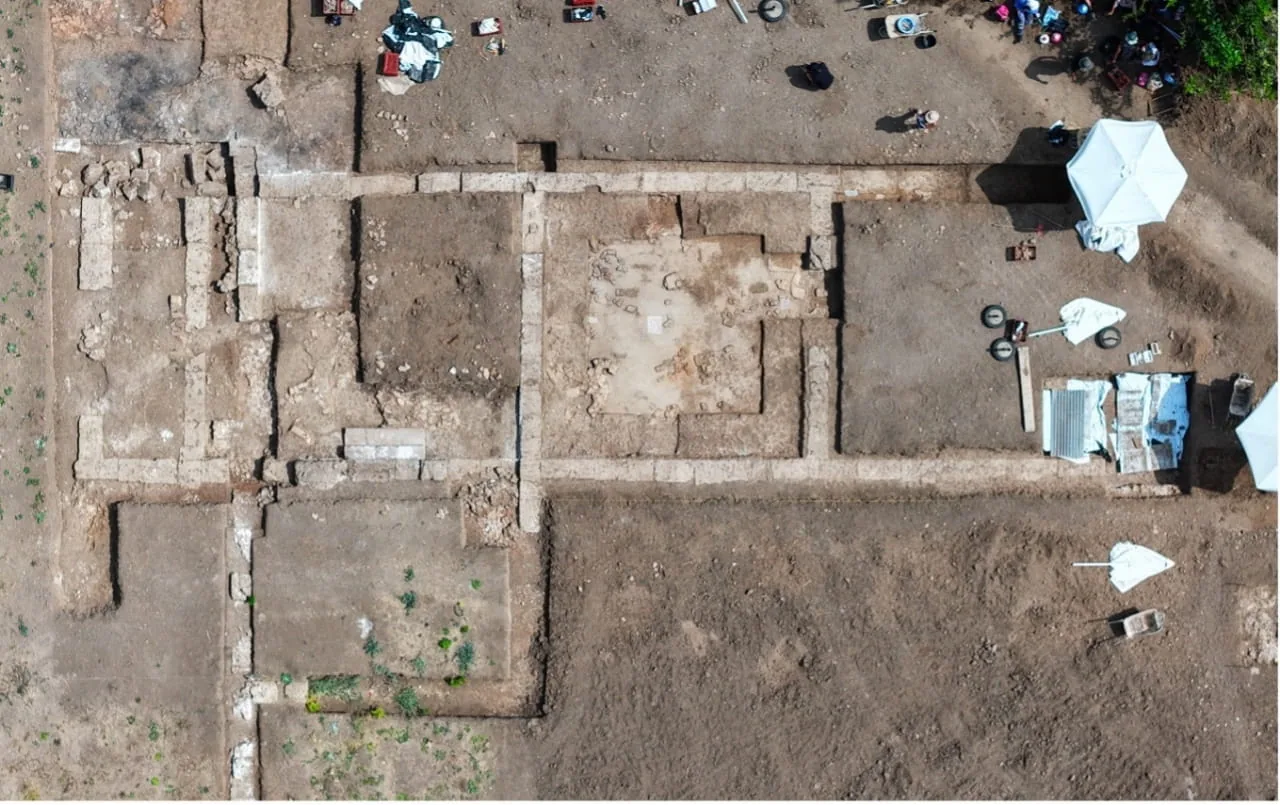
New Digging Season at the Mieza Gymnasium Uncovers Alexander’s School Complex
New digs at Mieza uncover teaching halls and mosaic banquet rooms at...
illustrarch Editoral Team2 Mins read


This article talks about the history of architecture. It covers different styles and periods. I learned a bit about ancient buildings and modern designs.
Honestly, this article is way too optimistic about architecture’s evolution. The focus on sustainable practices sounds great, but it feels like just another buzzword to make people feel good while ignoring the real issues in urban planning today. The mention of modern architects like Zaha Hadid and Norman Foster is just a reminder that their designs often prioritize aesthetics over actual functionality for the average person. And let’s not even get started on how many of these ‘innovative’ buildings end up being impractical.