

Removing Iteration Friction: How Laser Cleaning Improves Speed and Consistency in Prototyping Labs
Laser cleaning technology, such as the Xlaserlab Q1, is revolutionizing prototyping labs by enhancing surface preparation speed and consistency.
 illustrarch Editoral Team13 February 20263 Mins read151

Table of Contents Show
Singapore: In the fast-paced world of hardware startups and maker spaces, speed is the ultimate currency. Whether it is a tech company validating its first chassis design, a research team refining a functional mechanism, or a makerspace supporting multiple projects, the ability to iterate quickly often determines success.
As prototyping cycles accelerate to match the pace of software development, one often-overlooked process step is gaining critical attention: surface treatment. Once considered a secondary janitorial task, surface preparation is now proving to be a key variable in how fast teams can move from a CAD concept to functional validation.
Why Speed and Flexibility Matter in Modern Prototyping
Makers, hardware engineers, and R&D teams operate under constant pressure to test, modify, and improve designs in short sprints. Metal prototypes, brackets, housings, frames, and electrical contacts, are frequently reworked, reused, and reassembled across multiple iterations.
In this environment, parts are modified repeatedly. Welding, machining, and assembly happen in rapid succession. However, small surface inconsistencies can disrupt downstream processes. A layer of oxidation on an aluminum bracket can lead to a failed weld, while residual cutting fluid can compromise an adhesive bond.
To maintain momentum, engineers are increasingly moving away from manual abrasion and standardizing on solutions like the Xlaserlab Q1 laser cleaning machine, treating surface preparation as a controlled step that keeps rapid iteration cycles on track.
The Limits of Traditional Surface Treatment in Prototyping
Traditional methods of surface cleaning are ill-suited for modern prototyping. Manual finishing, such as hand sanding and grinding, depends heavily on individual technique. Results vary from person to person, time investment is high, and repeating the same surface condition across different iterations is difficult.
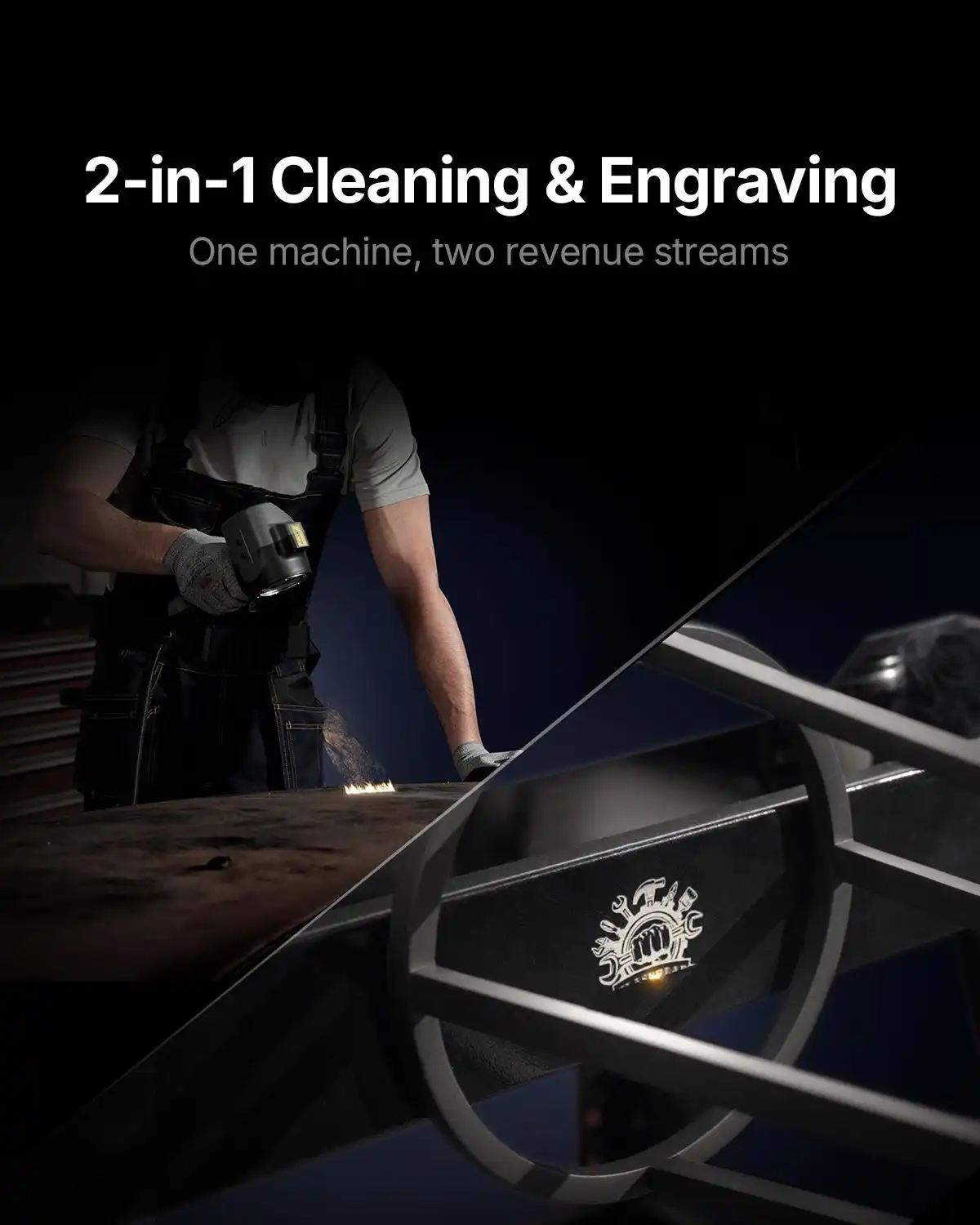
Chemical treatments are equally problematic in these settings. They lack flexibility; chemical cleaning methods are often impractical for small batches and frequent changes. Setup, handling, and disposal requirements make them unsuitable for fast-moving workflows.
These limitations lead to hidden delays. Poor surface condition can lead to unstable welding, inconsistent machining results, or unreliable testing outcomes, forcing teams into rework and delaying validation. To eliminate these variables, labs are increasingly adopting specialized laser cleaning equipment to ensure predictable results.
The Q1 Laser Cleaning Solution for Makers and Prototyping Teams
In prototyping, the goal is not perfection, but rapid and reliable validation. Surface condition directly influences how parts behave in subsequent steps such as welding, bonding, coating, or testing.
This need for speed and control is driving the adoption of solutions like the xlaserlab laser cleaning system. For prototyping teams, the appeal of the Q1 lies in its ability to remove surface variability from the iteration loop, so design failures are not confused with process noise.
The Xlaserlab Q1 provides non-contact surface treatment for a wide range of metal materials. As flexible laser cleaning equipment, it allows makers and engineers to remove oxidation, residues, and surface contaminants quickly, without damaging the base material or relying on extensive manual labor.
For prototyping teams, the key advantage of the Q1 lies in control and repeatability. The Q1 supports fast, consistent surface preparation that reduces dependence on individual experience, making it easier to repeat processes across iterations.
Practical Applications in Prototyping Environments
The integration of laser technology enables several efficiency gains:
Surface preparation before machining or welding: Laser cleaning stabilizes surface conditions, improving consistency in subsequent fabrication steps.
Localized cleaning during assembly and testing: Specific areas can be cleaned without reprocessing entire parts, supporting targeted iteration.
Reuse of parts across multiple versions: By restoring surface condition, laser cleaning enables components to be reused across design iterations, reducing material waste and turnaround time.

The Evolving Maker and Prototyping Ecosystem
By integrating xlaserlab laser cleaning into their workflows, teams can achieve shorter development and testing cycles.
As maker spaces and prototyping labs mature, the ability to iterate quickly without accumulating process noise becomes a competitive advantage. By integrating the Xlaserlab Q1 into their workflows, teams remove surface preparation as a recurring friction point, allowing faster validation, clearer test results, and more confident design decisions. In an ecosystem where speed defines relevance, controlled laser surface preparation becomes quiet infrastructure that enables innovation to scale.
About Xlaserlab Xlaserlab provides advanced laser cleaning solutions designed to improve efficiency and process control in manufacturing, restoration, and prototyping environments.






Futuro House Production Revived in Finland After Decades-Long Hiatus
A Facebook listing for abandoned moulds led to the first new Futuro...
illustrarch Editoral Team3 Mins read
Building Your Dream Home in NSW: What You Should Know About Montgomery Homes
Montgomery Homes has been building across Sydney, Newcastle, the Hunter, Wollongong and...
illustrarch Editoral Team4 Mins read

Designing a Home Theater: Where Drapery Fits Into the Plan
In a media room the curtains are a performance layer, not decoration....
illustrarch Editoral Team3 Mins read

Oscar Niemeyer’s Cathedral of Brasília: The Hyperboloid Concrete Hymn
The Cathedral of Brasília reads as a single gesture, yet it stood...
 Furkan Sen7 Mins read


Leave a comment