

Industrial Revolution Architecture vs Digital Age Architecture: What Really Changed
From the Crystal Palace's prefabricated iron frame to Zaha Hadid's algorithm-driven curves, architecture has transformed radically across two technological revolutions. This article traces the key differences in materials, design logic, and building philosophy between industrial-era and digital-age architecture.
 Sinan Ozen16 March 20269 Mins read180

Table of Contents Show
Industrial Revolution architecture vs Digital Age architecture represents one of the most dramatic transformations in how humans design and build. The first revolution gave us iron, steel, and mass production; the second gave us algorithms, parametric form-finding, and smart buildings. Together, these two eras define the full arc of modern architecture from the 1760s to today.

What Is Industrial Revolution Architecture?
Industrial revolution architecture emerged in Britain around 1760 and spread rapidly across Europe and North America through the 19th century. It was defined by a single, irreversible shift: materials that had previously been too expensive or scarce for widespread construction suddenly became abundant. Cast iron, structural steel, and plate glass transformed what could be built, how large it could grow, and how quickly it could go up.
Before this period, builders were constrained by stone, brick, and timber. Load-bearing masonry walls required immense thickness to reach any significant height. The introduction of iron framing changed the equation entirely. As documented in the architectural history record, the mass production of iron and later steel made them economically viable building materials for the first time, replacing the need for clustered, thick-walled structures and revealing the aesthetic potential of unfussy, open design.
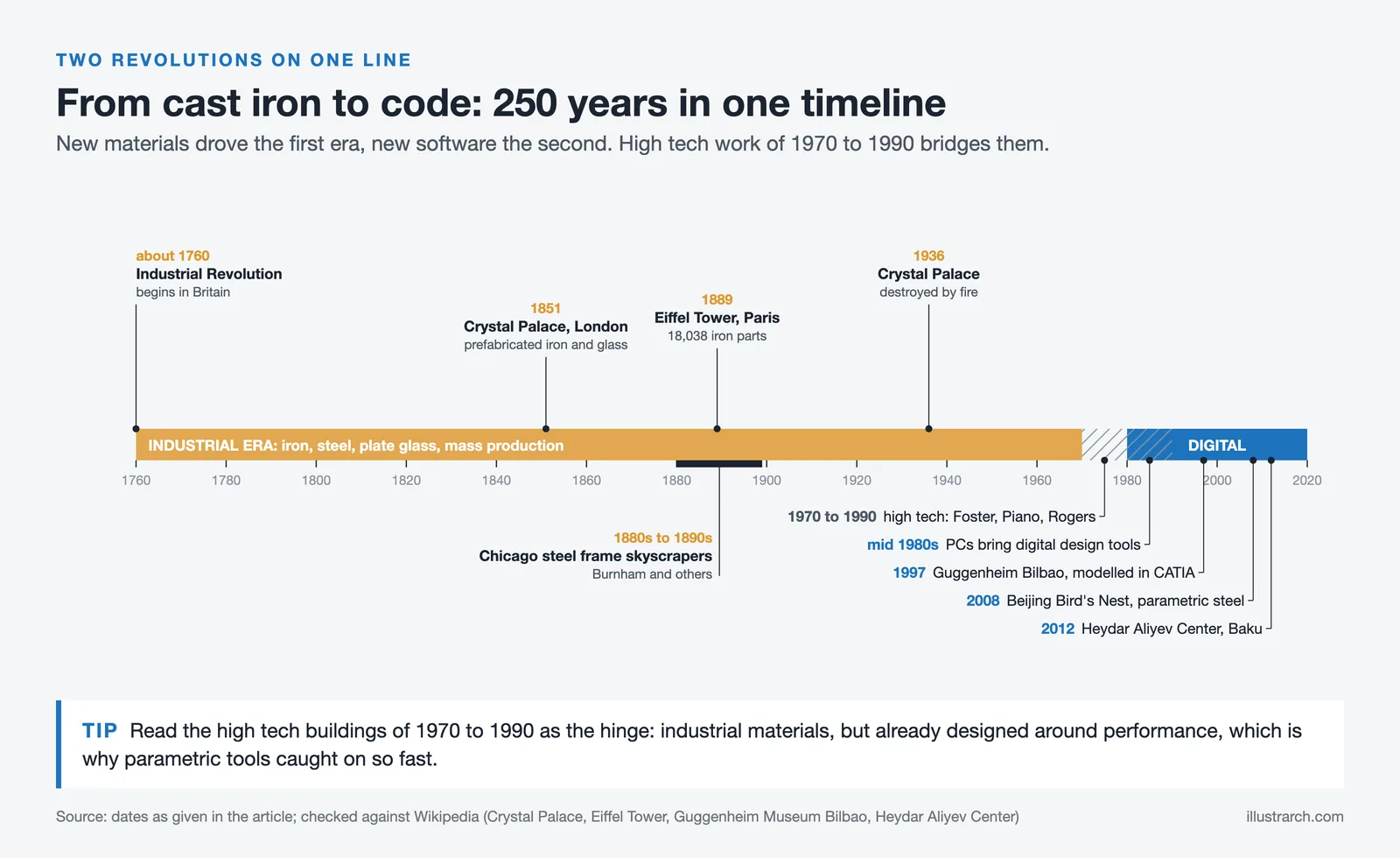
The Crystal Palace, completed in London in 1851 by Sir Joseph Paxton, became the defining symbol of this era. Built from prefabricated cast iron and glass components for the Great Exhibition, it demonstrated a kind of spatial beauty previously unimaginable: vast, light-filled interior volumes assembled with industrial precision. It also foreshadowed prefabricated construction and the widespread use of standardized components, techniques still central to building today.
📌 Did You Know?
The Crystal Palace (1851) covered approximately 92,000 square meters and was assembled in just 17 weeks using 4,500 tonnes of cast iron and 300,000 panes of glass. Its modular, prefabricated construction method was so radical that critics initially doubted it would stand — yet, after being dismantled and rebuilt at Sydenham Hill in 1852 to 1854, it stood for over 80 years until a fire destroyed it in 1936.
The factories, train stations, warehouses, and bridges of the industrial era were also the first building types designed around pure function rather than symbolic or civic expression. Ornamentation became secondary. Open spans, robust structural elements, and natural light from high windows defined the factory aesthetic. This is, in a direct lineage, where the modernist principle of “form follows function” — later articulated by Louis Sullivan — was born in physical practice rather than theory.

How Did the Industrial Revolution Change Architecture?
The changes were structural, cultural, and urban all at once. Structurally, iron and steel enabled taller buildings with thinner walls, wider column-free interiors, and longer bridge spans. The steel-frame skyscraper, pioneered in Chicago in the 1880s and 1890s by architects like Daniel Burnham, became the defining building type of the industrial city. Buildings like the Flatiron Building and, later, the Empire State Building are direct descendants of the structural logic unlocked by industrial-era metallurgy.
Culturally, industrialization created entirely new demands on architecture. Factories needed large, ventilated floors. Railway stations required vast covered platforms. Worker housing had to be produced at unprecedented scale and speed. These functional pressures stripped away the decorative priorities of earlier periods and pushed architects toward material honesty, which became a foundational value of 20th century modernism.
💡 Pro Tip
When analyzing industrial-era buildings for adaptive reuse projects, pay close attention to original column spacing and floor-to-ceiling heights. Buildings designed for manufacturing often have 4–6 meter clear heights and regular structural grids of 6–9 meters, which translate naturally into modern open-plan residential or office use with minimal structural intervention.
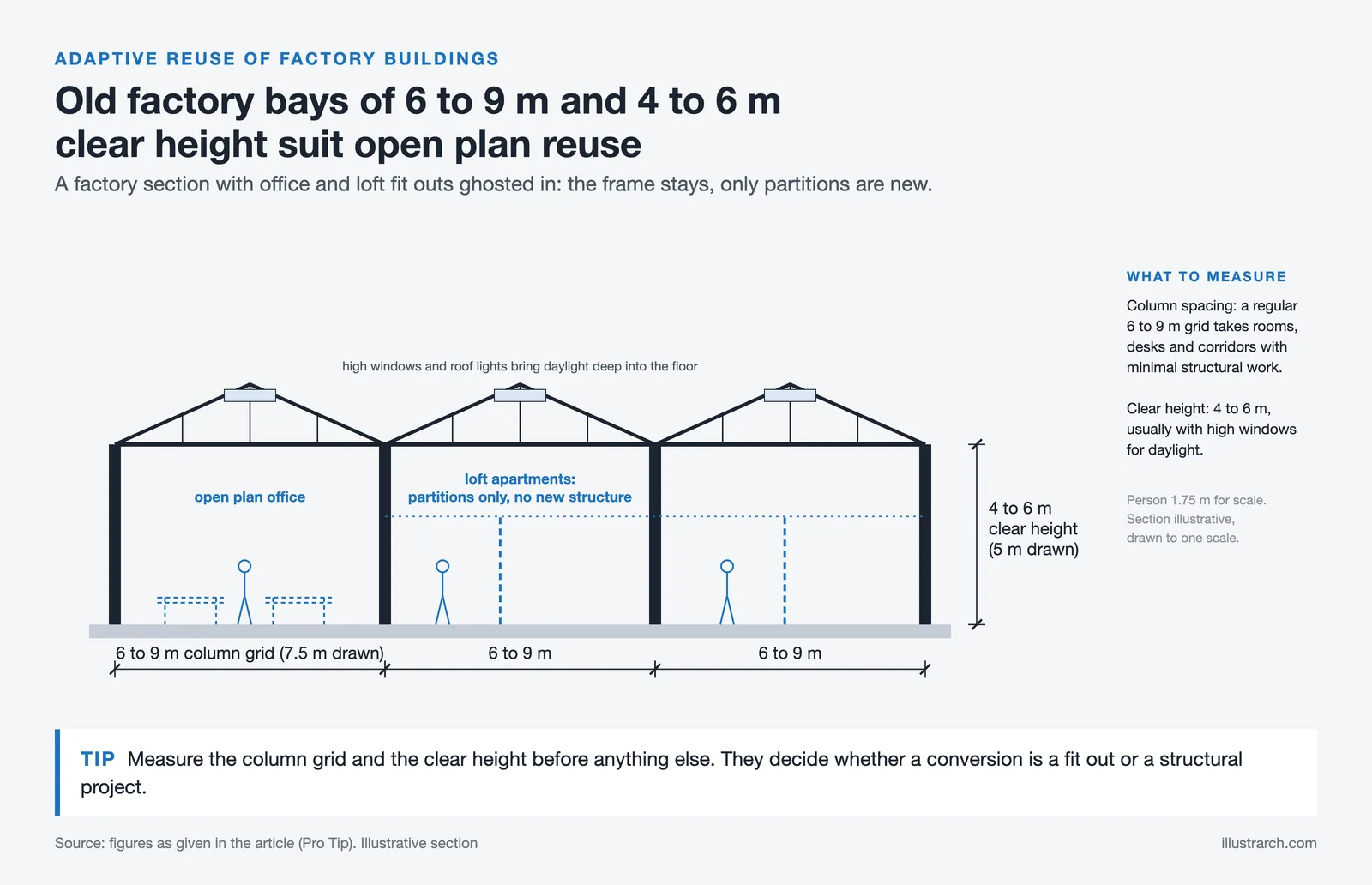
Urban consequences were equally significant. As populations migrated from rural areas into factory towns, cities expanded rapidly without adequate planning. This chaotic densification eventually produced an architectural and planning backlash, directly feeding into the Garden City movement, functionalist urban planning, and ultimately the high modernism of Le Corbusier’s Unité d’Habitation and the urban renewal projects of the mid-20th century.
What Is Digital Age Architecture?
Digital age architecture — also called digital architecture design, parametric architecture, or computational design — emerged progressively from the 1980s onward as software tools gave architects new powers of form generation and structural analysis. The shift accelerated dramatically in the 1990s when Frank Gehry’s Guggenheim Museum in Bilbao (1997) demonstrated that complex, non-Euclidean forms could move from digital model to physical construction at full scale.
Where industrial revolution architecture was defined by what new materials made possible, digital age architecture is defined by what new software makes thinkable. Algorithms can generate thousands of design variations in minutes, optimizing for structural efficiency, solar exposure, material use, or acoustic performance simultaneously. Parametric tools allow the entire design to respond dynamically to changing parameters: adjust one variable, and the whole building geometry updates automatically.
🎓 Expert Insight
“Architecture should speak of its time and place, but yearn for timelessness.” — Frank Gehry
Gehry’s own work embodies this tension. The titanium-clad Guggenheim Bilbao used CATIA aerospace software to translate sculptural sketches into fabrication-ready geometry — a workflow that simply did not exist before the digital age. It demonstrated that architecture’s aspiration toward timelessness could now be pursued through tools that were radically of their time.
Digital architecture also introduced a new relationship between design and fabrication. CNC milling, robotic construction, and 3D printing allow complex geometries to be manufactured with the same precision as simple ones, removing the industrial-era premium on standardization and repetition. A curved facade panel can now cost nearly the same as a flat one, erasing one of the core economic constraints that shaped modernist building from the 1920s onward.

Industrial vs Modern Architecture: A Direct Comparison
The following table maps the key differences between industrial revolution architecture and digital age architecture across the dimensions that matter most to designers, historians, and clients.
Industrial Revolution Architecture vs Digital Age Architecture: Comparison
This side-by-side comparison covers materials, design logic, structural systems, and cultural priorities:
| Dimension | Industrial Revolution Architecture | Digital Age Architecture |
|---|---|---|
| Primary Materials | Cast iron, structural steel, brick, glass | High-performance composites, ETFE, mass timber, smart glass |
| Design Tools | Hand drafting, physical scale models | BIM software, parametric tools (Grasshopper, Dynamo), AI |
| Form Logic | Orthogonal, grid-based, standardized | Organic, algorithm-generated, customizable |
| Structural System | Iron/steel frame, load-bearing masonry | Optimized shells, tensile structures, diagrids |
| Cultural Priority | Function, production efficiency, civic pride | Performance, sustainability, user experience |
| Fabrication Method | Mass production, standardized components | CNC, robotic assembly, digital fabrication |
| Iconic Examples | Crystal Palace, Eiffel Tower, Flatiron Building | Guggenheim Bilbao, CCTV Tower, Heydar Aliyev Center |
Parametric Architecture vs Industrial: How Design Logic Shifted
Industrial revolution architecture operated within strict geometric constraints: the grid, the right angle, the repeated module. This was not an aesthetic choice but a structural and economic one. Repeating identical elements across a facade or floor plan made industrial-era construction faster and cheaper. The iconic warehouse loft aesthetic we admire today — exposed steel columns at regular intervals, uniform window grids — was an efficiency artifact, not an artistic statement.
Parametric architecture vs industrial architecture reveals a fundamental inversion of this logic. With computational tools, complexity no longer costs significantly more than simplicity. Zaha Hadid Architects’ Heydar Aliyev Center in Baku (2012) replaced right angles with continuous, flowing surfaces generated by digital modeling. The building’s form was not designed component by component but emerged from a set of geometric rules applied by software, producing an architecture that would have been literally impossible to calculate by hand.
As ArchDaily noted in its analysis of modernism’s relationship to digital design, the parametric tools of the digital age allowed architects to pursue functional optimization and formal complexity simultaneously — a combination that neither handcraft nor industrial repetition could achieve alone.
⚠️ Common Mistake to Avoid
Many people assume parametric architecture is simply about unusual shapes. In practice, parametric tools are most powerfully used for performance optimization: calculating the ideal placement of structural members, minimizing material use, maximizing natural ventilation, or modelling solar shading across thousands of facade configurations. Aesthetics are often a byproduct of structural and environmental logic, not the starting point.

Smart Buildings vs Industrial Buildings: A Different Kind of Intelligence
Smart buildings vs industrial buildings is arguably the sharpest contrast between the two eras, because it reflects a difference not just in construction but in what a building is understood to be.
Industrial-era buildings were passive machines for function. A factory’s intelligence was designed once, at the drawing board, and expressed through spatial organization: where light fell, where processes flowed, where structure carried loads. Once built, the building did not adapt.
Smart buildings — a defining category of digital age architecture — incorporate sensors, automated systems, and real-time data processing to adjust their behavior continuously. Building Management Systems can regulate temperature, lighting, ventilation, and security in response to occupancy patterns, outdoor conditions, or energy pricing signals. The building is less a fixed object than an ongoing process.
🔢 Quick Numbers
- Smart building technology can reduce energy consumption by 20–30% compared to conventional buildings (World Green Building Council, 2023)
- The global smart building market was valued at approximately $80 billion in 2022 and is projected to exceed $300 billion by 2030 (MarketsandMarkets, 2023)
- Buildings account for approximately 37% of global energy-related CO2 emissions, making smart building technology critical to climate targets (International Energy Agency, 2023)
Architecture Evolution: Industrial to Digital — What Stayed the Same?
Despite the dramatic differences, the architecture evolution from industrial to digital is not a clean break. Several core priorities run continuously through both periods.
Both eras were driven by new materials and new tools, and both produced buildings that expressed those tools openly rather than hiding them. The Victorian engineer’s pride in exposed ironwork finds a clear parallel in the digital architect’s pride in visually complex facades generated by code. Both aesthetics are, at root, a kind of material honesty.
Both eras also produced new building typologies in response to cultural shifts. The industrial era created the factory, the train station, and the department store. The digital age produced the data center, the innovation campus, and the experience museum. Each new typology carries the formal DNA of its era’s tools and values.
🏗️ Real-World Example
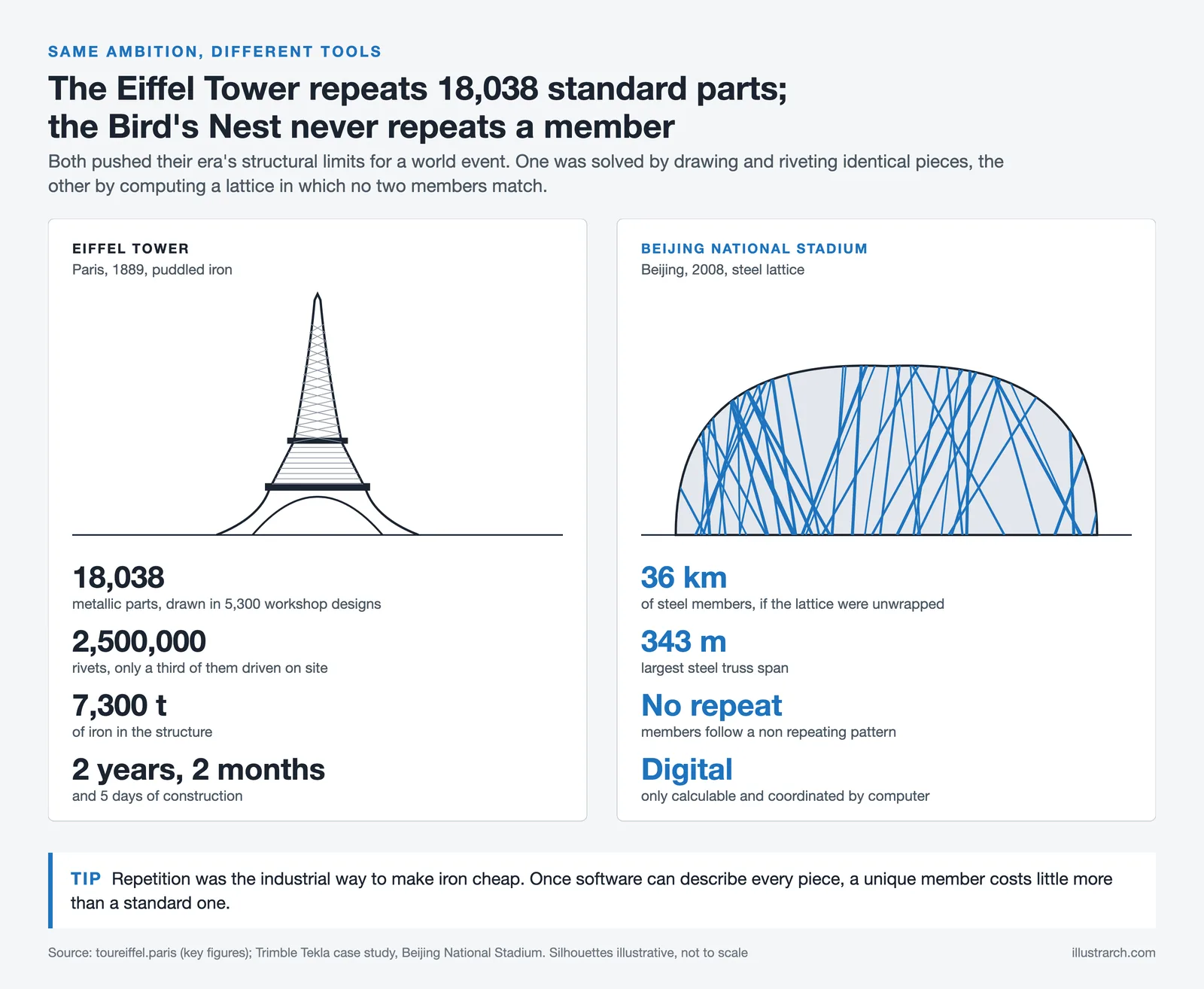
The Eiffel Tower (Paris, 1889) vs The Beijing National Stadium (Beijing, 2008): Both structures pushed the structural limits of their era in service of a major public event. The Eiffel Tower used 7,300 tonnes of puddled iron, assembled from 18,038 standardized components with 2.5 million rivets — pure industrial precision. The Bird’s Nest Stadium used parametric design to generate its complex steel lattice, with 36 km of unwrapped steel members forming a non-repeating structural pattern that could only be calculated and coordinated digitally. Same ambition, entirely different tools.
For a deeper look at how iron and glass architecture history shaped contemporary facades and curtain wall systems, the illustrarch architecture history timeline covers the full lineage from the Crystal Palace to today’s high-performance glass envelopes.

Iron and Glass Architecture History: The Foundation of Both Eras
Iron and glass architecture history is the technical bridge connecting industrial revolution architecture to digital age design. The Crystal Palace established the principle that a building’s structure and its enclosure could be entirely separate systems, with a lightweight, transparent skin hung from a rigid frame. This principle — structural frame plus non-structural cladding — remains the organizing logic of virtually every major contemporary building.
The Eiffel Tower (1889) extended this logic into pure structural expression. Gustave Eiffel’s firm used graphic statics and detailed wind load calculations (primitive by today’s standards, but rigorous for the era) to shape the tower’s parabolic profile. That process — using performance data to shape architectural form — is directly ancestral to today’s computational design methods.
You can explore more about how these structural traditions evolved in illustrarch’s coverage of the evolution of modern architecture from Bauhaus to Brutalism across the 19th and 20th centuries.
💡 Pro Tip
When studying the transition from industrial to digital architecture in academic or professional contexts, focus on the 1970s–1990s as the true pivot period. High-tech architecture (Foster, Piano, Rogers) used industrial materials with precision engineering logic, essentially completing the industrial tradition while simultaneously developing the performance-driven thinking that made parametric tools immediately relevant when they arrived in the 1990s.
What Does the Future of Architectural Evolution Look Like?
The trajectory from industrial revolution architecture to digital architecture design points toward a fourth phase now beginning to take shape. AI-generated design, robotic fabrication, and bio-integrated materials are converging in ways that may prove as transformative as iron was in 1760 or the personal computer in 1985.
Researchers at institutions like the ETH Zürich’s Digital Building Technologies lab are already demonstrating robotically assembled structures where no two components are identical, yet every component is structurally optimized. This would have been technically impossible in any previous era and prohibitively expensive even ten years ago.
The lesson from both revolutions is the same: architectural form does not change in isolation. It changes when the tools available to architects change in fundamental ways. The iron frame did not just make buildings taller. It changed what architects thought was worth building. Computational design has done the same thing to a new generation, and AI is likely to do it again.
For architects working across these two traditions, resources like ArchDaily’s digital architecture coverage and the Dezeen parametric design archive provide ongoing documentation of where the digital age is taking the built environment next.
✅ Key Takeaways
- Industrial revolution architecture was enabled by mass-produced cast iron and steel, unlocking taller structures, wider spans, and prefabricated assembly for the first time.
- Digital age architecture shifted the defining constraint from materials to computation, allowing complex geometries and performance optimization that standardized industrial methods could not achieve.
- Parametric architecture vs industrial architecture is not a rejection of the earlier tradition but an extension of it: both value structural honesty, material efficiency, and technology-driven form.
- Smart buildings represent the deepest break with industrial-era thinking, transforming buildings from fixed functional objects into responsive, data-driven systems.
- The technical bridge between the two eras runs through the iron-and-glass structural logic of the Crystal Palace and the Eiffel Tower, principles that remain fundamental to all contemporary large-scale architecture.
- architecture evolution industrial to digital
- digital age architecture
- digital architecture design
- history of modern architecture movements
- how industrial revolution changed architecture
- industrial revolution architecture
- industrial vs modern architecture
- iron and glass architecture history
- parametric architecture vs industrial
- smart buildings vs industrial buildings




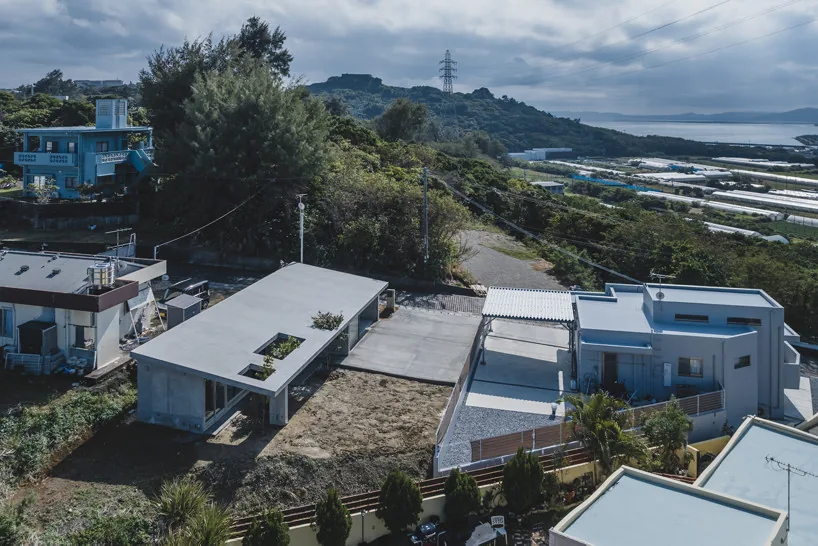
Overlapping Concrete Walls and One Roof Shape a House in Okinawa
IGArchitects built Overlapping Spaces in Okinawa from reinforced concrete walls, columns and...
 illustrarch Editoral Team1 Mins read
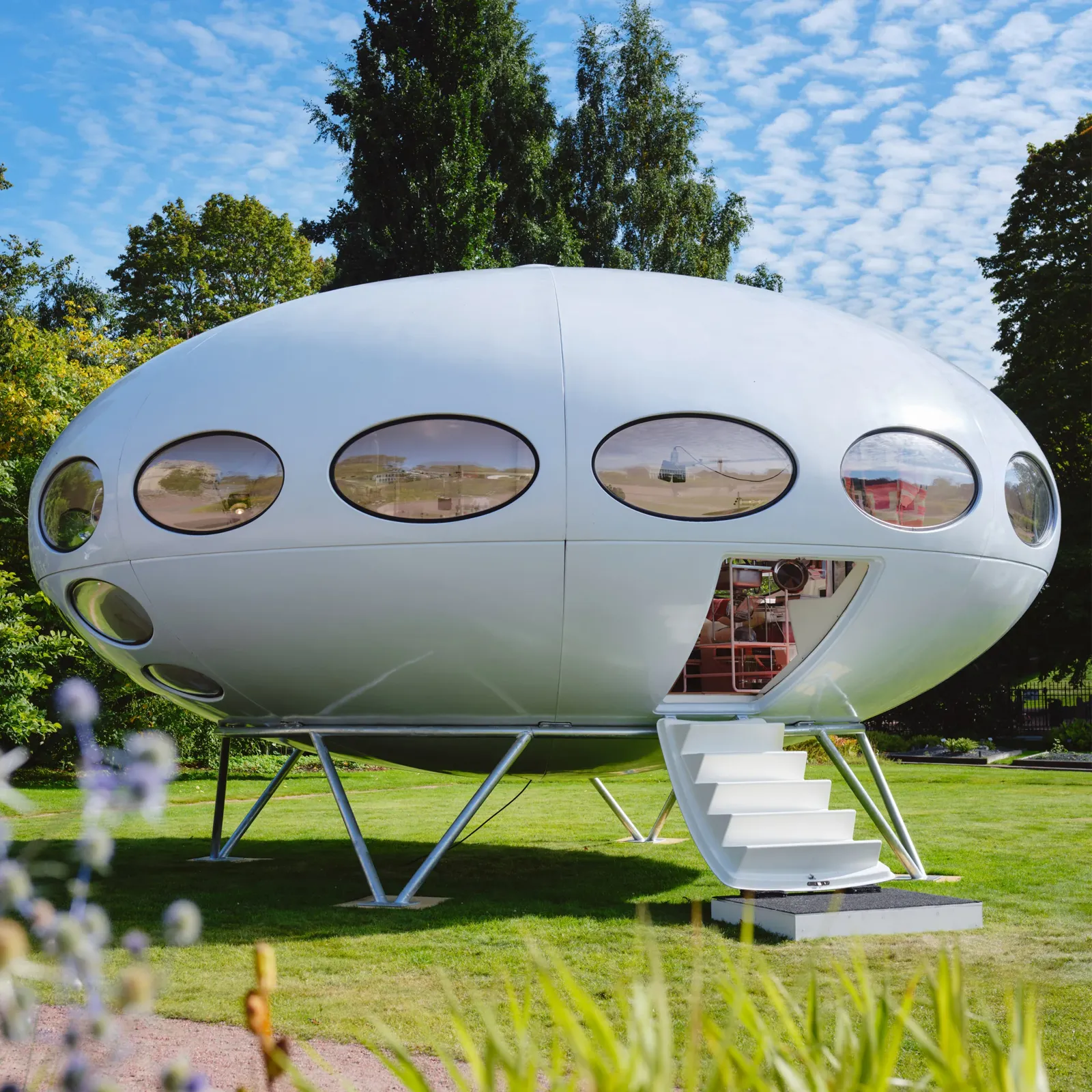
Futuro House Production Revived in Finland After Decades-Long Hiatus
A Facebook listing for abandoned moulds led to the first new Futuro...
illustrarch Editoral Team3 Mins read
Building Your Dream Home in NSW: What You Should Know About Montgomery Homes
Montgomery Homes has been building across Sydney, Newcastle, the Hunter, Wollongong and...
illustrarch Editoral Team4 Mins read

Designing a Home Theater: Where Drapery Fits Into the Plan
In a media room the curtains are a performance layer, not decoration....
illustrarch Editoral Team3 Mins read


Leave a comment