

Drones in Architecture: Surveying, Modeling, and Inspection
Drones in architecture handle site surveys, photogrammetry, 3D modeling, and building inspection. Here are the main uses, the benefits for design teams, and the flight rules to know.
 Elif Ayse Sen17 January 20255 Mins read593

Table of Contents Show
Drones in architecture are uncrewed aircraft that capture aerial data for site surveys, photogrammetry, building inspection, and project marketing. Architects use them to map terrain, build accurate 3D models, and document hard-to-reach structures faster and at lower cost than ground methods, which sharpens both early design decisions and construction oversight.
For years, aerial views meant hiring a helicopter or settling for satellite images that were already months old. Small drones changed that math. A surveyor can now fly a quadcopter over a plot, return with thousands of geotagged photos, and process them into a measurable model before lunch. That speed has moved drones from a novelty into a regular part of how studios gather site information and review work in progress.
How Drones Reshaped Daily Architectural Work
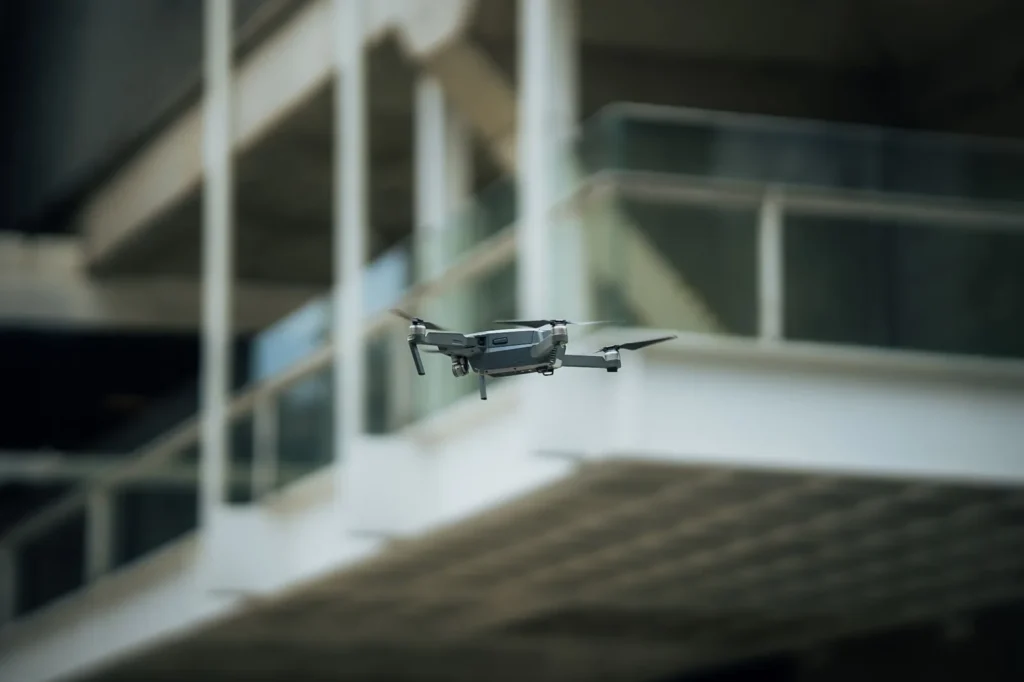
The value of a drone is simple: it puts a camera, and sometimes a laser scanner, exactly where a person cannot easily stand. Roof ridges, steep slopes, active construction zones, and tall facades all become accessible without scaffolding or a cherry picker. The data comes back tagged with coordinates, so it slots straight into design software instead of sitting in a folder of loose snapshots.
Most studios start small. A single mapping flight over a vacant lot replaces a day of manual measurement, and the resulting orthomosaic can be traced directly in CAD. From there, teams add inspection flights, progress documentation, and marketing footage. Each use builds on the same hardware, which is part of why adoption has spread quickly across firms of every size. If you want a wider view of practical applications, our look at the ways architects use drones beyond site surveys covers several field examples.
🎓 Expert Insight
“On most mid-size sites, a drone gives us the topographic base in a morning that used to take a two-person crew the better part of a week, and the client sees the same model we do.” (Chartered land surveyor, 18 years in practice)
The point is not just speed. Sharing one measured model early in a project keeps architects, surveyors, and clients working from the same facts instead of separate sketches.
The Main Uses of Drones in Architecture
Four applications account for most architectural drone work. Each one answers a specific need, from early site study through construction handover. The table below maps the common uses to their main benefit and a practical note worth keeping in mind.
Comparing Common Drone Applications
| Drone Use | Main Benefit | Practical Note |
|---|---|---|
| Site survey and mapping | Fast topographic data over large or uneven plots | Place ground control points for survey-grade accuracy |
| Photogrammetry and 3D modeling | Measurable point clouds and textured 3D meshes | Plan 70 to 80 percent image overlap for clean results |
| Building and structural inspection | Close views of roofs, facades, and damage zones | Pair RGB with thermal sensors to spot moisture or heat loss |
| Marketing and client visualization | Context shots that show a building in its setting | Shoot during golden hour for the strongest imagery |
Site Surveys and Mapping
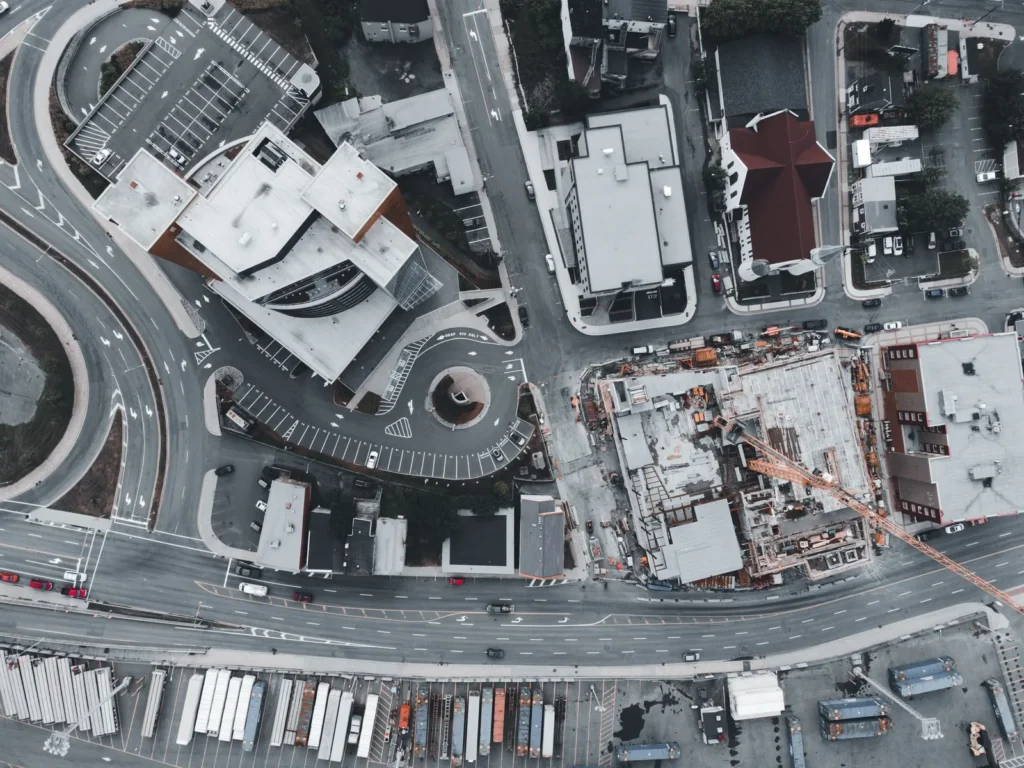
Mapping is where most firms begin. A drone flies a preset grid, captures overlapping nadir images, and software stitches them into an orthomosaic and a digital surface model. The result feeds straight into the kind of analysis covered in our guide to architectural site analysis, since slope, drainage, and existing features all read clearly from above. For larger or phased developments, this connects well with smarter site planning through spatial technology.
📐 Technical Note
Survey accuracy depends on ground sample distance (GSD) and ground control points (GCPs). A lower flight altitude produces a smaller GSD and finer detail, while surveyed GCPs anchor the model to real coordinates. The American Society for Photogrammetry and Remote Sensing (ASPRS) publishes positional accuracy standards that many survey deliverables follow.
Photogrammetry and 3D Modeling
Photogrammetry turns ordinary photos into geometry. By matching common points across many overlapping images, software reconstructs a dense point cloud that becomes a textured mesh. Architects import these models as a real-world base for massing studies, renovation work, or heritage documentation. Manufacturers such as DJI now ship enterprise drones with RTK positioning that tightens this accuracy without a dense GCP network.
Building and Structural Inspection
Inspection flights remove much of the risk from facade and roof checks. Instead of sending a worker up a ladder, an architect or engineer reviews high-resolution stills and video from the ground. Thermal cameras add another layer, revealing moisture intrusion and heat loss that the eye misses. Outlets like ArchDaily regularly document how practices fold this kind of data into renovation and assessment work.
📌 Did You Know?
After the 2019 fire at Notre-Dame de Paris, the city fire brigade flew drones to track hotspots and assess structural damage in real time. The aerial views helped commanders direct water away from the most fragile stone, a job that would have been far slower and riskier from the ground.
Marketing and Client Visualization
Once a project nears completion, the same drone earns its keep again. Aerial photos and flythrough video place a finished building in its neighborhood, showing scale, approach, and roofscape in a way that street-level shots cannot. These clips work well on project pages and in pitches, and they pair naturally with the field documentation workflows described in our review of the iPad Pro for site documentation.
Why Architects Keep Reaching for Drones
The benefits stack up across the project timeline. Speed is the headline, but accuracy, safety, and cost control matter just as much. A measured model gathered in one flight reduces the back-and-forth of manual surveys, cuts the hours people spend in hazardous positions, and gives every stakeholder the same reference data. For small firms, that combination lowers the barrier to offering services that once required outside specialists. The savings show up in two places at once: fewer billable hours lost to fieldwork, and fewer change orders later, because the design started from accurate ground truth rather than assumptions about the site.
🔢 Quick Numbers
- More than 1 million drones are registered with the FAA across the United States (FAA UAS registration data).
- The FAA has issued over 350,000 Part 107 remote pilot certificates for commercial operations (FAA).
- With surveyed ground control points, drone photogrammetry routinely reaches horizontal accuracy of 1 to 3 centimeters, close to traditional survey-grade results (ASPRS photogrammetry guidance).
There are limits worth naming. Wind, rain, and dense tree cover degrade data quality, and battery life caps how much ground a single flight covers. Reflective glass facades and water can confuse photogrammetry software, so inspection of mirrored towers still needs careful planning. None of these problems are dealbreakers, but they shape how teams schedule and scope a flight.
Rules and Limits You Should Know
Commercial drone work is regulated. In the United States, the Federal Aviation Administration requires a Part 107 remote pilot certificate for most paid flights, along with rules on altitude, airspace, and operations over people. Many missions also need airspace authorization through systems like LAANC. The full picture lives on the FAA’s uncrewed aircraft systems pages, and it changes often enough that checking before a flight is part of the job.
Drone regulations and building codes vary by jurisdiction. Always confirm current FAA rules and local authority requirements before flying any site.
Where to Go From Here
Drones in architecture have settled into the workflow not because they are flashy, but because they make site information cheaper, faster, and safer to gather. The studios getting the most from them treat a drone as a data tool first and a camera second, building the captured models into design, inspection, and client communication rather than filing the footage away.
Your Next Step: Before your next site visit, sketch a short flight plan: what you need to measure, the overlap and altitude that match that accuracy, and whether the airspace allows it. A ten-minute plan is the difference between usable survey data and a folder of pretty pictures.






Architecture Beneath the Surface: The Crucial Role of Structural Mechanics and Geotechnical Analysis in Groundwork Design
Bold architecture depends on the ground beneath it. How numerical geotechnical analysis...
 illustrarch Editoral Team1 Mins read
Designing Renovation Projects Around Debris Flow and Site Logistics
Effective renovation planning must prioritize debris flow management. Learn how to integrate...
illustrarch Editoral Team4 Mins read
Foster + Partners to Test Robot Swarms Building Timber from the Top Down
Foster + Partners wins €4m EU grant to build robot and drone...
illustrarch Editoral Team2 Mins read

How Long Does a Building Warranty Typically Last? Coverage Periods Explained
Building warranty cover is layered, not uniform: one year for finishes, two...
 Sinan Ozen5 Mins read


Leave a comment