

Revit vs Archicad Comparison: Features, Cost & Real-World Use Cases for Architects
Choosing between Archicad and Revit shapes how your firm designs, documents, and delivers projects. This in-depth 2026 comparison covers 10 critical differences including BIM modeling approach, pricing and total cost of ownership, system requirements, rendering capabilities, collaboration tools, visual programming, plugin ecosystems, and regional market adoption to help you pick the right platform.
 Elif Ayse Sen22 February 202624 Mins read618

Table of Contents Show
Archicad vs Revit comes down to your firm size, project type, and workflow priorities. Archicad, developed by Graphisoft, offers a design-focused interface with a gentler learning curve and native macOS support. Revit, built by Autodesk, provides deeper multi-discipline coordination for architecture, structural, and MEP teams. This 2026 guide breaks down the ten key differences so you can match the right BIM platform to your practice.
Choosing between Archicad and Revit is one of the biggest decisions an architecture firm can make. Both platforms sit at the top of the BIM (Building Information Modeling) market, yet they serve different workflows, team sizes, and project types. Understanding the features of Archicad vs Revit can save you from costly software migrations down the line. This guide breaks down seven critical differences between these two platforms so you can match the right tool to your practice.
Archicad, developed by Graphisoft, launched in 1987 as one of the first BIM solutions ever created. Revit, built by Autodesk, arrived in 2000 and quickly became the dominant force in multi-disciplinary project coordination. The archicad vs revit comparison goes beyond simple preference. It touches on how you design, collaborate, document, and deliver projects. For a broader look at BIM technology and its role in modern practice, see our guide on becoming a BIM expert.
📌 Did You Know?
Archicad was the first BIM-capable architectural software to reach the market, released by Graphisoft in Budapest back in 1987 under the name Radar CH. It predates Revit by 13 years, which partly explains why it remains the dominant BIM platform in parts of Europe where its early adoption created lasting workflow habits.
1. User Interface and Learning Curve
The first thing most architects notice in the revit vs archicad debate is the interface. Archicad uses a design-centric workspace with floating palettes and customizable toolbars that feel intuitive for architects transitioning from SketchUp or traditional drafting methods. You can start placing walls, slabs, and roofs within hours of opening the software for the first time. Many architects transitioning from SketchUp find Archicad’s interface immediately comfortable, which is worth considering if your team has that background. For more on how different design tools compare, check our Archicad vs SketchUp comparison.
Revit takes a different approach. Its ribbon-based interface groups tools by discipline (architecture, structure, MEP) in a structured layout. New users often describe the initial experience as overwhelming because of the sheer number of panels and options visible at once. However, this structure pays off on large projects where consistency across team members matters more than individual flexibility. Small tasks that seem straightforward, like moving between floors or adjusting zones, can require multiple steps compared to Archicad’s more streamlined approach.
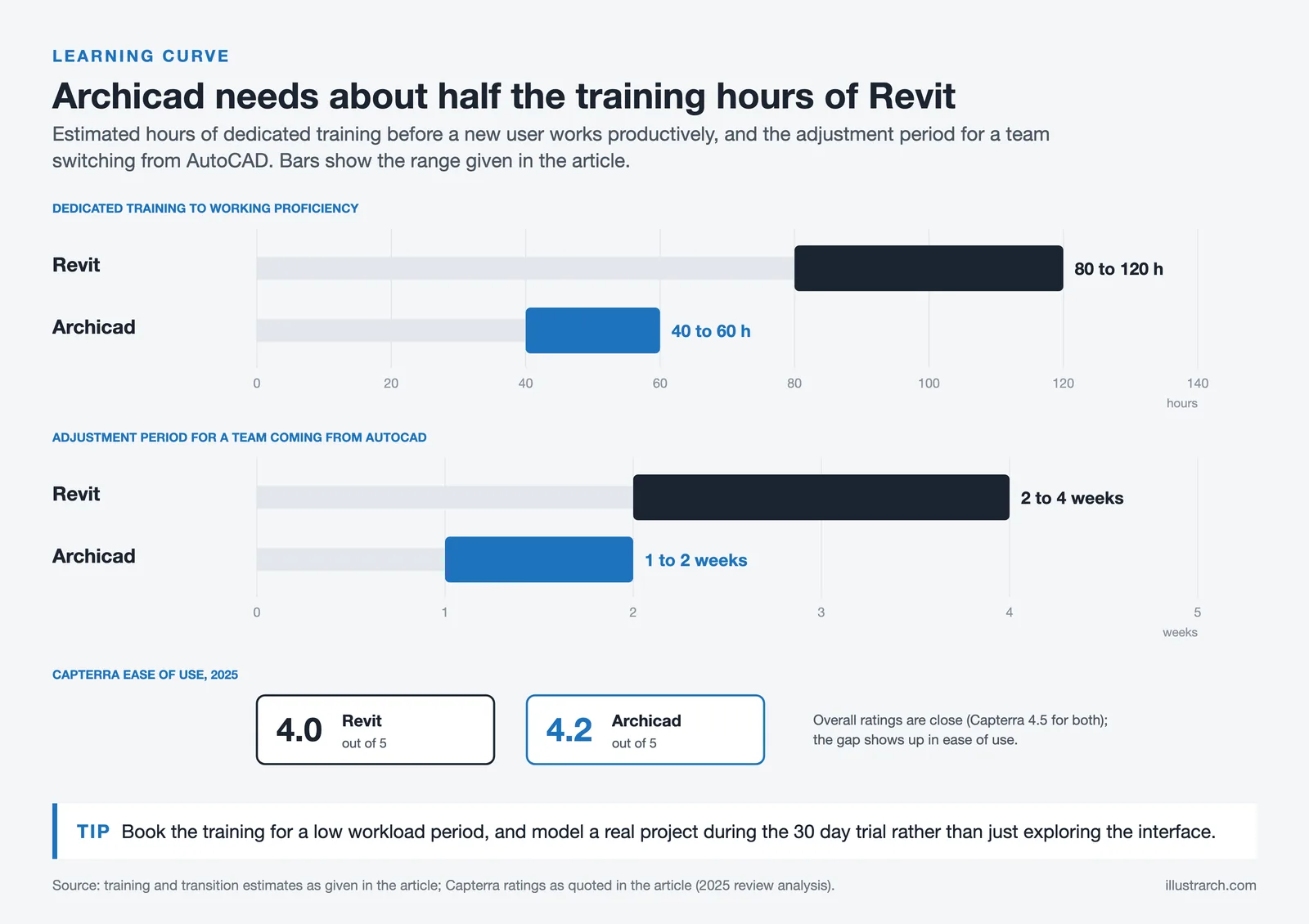
According to a 2025 review analysis by Capterra, Archicad scored 4.2 out of 5 for ease of use while Revit scored 4.0. The gap is small, but it reflects a consistent pattern: Archicad tends to be faster to learn, while Revit rewards deeper investment with broader capabilities. According to user reviews, achieving intermediate proficiency in Archicad takes about 40 to 60 hours of training, which is significantly less than what Revit typically requires.
User Ratings Comparison Across Review Platforms
The following table shows how Archicad and Revit are rated across major software review platforms, reflecting real user experiences:
| Review Platform | Revit Rating | Archicad Rating | Advantage |
|---|---|---|---|
| G2 | 4.5 / 5 (890+ reviews) | 4.4 / 5 (250+ reviews) | Revit (marginal) |
| Capterra | 4.5 / 5 (400+ reviews) | 4.5 / 5 (180+ reviews) | Tied |
| Software Advice | 4.61 / 5 (434+ reviews) | 4.47 / 5 (276+ reviews) | Revit |
| Capterra – Ease of Use | 4.0 / 5 | 4.2 / 5 | Archicad |
| Capterra – Customer Service | 3.8 / 5 | 4.0 / 5 | Archicad |
| Capterra – Value for Money | 3.8 / 5 | 4.1 / 5 | Archicad |
💡 Pro Tip
If your team includes members switching from AutoCAD, expect a 2 to 4 week adjustment period for Revit and roughly 1 to 2 weeks for Archicad. Planning dedicated training time during a low-workload period prevents project delays during the transition. If your team includes members who have only used 2D CAD tools, Archicad’s transition path is generally smoother, with many experienced architects reaching productive BIM workflows in about 40 to 60 hours of training.

2. BIM Modeling and Design Approach
Archicad and Revit both produce intelligent 3D models packed with building data, but their modeling philosophies differ significantly. This matters whether you are evaluating revit architecture vs archicad for a specific project or choosing a long-term platform.
Archicad uses what Graphisoft calls the “Virtual Building” concept. You work with building elements (walls, slabs, roofs, stairs) that behave like their real-world counterparts. This approach feels natural during early design phases when you need to explore forms, test massing options, and present quick concepts to clients. Archicad’s Morph tool and Shell tool also give you more freedom when creating organic or non-orthogonal shapes without leaving the BIM environment. Archicad handles organic and freeform geometry more gracefully out of the box, while Revit typically requires integration with tools like Rhino for non-orthogonal designs.
Revit is built around parametric families. Every element, from a simple door to a complex curtain wall panel, is defined by parameters that control its geometry, material data, and scheduling information. When you change a parameter, the entire model updates across all views, schedules, and sheets. This parametric rigor ensures data consistency on projects with hundreds of elements and multiple team members editing simultaneously. The Family Editor gives granular control over component creation, though mastering it takes time.
For architects focused on design exploration and presentation, Archicad’s approach typically feels more fluid. For firms handling large commercial buildings, hospitals, or infrastructure where data accuracy across disciplines is the priority, Revit’s parametric system provides tighter control.
2D Drafting Integration
A notable difference between these platforms is how they handle 2D drafting alongside 3D modeling. Archicad combines 3D modeling with 2D drafting smoothly in one environment, allowing architects to work fluidly between both modes. Revit generates 2D documentation from the 3D model but offers more limited standalone 2D tools. For firms that still need significant 2D drafting capability alongside their BIM workflow, Archicad’s integrated approach can streamline the process.

3. Multi-Disciplinary Integration
This category creates one of the sharpest divides in the archicad vs revit architecture discussion. Revit was purpose-built as an all-in-one platform spanning architecture, structural engineering, and MEP (mechanical, electrical, plumbing) design. All three disciplines can work within a single coordinated model, running clash detection and resolving conflicts before construction begins.
Archicad focuses primarily on architectural workflows. While you can model structural and MEP elements, the built-in tools are less developed than Revit’s dedicated structural and MEP modules. Archicad’s MEP Designer add-on (included in the Collaborate package) improves this, but it still does not match the depth that Revit offers for engineering-heavy projects.
Where Archicad compensates is through its Open BIM approach, championed by buildingSMART International. Archicad produces excellent IFC (Industry Foundation Classes) exports, allowing structural and MEP consultants using other software to coordinate effectively. If your engineers use Tekla, Robot, or other non-Autodesk tools, Archicad’s interoperability can actually be an advantage.
⚠️ Common Mistake to Avoid
Many small firms pick Revit because it is “the industry standard,” then struggle with its hardware demands and steep learning curve for architecture-only work. The smarter approach is to match the tool to your actual project mix: if 80% of your work is residential or small commercial with external engineering consultants, Archicad often fits better. Industry standard status only matters if your projects genuinely require the coordination depth it provides.
When comparing autocad architecture vs revit, it is worth noting that Revit goes beyond 2D drafting by offering intelligent parametric objects and real-time schedule generation, whereas AutoCAD remains primarily a drafting tool. Similarly, when comparing archicad vs autocad, Archicad is a full BIM solution while AutoCAD is primarily a 2D/3D drafting tool. Architects who need intelligent object-based modeling will benefit more from either Revit or Archicad over AutoCAD.
File Format and Interoperability Support
Interoperability is critical when collaborating with consultants and contractors. This table compares the file formats each platform supports:
| File Format | Revit | Archicad |
|---|---|---|
| Native format | .rvt / .rfa (families) | .pln / .pla (archive) |
| IFC (Open BIM) | Import & Export (IFC 2×3, IFC4) | Import & Export (IFC 2×3, IFC4 – certified by buildingSMART) |
| DWG / DXF (AutoCAD) | Import & Export (native Autodesk support) | Import & Export |
| SKP (SketchUp) | Import only | Import & Export |
| 3DM (Rhino) | Import via plugin / intermediary format | Grasshopper–Archicad Live Connection (direct) |
| FBX / OBJ (3D exchange) | Export (FBX native via Autodesk) | Export (FBX, OBJ, 3DS) |
| DGN (MicroStation) | Import & Export | Import & Export |
| Import (2D) & Export | Import (2D) & Export | |
| BCF (BIM Collaboration Format) | Supported via plugins | Native support |
| Revit file import | Native | Via IFC or Archicad-Revit Add-In |
For firms that handle full multi-discipline projects in-house, Revit is the stronger choice. For architecture-focused practices that collaborate with external consultants, Archicad’s Open BIM strategy works well.

4. Collaboration and Teamwork Features
Collaboration tools are essential for any firm with more than one person on a project, making this a crucial point in the revit vs archicad for architecture comparison.
Revit uses worksharing, which lets multiple users work on the same central model simultaneously. Team members “borrow” specific elements or worksets, edit them, and synchronize changes back to the central file. This system integrates with Autodesk’s BIM 360 (now Autodesk Construction Cloud) for cloud-based collaboration, enabling teams across offices and time zones to coordinate on a single project.
Archicad’s collaboration system is called Teamwork, powered by BIMcloud. It operates differently from Revit’s worksharing. Instead of worksets, Archicad uses element-level reservation. You reserve specific elements (a wall, a room, a floor) rather than broad categories. This granular approach reduces conflicts and lets architects work more independently within the same model. Archicad also champions Open BIM standards and strong IFC support, which helps bridge the gap when collaborating with consultants who use different software.
For large firms with 20 or more people on a single project spanning multiple disciplines, Revit’s worksharing and Autodesk ecosystem typically provide smoother coordination. For smaller teams of 2 to 10 architects, Archicad’s Teamwork system often feels less restrictive and easier to manage.
Collaboration Comparison at a Glance
The following table summarizes the key collaboration differences between these two platforms:
| Feature | Revit | Archicad |
|---|---|---|
| Multi-user system | Worksharing with worksets | Teamwork with element-level reservation |
| Cloud platform | Autodesk Construction Cloud (BIM 360) | BIMcloud |
| Best suited for | Large, multi-discipline teams (20+) | Small to mid-size architecture teams (2-10) |
| External coordination | Strong within Autodesk ecosystem | Strong IFC/Open BIM support |
| Conflict management | Workset-based borrowing | Granular element reservation |

5. Rendering and Visualization Capabilities
Both platforms connect to popular external renderers like Enscape, Lumion, V-Ray, and Twinmotion. The differences lie in their built-in rendering engines and how they integrate with these tools. This matters especially when evaluating revit vs archicad for interior design projects where visualization quality directly impacts client approval.
Archicad includes the CineRender engine (based on Maxon’s Cinema 4D technology) for in-software rendering. Recent versions added the Redshift engine for GPU-accelerated photorealistic output, giving architects fast, high-quality renders without leaving the application. Archicad also offers BIMx, an interactive 3D walkthrough tool that works on mobile devices, perfect for on-site client presentations. Additionally, Graphisoft has introduced an AI Visualizer feature powered by Stable Diffusion for generating concept visualizations directly within the software, further expanding Archicad’s built-in creative capabilities.
Revit’s built-in rendering capabilities are more basic, though Autodesk now includes Twinmotion access with Revit subscriptions for real-time visualization. Most Revit users rely on Enscape (which runs as a plugin directly inside Revit for real-time visualization) or export to Lumion and Twinmotion. Revit’s tight integration with 3ds Max also gives it an edge for high-end photorealistic rendering workflows. The advantage here is that Revit’s plugin ecosystem for visualization is slightly more mature, with a wider range of third-party options available through the Autodesk App Store.
For architects who want strong built-in rendering without additional software costs, Archicad has the edge. For those who already use Enscape or Twinmotion, both platforms work well, though Revit’s plugin ecosystem is slightly more mature.
Rendering and Visualization Comparison
This table breaks down the built-in and external rendering capabilities of each platform:
| Visualization Feature | Revit | Archicad |
|---|---|---|
| Built-in render engine | Basic Raytracer | CineRender (Maxon-based) + Redshift GPU |
| Included real-time visualizer | Twinmotion (included with subscription) | BIMx (interactive 3D walkthrough, iOS & Android) |
| AI-powered visualization | Not built-in | AI Visualizer (Stable Diffusion-powered) |
| Enscape plugin | Yes (real-time, runs inside Revit) | Yes (real-time plugin available) |
| Lumion support | Yes (LiveSync plugin) | Yes (LiveSync plugin) |
| V-Ray support | Yes (Chaos Group plugin) | Yes (Chaos Group plugin) |
| 3ds Max integration | Direct (Autodesk ecosystem) | Export via FBX/OBJ/3DS |
| Mobile presentation tool | Autodesk Construction Cloud mobile apps | BIMx (dedicated 3D/2D model viewer) |
| Best for | Plugin-based high-end visualization workflows | All-in-one rendering without extra costs |

6. Pricing, Licensing, and Platform Compatibility
Cost is often the deciding factor in the archicad vs autocad revit comparison, especially for small firms and solo practitioners. Here is how the two platforms stack up financially as of October 2026.
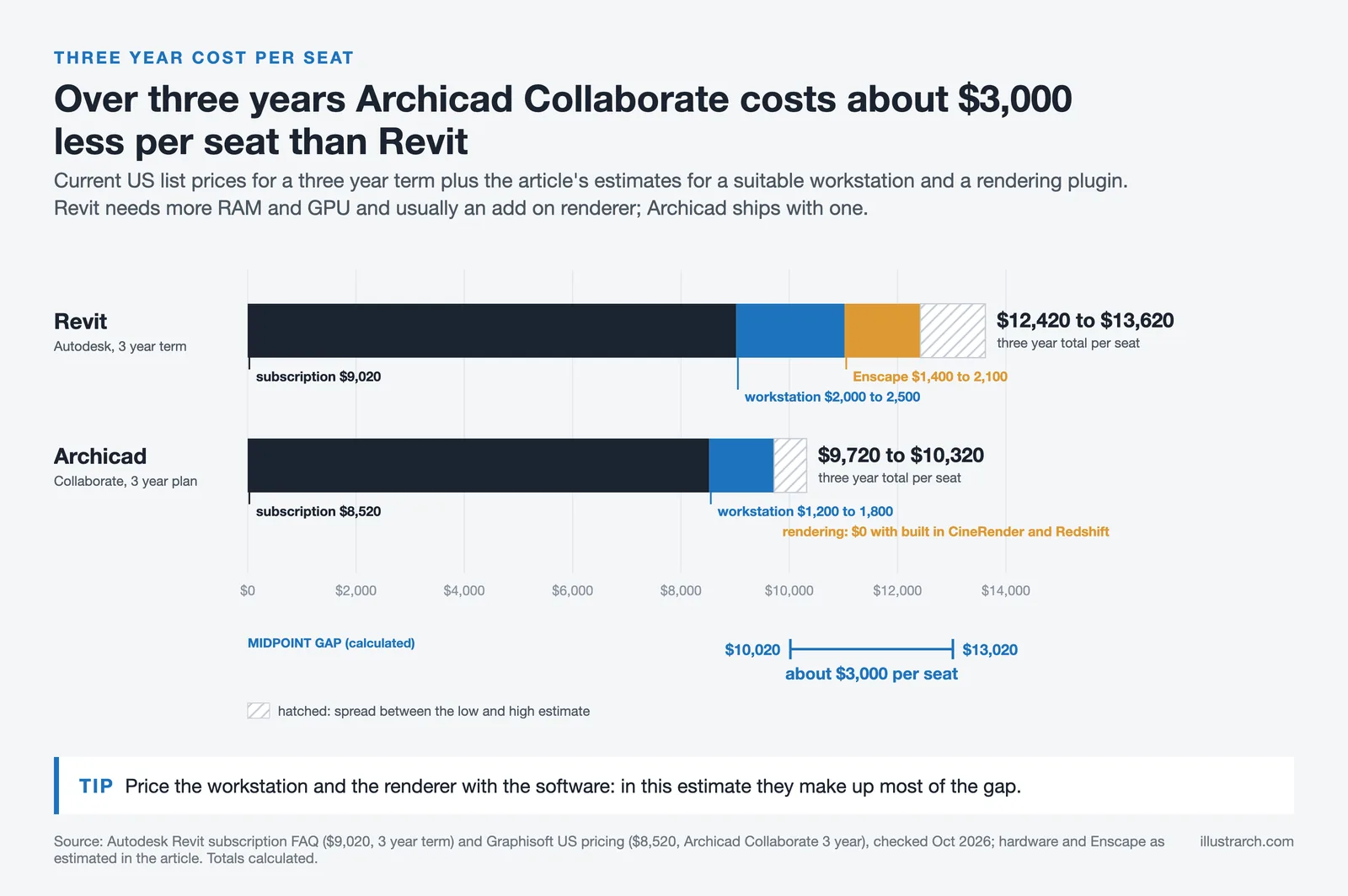
Revit is available exclusively through Autodesk’s subscription model. The annual subscription costs approximately $3,005 per user (as of October 2026), with a monthly option at around $380. Autodesk also offers the AEC Collection (which bundles Revit with AutoCAD, Navisworks, Civil 3D, and Autodesk Forma) at around $3,675 per year. A three-year plan is available at approximately $9,020, locking in pricing against future increases. Autodesk Flex provides a pay-as-you-go option starting at $300 for 100 tokens (10 tokens per day of use), which is useful for occasional users. There is no perpetual license available.
Archicad’s licensing landscape changed significantly in 2025-2026. Graphisoft announced a shift to a subscription-only model, phasing out perpetual licenses. New customers could no longer purchase perpetual licenses after December 31, 2024, and existing customers had until December 31, 2025 to acquire additional perpetual licenses. Starting in 2026, Archicad is available only through subscription. Archicad now offers two main subscription tiers: Archicad Studio (for solo practitioners and small firms with local teamwork via BIMcloud Basic) and Archicad Collaborate (for distributed teams with full cloud collaboration and MEP features). Subscription pricing varies by region, starting at approximately $201 (Studio) to $237 (Collaborate) per month with annual billing in the US, as of October 2026. Graphisoft also provides floating license options, which is convenient for teams sharing access across devices. Free educational licenses are available for students and teachers from both platforms.
Pricing Overview: Archicad vs Revit (2026)
This table breaks down the current pricing structure for each platform:
| Pricing Factor | Revit | Archicad |
|---|---|---|
| Monthly cost | ~$380/month | From ~$201 to $237/month (annual billing) |
| Annual cost | ~$3,005/year | Varies by tier and region |
| 3-year plan | ~$9,020 | Available (varies by region) |
| Pay-as-you-go option | Flex: $300/100 tokens (10 tokens/day) | Not available |
| Perpetual license | Not available | Phased out as of 2026 |
| Operating systems | Windows only | Windows and macOS (native Apple Silicon support) |
| Free educational license | Yes (1-year renewable) | Yes (1-year renewable) |
| Free trial | 30-day free trial | 30-day free trial |
| Bundled suite option | AEC Collection (~$3,675/year) | Archicad Studio and Collaborate tiers |
| License type | Named user (Standard, Premium, Enterprise) | Named user & floating license available |
3-Year Total Cost of Ownership (Per User)
When evaluating software costs, the subscription price is only part of the picture. This table estimates the total cost of ownership over three years, including hardware investments:
| Cost Component | Revit (3-Year Estimate) | Archicad Collaborate (3-Year Estimate) |
|---|---|---|
| Software subscription (3 years) | ~$9,020 | ~$8,520 |
| Recommended workstation | ~$2,000–$2,500 (32 GB RAM, dedicated GPU) | ~$1,200–$1,800 (16 GB RAM sufficient) |
| Rendering plugin (Enscape, optional) | ~$1,400–$2,100 (subscription over 3 years) | $0 (CineRender + Redshift built-in) or ~$1,400–$2,100 for Enscape |
| Training time (estimated) | 80–120 hours (3–6 weeks dedicated) | 40–60 hours (1–3 weeks dedicated) |
| Estimated 3-year total per user | ~$12,420 to $13,620 | ~$9,720 to $10,320 |
One often-overlooked factor is platform compatibility. Revit runs exclusively on Windows, which means Mac-based firms need to run a virtual machine, Parallels, or Boot Camp. Archicad runs natively on both Windows and macOS with native Apple Silicon optimization, a significant advantage for studios that use Apple hardware.
💡 Pro Tip
Before committing to either platform, calculate the total cost of ownership over three years, including hardware upgrades. Revit’s higher system requirements (especially RAM and GPU) can raise workstation costs compared to what Archicad demands. Factor this into your budget alongside the subscription price. Also take advantage of the free trials both Autodesk and Graphisoft offer. Model a real project during the trial period rather than just exploring the interface to get a genuine sense of how each platform handles your specific project type and team workflow.

7. Performance and System Requirements
Performance is a critical but often underestimated factor when choosing between Archicad and Revit, especially for firms that need to balance software capability with available hardware budgets.
Revit handles large-scale projects effectively, though its performance may lag on complex files without high-spec hardware. Its system requirements can make it resource-intensive for small firms with limited computing power. According to Autodesk’s system requirements page, Revit recommends at least 16 GB of RAM and a multi-core processor for optimal performance. On complex multi-discipline models with extensive MEP systems, 32 GB of RAM or more is advisable for a smooth workflow.
Archicad offers faster performance for design-focused projects. Optimized to handle mid-size models smoothly, it typically runs efficiently even on less capable systems. Its lightweight nature contributes to its popularity with smaller firms. Archicad’s minimum hardware requirements are noticeably lower than Revit’s, making it more accessible for studios operating on tighter budgets. With ArchiCAD 28, Graphisoft has also implemented native Apple Silicon optimization, which provides significant performance gains on newer Mac hardware.
For firms operating with limited IT budgets, Archicad’s lower hardware requirements can translate into meaningful savings per workstation. For large firms already investing in high-performance workstations for multi-discipline BIM coordination, Revit’s hardware demands are easier to absorb.
Minimum and Recommended System Requirements
This table compares the hardware specifications each platform requires, which directly impacts your total cost of ownership:
| Hardware Specification | Revit (Recommended) | Archicad (Recommended) |
|---|---|---|
| Operating system | Windows 10/11 64-bit only | Windows 10/11 64-bit or macOS 13+ |
| Processor (CPU) | Multi-core Intel/AMD, 3+ GHz (single-thread performance critical) | Multi-core Intel/AMD or Apple Silicon M1+ |
| RAM (minimum) | 16 GB | 16 GB |
| RAM (recommended for complex projects) | 32 GB or more | 16–32 GB |
| GPU | DirectX 11 capable with 4 GB VRAM (NVIDIA/AMD recommended) | OpenGL 4.0+ compatible with 2 GB+ VRAM |
| Storage | SSD with 30 GB+ free space | SSD with 10 GB+ free space |
| Display resolution | 1920 × 1080 minimum | 1920 × 1080 minimum |
| Estimated workstation cost (mid-range) | $1,800–$2,500+ | $1,200–$1,800 |
8. Visual Programming and Automation
Both Revit and Archicad offer tools for automating repetitive tasks and extending the software’s capabilities through scripting and visual programming, which is increasingly important for firms looking to optimize their workflows.
Revit includes Dynamo, a built-in visual scripting environment that allows users to automate tasks, create custom parametric logic, and manipulate model data without writing traditional code. Dynamo has a strong community and an extensive library of user-contributed packages. It is particularly useful for automating repetitive documentation tasks, generating complex geometry from algorithmic rules, and performing data extraction across large models.
Archicad takes a different approach with GDL (Geometric Description Language) for creating custom parametric objects and library parts. While GDL is more code-based than Dynamo, Archicad also supports a live connection with Grasshopper (the visual programming environment for Rhino), enabling architects to create complex computational designs and push them directly into the BIM environment. This Grasshopper-Archicad Live Connection is particularly valuable for firms that use Rhino for conceptual design and want a direct pipeline into their BIM model.
For firms that prioritize computational design and parametric workflows, the choice between Dynamo (Revit) and Grasshopper integration (Archicad) may influence which platform better fits their design methodology.
Visual Programming and Automation Comparison
| Automation Feature | Revit | Archicad |
|---|---|---|
| Visual scripting tool | Dynamo (built-in, node-based) | Grasshopper–Archicad Live Connection (via Rhino) |
| Custom object scripting | Family Editor + Dynamo | GDL (Geometric Description Language) |
| API / programming language | Revit API (.NET / C# / Python via pyRevit) | Archicad API (C++ / Python) |
| Community packages | Extensive (Dynamo Package Manager, pyRevit) | Growing (Grasshopper ecosystem + GDL libraries) |
| Learning difficulty | Moderate (Dynamo is beginner-friendly) | Higher (GDL is code-based; Grasshopper requires Rhino) |
| Best for | Automation of documentation, data management, repetitive tasks | Computational design, complex geometry generation, parametric facades |
9. Plugin Ecosystem and Documentation Tools
The extensibility of a BIM platform through plugins and add-ons can significantly expand its capabilities, and this is an area where Revit and Archicad differ notably.
Revit benefits from an extensive plugin ecosystem available through the Autodesk App Store, with thousands of third-party tools covering energy analysis (Cove.tool), automation (pyRevit), structural analysis, cost estimation, and more. This vast library means that almost any workflow gap can be filled with a plugin, giving large firms the ability to customize Revit to their exact needs.
Archicad’s plugin ecosystem is growing but remains smaller in comparison. Graphisoft offers its own add-ons, and third-party developers contribute tools for energy analysis, quantity takeoff, and design optimization. While the selection is more limited, Archicad’s built-in feature set is broader in certain areas (like rendering), which reduces the need for additional plugins.
When it comes to documentation and scheduling, both platforms generate construction documents from 3D models, but their approaches differ. Revit offers advanced scheduling capabilities with automatic sheet generation and detailed annotation tools that are particularly effective for large, data-heavy projects. Archicad’s Navigator Palette system simplifies the publishing workflow and provides good scheduling capabilities, with many users finding its documentation tools more intuitive for architecture-focused deliverables.
🎓 Expert Insight
“Revit is not BIM. Revit was designed for BIM, but it does not accomplish every aspect of BIM.”, Autodesk Knowledge Network, Revit Learning Documentation
This distinction, acknowledged by Autodesk itself, reinforces that BIM is a process rather than a brand. Using Revit without proper modeling standards, naming conventions, and data protocols delivers BIM software without a BIM workflow. The same holds for Archicad. Both tools require disciplined setup before their collaboration benefits emerge, which is a point often missed when firms compare feature lists alone.
10. Industry Adoption and Career Impact
Market share influences not just software purchases but hiring, collaboration, and career paths. In North America, Revit dominates the commercial architecture and engineering sectors. According to the NBS Digital Construction Report, Revit consistently ranks as the most widely used BIM tool globally, particularly in the United States, United Kingdom, and parts of Asia. Many government agencies and large construction firms mandate Revit-based BIM deliverables, making it the expected standard for public infrastructure and federal projects.
Archicad maintains a strong presence in Europe (especially Hungary, Germany, Austria, and Scandinavia), Australia, Japan, and among small to mid-size architecture practices worldwide. Firms that prioritize design quality over multi-discipline integration often gravitate toward Archicad. Archicad’s Open BIM philosophy and strong IFC support also give it an advantage in regions where interoperability between different software platforms is a regulatory requirement.
For architects considering career flexibility, Revit experience opens more doors in the current job market. Most large firms and government projects specify Revit proficiency in their requirements. That said, Archicad skills are valued at design-focused studios, and professionals who understand both platforms have a clear competitive edge. According to industry observations, a significant majority of AEC firms in North America list Revit proficiency as a requirement, while European firms more commonly accept or prefer Archicad skills. You can explore more about essential digital tools for architects to understand how these platforms fit within the broader software ecosystem. If you are considering alternatives to either tool, our Revit alternatives guide and Archicad alternatives guide cover eight platforms each with pricing and interoperability notes.
Regional Market Dominance: Revit vs Archicad
The following table highlights which platform has stronger adoption across key global markets:
| Region / Country | Dominant Platform | Notes |
|---|---|---|
| United States | Revit | Industry standard; required for most government and federal BIM mandates |
| United Kingdom | Revit | Strong adoption due to UK BIM Level 2 mandate; large firms favor Revit |
| Germany / Austria / Switzerland | Archicad | Strong Archicad tradition; Open BIM and IFC widely adopted |
| Hungary | Archicad | Graphisoft’s home country; dominant market share |
| Scandinavia (Nordic countries) | Archicad / Mixed | Open BIM requirements favor Archicad; Revit growing in larger firms |
| Australia / New Zealand | Archicad / Mixed | Strong Archicad presence in design studios; Revit in large commercial firms |
| Japan | Archicad | Widely used in architectural firms; strong Graphisoft partner network |
| Middle East / Turkey | Revit | Large-scale projects and international firms drive Revit adoption |
| China / Southeast Asia | Revit | Major infrastructure and commercial development favors Autodesk tools |
| South America | Mixed | Revit in larger firms; Archicad growing among design-focused studios |

What About Chief Architect?
When discussing Revit vs Archicad, a third option often enters the conversation: Chief Architect. This software is specifically designed for residential and light commercial projects. Unlike Revit and Archicad, which target the broader AEC industry, Chief Architect focuses on home design, remodeling, and interior work. It features automatic building tools for roofs, framing, and foundations, along with an extensive library of interior objects.
Chief Architect Premier is available at approximately $199 per month or around $1,995 per year, with a perpetual license option at roughly $2,995. This makes it considerably more affordable than either Revit or Archicad for firms that only handle residential projects.
If you primarily work on single-family homes or small renovations, Chief Architect vs Revit becomes a relevant comparison. However, for commercial architecture and full BIM workflows, Revit or Archicad remain the stronger choices. Chief Architect’s scope is much narrower, focusing exclusively on home design rather than full BIM workflows.
Archicad vs Revit: Full Feature Comparison Table
This side-by-side summary covers all key feature areas discussed in the article:
| Feature Area | Revit | Archicad |
|---|---|---|
| Learning curve | Steeper, 3-6 weeks to proficiency | Gentler, 1-3 weeks (~40 to 60 hours to intermediate) |
| Modeling approach | Parametric families with Family Editor | Virtual Building concept |
| 2D drafting | Generated from 3D model; limited standalone 2D tools | Integrated 3D + 2D workflow in one environment |
| Freeform geometry | Limited; requires Rhino integration for complex organic shapes | Morph & Shell tools handle organic shapes out of the box |
| Multi-discipline support | Architecture + Structure + MEP built-in | Architecture-focused, MEP add-on available |
| Collaboration | Worksharing + BIM 360/ACC | Teamwork + BIMcloud |
| Built-in rendering | Basic (Twinmotion included with subscription) | CineRender + Redshift + AI Visualizer |
| Mobile / on-site review | Autodesk Construction Cloud mobile apps | BIMx dedicated 3D model viewer (iOS & Android) |
| Visual programming | Dynamo (built-in visual scripting) | GDL + Grasshopper-Archicad Live Connection |
| Plugin ecosystem | Extensive (Autodesk App Store, thousands of plugins) | Growing but smaller; broader built-in features |
| Performance | Requires high-spec hardware (16 GB+ RAM recommended) | Efficient on mid-range systems; Apple Silicon optimized |
| Annual cost (approx.) | ~$3,005 | Varies by tier and region |
| Platform compatibility | Windows only | Windows & macOS (native Apple Silicon) |
| Ecosystem integration | Deep Autodesk suite (AutoCAD, Navisworks, 3ds Max) | Open BIM; strong IFC; Rhino/Grasshopper integration |
| Market dominance | North America, UK, large firms, government projects | Europe, Australia, Asia, design-focused firms |
Pros and Cons of Each Platform
To help you weigh the trade-offs at a glance, here is a summary of the key advantages and disadvantages of each platform.
Revit Pros
- Full multi-discipline BIM covering architecture, structural, and MEP in a single platform, making it ideal for complex commercial and institutional projects.
- Autodesk Construction Cloud enables real-time, cloud-based collaboration, enhancing coordination among architects, engineers, and contractors across offices and time zones.
- Deep integration with the broader Autodesk ecosystem including AutoCAD, Navisworks, Dynamo, and 3ds Max provides a unified workflow across design, analysis, and construction tools.
- Industry standard for many government BIM mandates and the most widely required BIM skill in North American job markets.
- Extensive plugin ecosystem through the Autodesk App Store with thousands of third-party tools.
Revit Cons
- Steep learning curve with an extensive feature set that requires significant dedicated training time, especially for users accustomed to traditional CAD tools.
- Resource-intensive software requiring high-spec hardware (16 GB RAM minimum, 32 GB recommended for complex models), which increases overall costs for smaller studios.
- Higher subscription costs starting at approximately $3,005 per year with no perpetual license option available.
- Windows-only platform, requiring Mac users to rely on virtualization solutions like Parallels.
- Limited organic and freeform design capability without integrating external tools like Rhino.
Archicad Pros
- Intuitive, design-centric interface that is accessible to beginners and experienced users alike, with significantly faster onboarding times.
- Runs smoothly on mid-range systems with lower hardware requirements, reducing total cost of ownership for smaller firms.
- Native macOS support with Apple Silicon optimization, making it the preferred choice for firms using Apple hardware.
- Integrated 3D and 2D drafting workflow plus stronger built-in rendering with CineRender, Redshift, and the AI Visualizer.
- Open BIM standards and strong IFC support for cross-platform collaboration with consultants using different software.
- Flexible licensing with floating license options and subscription tiers that cater to varying budgets and team setups.
Archicad Cons
- Limited multi-disciplinary integration compared to Revit, particularly for structural and MEP workflows that require dedicated engineering tools.
- BIMcloud Teamwork collaboration works well for small to medium teams but may not match Autodesk Construction Cloud for larger, complex multi-discipline teams.
- Smaller plugin ecosystem compared to Revit, though the broader built-in feature set partially compensates.
- Smaller market share than Revit, which can create collaboration challenges when working with engineering firms that predominantly use Autodesk products.
- The shift to subscription-only licensing in 2026 removes the perpetual license option that many long-time Archicad users previously valued.
Archicad vs Revit: Quick Comparison Video
Watch the following video for a visual overview of the key differences between Archicad and Revit and how each platform approaches architectural BIM workflows:
Can You Use Revit and Archicad Together?
Yes. Revit and Archicad can work together on a single project by exchanging data through open BIM standards, primarily using IFC files. Many firms use Archicad for architectural design during the early creative phases while their structural or MEP consultants work in Revit for coordination and engineering documentation. The IFC Model Exchange with the Archicad Add-In improves linking, importing, and coordination between the two platforms.
While the workflow is not as smooth as staying within a single ecosystem, it is a practical approach for mixed-software teams. Archicad handles early design phases where creative exploration matters most, and Revit takes over for documentation, coordination, and construction delivery. Understanding where each tool excels lets you build a workflow that plays to both strengths.
For teams exploring how different tools fit together in the broader architectural design development process, understanding interoperability is essential. Revit’s strength in the Autodesk ecosystem and Archicad’s Open BIM approach both offer valid paths to effective project delivery.
Recommendations Based on Use Cases
The following table maps specific practice types and scenarios to the recommended platform:
| Use Case | Recommended | Why? |
|---|---|---|
| Large multi-disciplinary projects | Revit | Advanced parametric tools, MEP/structural integration, Autodesk Construction Cloud |
| Small to mid-sized architecture firms | Archicad | Intuitive interface, efficient performance, design-focused workflows, lower costs |
| Residential design and remodeling | Chief Architect | Purpose-built for home design, automated roofing/framing, most affordable option |
| Teams needing quick onboarding | Archicad | Shorter learning curve, beginner-friendly layout, ~40 to 60 hours to intermediate proficiency |
| Firms in the Autodesk ecosystem | Revit | Tight integration with AutoCAD, Navisworks, and AEC Collection |
| Government / infrastructure BIM mandates | Revit | Industry standard for BIM deliverables in many government projects |
| Design visualization & conceptual work | Archicad | Morph/Shell tools, built-in CineRender & Redshift, AI Visualizer, creative flexibility |
| macOS users | Archicad | Native macOS support with Apple Silicon optimization; Revit is Windows-only |
| Open BIM / IFC-heavy workflows | Archicad | Strong IFC support and Open BIM philosophy for multi-platform collaboration |
| Computational / parametric design | Both (different approaches) | Revit offers Dynamo; Archicad offers Grasshopper Live Connection |
Which Software Should You Choose?
The features of Archicad vs Revit point toward different ideal users. Pick Revit if your firm handles multi-disciplinary projects, employs large teams, needs tight integration with structural and MEP consultants within the Autodesk ecosystem, operates in a market where Revit is the expected standard, or works on government projects that mandate specific BIM deliverables. Pick Archicad if your practice is architecture-focused, values design flexibility, works on macOS, operates with smaller teams, prioritizes faster onboarding, or collaborates with consultants through Open BIM and IFC workflows. For firms working exclusively on residential projects, Chief Architect offers a more focused and affordable alternative to both platforms.
Many successful firms use both. Archicad handles early design phases where creative exploration matters most, and Revit takes over for documentation, coordination, and construction delivery. Understanding where each tool excels lets you build a workflow that plays to both strengths. Test both platforms during their free trial periods with a real project before committing, as this hands-on experience will reveal which software delivers optimal value and productivity for your specific practice.
For more on how 3D modeling is changing the design process, explore how BIM tools fit into modern architectural practice. You can also review our earlier Revit vs Archicad guide for additional context on choosing between these platforms. For students exploring these tools, our list of best architectural software for students may also be helpful.
✅ Key Takeaways
- Pick Revit if you handle multi-discipline coordination, work in the Autodesk ecosystem, or serve markets with BIM mandates (US, UK, Middle East).
- Pick Archicad if your firm is architecture-focused, runs on macOS, has smaller teams, or needs faster onboarding for new hires.
- Archicad saves roughly $3,000 to $4,000 per user over three years compared to Revit when hardware, training, and rendering costs are added up.
- Revit opens more career doors in North America and the UK; Archicad skills are valued in Europe, Australia, and Japan.
- Both platforms can interoperate through IFC, so mixed-software teams can use Archicad for design and Revit for multi-discipline documentation.
- Always test with a real project during the 30-day free trial before committing to a 1 or 3 year subscription.
Frequently Asked Questions About Archicad vs Revit
Is Archicad easier to learn than Revit?
Yes, Archicad is generally easier to learn than Revit. Most architects reach intermediate proficiency in Archicad within about 40 to 60 hours of focused training, while Revit typically requires 80 to 120 hours because of its deeper parametric system, Family Editor complexity, and broader multi-discipline feature set. Archicad’s floating palette interface also feels closer to SketchUp and traditional drafting tools, which makes the transition smoother for architects coming from those environments.
Which is more expensive, Archicad or Revit?
Revit is more expensive over a three-year horizon once hardware and training are included. Revit costs approximately $3,005 per user per year, compared to $2,840 for an equivalent Archicad Collaborate subscription. Revit also demands higher-spec workstations and longer training time. The gap widens further for Mac-based firms, which need virtualization software or separate Windows machines to run Revit.
Can Archicad open Revit files?
Archicad cannot open native Revit .rvt files directly, but it can import them through the IFC (Industry Foundation Classes) format or by using the Archicad-Revit Add-In, which was developed by Graphisoft to improve interoperability. Revit users need to export their model as IFC 2×3 or IFC4 from within Revit, and Archicad then imports the geometry and metadata. The Revit-to-Archicad workflow is reliable for coordination but does not preserve every parametric family relationship.
Do architects use Archicad or Revit?
Architects use both Archicad and Revit, and the choice depends on region, firm size, and project type. In North America, the UK, and the Middle East, most commercial architects use Revit because of BIM mandates and large-firm ecosystem alignment. In Europe (especially Germany, Austria, and Scandinavia), Australia, Japan, and among small to mid-size architecture practices worldwide, Archicad is more common. Solo practitioners and design-focused studios often prefer Archicad for its lighter interface and macOS support.
Which BIM software is better for small firms?
Archicad is generally better for small firms because of its lower hardware demands, shorter learning curve, and native macOS support. A two to five person studio can get productive in Archicad within one to two weeks, while Revit typically requires three to six weeks of dedicated training plus higher workstation costs. Revit becomes the better choice only when small firms regularly collaborate with larger engineering consultancies that mandate Revit deliverables, or when the team specializes in multi-discipline coordination.
Software pricing and feature availability are subject to change. The figures cited in this article reflect publicly listed prices from Autodesk and Graphisoft as of early 2026. Always verify current pricing on the official vendor websites before making purchasing decisions.
Last updated:


1 Comment


Notion Alternatives for Architects: 7 Tools That Fit Studio Work
Notion works until a studio needs fee tracking, phase budgets and timesheets....
 Furkan Sen7 Mins read

Why Every Practice Ends Up With Five Versions of the Same Revit Family
Let’s learn why Revit family libraries accumulate duplicates, break schedules and slow...
 illustrarch Editoral Team5 Mins read
Visualizing Renovation Projects From Photographs: A Workflow for Existing-Building Work
Photo-based visualization turns a photograph of a building that already exists into...
illustrarch Editoral Team7 Mins read

Best Free CAD Blocks and Resources for Architects
A working guide to free CAD blocks for architects, covering ARCAT, CAD-Blocks.net,...
Furkan Sen7 Mins read


This article really clarifies the differences between Archicad and Revit. I didn’t know that Archicad is easier for those transitioning from SketchUp. Does anyone have experience with both? How do they compare in real project scenarios?