

Modern Architecture Prefab Homes: The Complete Guide to Modular Design and Construction
Modern architecture prefab homes are transforming how we design and build residences, offering factory-level quality control, faster timelines, and strong sustainability credentials. This guide covers how modular construction works, the design possibilities it opens, what it actually costs, and the technology driving the sector forward, from CLT panels to Passive House-certified modules.
 Furkan Sen29 March 202612 Mins read251

Table of Contents Show
Modern architecture prefab homes are residences built from factory-manufactured modules assembled on-site, combining precision engineering with thoughtful design. Far from the utilitarian structures of decades past, today’s prefab and modular homes deliver high-end aesthetics, superior energy performance, and construction timelines that traditional builds simply cannot match.
What Are Prefab and Modular Homes? Understanding the Basics
The terms “prefab” and “modular” are often used interchangeably, but they describe slightly different approaches. Prefab architecture is the broader category: any building where components are manufactured off-site before assembly. Modular construction is a subset, where complete three-dimensional volumetric units, fully fitted with plumbing, electrical systems, insulation, and finishes, are transported to a site and stacked or joined together.
Panelized systems, another prefab method, involve flat wall and floor panels fabricated in a factory and assembled on-site, giving builders more flexibility in layout. Container-based homes repurpose steel shipping containers as structural modules. Understanding which system suits a project depends on budget, site access, local codes, and design ambition.
⚠️ Common Mistake to Avoid
Many buyers assume “modular” means the same thing as “manufactured” or “mobile home.” They are legally and structurally different. Modular homes are built to the same International Residential Code (IRC) as site-built houses, are placed on permanent foundations, and hold their value like conventional homes. Manufactured homes are governed by federal HUD standards and sit on a steel chassis. Conflating the two categories leads to mistaken financing decisions and unrealistic expectations about resale value.
The roots of modular architecture in home design stretch back to the early 20th century. Walter Gropius championed standardized, industrially produced components as a democratic solution to housing scarcity. Jean Prouvé, the French architect-engineer, developed demountable aluminium houses in the 1940s that remain collectors’ objects today. Frank Lloyd Wright’s Usonian homes, while not modular in the strict sense, introduced modular planning grids that made construction more economical. These early experiments planted the seeds for what has become a global construction movement.
How Does Prefab Architecture Construction Actually Work?

The factory process begins with a digital design model. Architects and engineers work in BIM (Building Information Modeling) software to coordinate every pipe, beam, and wire before production starts. Once approved, CNC machines cut structural elements to millimetre tolerances. Wall panels are framed, insulated, sheathed, and wired on production lines. For volumetric modular units, entire rooms, bathrooms, kitchens, bedrooms, are completed under controlled conditions, then wrapped for shipping.
On-site, a prepared foundation waits. Modules arrive by flatbed truck and are lifted into position by crane, sometimes in a single day. Connections between modules are sealed, utility hookups made, and finishing work completed. The result is a permanent structure indistinguishable from a site-built home to the casual eye.
💡 Pro Tip
When planning a modular project, always confirm transportation route dimensions before finalizing module sizes. Maximum road transport widths with oversize permits typically range from 4.3 m to 4.9 m depending on jurisdiction, and height restrictions under bridges can force costly redesigns late in the process. Your architect should work backwards from these logistics constraints early, not as an afterthought.
Quality control is one of modular prefab architecture technology’s greatest selling points. Factory workers perform the same tasks repeatedly, building expertise that reduces errors. Third-party inspectors visit plants regularly. Critically, weather plays no role: a module being built in December in a heated factory is not subject to frozen concrete, warped timber from rain, or delayed deliveries that plague traditional sites.
Modular Prefab Architecture Technology: What’s Driving the Sector Forward

The leap from basic box modules to architecturally expressive homes has been powered by several converging technologies. Cross-laminated timber (CLT) has opened the door to precision wood-based modules that are lighter than concrete equivalents, structurally robust, and carry sequestered carbon rather than releasing it. Robotic assembly is reducing the labour cost premium associated with complex geometries. Digital twins allow manufacturers to virtually test a module’s structural, thermal, and acoustic performance before a single piece of material is cut.
📐 Technical Note
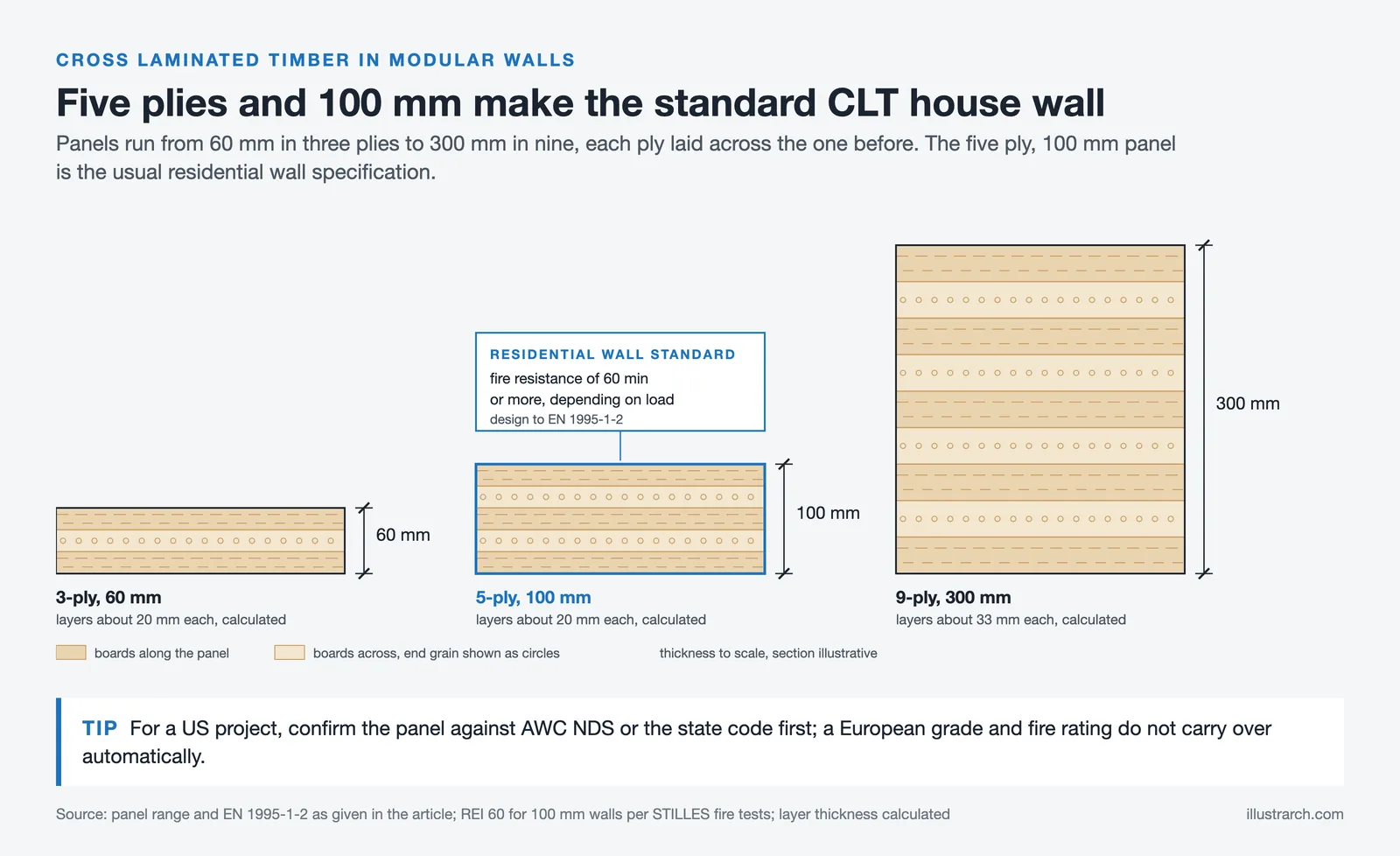
Standard CLT panels used in modular wall assemblies range from 60 mm (3-ply) to 300 mm (9-ply). For residential wall applications, 100 mm (5-ply) is the most common specification, typically achieving a fire resistance of REI 60 or more depending on load, as calculated under EN 1995-1-2 (Eurocode 5). When specifying CLT modules for markets using U.S. codes, confirm equivalency under AWC NDS or applicable state provisions, as international panel grades do not automatically translate.
BIM integration with manufacturing software is eliminating the translation errors that previously occurred when design files moved from architect to factory floor. Increasingly, modular manufacturers run parametric design tools that generate production drawings and material cut lists directly from the architect’s model. This closed-loop workflow is making the future of modular structures in architectural design look less like a niche sector and more like the default construction method for efficiency-driven markets.
Smart home integration is another frontier. Because modules are wired in controlled factory conditions, it is far easier to embed sensor networks, pre-route data cabling, and install smart energy management systems than it is to retrofit a traditionally built home. Several manufacturers now deliver modules pre-fitted with IoT-enabled HVAC controls, leak detection, and occupancy-based lighting, features that would add significant cost to a site-built project.
Prefab Architecture: A Guide to Design Principles and Aesthetic Possibilities

One of the most persistent misconceptions is that modular homes all look the same. Resolution: 4 Architecture, the New York firm behind the book Modern Modular, has spent two decades proving otherwise. Their prefab houses in the Berkshires, Hudson Valley, and rural Pennsylvania demonstrate that modular constraints can produce striking results, cantilevered volumes, double-height living spaces, and floor-to-ceiling glazing are all achievable within factory dimensions.
🏗️ Real-World Example
Berkshires Prefab House by Resolution: 4 Architecture (New York, 2010s): This single-level modular home in the Massachusetts Berkshires was completed in roughly half the time of a comparable site-built project. Clad in cedar with generous overhangs and open-plan living spaces, it is widely cited in prefab architecture literature as proof that modular construction and design ambition are not mutually exclusive. The project appears on illustrarch’s own coverage of modular homes in home design.
Good prefab architecture begins with an understanding of the module as a design unit, not a constraint. Experienced architects work with standard module widths, typically 3.6 m to 4.2 m, to compose plans that feel spatially generous. Multi-module arrangements allow L-shaped, U-shaped, and courtyard configurations. Mixing volumetric modules with site-built elements, such as a concrete ground floor or a timber deck, can add spatial variety and disguise the repetitive logic of the system entirely.
Material selection for facades and interiors is where modular homes gain the most expressive latitude. Timber cladding, zinc panels, brick slips, and fibre-cement boards are all compatible with factory production. Inside, the limitations of module widths push designers toward clever storage solutions, built-in furniture, and open layouts that make spaces feel larger than their footprints suggest.
🎓 Expert Insight
“Modular isn’t a construction product; it’s a construction process.”
Tom Hardiman, Executive Director, Modular Building Institute (MBI)
This distinction matters enormously for designers and clients. Once you understand modular as a method rather than a product category, the design possibilities expand. Any building type, material palette, or spatial arrangement becomes a candidate for modular delivery, as long as the logistics and structural coordination are addressed early in the process.
Sustainability in Prefab Architecture and Modular Construction

The environmental case for prefab modular architecture construction is well documented. Factory fabrication reduces on-site material waste dramatically because offcuts are sorted and recycled within the plant rather than sent to landfill. According to the Modular Building Institute’s 2023 annual report, modular construction generates up to 90% less material waste than conventional site-built methods. The same report noted project completion times reduced by 30% to 50% on average, which translates directly into lower carbon emissions from site machinery and reduced worker commuting.
🔢 Quick Numbers
- Modular construction reduces project completion time by 30-50% compared to traditional methods (Modular Building Institute, 2023)
- On-site material waste reduced by up to 90% in factory-produced modular builds (Modular Building Institute, 2023)
- Sweden builds approximately 90% of residential single-family houses using prefab wood construction (ArchDaily, 2024)
- The global modular construction market was valued at $90.6 billion in 2023 and is projected to grow at 6.5% CAGR through 2030 (Grand View Research, 2024)
Energy performance is another area where modern modular prefab architecture homes frequently outperform conventional builds. Tight factory tolerances mean wall assemblies, roof panels, and window framing are installed with consistent air sealing that is difficult to achieve on a traditional site. Several modular manufacturers, Mighty Buildings, Vantem, and others, are producing units certified to Passive House standards, delivering heating and cooling loads a fraction of those in code-minimum construction.
The use of cross-laminated timber in modular construction adds another sustainability layer. CLT panels store carbon sequestered during the tree’s growth, meaning a timber modular home can have net-negative embodied carbon depending on the supply chain. This positions sustainable architecture trends and modular construction as natural allies rather than separate conversations.
Cost, Timeline, and the Realities of Buying a Modular Prefab Home

Cost comparisons between modular and site-built homes are often misleading because they compare apples to oranges. A baseline modular home may cost 10-20% less than an equivalent site-built structure in the same market, largely due to reduced labour and faster delivery. However, the final comparison depends heavily on site preparation costs, foundations, utility connections, access roads, and crane hire, which can be significant on rural or constrained sites.
Custom modular homes with high-specification finishes can cost as much as or more than site-built equivalents. The true financial advantage often lies not in upfront cost but in predictability: factory production reduces the change orders, weather delays, and subcontractor variability that push traditional projects over budget. For developers building at scale, the efficiency gains are compounding.
💡 Pro Tip
When comparing quotes from modular manufacturers, always ask for a fully inclusive price: modules delivered, crane hire, foundation by a local contractor, utility connections, and finishing works on-site. The module cost alone is rarely the final number. A common source of budget shock is discovering that site work, which modular quotes often exclude, accounts for 30-40% of total project cost, especially on sloped or remote sites.

Timeline savings are real and significant. While a traditional custom home might take 12 to 18 months from groundbreaking to completion, a modular equivalent in production typically delivers in 6 to 9 months. This acceleration matters for clients paying rent or bridge financing during construction, and for developers whose pro forma depends on a specific delivery date.
The construction process also runs in parallel: while the factory produces modules, site teams prepare the foundation simultaneously. This concurrency is one of prefab architecture’s most underappreciated advantages. Modular construction’s transformation of the US building landscape is being driven precisely by this dual-track efficiency, particularly in markets where labour shortages are making conventional timelines unreliable.
Challenges and Limitations Worth Knowing Before You Build
No construction method is without trade-offs, and prefab modular architecture is no exception. Transportation logistics impose real constraints. Module widths are limited by road regulations, about 2.6 m (8.5 ft) without special oversize permits, which means very wide open-plan spaces require either multiple modules joined on-site or hybrid construction with a site-built structural element spanning the gap. Tall modules face similar restrictions when navigating low bridges or overhead power lines on delivery routes.

Permit processes vary enormously by jurisdiction. In some states and countries, modular homes receive streamlined approvals because factory inspections substitute for multiple on-site inspections. In others, local authorities are unfamiliar with modular construction and impose requirements suited to conventional builds. Engaging a manufacturer with local permitting experience, or working with an architect who has navigated the local process, is strongly advisable.
Customisation has limits. While the industry has become dramatically more flexible, highly bespoke curved walls, non-standard module geometries, or unique structural requirements can eliminate the cost advantage by requiring expensive custom jigs and tooling at the factory. The best modular projects work creatively within standard parameters rather than fighting against them.
For a deeper look at how these buildings are evolving in non-urban contexts, the coverage of modular architecture in small-town America is instructive, showing how prefab design adapts to local vernacular, site logistics, and community character when removed from metropolitan supply chains.
Key Players and Projects Defining Modern Modular Prefab Architecture

The modular sector has attracted serious design talent. Resolution: 4 Architecture in New York has built a body of work demonstrating that prefab and architectural quality are not in tension. Huf Haus in Germany has spent decades producing timber-and-glass post-and-beam homes that are factory-built to the highest technical standards. Blu Homes in California offered folding prefab units that shipped flat and opened on-site. Method Homes in Seattle combines modular structure with Passive House detailing and premium finishes.
At the more accessible end, ICON’s 3D-printed concrete modules and Mighty Buildings’ polymer composite panels are pushing the boundaries of what factory-produced housing means, blurring the line between traditional modular prefab architecture construction and digitally fabricated homes that represent the next generation of off-site production.
📌 Did You Know?
Prefabrication is not a modern invention. As far back as AD 43, the Roman army transported prefabricated fort components to Britain to speed up military construction. Japan has been building in wood off-site and assembling components on-location for over a thousand years. What’s new is not the concept but the precision: today’s factory production combines CNC machining, robotics, and BIM coordination to deliver tolerances of ±1 mm consistently across an entire building (ArchDaily, 2024).
International examples are equally instructive. In Sweden, where nearly 90% of single-family homes are built using prefab wood systems, the method is simply how houses are built, not a niche alternative. Japan’s major housing manufacturers, including Sekisui House and Daiwa House, have run sophisticated modular production lines for decades, producing homes with extraordinary quality control and 60-year performance warranties. These markets show where the global industry is heading as skilled construction labour becomes scarcer and more expensive.
Connecting prefab’s technical qualities with the broader principles explored in the modern architecture guide helps situate modular construction within a longer design tradition: one that has always sought to use the best available tools to make well-designed, durable, and accessible buildings.
FAQ: Modern Architecture Prefab Homes
What is the difference between prefab and modular homes?
Prefab is the broader term for any building with factory-manufactured components, including panelised systems and volumetric modules. Modular homes specifically use complete three-dimensional room-sized units built and finished in a factory. All modular homes are prefab, but not all prefab homes are modular.
How long does it take to build a modular prefab home?
From design sign-off to move-in, most modular homes complete in 6 to 9 months, compared to 12 to 18 months for a traditionally built custom home. Factory production and on-site preparation run simultaneously, which is the main driver of the time saving. Site complexity, permit processing times, and manufacturer lead times all affect the final schedule.
Are prefab modular homes as durable as site-built homes?
Yes. Modular homes built to the International Residential Code (IRC) must meet the same structural, fire, and energy standards as conventional construction. Because modules are transported by truck, they are often engineered to higher structural tolerances than standard site-built framing. Many manufacturers offer warranties comparable to those provided by traditional homebuilders.
Can I customise the design of a modular prefab home?
Significantly, yes. Most manufacturers offer extensive configuration options: module arrangements, facade materials, window placements, interior finishes, and systems specifications. Full architectural customisation is possible with most premium producers, though highly non-standard geometries can reduce cost efficiency. Working with an architect experienced in modular systems helps you understand what is flexible and what is not.
What is modular prefab architecture technology in 2025 and beyond?
The current frontier includes CLT-based volumetric modules, robotic assembly systems, Passive House certified modular units, integrated solar and battery systems pre-installed in factories, and AI-driven parametric design that generates production-ready drawings from client briefs. Several manufacturers are also exploring 3D printing as a fabrication method for structural and cladding elements, blurring the boundary between modular and digitally fabricated construction.
✅ Key Takeaways
- Modern architecture prefab homes are built to the same codes as site-built houses and hold their value similarly, the “trailer home” association is outdated and inaccurate.
- Factory production delivers measurable advantages: up to 50% faster timelines, up to 90% less on-site waste, and more consistent quality than weather-dependent site construction.
- Design possibilities are far broader than most people assume, from modest single-module cabins to multi-storey residential buildings with expressive facades and high-specification interiors.
- Sustainability credentials are strong: tight tolerances, CLT materials, and pre-installed smart systems make modular homes natural candidates for net-zero energy performance.
- True cost comparisons must include site preparation, foundations, crane hire, and finishing works, the module price alone does not represent total project cost.
- Understanding modular as a construction process, not a product type, is the key mental shift that unlocks its full design potential.
Cost figures referenced are general market estimates and vary significantly by region, specification level, site conditions, and manufacturer. Consult local contractors and modular producers for project-specific pricing.
Further reading: Modular Building Institute (MBI) | ArchDaily: Modular & Prefabricated | Dezeen: Prefabricated Buildings | U.S. Green Building Council (USGBC) | Passive House Institute
- architectural prefab homes
- modern architecture prefab homes
- modern modular the prefab houses of resolution 4 architecture
- modular prefab architecture
- modular prefab architecture technology
- prefab architecture
- prefab architecture a guide to modular design and construction
- prefab architecture modular construction
- prefab modular architecture




Architecture Beneath the Surface: The Crucial Role of Structural Mechanics and Geotechnical Analysis in Groundwork Design
Bold architecture depends on the ground beneath it. How numerical geotechnical analysis...
 illustrarch Editoral Team1 Mins read
Designing Renovation Projects Around Debris Flow and Site Logistics
Effective renovation planning must prioritize debris flow management. Learn how to integrate...
illustrarch Editoral Team4 Mins read

How Long Does a Building Warranty Typically Last? Coverage Periods Explained
Building warranty cover is layered, not uniform: one year for finishes, two...
 Sinan Ozen5 Mins read

What Is an Architect’s Certificate of Practical Completion?
A practical breakdown of the architect's certificate of practical completion: who issues...
Sinan Ozen6 Mins read


Leave a comment