

NAB 3 Parramatta Square & NAB 2 Carrington St. Offices by Woods Bagot
NAB 3 Parramatta Square and NAB 2 Carrington Street by Woods Bagot form a unified Sydney workplace campus, translating NAB’s identity into two distinct yet connected environments shaped by movement, context, and collaboration.
 Begum Gumusel20 January 20264 Mins read215


Table of Contents Show
At first glance, NAB 3 Parramatta Square and NAB 2 Carrington Street appear as two independent workplace projects positioned at opposite ends of Sydney’s metropolitan geography. Separated by 24 kilometers, one sits at the heart of Parramatta’s rapidly evolving Central City, while the other occupies a heritage-rich address in Sydney’s traditional CBD. Yet together, these two projects form what National Australia Bank (NAB) calls its Sydney campus, a unified workplace ecosystem designed to accommodate more than 6,000 desks and redefine the bank’s relationship with its people, customers, and city.
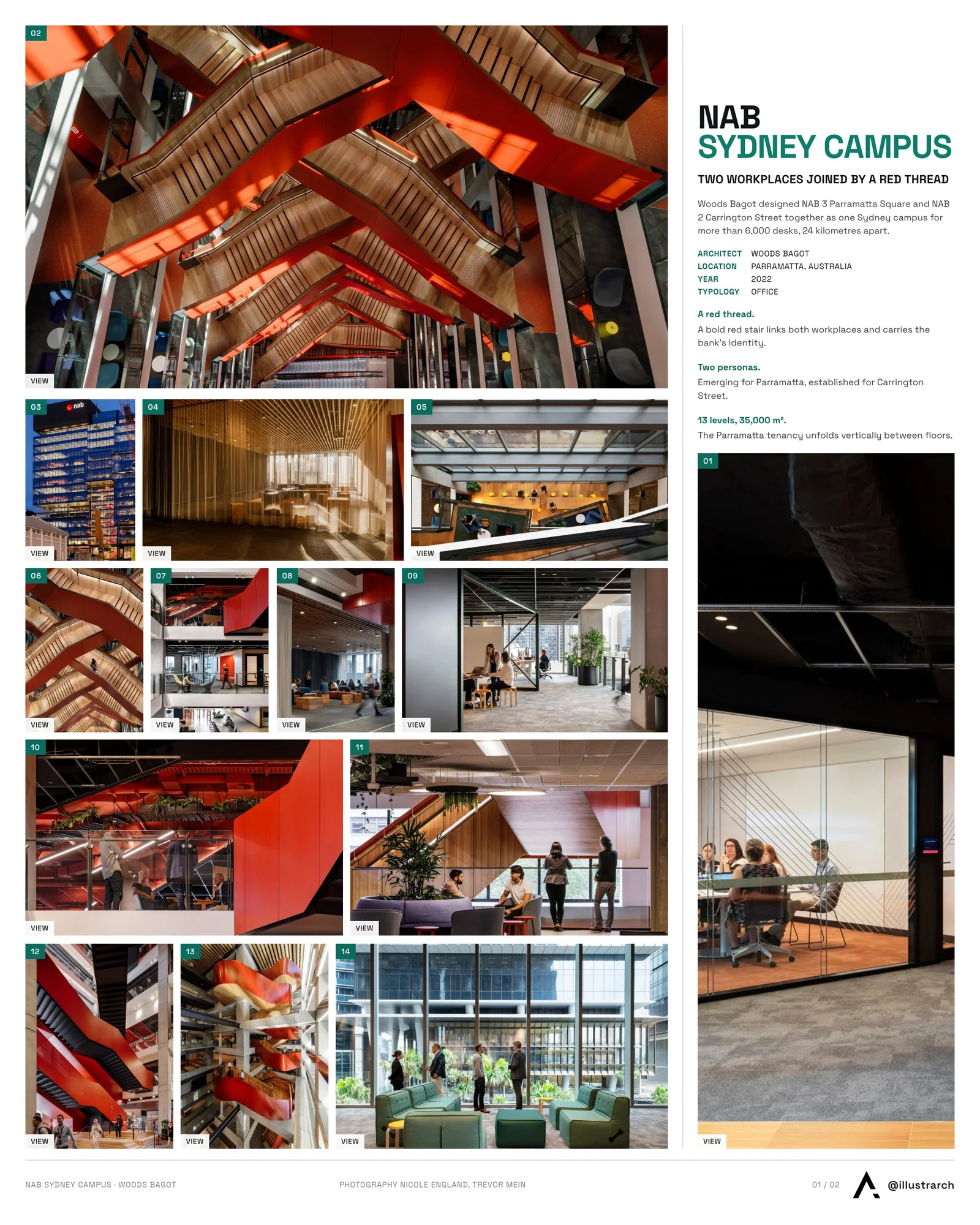
Designed by Woods Bagot, the two tenancies were conceived and delivered in parallel, allowing a rare opportunity to reimagine a large-scale corporate workplace not as a single building, but as a networked spatial experience. Central to this idea is a bold red stair, described as a “red thread”, that symbolically and spatially links both locations, carrying NAB’s identity, movement culture, and collaborative ethos across the city.
One Client, Two Personas
While united by brand and ambition, each workplace responds distinctly to its urban, cultural, and demographic context. Woods Bagot distilled NAB’s organizational DNA into two complementary project personas: “emerging” for Parramatta and “established” for Carrington Street. These conceptual frameworks guided decisions across planning, circulation, geometry, materiality, and user experience.
Rather than replicating a single workplace model, the design strategy embraced difference, allowing each site to express a unique identity while remaining recognizably part of the same institutional family.
NAB 3 Parramatta Square: The Emerging Workplace
Located within the transformative Parramatta Square precinct, NAB 3PS is a 13-level, 35,000 sqm adaptable workplace positioned at the core of one of Australia’s largest urban renewal projects. Here, the “emerging” persona manifests as a raw, energetic, and expressive environment, reflecting Western Sydney’s cultural diversity and Parramatta’s role as Sydney’s second CBD.
Spatially, the interior is defined by intersecting volumes, layered forms, and dynamic movement paths. Rather than compartmentalized floors, the workplace unfolds vertically, encouraging interaction between levels and visual connection across teams. The architecture deliberately exposes activity, using transparency and openness to “lift the curtain” on the bank’s inner workings.
The lower levels play a crucial civic role. Designed to engage directly with the public realm, they invite customers and community members inward through immersive spaces for co-creation, collaboration, and learning. These areas blur the boundary between corporate workplace and urban interior, positioning the bank as an active participant in city life rather than a closed institution.
Materially, NAB 3PS embraces an authentic, unfinished aesthetic, with robust textures and expressive structural elements reinforcing the project’s emerging identity. Movement is celebrated, not hidden, most notably through the red stair, which cuts through the building as both circulation device and symbolic anchor.
NAB 2 Carrington Street: The Established Workplace
By contrast, NAB 2 Carrington Street occupies a historically significant and highly connected CBD location. The 12-level, 29,000 sqm workplace spans the heritage-listed Shell House and a newly constructed commercial tower, united by a central atrium that stitches old and new together.
Here, the “established” persona translates into a refined, composed architectural language. Overlooking Wynyard Park, the workplace capitalizes on rare park-side views, framing treetops and laneways through carefully positioned windows and communal spaces. The atmosphere is calmer and more measured, balancing corporate gravitas with openness and accessibility.
The first four levels are publicly accessible, extending the city into the building through a Micro Branch and Café. This public-facing base transforms the workplace into an extension of the urban realm, inviting interaction rather than separation. A sculptural entry ribbon initiates the circulation journey, guiding visitors and staff upward toward a concierge-style experience that elevates arrival into a spatial event.
As users ascend, the workplace transitions into a highly flexible environment offering a diverse range of settings: collaboration hubs, amphitheaters, expansive dealing floors, outdoor terraces, and support spaces designed with a heightened level of amenity. Together, these spaces support both focused work and collective exchange, reinforcing the workplace as a social and cultural environment.
The Red Thread: Architecture as Connector
Despite their contrasting identities, the two workplaces are united through a series of meaningful architectural interventions, most notably the red stair and associated void strategy. This element functions simultaneously as circulation, social condenser, and brand expression.
Rather than relegating stairs to the periphery, Woods Bagot placed them at the heart of the spatial experience, encouraging movement, chance encounters, and physical engagement. The stair becomes a spatial narrative device, translating NAB’s values into built form and ensuring continuity between the two locations.
This strategy reflects a broader shift in workplace design: prioritizing movement, wellbeing, and connection over static efficiency. In doing so, the projects question traditional metrics of workplace value and propose a more human-centered, experience-driven model.
A Decade-Long Collaboration Realized
NAB 3PS and NAB 2CS represent the culmination of over a decade of collaboration between NAB and Woods Bagot, building upon earlier landmark projects such as NAB’s Melbourne headquarters at 700 Bourke Street. This long-term partnership allowed for a deep understanding of the client’s evolving culture, ambitions, and operational needs.

Delivered concurrently, the two projects demonstrate what is possible when client and architect engage in a sustained, reciprocal design dialogue. The result is not merely two successful workplaces, but a cohesive campus that redefines how a major financial institution can inhabit and contribute to the city.
Together, NAB 3 Parramatta Square and NAB 2 Carrington Street offer a compelling model for the future of corporate architecture, one where identity is flexible, place matters, and architecture becomes a tool for connection rather than containment.
Photography: Nicole England & Trevor Mein



New PRF Headquarters Building by Impare Arquitectura
Impare Arquitectura extend a Leiria gas-solutions company with a volume aligned to...
 illustrarch Editoral Team2 Mins read

Mokuzai by IT’S Architecture
Mokuzai by IT'S Architecture is a 7,500 square metre office and health...
illustrarch Editoral Team2 Mins read
Corporativo MGP by Sensorial Arquitectura
A corporate project exploring the duality between rigidity and softness, seeking a...
illustrarch Editoral Team2 Mins read
Office That Breathes by archicraft
For the people who work here, the outcome is an office that...
illustrarch Editoral Team2 Mins read


Leave a comment