

15+ Best Tiny Home Communities in Texas: Costs, Zoning Laws, and Honest Reviews
Texas is one of the best states for tiny home living. Explore 15+ tiny home communities across Austin, Dallas, Hill Country, and beyond with lot costs, zoning info, amenities, and expert tips for finding your ideal tiny community in TX.
 Bahattin Duran26 February 202625 Mins read332

Table of Contents Show
The best tiny home communities in Texas include Village Farm Austin ($600/mo lot rent), Lake Dallas Tiny Home Village ($500-$550/mo), Community First! Village in Austin (subsidized housing), Majestic Hills near Lake Conroe ($450-$750/mo), and Liberty Tiny Village in Aubrey ($950/mo for 55+ residents). Monthly lot rent across Texas ranges from $300 in rural East Texas to over $1,000 in premium Austin communities. Texas allows tiny homes on foundations in most cities and counties, while tiny homes on wheels (THOWs) are permitted in designated RV parks and approved tiny home communities.
Texas has become one of the most popular states for tiny home living in the United States, and it is easy to see why. With its relatively relaxed zoning regulations, affordable land prices, and diverse climate zones, the Lone Star State offers something for every tiny home enthusiast. From the vibrant streets of Austin to the wide-open spaces of the Hill Country, tiny home communities in Texas provide a unique combination of freedom, affordability, and community that draws tiny home dwellers from across the country. If you are exploring the top tiny house communities across the USA, Texas deserves a spot at the top of your list. This guide covers everything you need to know about finding, joining, and thriving in a tiny home community in Texas, including up-to-date pricing, legal requirements, and honest reviews of the top communities.
Cost figures are approximate and vary by region, community, and current market conditions. Zoning regulations can change; always verify current requirements with local authorities before purchasing.
What Are the Tiny Home Zoning and Legal Requirements in Texas?
Texas tiny home zoning works at the city and county level, not the state level. Tiny homes on foundations are treated as standard dwellings and must meet local building codes. Tiny homes on wheels (THOWs) are classified as RVs and are restricted to RV parks or approved communities. Key requirements include: building permits and inspections for foundation homes, RVIA or NOAH certification for THOWs, connection to city utilities in most municipalities, and compliance with minimum square footage rules that vary by location.
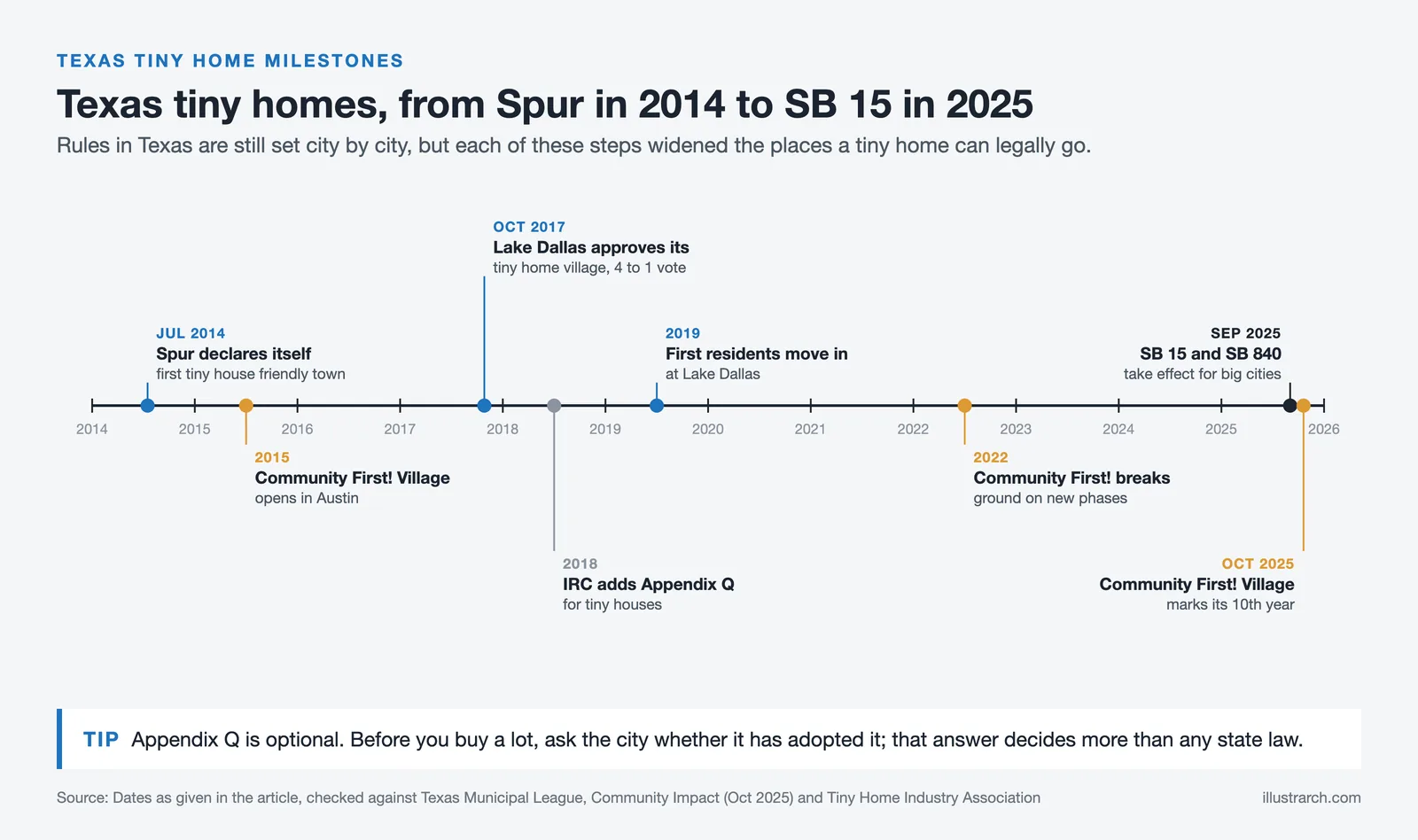
Before you start shopping for a tiny home lot in Texas, you need to understand the legal landscape. Texas does not have a single statewide definition for tiny homes. Instead, regulations are set at the city and county level, creating a patchwork of rules that varies widely depending on where you want to live. Most cities and counties in Texas follow the International Residential Code (IRC), which added Appendix Q specifically for tiny houses in 2018. However, adoption of Appendix Q is optional, and not every municipality has embraced it. You can review the Texas State Law Library’s building codes guide for a primer on how the state adopts these standards.
The most important legal distinction for tiny home owners in Texas is whether the home sits on a permanent foundation or on wheels. A tiny house on a foundation is generally treated as a standard residential dwelling and must comply with local building codes, minimum square footage requirements, and utility hookup regulations. A tiny home on wheels (THOW) is typically classified as a recreational vehicle (RV) and is subject to RV parking rules, which often restrict full-time living to designated RV parks or tiny home communities.

What Is the Difference Between Foundation and Wheels in Texas?
| Feature | Tiny Home on Foundation | Tiny Home on Wheels (THOW) |
|---|---|---|
| Legal classification | Residential dwelling | Recreational vehicle (RV) |
| Where allowed | Most residential zones | RV parks, mobile home parks, approved communities |
| Property tax | Yes (taxed as real property) | No (motor vehicle registration fees apply) |
| Permits needed | Building permit + inspections | RVIA or NOAH certification |
| Utility hookup | Required (water, sewer, electric) | Through community hookups |
| Placement flexibility | Higher (broader zoning acceptance) | Lower (restricted to designated areas) |
If you build a tiny home on a permanent foundation, you can place it on residential land in most Texas cities, provided it meets local building codes. Foundation-based tiny homes are taxed as real property, just like traditional houses. They require building permits, inspections, and connections to city water, sewer, and electrical systems. The upside is more placement flexibility and long-term stability.
Tiny homes on wheels face more restrictions. In most Texas cities, THOWs cannot be parked permanently on residential lots. They are typically allowed only in RV parks, mobile home parks, or designated tiny home communities. THOWs certified by the Recreational Vehicle Industry Association (RVIA) or the National Organization of Alternative Housing (NOAH) have an easier time getting placed in communities. THOWs are not subject to property tax but may be subject to annual motor vehicle registration fees.
Which Texas Counties and Cities Allow Tiny Homes?
The table below summarizes tiny home zoning rules for some of the most popular areas in Texas. Because regulations change frequently, always confirm current rules with the local planning or permitting office before making any decisions.
| County/City | Tiny Home on Foundation | THOW Allowed | Min Sq Ft | Key Notes |
|---|---|---|---|---|
| Austin (Travis County) | Yes (as ADU or primary) | RV parks/communities only | Varies by zone | HOME initiative allows up to 3 units on single-family lots; THOWs classified as RVs |
| Spur (Dickens County) | Yes, no minimum sq ft | Only if wheels removed, on foundation | None (under 900 sq ft to qualify as tiny) | First tiny house-friendly town in the U.S.; Ordinance 677; composting toilets not permitted |
| Lake Dallas (Denton County) | Yes | Yes, with IRC Appendix Q compliance | 100-399 sq ft (max 8.5 ft wide for THOW) | First in-city tiny home village for THOWs; NOAH or third-party inspection required |
| Houston (Harris County) | Yes (as ADU) | RV/mobile home parks only | Varies | No formal zoning; SB 15 (2025) prevents min lot sizes over 3,000 sq ft in new subdivisions |
| Fort Worth (Tarrant County) | Yes (permits required for ADU) | RV parks only | Varies by district | Experimenting with tiny home developments; check specific district rules |
| San Antonio (Bexar County) | Yes | RV parks only | Varies | ADU-friendly; growing interest in tiny home ordinances |
| Medina County | Yes | Limited (private land, rural) | Minimal | Hill Country location; relatively relaxed regulations |
| Ellis County | Yes | Limited | Minimal | South of Dallas; rural areas with fewer zoning hurdles |
| Baylor County | Yes | Limited | Minimal | Rural West Texas; minimal restrictions outside city limits |
| Unincorporated Rural Areas | Yes (most counties) | Generally yes | Varies | Counties have limited zoning authority; still need septic permit and legal water source |
Source: Individual city zoning ordinances, Texas Local Government Code Chapter 211, IRC 2018 Appendix Q.
What Texas Laws Affect Tiny Home Building in 2025?
Several recent Texas laws have shaped the tiny home landscape. Senate Bill 15 (SB 15), signed by Governor Abbott and effective September 2025, prevents major cities from requiring minimum lot sizes larger than 3,000 square feet in new subdivisions. Senate Bill 840 (SB 840), signed alongside SB 15, allows residential development on commercially zoned land without rezoning in cities of more than 150,000 people located at least partly in a county of more than 300,000, with exceptions such as sites near airports, opening new inventory for tiny home and ADU projects. These laws reflect a growing state-level push toward housing flexibility and affordability. At the city level, Austin’s HOME initiative and Lake Dallas’s adoption of IRC Appendix Q are two of the most significant local actions supporting tiny home living.

Best 15 Tiny Home Communities in Texas (Ranked by Value)
The best tiny home communities in Texas ranked by overall value are: Village Farm Austin (best eco-community), Lake Dallas Tiny Home Village (best for THOWs in city limits), Community First! Village (best mission-driven community), Majestic Hills (best resort-style amenities), Shilo Village (best Hill Country location), The Pines RV Community (best budget option near Fort Worth), and Liberty Tiny Village (best 55+ community). Published lot rents range from $350/mo near Fort Worth and Bastrop to $950/mo in premium North Texas communities.
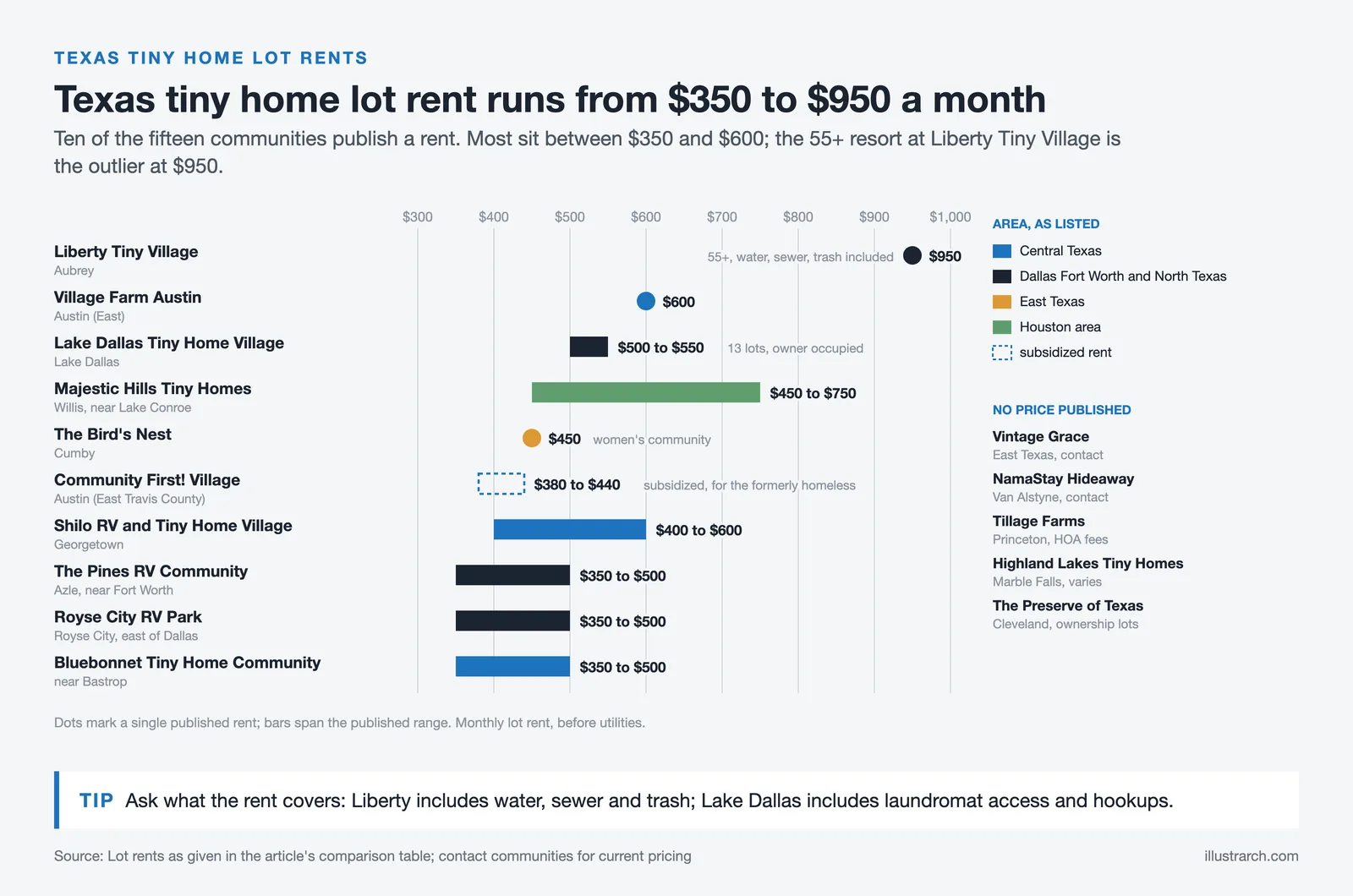
Texas is home to a growing number of tiny home communities that cater to a wide range of lifestyles, budgets, and preferences. Whether you want an eco-village near Austin, a lakeside retreat in the DFW area, or an affordable lot in East Texas, there is a community for you. For a broader perspective on how Texas communities compare to options nationwide, see our guide to the top tiny house communities in the USA. The table below provides a side-by-side comparison of 15 standout communities. Detailed spotlights on several communities follow the table.
| Community Name | Location | Lot Rent ($/mo) | Amenities | Min Size (sq ft) | Pet Policy | Website |
|---|---|---|---|---|---|---|
| Village Farm Austin | Austin (East) | $600 | Dog parks, community gardens, outdoor kitchens, farmers market, fire pits | 399 | Dogs allowed (2 dog parks) | villagefarmaustin.com |
| Community First! Village | Austin (East Travis County) | Subsidized ($380-$440) | Community kitchens, art studio, health clinic, market, worship spaces | 200 | Program-specific | mlf.org |
| Lake Dallas Tiny Home Village | Lake Dallas (DFW area) | $500-$550 | Courtyard, fire pit, community garden, laundromat, walkable downtown | 100 | Pets allowed (fenced area) | lakedallastinyhomevillage.com |
| Majestic Hills Tiny Homes | Willis (near Lake Conroe) | $450-$750 | Pool, dog park, fitness center, gated community | Varies | Dog park on-site | majestichillstinyhomes.com |
| Shilo RV & Tiny Home Village | Georgetown (Hill Country) | $400-$600 | Low-density lots, native tree preservation, access to Hwy 29 | Varies | Pets generally allowed | Contact directly |
| The Pines RV Community | Azle (near Fort Worth) | $350-$500 | 18 acres, oak/pine trees, full hookups, laundry, Wi-Fi | Varies | Pets allowed | Contact directly |
| Liberty Tiny Village | Aubrey (North Texas) | $950 | Resort-style 55+ community, landscaping, Wi-Fi, water/sewer/trash included | Under 400 | Pets allowed | Contact directly |
| Vintage Grace | East Texas | Contact for pricing | Senior-friendly, park model homes, community events | Varies | Contact community | vintagegracetexas.com |
| NamaStay Hideaway | Van Alstyne (North Texas) | Contact for pricing | THOW-friendly, intentional community, lot rentals | Varies | Contact community | namastayhideaway.com |
| The Bird’s Nest | Cumby (East Texas) | $450 | Women’s community, 14 concrete pads, supportive environment | Varies | Contact community | Contact directly |
| Royse City RV Park | Royse City (East of Dallas) | $350-$500 | Shade trees, laundry/storm shelter, near lakes Tawakoni & Ray Hubbard | Varies | Pets allowed | Contact directly |
| Bluebonnet Tiny Home Community | Near Bastrop (Central Texas) | $350-$500 | Water, electric, sewer, laundry, storage units, near Austin | Varies | Contact community | Contact directly |
| Tillage Farms | Princeton (Collin County) | HOA fees (ownership) | Pool, community center, basketball courts, playground | Under 700 | Contact community | Contact directly |
| Highland Lakes Tiny Homes | Marble Falls / Hill Country | Varies | Platinum Cottages, consultation, Hill Country setting | Varies | Contact community | highlandlakestinyhomes.com |
| The Preserve of Texas | Cleveland (East Texas) | Varies (ownership lots) | 2,000+ acres, 1/4 acre lots, rural setting | Varies | Contact community | preserveoftexas.com |
Pricing and availability change frequently. Contact each community directly to confirm current lot rents, requirements, and openings.
What Is Community First! Village in Austin?
Community First! Village is a 51-acre master-planned tiny home neighborhood in East Travis County, Austin, that provides permanent, affordable housing for people coming out of chronic homelessness. Operated by the nonprofit Mobile Loaves & Fishes since 2015, it currently houses over 420 residents in microhomes (200 sq ft, $380/mo) and manufactured tiny homes (400 sq ft, $440/mo). An expansion to 1,900 homes across 178 acres is underway.
Community First! Village is unlike any other tiny home community in Texas. Developed by the nonprofit Mobile Loaves & Fishes, this master-planned neighborhood in East Travis County provides affordable, permanent housing for men and women coming out of chronic homelessness. Since opening in 2015, the village has grown into the largest development of its kind in the United States.
The village currently houses more than 420 formerly homeless residents across a 51-acre site on Hog Eye Road. Homes range from 200-square-foot microhomes (with shared kitchens and bathrooms) to 400-square-foot manufactured tiny homes with private kitchenettes. Monthly rent runs approximately $380 for a microhome and $440 for a manufactured tiny home, with utilities included. These figures are heavily subsidized through donations and grants, including a $36.6 million contribution from the Michael and Susan Dell Foundation.
The community is designed to foster connection. Every home has a front porch, and homes are clustered around common areas with laundry rooms, outdoor community kitchens, and green spaces. On-site amenities include an art studio with pottery kilns and jewelry-making stations, a health clinic, a community market, a weekly farmers’ market, outdoor cinema, and worship spaces. Residents can earn income through micro-businesses within the village. The architectural design, known as “Neighborhoods of Knowingness,” was developed in collaboration with several Austin-based architecture firms including AIA Austin’s DesignVoice committee.
An ambitious expansion is underway. The nonprofit broke ground on additional phases in 2022 and plans to reach 1,900 homes across 178 acres by the end of the decade. The village celebrated its 10th anniversary in October 2025 and confirmed that plans to build 500 additional homes over the following five years remain on track.
To live at Community First! Village, applicants must be chronically homeless (living unhoused for more than one year), able to pay rent, and willing to follow community rules. Convicted sex offenders are not accepted. The application process is managed through Mobile Loaves & Fishes. This is not a community you can simply move into; it serves a specific population with a specific mission.

What Makes Spur, TX the First Tiny Home Friendly Town?
Spur, Texas (population 863) became the first tiny house-friendly town in the United States in July 2014, when its city council eliminated minimum square footage requirements for homes on foundations. Under Ordinance 677, any residence under 900 sq ft qualifies as a tiny home, and there is no minimum size. Homes must be on a foundation with city utility connections. Land is extremely affordable, with total move-in costs reported as low as $47,000 including land purchase.
In July 2014, the city council of Spur, a small West Texas town in Dickens County, passed a resolution proclaiming itself the first tiny house-friendly town in America. That decision put Spur on the map and attracted national attention from tiny home enthusiasts looking for a place to build without the typical red tape.
Spur has a population of about 863 people (2020 Census) and sits east of Lubbock. The town had been losing population for decades as residents moved to bigger cities. By eliminating minimum square footage requirements for homes on foundations, Spur aimed to attract new residents and revitalize empty lots. The American Planning Association documented Spur’s Ordinance 677 as a notable case study in tiny home regulation.
Under Spur’s Ordinance 677, a tiny home is defined as any residence with less than 900 square feet of living space. There is no minimum square footage. However, there are rules: homes must be on a foundation (at least a six-inch cement footing), connected to city utilities, and equipped with flush toilets. Composting toilets are not allowed. Tiny homes on wheels are not permitted unless the wheels are removed and the structure is tied to a foundation. Wood or metal framing is required, and house plans must be approved.
Since the resolution passed, over 70 lots have been sold to people looking to build. Land in Spur is remarkably affordable. One resident, Conor McCann, completed his entire move, including land purchase and fees, for just over $47,000. The permitting process is free and straightforward.
Spur is not for everyone. The town is remote, roughly 60 miles east of Lubbock, with limited local employment and services. Many residents commute to Lubbock or work remotely. But for those who value simplicity, low costs, and a tight-knit community, Spur offers something rare: a town that genuinely welcomes tiny homes.
What Is the Lake Dallas Tiny Home Village?
The Lake Dallas Tiny Home Village is a 13-lot community at 204 Gotcher Avenue in Lake Dallas, Texas (30 miles north of Dallas), and it was the first tiny home village in the United States built from the ground up inside city limits specifically for tiny homes on wheels. Lot rent is $500-$550/mo. The village is owner-occupied only (no rentals), requires NOAH certification or IRC Appendix Q compliance, and has a wait list that regularly exceeds 100 applicants.
The Lake Dallas Tiny Home Village holds a special place in the tiny home movement. Located at 204 Gotcher Avenue in the downtown district of Lake Dallas, about 30 miles north of Dallas, this 13-lot community was the first in the nation to be built from the ground up inside city limits specifically for tiny homes on wheels, using IRC Appendix Q as its regulatory framework. The Tiny Home Industry Association documented the project as a groundbreaking achievement for the movement.
Developer Terry Lantrip spent three years pushing the project through planning, public hearings, and city council votes before receiving approval in October 2017 by a 4-1 vote. The village welcomed its first residents in 2019. All 13 lots are currently occupied, and the wait list regularly exceeds 100 applicants.
Lot rent ranges from $500 to $550 per month, which includes access to a laundromat and hookups for water and sewer service. The village features a courtyard with a fire pit, a community garden, and a grill/smoker area. It sits within walking distance of parks, restaurants, schools, a library, and Lake Lewisville.
The village is owner-occupied only. No rentals or short-term stays are allowed. Residents must own their tiny home and meet certification requirements. Homes must pass inspection by NOAH, a Texas-certified third-party inspector, or meet IRC Appendix Q standards. The maximum width for a THOW in the village is 8.5 feet, and park model homes (typically 399 sq ft and wider) are not accepted.
The Lake Dallas Tiny Home Village has become a model for other developers and city officials exploring tiny home ordinances. Lantrip has consulted with developers looking to build similar villages in other DFW-area cities. The village demonstrates that with proper planning and strict guidelines, tiny home communities can thrive inside city limits.

How Much Does It Cost to Live in a Tiny Home Community in Texas?
Living in a tiny home community in Texas costs between $545 and $1,885 per month, not counting the home purchase. This includes lot rent ($300-$1,000), electricity ($50-$150), water/sewer ($30-$75), internet ($40-$80), insurance ($50-$150), and property tax for foundation homes ($50-$200). The tiny home itself costs $50,000 to $150,000. Compared to traditional Texas housing, tiny home residents save $1,000 to $2,500 per month.

One of the biggest draws of tiny home living is the potential for significant cost savings. But how much does it actually cost to live in a tiny home community in Texas? The answer depends on your location, the type of community, and your lifestyle. The table below breaks down typical monthly expenses for a tiny home community resident in Texas.
| Expense Category | Monthly Low ($) | Monthly High ($) | Notes |
|---|---|---|---|
| Lot Rent | 300 | 1,000 | Varies by location; Austin/DFW higher, rural areas lower |
| Electricity | 50 | 150 | Smaller space = lower usage; some communities include in lot rent |
| Water/Sewer | 30 | 75 | Often included in lot rent at community parks |
| Internet/Wi-Fi | 40 | 80 | Some communities provide Wi-Fi; rural areas may have limited options |
| Trash/Recycling | 0 | 30 | Frequently included in lot rent |
| Insurance (THOW) | 50 | 150 | Specialty tiny home or RV insurance; foundation homes use homeowner’s insurance |
| Property Tax (foundation) | 50 | 200 | Based on assessed value; THOWs exempt from property tax |
| HOA/Community Fees | 0 | 100 | Not all communities charge HOA fees; some bundle into lot rent |
| Maintenance/Repairs | 25 | 100 | Smaller home = lower maintenance; budget for roof, plumbing, etc. |
| Total Estimated | 545 | 1,885 | Does not include mortgage/purchase payment for the tiny home itself |
For context, the tiny home itself typically costs between $50,000 and $150,000 in Texas, depending on size, custom features, and builder. Many tiny home owners pay cash from savings or the sale of a previous home, avoiding a mortgage entirely. Those who finance can expect monthly payments of $400 to $900 depending on the loan amount and terms.
Compared to traditional housing, tiny home community living in Texas can save residents $1,000 to $2,500 per month. Texas also has no state income tax, which further boosts the financial appeal of downsizing here.

What Are the Best Regions in Texas for Tiny Home Living?
The five best regions for tiny home living in Texas are: Austin Metro (best urban tiny home culture, $600-$1,050/mo lot rent), Dallas-Fort Worth (growing infrastructure, $500-$950/mo), Hill Country (most scenic setting, moderate land prices), East Texas (most affordable at $300-$450/mo lot rent), and Gulf Coast (beach access, flexible Houston zoning). Each region offers different trade-offs between cost, climate, employment access, and community options.

Texas is a massive state with distinct regions, each offering different advantages for tiny home residents. Here is a breakdown of the five best regions for tiny house living in Texas.
| Region | Lot Rent Range | Best For | Watch Out For |
|---|---|---|---|
| Austin Metro | $600-$1,050/mo | Urban culture, jobs, progressive zoning | Rising costs, higher lot rents |
| Dallas-Fort Worth | $500-$950/mo | Employment, growing tiny home infrastructure | Tornado risk, suburban sprawl |
| Hill Country | $400-$700/mo | Scenic setting, retirees, remote workers | Limited public transit, water scarcity |
| East Texas | $300-$450/mo | Lowest cost, minimal zoning, privacy | Limited jobs, fewer urban amenities |
| Gulf Coast | $450-$750/mo | Beach access, flexible Houston zoning | Hurricanes, flooding, higher insurance |
Best for Urban Tiny Living: Austin Metro
Austin is the epicenter of tiny home culture in Texas. The city’s progressive zoning policies, including the HOME initiative that allows up to three dwelling units on most single-family lots, have created fertile ground for tiny home development. Communities like Village Farm and Constellation ATX are located here. The downsides are higher lot rents (typically $600 to $1,050/month) and Austin’s rising cost of living in general. If you want urban amenities, a thriving job market, and a strong community of like-minded tiny home enthusiasts, the Austin area is hard to beat.
Best for Job Access: Dallas-Fort Worth (DFW)
The DFW metroplex offers a growing number of tiny home options, from the pioneering Lake Dallas Tiny Home Village to newer developments like Liberty Tiny Village in Aubrey and Tillage Farms in Princeton. The region benefits from strong employment opportunities and relatively affordable suburban land. Lake Dallas proved that tiny home villages can work inside city limits, and several other DFW suburbs are now exploring similar ordinances. Lot rents in the DFW area typically range from $500 to $950 per month.
Best for Scenic Living: Hill Country
The Texas Hill Country, stretching west of Austin and San Antonio through towns like Fredericksburg, Marble Falls, Dripping Springs, and Georgetown, is one of the most scenic regions in the state. Rolling hills, spring-fed rivers, and wide-open skies make it a dream setting for tiny home living. Communities like Shilo Village near Georgetown and Highland Lakes Tiny Homes near Marble Falls cater to residents who want a quieter pace of life. Medina County, located in the Hill Country west of San Antonio, is known for relatively relaxed regulations. Land prices are moderate, and the region attracts retirees, remote workers, and outdoor enthusiasts.
Best for Budget Living: East Texas
East Texas offers some of the most affordable land in the state, with dense forests, rolling pastures, and a slower pace of life. Communities like Vintage Grace, The Bird’s Nest in Cumby, and The Preserve of Texas in Cleveland are located here. Many East Texas counties have minimal zoning restrictions, making it easier to place a tiny home on private land. Lot rents can be as low as $300 to $450 per month. The trade-off is limited access to major employment centers and urban amenities, though many residents work remotely or are retired.
Best for Coastal Lifestyle: Gulf Coast
The Texas Gulf Coast, including areas near Houston, Galveston, and Corpus Christi, offers access to beaches, fishing, and a warm climate. Houston’s lack of formal zoning makes it one of the more flexible major cities for tiny home placement. Communities near Lake Conroe, such as Majestic Hills, offer a resort-style tiny home experience. However, the Gulf Coast comes with higher risks from hurricanes and flooding. Insurance costs tend to be higher, and builders must account for elevation requirements in flood-prone areas. Despite these challenges, the region’s affordability and lifestyle appeal continue to attract tiny home residents.

How Does Texas Climate Affect Tiny Home Living?
Texas spans five distinct climate zones, each affecting tiny home design, insulation, and maintenance. The table below summarizes what tiny home owners should plan for in each region.
| Region | Climate Type | Key Challenges | Tiny Home Design Priorities |
|---|---|---|---|
| West Texas / Panhandle | Hot, dry summers; cold winters | Extreme temperature swings, ice storms, high winds | Heavy insulation, efficient heating, wind-resistant construction |
| Central Texas / Hill Country | Semi-arid; hot summers, mild winters | Severe thunderstorms, rare ice events | Cross-ventilation, shade structures, energy-efficient cooling |
| East Texas | Humid subtropical | High humidity, mold risk, heavy rainfall | Vapor barriers, dehumidifiers, mold-resistant materials, proper ventilation |
| Gulf Coast | Tropical/subtropical | Hurricanes (June-Nov), flooding, high winds | Wind-rated construction, elevated foundations, evacuation plan for THOWs |
| North Texas / DFW | Humid subtropical with tornado risk | Tornadoes, severe storms, hail | Access to storm shelter or safe room, impact-resistant roofing |
West Texas and the Panhandle experience hot, dry summers and cold winters with occasional ice storms. Tiny homes here need solid insulation, efficient heating, and wind-resistant construction. Spur, located in this zone, can see temperatures drop below freezing in winter and exceed 100°F in summer.
Central Texas and the Hill Country have a semi-arid climate with hot summers and mild winters. This region sees occasional severe thunderstorms and rare ice events. Tiny homes here benefit from good cross-ventilation, shade structures, and energy-efficient cooling systems.
East Texas is humid subtropical, with hot, humid summers and mild winters. Moisture management is a top priority. Tiny homes should incorporate vapor barriers, dehumidifiers, and mold-resistant materials. Proper ventilation is essential.
The Gulf Coast is the most hurricane-prone region. Tiny homes here must be engineered for high winds and flooding. THOWs on the coast should have a plan for evacuation during hurricane season (June through November). Elevated foundations are strongly recommended for permanent structures.
North Texas and the DFW area sit in “Tornado Alley.” While tornadoes can strike anywhere in Texas, this region sees the highest frequency. Tiny home residents should have access to a storm shelter or safe room. Some communities, like Royse City RV Park, include laundry facilities that double as storm shelters.

How to Set Up an Off-Grid Tiny Home in Texas
Texas is one of the best states for off-grid tiny home living. Solar power is viable across the state (230-300 sunny days/year), rainwater harvesting is legal, and rural land with minimal zoning is widely available. A complete off-grid setup including solar (2-5 kW system), water collection, and septic typically costs $9,000 to $27,000 (more if you drill a private well) on top of the tiny home and land purchase.
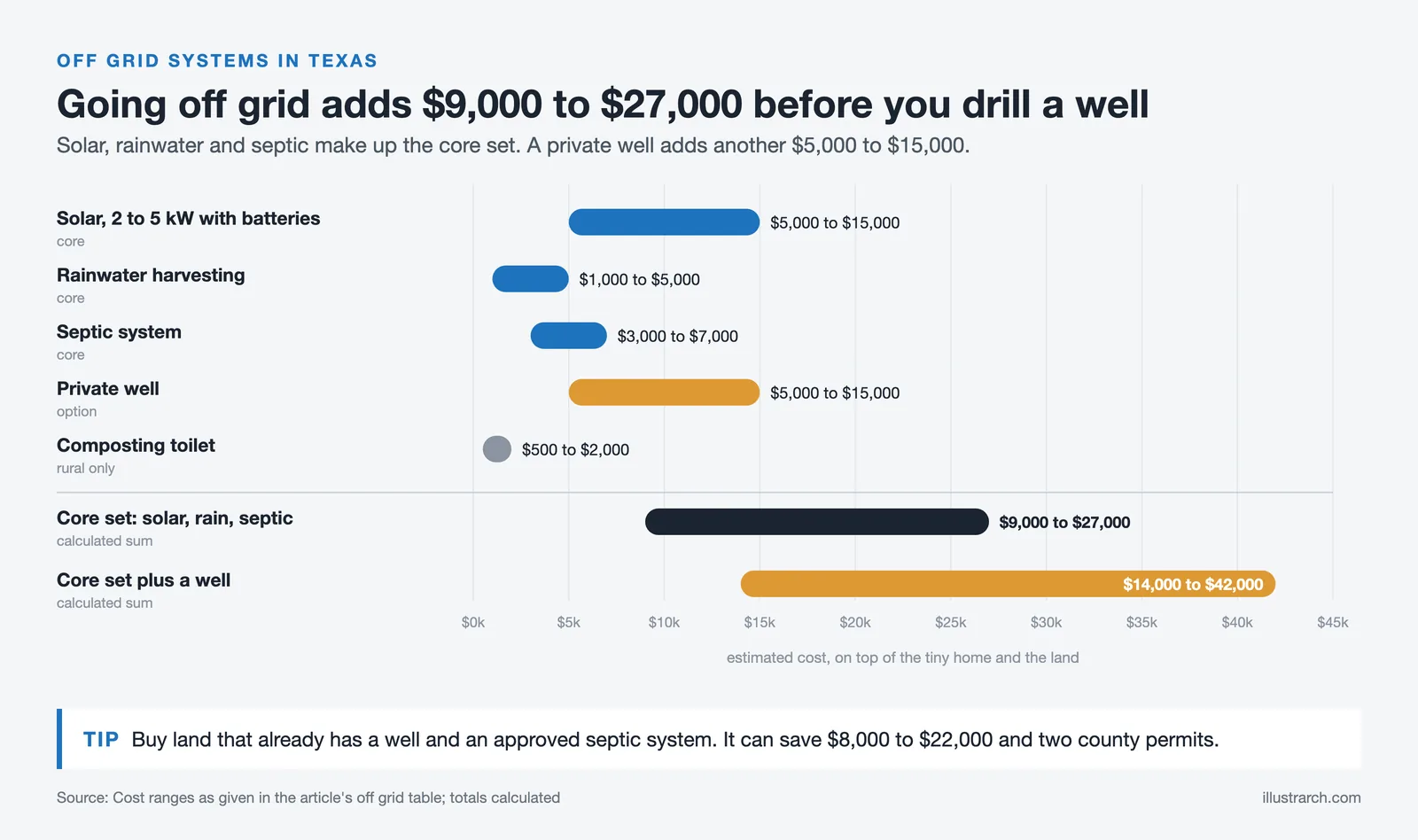

For those who want to go beyond community living and embrace full independence, Texas offers excellent opportunities for off-grid tiny homes. The state’s abundant sunshine, available land, and relatively permissive rural regulations make off-grid living more practical here than in most states.
| Off-Grid System | Estimated Cost | Best Texas Region | Key Consideration |
|---|---|---|---|
| Solar (2-5 kW + batteries) | $5,000-$15,000 | West Texas, Hill Country | 230-300 sunny days/year statewide |
| Rainwater harvesting system | $1,000-$5,000 | East Texas (most rainfall) | Legal statewide; 20-60 in/year rainfall |
| Private well | $5,000-$15,000 | All rural areas | County permits required |
| Septic system | $3,000-$7,000 | All rural areas | County health dept. approval needed |
| Composting toilet | $500-$2,000 | Rural only (outside city limits) | Not permitted in most cities including Spur |
Solar Power
Texas averages 230 to 300 sunny days per year, depending on the region, making solar power a strong option for off-grid tiny homes. A typical tiny home can run on a 2 to 5 kW solar panel system, which costs between $5,000 and $15,000 including batteries and installation. West Texas and the Hill Country receive the most sunlight. Battery storage systems like Tesla Powerwall or LFP batteries allow you to store excess energy for nighttime and cloudy days.
Water
Rainwater harvesting is legal in Texas and is a primary water source for many off-grid tiny homes. The state averages 20 to 60 inches of rainfall per year, depending on the region (East Texas gets the most, West Texas the least). A properly sized collection system with first-flush diverters and filtration can supply a tiny home year-round in most areas. For drinking water, a combination of UV sterilization and carbon filtration is standard. In some counties, you may also drill a private well, though permitting and costs vary.
Septic and Waste
Off-grid tiny homes in Texas typically require a septic system approved by the county health department. Conventional septic systems for tiny homes cost $3,000 to $7,000 depending on soil conditions and county requirements. Aerobic treatment systems are an option where soil percolation is poor. Composting toilets are used by some off-grid tiny home owners, but they are not permitted within city limits in most Texas municipalities, including Spur. The Texas Department of Licensing and Regulation (TDLR) provides additional guidance on industrialized and modular housing standards that may apply to factory-built tiny homes.

How to Move to a Tiny Home Community in Texas (9-Step Checklist)
Ready to make the move? Here is a practical checklist for joining a tiny home community in Texas.
Step 1: Define your priorities. Decide what matters most: proximity to a city, lot cost, climate, community size, pet policies, or off-grid capability. This will narrow your search significantly.
Step 2: Research communities. Use the comparison table in this guide as a starting point. Visit community websites, join Facebook groups like “DFW Tiny House Enthusiasts,” and contact communities directly for current pricing and availability.
Step 3: Verify zoning and legal requirements. Before committing, check the local zoning ordinance for your chosen area. Confirm whether your tiny home type (foundation or THOW) is permitted and what certifications are required. For THOWs, NOAH or RVIA certification is often necessary.
Step 4: Visit in person. Tour the community if possible. Most communities offer scheduled tours. Pay attention to lot sizes, neighbor spacing, road conditions, amenity quality, and the overall vibe.
Step 5: Secure your tiny home. If you do not already own a tiny home, research builders and models that meet the community’s requirements. Texas-based builders like Platinum Cottages, Indigo River Tiny Homes, and Cowtown Cottages are popular options. Custom builds from local builders typically take 3 to 6 months.
Step 6: Apply and reserve a lot. Most communities require an application and a refundable deposit to reserve a lot. Wait lists are common at popular communities like Lake Dallas Tiny Home Village.
Step 7: Arrange transport and setup. Coordinate the delivery of your tiny home to the community. Ensure utility hookups (water, sewer, electric) are ready. For THOWs, confirm that your home meets the community’s size limits (width, length, and height).
Step 8: Set up insurance. Get specialty tiny home or RV insurance before move-in. Standard homeowner’s policies typically do not cover THOWs. Companies like Strategic Insurance Agency and Foremost specialize in tiny home coverage.
Step 9: Move in and connect. Once settled, introduce yourself to neighbors, attend community events, and explore your new area. The social connections are often the best part of tiny home community living.

Frequently Asked Questions About Tiny Home Communities in Texas
Are tiny homes legal in Texas?
Yes. Tiny homes on permanent foundations are legal in most Texas cities and counties, provided they meet local building codes. Tiny homes on wheels are classified as RVs and are typically allowed only in designated RV parks or tiny home communities. Regulations vary by municipality, so always check with local authorities.
How much does it cost to live in a tiny home community in Texas?
Monthly lot rent in Texas tiny home communities ranges from about $300 in rural East Texas to $1,000 or more in premium Austin or DFW communities. Total monthly living costs, including utilities, insurance, and fees, typically fall between $545 and $1,885, not counting the home purchase or mortgage payment.
What is the minimum square footage for a tiny home in Texas?
There is no statewide minimum. Minimum square footage is set by individual cities and counties. The IRC (Section R304.1) requires each habitable room to have at least 70 square feet of floor area. Spur, Texas, has no minimum square footage at all. Many communities accept homes from 100 to 399 square feet.
Can I put a tiny home on my own land in Texas?
It depends on where the land is located. On rural, unincorporated land, you generally have more flexibility, though you still need septic permits and a legal water source. Inside city limits, your tiny home must comply with local zoning and building codes. Foundation-based tiny homes have broader placement options than THOWs.
Do I need a permit to build a tiny home in Texas?
In most Texas cities, yes. A tiny home on a foundation requires a building permit and must pass inspections for structural integrity, electrical, plumbing, and mechanical systems. THOWs typically need RVIA or NOAH certification rather than a traditional building permit. In rural counties with limited permitting offices, requirements may be less formal but still exist.

What counties in Texas are most friendly to tiny homes?
Dickens County (Spur), Medina County, Ellis County, Baylor County, and Brown County are frequently cited as tiny-home-friendly. Unincorporated areas of most Texas counties offer flexibility due to limited county zoning authority. Travis County (Austin) and Denton County (Lake Dallas) stand out for progressive urban policies.
Can I live in a tiny home on wheels full-time in Texas?
Full-time living in a THOW is permitted in designated RV parks, mobile home parks, and approved tiny home communities. It is not typically permitted on residential lots inside city limits. Some rural counties allow THOWs on private land with fewer restrictions, but you should verify with local authorities.
Do tiny homes in Texas pay property tax?
Tiny homes on permanent foundations are taxed as real property, just like traditional homes. The tax is based on the assessed value of the home and the land it sits on. Tiny homes on wheels are generally exempt from property tax but may be subject to annual motor vehicle registration fees.
What is the best city in Texas for tiny home living?
Austin is widely considered the best city for tiny home living due to its progressive zoning policies, multiple established communities, strong job market, and cultural appeal. For affordability, Spur and smaller East Texas towns offer much lower costs. The DFW area provides a good balance of urban access and growing tiny home infrastructure.
Are there 55+ or senior tiny home communities in Texas?
Yes. Liberty Tiny Village in Aubrey is a dedicated 55+ community with resort-style amenities and homes priced between $75,000 and $160,000. Vintage Grace in East Texas also caters to seniors. As the tiny home movement matures, more age-restricted communities are expected to open across the state.






Tiny House Water Systems: Your Complete Guide to Plumbing, Rainwater Harvesting and Off-Grid Solutions
A practical guide to designing a tiny house water system, covering PEX...
Bahattin Duran14 Mins read
Off-Grid Tiny House Living: Complete Setup Guide for Beginners
This guide walks you through every stage of setting up an off-grid...
Bahattin Duran15 Mins read
Tiny House with Loft: Design Ideas, Plans and Building Tips for Vertical Living
A complete guide to designing and building a tiny house with loft,...
Bahattin Duran15 Mins read
8+ Best Tiny Home Communities in Michigan: Great Lakes Tiny Living Guide
Explore tiny home communities in Michigan. Great Lakes lifestyle, affordable land, and...
Bahattin Duran18 Mins read


Leave a comment