

Shed House vs Tiny House: Which One is Better For You
Shed house vs tiny house – which affordable housing option is right for you? This comprehensive guide compares costs, interior design, legal considerations, and conversion steps for turning a shed to home living. Discover small shed home plans, learn how to make a shed house livable, and find out whether shed living or a purpose-built tiny house better fits your budget and lifestyle.
 Bahattin Duran14 February 202617 Mins read1.1k

Table of Contents Show
If you want to simplify your life, save money, and reduce your environmental impact, converting a shed to home living might be the right move. The shed house vs tiny house debate has become one of the most discussed topics among people exploring affordable housing alternatives. Whether you dream of a tiny shed home in a rural backyard or a fully finished small shed house on a permanent foundation, both options let you enjoy the benefits of compact living. However, they differ in cost, design flexibility, and legal considerations. In this guide, we break down every angle of the shed house vs tiny house comparison so you can make a confident, informed decision about which path to shed living suits your lifestyle.
What Is a Shed House? Understanding the Shed to Home Concept
A shed house is a type of small dwelling built from a prefabricated shed that has been converted into a livable space. The shed to home conversion process transforms a basic storage structure into a fully functional residence. You can buy a shed from a company like The Shed House LLC Portable Buildings, which offers a variety of sizes, styles, and features to suit your needs. Alternatively, if you prefer to build your own shed rather than purchasing a new one, Craftcamp provides excellent DIY shed plans that guide you through the construction process step by step. You can then customize the shed to make it livable by adding insulation, plumbing, electricity, windows, doors, and interior finishes. Depending on your preference and local regulations, a shed built into house standards can be placed on a permanent foundation or a trailer.
The concept of shed to homes conversion has grown rapidly as more people look for budget-friendly paths to homeownership. According to the U.S. Census Bureau’s housing data, the median price of a new home in the United States continues to rise, pushing many prospective homeowners toward alternative solutions like small shed homes. A standard prefabricated shed can range from 100 to 400 square feet, giving you enough room for a one bedroom shed house layout with a small kitchen, bathroom, and living area. Some owners even opt for a two story shed house design with a sleeping loft above the main floor, which maximizes vertical space without expanding the footprint.
Small Shed House Interior: Making a Tiny Shed Home Feel Like Home
One of the biggest concerns people have about living in a shed is whether the small shed house interior will actually feel comfortable. The truth is that shed house interior design has come a long way. Homeowners and DIY builders are turning plain storage buildings into warm, inviting small shed homes using a mix of clever layout planning and affordable finishes.
For the walls, many shed home conversions use shiplap, tongue-and-groove pine, or simple drywall to create a clean, finished look. Light colors on walls and ceilings help a small shed house interior feel more spacious, and strategically placed windows bring in natural light. Flooring options range from budget-friendly vinyl plank to reclaimed hardwood, depending on your taste and budget.
A loft shed house layout is one of the most popular approaches to shed homes interior design. By building a sleeping loft above the main living area, you free up the ground floor for a kitchen, bathroom, and living space. This vertical approach works especially well in shed style houses with higher rooflines, such as barn-style or gambrel sheds.
When it comes to furniture, multi-functional pieces are your best friend inside shed like homes. Fold-down tables, storage ottomans, and wall-mounted desks save precious floor space. If you want practical ideas for making every square foot count, the tiny house interior design tips and tricks used by the tiny house community apply directly to shed cabin interiors as well. For broader design inspiration, ArchDaily’s tiny house project archive showcases dozens of professionally designed small dwellings from around the world.
Interior Finish Options: Cost and Suitability Comparison
| Interior Finish | Estimated Cost (per sq ft) | Best For | Difficulty Level |
|---|---|---|---|
| Shiplap / Tongue-and-Groove Pine | $3 – $7 | Rustic, farmhouse-style shed homes | Beginner to Intermediate |
| Drywall | $1.50 – $3 | Clean, modern interiors | Intermediate |
| Plywood Paneling | $1 – $2.50 | Budget-friendly DIY projects | Beginner |
| Vinyl Plank Flooring | $2 – $5 | Water-resistant, easy-install flooring | Beginner |
| Reclaimed Hardwood Flooring | $5 – $12 | High-end, eco-conscious builds | Intermediate to Advanced |
| Laminate Flooring | $1.50 – $4 | Affordable wood-look alternative | Beginner |
Small Shed Home Plans and Design Options
Before you start building, you will need reliable small shed home plans that include shed house blueprints. A good set of shed home plans covers the structural layout, electrical routing, plumbing lines, and insulation details. You can find pre-made plans online for common configurations like a 12×24 one bedroom shed house or a 16×32 two story shed house with a loft.
There are several popular shed homes designs to consider:
- Barn-style or gambrel roof: Provides extra headroom for a sleeping loft and gives your shed style house a rustic, farmhouse appearance.
- Modern lean-to: A single-slope roof design that works well for contemporary small shed house designs and pairs easily with large windows or sliding glass doors.
- Cottage-style: Features a traditional gable roof, front porch, and residential-grade siding, making the shed like house almost indistinguishable from a conventional small home.
- Garden shed tiny house: A smaller footprint (100 to 200 square feet) suited for a studio, guest house, or minimalist solo dwelling in a backyard setting.
If you are looking for architectural inspiration for compact living spaces, the Big Ideas in Small Buildings collection on illustrarch showcases creative approaches to designing within tight constraints. You may also want to browse the illustrarch tiny house category for more real-world examples of small-scale residential design.
Popular Shed Home Designs at a Glance
| Design Style | Typical Size | Loft Potential | Best Use Case | Aesthetic |
|---|---|---|---|---|
| Barn-Style / Gambrel Roof | 200 – 500 sq ft | Excellent | Full-time residence with sleeping loft | Rustic / Farmhouse |
| Modern Lean-To | 150 – 400 sq ft | Limited | Contemporary small home, studio | Modern / Minimalist |
| Cottage-Style (Gable Roof) | 200 – 500 sq ft | Moderate | Primary dwelling, guest house | Traditional / Residential |
| Garden Shed Tiny House | 100 – 200 sq ft | Limited | Studio, office, minimalist solo dwelling | Compact / Charming |
| A-Frame | 150 – 400 sq ft | Excellent | Cabin retreat, vacation home | Rustic / Mountain |
Pros of a Shed House
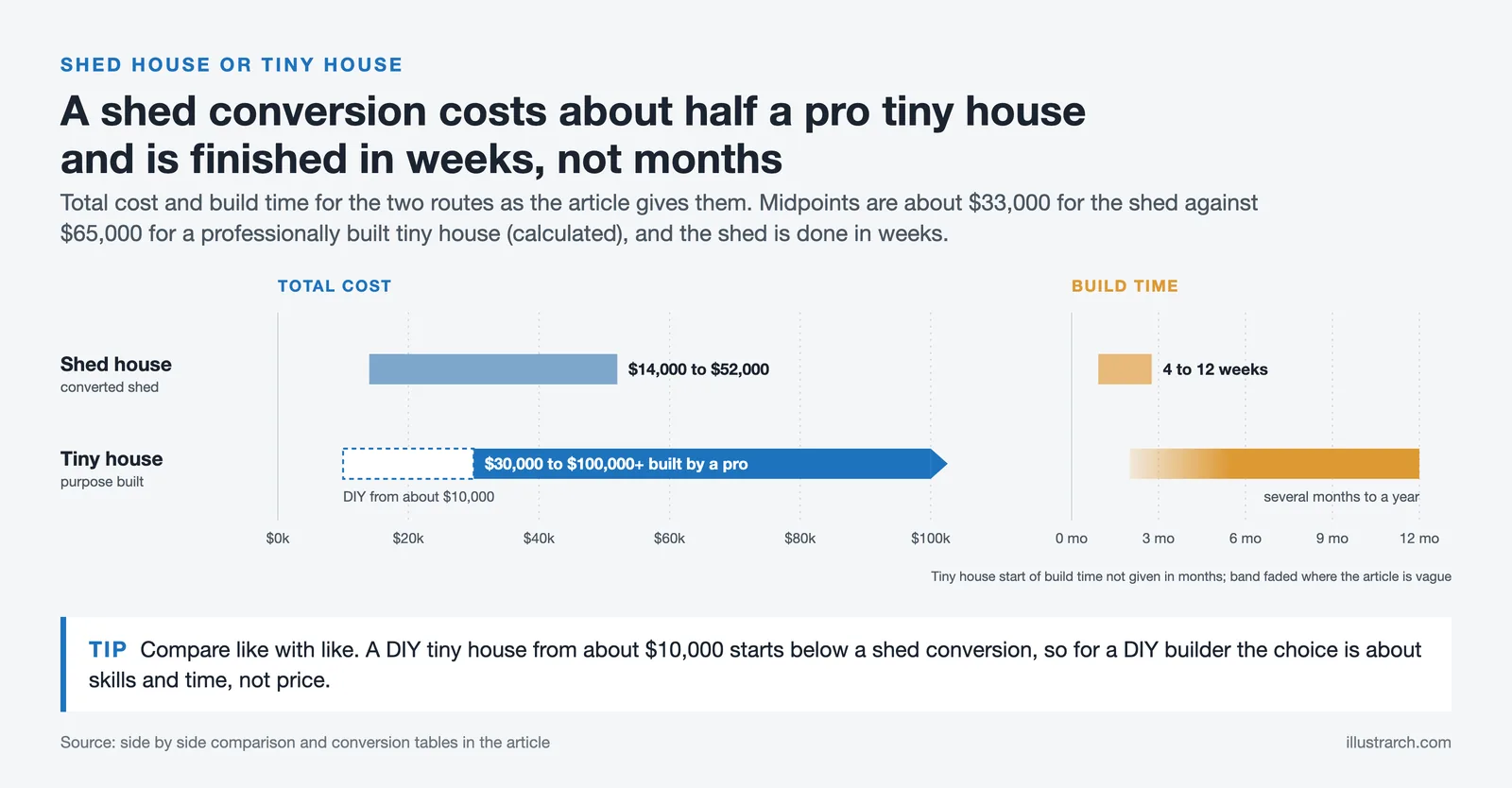
- Cheaper than a tiny house. You can buy a prefabricated shed for about $3,000 to $8,000 and then spend another $5,000 to $25,000 making it livable. The total cost of building a tiny house from a shed is typically $14,000 to $52,000, well below the average custom tiny house price.
- Easier to build than a tiny house. Since the shell already exists, you skip the framing stage entirely and focus on insulation, utilities, and interior finishes. This makes it a realistic project even for people with limited construction experience.
- More spacious than many tiny houses. You can choose a shed up to 400 square feet or even larger if local codes allow, giving you room for a comfortable one bedroom or studio layout.
- More flexible than a tiny house. You can modify the layout, add windows, extend the roofline for a loft, or even connect two sheds together. Some homeowners move their shed to a new property when needed.
- Fast construction timeline. A prefabricated shed can be delivered and set up in a single day. The full conversion, depending on complexity, can be finished in weeks rather than the months a ground-up tiny house build often requires.
Cons of a Shed House
- May not be as durable as a tiny house. Standard sheds are not designed to withstand long-term residential use, and the framing, roofing, and siding may require upgrades to meet the demands of year-round living.
- May not be as aesthetically pleasing as a tiny house. Without intentional design work, a shed can retain its industrial or utilitarian appearance. Investing in exterior cladding, landscaping, and quality interior finishes helps overcome this.
- May not be as legal as a tiny house. Sheds are classified as accessory structures rather than dwellings in many jurisdictions. Before converting a shed into a living space, check local building codes and zoning regulations. Some states and municipalities have specific requirements for sheds being used as residences. Understanding the permit requirements can be crucial to ensuring compliance with local laws and avoiding potential issues down the line.
- May not be as eco-friendly as a purpose-built tiny house. Sheds are not typically constructed with energy efficiency in mind, so you may need to add extra insulation, energy-efficient windows, and weatherproofing to reduce heating and cooling costs.
What Is a Tiny House?
A tiny house is a small dwelling built from scratch or assembled from a prefabricated kit. Unlike a shed to home conversion, a tiny house is purpose-designed for full-time living from the start. You can design your own tiny house and customize every detail, from the floor plan to the roofline. Features like insulation, plumbing, electricity, and interior design are built into the original construction plan. Depending on your preference and local regulations, a tiny house can be placed on a permanent foundation or a trailer.
Tiny houses typically range from 100 to 400 square feet. The step-by-step guide to building a tiny house in the USA on illustrarch covers the planning, legal, and construction phases in detail for anyone considering this route.

Pros of a Tiny House
- More durable than a shed house. Tiny houses are built with high-quality materials and professional craftsmanship, designed to last 20 to 50 years or more with proper maintenance.
- More aesthetically pleasing than a shed house. Tiny houses are built with architectural creativity and attention to detail, resulting in unique, charming homes that reflect the owner’s personality.
- More legal than a shed house. Tiny houses, especially those on wheels classified as RVs, often have clearer legal pathways in many jurisdictions. Purpose-built tiny houses can more easily comply with building codes and zoning laws.
- More eco-friendly than a shed house. Tiny houses are designed with energy efficiency and sustainability in mind, often incorporating solar panels, composting toilets, rainwater collection systems, and high-performance insulation.
- Higher resale value. A well-built tiny house holds its value better than a converted shed, especially if it includes professional-grade finishes and is road-legal on a trailer.
Cons of a Tiny House
- More expensive than a shed house. A basic tiny house starts around $10,000 for a DIY build, and professionally built models range from $30,000 to $100,000 or more for luxury finishes.
- Harder to build than a shed house. Building from scratch requires carpentry, electrical, and plumbing skills, or the budget to hire professionals for each trade.
- Less spacious than a shed house. Because tiny houses prioritize portability and weight limits (especially on trailers), you often work with tighter dimensions than a converted shed allows.
- Less flexible than a shed house. Once built, altering the structural layout of a tiny house is difficult and expensive. Moving a tiny house on a foundation also presents logistical challenges.
Shed House vs Tiny House: Side-by-Side Comparison
The following table summarizes the key differences between a shed house and a tiny house across the factors that matter most:
| Feature | Shed House | Tiny House |
|---|---|---|
| Typical Cost | $14,000 to $52,000 | $30,000 to $100,000+ |
| Build Difficulty | Beginner to intermediate | Intermediate to advanced |
| Size Range | 100 to 500+ sq ft | 100 to 400 sq ft |
| Durability | Moderate (upgrades needed) | High (purpose-built) |
| Legal Pathway | Varies, often complex | Clearer in many areas |
| Customization | Highly flexible | Limited after build |
| Construction Time | Weeks to a few months | Several months to a year |
| Eco-Friendliness | Requires added upgrades | Built-in from the start |
| Resale Value | Lower | Higher |
How to Convert a Storage Shed into a Tiny House
A shed to tiny home conversion is one of the most accessible ways to start living small. Turning tiny houses made from storage buildings into comfortable residences involves several key steps, and careful planning at each stage will save you time and money. If you have ever wondered how to make a shed house, this section walks you through the process.
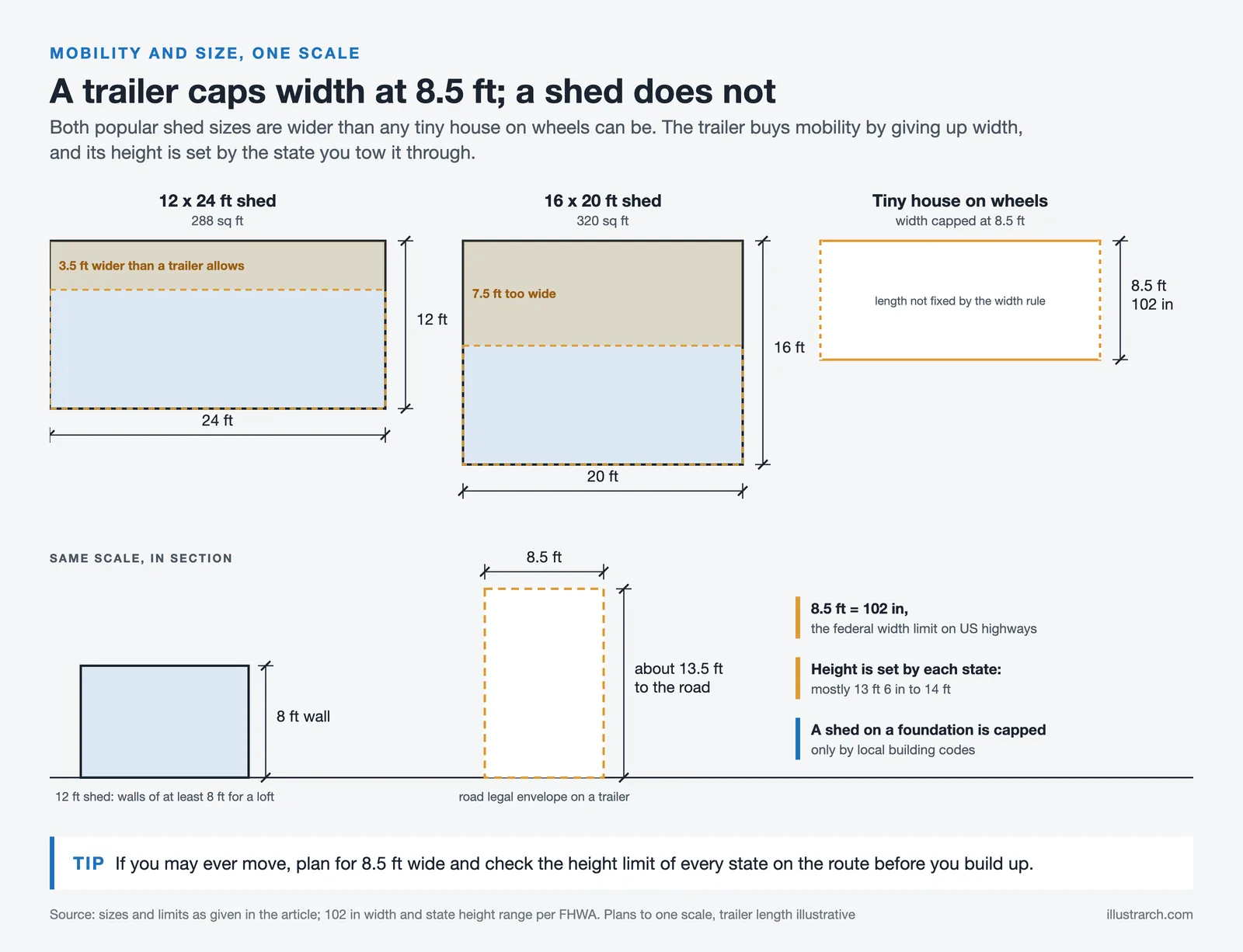
First, choose the right shed. The best sheds for tiny homes are wood-framed models with sturdy flooring, a weather-resistant roof, and enough headroom for comfortable living. Look for sheds with at least 8-foot walls if you plan to add a sleeping loft. A 12×24 or 16×20 shed gives you 288 to 320 square feet of living space, which is enough for a well-designed one bedroom layout.
Next, address the foundation. While gravel pads work for standard sheds, a tiny house out of a shed will carry more weight from furniture, appliances, and occupants. A concrete slab or concrete pier foundation provides the stability needed for long-term residential use.
Insulation is critical. Spray foam or rigid foam board in the walls, floor, and ceiling keeps your shed warm in winter and cool in summer. Without proper insulation, energy costs for heating and cooling a shed can be surprisingly high. The U.S. Department of Energy’s insulation guide offers detailed recommendations for choosing the right R-value for your climate zone.
After insulation, run your electrical wiring and plumbing before closing up the walls. Hire a licensed electrician and plumber if you are not experienced with these systems, as code compliance is essential for both safety and legality.
Finally, finish the interior. This is where your shed to small house conversion truly comes to life. Install drywall or paneling, lay your flooring, and build out your kitchen and bathroom. The luxurious designs for tiny spaces feature on illustrarch offers creative ideas for making compact interiors feel open and refined.
Shed to Home Conversion: Step-by-Step Overview
| Step | Task | Estimated Cost | DIY or Professional? | Estimated Timeline |
|---|---|---|---|---|
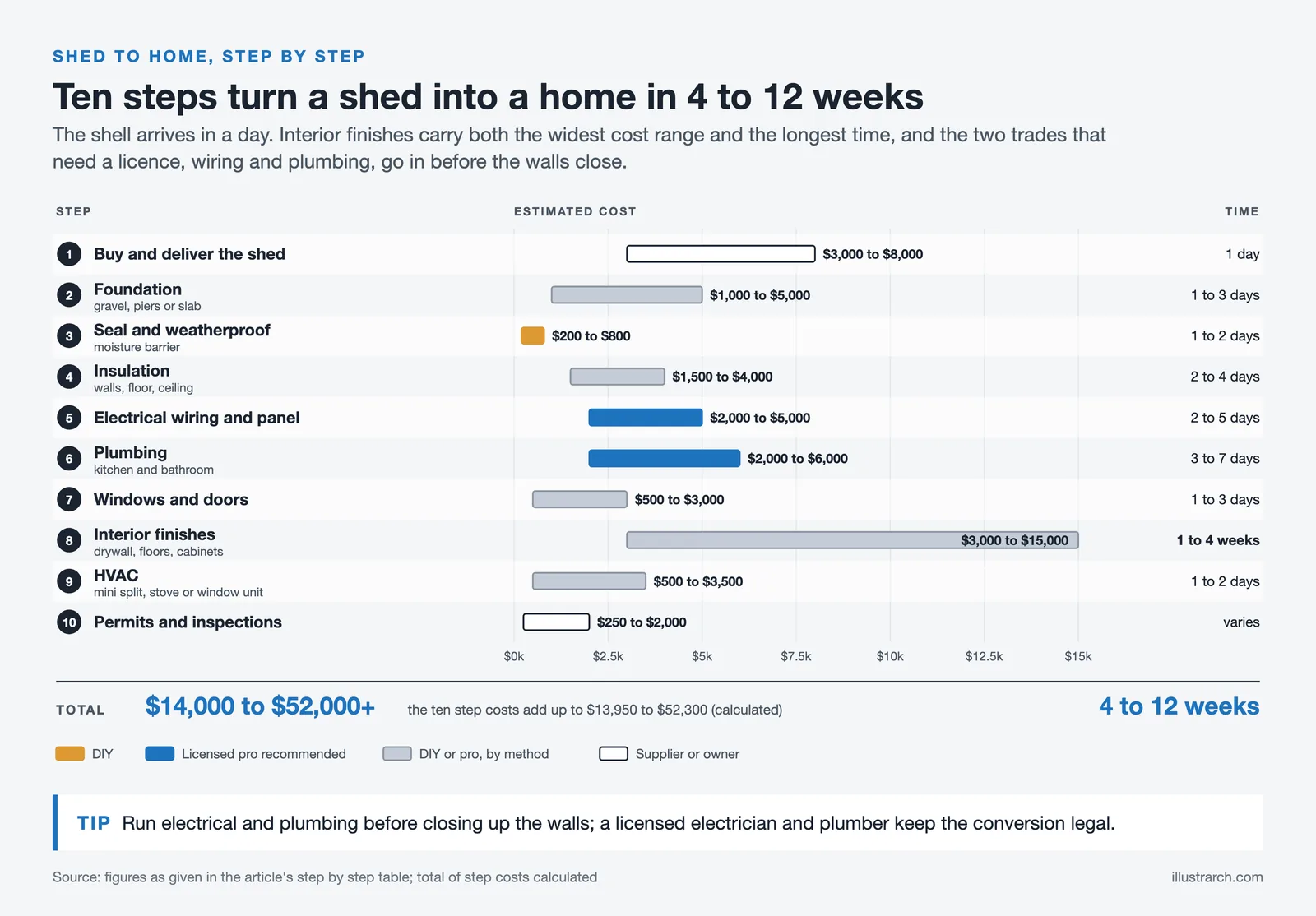
| 1 | Purchase and deliver the shed | $3,000 – $8,000 | Manufacturer delivery | 1 day |
| 2 | Foundation (gravel, piers, or slab) | $1,000 – $5,000 | DIY (gravel) / Professional (concrete) | 1 – 3 days |
| 3 | Sealing, weatherproofing, and moisture barrier | $200 – $800 | DIY | 1 – 2 days |
| 4 | Insulation (walls, floor, ceiling) | $1,500 – $4,000 | DIY (batts, rigid foam) / Professional (spray foam) | 2 – 4 days |
| 5 | Electrical wiring and panel installation | $2,000 – $5,000 | Licensed electrician recommended | 2 – 5 days |
| 6 | Plumbing (kitchen and bathroom) | $2,000 – $6,000 | Licensed plumber recommended | 3 – 7 days |
| 7 | Windows and doors (upgrade or add) | $500 – $3,000 | DIY / Professional | 1 – 3 days |
| 8 | Interior finishes (drywall, flooring, cabinetry, fixtures) | $3,000 – $15,000 | DIY / Professional | 1 – 4 weeks |
| 9 | HVAC (mini-split, wood stove, or window unit) | $500 – $3,500 | Professional (mini-split) / DIY (window unit) | 1 – 2 days |
| 10 | Permits and inspections | $250 – $2,000 | Owner / Contractor | Varies by jurisdiction |
| Total Estimated Range | $14,000 – $52,000+ | 4 – 12 weeks |
Best Sheds for Tiny Houses: What to Look For
Not every shed is a good candidate for a shed into house conversion. When shopping for the best sheds for tiny homes, keep these factors in mind:
- Material quality: Wood-framed sheds with treated lumber and quality OSB or plywood sheathing provide the strongest base for residential conversion. Metal sheds are durable but harder to insulate and modify.
- Roof style: A higher roofline (barn, gambrel, or A-frame) gives you room for a loft. Standard flat or low-slope roofs limit your vertical options.
- Size: For a comfortable small livable shed, aim for at least 200 square feet. Anything smaller works for a studio or guest space but can feel cramped for full-time living.
- Manufacturer reputation: Companies that specialize in prefabricated shed homes or shed-to-house kits often build with thicker framing, better hardware, and residential-grade materials compared to basic garden shed manufacturers.
- Delivery and setup: Check whether the company delivers the shed fully assembled and whether your property has access for a delivery truck. Some rural or narrow-lot sites may require on-site assembly.
Shed Material Comparison for Tiny Home Conversion
| Shed Material | Ease of Conversion | Insulation Compatibility | Durability | Cost Range (200–400 sq ft) |
|---|---|---|---|---|
| Wood-Framed (treated lumber) | Excellent – easy to cut, frame, and modify | Excellent – fits all insulation types | High with proper maintenance | $3,000 – $10,000 |
| Metal / Steel | Moderate – requires special tools for cutting | Moderate – condensation risk, needs vapor barrier | Very high – pest and rot resistant | $2,500 – $8,000 |
| Vinyl / Plastic | Low – difficult to modify structurally | Poor – limited wall cavity for insulation | Moderate – weather resistant but not load-bearing | $1,500 – $5,000 |
| Prefab Shed-to-Home Kit | Excellent – designed for residential use | Excellent – residential-grade materials included | High – built to residential standards | $8,000 – $40,000 |
How to Make a Shed House: Cost Breakdown for 2025
Understanding the full cost of a shed to home project helps you budget accurately. Here is a realistic breakdown of what to expect when converting a small house made from sheds:
The shell itself is the most affordable part. A prefabricated shed ranging from 200 to 400 square feet typically costs between $3,000 and $8,000 delivered. Foundation work, whether a gravel pad, concrete piers, or a full slab, adds $1,000 to $5,000 depending on soil conditions and local labor rates.
Interior conversion is where most of your budget goes. Insulation runs $1,500 to $4,000, electrical wiring and panel installation costs $2,000 to $5,000, and plumbing for a basic kitchen and bathroom adds $2,000 to $6,000. Interior finishes including drywall, flooring, cabinetry, and fixtures can range from $3,000 to $15,000 depending on the quality of materials you choose.
In total, a well-finished shed to homes project lands between $15,000 and $40,000 for most owners, making it one of the most affordable routes to homeownership available today. For more context on building affordably, the cost to build a tiny house breakdown on illustrarch compares expenses across different construction methods.
Shed to Home Conversion Cost by Level of Finish (2025)
| Conversion Level | Description | Total Estimated Cost | Typical Features |
|---|---|---|---|
| Basic / Budget | Essential upgrades with minimal plumbing and off-grid options | $5,000 – $15,000 | Insulation, basic electrical, window unit HVAC, composting toilet, minimal finishes |
| Mid-Range | Well-equipped home with plumbing and functional layout | $15,000 – $35,000 | Full electrical, basic plumbing, mini-split HVAC, drywall, standard kitchen and bathroom |
| High-End / Luxury | Fully finished home with premium materials and full systems | $35,000 – $60,000+ | Complete HVAC, full kitchen with appliances, bathroom with shower/tub, hardwood floors, custom cabinetry, laundry area |
Living in a Shed: Legal and Practical Considerations
Can you live in a shed legally? The answer depends on where you are. Living in a shed is legal in some areas but not others, and the rules vary widely by state, county, and municipality. Before you invest in a shed to home conversion, research these key areas:
Zoning laws determine whether your property allows a secondary dwelling. Many areas that permit accessory dwelling units (ADUs) will also allow a properly converted shed in home use as a residence, but you typically need to meet minimum square footage requirements, utility connection standards, and setback rules.
Building codes set the construction standards your shed must meet. In most jurisdictions, a shed being used as a dwelling needs to comply with the same codes as any other residential structure. This means proper egress windows, smoke detectors, electrical panel capacity, and plumbing connections. The International Code Council (ICC) publishes the building codes adopted by most U.S. jurisdictions.
Permits are almost always required. Even in rural areas with relaxed enforcement, obtaining the proper permits protects you legally and ensures your conversion is safe. The permitting process usually involves submitting your shed house blueprints, scheduling inspections at key stages, and receiving a certificate of occupancy once the work is complete.
If you are exploring the broader tiny house legal landscape, the top tiny house communities in the USA guide covers locations where small-space living is actively encouraged and supported by local regulations.
Key Legal Requirements Checklist: Shed House vs Tiny House
| Legal Requirement | Shed House (on Foundation) | Tiny House (on Foundation) | Tiny House (on Wheels) |
|---|---|---|---|
| Building Permit Required | Yes, in most jurisdictions | Yes | Varies – often classified as RV |
| Zoning Compliance | Must meet ADU or dwelling zoning rules | Must meet residential zoning rules | Must follow RV or mobile home zoning rules |
| Minimum Square Footage | Often required (varies by area) | Often required (varies by area) | Generally not applicable |
| Building Code Compliance (IRC) | Required for residential use | Required | RVIA or ANSI certification instead |
| Utility Connections (water, sewer, electric) | Required by most codes | Required by most codes | RV-style hookups or off-grid systems |
| Certificate of Occupancy | Required in most areas | Required | Not typically required |
| Property Taxes | Subject to property tax | Subject to property tax | May be exempt (treated as vehicle) |
| Inspections | Foundation, framing, electrical, plumbing, final | Foundation, framing, electrical, plumbing, final | RVIA certification or state DMV inspection |
Trailer vs Tiny House on a Foundation: Mobility Matters
One factor that often comes up in the shed house vs tiny house discussion is mobility. A tiny house on a trailer can be towed to a new location, which appeals to people who want flexibility in where they live. Some tiny house owners move seasonally, while others use mobility as a strategy to navigate zoning restrictions by parking in RV-friendly areas.
A house with shed origins, on the other hand, is usually placed on a fixed foundation. While it is technically possible to move a shed (many are delivered on flatbed trucks), relocating a fully converted shed home with plumbing and electrical connections is more complex and expensive than hitching a tiny house trailer.
If mobility is a priority for you, a tiny house on wheels is likely the better choice. If you prefer to stay in one place and want the most space for your money, a shed small house on a permanent foundation offers a more grounded option.
Foundation Types: Trailer vs Permanent Foundation Comparison
| Factor | Tiny House on Wheels (Trailer) | Permanent Foundation (Slab / Piers) |
|---|---|---|
| Mobility | High – can be towed to new locations | Low – fixed to one location |
| Foundation Cost | $3,000 – $6,000 (trailer) | $1,500 – $5,000 (slab or piers) |
| Structural Stability | Moderate – subject to road vibration and wind | High – anchored and weather-resistant |
| Size Limitations | Limited by road-legal dimensions (8.5 ft wide; height set by each state, mostly 13.5 to 14 ft) | Limited only by local building codes |
| Property Value Impact | Depreciates over time (like a vehicle) | Appreciates with land value |
| Utility Hookups | RV-style hookups or off-grid systems | Standard residential connections |
| Financing Options | Limited – most banks will not finance | Standard mortgage or home equity loan possible |
| Insurance | RV insurance (limited coverage) | Homeowner’s insurance |
| Maintenance | Higher – trailer, wheels, road wear | Lower – standard home maintenance |
| Best For | Travelers, seasonal movers, RV park residents | Long-term residents, property owners, families |
Shed Living: Utilities and Off-Grid Options
One advantage of shed living is the flexibility to choose between grid-connected and off-grid utility setups. Many people who live in a shed opt for a hybrid approach, connecting to municipal water and electricity while using a composting toilet or septic system to reduce costs.
For fully off-grid small shed homes, solar panel systems have become increasingly affordable. A basic setup capable of powering lights, a refrigerator, and charging devices can be installed for $3,000 to $8,000. Rainwater harvesting paired with a filtration system provides a water source for properties without well or municipal access.
Heating and cooling a tiny shed home efficiently requires proper insulation combined with a mini-split heat pump or a small wood stove. These systems are well-suited to the compact square footage of shed like homes and keep energy bills minimal. Explore microhousing architecture for examples of how architects integrate sustainable systems into small-footprint dwellings.
Utility Options for Shed and Tiny Home Living
| Utility | Grid-Connected Option | Off-Grid Alternative | Off-Grid Setup Cost |
|---|---|---|---|
| Electricity | Municipal power connection | Solar panel system with battery storage | $3,000 – $8,000 |
| Water | Municipal water line | Well or rainwater harvesting + filtration | $1,500 – $10,000 |
| Sewage | Municipal sewer connection | Septic system or composting toilet | $200 – $8,000 |
| Heating | Electric or gas furnace / mini-split | Wood stove or propane heater | $500 – $3,000 |
| Cooling | Central AC or mini-split | Solar-powered fan or portable AC unit | $200 – $2,000 |
| Hot Water | Electric or gas water heater | Tankless propane water heater or solar thermal | $300 – $2,500 |
The Tiny Shed: Using Small Sheds as Guest Houses and Studios
Not every shed to home project needs to be a full-time residence. The tiny shed concept is also popular as a backyard guest house, home office, art studio, or rental unit. A garden shed tiny house under 200 square feet can serve as a comfortable retreat without the full plumbing and electrical investment of a primary dwelling.
Many municipalities have more relaxed permitting requirements for non-dwelling accessory structures, which makes building a small shed house for supplementary use easier than converting one for full-time habitation. If you are considering this route, check whether your local zoning allows short-term rental use, as platforms like Airbnb have made backyard shed rentals a viable income source.
For more ideas on maximizing garden structures, the garden buildings ideas from storage sheds to stylish retreats feature on illustrarch provides excellent inspiration.
Shed Use Cases: Requirements and Budget Comparison
| Use Case | Recommended Size | Plumbing Needed? | Electrical Needed? | Estimated Budget | Permit Difficulty |
|---|---|---|---|---|---|
| Full-Time Residence | 200 – 500 sq ft | Yes (kitchen + bathroom) | Yes (full panel) | $15,000 – $50,000+ | High |
| Guest House | 120 – 300 sq ft | Optional (bathroom recommended) | Yes | $8,000 – $25,000 | Moderate |
| Home Office / Studio | 100 – 200 sq ft | No | Yes | $3,000 – $10,000 | Low |
| Airbnb / Short-Term Rental | 150 – 400 sq ft | Yes (kitchen + bathroom) | Yes (full panel) | $15,000 – $40,000 | High (check local STR laws) |
| Art Studio / Workshop | 100 – 250 sq ft | Optional (utility sink) | Yes | $3,000 – $12,000 | Low |
| Garden Retreat / She-Shed | 80 – 150 sq ft | No | Optional | $1,500 – $5,000 | Very Low |
Shed House vs Tiny House: Which One Is Better for You?
Shed houses and tiny houses are both popular options for people who want to live in a small space. The right choice depends on your budget, your building skills, your timeline, and your long-term goals.
You might prefer a shed house if you want a cheaper, faster, and more flexible path to small-space living. A shed conversion is ideal for someone comfortable with a moderate DIY project and looking to keep total costs under $30,000. It also works well as a guest house, home office, or garden retreat.
You might prefer a tiny house if you value durability, design quality, and legal clarity. A custom-built tiny house is a better fit for someone who plans to live in the space full-time for many years and wants a home that holds its value. The best tiny house building companies in the USA can help you design and build a tiny home tailored to your exact needs.
Which Option Is Right for You? Quick Decision Guide
| If You Want… | Choose a Shed House | Choose a Tiny House |
|---|---|---|
| Lowest possible cost | ✔ Budget-friendly ($14K to $52K) | |
| Professional-grade durability | ✔ Built to last 20–50+ years | |
| Quick build timeline | ✔ Weeks to a few months | |
| Architectural design quality | ✔ Custom-designed from scratch | |
| DIY-friendly project | ✔ Shell already built for you | |
| Mobility (travel with your home) | ✔ Tiny house on wheels (THOW) | |
| Maximum square footage | ✔ Up to 500+ sq ft | |
| Clearer legal pathway | ✔ More established codes and standards | |
| Higher resale value | ✔ Holds value better over time | |
| Eco-friendly from day one | ✔ Sustainability built into design | |
| Guest house or home office use | ✔ Easy and affordable to set up | |
| Layout flexibility after build | ✔ Easy to modify and expand |
Either way, living in a small space can be a rewarding experience that simplifies your daily life, reduces your expenses, and lowers your environmental footprint. Whether you choose to build a tiny house from a shed or invest in a purpose-built tiny home, the growing community of small-space dwellers proves that you do not need a large house to live well. For more inspiration, explore the microhousing architecture movement and see how architects around the world are rethinking what home can be.
Last updated:


2 Comments




Tiny House Water Systems: Your Complete Guide to Plumbing, Rainwater Harvesting and Off-Grid Solutions
A practical guide to designing a tiny house water system, covering PEX...
Bahattin Duran14 Mins read
Off-Grid Tiny House Living: Complete Setup Guide for Beginners
This guide walks you through every stage of setting up an off-grid...
Bahattin Duran15 Mins read
Tiny House with Loft: Design Ideas, Plans and Building Tips for Vertical Living
A complete guide to designing and building a tiny house with loft,...
Bahattin Duran15 Mins read
8+ Best Tiny Home Communities in Michigan: Great Lakes Tiny Living Guide
Explore tiny home communities in Michigan. Great Lakes lifestyle, affordable land, and...
Bahattin Duran18 Mins read


I found the information about shed houses and tiny houses interesting. It seems like both have their pros and cons. I might consider living in a small space someday.
I was intrigued by the idea of converting a shed into a living space. The article explains that you can buy a shed for as low as $2,000, which seems like a good deal. I wonder what the overall cost ends up being after all the renovations are done. Also, how do you ensure it’s legal to live in it?