

10 Tips for Managing Solar Battery Power in a Tiny House
Discover essential strategies for optimizing solar battery systems in tiny houses, from choosing the right equipment to maintaining peak performance year-round.
 Begum Gumusel18 February 202616 Mins read220

Table of Contents Show
Living off-grid in a tiny house requires careful energy management, and your solar battery system serves as the heart of your power infrastructure. Whether you’re designing a new tiny house solar panel and battery setup or optimizing an existing system, understanding how to manage your solar batteries effectively can mean the difference between comfortable self-sufficiency and frustrating power shortages.
This comprehensive guide explores proven strategies for maximizing the performance, longevity, and reliability of your tiny house solar batteries, ensuring you maintain consistent power regardless of weather conditions or seasonal variations.

Quick Reference: Solar Battery Technologies at a Glance
Before diving into the tips, here’s a comprehensive comparison of the most common battery technologies used in tiny house solar systems:
| Feature | LiFePO4 (LFP) | Lithium NMC | Lead-Acid (AGM) | Lead-Acid (Flooded) |
|---|---|---|---|---|
| Cycle Life | 3,000-10,000 cycles | 1,000-3,000 cycles | 300-800 cycles | 200-500 cycles |
| Expected Lifespan | 10-20 years | 8-12 years | 3-5 years | 2-4 years |
| Usable Capacity (DoD) | 80-95% | 80-90% | 50% | 50% |
| Round-Trip Efficiency | 92-98% | 90-95% | 80-85% | 75-80% |
| Cost per kWh (2025) | $200-$350 | $300-$500 | $150-$250 | $100-$175 |
| Cost per Cycle | $0.03-$0.06 | $0.10-$0.17 | $0.30-$0.50 | $0.35-$0.50 |
| Weight (per kWh) | ~7 kg | ~6 kg | ~25 kg | ~30 kg |
| Maintenance | None | None | Minimal | Regular (watering, equalization) |
| Thermal Safety | Excellent (270°C runaway) | Moderate (150°C runaway) | Good | Good |
| Best For | Tiny houses, off-grid living | High energy density needs | Budget off-grid setups | Very low budget systems |
💡 Pro Tip: While lead-acid batteries have a lower upfront cost, LiFePO4 batteries cost roughly 5-10x less per cycle when you factor in their superior lifespan. For a tiny house that cycles daily, LFP pays for itself within 3-4 years. According to industry data from 2025, LiFePO4 battery prices have dropped 10-15% compared to 2023 due to manufacturing scale improvements.
1. Choose the Right Battery Technology for Your Needs
The foundation of effective solar battery management begins with selecting appropriate battery technology. Lithium iron phosphate (LiFePO4) batteries have become the gold standard for tiny house solar panel and battery setup installations due to their superior depth of discharge (80-95%), longer lifespan (10-20 years), lighter weight, and exceptional thermal safety compared to traditional lead-acid alternatives.
When evaluating options for your best tiny house solar kit with battery, consider these key factors:
- Usable capacity: LiFePO4 batteries deliver 80-95% of their rated capacity, while lead-acid batteries only offer about 50% usable energy at the same rating
- Temperature tolerance: LFP chemistry is typically rated to discharge at up to 50°C to 57°C (122°F to 135°F), with charging often cut off at a lower temperature, making it ideal for mobile tiny houses that encounter variable climates
- Charging efficiency: Modern lithium batteries achieve 92-98% round-trip efficiency, meaning less solar energy is wasted during charging compared to 75-85% for lead-acid
- Maintenance requirements: Sealed lithium systems require virtually no maintenance compared to flooded lead-acid batteries that need regular watering and equalization charges
💡 Pro Tip: If you’re building a tiny house on wheels, weight matters significantly. LiFePO4 batteries weigh roughly 7 kg per kWh compared to 25-30 kg per kWh for lead-acid. For a 10 kWh system, that’s a 180-230 kg weight savings, critical for towing capacity calculations.
For detailed comparisons of battery technologies in compact living spaces, explore resources on sustainable architecture practices and tiny house energy systems.

2. Size Your Battery Bank Appropriately
Undersized battery banks represent one of the most common failures in solar battery system for rv or tiny house installations. Calculate your daily energy consumption in watt-hours (Wh) by auditing all electrical devices, then multiply by the days of autonomy you need and divide by the usable depth of discharge (for example, 2 days at 80% DoD means multiplying by 2.5).
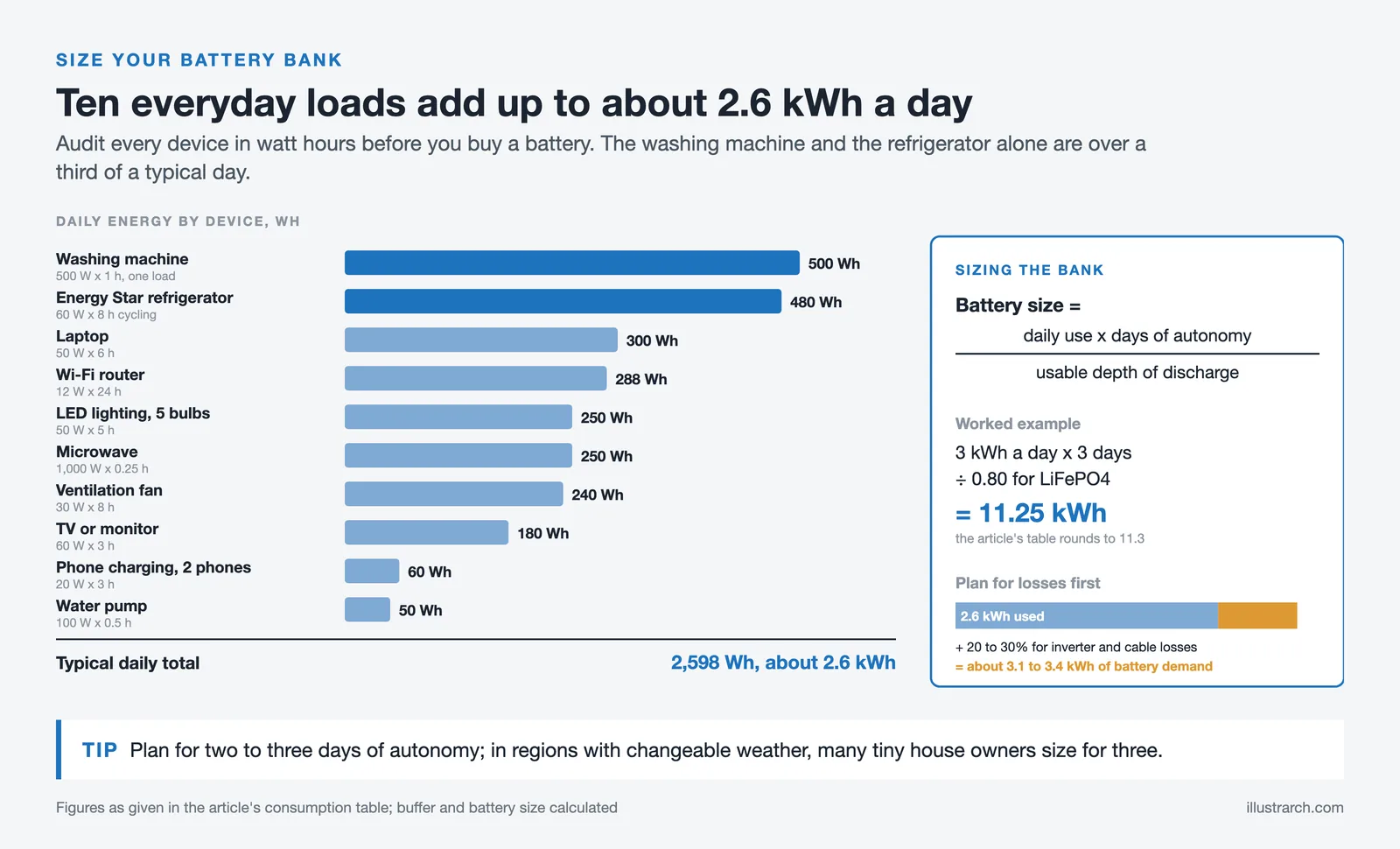
For a tiny house consuming 3 to 5 kWh daily, a battery bank of 7.5 to 12.5 kWh provides comfortable autonomy. This sizing ensures you never discharge batteries below 20-30% state of charge, dramatically extending their lifespan. According to research from the National Renewable Energy Laboratory, proper battery sizing can double the effective lifespan of your energy storage system.
Tiny House Daily Energy Consumption Reference
Use this table to estimate your daily energy needs and determine the right battery bank size:
| Appliance / Device | Typical Wattage | Daily Hours of Use | Daily Wh Consumption |
|---|---|---|---|
| LED Lighting (5 bulbs) | 50W total | 5 hours | 250 Wh |
| Energy Star Refrigerator | 60W | 8 hours (cycling) | 480 Wh |
| Laptop Computer | 50W | 6 hours | 300 Wh |
| Phone Charging (2 phones) | 20W | 3 hours | 60 Wh |
| Water Pump | 100W | 0.5 hours | 50 Wh |
| Ventilation Fan | 30W | 8 hours | 240 Wh |
| Wi-Fi Router | 12W | 24 hours | 288 Wh |
| Washing Machine (per load) | 500W | 1 hour | 500 Wh |
| Microwave | 1,000W | 0.25 hours | 250 Wh |
| TV / Monitor | 60W | 3 hours | 180 Wh |
| Typical Daily Total | 2,598 Wh (~2.6 kWh) |
💡 Pro Tip: Always add 20-30% to your calculated daily consumption for inverter losses, cable resistance, and unexpected usage. A tiny house calculating 2.6 kWh daily use should plan for approximately 3.1 to 3.4 kWh of actual battery demand. This “real world” buffer prevents unpleasant surprises during winter months when solar input drops.
Understanding Days of Autonomy
Your battery bank should provide 2-3 days of autonomy during periods without solar input. This buffer protects against consecutive cloudy days and reduces stress on your batteries by preventing deep discharge cycles. Many experienced tiny house dwellers recommend calculating for 3 days of autonomy in regions with variable weather patterns.
Battery Sizing Quick Calculator
| Daily Consumption | 2 Days Autonomy (LiFePO4 @ 80% DoD) | 3 Days Autonomy (LiFePO4 @ 80% DoD) | Recommended Panel Wattage |
|---|---|---|---|
| 2 kWh/day | 5.0 kWh battery | 7.5 kWh battery | 600-800W |
| 3 kWh/day | 7.5 kWh battery | 11.3 kWh battery | 900-1,200W |
| 5 kWh/day | 12.5 kWh battery | 18.8 kWh battery | 1,500-2,000W |
| 7 kWh/day | 17.5 kWh battery | 26.3 kWh battery | 2,100-2,800W |
| 10 kWh/day | 25.0 kWh battery | 37.5 kWh battery | 3,000-4,000W |
Formula: Battery Size = (Daily Consumption × Days of Autonomy) ÷ Usable DoD

3. Implement a Quality Battery Management System (BMS)
Every solar panel with battery system for tiny house requires sophisticated battery management. A quality BMS monitors individual cell voltages, balances charge across cells, prevents overcharging and over-discharging, and manages temperature-related safety protocols.
Modern BMS units offer smartphone connectivity, allowing you to monitor battery health remotely and receive alerts about potential issues before they become critical. This technology is particularly valuable for tiny houses on wheels that may experience vibration and movement that can affect battery performance.
According to industry reports, batteries with intelligent BMS systems can achieve up to 30% longer measured lifespans compared to traditional systems without active management.
💡 Pro Tip: When shopping for batteries, prioritize those with Bluetooth or Wi-Fi-enabled BMS that show individual cell voltages, not just overall pack voltage. Cell-level monitoring lets you catch imbalance issues early, which is the #1 cause of premature battery failure in multi-cell configurations. Look for BMS units that also include temperature-activated heating for cold climate use.

4. Optimize Solar Panel Positioning and Maintenance
Battery management begins with consistent charging. Position solar panels to maximize sun exposure throughout the day, adjusting tilt angles seasonally if your tiny house remains stationary. In winter, steeper angles (latitude + 15°) capture low-angle sunlight, while summer benefits from shallower angles (latitude – 15°).
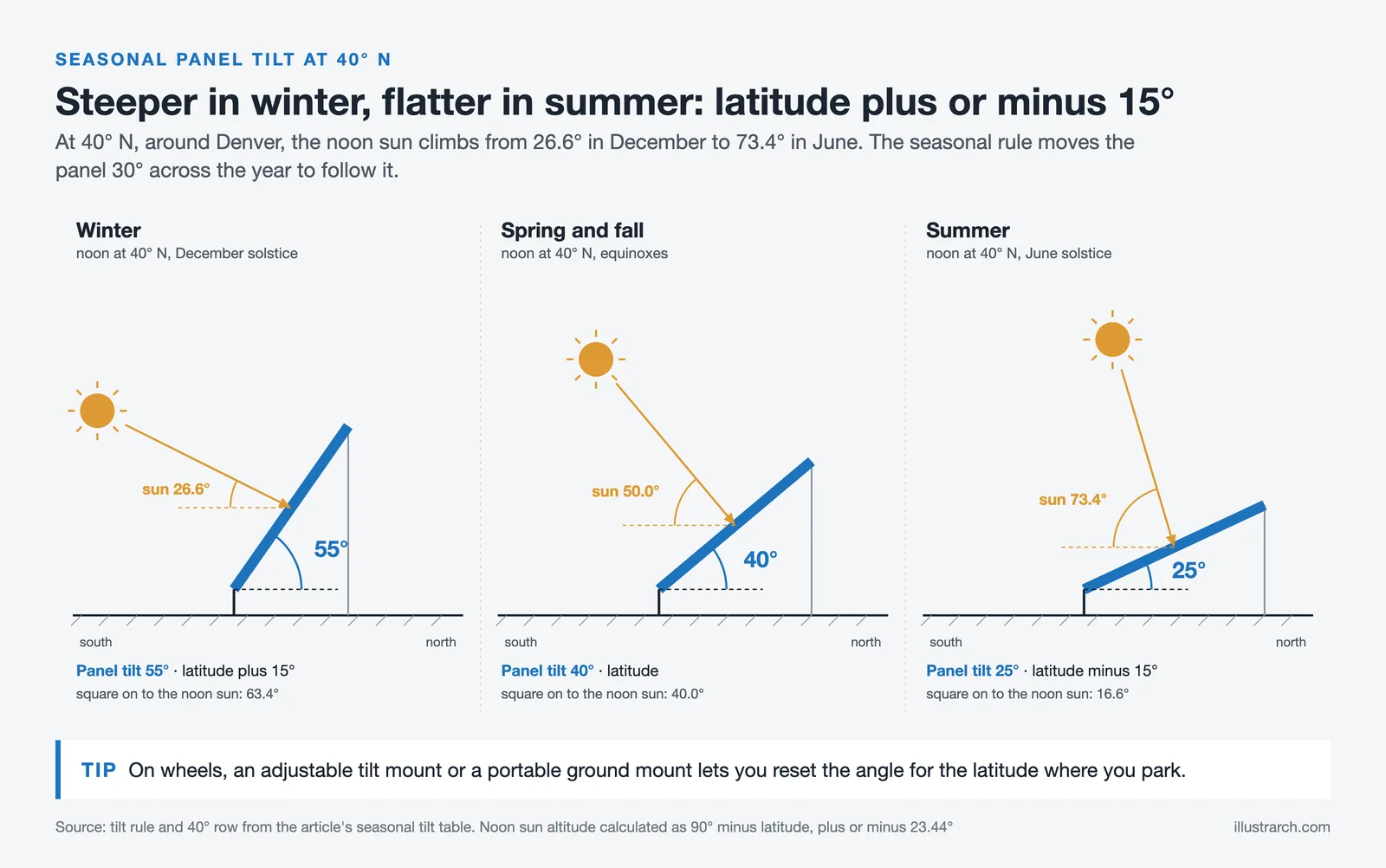
Keep panels clean, even a thin layer of dust can reduce output by 20-30%. For tiny houses in dusty or pollen-heavy environments, monthly cleaning maintains optimal performance. Learn more about integrating solar panels into architectural design for both aesthetics and functionality.
Seasonal Solar Panel Tilt Angle Guide
| Your Latitude | Spring/Fall Tilt | Summer Tilt | Winter Tilt | Year-Round Fixed Tilt |
|---|---|---|---|---|
| 25° (e.g., Miami, FL) | 25° | 10° | 40° | 25° |
| 35° (e.g., Albuquerque, NM) | 35° | 20° | 50° | 35° |
| 40° (e.g., Denver, CO) | 40° | 25° | 55° | 40° |
| 45° (e.g., Portland, OR) | 45° | 30° | 60° | 45° |
| 50° (e.g., London, UK) | 50° | 35° | 65° | 50° |
💡 Pro Tip: For tiny houses on wheels, consider adjustable tilt mounting systems or portable ground-mount panels. When you park, you can angle the panels optimally for your current latitude and orientation. Even a 15° tilt adjustment between seasons can improve annual energy harvest by 10-25%, depending on location.

5. Monitor State of Charge (SOC) Religiously
Install a reliable battery monitor that displays state of charge, voltage, current flow, and cumulative amp-hours. Understanding your battery’s SOC helps you make informed decisions about energy consumption and prevents damaging deep discharges.
Establish personal guidelines for energy use based on SOC:
- 80-100% SOC: Normal operation of all systems
- 50-80% SOC: Moderate use, avoid heavy loads
- 30-50% SOC: Conservation mode, essential systems only
- Below 30% SOC: Critical conservation, risk of battery damage
💡 Pro Tip: Set up audible or push notification alerts at key SOC thresholds (50%, 30%, and 20%). Human memory alone isn’t reliable, automated warnings give you time to react before damage occurs. Many experienced off-gridders keep a simple daily log of morning SOC, midday peak SOC, and evening SOC, which reveals patterns and helps predict low-production days.

6. Control Depth of Discharge (DoD)
While lithium batteries tolerate deeper discharges than lead-acid, regularly draining them below 20% significantly reduces lifespan. Research published by the U.S. Department of Energy indicates that limiting DoD to 80% can extend battery life by 50% or more.
Configure your system’s low-voltage disconnect (LVD) to protect batteries from excessive discharge. Most installers set LVD at 20-30% SOC, automatically disconnecting loads before critical damage occurs. This feature is essential in tiny house solar batteries systems where daily cycling is inevitable.
Depth of Discharge vs. Battery Lifespan
| Typical DoD | LiFePO4 Expected Cycles | Estimated Years (1 cycle/day) | Lead-Acid Expected Cycles | Estimated Years (1 cycle/day) |
|---|---|---|---|---|
| 50% | 8,000-10,000 | 22-27 years | 800-1,200 | 2-3 years |
| 60% | 6,000-8,000 | 16-22 years | 500-800 | 1.5-2 years |
| 70% | 4,000-6,000 | 11-16 years | 350-500 | 1-1.5 years |
| 80% | 3,000-5,000 | 8-14 years | 200-350 | 0.5-1 year |
| 90% | 2,000-3,500 | 5-10 years | 150-200 | ~6 months |
| 100% | 1,000-2,000 | 3-5 years | 100-150 | 3 to 5 months |
Data compiled from manufacturer specifications, DOE research, and the Preger study (Journal of The Electrochemical Society, 2020).
Balancing Usability and Longevity
Find the sweet spot between battery capacity utilization and longevity. While you technically have access to 80-95% of lithium battery capacity, regularly using only 60-70% provides a comfortable buffer that extends service life while maintaining adequate daily energy.
💡 Pro Tip: Cycling at 100% DoD sharply reduces LiFePO4 cycle life compared to cycling at 50% DoD. The “sweet spot” for most tiny house owners is 60-70% daily DoD, deep enough to access sufficient energy, shallow enough to ensure 10+ years of reliable service.

7. Manage Temperature Extremes
Battery performance and longevity are heavily influenced by temperature. Lithium batteries perform optimally between 50-85°F (10-30°C). Extreme cold reduces available capacity, while excessive heat accelerates degradation and can trigger safety shutoffs.
Research indicates that operating at 35°C (95°F) accelerates battery degradation approximately twice as fast as operating at 25°C (77°F), primarily due to accelerated electrolyte decomposition. Additionally, every 8°C increase above 25°C can reduce battery life by up to 50%.
For tiny houses in extreme climates, consider these strategies:
- Insulate battery compartments to moderate temperature swings
- Install heating pads for cold climates (some BMS systems include temperature-activated heating)
- Ensure adequate ventilation in warm climates to prevent heat buildup
- Position batteries in climate-controlled interior spaces when possible
Temperature Impact on Battery Performance
| Temperature Range | Available Capacity | Charging Allowed? | Degradation Rate | Action Needed |
|---|---|---|---|---|
| Below -20°C (-4°F) | ~40-50% | ❌ No | Risk of lithium plating | Activate heating pads before charging |
| -20°C to 0°C (-4°F to 32°F) | ~60-80% | ⚠️ Reduced current only | Low | Pre-warm battery; use low charge rates |
| 0°C to 10°C (32°F to 50°F) | ~80-90% | ✅ Yes | Low | Insulate battery compartment |
| 10°C to 30°C (50°F to 86°F) | 100% | ✅ Yes | Normal (baseline) | Optimal operating range |
| 30°C to 45°C (86°F to 113°F) | 100% (but degrading) | ✅ Yes (caution) | 2-3x faster | Ensure ventilation; avoid direct sun |
| Above 45°C (113°F) | BMS may disconnect | ❌ BMS cutoff likely | Severe damage risk | Immediate cooling required |
💡 Pro Tip: Never charge LiFePO4 batteries below 0°C (32°F), this causes lithium plating on the anode, which permanently and irreversibly damages cells. Invest in a BMS with low-temperature charging protection and integrated heating. Many modern units start self-heating at 5°C and enable charging only once internal temperature reaches a safe threshold.
The climate-responsive design principles used in modern tiny houses often incorporate strategic battery placement as part of the overall thermal management strategy.

8. Implement Smart Load Management
Effective battery management requires conscious energy consumption. Prioritize high-draw appliances during peak solar production hours (10 AM, 3 PM) when excess solar energy prevents battery discharge. Run washing machines, vacuum cleaners, power tools, and other heavy loads during this window.
Consider installing timers or smart plugs to automatically schedule energy-intensive tasks during solar production peaks. This strategy, known as “load shifting,” reduces battery cycling and ensures your best tiny house solar kit with battery operates in the most efficient manner possible.
Smart Load Scheduling Guide
| Time Period | Solar Status | Recommended Activities | Avoid |
|---|---|---|---|
| 6-9 AM | Low production (ramp-up) | Low-draw essentials: lights, phone charging, coffee | Heavy loads, power tools |
| 9 AM: 12 PM | Moderate to high production | Laptop work, cooking, moderate loads | Still avoid peak loads if cloudy |
| 12-3 PM | Peak production | Washing machine, vacuum, power tools, water heating, heavy cooking | Nothing: this is your power window |
| 3-6 PM | Declining production | Moderate loads, battery should be near full | Starting new heavy loads |
| 6 PM: 6 AM | No production (battery only) | Essential loads: lights, fridge, devices, entertainment | Discretionary high-draw appliances |
Creating an Energy Budget
Track daily energy consumption for a month to understand your patterns. Identify discretionary loads that can be reduced or eliminated during low-production periods. Many tiny house residents find that awareness alone reduces consumption by 20-30%.
💡 Pro Tip: Use a simple kill-a-watt meter ($20-$30) on each appliance to measure actual consumption, manufacturer ratings are often maximum values, not typical usage. You’ll likely discover that your actual daily consumption is 15-25% lower than calculated estimates, giving you more battery headroom than expected.

9. Perform Regular Maintenance and Inspections
While modern tiny house solar panel and battery setup systems require minimal maintenance, regular inspections prevent small issues from becoming major failures.
Battery systems follow a reliability pattern known as the “bathtub curve” approximately 1 in 100 systems experience early component failures within the first two years, followed by a stable period where failure rates drop well below 1% annually, and then gradual wear-out after 10+ years. Proactive maintenance during the stable period is what separates systems that last 8 years from those that last 15+.
Maintenance Checklist
| Frequency | Task | What to Check / Do |
|---|---|---|
| Monthly | Visual inspection | Look for corrosion, swelling, unusual odors, or leaks |
| Monthly | Panel cleaning | Remove dust, debris, bird droppings; use soft cloth & water |
| Monthly | BMS data review | Check cell balance, temperature logs, and error history |
| Quarterly | Connection check | Torque-check all terminals; inspect for loosening from vibration |
| Quarterly | Ventilation check | Clear battery compartment vents; ensure airflow is unobstructed |
| Quarterly | Capacity test | Compare current capacity against baseline; note degradation trends |
| Annually | Professional inspection | Full system audit: wiring, charge controller settings, inverter calibration |
| Annually | Firmware updates | Update BMS, charge controller, and inverter firmware |
| Annually | Wiring inspection | Check for chafing, rodent damage, UV degradation on exposed runs |
Keeping detailed logs of battery performance helps identify degradation trends early. Note any changes in charging behavior, capacity reduction, or unusual voltage patterns. Documentation from the Solar Energy Industries Association emphasizes that proactive maintenance extends system life by an average of 25%.
💡 Pro Tip: Start a simple spreadsheet or notebook from day one. Record monthly SOC ranges, total kWh throughput, and any anomalies. After 6 months, you’ll have a baseline that makes it easy to spot gradual capacity loss. Replace any battery that drops below 70-80% of its original rated capacity, continued use below this threshold accelerates degradation exponentially.

10. Plan for Future Expansion and Upgrades
Design your initial solar battery system for rv or tiny house with expansion in mind. Use modular components that allow adding battery capacity or solar panels as needs evolve. Many tiny house owners find their energy consumption increases over time as they add comfort features or work-from-home equipment.
When planning expansion:
- Ensure charge controllers can handle additional solar panel capacity
- Verify inverter sizing accommodates potential load increases
- Use battery chemistries and brands that allow parallel expansion
- Document your system configuration for future reference
Estimated System Costs (2025)
| System Component | Budget Setup | Mid-Range Setup | Premium Setup |
|---|---|---|---|
| Solar Panels (per watt) | $0.50-$0.80 | $0.80-$1.20 | $1.20-$2.00 |
| Battery Bank (per kWh) | $150-$250 (Lead-Acid) | $250-$350 (LiFePO4) | $350-$500 (Premium LFP/NMC) |
| Charge Controller | $100-$200 (PWM) | $200-$500 (MPPT) | $500-$1,000 (Advanced MPPT) |
| Inverter | $200-$500 | $500-$1,500 | $1,500-$3,000 |
| BMS & Monitoring | Included in battery | $100-$300 | $300-$800 |
| Wiring & Hardware | $100-$300 | $300-$600 | $600-$1,200 |
| Total (3 kWh/day system) | $2,000-$4,000 | $4,000-$8,000 | $8,000-$15,000 |
Note: Prices reflect 2025 U.S. market averages. The 30% federal Investment Tax Credit (ITC) may apply to qualifying systems, significantly reducing effective costs.
💡 Pro Tip: Buy a charge controller rated for 50-100% more capacity than your initial panel array. The cost difference is minimal ($50-$150), but it saves you from replacing the entire controller when you expand. Similarly, choose an inverter that handles at least 1.5x your current peak load, your future self will thank you.
The modular nature of modern solar systems makes staged expansion cost-effective. Rather than over-building initially, many tiny house dwellers start with adequate capacity and expand based on actual usage patterns. Explore off-grid living solutions that showcase successful expansion strategies.

Conclusion: Sustainable Power Management for Tiny Living
Mastering solar battery management in your tiny house combines technical knowledge with daily awareness. By selecting appropriate equipment, sizing systems correctly, monitoring performance religiously, and practicing conscious energy consumption, you create a reliable, long-lasting power solution that supports comfortable off-grid living.
Remember that your solar panel with battery system for tiny house is an investment in independence and sustainability. Treat your batteries well through proper management, and they’ll provide years of dependable service, powering your tiny house adventures wherever they may lead.
For additional insights into sustainable tiny house design and energy-efficient living, explore comprehensive resources on contemporary tiny house architecture and green building practices that integrate renewable energy systems from the ground up.
Frequently Asked Questions (FAQ)
How many solar panels and batteries do I need for a tiny house?
A typical tiny house consuming 3 to 5 kWh per day needs 4 to 8 solar panels (400W each) and a battery bank of 7.5 to 12.5 kWh. The exact number depends on your location’s peak sun hours, daily energy consumption, and desired days of autonomy. Use the battery sizing formula: Battery Size = (Daily Consumption × Days of Autonomy) ÷ Usable DoD. For example, 3 kWh/day × 3 days ÷ 0.80 DoD = 11.25 kWh battery bank.
What is the best battery type for a tiny house solar system?
LiFePO4 (lithium iron phosphate) batteries are widely considered the best choice for tiny house solar systems in 2025. They offer 3,000-10,000 cycle life, 80-95% usable capacity, virtually no maintenance, superior thermal safety, and lightweight construction. While their upfront cost is higher than lead-acid alternatives, the cost per cycle is 5-10x lower, making them more economical over their 10-20 year lifespan.
How long do solar batteries last in a tiny house?
LiFePO4 batteries typically last 10-20 years when properly managed with controlled depth of discharge and appropriate temperature conditions. Lead-acid batteries last only 2-5 years under similar daily cycling conditions. Factors that most impact lifespan include depth of discharge, operating temperature, charge/discharge rates, and maintenance quality.
Can I run a tiny house entirely on solar power?
Yes, a tiny house can run entirely on solar power with proper system sizing. Most tiny houses consume only 1-5 kWh per day, which is achievable with a well-designed solar panel and battery system. Key requirements include adequate panel capacity, sufficient battery storage for 2-3 days of autonomy, energy-efficient appliances, and conscious load management. Propane can supplement solar for high-draw needs like heating and cooking.
How much does a solar battery system for a tiny house cost?
As of 2025, a complete tiny house solar system costs between $2,000 and $15,000 depending on quality and capacity. A mid-range system with LiFePO4 batteries typically runs $4,000-$8,000 for a 3 kWh/day setup. The 30% federal Investment Tax Credit (ITC) can significantly reduce the effective cost. LiFePO4 battery prices specifically have dropped to approximately $200-$350 per kWh in 2025, down 10-15% from 2023.
What temperature range is safe for solar batteries?
LiFePO4 batteries perform optimally between 10-30°C (50-86°F). They should never be charged below 0°C (32°F), as this causes irreversible lithium plating damage. Operating above 35°C accelerates degradation at roughly double the normal rate. For extreme climates, invest in insulated battery compartments, BMS systems with temperature-activated heating, and proper ventilation.
How do I calculate my tiny house’s daily energy consumption?
List every electrical device you plan to use, multiply each device’s wattage by its daily hours of use to get watt-hours (Wh), then add all values together. A typical efficient tiny house consumes 2-4 kWh per day. Add 20-30% to your calculated total for inverter losses and unexpected usage. You can also use a kill-a-watt meter on each appliance for more accurate real-world measurements.
Should I use a PWM or MPPT charge controller for my tiny house?
MPPT (Maximum Power Point Tracking) charge controllers are recommended for most tiny house installations. They are 20-30% more efficient than PWM (Pulse Width Modulation) controllers and allow you to use higher-voltage panel strings with lower-voltage battery banks. The additional cost ($100-$300 more) is easily recouped through increased energy harvest, especially in partially shaded conditions or during winter months.
How often should I maintain my tiny house solar battery system?
Perform visual inspections and panel cleaning monthly, check electrical connections and ventilation quarterly, and schedule a professional system audit annually. LiFePO4 batteries require virtually no hands-on maintenance, but regularly reviewing BMS data, checking for connection corrosion (especially in mobile tiny houses), and updating firmware keeps the system running at peak efficiency. Proactive maintenance extends system life by approximately 25%.
What happens if my solar batteries fully discharge?
Fully discharging (0% SOC) a LiFePO4 battery can cause permanent cell damage, reduced capacity, and potentially void the manufacturer’s warranty. Most quality BMS systems include a low-voltage disconnect (LVD) that automatically cuts off loads at 10-20% SOC to prevent this. If a full discharge occurs, recharge immediately at a low current rate and test capacity, if capacity has dropped significantly, the cells may need replacement.
Last updated:





Tiny House Water Systems: Your Complete Guide to Plumbing, Rainwater Harvesting and Off-Grid Solutions
A practical guide to designing a tiny house water system, covering PEX...
 Bahattin Duran14 Mins read
Off-Grid Tiny House Living: Complete Setup Guide for Beginners
This guide walks you through every stage of setting up an off-grid...
Bahattin Duran15 Mins read
Tiny House with Loft: Design Ideas, Plans and Building Tips for Vertical Living
A complete guide to designing and building a tiny house with loft,...
Bahattin Duran15 Mins read
8+ Best Tiny Home Communities in Michigan: Great Lakes Tiny Living Guide
Explore tiny home communities in Michigan. Great Lakes lifestyle, affordable land, and...
Bahattin Duran18 Mins read


Leave a comment