

How 19th Century Skyscrapers Revolutionized Urban Architecture and Economic Growth
Explore the profound impact of 19th-century skyscrapers on urban landscapes. Discover how innovations in steel and elevators, along with trailblazing architects like William Le Baron Jenney and Louis Sullivan, revolutionized building designs. Uncover the economic, social, and cultural significance of these towering structures that reshaped cities during the Industrial Revolution.
 Furkan Sen29 September 202416 Mins read1.4k
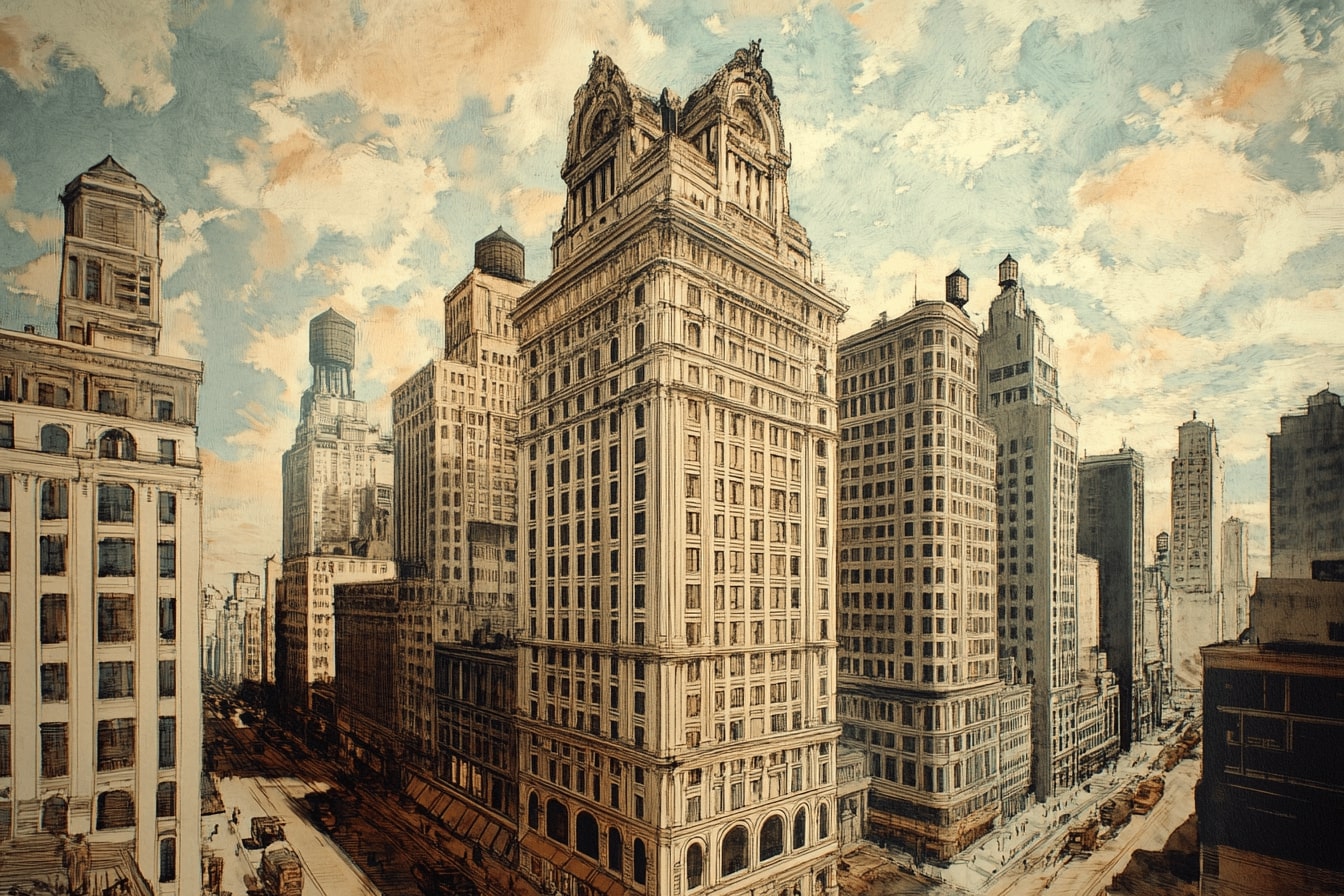
Table of Contents Show
Quick answer: The first skyscrapers rose in the late 19th century, made possible by steel frame construction, the safety elevator, and fireproofing. Chicago’s Home Insurance Building of 1885 is often called the first skyscraper, and the era shifted cities upward as land values and ambition grew.
19th century skyscrapers transformed urban architecture by combining structural steel frames with the safety elevator, allowing buildings to rise higher than the traditional six-story limit. Pioneered in Chicago and New York between 1885 and 1900, these towers introduced a new vertical model of city building that still defines modern downtowns today.
The late 1800s marked a turning point in architecture as American cities began building upward instead of outward. New construction technologies, especially steel framing and mechanical elevators, made it possible to design office towers that rose ten, fifteen, even twenty stories above the street. These early high-rises were not just engineering experiments. They were responses to rising land prices, expanding businesses, and the cultural ambitions of fast-growing industrial cities.
This guide covers the history of 19th century skyscrapers, the architects who shaped them, the iconic buildings that defined the era, and the lasting impact these structures had on urban planning, economics, and culture. Many of the principles established during this period still inform how architects approach skyscraper architecture and design today.

The Birth of the Skyscraper
The late 19th century witnessed the birth of the skyscraper, dramatically transforming urban landscapes. Technological advancements played a crucial role in this transformation. Structural steel and the invention of the safety elevator by Elisha Otis in 1852 enabled buildings to reach unprecedented heights. By using steel frames, architects could design taller structures without the limitations imposed by traditional masonry.
In 1885, the Home Insurance Building in Chicago, often cited as the first skyscraper, was constructed. Architect William Le Baron Jenney incorporated a steel skeleton, allowing it to rise to 10 stories tall. This building marked a significant departure from conventional load-bearing walls, setting a precedent for future skyscrapers. According to Wikipedia’s research on skyscraper history, this was the first steel-frame skyscraper in the world, originally 10 stories with a height of 138 feet.
Economic factors also spurred the development of skyscrapers. Rapid urbanization and industrial growth increased the demand for office space in central business districts. These towering structures utilized limited land efficiently, accommodating more tenants per square foot. For instance, New York City and Chicago became epicenters for these architectural innovations due to their booming economies and limited space. Chicago grew from a village of around 50 inhabitants in 1830 to a city of nearly 300,000 by 1870, according to the Library of Congress historical records.
Visionary architects like Louis Sullivan, whom many regard as the “father of skyscrapers,” contributed significantly to the aesthetic and functional aspects of these buildings. Sullivan’s principle that “form follows function” influenced designs that were both practical and artistically impressive. Sullivan designed the Wainwright Building in St. Louis in 1891, which exemplified his architectural philosophy. This relationship between form and function became foundational for what later evolved into modern architecture and its design principles.
The combination of technological breakthroughs, economic pressures, and visionary architectural thinking shaped the modern urban form. Each factor on its own would not have produced the skyscraper. Together, they made vertical cities possible.
💡 Pro Tip
When studying 19th century skyscrapers for design inspiration or research, focus on the structural logic before the ornament. The Beaux-Arts facades of buildings like the New York World Building can be misleading because the real innovation lies in what’s behind the masonry: the steel skeleton. Architects who understand this distinction develop a sharper eye for how form and structure separate in early high-rise design.
What Architectural Innovations Made 19th Century Skyscrapers Possible?
The 19th century introduced groundbreaking changes in architecture, particularly with the rise of skyscrapers. Key innovations in building materials and elevator technology played significant roles in this transformation. Without these two parallel developments, the high-rise office tower simply could not have existed.
Advances in Building Materials
Steel revolutionized skyscraper construction. Structural steel, unlike traditional materials, offered unprecedented strength and flexibility, enabling taller, more stable buildings. The Home Insurance Building in Chicago, built in 1885, utilized a steel skeleton frame. Brick and stone, previously used for load-bearing walls, became purely decorative. Architects could now design bigger windows and lighter walls, allowing more natural light into buildings. Fire-resistant materials like terracotta emerged, enhancing safety in urban environments.
The Bessemer process, developed in the 1850s, made mass production of steel affordable for the first time. Before this, iron was the dominant metal, but it lacked the tensile strength needed for tall structures. Steel’s strength-to-weight ratio allowed builders to create skeleton frames that carried both vertical loads and lateral wind forces. Wind bracing, drawing on engineering equations from Augustin-Jean Fresnel, became standard for buildings over ten stories. The principles behind these steel frame structures still guide modern construction today.
Role of Elevators
Elisha Otis’s safety elevator, patented in 1852, transformed building design. Before this invention, buildings rarely exceeded six stories due to the impracticality of climbing stairs. With elevators ensuring safe vertical transport, architects could design much taller structures. Elevators also influenced the layout of skyscrapers. Central shafts became standard to house the elevator systems, and this allowed for maximum usable floor space. The widespread adoption of elevators made skyscrapers more feasible and practical, meeting the increasing demand for office space in crowded cities.
Otis’s key innovation was a safety brake that prevented free-fall if the lifting cable broke. He demonstrated it publicly in 1854 at the New York Crystal Palace, cutting the cable while standing on the platform to prove the brake would catch the elevator. This single moment shifted public confidence in vertical transport. The first commercial passenger elevator was installed in 1857 at the Haughwout Building in Manhattan. By 1870, hydraulic elevators could serve buildings far taller than six stories, opening the door to truly tall office structures.
📌 Did You Know?
The word “skyscraper” was first used in the 1780s to describe a particularly tall horse, then later applied to a high-flying ball, tall hats, and the topmost sail on a ship’s mast. According to historical records on early skyscrapers, the term was first applied to a building in 1883 and became widespread for tall office blocks by 1889.
Iconic 19th Century Skyscrapers
Numerous skyscrapers emerged in the 19th century, setting new standards in architecture and engineering. Among these, the Home Insurance Building, the New York World Building, and the Wainwright Building stand out as the most influential.

Home Insurance Building (1885)
The Home Insurance Building in Chicago, completed in 1885, represents the birth of the skyscraper. Designed by William Le Baron Jenney, it was the first building to use a steel skeleton frame, marking a departure from traditional masonry structures. With ten stories and a height of 138 feet, it set a precedent for future skyscrapers. The use of steel allowed for larger windows and reduced the weight of the building. Jenney’s innovative design integrated structural steel, ensuring stability and strength. This approach enabled architects to construct taller buildings efficiently.
Two additional stories were later added, bringing the total to 12. The building was demolished in 1931 to make way for the Field Building, but its legacy as the prototype for modern high-rise construction remains intact. Jenney’s training as a military engineer shaped his approach: he treated the building as a load-bearing structural problem, separating skeleton from skin in a way no architect had attempted at this scale before.
New York World Building (1890)
The New York World Building, completed in 1890, exemplified the skyscraper boom in New York City. Designed by George B. Post for publisher Joseph Pulitzer, this building stood 20 stories tall and reached a height of 309 feet. Notably, it held the title of the world’s tallest office building at the time. Its design included modern features such as elevators and electric lighting. The use of structural steel and the building’s ornate facade showcased the blend of functionality and aesthetics. This skyscraper symbolized the synergy between technological innovation and architectural ambition in the late 19th century.
The building’s gilded dome was visible from across the harbor, making it a marker for ships entering New York. Pulitzer himself worked from a top-floor office, signaling the new association between height and prestige in American business culture. The structure was demolished in 1955 to expand an entrance ramp to the Brooklyn Bridge, a loss that preservationists still cite as a turning point in the modern historic preservation movement.
Wainwright Building (1891)
Designed by Louis Sullivan and Dankmar Adler, the Wainwright Building in St. Louis stands as one of the earliest aesthetic statements about what a skyscraper should look like. Sullivan rejected the idea of stacking classical horizontal facades on top of each other and instead emphasized vertical lines, treating the tall office block as a coherent architectural type with its own visual logic.
The 10-story red brick and terracotta tower introduced what Sullivan called the “tall office building artistically considered.” His tripartite division, a base, a shaft of repeated office floors, and an ornamental cornice, became the template for skyscraper composition for the next forty years. The building still stands today and is a National Historic Landmark, offering one of the few intact opportunities to study early skyscraper aesthetics in person.
Other Notable 19th Century Skyscrapers
Beyond the three best-known examples, several other 19th century skyscrapers played important roles in shaping the form. The Tacoma Building in Chicago (1889), designed by Holabird and Roche, was one of the first to use a fully riveted steel frame. The Reliance Building (1895), also in Chicago, pushed the use of glass curtain walls so far that it has been called a precursor to 20th-century modernist towers. The Manhattan Building (1891) reached 16 stories and used a combination of wind bracing and steel framing that engineers still study.
According to research published by The Skyscraper Museum, structural engineer Donald Friedman documented hundreds of buildings between 1871 and 1900 that contributed to the technical evolution of the type, far more than the handful of canonical examples typically cited.
🏗️ Real-World Example
Reliance Building (Chicago, 1895): Designed by Charles B. Atwood and Daniel Burnham, this 14-story tower has more glass than masonry on its facade, an extreme rarity for its era. The Chicago window, a wide central pane flanked by two narrow operable sashes, was perfected here. The building still stands at 32 N. State Street and is now the Hotel Burnham, allowing visitors to study an intact 19th century skyscraper from the inside.
These iconic buildings embody the architectural advancements and economic forces that shaped urban landscapes in the 19th century. They were not isolated experiments but part of a larger ecosystem of architects, engineers, developers, and clients all pushing in the same direction.
How Did 19th Century Skyscrapers Change Urban Development?
Skyscrapers in the 19th century revolutionized urban development. Central business districts (CBDs) flourished as cities embraced vertical growth. This vertical expansion allowed cities to accommodate increasing populations and business activities without expanding outwards excessively.
Space Optimization and Land Use
Skyscrapers maximized land use efficiency. Tall buildings facilitated high-density occupation, crucial for growing urban centers with limited land resources. For example, the Home Insurance Building utilized steel skeleton construction, creating more usable space by reducing the need for thick load-bearing walls. In Manhattan, where the original colonial street grid had divided land into many small parcels, this efficiency was especially valuable. A single 1880s plot could now hold ten times the rentable office space of a traditional masonry building.
Economic Growth and Business Clustering
Vertical architecture stimulated economic growth. Centralized office spaces promoted business clustering, enhancing economic interactions and opportunities. As a direct consequence, cities like Chicago and New York experienced rapid economic expansion, driven by concentrated business hubs. Banks, insurance companies, law firms, and trading houses concentrated within walking distance of each other, accelerating deal flow and information exchange in ways that would have been impossible in a horizontally spread-out city.
Technological Influence
Innovations like the safety elevator redefined building functionality. Otis’s invention in 1852 permitted the realization of taller structures, with elevator shafts centrally located to optimize floor plans and increase usable space. Buildings became more practical and appealing for commercial purposes, further concentrating economic activities in urban cores. Electric lighting, central heating, and pneumatic mail tubes also became standard in 19th century skyscrapers, turning the office tower into a fully integrated technological system rather than just a tall enclosure.
Social Stratification
Vertical living began to shape social stratification. Higher floors, once less desirable due to accessibility issues, became premium locations offering better views and air quality. This shift influenced urban lifestyles and residential patterns, with affluent residents moving to higher floors, leaving lower levels for commercial use or less affluent occupiers.

Infrastructure Development
Skyscrapers necessitated advancements in urban infrastructure. Cities developed stronger foundations, sewage systems, and more robust water supply networks to support these towering structures. This led to more comprehensive urban planning, ensuring that supporting systems could handle the increased demands of taller buildings. In Chicago, the famous raising of the city street grade in the 1850s and 1860s, combined with the engineering response to the Great Chicago Fire of 1871, set the stage for the kind of dense urban infrastructure that 19th century skyscrapers required.
Architectural Identity
The introduction of skyscrapers contributed to a distinctive architectural identity. Buildings like the Wainwright Building, designed by Louis Sullivan, showcased unique styles and innovations. This architectural evolution helped cities form unique skylines, recognizable worldwide, and became symbols of economic prowess and artistic expression. The relationship between buildings and city character is something architects still navigate today, as explored in our analysis of how architecture shapes urban identity.
Urban Mobility
The emergence of tall buildings influenced urban mobility patterns. Centralized workspaces increased reliance on public transportation, prompting development or expansion of transit systems. Efficient transportation networks became essential for connecting the workforce to the CBDs, addressing the mobility challenges posed by vertical urban landscapes. New York’s elevated trains, Chicago’s L system, and the early subway lines were all responses to the concentrated demand that 19th century skyscrapers created.
🔢 Quick Numbers
- 138 feet: original height of the Home Insurance Building, the first skyscraper (1885 source: Wikipedia)
- 309 feet: height of the New York World Building, the world’s tallest office building when completed in 1890
- 50 to 300,000: Chicago’s population growth from 1830 to 1870, fueling skyscraper demand (source: Library of Congress)
- 1854: year Elisha Otis publicly demonstrated his safety elevator at the New York Crystal Palace
Cultural Significance of 19th Century Skyscrapers
Skyscrapers in the 19th century represented more than just architectural achievements; they embodied the cultural aspirations of a rapidly evolving society. These towering structures symbolized progress, innovation, and the newfound possibilities brought about by the industrial revolution. As cities expanded, skyscrapers became markers of economic prosperity and technological advancement, making them central to urban identity. The connection between industrial revolution architecture and modern design began with these very buildings.
Economic Growth and Urban Identity
Skyscrapers played a pivotal role in shaping the economic and cultural identity of urban centers. Their presence in city skylines indicated a city’s economic might and intellectual ambition. For instance, Chicago, with its Home Insurance Building, and New York, with its New York World Building, didn’t just showcase engineering feats. They declared the cities’ statuses as economic powerhouses. This was not lost on the cities’ rivals: Philadelphia, Boston, and St. Louis quickly built their own tall office towers to keep up.
Architectural Aesthetics and Artistic Expression
Architects like Louis Sullivan viewed skyscrapers as opportunities to merge functionality with artistry. His designs, such as the Wainwright Building, featured intricate facades and aesthetic flourishes that elevated the cultural status of these structures. Skyscrapers served as canvases where architects expressed creativity and explored new styles, influencing architectural trends worldwide. The Beaux-Arts tradition, brought back from Paris by American architects in the 1880s, supplied the decorative vocabulary for many early skyscrapers, even as their underlying logic was entirely new.
Social Stratification and Urban Dynamics
Higher floors in skyscrapers became synonymous with luxury, significantly impacting social hierarchies. Affluent residents and businesses sought premium upper-floor spaces, altering urban social dynamics. This vertical stratification reflected broader changes in societal structures during the industrial age, emphasizing distinct divisions in urban living and working environments.
Symbol of Innovation and Human Potential
The advent of skyscrapers showcased what human ingenuity and technological progress could achieve. These structures stood as symbols of human potential, epitomizing the era’s inventive spirit and the continuous push towards new horizons. Skyscrapers like the Home Insurance Building weren’t just buildings. They were testaments to visionary thinking. The same drive that produced the Eiffel Tower in 1889, the Forth Bridge in Scotland, and the Brooklyn Bridge in 1883 also gave us the first generation of high-rise office towers.
Influence on Popular Culture
Skyscrapers also permeated popular culture, featuring in literature, art, and media as icons of modernity and aspiration. They inspired works like Frank Norris’s novel “The Pit,” which centered on themes of ambition and economic power. Their representation in culture reinforced their status as symbols of progress and the human quest for greatness. By the early 20th century, postcards of American skyscrapers were sold across Europe, making the U.S. skyline one of the country’s most recognizable global exports.
19th-century skyscrapers were more than feats of engineering. They were cultural landmarks that symbolized a transformative period in history, reflecting the dynamic interplay of technological advancement, economic prosperity, and artistic expression. The same dialogue between innovation and identity continues today, as the world’s most iconic buildings show.
💡 Pro Tip
If you want to study 19th century skyscrapers in person, Chicago offers the highest density of intact examples in a single walkable area. The Loop district contains the Reliance Building, the Rookery, the Monadnock Building, and the Auditorium Building within a 15-minute walk of each other. Compare facades, structural systems, and floor plates side by side, you will learn more in an afternoon than from a semester of slide lectures.
Why Are 19th Century Skyscrapers Important Today?
19th century skyscrapers matter today because they established the structural, technological, and cultural template that every modern high-rise still follows. The steel skeleton, the central elevator core, the curtain wall, and the separation of structure from skin all originated during this period. When contemporary architects design supertall towers in Dubai, Shanghai, or New York, they work within a framework first established between 1885 and 1900.
These buildings also offer a working model for sustainable preservation. The Wainwright Building, the Reliance Building, and the Monadnock Building have all been adapted for modern use without losing their historical character. As cities increasingly prioritize embodied carbon, reusing 19th century skyscrapers, rather than demolishing them, has become an environmentally and economically sound strategy. The lessons from how historic structures inspire today’s architects apply directly to this generation of buildings.
⚠️ Common Mistake to Avoid
Many sources state that the Home Insurance Building was the “first skyscraper” without qualification. The reality is more nuanced. Buildings like the Equitable Life Building (1870) and the Jayne Building in Philadelphia (1849) reached 7 to 10 stories before Jenney’s design. What made the Home Insurance Building distinct was its full structural steel skeleton, not its height. When studying or writing about 19th century skyscrapers, distinguish between height, technology, and aesthetic claims rather than treating them as one.
Frequently Asked Questions
What was the first skyscraper in the 19th century?
The Home Insurance Building in Chicago, completed in 1885, is widely considered the first true skyscraper. Designed by William Le Baron Jenney, it was the first building to use a structural steel skeleton, originally rising 10 stories to a height of 138 feet. Two additional stories were later added before the building was demolished in 1931.
Who is considered the father of skyscrapers?
Louis Sullivan is widely regarded as the father of skyscrapers for his work on the aesthetic and theoretical foundations of high-rise design. His phrase “form follows function” defined how architects approached the new building type, and his Wainwright Building (1891) in St. Louis is often cited as the first skyscraper designed as a coherent architectural type rather than a stack of conventional floors.
Why did skyscrapers first appear in the 19th century?
Skyscrapers first appeared in the late 19th century because three conditions converged: the safety elevator (patented in 1852) made vertical transport practical, the Bessemer process (1850s) made structural steel affordable, and rapid urbanization in cities like Chicago and New York created intense demand for office space on limited land. No single one of these factors would have produced the skyscraper, but together they made it both possible and economically necessary.
What materials were used in 19th century skyscrapers?
19th century skyscrapers combined a steel skeleton frame with masonry cladding, typically brick, stone, or terracotta. The steel frame carried all structural loads, while the masonry served decorative and fire-protection roles. Glass was used in increasingly large windows, and cast iron was sometimes used for ornamental elements. Wrought iron framing was common in the earliest examples before being replaced by mass-produced structural steel.
How tall were the tallest 19th century skyscrapers?
The tallest 19th century skyscrapers reached around 20 to 22 stories. The New York World Building (1890) stood at 309 feet across 20 stories. The Manhattan Life Insurance Building (1894) reached approximately 348 feet. By comparison, the Eiffel Tower (1889) was 1,010 feet tall but functioned as an observation tower rather than an inhabited office building, so most architectural historians treat it as a separate category.
✅ Key Takeaways
- The 1885 Home Insurance Building in Chicago, designed by William Le Baron Jenney, is considered the first true skyscraper because of its structural steel skeleton.
- Two technological breakthroughs made 19th century skyscrapers possible: Elisha Otis’s safety elevator (1852) and affordable mass-produced steel from the Bessemer process.
- Louis Sullivan, the father of skyscrapers, established the aesthetic logic of the high-rise office tower with the Wainwright Building (1891) and the principle “form follows function.”
- Chicago and New York led skyscraper development because of rapid population growth, expensive land, and concentrated business activity in central districts.
- The structural and architectural principles established by 19th century skyscrapers still define modern high-rise design over 130 years later.
Conclusion
Skyscrapers of the 19th century revolutionized urban architecture, reflecting technological advancements and societal ambitions. The advent of structural steel and Elisha Otis’s safety elevator enabled the construction of these towering structures, transforming cityscapes and optimizing land use in burgeoning urban centers.
Architects like William Le Baron Jenney and Louis Sullivan played pivotal roles, blending functionality with artistic expression. Sullivan’s design of the Wainwright Building exemplifies this fusion, setting a precedent for future skyscrapers. Moreover, these structures brought about significant changes in urban mobility and social stratification, with higher floors becoming premium spaces.
These early skyscrapers symbolized economic growth and cultural progress. Their presence in city skylines marked the Industrial Revolution’s impact on architecture and urban development. Skyscrapers not only addressed the need for office space but also became icons of human ingenuity and modernity. For a deeper look at how this lineage continues, explore our guide to the tallest buildings in the world today, where the principles first established in 1885 are still being pushed to new heights.


3 Comments




A 2,500-Year-Old Solar Observatory in Puebla Is the First Group E Complex Found Outside the Maya Area
Archaeologists working for Mexico's INAH have confirmed that two platforms at Teteles...
 illustrarch Editoral Team2 Mins read

Donald Insall, the Conservation Architect Who Led Windsor Castle’s Restoration, Dies at 100
Donald Insall, the British architect who turned conservation into a planning discipline...
illustrarch Editoral Team2 Mins read
New Digging Season at the Mieza Gymnasium Uncovers Alexander’s School Complex
New digs at Mieza uncover teaching halls and mosaic banquet rooms at...
illustrarch Editoral Team2 Mins read

A Record El Niño Threatens More Than 10,000 Adobe Heritage Sites on Peru’s Coast
With a possibly record-breaking El Niño under way, Peru's coastal adobe heritage...
illustrarch Editoral Team2 Mins read


The article talks about skyscrapers and their history. It seems interesting how they changed cities.
I learned a bit about the first skyscrapers. It’s good to know how they were made and why they matter.
The information about the architects and their designs is useful. Skyscrapers really changed urban life.