

Al-Masjid an-Nabawi Architectural Styles: The Evolution of a Sacred Core
A detailed look at how Al-Masjid an-Nabawi evolved from a palm-trunk courtyard in 622 CE into a vast modern complex, tracing the architectural signatures left by Rashidun, Umayyad, Abbasid, Mamluk, Ottoman and Saudi builders.
 Furkan Sen2 May 202611 Mins read291
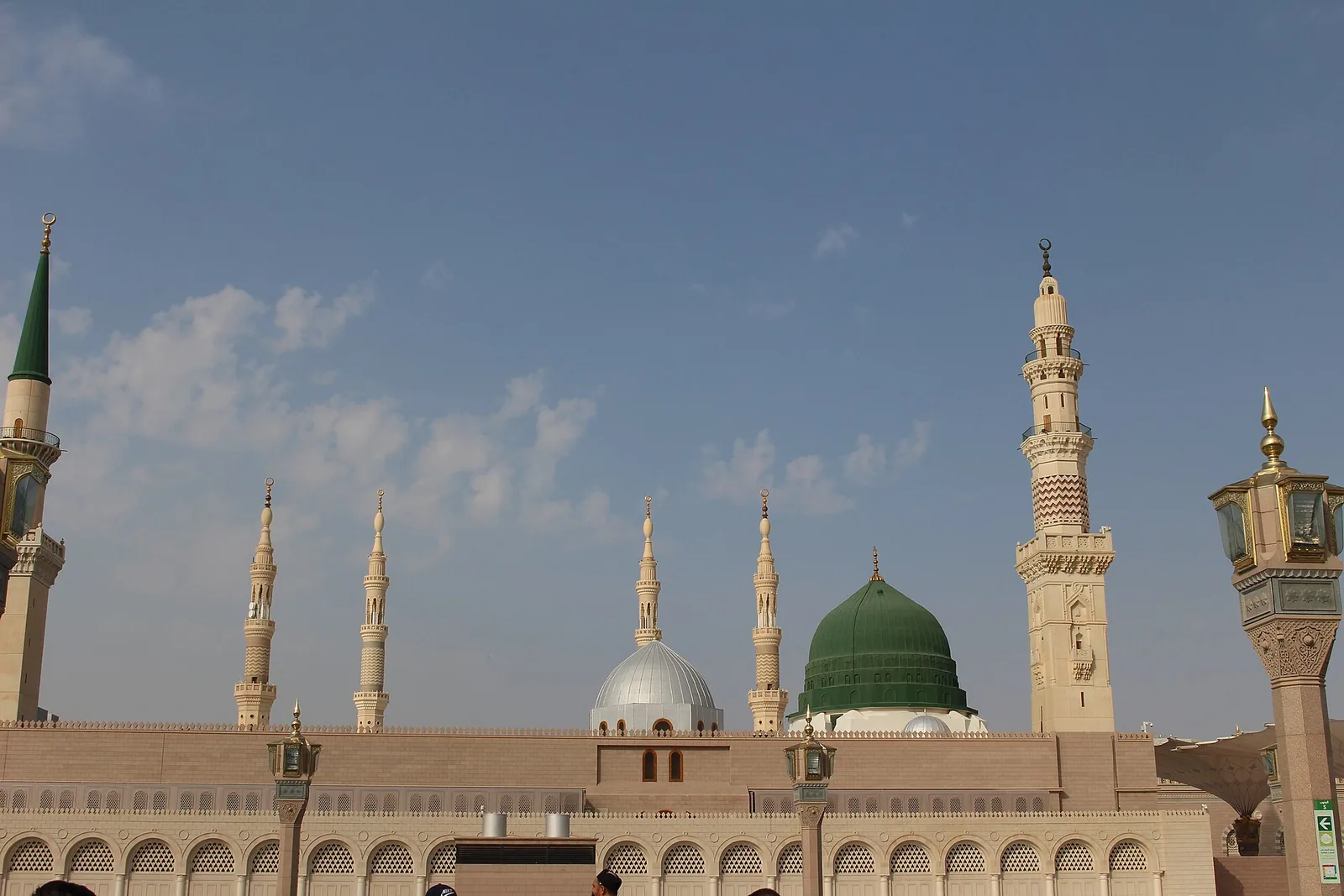
Table of Contents Show
The al masjid an nabawi architectural styles span nearly 1,400 years, tracing a transformation from a mud-brick courtyard with palm-trunk columns into a complex covering over 500,000 square meters. Each dynasty, from the Rashidun caliphs through the Umayyads, Abbasids, Mamluks, Ottomans, and modern Saudi state, left a distinct architectural signature on Islam’s second holiest mosque.
The Origin of Al-Masjid an-Nabawi Architecture in 622 CE
The founding phase of al masjid an nabawi architecture establishes the baseline against which every later expansion must be read. When the Prophet Muhammad arrived in Medina following the Hijra in 622 CE, the mosque was built on land acquired from two orphan brothers, Sahl and Suhayl, with Abu Ayyub al-Ansari paying the price on the Prophet’s behalf. Construction took roughly seven months and produced a structure of radical simplicity, tuned to the needs of a young community rather than to any inherited monumental type.
The original footprint measured approximately 30 by 35 meters, oriented at first toward Jerusalem with the qibla wall facing north. The walls were built of mud brick, the columns were trunks of date palms, and the roof was made from palm leaves. The floor was left bare until 624 CE, when pebbles were introduced to cover the earth in the courtyard, as documented in the Archnet architectural archive. A raised platform called the Suffah, along the southern wall, sheltered companions who had no shelter of their own, while a simple palm-trunk column served as the Prophet’s leaning post during sermons.
This early plan already contained the spatial DNA of later Islamic religious architecture: an open sacred courtyard, a qibla wall defining orientation, a sheltered prayer zone, and adjacent domestic chambers for the Prophet’s family. The first modest expansion came in 629 CE after the Battle of Khaybar, when the structure was roughly doubled in size to around 50 by 50 meters, with three rows of columns added along the western wall and an increased roof height. Nothing of this original fabric survives intact today, but its geometry still governs the placement of the mihrab, the tomb, and the Rawdah at the heart of the present complex.
💡 Pro Tip
When studying the evolution of a sacred site like Al-Masjid an-Nabawi, always map the surviving fixed points first, such as the location of the Prophet’s burial chamber, the original qibla wall alignment, and the Rawdah. Every expansion layer had to negotiate these fixed elements, and understanding them clarifies why certain walls are preserved while others were demolished during later rebuilds.
Rashidun and Umayyad Transformations in Medina Mosque Architecture
The Rashidun caliphs were the first to face the architectural question that would define medina mosque architecture for centuries: how to enlarge a sacred precinct without erasing what the founder built. Caliph Umar ibn al-Khattab led the first major expansion around 639 CE, purchasing and demolishing surrounding houses while preserving only the dwellings of the Prophet’s wives. Caliph Uthman ibn Affan then rebuilt the walls in carved stone, replaced the palm-trunk columns with stone shafts, and introduced a teak wood roof, a significant material upgrade that set a precedent for treating the mosque as a permanent monumental building rather than a vernacular shelter.
The most consequential architectural leap came under the Umayyads. Between 707 and 710 CE, Caliph al-Walid I, supervised by his Medina governor Umar ibn Abd al-Aziz, completely rebuilt the mosque on a trapezoidal plan measuring roughly 84 by 100 meters. Stone foundations carried a teak roof on stone columns, and Coptic and Greek craftsmen covered the walls in glass mosaics depicting trees and architectural landscapes, a decorative programme closely related to the contemporaneous Umayyad Mosque in Damascus and the Dome of the Rock in Jerusalem. The reconstruction deliberately incorporated the Prophet’s burial chamber within the mosque walls, shaping all subsequent expansions.
Two architectural features introduced during this Umayyad phase became fundamental to Islamic religious buildings everywhere. The first was the concave mihrab, installed for the first time at the Prophet’s Mosque around 707 CE to mark the qibla direction with a curved niche clad in marble and gold leaf. The second was the four-cornered minaret configuration, with towers roughly 8 meters high, which established a visual vocabulary followed later by the Great Mosque of Mecca and many others across the Umayyad realm. For a broader view of how courtyard and minaret logic spread through the Islamic world, see the discussion in Islamic Architecture vs Gothic Architecture.
⚠️ Common Mistake to Avoid
Many introductions to Islamic architecture credit the first concave mihrab to the Great Mosque of Damascus. According to Wikipedia’s architectural history, the first concave mihrab niche was added during al-Walid’s expansion of Al-Masjid an-Nabawi in the early 8th century, while the Damascus mihrab followed as the second known example. The Medina mosque is therefore not a late imitator of Umayyad style but one of its earliest prototypes.
Abbasid and Mamluk Layers: The Shaping of Masjid Al Haram Architecture Language
Although this article focuses on the Prophet’s Mosque, the architectural language that developed in Medina during the Abbasid and Mamluk eras was part of a wider shared grammar, visible across masjid al haram architecture in Mecca and other major sanctuaries. Abbasid Caliph al-Mahdi, between 778 and 781 CE, demolished the northern section of al-Walid’s building and extended the mosque northward, adding twenty doors, with eight on each of the east and west walls and four on the north wall. These gates introduced a more formalized system of controlled access and circulation, foreshadowing the forty-two gates that organize the complex today.
The Mamluk period, particularly from the late 13th through the 15th centuries, produced the architectural elements most visually associated with the mosque today. In 678 AH, corresponding to 1279 CE, Sultan al-Mansur Qalawun erected the first dome directly above the Prophet’s tomb, initially of unpainted wood. This structure marked the birth of what would later become the iconic Green Dome. Around 1307 CE, Sultan al-Nasir Muhammad ibn Qalawun added a fifth minaret at Bab as-Salam, the first minaret beyond the original four Umayyad towers. After a devastating lightning strike and fire destroyed much of the mosque in 1481 CE, Sultan Qaitbay rebuilt the eastern, western, and qibla walls and reinforced the wooden dome base with brick and lead sheeting, a conservation measure that helped the structure survive until the Ottoman era.
Mamluk intervention at Medina follows a pattern seen at other holy sites the dynasty patronized, where existing sacred geometry was preserved while structural vulnerabilities were addressed with stronger materials. The same patronage logic produced the heavily fortified works that distinguish buildings of this period, and it is the direct ancestor of later Ottoman restoration practice.
📌 Did You Know?
Al-Masjid an-Nabawi became the first building in the Arabian Peninsula to be lit by electric light. According to IRCICA’s architectural heritage database and multiple historical sources, electric lighting was installed inside the mosque in 1908 or 1909 (1327 Hijri), during the late Ottoman period, before most public buildings in the Hijaz had any permanent electrical infrastructure.
Ottoman Imprint on Islamic Holy Mosque Architecture
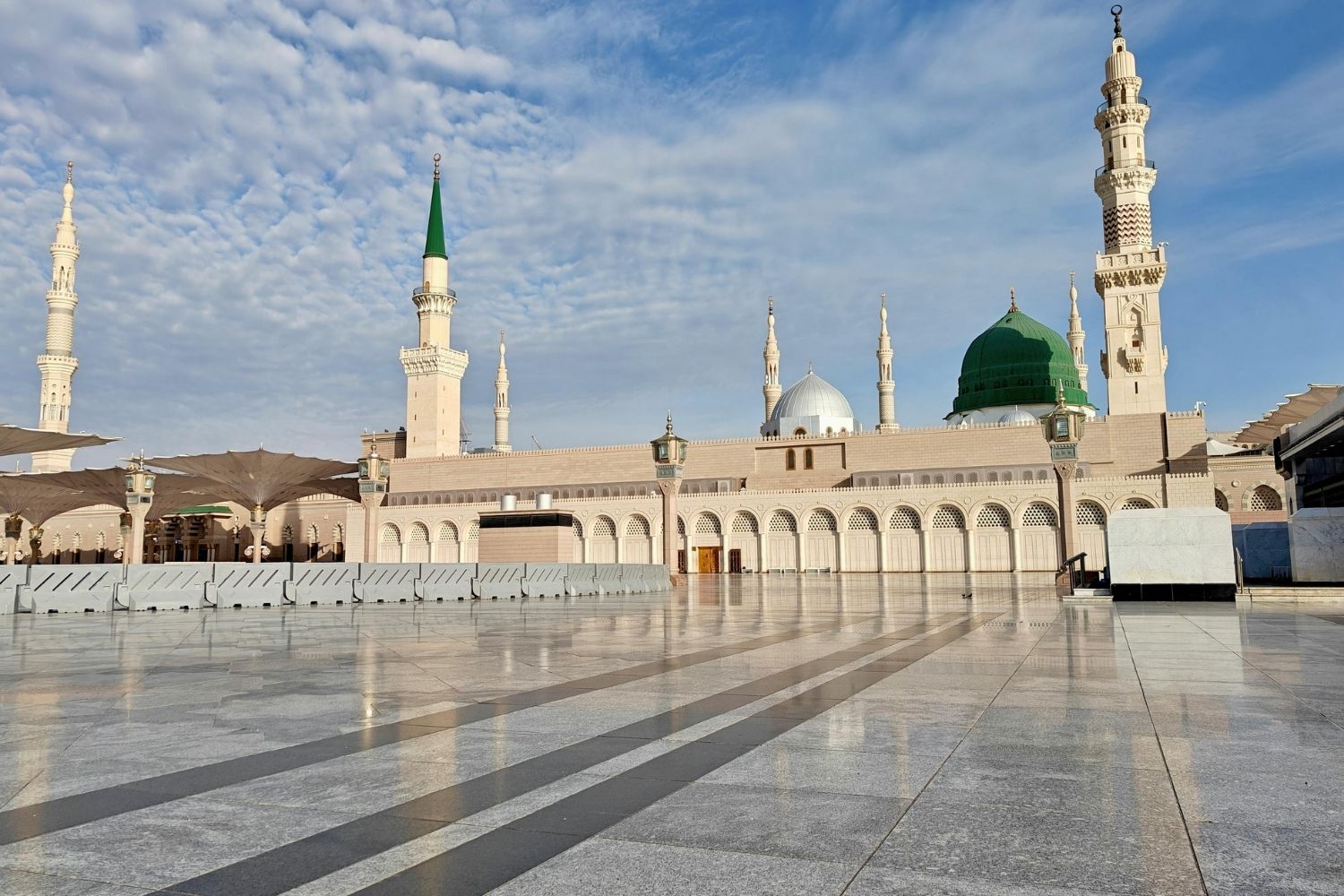
The Ottomans took control of the Hijaz in 1517 and governed Medina until the First World War. Their architectural contribution to islamic holy mosque architecture at the Prophet’s Mosque unfolded in two major phases, and the second of these is the single most influential intervention shaping the mosque visitors see today. During the reign of Sultan Suleiman the Magnificent (1520 to 1566), the western and eastern walls were rebuilt, the Suleymaniyya minaret was erected at the northeastern corner, and a new mihrab called al-Ahnaf was added beside the Prophet’s Shafi’iyyah mihrab. Crucially, Suleiman placed a lead-sheeted dome covered in green paint over the Prophet’s tomb, giving the monument its now universally recognized profile.
The definitive Ottoman reconstruction was undertaken by Sultan Abdulmajid I between 1849 and 1861. This thirteen-year project remodeled almost the entire mosque, sparing only the Prophet’s Tomb, the three historic mihrabs, the minbar, and the Suleymaniyya minaret. The prayer hall to the south was doubled in width and roofed with approximately 170 small domes of uniform size, with larger domes marking the mihrab area, Bab al-Salam, and the Prophet’s Tomb. The qibla wall was sheathed in glazed tiles carrying Quranic calligraphy, and the floors were paved in marble and red stone. The domes themselves were decorated with verses from the Quran and with lines from the Qasidat al-Burda, the 13th-century poem by al-Busiri. Ottoman craftsmen also added the Majidiyya minaret to the west, bringing the total to five, and the green paint that defines the Green Dome today was first applied in 1837 during the reign of Sultan Mahmud II.
This Ottoman envelope, with its small uniform domes, pointed arches, marble paneling, and pencil-profile minaret at Bab as-Salam, still forms the inner core of the present mosque. For a deeper discussion of the central-dome system and craft traditions that shaped these interventions, see illustrarch’s study of the legacy of Ottoman architecture and its definitive expression in the Selimiye Mosque in Edirne.
How Does the Ottoman Prayer Hall Differ From the Modern Saudi Extension?
The Ottoman prayer hall and the modern Saudi extension are distinguishable at a glance. The Ottoman section uses polychrome decoration, colored marble, closely spaced columns carrying pointed arches, and a roof composed of many small domes painted with calligraphy. The Saudi extension, by contrast, relies on gleaming white marble, broader column spacing, wider pointed arches framed in black and white voussoirs, fully air-conditioned volumes, and a flat roof punctuated by 27 motorized sliding domes. Walking from one section into the other, the shift in scale, temperature, light, and ornamental density is immediate.
Saudi Era Engineering and the Contemporary Kaaba Architecture Dialogue
Saudi-era interventions turned Al-Masjid an-Nabawi into one of the largest religious buildings on earth, and they form the final major chapter of al masjid an nabawi architectural styles. Although its sister sanctuary in Mecca exemplifies a different liturgical geometry centered on kaaba architecture, the Medina mosque shares the same modern Saudi design vocabulary: white marble cladding, repetitive bays, brass-capped columns, and integrated climate and crowd management infrastructure.
The first Saudi expansion began in 1951 under King Abdulaziz al-Saud. Workers demolished the structures immediately surrounding the Ottoman prayer hall to create new east and west wings framed by reinforced concrete columns carrying pointed arches. The Suleymaniyya and Majidiyya minarets were replaced by two new minarets in a Mamluk revival style, and two additional minarets were raised at the northeast and northwest corners. Ottoman columns were reinforced internally with concrete and braced with copper rings, and a library was built along the western wall.
In 1973, King Faisal ibn Abdulaziz ordered the construction of temporary shaded prayer areas around the mosque to accommodate expanding pilgrim numbers. King Fahd’s major expansion, launched in the mid-1980s, enlarged the mosque roughly fivefold, added 27 motorized sliding domes that can move on metal tracks to open and close the roof, and introduced extensive climate control. The structure was further equipped with six peripheral minarets on the new extension and four framing the Ottoman structure, bringing the mosque to ten minarets rising to approximately 104 meters.
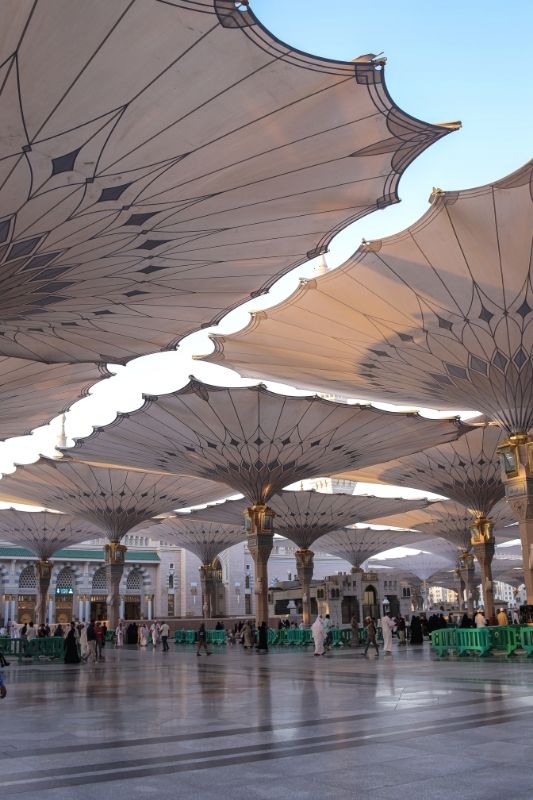
Expansion continued into the 21st century. In late 2012 (1433 AH), King Abdullah laid the foundation stone for the Third Saudi Expansion on the eastern side, a project planned to raise the mosque’s capacity toward approximately two million worshippers. The most visible addition to the courtyards is a system of 250 giant retractable umbrellas designed by the German architect Mahmoud Bodo Rasch, which open after Fajr and close after Maghrib, shading the exterior prayer areas in response to sun and temperature.
🏗️ Real-World Example
Medina Piazza Umbrellas (Al-Masjid an-Nabawi, 2010): Designed by Mahmoud Bodo Rasch and SL Rasch GmbH, the 250 convertible umbrellas deployed across the courtyards of the Prophet’s Mosque each span a piazza of roughly 25.5 by 25.5 meters when open. They reduce solar load on the stone surfaces and provide shaded prayer space for tens of thousands of additional worshippers, while folding away completely at night to preserve sightlines toward the Ottoman sanctuary and the Green Dome.
How the Architectural Core Was Preserved Across Dynasties
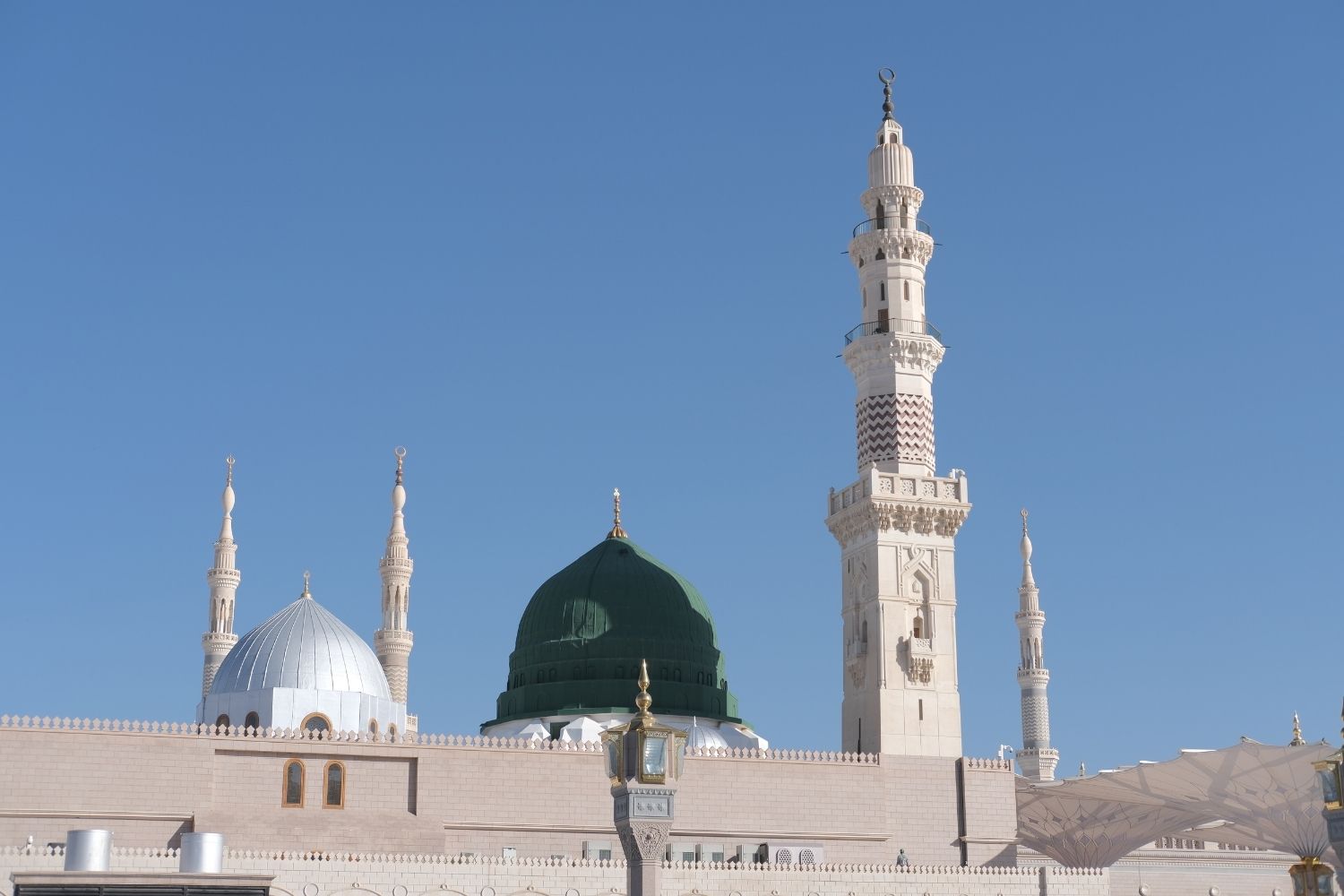
A recurring question about mecca architecture, medina mosque architecture and other sacred sites is how they can have been rebuilt so many times and still be regarded as authentic. In the case of Al-Masjid an-Nabawi, the answer lies in a consistent architectural logic that every dynasty respected: the location of the Prophet’s tomb, the line of the qibla wall, the position of the Mihrab Nabawi, the minbar, and the Rawdah, the “Garden of Paradise” between the minbar and the tomb.
Although no fabric earlier than the late Ottoman period survives in the building, these reference points were treated as fixed across every rebuild. Mamluk sultans built domes above the grave but did not move it. Ottoman architects doubled the prayer hall but preserved the Suleymaniyya minaret, the three mihrabs, and the minbar. Saudi engineers reinforced Ottoman columns with internal concrete and copper rings rather than replacing them, and they expanded eastward, westward, and northward around the Ottoman core rather than through it. Where archaeological data is scarce, such as the exact form of the first wooden dome over the tomb, modern historians draw on later sources such as al-Samhudi’s Wafa al-Wafa and the 18th-century bronze tokens that depict the Mamluk-era dome.
This is a different conception of heritage than the European “freeze in place” model. The mosque is not preserved as a static historic monument. It is preserved as a ritual instrument whose spatial geometry, far more than its material fabric, carries the sanctity.
📐 Technical Note
The ten modern minarets of Al-Masjid an-Nabawi rise approximately 104 meters and follow a three-stage profile typical of Saudi Mamluk-revival design: square base, octagonal middle section, and cylindrical upper shaft. Only the Bab as-Salam minaret retains Ottoman construction, with a characteristic conical cap, while the roof of the Saudi extension incorporates 27 motorized sliding domes, each set on square bases, that translate horizontally on metal tracks to ventilate and shade the prayer hall below.
A Timeline of Al-Masjid an-Nabawi Architectural Styles
The following timeline summarizes the principal architectural phases of the mosque, from its mud-brick origin to its present form, with emphasis on the stylistic and structural vocabulary introduced in each period.
Key Phases and Their Architectural Signatures
| Period | Approx. Dates | Key Patron | Architectural Signature |
|---|---|---|---|
| Prophetic | 622 to 632 CE | Prophet Muhammad | Mud brick walls, palm-trunk columns, palm-leaf roof, open courtyard |
| Rashidun | 634 to 656 CE | Umar and Uthman | Stone walls, stone columns, teak roof, first formal expansion |
| Umayyad | 707 to 710 CE | Al-Walid I | Concave mihrab, four corner minarets, glass mosaics, trapezoidal plan 84 by 100 m |
| Abbasid | 778 to 781 CE | Al-Mahdi | Northern extension, twenty gates, refined hypostyle layout |
| Mamluk | 1279 to 1481 CE | Qalawun, al-Nasir, Qaitbay | First dome over the Prophet’s tomb, Bab as-Salam minaret, brick and lead reinforcement |
| Ottoman | 1520 to 1861 CE | Suleiman I, Mahmud II, Abdulmajid I | Green Dome painted in 1837, ~170 small domes, glazed tile qibla wall, Suleymaniyya and Majidiyya minarets |
| First Saudi | 1951 to 1955 CE | King Abdulaziz | Reinforced concrete wings, Mamluk-revival minarets, internal bracing of Ottoman columns |
| Second Saudi | 1985 to 1994 CE | King Fahd | White marble extension, 27 sliding domes, ten minarets ~104 m, full climate control |
| Third Saudi | 2012 CE onward | King Abdullah, King Salman | Eastern expansion toward ~2 million capacity, 250 convertible umbrellas, integrated services |
Lessons from Al-Masjid an-Nabawi for Contemporary Mosque Design
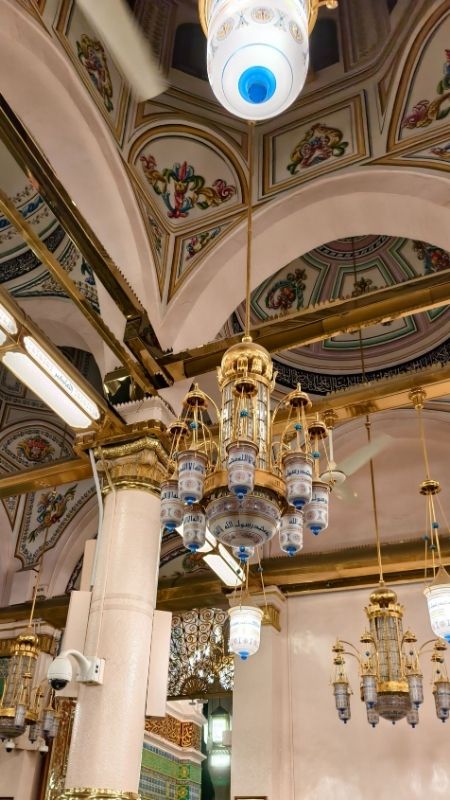
For architects and students studying sacred sites today, Al-Masjid an-Nabawi is less a single building than a living archive of how a community can continuously rebuild around an unbroken spiritual geometry. Its methods remain directly relevant to contemporary mosque projects, from the Sheikh Zayed Grand Mosque in Abu Dhabi, which synthesizes several Islamic traditions in a single new building, to the Safavid masterpiece discussed in the Imam Mosque of Isfahan article, which resolves a similar tension between civic orientation and sacred alignment.
Three practical lessons stand out. First, architectural modernization and sacred preservation need not conflict when the spatial logic of the site, rather than its surface material, is treated as the object of preservation. Second, every major expansion must respect fixed ritual reference points such as the mihrab, the minbar, and the burial chamber, because these are what allow stylistic variation across centuries to read as continuity rather than rupture. Third, infrastructure that manages environment and crowd flow, from sliding domes to retractable umbrellas, is itself a form of contemporary sacred architecture when it serves ritual clarity rather than spectacle. These principles are also shaping how other sacred precincts in the Arabian Peninsula are being updated today, as explored in illustrarch’s survey of remarkable mosques in the Arabian Peninsula.
✅ Key Takeaways
- Al-Masjid an-Nabawi began in 622 CE as a mud-brick courtyard roughly 30 by 35 meters with palm-trunk columns and a palm-leaf roof.
- The concave mihrab and the four corner minarets were first introduced at the Prophet’s Mosque during the Umayyad expansion under al-Walid I in 707 to 710 CE.
- The Mamluk period gave the mosque its first dome over the Prophet’s tomb in 1279 CE, the direct ancestor of today’s Green Dome.
- The Ottoman reconstructions under Suleiman the Magnificent and Sultan Abdulmajid I defined the mosque’s inner core with around 170 small domes, a painted green dome from 1837, and a distinctive Bab as-Salam minaret.
- Modern Saudi expansions added reinforced concrete wings, ten minarets near 104 meters tall, 27 sliding domes, 250 retractable courtyard umbrellas, and a capacity target approaching two million worshippers.
- Across every phase the architectural continuity of al masjid an nabawi architectural styles depends on preserving fixed ritual reference points rather than original fabric.
Final Thoughts
Al-Masjid an-Nabawi is one of the clearest case studies in Islamic architecture of how a sacred site can be continuously reinvented while remaining, in the experiential sense, the same building. From the Prophet’s mud-brick courtyard to al-Walid’s mosaic-clad Umayyad prayer hall, from Qalawun’s first wooden dome to Sultan Suleiman’s green lead dome and Abdulmajid’s 170 small Ottoman domes, and from King Abdulaziz’s reinforced concrete extension to the retractable umbrellas of the Third Saudi Expansion, every layer answers the same question in a different material idiom. Understanding al masjid an nabawi architectural styles therefore means reading the building not as a stylistic sequence but as a long conversation about how architecture can serve a living ritual without ever pretending to stand still.




Futuro House Production Revived in Finland After Decades-Long Hiatus
A Facebook listing for abandoned moulds led to the first new Futuro...
 illustrarch Editoral Team3 Mins read
Building Your Dream Home in NSW: What You Should Know About Montgomery Homes
Montgomery Homes has been building across Sydney, Newcastle, the Hunter, Wollongong and...
illustrarch Editoral Team4 Mins read
Designing a Home Theater: Where Drapery Fits Into the Plan
In a media room the curtains are a performance layer, not decoration....
illustrarch Editoral Team3 Mins read
Oscar Niemeyer’s Cathedral of Brasília: The Hyperboloid Concrete Hymn
The Cathedral of Brasília reads as a single gesture, yet it stood...
Furkan Sen7 Mins read


Leave a comment