Discover what an architectural concept is, explore the main concept types used in design, and follow a step-by-step process for developing your own. Includes real use cases, common mistakes, and practical tips for architects and students.
An architectural concept is a thought, idea, or notion that serves as the foundation of a design project, as well as the engine that propels it forward. It becomes the power and identity of an architectural project’s development, and it is regularly consulted at all stages. Whether you are an architecture student working on your first studio assignment or a practicing professional shaping a complex building, the concept in architecture remains the single most important driver of meaningful design.
The concept, as a result of all the readings and analysis by the architects, can be defined as an idea, thought, abstraction, philosophy, belief, inspiration, intention, theory or hypothesis. A strong architectural concept ties together every decision in the project, from early sketches to construction documents, and gives the building a clear reason for being.
Your concept should affect all aspects of the project, from its proportions to interior effects, from facade design to flooring materials. Each component should be designed and created by a concept in architectural projects. When concept design architecture is applied consistently, the result is a building that feels unified, intentional, and rooted in purpose.
What Is an Architectural Concept and Why Does It Matter?
At its simplest, an architecture concept is the central idea that organizes and gives meaning to a design. It answers a basic question: what is this building trying to do, say, or solve? Without a clear concept, architectural decisions become arbitrary. Rooms get arranged without logic, facades become decorative afterthoughts, and the finished building lacks a story that connects its parts.
A well-formed concept for architecture acts as a filter. Every material choice, structural decision, and spatial arrangement passes through it. If the concept is “transparency between public life and private retreat,” then the floor plan, the glazing strategy, the landscaping, and even the door hardware should reflect that idea. This kind of conceptual consistency is what separates memorable architecture from generic construction.
Architecture concepts also serve a practical role in communication. They help architects explain design intentions to clients, engineers, consultants, and planning authorities. A clear concept, expressed in a single sentence and supported by diagrams, makes collaboration smoother and reduces misunderstandings during later project phases. For a deeper look at how concepts evolve into complete designs, see this guide on architectural design development.
Architectural Concept in Practice: 2026 Trends, Real Use Cases and Before/After Insights
In 2026, understanding an architectural concept is no longer limited to abstract diagrams or poetic narratives. The concept phase has evolved into a data-informed, performance-driven design process where ideas are tested early through digital tools, simulations, and visual storytelling. Architects now develop concepts that respond simultaneously to context, sustainability metrics, user behavior, and constructability. This shift has made architectural concepts more actionable, measurable, and easier to communicate to clients and stakeholders.
A clear before/after distinction can be seen in how concepts are presented. Previously, concepts were often explained through mood boards and conceptual sketches that left room for interpretation. Today, the same concept is supported by early massing studies, environmental analysis, and real-time visualization. The “before” stage relied heavily on intuition alone, while the “after” stage integrates intuition with validation, resulting in concepts that are both creative and defensible.
Real-world use cases further highlight this transformation. For example, in contemporary housing and mixed-use projects, the architectural concept often begins with a social or environmental problem, such as community interaction or climate adaptation, and is translated directly into spatial strategies. Courtyard systems, adaptive facades, or modular layouts are no longer design afterthoughts; they are conceptual drivers. This approach helps ensure that the architectural concept remains visible and relevant from the first sketch to the final built form.
Photo Source: Gallery of Saint-Michel Soccer Center / Côté Leahy Cardas Architects – 7 (archdaily.com)
How to Generate Your Architectural Concept
How can you generate your concept? Primarily, readings are one of the important studies for the process of the concept development. Readings which include site readings can give the architects various inspirations. You may have many ideas and explore the problems, potentials and opportunities while you are reading on the projects site. Site reading means analysis and the understanding process of the site with its environment, culture, sociology and etc.
The more you try, the more you find. Seeing the 2D and 3D versions of your ideas with scaled sketches and sketch models improves your concept. Sketching is always generate your ideas. Do not afraid to sketch on your sketchbooks or making some 3D models as drafts. You may use any material for your sketch models, it is important to improve your ideas. Making your model in scaled is much more critical at this point. If you want to explore how diagrams can support this process, our article on conceptual diagrams in architecture covers diagram types and creation methods in detail.
Types of Architectural Concepts
Not every concept works the same way. Some designers respond to climate and orientation, others to cultural narratives, and still others to material experimentation. Understanding the range of concept types helps you choose the right approach for each project. Below is a summary of the most common types of architecture concepts and how they typically translate into built form.
Concept Type
Description
Example in Practice
Contextual
Driven by the physical, cultural, or historical character of the site
A building that mirrors the scale and materiality of surrounding structures
Metaphorical
Rooted in an abstract idea such as flow, shelter, or erosion
A museum whose form evokes the movement of water through a landscape
Programmatic
Based on how spaces relate to user activities and building functions
A school designed around overlapping zones of learning and play
Material-Led
Uses a specific material or construction technique as the central idea
A pavilion where exposed timber framing defines both structure and aesthetic
Sustainable/Environmental
Guided by ecological performance, passive design, or resource efficiency
A housing project using courtyard typology for natural ventilation and shading
Circulation-Based
Organized around how people move through and experience the space
A gallery with a continuous spiral ramp connecting all exhibition levels
Each of these types can overlap, and the strongest projects often combine two or three concept approaches into one unified idea. The key is selecting an approach that genuinely responds to the project brief, the site, and the people who will use the building. For more concept starting points and visual references, explore this collection of architectural concept ideas.
Common Mistakes When Developing an Architectural Concept
One of the most common mistakes in architectural concept development is starting with form instead of intent. When a project begins with a visually striking shape but lacks a clear conceptual rationale, the design often struggles to adapt to real constraints such as site conditions, program changes, or user needs. This results in concepts that look compelling on paper but lose coherence as the project progresses.
Another frequent issue is overcomplicating the concept narrative. Strong architectural concepts are not defined by complexity, but by clarity. When a concept requires excessive explanation to be understood, it often signals that the idea is not well distilled. Successful concepts can be summarized in a single sentence and consistently reflected across plans, sections, and spatial decisions.
A third mistake, especially common among students, is treating the concept as a finished product rather than a living framework. A good concept in architecture evolves as the project develops. It should be revisited and tested at every design stage. If the concept cannot absorb changes in program, budget, or constructability, it may be too rigid or too disconnected from real project conditions.
Photo Source: 10 Tips on how to Develop Design Concepts in Architecture – (re-thinkingthefuture.com)
Learning from Case Studies and Precedent Projects
Try to understand the others! Before studying on a new project, you should make case studies to understand. Make a case study on projects that are similar to the site you will work on, the initial concepts that formed your first ideas, the programs that will take place in your building, and similar climate and geographical conditions.
Case study research is one of the most reliable ways to strengthen your own design concept architecture. When you study how established architects translated an abstract idea into spatial form, you gain tools for doing the same in your own work. Pay attention not only to the final building, but also to the diagrams, sketches, and models that reveal the design thinking behind it. Resources like ArchDaily and Dezeen publish project narratives that often explain the original concept and how it shaped the built result.
Photo Source: What is an Architectural Concept? – archisoup | Architecture Guides & Resources
Book Suggestion: Le Corbusier, an analysis of form
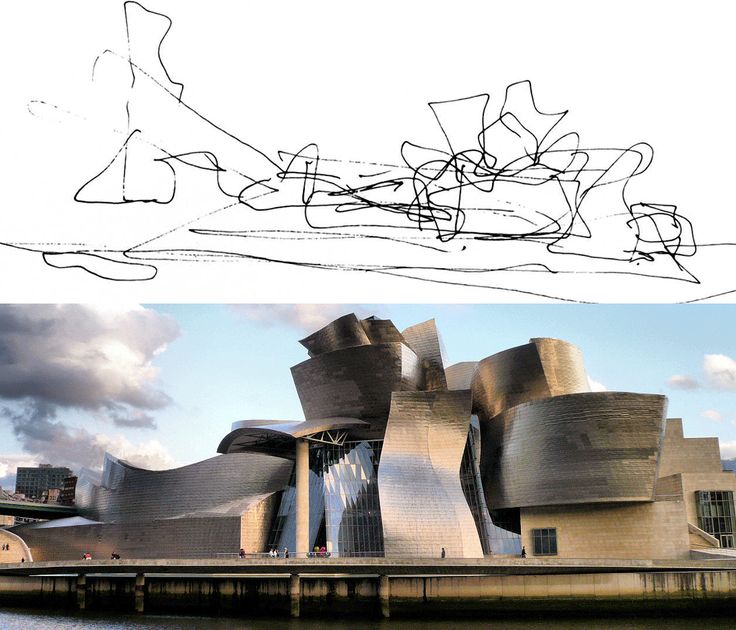
Curiosity is essential for creativity. Wonder what Le Corbusier had in mind when designing his building? What was Frank Gehry’s starting point and why? Asking these questions will help you to develop the concept. Studying the work of celebrated architects provides both inspiration and methodology. The architectural design values outlined in broader design theory also offer a useful lens for evaluating how well a concept holds together from idea to execution.
Before and After: How Architectural Concepts Have Evolved
Before, architectural concepts were primarily communicated through abstract sketches, metaphors, and theoretical references. While these approaches encouraged creativity, they often created a gap between concept and execution. The transition from idea to construction relied heavily on interpretation, increasing the risk of dilution or misalignment during later stages.
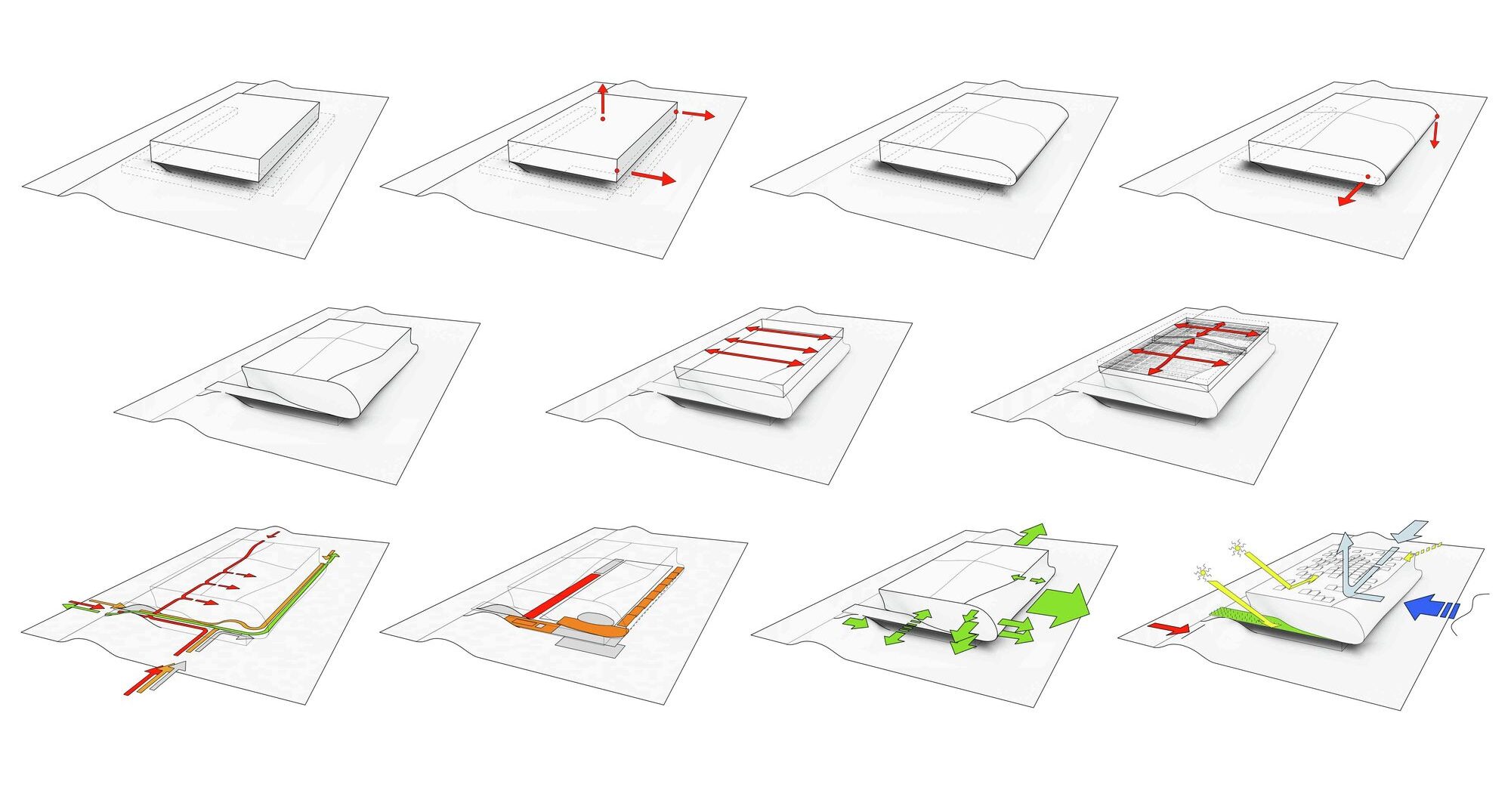
After this evolution, architectural concepts are now developed alongside technical logic from the very beginning. Concepts are tested through early massing models, environmental simulations, and spatial diagrams that validate the idea in real conditions. This shift allows architects to maintain conceptual integrity while responding effectively to budget, structure, and sustainability requirements. Tools like SketchUp for concept diagrams and BIM platforms have made this integration faster and more accessible.
Photo Source: Pinterest
Real Use Case: Translating Concept Into Spatial Strategy
A strong architectural concept becomes most valuable when it directly informs spatial organization. In real use cases such as educational buildings or cultural centers, concepts rooted in movement, interaction, or hierarchy often translate into circulation paths, sectional relationships, and spatial sequencing. The concept is no longer an abstract layer but a decision-making tool.
For instance, a concept based on “openness and accessibility” may result in transparent ground floors, fluid transitions between public and private zones, and flexible interior layouts. This demonstrates how an architectural concept can guide tangible design outcomes, ensuring consistency between idea, experience, and built form. If you want to understand how diagrams help visualize these spatial strategies, our guide to architectural diagrams by architects provides real project examples.
From Context to Concept: Creating Meaningful Architectural Ideas
Examining the surrounding buildings and understanding their materials, styles, and proportions is one of the most powerful ways to generate meaningful architectural concepts. By closely observing the built environment, you gain insight into how spaces respond to context, climate, and human behavior. Studying how people move, gather, and interact within these spaces helps transform abstract ideas into concepts rooted in real life rather than pure theory.
A successful architectural concept emerges from a deep awareness of physical conditions and spatial relationships. Through landscape analysis, distinguishing between hard and soft surfaces, and exploring colors, patterns, textures, and material transitions, the concept becomes more refined and cohesive. When applied consistently across every layer of the project, from form and circulation to detail and atmosphere, the concept evolves into a clear design language that strengthens both the visual and experiential quality of the architecture. To learn more about how site analysis feeds concept development, visit this resource on architectural concept development.
Step-by-Step Process for Developing a Concept in Architecture
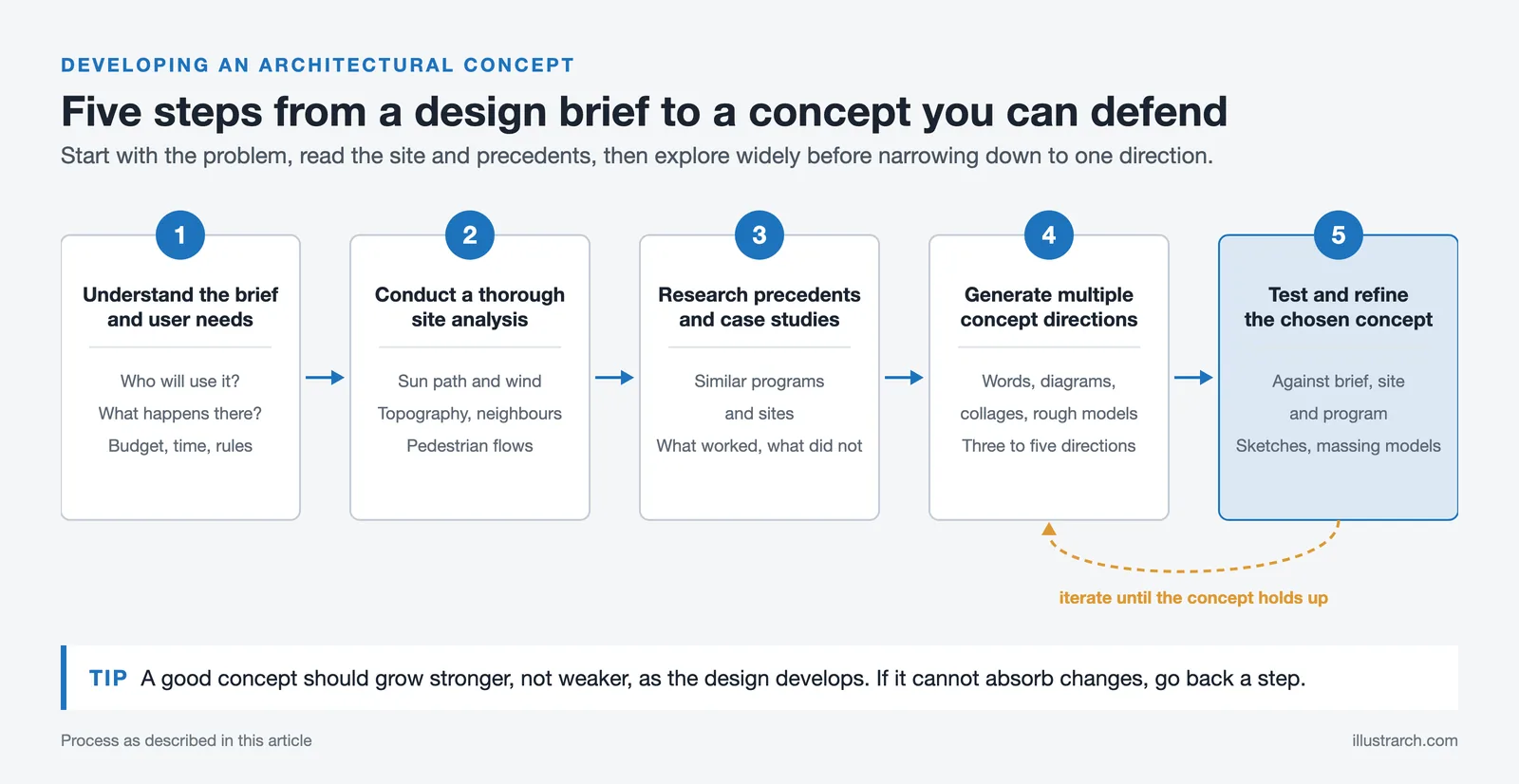
While every project is different, the following process provides a reliable framework for developing a concept that is both creative and grounded in reality. This approach works whether you are working on a student studio project or a professional commission.
Diagram: illustrarch
1. Understand the Brief and User Needs
Read the design brief carefully and identify what the building needs to achieve. Who will use it? What activities will take place? What constraints exist around budget, time, or regulations? Documenting these questions gives you a clear starting point. The architectural design process always begins with understanding the problem before proposing a solution. For more on this topic, see our article on the architecture design process.
2. Conduct a Thorough Site Analysis
Visit the site and observe its physical, social, and environmental qualities. Record sun paths, wind patterns, topography, neighboring buildings, pedestrian flows, and any notable features. These observations often reveal the most compelling starting points for a concept. A concept that grows out of real site conditions will always feel more grounded than one invented in isolation.
3. Research Precedents and Case Studies
Study buildings with similar programs, sites, or ambitions. Focus on how other architects translated their concepts into spatial and material decisions. Take notes on what worked and what did not. Precedent research sharpens your own thinking and saves time by showing you tested strategies.
4. Generate Multiple Concept Directions
Sketch freely. Use words, diagrams, collages, and rough models to explore different ideas. At this stage, quantity matters more than quality. Try at least three to five distinct conceptual directions before narrowing down. Parti diagrams are particularly useful for distilling each idea into a single, clear visual statement.
5. Test and Refine Your Chosen Concept
Once you select the strongest direction, test it against the brief, the site, and the building program. Does it hold up when you start arranging rooms? Can it accommodate structural requirements? Does it still make sense at different scales? Refine the concept through iterative sketching, massing models, and early spatial layouts. A good concept should grow stronger, not weaker, as the design develops.
How Digital Tools Are Changing Concept Design Architecture
The relationship between concept development and digital tools has changed significantly in recent years. Where architects once relied almost entirely on hand sketches and physical models during the concept phase, many now use parametric modeling, environmental simulation, and real-time visualization to test ideas at the earliest stages.
Software such as Rhino with Grasshopper allows designers to explore multiple formal variations driven by site data or performance criteria. Meanwhile, tools like SketchUp, Revit, and Blender enable quick massing studies that can be shared with clients and collaborators within hours. The ability to simulate daylight, wind flow, and energy performance during the concept phase means that design decisions carry more evidence and less guesswork. For students and professionals interested in this intersection, our article on computational design in architecture offers a good introduction.
Digital workflows also make it easier to document the concept development process through architectural diagram sequences and visual narratives. These assets are valuable not only for presentations, but also for maintaining conceptual clarity as the project moves through design development and construction documentation.
The Role of Sketching and Physical Models in Concept Architecture
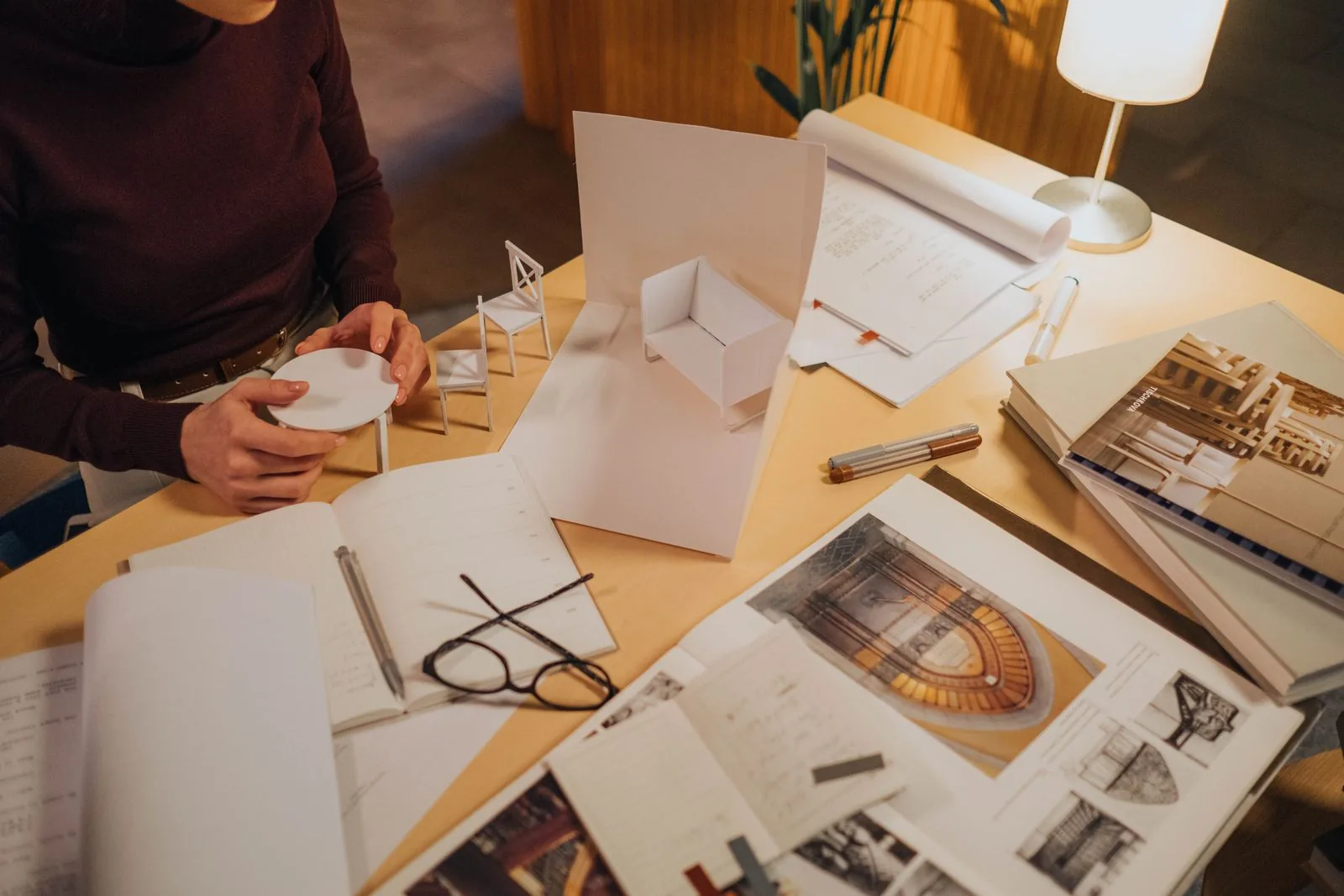
Despite the rise of digital tools, hand sketching and physical model making remain essential to concept development. Sketching allows architects to think with their hands, to explore ideas quickly without the constraints of software interfaces. A rough sketch captures spatial relationships, proportions, and atmosphere in ways that a digital model sometimes cannot.
Small paper study models let you test a concept in three dimensions. Photograph: Ron Lach, Pexels.
Physical models, even simple ones made from cardboard, foam, or balsa wood, offer a three-dimensional understanding that screens do not fully replicate. Holding a model, turning it, and viewing it at eye level reveals spatial qualities that flat drawings miss. Many established architects, from Tadao Ando to Peter Zumthor, continue to use physical models extensively during the concept phase precisely because they encourage intuitive design decisions. If you want to improve your concept communication through visual tools, our overview of transforming architectural ideas through diagrams offers practical techniques.
Presenting Your Architectural Concept Effectively
A strong concept loses impact if it cannot be communicated clearly. The presentation of an architectural concept should be as considered as the concept itself. Start with a single, clear statement that captures the core idea. Support it with diagrams that show how the concept translates into spatial organization, material logic, and user experience.
Avoid overloading presentations with too many references or overly abstract imagery. The goal is to make the concept immediately understandable. Use a sequence that moves from the problem or opportunity, through the conceptual response, to the spatial and formal outcome. Creating architecture diagrams that are visually clean and logically structured is one of the most effective ways to achieve this. A well-presented concept builds client confidence and sets a clear direction for the entire design team.
Elif Ayse Sen is a senior architecture writer at illustrarch. A trained architect with a B.Arch from Altınbaş University, she covers interior design, architecture schools and education, and residential design, and has written hundreds of articles for the publication.
Can someone please help me with a concept for a retirement/country home for a professor
Phillips
This article talks about architectural concepts, which seems important for design projects. It’s interesting how readings and site analysis can help in developing ideas. I guess sketching is also a good way to explore concepts.
Fink
This article explains well what an architectural concept is. It says that a concept is very important for designing buildings. The author mentions that reading and understanding the site can give architects good ideas. I like how they talk about sketching and models too. It’s interesting to see how much thought goes into planning a building.
Mullen
This article talks about architectural concepts. It explains how important the idea is for a design project. I learned that reading and sketching can help develop these concepts.
Upload a sketch, CAD export or 3D model and turn it into a photorealistic architectural render in under 30 seconds. No complex rendering setup, no plugins. Start with 3 free renders.


 Elif Ayse Sen28 November 202511 Mins read943










 illustrarch Editoral Team1 Mins read

 Furkan Sen6 Mins read

 Sinan Ozen8 Mins read


Can someone please help me with a concept for a retirement/country home for a professor
This article talks about architectural concepts, which seems important for design projects. It’s interesting how readings and site analysis can help in developing ideas. I guess sketching is also a good way to explore concepts.
This article explains well what an architectural concept is. It says that a concept is very important for designing buildings. The author mentions that reading and understanding the site can give architects good ideas. I like how they talk about sketching and models too. It’s interesting to see how much thought goes into planning a building.
This article talks about architectural concepts. It explains how important the idea is for a design project. I learned that reading and sketching can help develop these concepts.