

Top 10 Iconic Buildings by Rem Koolhaas
From the CCTV Headquarters in Beijing and De Rotterdam to the Seattle Central Library and Casa da Música, this guide explores 10 of the most iconic Rem Koolhaas buildings. Learn how the Pritzker Prize-winning architect and OMA founder has challenged architectural conventions across five continents, shaping the way we think about cities, culture, and modern design.
 Begum Gumusel27 January 202611 Mins read331

Table of Contents Show
Rem Koolhaas has reshaped contemporary architecture by challenging conventional ideas of form, program, and urban life. As the founder of OMA (Office for Metropolitan Architecture), the Dutch architect Rem Koolhaas approaches buildings as cultural instruments, structures that register politics, economics, media, and behavior as much as they do aesthetics. His influential essay Junkspace, published in 2001, critiqued the homogenized spaces of late capitalism and remains essential reading for understanding his architectural philosophy. Rem Koolhaas architecture projects often resist stylistic consistency, instead responding to context, scale, and societal forces with radical clarity. From cultural institutions and libraries to headquarters and housing, the buildings designed by architect Rem Koolhaas have become reference points for architects worldwide. Whether examining famous architects and their works or studying individual masterpieces, Rem Koolhaas buildings consistently stand out for their intellectual ambition. The following ten projects represent some of his most famous buildings by Rem Koolhaas, each illustrating how architecture can critically engage with the complexities of the modern world.

Understanding Rem Koolhaas: The Architect Behind the Buildings
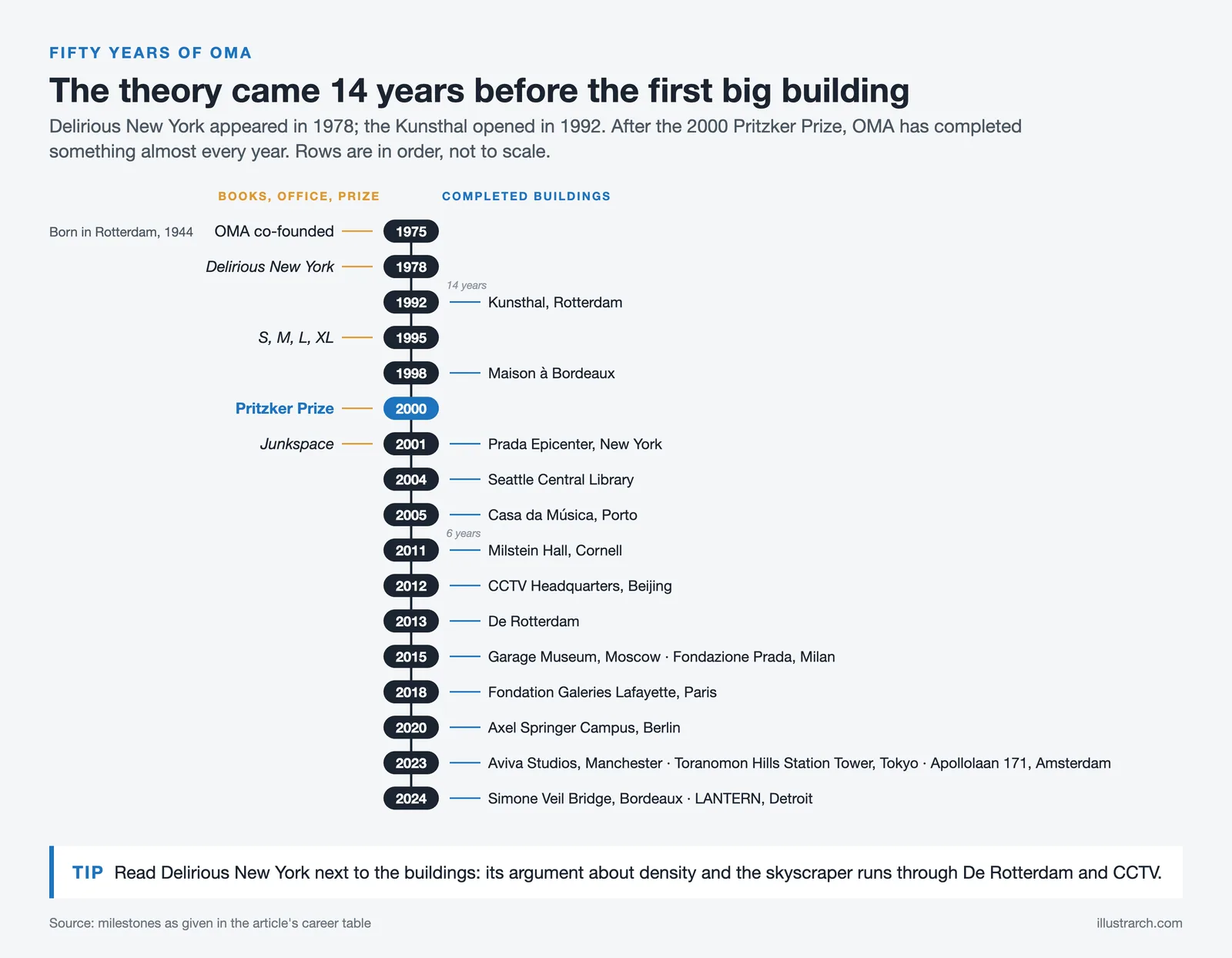
Before exploring his most significant works, understanding who Rem Koolhaas is provides essential context. Born in Rotterdam in 1944, Koolhaas initially worked as a journalist and screenwriter before studying architecture at the Architectural Association in London. This unconventional background shaped his unique approach to architecture Rem Koolhaas developed, one that treats buildings as narrative devices and cultural commentary. In 1975, he co-founded OMA, and his theoretical work, including the groundbreaking book Delirious New York (1978) and the concept of Junkspace Rem Koolhaas introduced, has influenced generations of architects. He received the Pritzker Prize in 2000, architecture’s highest honor. He also mentored Zaha Hadid during her time at the Architectural Association, recognizing her as “a planet in her own orbit.” Today, OMA Rem Koolhaas buildings span five continents, with offices in Rotterdam, New York, Hong Kong, and Brisbane, and the firm continues to push architectural boundaries under his direction.

Rem Koolhaas Buildings in Rotterdam and Amsterdam
The Netherlands holds a special place in the story of buildings by Rem Koolhaas. Rotterdam, his birthplace, served as both the testing ground and headquarters for OMA’s most formative experiments. The Kunsthal and De Rotterdam, both discussed in detail below, are among the most celebrated Rem Koolhaas buildings Rotterdam has to offer. In Amsterdam, OMA has also left its mark with projects such as Apollolaan 171, a residential building completed in 2023, and the ongoing Bajes Kwartier redevelopment transforming a former prison complex into a mixed-use neighborhood. These Amsterdam projects reflect his commitment to urban density and programmatic diversity. Taken together, the Rem Koolhaas Amsterdam buildings and Rem Koolhaas Rotterdam buildings demonstrate how one architect’s vision can profoundly shape the identity of two Dutch cities.
Quick Reference: 10 Iconic Buildings by Rem Koolhaas at a Glance
| # | Building | Location | Year Completed | Typology | Total Area (m²) |
|---|---|---|---|---|---|
| 1 | Seattle Central Library | Seattle, USA | 2004 | Public Library | 33,723 |
| 2 | Casa da Música | Porto, Portugal | 2005 | Concert Hall | 22,000 |
| 3 | CCTV Headquarters | Beijing, China | 2012 | Office / Broadcasting HQ | 473,000 |
| 4 | Kunsthal | Rotterdam, Netherlands | 1992 | Exhibition Hall / Museum | 3,300 |
| 5 | Garage Museum of Contemporary Art | Moscow, Russia | 2015 | Contemporary Art Museum | 5,400 |
| 6 | Prada Epicenter | New York, USA | 2001 | Retail / Cultural Space | 2,300 |
| 7 | Maison à Bordeaux | Bordeaux, France | 1998 | Private Residence | ~500 |
| 8 | De Rotterdam | Rotterdam, Netherlands | 2013 | Mixed-Use High-Rise | 160,000 |
| 9 | Milstein Hall, Cornell University | Ithaca, USA | 2011 | Educational / Academic | 4,366 |
| 10 | Fondation Galeries Lafayette | Paris, France | 2018 | Art Foundation / Gallery | ~2,800 |
1. Seattle Central Library, USA
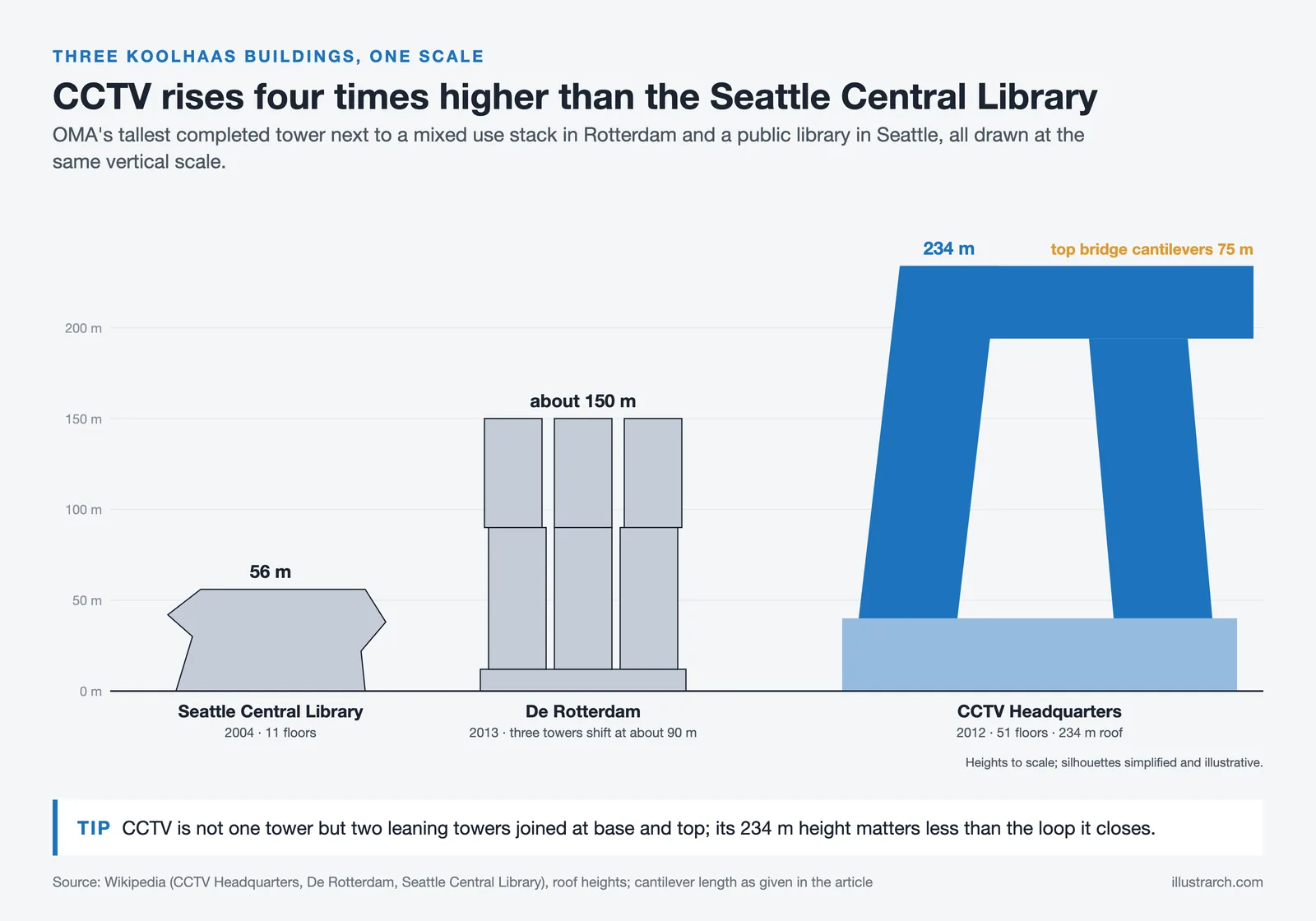
The Seattle Central Library redefined what a public library could be in the digital age. Rather than organizing books through traditional hierarchies, this Rem Koolhaas building is structured around a continuous “book spiral” that allows collections to grow without disruption. Its faceted glass-and-steel envelope expresses the complexity of its interior program while remaining transparent and civic in character. Koolhaas treated the library as an information machine and a social condenser, combining reading spaces, public forums, and digital access within a single architectural system. The project demonstrates how architecture Rem Koolhaas envisions can adapt to changing cultural habits while preserving the library’s role as a democratic public space.

2. Casa da Música, Porto, Portugal
Casa da Música is a radical reinterpretation of the concert hall typology by Rem Koolhaas architects at OMA. Instead of hiding performance spaces within a neutral shell, Koolhaas shaped the building as a faceted concrete volume that asserts itself within the city. The main concert hall is surrounded by secondary spaces that expose rehearsals, circulation, and urban views, breaking the traditional separation between performer and public. Acoustics, structure, and urban presence are tightly interwoven, making this Rem Koolhaas building both a musical instrument and a civic landmark. The project reflects the architect Rem Koolhaas’s belief that cultural buildings should actively engage the city rather than exist as isolated monuments.

3. CCTV Headquarters, Beijing, China
The CCTV Headquarters is one of the most ambitious skyscrapers ever built and perhaps the most recognized among Rem Koolhaas buildings. Rejecting the conventional vertical tower, Koolhaas designed a continuous loop that connects offices, studios, and broadcasting facilities into a single structural system. The CCTV building Rem Koolhaas created challenges traditional ideas of height, gravity, and monumentality while symbolizing China’s rapid economic and cultural transformation. Its daring cantilever and structural complexity required unprecedented engineering collaboration with Arup Engineers. More than an icon, this Rem Koolhaas China building represents his interest in how architecture embodies institutional power and media influence within contemporary society. Completed in 2012 after an eight-year construction period, the CCTV building Beijing OMA Rem Koolhaas designed remains a defining work of 21st-century architecture and the most widely discussed Rem Koolhaas office building globally.

4. Kunsthal, Rotterdam, Netherlands
The Kunsthal is an early and highly influential project that encapsulates Koolhaas’s architectural philosophy. Rather than creating a neutral museum box, the building functions as an urban intersection, allowing multiple circulation paths to cut through the site. Ramps, floors, and façades respond to surrounding roads, parks, and city life. Inside, exhibition spaces are deliberately flexible and non-hierarchical. As one of the most important Rem Koolhaas best buildings in Rotterdam, the Kunsthal shows how Rem Koolhaas architecture can be simultaneously pragmatic and experimental, treating movement and context as primary design drivers rather than fixed form.

5. Garage Museum of Contemporary Art, Moscow, Russia
The Garage Museum of Contemporary Art represents Rem Koolhaas’s nuanced approach to adaptive reuse and architectural transformation. Instead of demolishing the existing Soviet-era Vremena Goda restaurant, the architect Rem Koolhaas chose to preserve its concrete frame and historical traces while inserting a new contemporary cultural program inside. The building is wrapped in a translucent polycarbonate façade that blurs the boundary between old and new, allowing the past to remain visible without becoming nostalgic. Interior spaces are flexible, neutral, and deliberately unfinished, supporting constantly changing exhibitions and public activities. This Rem Koolhaas building reflects his belief that preservation should not mean freezing architecture in time, but enabling it to evolve. The Garage Museum stands as a critical example of how contemporary architecture can reinterpret history pragmatically, turning remnants of ideology into active cultural infrastructure within a rapidly transforming city.

6. Prada Epicenter, New York, USA
The Prada Epicenter in New York blurred the boundary between retail, architecture, and performance, a hallmark of architecture Rem Koolhaas conceptualized. Koolhaas transformed shopping into a spatial experience by introducing elements such as a wave-like wooden floor that functions as seating, stage, and circulation. The store became a cultural venue rather than a conventional commercial interior. As a Rem Koolhaas New York building, this project reflects Koolhaas’s interest in consumer culture and branding as architectural forces, themes he also explored in his writings on contemporary urbanism. It also demonstrates how Rem Koolhaas buildings can critique commerce while simultaneously participating in it.

7. Maison à Bordeaux, France
Maison à Bordeaux is one of Koolhaas’s most human-centered projects and demonstrates how Rem Koolhaas architects approach residential design. Designed for a client with limited mobility, the house is organized around a movable platform that functions as an elevator, room, and social space. The building challenges conventional domestic hierarchies by placing accessibility and flexibility at the core of its design. Structurally daring yet deeply personal, the house illustrates the architect Rem Koolhaas’s ability to merge technological innovation with intimate human needs. It remains a powerful example of architecture responding directly to lived experience.

8. De Rotterdam, Netherlands
De Rotterdam is a vertical city composed of stacked and shifted volumes that house offices, residences, hotels, and public spaces. Rather than a singular iconic tower, Koolhaas conceived this Rem Koolhaas building as an urban condition, dense, repetitive, and infrastructural. The building reflects contemporary metropolitan life, where high-rise architecture operates at the scale of systems rather than objects. De Rotterdam demonstrates Koolhaas’s ongoing interest in “bigness”, a concept he articulated in his theoretical writings, and how scale alters architectural responsibility and perception. This is one of the largest Rem Koolhaas buildings in Europe and a defining landmark among Rem Koolhaas Rotterdam buildings.

9. Milstein Hall, Cornell University, USA
Milstein Hall expands Cornell’s architecture campus through a bold cantilevered structure that creates a new public ground beneath it. This Cornell Rem Koolhaas building emphasizes openness, collaboration, and visibility, aligning architectural education with contemporary design culture. Its large studio spaces encourage interaction and experimentation, while its structural expression reinforces the relationship between design and engineering. Milstein Hall exemplifies the approach Rem Koolhaas architects take toward academic architecture, as a platform for collective production rather than isolated study. For students exploring top universities to study architecture in the US, Cornell’s Milstein Hall stands as a powerful example of how the building itself can embody pedagogical values.

10. Fondation Galeries Lafayette, Paris, France
Located in a historic Parisian building, this project demonstrates Koolhaas’s sensitivity to existing contexts. By inserting a dramatic steel tower and flexible exhibition spaces within the old structure, the design creates a dialogue between past and present. The project explores how contemporary architecture can coexist with heritage without imitation. It reflects the belief central to architecture Rem Koolhaas practices that preservation should allow for transformation rather than freezing buildings in time.

Structural and Design Features Comparison
| Building | Height / Floors | Primary Materials | Key Structural Innovation | Structural Engineer |
|---|---|---|---|---|
| Seattle Central Library | 56.4 m / 11 floors | Glass, steel | Continuous “Book Spiral” ramp system | Arup / Magnusson Klemencic |
| Casa da Música | 40 m | White concrete, corrugated glass | Faceted concrete monolith with 1,300-seat shoebox auditorium | Arup / AFA |
| CCTV Headquarters | 234 m / 51 floors | Steel, glass | 75 m cantilever loop; continuous structural tube façade | Arup (Cecil Balmond) |
| Kunsthal | Low-rise / 2 floors | Concrete, steel, glass, travertine | Intersecting ramp circulation as urban connector | Arup |
| Garage Museum | Low-rise / 2 floors | Concrete (preserved), polycarbonate | Adaptive reuse of Soviet prefab concrete frame | Arup |
| Prada Epicenter | Interior renovation | Wood, resin, steel, polycarbonate | Wave-shaped wooden floor as stage, seating, and retail | : |
| Maison à Bordeaux | 3 floors | Concrete, glass, steel | Hydraulic movable platform (3 m × 3.5 m elevator-room) | Arup (Cecil Balmond) |
| De Rotterdam | 150 m / 45 floors | Concrete, glass, steel | Three stacked/shifted towers on shared plinth | Corsmit / IMd |
| Milstein Hall | 2 floors + basement | Steel, concrete, glass, Turkish marble | 50 ft cantilever over street; hybrid structural trusses | Robert Silman Associates |
| Fondation Galeries Lafayette | Heritage building / 4 floors | Steel, glass, existing masonry | Inserted steel exhibition tower with mobile platforms | : |
Rem Koolhaas Building Berlin: The Axel Springer Campus
Beyond the ten projects above, the Rem Koolhaas building Berlin produced for Axel Springer deserves special mention. Completed in 2020, the Axel Springer Campus sits on the former path of the Berlin Wall, a location rich in historical tension that resonated deeply with Koolhaas’s interest in architecture as political commentary. The building features a dramatic diagonal atrium that slices through the structure, creating a valley of open space designed to encourage interaction between media workers. This building on the former Berlin Wall border strip transforms the symbolic division of a city into a spatial experience of connection and exchange, making it one of the most thoughtful OMA Rem Koolhaas buildings of the past decade.
Are Rem Koolhaas Buildings Eco-Friendly?
A growing question among architecture enthusiasts is whether Rem Koolhaas buildings are eco-friendly and good for the environment. Koolhaas has taken a characteristically contrarian stance on sustainability, arguing that what is commonly called “green architecture” is often a superficial response to deeper systemic challenges. Rather than applying visible green features, OMA’s approach to sustainability focuses on adaptive reuse, as seen in the Garage Museum and Fondation Galeries Lafayette, programmatic flexibility that extends building lifespans, and urban density strategies that reduce sprawl. Projects like De Rotterdam concentrate mixed uses within a single footprint, minimizing transportation needs. OMA has also explored large-scale energy infrastructure through its Noordzee master plan. While individual Rem Koolhaas buildings may not carry conventional green certifications, his broader philosophy positions architecture as a tool for systemic environmental responsibility rather than cosmetic greening. For those researching whether Rem Koolhaas buildings are good for the environment, the answer lies in this structural, rather than decorative, approach to ecological design.
OMA’s Sustainability Strategies Across Rem Koolhaas Buildings
| Building | Sustainability Strategy | Approach Type |
|---|---|---|
| Garage Museum | Adaptive reuse of Soviet-era concrete structure; minimal new construction | Adaptive Reuse |
| Fondation Galeries Lafayette | Heritage rehabilitation; insertion within existing 19th-century industrial building | Adaptive Reuse |
| De Rotterdam | High-density mixed-use reduces urban sprawl and transportation needs | Urban Density |
| Seattle Central Library | Natural daylight optimization; flexible program extends building lifespan | Programmatic Flexibility |
| Milstein Hall | Green roof; cogeneration steam heating; lake-chilled water cooling; radiant floor heating | Energy Efficiency |
| Kunsthal | Non-hierarchical flexible exhibition spaces; designed for long-term programmatic change | Programmatic Flexibility |
| Axel Springer Campus | Diagonal atrium provides natural ventilation and daylight; workplace adaptability | Energy Efficiency / Flexibility |
Latest Building Completed by Rem Koolhaas and OMA
OMA continues to expand its global portfolio under the direction of Rem Koolhaas. Among the latest buildings completed by Rem Koolhaas and his partners are the Simone Veil Bridge in Bordeaux and the LANTERN cultural space in Detroit, both completed in 2024. The firm also delivered Mangalem 21 in Tirana, Aviva Studios (Factory International) in Manchester, and the Toranomon Hills Station Tower in Tokyo in 2023. Currently under construction are the New Museum expansion in New York, the Museo Egizio renovation in Turin, and the Bajes Kwartier development in Amsterdam, expanding the list of Rem Koolhaas Amsterdam buildings. These ongoing projects demonstrate that the legacy of OMA Rem Koolhaas buildings continues to evolve across cultural, civic, and residential typologies. To learn more about how OMA’s research branch informs its design practice, explore the Countryside: A Place to Live, Not to Leave exhibition by AMO/OMA.
Rem Koolhaas & OMA: Key Career Milestones
| Year | Milestone |
|---|---|
| 1944 | Born in Rotterdam, Netherlands |
| 1963 | Began career as a journalist at Haagse Post |
| 1968-1972 | Studied architecture at the Architectural Association, London |
| 1975 | Co-founded OMA (Office for Metropolitan Architecture) |
| 1978 | Published Delirious New York: A Retroactive Manifesto for Manhattan |
| 1992 | Completed the Kunsthal in Rotterdam |
| 1995 | Published S, M, L, XL |
| 1998 | Completed Maison à Bordeaux |
| 2000 | Awarded the Pritzker Prize |
| 2001 | Published Junkspace; opened Prada Epicenter in New York |
| 2004 | Completed Seattle Central Library |
| 2005 | Completed Casa da Música in Porto |
| 2011 | Completed Milstein Hall at Cornell University |
| 2012 | Completed CCTV Headquarters in Beijing |
| 2013 | Completed De Rotterdam |
| 2015 | Completed Garage Museum of Contemporary Art, Moscow; Fondazione Prada, Milan |
| 2018 | Completed Fondation Galeries Lafayette in Paris |
| 2020 | Completed Axel Springer Campus in Berlin |
| 2023 | Delivered Aviva Studios (Manchester), Toranomon Hills Station Tower (Tokyo), Apollolaan 171 (Amsterdam) |
| 2024 | Completed Simone Veil Bridge (Bordeaux) and LANTERN (Detroit) |
| Ongoing | New Museum expansion (New York), Museo Egizio (Turin), Bajes Kwartier (Amsterdam) |
The Lasting Influence of Rem Koolhaas on Modern Architecture
Rem Koolhaas’s most iconic buildings are not defined by a single style, but by a consistent intellectual ambition. Each project responds to its cultural, political, and urban context with a critical stance that challenges architectural norms. From libraries and concert halls to skyscrapers and houses, the architect Rem Koolhaas treats architecture as a tool for understanding the modern world. His theoretical contributions, from Delirious New York to the provocative concept of Junkspace Rem Koolhaas developed, continue to shape architectural discourse. These Rem Koolhaas famous buildings illustrate how architecture can operate simultaneously as infrastructure, theory, and lived space, making Rem Koolhaas one of the most influential architects of our time. His influence is clearly visible in the work of prize-winning architects shaping architecture today. For those interested in exploring more groundbreaking architectural works, discover our collection of architectural analyses and contemporary architecture features.
Key Theoretical Works and Publications by Rem Koolhaas
| Publication | Year | Key Concept | Influence on Practice |
|---|---|---|---|
| Delirious New York | 1978 | Manhattan as a “culture of congestion”; architecture as an organic product of urban forces | Shaped OMA’s approach to density and urbanism; influenced projects like De Rotterdam and CCTV |
| S, M, L, XL | 1995 | “Bigness” the theory that beyond a certain scale, buildings become urban systems beyond architectural control | Directly informed De Rotterdam, CCTV Headquarters, and Axel Springer Campus |
| Junkspace | 2001 | Critique of homogenized commercial spaces produced by late capitalism | Informed Prada Epicenter’s critical engagement with retail and consumer culture |
| Content | 2004 | Architecture in the context of politics, media, and globalization | Influenced CCTV as an embodiment of media power and institutional architecture |
| Countryside, A Report | 2020 | Shifting architectural attention from cities to non-urban territories and landscapes | Expanded OMA/AMO’s research into sustainability, food production, and rural transformation |


1 Comment


Futuro House Production Revived in Finland After Decades-Long Hiatus
A Facebook listing for abandoned moulds led to the first new Futuro...
 illustrarch Editoral Team3 Mins read
Building Your Dream Home in NSW: What You Should Know About Montgomery Homes
Montgomery Homes has been building across Sydney, Newcastle, the Hunter, Wollongong and...
illustrarch Editoral Team4 Mins read
Designing a Home Theater: Where Drapery Fits Into the Plan
In a media room the curtains are a performance layer, not decoration....
illustrarch Editoral Team3 Mins read
Oscar Niemeyer’s Cathedral of Brasília: The Hyperboloid Concrete Hymn
The Cathedral of Brasília reads as a single gesture, yet it stood...
 Furkan Sen7 Mins read


I think Rem Koolhaas has some interesting ideas about architecture. The buildings look different and have unique designs. It’s nice to see how they can be used in modern life.