

David Chipperfield: The Quiet Modernist Who Transforms Historic Buildings with Timeless Elegance
David Chipperfield is a British architect whose restrained, civic-minded buildings have redefined how modern design engages with historic places. From the Neues Museum in Berlin to the Procuratie Vecchie in Venice, his work shows how restraint can carry weight and how new architecture can honor what came before.
 Furkan Sen8 May 202610 Mins read189

Table of Contents Show
David Chipperfield is a British architect, born in London in 1953, who built his international reputation on a quiet, contextual approach to modern design and historic restoration. Best known for the reconstruction of Berlin’s Neues Museum and the restoration of the Procuratie Vecchie on St. Mark’s Square in Venice, he received the 2023 Pritzker Architecture Prize, the highest honor in the field.
For more than four decades, the work of David Chipperfield has stood out for what it refuses to do. There are no shouting facades, no formal acrobatics, no signature shape repeated across continents. Instead, his buildings settle into their cities, listen to what is already there, and gain authority through restraint. That position, against the grain of much of contemporary architecture, helps explain why the Pritzker jury chose him in 2023, and why his practice continues to shape the way architects think about restoration, civic life, and the long life of buildings.
Who Is David Chipperfield? A Brief Biography
David Alan Chipperfield was born on December 18, 1953, in London and raised on a farm in Devon, in southwest England. He has often spoken about how the rural barns and outbuildings of his childhood shaped his early sense of structure, material, and the patient way buildings settle into a landscape.
He studied at Kingston School of Art and then at the Architectural Association School of Architecture in London, graduating in 1977. Before launching his own practice, he worked in the offices of Douglas Stephen, Richard Rogers, and Norman Foster, two future Pritzker laureates whose high-tech sensibility could hardly be more different from the path Chipperfield would later take.
In 1985, the British architect David Chipperfield founded David Chipperfield Architects in London. The firm later opened offices in Berlin (1998), Shanghai (2005), Milan (2006), and Santiago de Compostela (2022). Today, the studios employ hundreds of people from many countries, and the portfolio spans museums, civic buildings, housing, retail, masterplans, and small-scale objects.
💡 Pro Tip
When studying Chipperfield’s work as a young architect, do not focus on plans and renderings alone. Visit at least one of his buildings in person. The proportions, the weight of the stone, the way light falls on a wall, these are decisions that flatten on a screen but read clearly on site, where his real lessons live.
What Defines David Chipperfield’s Architecture?
The architecture of David Chipperfield is defined by careful proportion, material clarity, and a strong response to context. Rather than imposing a single style, he develops each project from the conditions of its site, climate, history, and program. The result is a body of work that feels familiar across countries without ever looking like a brand.
Restraint as a Design Philosophy
His buildings are often described as quiet, but quiet is not the same as empty. Walls are thick. Stone is real. Windows are sized to the rooms they serve, not to the elevation. Spaces tend to be calm, naturally lit, and clearly organized. Many architects work to be noticed; Chipperfield works so that the building can fade into use.
This approach connects his work to the broader tradition of minimalism in architecture, though he resists being labeled a minimalist. The point, in his case, is not stylistic reduction but giving the public realm and the existing city the benefit of the doubt.
Materials, Proportion, and Civic Presence
Chipperfield’s projects often rely on a small palette: stone, in-situ concrete, brick, timber, glass. What changes is how these materials are detailed and joined. A David Chipperfield building tends to feel weighty rather than light, with deep reveals, framed openings, and surfaces that age well. The architect is openly skeptical of buildings designed for the photograph rather than for thirty or fifty years of use.
🎓 Expert Insight
“The difference between good and bad architecture is the time you spend on it.”, David Chipperfield
This sentence captures the working method of the practice as well as any single line can. The slow, layered process behind each project, with multiple iterations, on-site mock-ups, and patient client dialogue, is the reason a Chipperfield building rarely feels rushed or arbitrary.
Iconic David Chipperfield Buildings Around the World
Across more than a hundred completed works, a handful of David Chipperfield buildings have become reference points in their cities and in the wider profession. They span museums, libraries, offices, and historic restorations on three continents.
Neues Museum, Berlin (1997 to 2009)
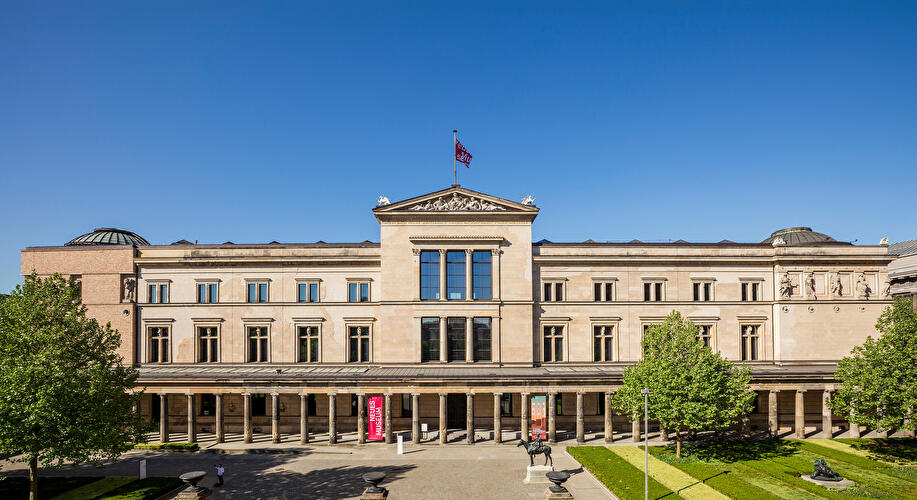
The Neues Museum on Berlin’s Museum Island is the project that defined Chipperfield’s reputation in continental Europe. Severely damaged in World War II, the 19th-century building had stood as a ruin for decades when Chipperfield, working with conservation architect Julian Harrap, won the competition for its reconstruction in 1997.
According to the Pritzker Prize official record, the project ran from 1993 to 2009. The architects chose not to imitate the lost decoration. Instead, surviving fragments were stabilized, missing volumes were rebuilt in recycled brick and reinforced concrete, and shrapnel scars were left visible where they carried meaning. The result is a museum where loss and continuity sit in the same room. The project received the European Union Prize for Contemporary Architecture (Mies van der Rohe Award) in 2011 and remains a touchstone for serious work on damaged historic structures.
James-Simon-Galerie, Berlin (1999 to 2018)
Adjacent to the Neues Museum, the James-Simon-Galerie serves as the new entrance building for the entire Museum Island UNESCO ensemble. Its tall, slender colonnades echo the classical context without copying it, while inside, contemporary spaces handle ticketing, education, and visitor flow that the historic museums were never designed for.
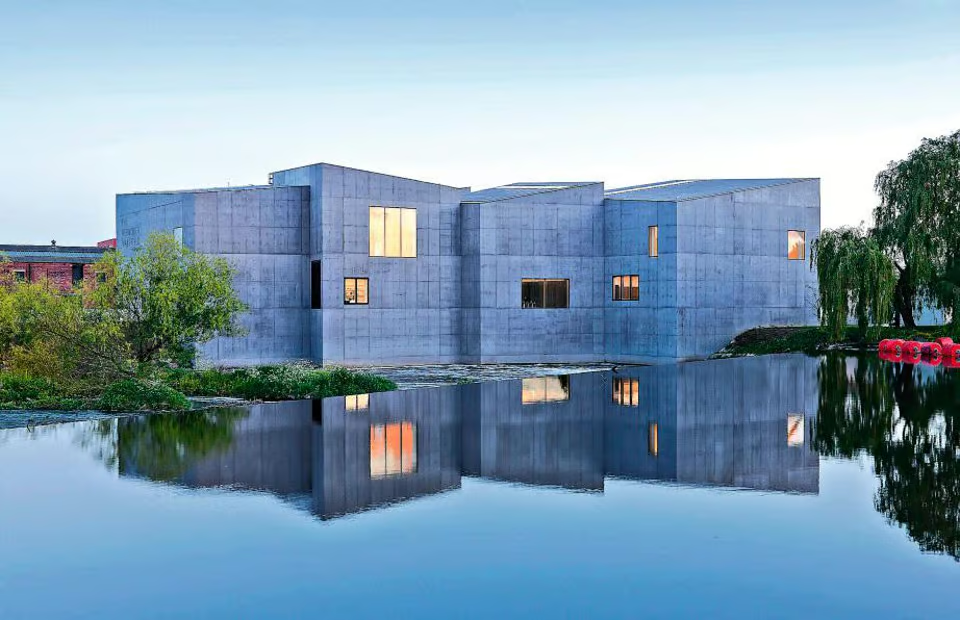
, England (2003 to 2011)
The Hepworth Wakefield art gallery, on the River Calder in Yorkshire, is one of the most quoted David Chipperfield buildings in England. The structure is a cluster of pigmented in-situ concrete blocks, each shaped to suit a specific gallery, light condition, or view back across the river. It demonstrates how a contemporary museum can sit in a post-industrial English town without either pretending to fit in or trying to dominate it.
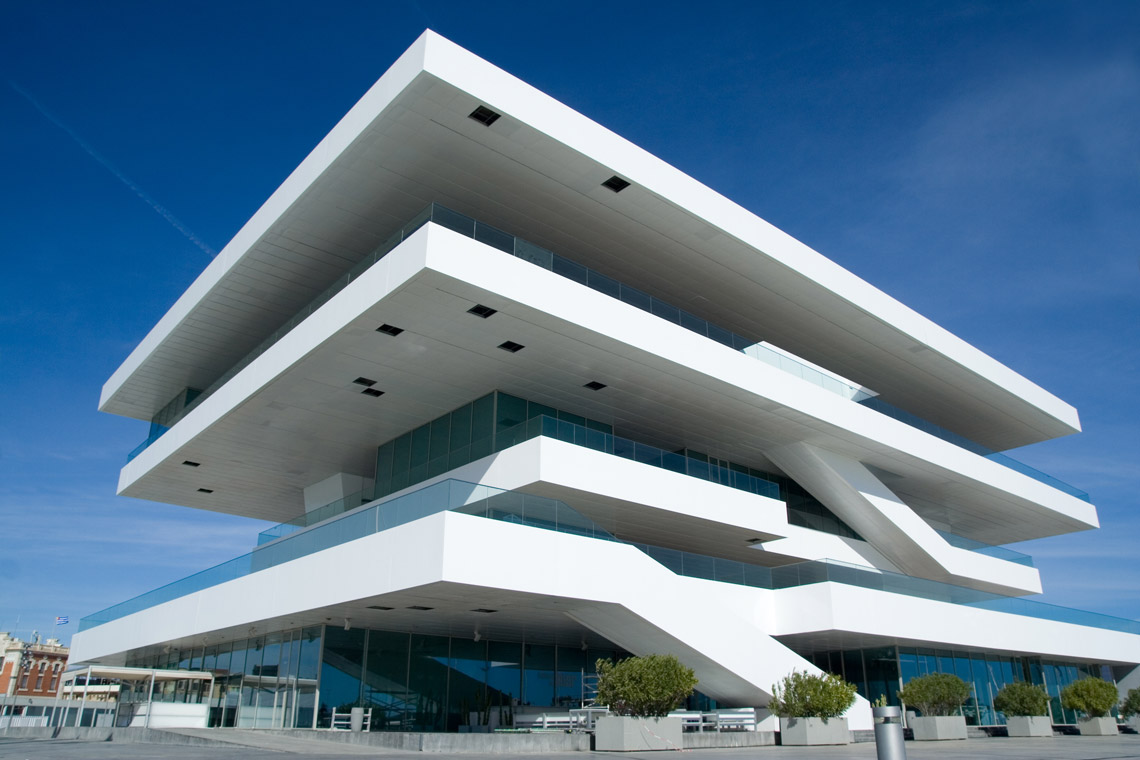
America’s Cup Building “Veles e Vents”, Valencia (2006)
Designed for the 2007 America’s Cup, this four-story concrete and steel pavilion was completed in only eleven months. Its stacked horizontal planes cantilever up to fifteen meters, providing shade and uninterrupted views of the Mediterranean from a redeveloped industrial port. It is one of the clearest examples of how Chipperfield handles fast, public-facing commissions without losing rigor.
Museo Jumex, Mexico City (2009 to 2013)
The Museo Jumex, located in the Polanco district of Mexico City, holds one of Latin America’s most important contemporary art collections. The travertine-clad building stands on slender columns, its sawtooth roof shaping daylight for the galleries above. It shows the practice’s restraint working in a very different climate and culture from northern Europe.
Procuratie Vecchie, Venice (2017 to 2022)
The Procuratie Vecchie is the 16th-century building on the north side of St. Mark’s Square in Venice, recognizable by its long arched colonnade. Chipperfield’s office completed the first restoration in five centuries, opening previously closed upper floors to the public for the first time. The work is the kind of intervention his practice is known for: precise, almost invisible at first glance, but deeply consequential for how a city uses one of its most famous rooms.
Amorepacific Headquarters, Seoul (2010 to 2017)
The Amorepacific Headquarters is a single, almost cubic volume in central Seoul, with three large openings cut into its facade to bring sky and air deep into the building. Around 7,000 staff use a structure that, despite its scale, reads as one calm, ordered object in a busy district.
Other Notable Works
The portfolio also includes the River and Rowing Museum in Henley-on-Thames, the Museum of Modern Literature in Marbach (Stirling Prize, 2007), the BBC Scotland Headquarters in Glasgow, the Saint Louis Art Museum extension, the renovation of the Neue Nationalgalerie by Mies van der Rohe in Berlin, and the David Chipperfield NYC project at 1014 Fifth Avenue, an Upper East Side residential building. The Arena Santa Giulia (PalaItalia) in Milan, designed with Arup, is set to host ice hockey events at the 2026 Winter Olympics and Paralympics.
🏗️ Real-World Example
Procuratie Vecchie, Venice (2022): This 16th-century building on St. Mark’s Square reopened to the public after Chipperfield’s office completed the first major restoration in roughly 500 years. The intervention added new vertical circulation, restored timber and terrazzo finishes, and opened the third floor as a public space for the first time, all while preserving the famous arched colonnade and the building’s place in the most photographed square in Italy.
How Does David Chipperfield Approach Historic Buildings?
Few contemporary architects have built a more consistent body of work in historic settings than David Chipperfield. His method, refined over the Neues Museum, the Procuratie Vecchie, and the Neue Nationalgalerie restoration, can be described in three moves: read the existing fabric carefully, repair what can be repaired, and add only what the building genuinely needs.
Old material is preserved where possible, including damage that carries meaning. New work is built in clearly contemporary techniques, but in materials and proportions that talk to the original. The boundary between old and new is legible without being theatrical. This is closer to surgery than to autobiography.
The approach has parallels in how cities now think about adaptive reuse and breathing new life into old structures, and in the broader argument that preserving historic buildings shapes better cities. For Chipperfield, restoration is not nostalgia. It is a practical answer to the carbon, social, and cultural cost of demolition.
📌 Did You Know?
When the Neues Museum reopened in 2009, the project had already been running for 12 years from the moment Chipperfield and Julian Harrap won the 1997 competition, and roughly 16 years counting from the earliest competition phase in 1993 reported by the Pritzker Foundation. The slow timeline was part of the design itself. Materials, sample walls, and conservation strategies were tested and revised across more than a decade before being committed to the finished building.
What Awards Has David Chipperfield Won?
The recognition for David Chipperfield’s architecture has been steady rather than sudden. His most important awards include the 2011 RIBA Royal Gold Medal for lifetime achievement, the 2011 European Union Prize for Contemporary Architecture (Mies van der Rohe Award) for the Neues Museum, the 2007 Stirling Prize for the Museum of Modern Literature in Marbach, the Heinrich Tessenow Medal (1999), the Praemium Imperiale (2013) from the Japan Art Association, and Germany’s Order of Merit (2009).
He was knighted in 2010 and made a member of the Order of the Companions of Honour in 2021. In March 2023, the Hyatt Foundation announced him as the 2023 Laureate of the Pritzker Architecture Prize, often called the Nobel Prize of architecture. The jury cited his civic responsibility, his climate-conscious approach to existing buildings, and the calm consistency of his work over four decades.
Chipperfield joins a list of laureates that includes other recent Pritzker Prize winners recognized for design that puts community and context first rather than pure formal innovation.
Video: Why David Chipperfield Won the 2023 Pritzker Prize
The video below walks through the reasoning behind the Pritzker jury’s 2023 decision and connects it to specific projects, including the Neues Museum and the James-Simon-Galerie. It is a useful introduction for students or readers who are new to his work.
The Pritzker Prize 2023 and Chipperfield’s Civic Voice
The 2023 Pritzker citation describes Chipperfield as a civic architect, urban planner, and activist. That activist label is not a marketing flourish. Over the past decade, he has used his platform to argue that architecture is too often shaped by global capital rather than local society, and that the discipline must respond to the climate emergency by reusing the buildings that already exist.
His foundation in Galicia, Fundación RIA, focuses on long-term planning for the rural and coastal landscape of northwest Spain, including questions of fishing, food production, settlement patterns, and climate adaptation. Few starchitects have taken such a deliberate step toward small-scale rural advocacy. It is consistent with the rest of his work: patient, local, and skeptical of architectural noise.
How Has David Chipperfield Influenced Contemporary Architecture?
The influence of David Chipperfield architecture is most visible in three areas: museum design, restoration practice, and the wider cultural argument for restraint.
In museums, his work has helped move the genre away from the spectacular Bilbao-effect model and toward something closer to a calm, well-detailed civic room. In restoration, the Neues Museum has become a reference for how to handle damaged historic structures without either over-cleaning them or freezing them in time. In the cultural conversation, he is one of the most consistent voices arguing that architecture’s job is to serve cities and communities over decades rather than to perform for the next image-driven cycle.
This contextual sensibility shows clear lines of continuity with the work of earlier modern masters like Peter Zumthor and Tadao Ando, while also offering younger architects an alternative model to formal experimentation.
📐 Technical Note
Chipperfield’s offices have applied UNESCO World Heritage standards on multiple projects, including the Neues Museum and the James-Simon-Galerie within Berlin’s Museum Island UNESCO ensemble, and the Procuratie Vecchie within the Venice and its Lagoon UNESCO site. Working in such contexts requires compliance with the UNESCO World Heritage Convention framework and close coordination with national heritage authorities, which significantly shapes the design and approval timeline.
What Architects Can Learn from David Chipperfield
For students and practicing architects, the work of David Chipperfield offers a clear set of lessons that go beyond style.
First, take time as a real material. Many of his most admired projects ran for ten years or more, with extensive prototyping. Second, treat existing buildings as a starting point rather than a problem to be removed. Third, use a small palette of materials very well, rather than a wide palette badly. Fourth, design for thirty or fifty years of use, not for the launch photograph.
None of this is anti-modern. Chipperfield is firmly part of the modernist lineage, particularly in his admiration for figures like Ludwig Mies van der Rohe, whose Neue Nationalgalerie his office carefully restored. The lesson is that modern architecture can still mean something specific and rigorous in 2026, rather than a generic visual style.
✅ Key Takeaways
- David Chipperfield is a British architect, born in 1953, who founded David Chipperfield Architects in London in 1985 and now leads offices in five cities.
- His work is defined by restraint, contextual response, careful material use, and a long, iterative design process rather than a single signature form.
- The reconstruction of the Neues Museum in Berlin and the restoration of the Procuratie Vecchie in Venice are landmark examples of his approach to historic buildings.
- He received the 2023 Pritzker Architecture Prize, alongside the 2011 RIBA Royal Gold Medal, the 2007 Stirling Prize, and many other major honors.
- For younger architects, his career is a model for how to combine modern design, historic preservation, and civic responsibility in a single practice.
Final Thoughts
David Chipperfield’s career argues, project by project, that architecture is at its best when it is honest, slow, and genuinely useful. His buildings rarely shout, and that is the point. They sit beside churches, palaces, ruins, and ordinary city streets without trying to outdo them, and they tend to age into their surroundings rather than away from them.
For anyone studying contemporary practice, his work is a reminder that the architect’s authority comes from the discipline’s long view: durable materials, considered proportions, and respect for what was already on the site. That is also why, in a field that often confuses fame with influence, the British architect David Chipperfield ends up shaping how the next generation thinks about modern design and historic places.




Interior Design for Commercial Spaces: Enhancing Functionality and Brand Identity
Commercial interior design has to serve brand, function and regulation at once....
 Begum Gumusel4 Mins read
Futuro House Production Revived in Finland After Decades-Long Hiatus
A Facebook listing for abandoned moulds led to the first new Futuro...
 illustrarch Editoral Team3 Mins read

Building Your Dream Home in NSW: What You Should Know About Montgomery Homes
Montgomery Homes has been building across Sydney, Newcastle, the Hunter, Wollongong and...
illustrarch Editoral Team4 Mins read
Designing a Home Theater: Where Drapery Fits Into the Plan
In a media room the curtains are a performance layer, not decoration....
illustrarch Editoral Team3 Mins read


Leave a comment