

Top 10 Free Online Architecture Courses for 2026
A Top 10 guide to free online architecture courses from Harvard, MIT, Yale, and TU Delft, most free to audit on edX, Coursera, and Alison.
 Elif Ayse Sen25 May 20255 Mins read464

Table of Contents Show
Free online architecture courses let you study design theory, history, sustainability, and urban planning through universities like Harvard, MIT, Yale, and TU Delft without paying tuition. This Top 10 list gathers the strongest options on edX, Coursera, MIT OpenCourseWare, and Alison. Most are free to audit, with a graded certificate available for an optional fee.
The gap between you and a world-class design education keeps shrinking. Elite schools now stream their lecture halls straight to your laptop, so you can study Roman construction one month and net-zero building envelopes the next. One detail is worth knowing before you enroll: most of these programs are free to audit, which means you can watch every lecture, read the assigned material, and work through the exercises at no cost, while a graded certificate usually carries a price. If you are still weighing whether formal study suits you, our guide on what subjects you need to study architecture pairs well with the self-directed path below.
Free Online Architecture Courses at a Glance
The table below sums up all ten picks so you can match a course to your current goal before reading the detail. Provider shows the school behind the material, and Focus points to the main skill you will build.
| Course | Provider | Platform | Focus |
|---|---|---|---|
| The Architectural Imagination | Harvard University | edX (free to audit) | Design theory |
| Roman Architecture | Yale University | Coursera (free to audit) | Architectural history |
| Making Architecture | IE School of Architecture | Coursera (free to audit) | Design process |
| A Global History of Architecture | MIT | MIT OpenCourseWare (fully free) | Architectural history |
| Sustainable Building Design | MIT | edX (free to audit) | Sustainability and energy |
| Sustainability in Architecture | Universitat Politecnica de Valencia | edX (free to audit) | Sustainability |
| Smart Cities | EPFL | Coursera (free to audit) | Urban infrastructure |
| Zero-Energy Design | TU Delft | edX (free to audit) | Sustainability |
| Global Housing Design | TU Delft | edX (free to audit) | Affordable housing |
| Architecture Micro-Courses | Various instructors | Alison (fully free) | Mixed topics |
💡 Pro Tip
Always start in audit mode. On both edX and Coursera you can access every lecture and reading for free, so treat the paid certificate as a later decision. Only upgrade once you know you need the graded track for continuing-education credits or a verified record on your CV.
The 10 Courses Worth Your Time
1. The Architectural Imagination (Harvard University)
Harvard Graduate School of Design built this course to teach you how to read and think about buildings the way an architect does. Weekly video lectures and model-making exercises show how form, structure, and cultural context interact, moving from classical vaults to modern experiments. It is a strong warm-up before a studio review or a design competition, since it sharpens the vocabulary you use to defend your choices. The program is free to audit on edX, and the paid certificate track has historically qualified for AIA learning units.
2. Roman Architecture (Yale University)
Professor Diana Kleiner turns the ancient Mediterranean into a case study in political messaging, engineering nerve, and city planning. Across the sessions you learn to read concrete domes, triumphal arches, and street grids as deliberate design decisions rather than static ruins. The course sits on Coursera and is free to audit, with an optional certificate.
3. Making Architecture (IE School of Architecture)
Filmed in Segovia and Madrid, this short program looks at how practicing architects actually work: where ideas start, how a sketch becomes a BIM model, and why feedback loops matter. The emphasis lands on building a personal design method you can repeat on real projects. Short interviews with working designers give you a candid look at how firms move from concept to construction. Audit it for free on Coursera before deciding on a certificate.
4. A Global History of Architecture (MIT)
If you prefer self-study with no login and no paywall, MIT OpenCourseWare publishes the full materials for course 4.605, taught by Mark Jarzombek. You get lecture notes, reading lists, and assignments covering architecture from prehistory through the sixteenth century across both Eastern and Western traditions. Browse the complete set on MIT OpenCourseWare.
📌 Did You Know?
MIT OpenCourseWare has published free teaching materials from more than 2,500 MIT courses since it launched in 2001, according to MIT OpenCourseWare. That archive includes full lecture notes and assignments from the Department of Architecture, all open with no registration required.
5. Sustainable Building Design (MIT)
Taught by building scientist Christoph Reinhart, this course covers the thermal and daylight behavior of buildings and introduces analysis tools such as ClimateStudio. You learn to reason about envelopes, energy loads, and comfort with real climate data. It is free to audit on edX, and AIA members can earn 22 learning units on the verified certificate.
6. Sustainability in Architecture (Universitat Politecnica de Valencia)
A tight four-week program that threads life-cycle assessment, material performance, and neighborhood-scale policy into a single systems view. It suits interns who are comfortable with studio aesthetics but need to fold environmental metrics into their proposals. The course is free to audit on edX.
7. Smart Cities (EPFL)
As sensors move from gadgets into streets, architects increasingly work alongside data scientists and utility engineers. This EPFL course from Switzerland gives you the governance, energy-grid, and mobility background to design buildings that connect to wider urban systems. Expect practical discussion of sensor networks, data platforms, and how city managers actually run these systems day to day. Audit it free on Coursera.
8. Zero-Energy Design (TU Delft)
Working on a retrofit brief? This course walks you through the reduce, reuse, produce order of operations, insulation and passive gains first, on-site renewables last. Dutch case studies anchor each step and translate well to other climates. TU Delft offers it free to audit through its online learning platform on edX.
9. Global Housing Design (TU Delft)
With close to a billion people living in inadequate housing, affordable design is one of the defining problems of the profession. This course, developed with the Aga Khan Trust for Culture, teaches you to balance density, affordability, and community across different climates and cultures. It won the 2022 edX Prize and is free to audit on edX. Pair it with our primer on housing design fundamentals for extra grounding.
⚖️ Pros & Cons at a Glance
✔️ Pros: No tuition to audit, direct access to top schools, self-paced schedules, and real material for your portfolio.
✖️ Cons: Certificates and continuing-education credits cost extra, none replace an accredited degree, and finishing depends entirely on your own discipline.
10. Architecture Micro-Courses (Alison)
If you like short modules you can finish over a weekend, Alison hosts free courses on topics from blueprint reading to heritage conservation. Each one ends with a competency check, and the platform is ad-supported, so the courses and a downloadable certificate stay free. Browse the catalogue on Alison. Emerging designers who want a wider view of the field can also study the working habits of young architects worth following.
How to Get the Most From These Free Courses
Signing up is easy; finishing is the hard part. A few habits separate the people who collect logins from the people who actually build skills.
- Set a fixed weekly slot, such as an hour every Friday morning, and treat it like a studio deadline rather than optional reading.
- Turn each lesson into output. Redraw a zero-energy detail, model a housing block, or map a street using the analysis method from that week.
- Use the discussion forums. Peer feedback and the contacts you make often prove as useful as the video lectures themselves.
- Audit several courses at once, then commit to the certificate only for the one that matches a real career need.
Where to Go From Here
Your Next Step: Pick a single course from the table that matches the skill gap you feel most right now, enroll in audit mode today, and block one recurring hour in your calendar to work through it. Momentum beats ambition, and one finished course teaches more than five half-watched ones.





Unlock the Benefits of Learning from Online Architecture Courses Today
Explore the transformative potential of online architecture courses, offering unmatched flexibility and...
 Muhammad Abdullatef - Tifa Studio4 Mins read
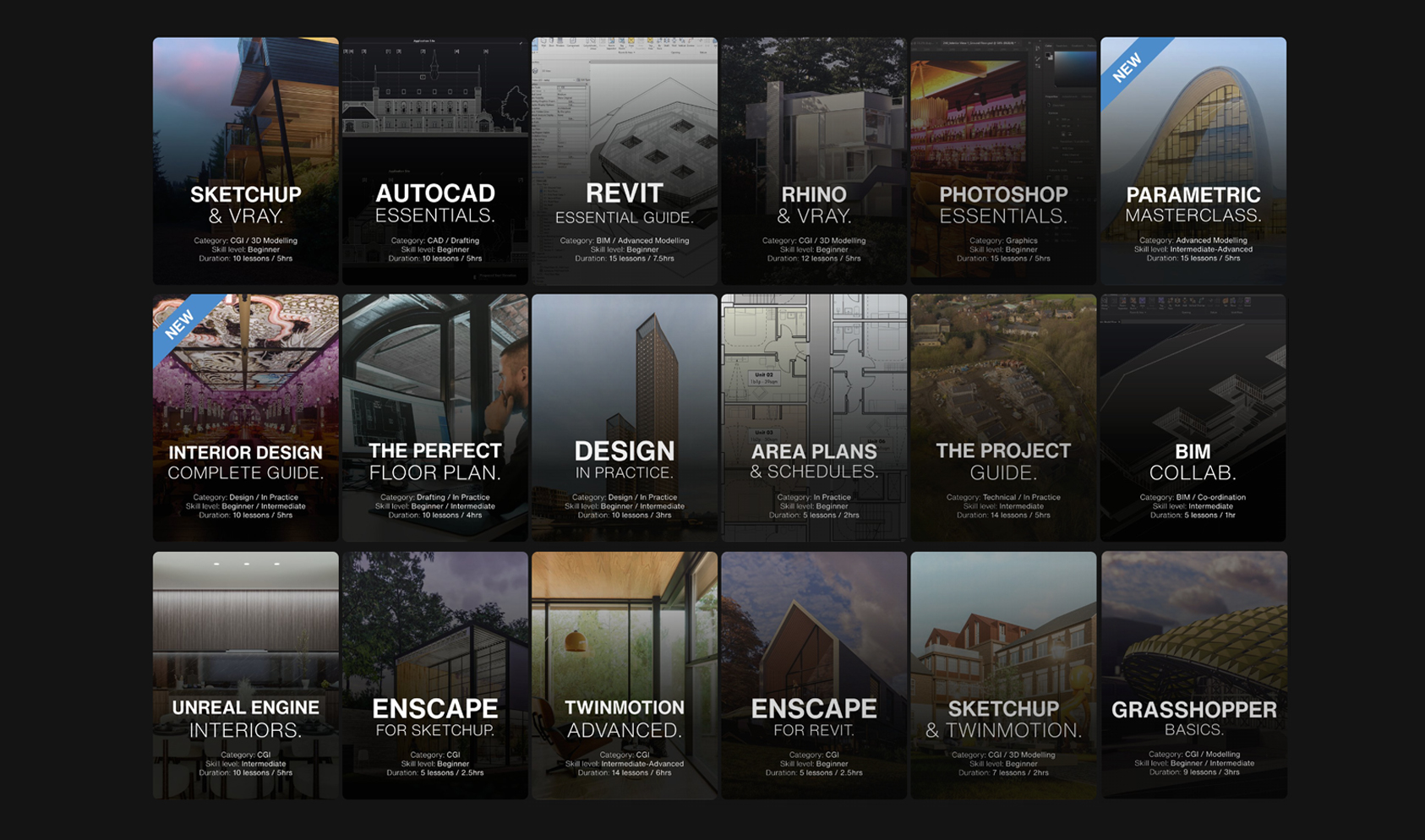
An Innovative Platform Empowering Architects and CG Artists
Table of Contents Show What ArchAdemia Offers Architects and CG ArtistsWho the...
Muhammad Abdullatef - Tifa Studio5 Mins read

Best Courses for Learning AutoCAD
AutoCAD is one of the most essential tools for every architect and...
Elif Ayse Sen7 Mins read

Online Tutorials for 3Ds Max
3Ds max that is Autodesk's professinal modeling software, which stands out in...
 illustrarch Editoral Team3 Mins read


Leave a comment