

Heritage “Ay” Kiln Adaptive Renewal by WUGE Studio & YFS
Heritage “Ay” Kiln Adaptive Renewal by WUGE Studio + YFS reinterprets a century-old dragon kiln site in Fujian through spatial clarity, material continuity, and architectural mediation. By using walls, courtyards, and crafted thresholds to organize production, exhibition, and visitor experience, the project transforms fragmented rural heritage into a legible cultural landscape where tradition and contemporary architecture coexist.
 Begum Gumusel29 January 20264 Mins read220


Table of Contents Show
The Heritage “Ay” Kiln Adaptive Renewal project is located in the mountainous region of northeastern Fujian, where the tradition of producing Ay (硋), a rare black-glazed ceramic positioned between pottery and porcelain, has shaped both landscape and livelihood for generations. The site itself is not a curated heritage compound but rather the product of a century-long process of self-organized making. At its center lies a traditional elongated dragon kiln, built into the hillside, flanked by a rammed-earth house to the west, a later brick-and-concrete dwelling to the east, and scattered stone outbuildings surrounding open agricultural fields.
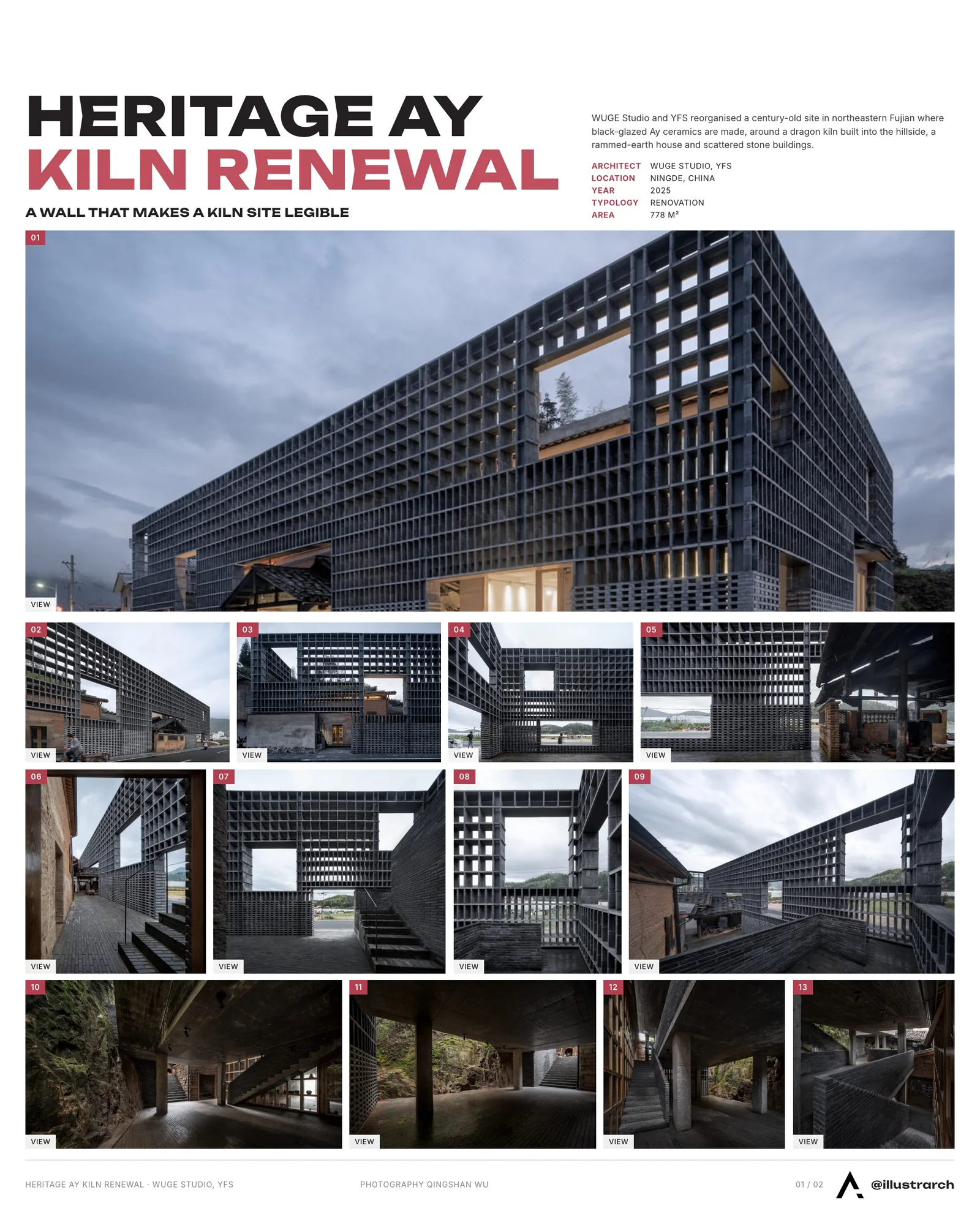
This layered assemblage tells the story of continuous adaptation: spaces expanded when production grew, repaired when structures aged, and accumulated when new needs emerged. Yet while this organic evolution embodies local craftsmanship, it also produced spatial confusion. Boundaries between working, living, displaying, and visiting blurred into a visually overloaded environment where cultural depth risked dissolving into ordinary labor. The project begins precisely here: not by erasing complexity, but by reorganizing it into legibility.
Transparency and Obstacle as Architectural Strategy
A critical challenge of the site was its lack of spatial mediation between the compound and the adjacent village road. Instead of creating openness through removal, the architects introduced a deliberate architectural counterpoint: a two-story boundary wall along the site edge. This wall does not isolate; rather, it becomes an ordering device, organizing dispersed buildings, clarifying edges, and allowing the existing kiln, houses, and stone structures to be read once again as historical artifacts within a coherent field.
The conceptual framework draws from Jean Starobinski’s idea of La Transparence et l’Obstacle, in which true understanding often emerges not through total exposure, but through carefully constructed barriers. Here, the wall becomes both obstacle and instrument of clarity. Openings are precisely positioned to frame views, direct attention, and construct moments of pause. Instead of dissolving material presence, the architecture builds a cognitive transparency, one that allows visitors to perceive the craft, the site, and its temporal depth with renewed intensity.
Old materials, rammed earth, timber, stone, and the dragon kiln itself, are retained and interlocked with new systems, producing a multi-temporal architectural field where past and present coexist without hierarchy.
Spatial Clarification Through Process and Ritual
One of the project’s most significant achievements lies in how it reorganizes spatial experience around the traditional ceramic-making sequence:
raw material → forming → glazing → firing → display/experience → retail.
Rather than separating production from visitation, the design choreographs both into a layered system of circulation. Visitors move through the site in alignment with craftsmen’s workflows, witnessing the process as it unfolds without interrupting it. This approach transforms daily labor into a form of living exhibition, production becomes narrative.
Three courtyards structure this experience. The front courtyard functions as reception and display space, mediating between village and workshop. The central courtyard supports daily production activities, maintaining the site’s working authenticity. The rear courtyard rises toward the hillside, where platforms, stairs, and terraces enable panoramic observation of both landscape and process. Through movement, visitors do not merely observe intangible heritage, they physically encounter it.
Material Continuity and Constructed Time
Material intervention is approached with exceptional restraint and intelligence. Rather than applying a singular contemporary language, the project exposes temporal layers through construction itself. Existing rammed-earth and stone walls are preserved wherever structurally viable. Where deterioration occurred, replacements are not disguised but reinterpreted: timber shelving systems, glass display walls, and double-layered timber frameworks, crafted by local carpenters, introduce new spatial clarity while honoring traditional techniques.
At the rear of the site, new platforms are constructed using beamless concrete slab systems textured with 10 cm wood-grain imprints. This material choice is more than aesthetic. Concrete, once fluid, now solid, acts as a mediator between porous earth and immovable rock, bridging natural terrain and built intervention. The architecture thus becomes an expression of continuity through transformation, rather than preservation through freezing.
The Brick Wall as Structure, Symbol, and Lens
The project’s most powerful architectural element is undoubtedly the 8-meter-tall grey brick wall. Functioning simultaneously as spatial geometry, structural system, and symbolic condenser, the wall aligns with the gable of the dragon kiln, reinforcing a dialogue between old and new forms.
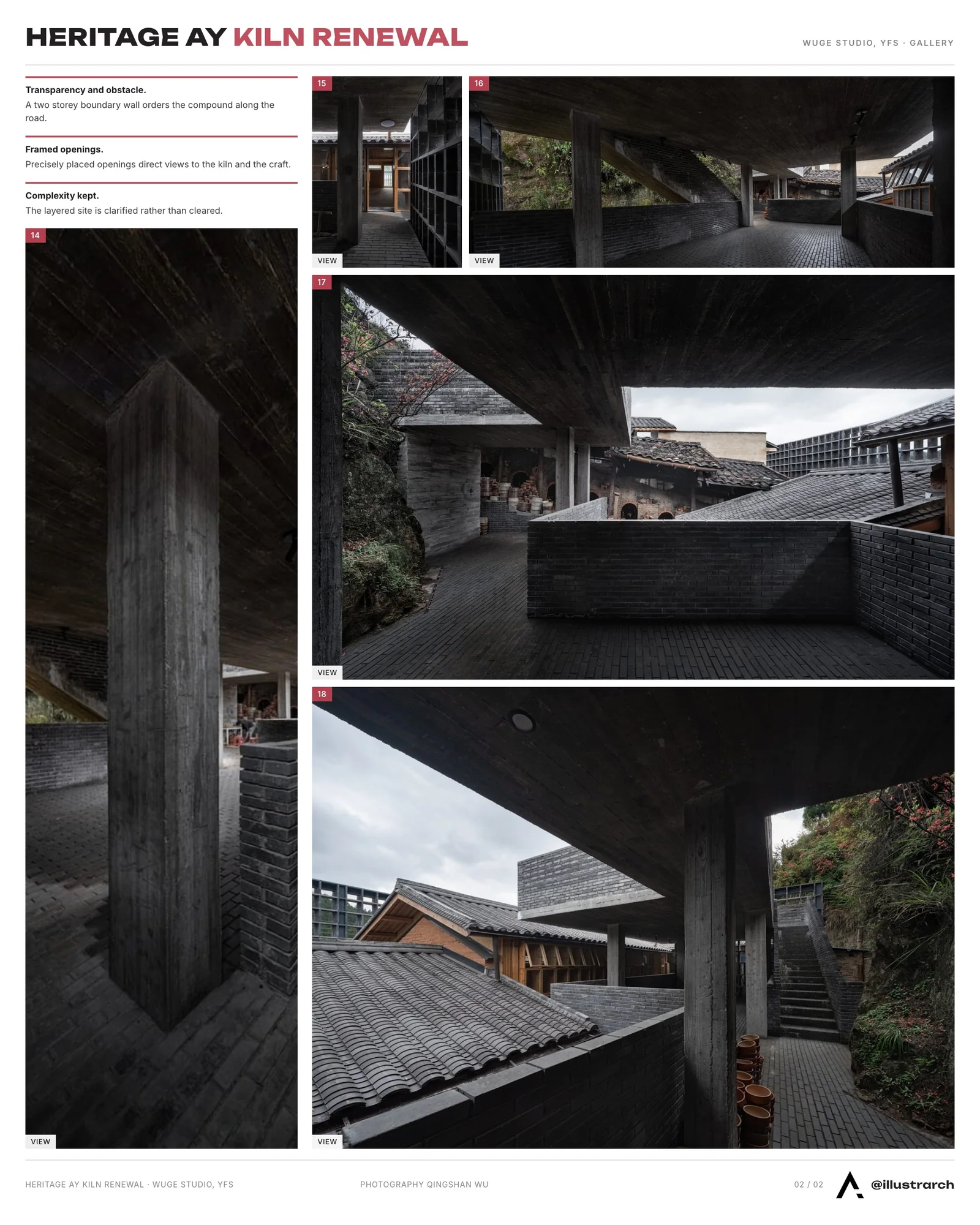
Its openings are not decorative but interpretive. Each window frames a fragment of the production process, translating the three-dimensional reality of craft into an almost elevation-like narrative. Structurally, the wall employs a concealed steel frame and rebar lattice, enabling brick modules to transition from dense to porous. This gradient evokes the kiln’s airflow patterns while generating a visual tension between weight and lightness.
Materially, the wall resonates deeply with its context. Fired brick echoes the essence of Ay ceramics, earth transformed by fire, making the architecture itself an extension of the craft tradition. It stands as both obstacle and window, separating yet revealing, grounding the project in lineage while asserting contemporary architectural agency.
A Contemporary Framework for Living Heritage
Rather than romanticizing vernacular architecture or imposing a dominant contemporary form, the Heritage “Ay” Kiln Adaptive Renewal constructs a new framework through which tradition can continue to evolve. By clarifying spatial order, rearticulating boundaries, and translating process into experience, the project allows the site to function simultaneously as workshop, exhibition, social space, and cultural landmark.
Heritage here is not preserved as artifact but activated as practice. The architecture does not seek transparency through erasure but through careful composition, using walls, thresholds, courtyards, and material contrasts to make meaning legible. In doing so, WUGE Studio and YFS offer a rare example of adaptive reuse that operates intellectually, culturally, and spatially at once.
The renewal of the Ay kiln is neither restoration nor reconstruction, but a deeply architectural act of re-reading and re-ordering. Through a precise balance of obstacle and openness, preservation and intervention, craft and structure, the project transforms a fragmented rural compound into a coherent landscape of production, memory, and encounter. It demonstrates how architecture can act as a mediator between time, material, and meaning, allowing intangible heritage not only to survive, but to be experienced, understood, and carried forward.
Photography: Qingshan Wu


Phinney Mini by Best Practice Architecture
Phinney Mini by Best Practice Architecture reworks a 16.5 foot wide 1907...
 illustrarch Editoral Team2 Mins read

Inhabiting the Roof by Paris Atlas
Inhabiting the Roof by Paris Atlas turns two rainwater shedding roofs on...
illustrarch Editoral Team3 Mins read

Adaptive Reuse of the Michelin Factory by Kengo Kuma & Associates
Kengo Kuma & Associates has unveiled a proposal to transform the former...
 Elif Ayse Sen3 Mins read
Inverse Ruin: Reimagining an Ancient Temple Through Contemporary Intervention
A contemporary architectural installation at the Herakleia archaeological site in Policoro offers...
Elif Ayse Sen2 Mins read


Leave a comment