

Banua Tututra
Banua Tutura is an architectural project that transforms traditional disaster storytelling of the Kaili people into interactive play spaces for children in Palu, Indonesia.
 illustrarch Editoral Team28 June 20191 Mins read400
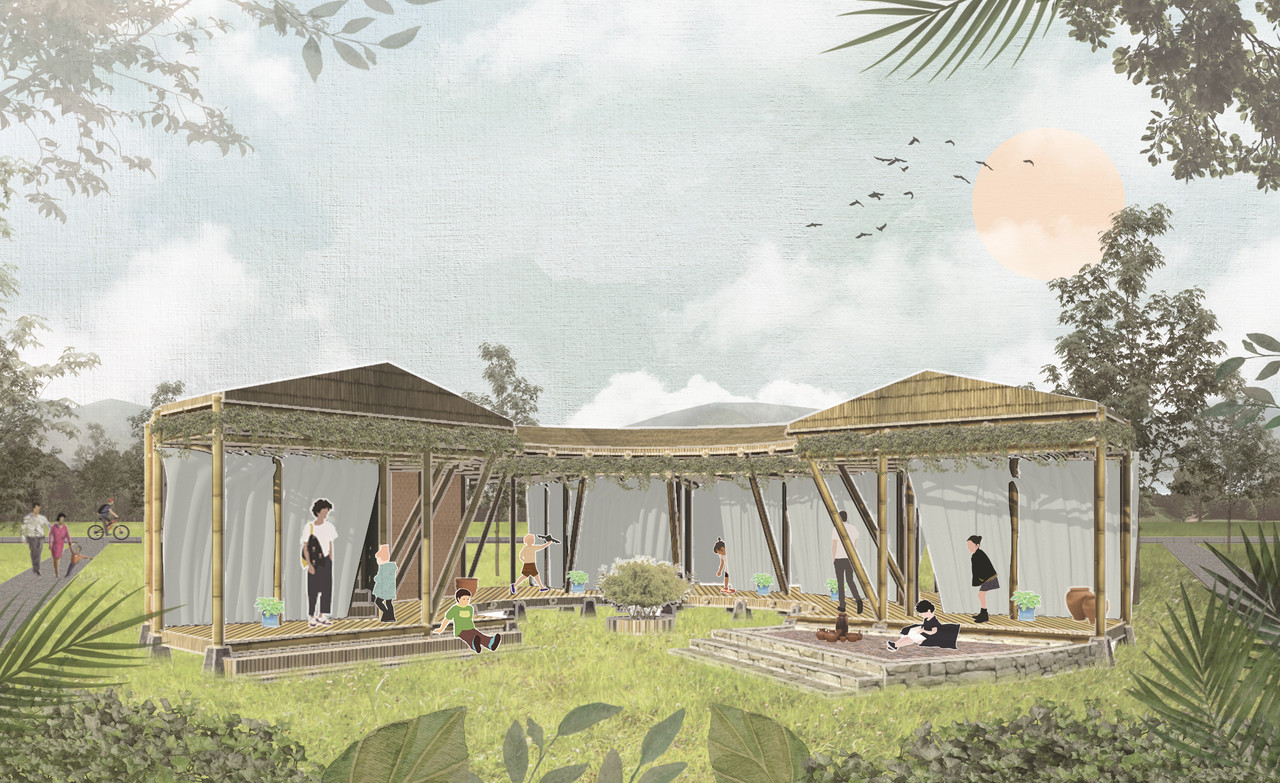


Banua Tutura, or Storytelling House, reimagines disaster preparedness as architecture children can play inside, translating the oral traditions of Palu’s Kaili people into spatial form. Designed by Nathanael Hanli, Veren Calisca, and Vito Wijaya, the project earned a place among the Top 25 of the Archfest 2019 Competition. Stories hold an integral part in our civilization. Aside from explaining natural phenomena through myths, stories also serve as a medium to preserve local wisdom and tradition so that they can be inherited by children for generations to come.
In Palu, Indonesia, natural phenomena such as earthquake, tsunami, and even liquefaction, along with the traditional mitigation systems for those disasters, were passed down through generations by the local Kaili people in the form of children’s stories known as “Tutura”. Modernization concealed them from recent memory, and when disaster struck, the community was left without anticipation. Banua Tutura aims to revive the Tutura tradition in an architectural form of interactive storytelling. The disaster tales of Lingu, Bombatalu, and Nalonjo are translated into spatial sequences as a traumatic play platform, hoping that children can express their disaster trauma through thematic motoric and sensoric play while preserving local wisdom for future generations.
Housing and Memory in a Disaster Zone
As a work of housing, Banua Tutura carries responsibilities that go beyond shelter. A home in a hazard-prone region must hold a family safely, but it can also teach. Palu sits in one of the most seismically active parts of Indonesia, where earthquakes and the rare ground failure of soil liquefaction shape how buildings should be sited, founded, and arranged. Architecture that responds to this setting tends to favor clear escape routes, legible thresholds, and layouts that orient occupants quickly in a moment of crisis.
By turning these survival lessons into a sequence of rooms and play spaces, the design treats the house itself as a teacher. Each spatial episode corresponds to a tale, so that the act of moving through the building rehearses the right response to a real event. Storytelling as a form of oral tradition becomes a structural idea rather than decoration, binding cultural memory to physical form. The result is a quietly ambitious proposal: a dwelling that protects its inhabitants while keeping the wisdom of the Kaili people present in everyday life, ready for the next generation to carry forward.




Four Design and Architecture Contests Open for Entries This Fall
Four separate design contests, in California, Vancouver, Canada's new RIBA chapter and...
illustrarch Editoral Team2 Mins read
Residential Architecture Face-Off: Co-Living vs Traditional Apartment for Urban Housing
Co-living and traditional apartments represent two distinct approaches to residential architecture in...
 Furkan Sen8 Mins read
Architecture Competitions 2026: Open Calls, Deadlines and a Practical Guide
Architecture competitions open in 2026 with live deadlines, fees and prizes, and...
 Sinan Ozen8 Mins read
Designing a Liminal Space Where Urban Meets Coastal
The Liminal House by Mcleod Bovell Modern Houses in West Vancouver is...
 Elif Ayse Sen5 Mins read


Leave a comment