

Revealing the Lost Identity, Ahmednagar
Ahmednagar's architectural renovation thesis by Suchit Dilip Mutha revitalizes the city's historical identity through a framework that engages local culture and memory.
 illustrarch Editoral Team18 April 20191 Mins read436
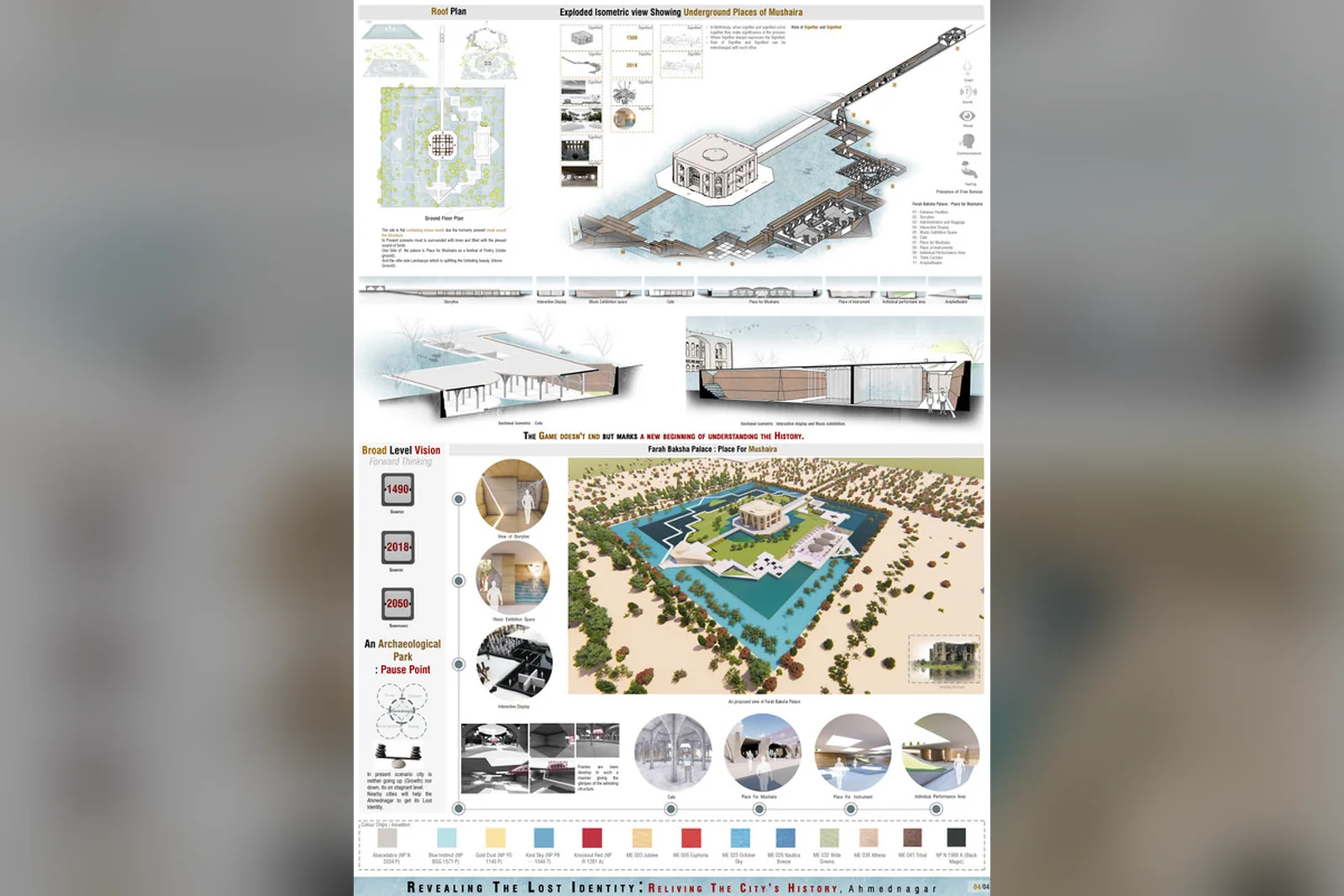


Revealing the Lost Identity is a renovation thesis by architect Suchit Dilip Mutha that treats the city of Ahmednagar, Maharashtra, as a single living archive of memory and history. The project begins with a childhood recollection and a simple, uncomfortable question: can history be conveyed? Once counted among the developed cities of the world and spoken of in the same breath as Mecca and Cairo, Ahmednagar today is a relatively small town, showing less growth than the nearby western Maharashtra centres of Mumbai and Pune. Its culture still holds its identity, and its historical structures each carry a story of their time, yet the golden lineage of the place seems half forgotten by the people who live among it.
Rather than starting from scratch, the proposal works as a catalyst that revives an existing charm. Mutha frames the lost identity through history itself, using built structure as a tool and the city’s people as a backdrop set against the passage of time. The strategy introduces a game in which the entire city becomes a playing field and every citizen becomes a participant. From a close reading and interpretation of local history, a new framework is derived for the historical structures, with mythology adopted as a system of communication that translates history into architecture.
Working at three scales
The thesis is organised into three parts that move from the broad to the specific. At the city level sits the game itself. At the macro level comes a policy for the historical structures, a set of principles for how heritage might be read and reactivated. At the micro level is a built experiment at Farah Baksha, where the larger ideas are tested against a single site. This layered method mirrors the wider discipline of architectural conservation, where decisions made for one monument must answer to the whole urban fabric around it.
Heritage-led urban renewal of this kind asks a building type difficult questions. A renovation must respect what stands while making it legible and useful to a contemporary public, balancing preservation against everyday life. By casting cultural heritage as something played, walked and inhabited rather than merely catalogued, the project argues that a city does not need to invent a future from nothing. Ahmednagar already holds its own answer, and the work simply hands it back to the people who walk its streets.



Phinney Mini by Best Practice Architecture
Phinney Mini by Best Practice Architecture reworks a 16.5 foot wide 1907...
illustrarch Editoral Team2 Mins read

Inhabiting the Roof by Paris Atlas
Inhabiting the Roof by Paris Atlas turns two rainwater shedding roofs on...
illustrarch Editoral Team3 Mins read

Heritage “Ay” Kiln Adaptive Renewal by WUGE Studio & YFS
Heritage “Ay” Kiln Adaptive Renewal by WUGE Studio + YFS reinterprets a...
 Begum Gumusel4 Mins read

Adaptive Reuse of the Michelin Factory by Kengo Kuma & Associates
Kengo Kuma & Associates has unveiled a proposal to transform the former...
 Elif Ayse Sen3 Mins read


Leave a comment