

Rifting Lands
Rifting Lands is a competition proposal for a visitor center and observation point in Iceland that reflects the geological separation of the North American and Eurasian.
 illustrarch Editoral Team16 March 20211 Mins read412


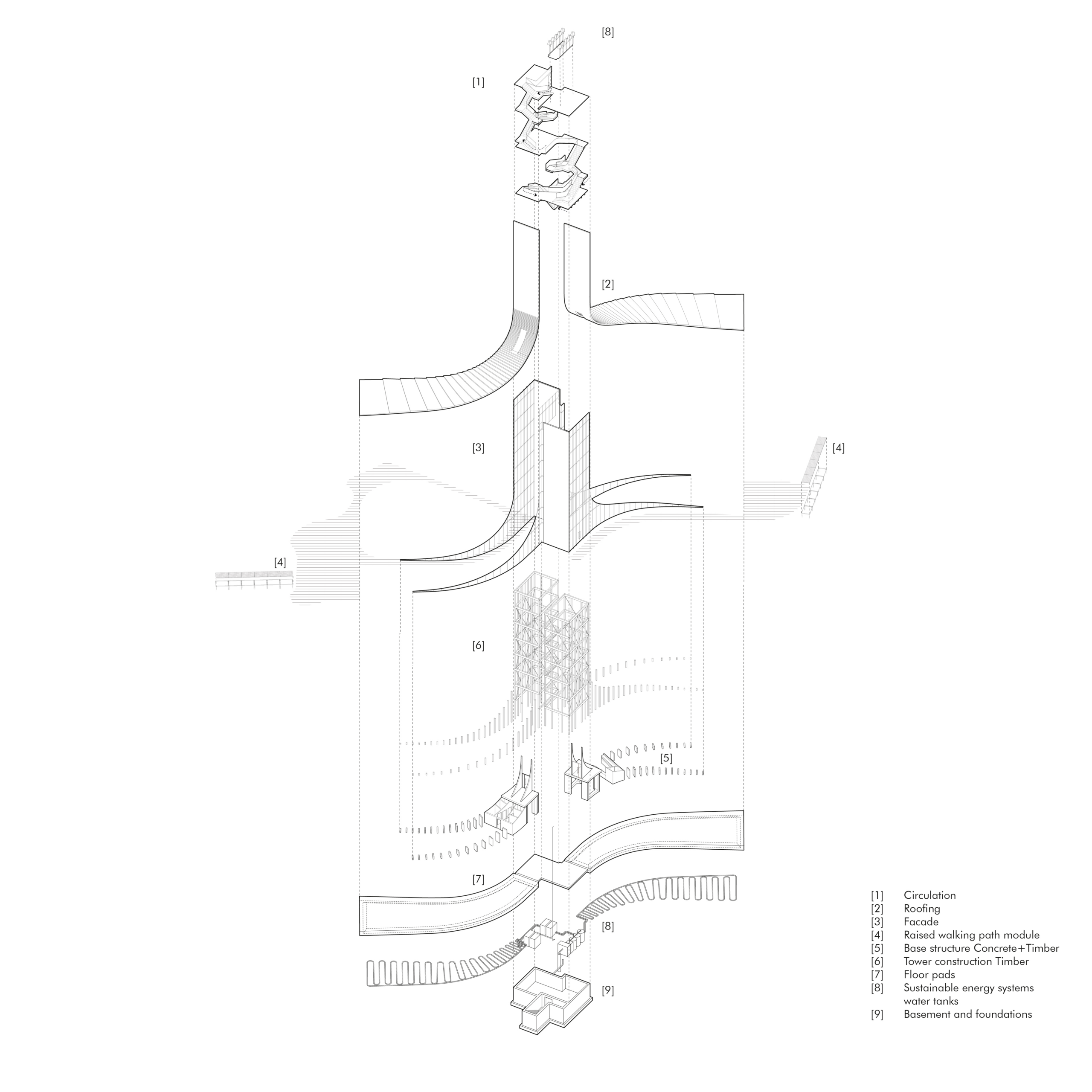


Rifting Lands is a competition proposal for an observation point and small visitor center beside Grjotagja in Iceland, a fissure several meters wide that traces the diverging boundary between the North American and Eurasian tectonic plates. Designed by Georg Erharter, Eva Schwarzler, Sara Maria Camagni, and Carlheinz, the scheme draws its form directly from this rare geological setting, where the ground itself records the slow pulling apart of two continents.
The design works through a single idea carried at two scales: continuity and division. Visitors move both experientially and physically through the building, circulating along paths that join and split much as the land does at the rift. This duality is expressed in the architecture itself, giving the structure a strong identity as a landmark that can be read from far away across the open terrain. While the proposal is rooted in the inherent characteristics of the site, the tower lets itself stand apart, becoming a clearly man-made intervention rising out of the landscape rather than disappearing into it.
Building for a Landscape That Moves
Designing a visitor structure on a site like this raises questions that are common to projects set within protected or geologically active landscapes. The architecture has to give people a vantage point and shelter without overwhelming the very thing they came to see. A vertical element such as a tower answers part of that challenge by lifting the eye and offering elevated views while keeping its footprint on the ground compact. The work of geotourism projects is often to frame a natural feature, channel movement, and protect fragile surfaces, all while reading as a deliberate human gesture.
The setting also shapes the concept. Grjotagja sits within the volcanic zone of Iceland, where the surface expression of plate tectonics is unusually visible. By echoing the splitting and rejoining of the rift in its circulation and massing, Rifting Lands turns an abstract geological process into something a visitor can walk through and feel. The result is a building that explains its place as much as it occupies it, standing as a marker for a landscape defined by separation and slow movement.



Living Typologies by Stela Boldur
Living Typologies by Stela Boldur is a student masterplan for the former...
illustrarch Editoral Team2 Mins read

Modern Earthy Sanctuary House by PENTARCH designers
The Modern Earthy Sanctuary is a 10 Marla house in Sheikhupura, Pakistan,...
illustrarch Editoral Team2 Mins read
Casa Paisaje by TAP Arquitectura
Casa Paisaje is TAP Arquitectura's unbuilt 2025 competition proposal for a 302...
illustrarch Editoral Team2 Mins read

Casa d’Abreu Neto by Álvaro Siza
Casa d’Abreu Neto in Matosinhos is the first house Álvaro Siza saw...
illustrarch Editoral Team3 Mins read


Leave a comment