

How the Golden Ratio Modern Architecture Principle Shapes Today’s Iconic Buildings
The golden ratio continues to shape modern architecture, guiding proportions in iconic buildings from Le Corbusier's Villa Savoye to Apple Park. This article examines how architects apply the 1.618 proportion to facade composition, spatial planning, and parametric design, with real examples and practical insights.
 Elif Ayse Sen22 April 202610 Mins read49
Table of Contents Show
What Is the Golden Ratio and Why Does It Matter in Modern Architecture?
The golden ratio, also known as Phi (Φ) or the Divine Proportion, is a mathematical value of approximately 1.6180339887. It describes a relationship where a line is divided so that the ratio of the whole length to the longer part equals the ratio of the longer part to the shorter one. First formally described by Euclid around 300 BCE in his treatise Elements, it was later linked to the Fibonacci sequence by Leonardo of Pisa in 1202. In modern architecture, the golden ratio serves a different purpose than it did in classical antiquity. Classical buildings like the Parthenon used proportional systems partly for symbolic and religious reasons. Modern architects, by contrast, adopted Phi as a rational tool that connected their functionalist ideals with a visual order rooted in human perception. The use of golden ratio in modern architecture is therefore less about mysticism and more about creating compositions that feel stable, balanced, and psychologically comfortable. This proportional system aligns closely with broader scale and proportion principles that have guided building design for millennia. What makes modern architecture golden ratio applications distinct is their integration with industrial materials, open floor plans, and rejection of ornament.💡 Pro Tip
When applying the golden ratio to a modern facade, draw regulating lines early in the schematic design phase rather than retrofitting them later. Architects working on minimalist elevations often divide the primary rectangle into a golden section first, then align window heads, sill lines, and structural bays to these guides. This prevents the proportional system from feeling forced once cladding and glazing details are added.
How Is the Golden Ratio Used in Modern Architecture Today?
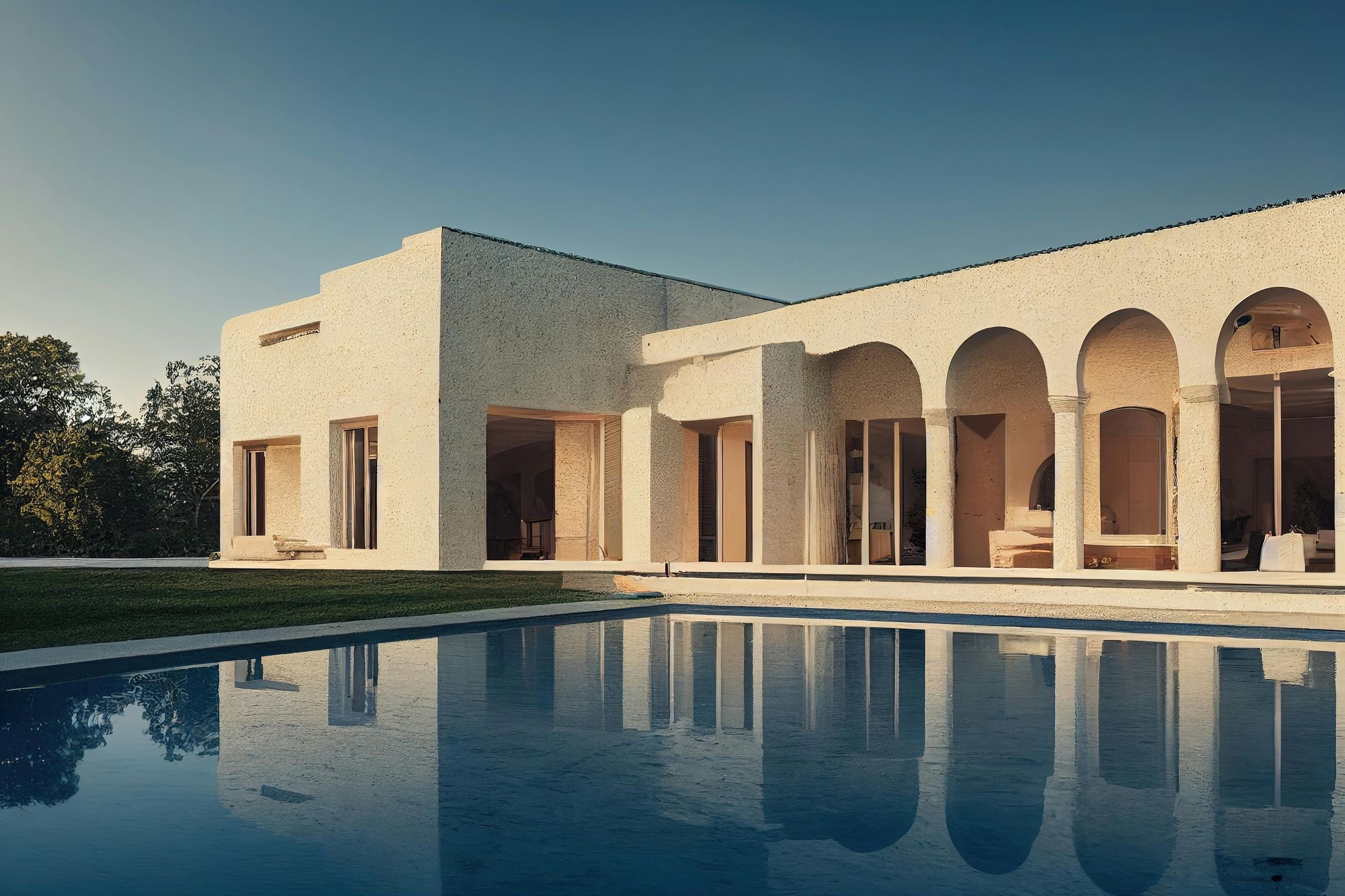 The use of golden ratio in modern architecture falls into several categories, each addressing a different design challenge. Architects apply Phi to the overall massing of a building, the subdivision of facades, the proportions of interior rooms, and the relationships between structural elements. The ratio also appears in site planning, where it helps organize pathways, courtyards, and landscape features relative to building footprints.
The approach is rarely rigid. Most contemporary practitioners treat the golden ratio as one of several proportional tools, alongside modular grids, square root systems, and parametric algorithms. What distinguishes golden ratio and modern architecture from historical applications is the integration with digital design software, which allows architects to test Phi-based proportions against structural, thermal, and daylighting constraints in real time.
The use of golden ratio in modern architecture falls into several categories, each addressing a different design challenge. Architects apply Phi to the overall massing of a building, the subdivision of facades, the proportions of interior rooms, and the relationships between structural elements. The ratio also appears in site planning, where it helps organize pathways, courtyards, and landscape features relative to building footprints.
The approach is rarely rigid. Most contemporary practitioners treat the golden ratio as one of several proportional tools, alongside modular grids, square root systems, and parametric algorithms. What distinguishes golden ratio and modern architecture from historical applications is the integration with digital design software, which allows architects to test Phi-based proportions against structural, thermal, and daylighting constraints in real time.
Facade Composition and Window Placement
Facade design remains the most visible area where the golden ratio influences modern architecture. By dividing an elevation into a large rectangle and a smaller one in the 1:1.618 ratio, architects establish a primary visual zone and a secondary zone. Window openings, balcony lines, and structural mullions can then be aligned within these zones to create rhythm without monotony. This approach is visible in modernist villas, corporate headquarters, and mid-rise residential buildings. The ratio helps avoid two common facade failures: visual chaos when openings are randomly placed, and visual boredom when a grid is applied without hierarchy. For a detailed look at how this applies across project types, see this breakdown of seven ways architects use the golden ratio in design.Spatial Planning and Room Proportions
Inside buildings, the golden ratio in modern architecture shapes how rooms relate to corridors, how ceiling heights relate to floor areas, and how openings frame views. A living room with a length-to-width ratio of 1.618 tends to feel balanced, neither cramped nor awkwardly elongated. Modern architects often use this ratio when laying out open-plan interiors, where fewer walls mean that proportions become the primary organizing device.Massing and Building Envelope
At the massing scale, Phi helps architects decide how tall a building should be relative to its footprint, or how a cantilever should relate to the main volume. When overall massing follows the golden ratio, buildings tend to feel grounded rather than top-heavy. This contributes to the quiet visual confidence that characterizes the best modernist work.Examples of the Golden Ratio in Modern Architecture
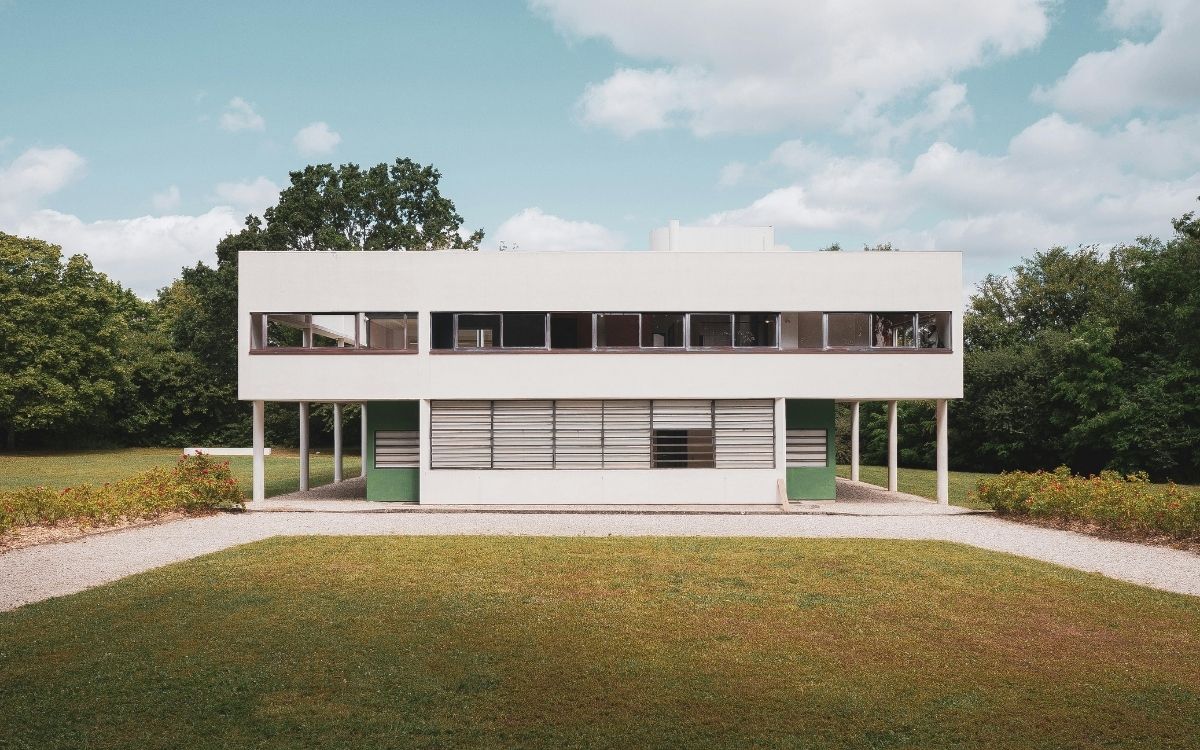
Villa Savoye by Le Corbusier (1929-1931)
Villa Savoye in Poissy, France, is perhaps the most analyzed modern architecture golden ratio example. Le Corbusier organized the villa’s modular grid and interior proportions around Phi-based relationships, including the dimensions of rooms and the placement of windows and doors. The result is a house whose geometric clarity depends on proportional precision rather than ornament.Villa Stein de Monzie by Le Corbusier (1927)

Guggenheim Museum by Frank Lloyd Wright (1959)
The Guggenheim Museum in New York City uses a spiral form closely related to the golden spiral, which is derived from nested golden rectangles. Wright’s ramp circulates visitors through the building along a curve whose proportions echo those found in nautilus shells and sunflower seed arrangements. The museum shows how Phi can organize three-dimensional movement, not just flat composition.CN Tower by John Andrews (1976)

Apple Park by Foster + Partners (2017)
Apple Park in Cupertino applies the golden ratio at the site-planning scale. The ring-shaped main building uses circular geometry that relates to Phi proportions in its relationship to the surrounding landscape, parking structures, and pathways. The project demonstrates how the ratio can inform contemporary corporate campus design through parametric tools.🏗️ Real-World Example
United Nations Secretariat Building (New York, 1952): Designed by a team led by Wallace Harrison with input from Le Corbusier and Oscar Niemeyer, the 39-story Secretariat uses a facade whose vertical proportions approximate three stacked golden rectangles. The building’s slab form became a template for corporate high-rises worldwide, demonstrating how Phi-based massing could communicate institutional seriousness without classical ornament.
Eden Project by Grimshaw Architects (2001)
The Eden Project in Cornwall, England, uses geodesic domes whose geometry relates to Fibonacci and golden ratio patterns. The hexagonal and pentagonal panels that form the biomes follow proportional relationships that maximize structural efficiency while minimizing material use.The Modulor: Le Corbusier’s Golden Ratio System
 No discussion of golden ratio and modern architecture is complete without the Modulor. Developed by Le Corbusier between 1943 and 1955, the Modulor is a scale of proportions derived from the human figure and the golden ratio. It consists of two series of numbers, the Red and Blue series, based on the height of a person with a raised arm (2.26 meters) and the navel height (1.13 meters).
Le Corbusier used the Modulor to determine dimensions of furniture, room heights, door widths, and entire building facades. The system appears in the Unité d’Habitation in Marseille (1952), where apartment proportions, ceiling heights, and corridor widths all derive from Modulor measurements. The Modulor represents the most systematic attempt to integrate Phi into a complete architectural workflow.
No discussion of golden ratio and modern architecture is complete without the Modulor. Developed by Le Corbusier between 1943 and 1955, the Modulor is a scale of proportions derived from the human figure and the golden ratio. It consists of two series of numbers, the Red and Blue series, based on the height of a person with a raised arm (2.26 meters) and the navel height (1.13 meters).
Le Corbusier used the Modulor to determine dimensions of furniture, room heights, door widths, and entire building facades. The system appears in the Unité d’Habitation in Marseille (1952), where apartment proportions, ceiling heights, and corridor widths all derive from Modulor measurements. The Modulor represents the most systematic attempt to integrate Phi into a complete architectural workflow.
🎓 Expert Insight
“Architecture should speak of its time and place, but yearn for timelessness.”, Frank Gehry
Gehry’s statement captures why the golden ratio retains relevance in modern architecture. Even as styles shift from International Style modernism to parametric design, the ratio’s link to human perception gives it a timeless quality that outlasts individual movements, which is why architects return to it across generations.
Why Does the Golden Ratio Still Influence Modern Architecture?
The persistence of the golden ratio in modern architecture comes down to three factors. First, the ratio connects design decisions to human perception in ways that have been studied for centuries. Second, it provides a flexible proportional system that can adapt to different building types, scales, and programs. Third, it offers architects a shared language that links new work to architectural history without requiring stylistic imitation. Research on visual perception suggests that proportions approximating 1.618 feel subtly more balanced to human observers than arbitrary ratios, though this effect varies across cultures and individuals. A review published in the journal Frontiers of Architectural Research has examined how proportional systems influence perceived aesthetic quality in contemporary building design.Integration with Parametric Design and Digital Tools
Contemporary architects often use the golden ratio within parametric workflows in tools like Grasshopper for Rhino and Autodesk’s Dynamo for Revit. These platforms allow Phi-based proportions to drive geometry that would be impractical to draw by hand, such as curved facades whose panel sizes scale according to Fibonacci sequences. This integration with digital design is where the most innovative work on the golden ratio in modern architecture is happening today.⚠️ Common Mistake to Avoid
Many designers assume that applying the golden ratio automatically produces beautiful buildings. It does not. Phi is a proportional framework, not a guarantee of quality. Several studies, including a 2012 analysis by mathematician George Markowsky, found that claims of golden ratio proportions in famous buildings are often exaggerated or imposed retroactively. Use the ratio as one design tool among many, not as a formula for beauty.
Golden Ratio Modern Architecture vs Classical Applications
Understanding how the modern era differs from classical uses of Phi helps clarify what makes contemporary applications distinctive. The table below compares key characteristics.Comparison of Classical and Modern Golden Ratio Applications
| Aspect | Classical Architecture | Modern Architecture |
|---|---|---|
| Purpose of Phi | Symbolic, religious, aesthetic order | Rational, functional, perceptual balance |
| Typical Application | Facades, columns, sculptural ornament | Massing, grids, open-plan interiors |
| Tools Used | Drafting, manual geometry | CAD, BIM, parametric software |
| Materials | Stone, timber, masonry | Steel, concrete, glass, composites |
| Example Building | Parthenon (438 BCE) | Villa Savoye (1931) |
| Design Flexibility | Fixed within stylistic canon | Adaptable across styles and programs |
Criticisms and Debates Around Golden Ratio Modern Architecture

📐 Technical Note
To construct a golden rectangle for facade design, start with a square of any side length (a). Mark the midpoint of one side, then draw a line from that midpoint to a corner on the opposite side. Use that line as the radius of an arc that extends the original square into a rectangle. The new rectangle’s long side will equal a × 1.618, producing a precise golden rectangle. This method, described in Euclid’s Elements, remains the standard geometric construction taught in architectural education.
Practical Applications for Architects and Designers
For architects working on modern projects today, the golden ratio offers several concrete applications. It can inform the initial massing sketches before site constraints and program requirements are fully defined. It can guide facade studies when elevations start feeling disorganized. It can help resolve awkward room dimensions during space planning reviews. It can also serve as a sanity check on proportions generated by parametric scripts. Understanding the importance of proportion and scale is a prerequisite for applying the ratio well. Architects who treat Phi as a starting framework rather than a final answer tend to produce more compelling results than those who impose it mechanically. Design students can practice golden ratio applications using free tools like the online architectural golden ratio calculator, which allows overlaying a golden spiral or rectangle on any building photograph or sketch. This helps develop an intuitive sense of when Phi-based proportions are present and when they are not.💡 Pro Tip
When reviewing a design that feels “off” but you cannot identify why, overlay a golden ratio grid on the elevation or plan. Experienced architects often find that uncomfortable compositions violate Phi-based relationships in ways that are hard to see but easy to feel. Adjusting a single dimension by 5-10 percent to align with the ratio can resolve tension that would otherwise require redesign.
The Future of Golden Ratio in Modern Architecture
 Looking ahead, the role of the golden ratio in modern architecture will likely continue through three channels. Parametric and generative design tools will embed Phi-based algorithms into default workflows, making the ratio a background influence rather than an explicit choice. Sustainability requirements will push architects toward biomimetic forms that naturally follow Fibonacci and Phi patterns because these proportions are structurally efficient. And computational analysis of human perception will produce better data on which proportional systems actually influence occupant experience.
The ratio will probably not dominate architecture the way it did during the early modernist period, when Le Corbusier promoted the Modulor as a universal design tool. Instead, it will remain one of several proportional frameworks that architects draw on, valued for its connection to history and its adaptability to contemporary challenges.
Looking ahead, the role of the golden ratio in modern architecture will likely continue through three channels. Parametric and generative design tools will embed Phi-based algorithms into default workflows, making the ratio a background influence rather than an explicit choice. Sustainability requirements will push architects toward biomimetic forms that naturally follow Fibonacci and Phi patterns because these proportions are structurally efficient. And computational analysis of human perception will produce better data on which proportional systems actually influence occupant experience.
The ratio will probably not dominate architecture the way it did during the early modernist period, when Le Corbusier promoted the Modulor as a universal design tool. Instead, it will remain one of several proportional frameworks that architects draw on, valued for its connection to history and its adaptability to contemporary challenges.
✅ Key Takeaways
- The golden ratio in modern architecture is a proportional tool of approximately 1:1.618, used to organize massing, facades, and interiors rather than as a symbolic device.
- Le Corbusier’s Modulor system represents the most systematic integration of Phi into modernist design methodology, influencing projects like Villa Savoye and Unité d’Habitation.
- Iconic modern buildings including Villa Stein de Monzie, the Guggenheim Museum, and Apple Park demonstrate how the ratio adapts to different scales, programs, and design eras.
- Contemporary architects use Phi within parametric design tools, allowing the ratio to drive complex geometries and material-efficient forms.
- Critical voices caution that claims of golden ratio proportions are sometimes retrofitted, so architects should treat Phi as one tool among many rather than a universal formula for beauty.
Final Thoughts on Golden Ratio Modern Architecture
The golden ratio’s influence on modern architecture proves that mathematical proportions and functional design are not opposing forces. From Le Corbusier’s early villas to contemporary parametric projects, architects have used Phi to bring order to buildings that reject classical ornament and embrace industrial materials. The ratio works because it connects design decisions to how humans perceive space, not because it carries mystical meaning. For architects, designers, and students exploring the use of golden ratio in modern architecture, the most productive approach is curiosity combined with skepticism. Study the examples, try the ratio in your own work, measure the results, and trust your eye as much as the math. The best modernist buildings teach us that proportion is a conversation between geometry and experience, and the golden ratio remains one of the most useful conversation starters architects have ever developed.- examples of the golden ratio in modern architecture
- golden ratio and modern architecture
- golden ratio in modern architecture
- Golden Ratio modern architecture
- golden ratio used in modern architecture
- how is the golden ratio used in modern architecture
- modern architecture golden ratio
- modern architecture golden ratio examples
- modern architecture golden ratio in architecture
- the golden ratio in modern architecture
- use of golden ratio in modern architecture








Petronas Towers: Islamic Geometry Meets Modern Skyscraper Design
Designed by Cesar Pelli and completed in 1998, the Petronas Twin Towers...
 Sinan Ozen5 Mins read
Fractals in Architecture: How Nature’s Patterns Shape Design<
Fractals appear everywhere in nature, from fern leaves to coastlines, and architects...
Elif Ayse Sen9 Mins read
La Casa Milà Barcelona: Gaudí’s Stone Quarry Turned Architectural Icon
Casa Milà, nicknamed La Pedrera for its rough stone exterior, stands on...
 Furkan Sen6 Mins read

Architecture Design Brief: What to Include and Examples
A design brief turns a client's goals into clear instructions a design...
Elif Ayse Sen9 Mins read


Leave a comment