

Step-by-Step Process for Crafting Dynamic Facade Designs
This practical guide breaks down the full process of crafting dynamic facade designs into clear, actionable steps. Covering concept development, material selection, kinetic mechanisms, sensor integration, and performance testing, the article includes real project references and technical notes to help architects and designers create responsive, adaptive building envelopes.
 Elif Ayse Sen14 April 202616 Mins read230

Table of Contents Show
Crafting dynamic facade designs involves a structured sequence of decisions, from identifying environmental drivers and selecting kinetic mechanisms to integrating sensors and validating performance through simulation. A well-executed dynamic facade adapts to sunlight, wind, and temperature in real time, reducing energy consumption while producing a building envelope that evolves visually throughout the day.
Buildings with static envelopes are increasingly falling short of both performance targets and occupant expectations. A dynamic facade design addresses this gap by introducing movement, whether through mechanical actuators, pneumatic systems, or material-based responses, into the building skin. The result is an exterior that actively manages solar gain, glare, ventilation, and even privacy. Projects like the Al Bahar Towers in Abu Dhabi and the Kiefer Technic Showroom in Austria have demonstrated what becomes possible when architects treat the facade as a responsive system rather than a fixed barrier. This guide walks through the complete process for creating these adaptive systems, step by step.
What Is Dynamic Facade Design?

A dynamic facade is a building envelope system that changes its configuration, appearance, or performance properties in response to external or internal stimuli. Unlike conventional facades that remain fixed after construction, a dynamic facade can adjust shading angles, modify transparency, alter ventilation openings, or shift its geometry based on conditions like sun position, ambient temperature, wind speed, or occupancy patterns.
The term covers a range of approaches. Mechanical systems use motors and actuators to physically move panels, louvers, or screens. Pneumatic systems inflate or deflate membrane cushions to change opacity. Material-based systems rely on shape-memory alloys, thermobimetallic strips, or electrochromic glass that respond to heat or electrical input without any moving parts in the traditional sense. Each category presents different trade-offs in cost, maintenance, aesthetic range, and degree of adaptability.
🎓 Expert Insight
See also our guide to facade design.
“The facade on Al Bahar, computer-controlled to respond to optimal solar and light conditions, has never been achieved on this scale before.”
Chris Wilkinson, Wilkinson Eyre Architects (CTBUH Awards Jury)
This recognition of the Al Bahar Towers highlights how dynamic facades have moved from experimental prototypes to fully operational building systems capable of performing at the scale of commercial high-rises.
Step 1: Define Performance Objectives and Environmental Drivers

Every successful responsive facade design begins with a clear understanding of what the facade must accomplish. Start by identifying the primary environmental challenges at your site: Is the building subject to intense solar radiation from specific orientations? Does it face high wind loads? Are there dramatic seasonal temperature swings? The answers to these questions shape every subsequent decision.
List your performance targets in measurable terms. For a commercial tower in a hot climate, the objective might be to reduce solar heat gain by 40-50% on south and west exposures while maintaining at least 300 lux of daylight at the work plane. For a cultural building in a temperate zone, the goal could be creating a visually animated exterior that also manages glare for gallery spaces. Without specific, measurable targets, the design process lacks direction and the final facade risks being either over-engineered or under-performing.
Conduct a detailed site analysis using solar path diagrams, wind rose data, and microclimate studies. Map sun angles across seasons and times of day to identify which facade zones receive the most radiation and when. This data becomes the foundation for your dynamic facade strategy.
Step 2: Select the Kinetic Mechanism Type

With performance objectives defined, the next step is choosing how the facade will move. This is the core technical decision in kinetic facade architecture, and it affects everything from structural loading to maintenance schedules.
Mechanical kinetic systems use electric motors, linear actuators, or hydraulic cylinders to drive physical movement. They offer precise, programmable control and can handle large, heavy panels. The Al Bahar Towers employ over 2,000 motorized umbrella-like shading units on a steel substructure, each controlled independently through a building management system. The Kiefer Technic Showroom uses perforated aluminum shutters on motorized tracks that slide horizontally and vertically to regulate light and privacy.
Pneumatic systems work by inflating or deflating air cushions, typically made from ETFE (ethylene tetrafluoroethylene) film. The Media-TIC building in Barcelona by Cloud 9 uses ETFE cushions that change opacity by injecting or releasing nitrogen, adjusting solar transmission without any rigid moving parts. This approach is lighter than mechanical systems and creates a distinctive soft, pillow-like aesthetic.
Material-responsive systems eliminate motors entirely. Thermobimetallic facades use strips of two metals with different thermal expansion rates, causing panels to curl or flatten as temperatures change. Doris Sung’s research at the University of Southern California has produced prototype facades where thousands of small metal elements open passively as temperatures rise, allowing ventilation without any power input.
💡 Pro Tip
When selecting a kinetic mechanism, always request cycle-life ratings from component manufacturers. A facade actuator rated for 50,000 cycles might sound adequate, but a shading system that adjusts every 15 minutes during a 10-hour workday will reach about 146,000 cycles within 10 years. Under-specifying duty ratings is one of the most common sources of premature facade failure.

Comparison of Kinetic Facade Mechanism Types
The following table summarizes the key differences between the three main mechanism categories:
| Feature | Mechanical | Pneumatic | Material-Responsive |
|---|---|---|---|
| Power Requirement | Electric motors, actuators | Air compressors, pumps | None (passive response) |
| Control Precision | High (programmable per unit) | Moderate (zone-based) | Low (autonomous, no override) |
| Weight | Heavy (steel, aluminum frames) | Light (ETFE membranes) | Light to moderate |
| Maintenance | Regular (motors, gears, tracks) | Moderate (seals, compressors) | Minimal |
| Example Project | Al Bahar Towers, Abu Dhabi | Media-TIC, Barcelona | Bloom Installation, Los Angeles |
| Relative Cost | High | Moderate to high | Low to moderate |
Step 3: Develop the Geometric and Parametric Design

Once the mechanism type is chosen, translate your performance requirements into geometry. This is where adaptive facade architecture intersects with computational design tools. The shape, size, orientation, and folding pattern of each facade element must be calibrated to deliver the required shading, ventilation, or visual effect.
Use parametric modeling software such as Grasshopper for Rhino or Dynamo for Revit to define relationships between environmental inputs and facade geometry. For a sun-shading facade, this means creating algorithms that map solar incidence angles to panel rotation angles for every hour and season. The Al Bahar Towers team used parametric tools to simulate the opening and closing behavior of each mashrabiya unit across the full range of annual sun positions, optimizing geometry before a single prototype was built.
Consider modularity early. A kinetic building facade composed of repeated modular units is far easier to fabricate, install, and maintain than one with unique components at every position. The SDU Campus Kolding by Henning Larsen Architects achieved a highly responsive facade using 1,600 identical triangular shutters, each linked to sensors that track light and heat. Standardization reduced manufacturing costs without sacrificing performance variation across the building’s different orientations.
⚠️ Common Mistake to Avoid
Many designers develop parametric facade geometry purely for visual effect, without linking it to measurable performance criteria. A pattern that looks striking in a rendering may produce negligible shading improvement or, worse, redirect glare into occupied spaces. Always validate parametric outputs against daylight simulation (such as sDA and ASE metrics) before committing to fabrication.
Step 4: Choose Materials and Structural Systems

Material selection for a dynamic facade must balance durability, weight, weather resistance, and movement capability. Unlike a static cladding panel that only needs to resist loads and weathering, a kinetic element must also survive repeated mechanical cycles over decades without fatigue, corrosion at joints, or degradation of surface finishes.
Aluminum is the most widely used material for mechanical dynamic facade buildings. It is lightweight, corrosion-resistant, and easy to perforate or fold into complex profiles. The Kiefer Technic Showroom’s shutters and the Brisbane Airport Car Park’s wind-responsive panels both use aluminum. For pneumatic systems, ETFE film offers high transparency, extreme lightness (about 1% the weight of glass), and strong UV resistance. Glass fiber reinforced polymers (GFRP) appear in projects like SOMA’s One Ocean Pavilion, where the lamellas need to flex repeatedly without cracking.
The structural subframe is equally important. Moving facade elements apply dynamic loads, not just static dead weight and wind pressure. Account for inertial forces during movement, potential resonance with wind gusts, and the cumulative effect of thermal expansion on joints and tracks. Engage structural engineers early, and plan for independent movement between the facade substructure and the primary building frame to avoid transferring vibrations.
📐 Technical Note
For aluminum kinetic facade panels, standard alloy 5005-H34 provides good corrosion resistance and formability for perforated screens. Panel thicknesses typically range from 2 mm to 4 mm depending on span and wind load requirements. Hinge and track hardware should be rated to at least IP55 (dust-protected, water-jet resistant) per IEC 60529, and all fasteners should be stainless steel grade 316 to prevent galvanic corrosion at aluminum-steel interfaces.
How Do Sensors and Controls Drive a Smart Facade Design?

Step 5 in the process addresses the intelligence layer. A smart facade design is only as effective as its sensor network and control logic. Without reliable environmental data, even the most sophisticated mechanical system cannot respond appropriately to changing conditions.
The sensor suite for a typical kinetic facade architecture project includes pyranometers or photodiodes for measuring solar irradiance, anemometers for wind speed and direction, and thermocouples for surface and ambient temperature. Some advanced systems add rain sensors and occupancy detectors. Position each sensor to represent the actual conditions at the facade zone it controls, not in a single central weather station that may miss localized shading or wind effects.
The control system translates sensor data into actuator commands. Simple systems use threshold-based logic: if solar irradiance exceeds 400 W/m² on a given zone, close the shading panels to a 30-degree angle. More advanced setups use predictive algorithms that reference weather forecast APIs, solar position calculations, and historical performance data to anticipate conditions and pre-position panels before peak heat arrives. The Al Bahar Towers use a building management system (BMS) that calculates optimal shading positions based on time, date, and orientation, then fine-tunes in real time using facade-mounted sensors.
Plan for manual override. Occupants in offices or residential units may want direct control over their immediate facade zone, particularly for privacy or view preferences. The Kiefer Technic Showroom allows individual users to adjust panels in their section through local controls, layered on top of the automated program.
📌 Did You Know?
The Al Bahar Towers’ dynamic mashrabiya system contains 2,098 individual shading units, making it the largest computerized responsive facade in the world at the time of its completion in 2012. The system reduced solar heat gain by more than 50%, allowing the use of clearer glass and significantly cutting air conditioning demand across both towers (Council on Tall Buildings and Urban Habitat, 2012).

Step 6: Prototype, Test, and Simulate

No amount of digital modeling can replace physical prototyping for a dynamic facade technology project. Build a full-scale prototype of at least one bay or module, including all moving components, actuators, sensors, and weatherproofing, and subject it to controlled testing before committing to full production.
Test the prototype for mechanical endurance by running it through thousands of open-close cycles under varying temperature and humidity conditions. Check for noise levels during operation, because a facade that creates audible clicking or motor whine every 15 minutes will generate occupant complaints. Verify weather sealing at all positions of movement, as water infiltration at panel edges or track joints is a persistent risk in kinetic systems.
Run performance simulations in parallel. Use energy modeling software (EnergyPlus, IES VE, or similar) to quantify the facade’s impact on building heating, cooling, and lighting loads across a full year. Feed in your control logic so the simulation reflects actual operational patterns, not just the best-case scenario. Compare results against the performance targets defined in Step 1. If the simulated facade fails to hit the 40% solar heat gain reduction you targeted, adjust panel geometry, control logic, or both before production.
The Al Bahar Towers project fabricated a full-scale prototype of the mashrabiya system at Yuanda’s facilities in China, subjecting it to mechanical, wind, and durability testing before approving the design for the 2,098-unit production run. This investment in prototyping prevented costly field failures on a 145-meter-tall building in one of the world’s harshest climates.
🏗️ Real-World Example
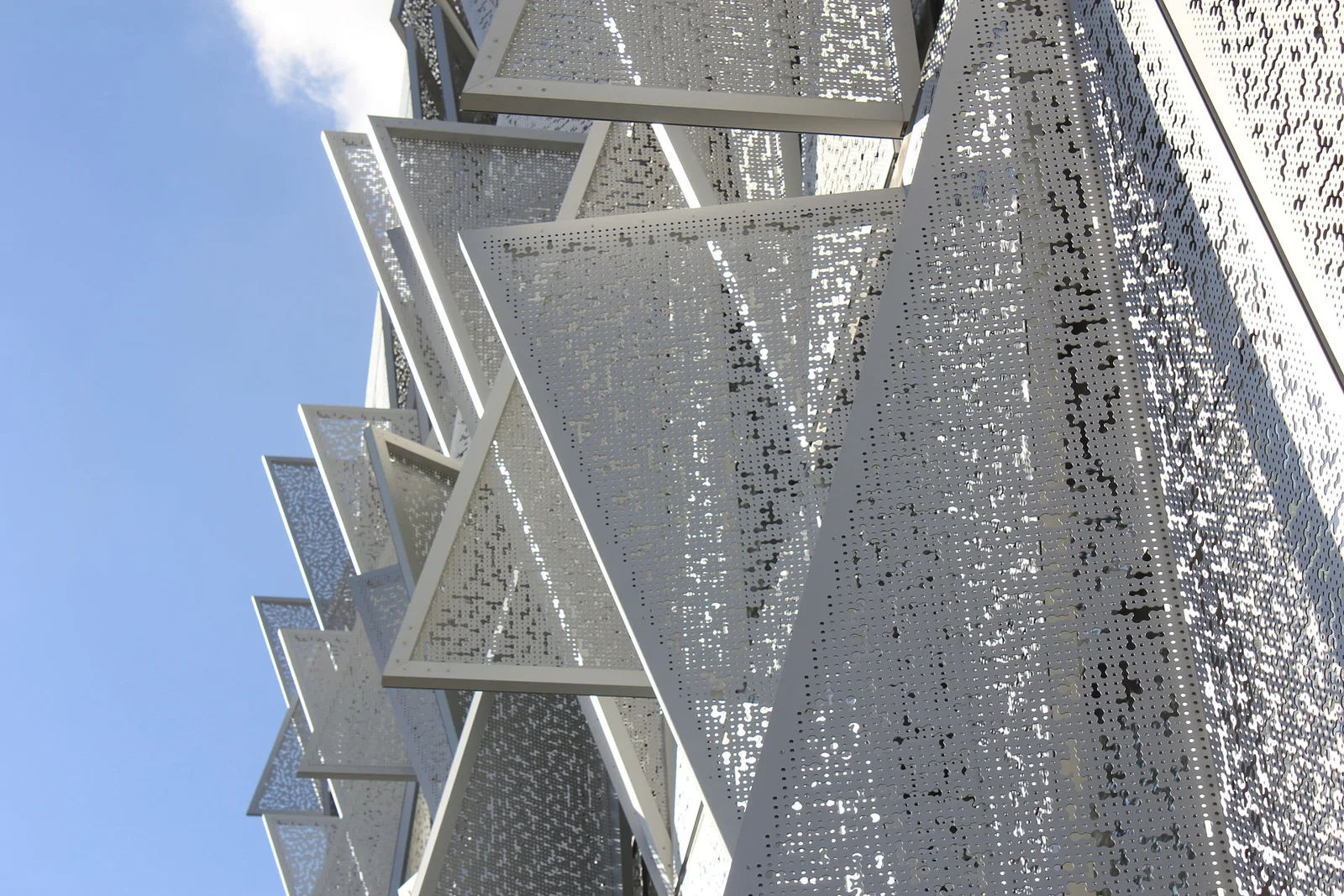
SDU Campus Kolding (Kolding, Denmark, 2014): Designed by Henning Larsen Architects, this university building features 1,600 triangular perforated steel shutters on its facade. Each shutter is connected to sensors that detect sunlight levels and adjust its angle automatically. The system optimizes daylight intake across different building orientations while maintaining consistent interior light quality for lecture halls and offices, demonstrating how standardized modules can create a highly varied kinetic effect at institutional scale.
Step 7: Install, Commission, and Plan for Maintenance
Installation of a kinetic building facade requires closer coordination between trades than a conventional curtain wall. The structural subframe, weatherproofing layer, kinetic modules, electrical wiring, sensor cabling, and control hardware must all come together with tight tolerances. Establish clear installation sequences and test each module individually before integrating it into the building management system.
Commissioning is a critical phase that is frequently underestimated. Walk through every operational scenario: normal daily cycling, high-wind lockout mode, power failure failsafe positions, and maintenance access procedures. Verify that the facade defaults to a safe position (typically fully closed for shading systems) if power or communication is lost. Document all control logic, sensor calibration values, and maintenance procedures in an operations manual for the building owner’s facilities team.
Develop a preventive maintenance schedule from the outset. Moving parts wear, sensors drift, and weather seals degrade. A realistic maintenance plan includes quarterly inspections of actuators and tracks, annual sensor recalibration, and replacement of wear components on a defined cycle. Budget for these costs during the design phase and communicate them clearly to the client, because a dynamic facade that stops working due to deferred maintenance is worse than a static one.
💡 Pro Tip
Always design kinetic facade modules for tool-free panel removal from inside the building. If a technician needs a crane or exterior scaffold to replace a failed actuator on the 20th floor, your maintenance costs will be five to ten times higher than necessary. The best systems use clip-in modules that can be swapped out by two workers from the interior, with the replacement module pre-tested in a workshop.
Notable Dynamic Facade Examples Worth Studying

Studying completed projects is one of the most effective ways to learn what works and what doesn’t in dynamic facade examples. Each project below illustrates a different approach to movement, material, and control.
The Institut du Monde Arabe in Paris, designed by Jean Nouvel and completed in 1987, is the earliest large-scale example of a mechanized responsive facade. Its south elevation features hundreds of camera-iris-like diaphragms that open and close to regulate light. While the mechanical systems experienced long-term maintenance challenges, the project proved the concept of a building envelope that actively manages its own transparency and directly inspired the next generation of responsive facades.
SOMA’s One Ocean Pavilion for the 2012 Yeosu Expo used fiberglass-reinforced polymer lamellas inspired by marine biology. The lamellas twist and flex through actuators, creating a wave-like motion across the facade that reflects the pavilion’s oceanic theme while modulating daylight. The use of GFRP allowed repeated flexion cycles that metal panels could not sustain.
The Sharifi-ha House in Tehran, designed by Alireza Taghaboni of Next Office, takes the concept further by rotating entire rooms rather than individual panels. Three box-like volumes pivot 90 degrees to transform from enclosed interior rooms into open terraces, responding to Iran’s dramatic seasonal shifts between extreme summer heat and cold winters. This project redefines what a dynamic facade can be by making the building envelope and the habitable space one and the same.
The Brisbane Domestic Terminal Car Park, designed by Ned Kahn with Urban Art Projects, takes the opposite approach to high-tech control. Well over 100,000 small aluminum panels are loosely hinged to the parking structure’s exterior, and they simply flutter in the wind. There are no motors, no sensors, and no control systems. The passive kinetic effect creates a shimmering, rippling surface that transforms a utilitarian parking garage into an urban spectacle, proving that dynamic facades need not be complex to be effective.
🔢 Quick Numbers
- Dynamic shading facades can reduce solar heat gain by 20-50% depending on climate and system type (Jamilu et al., Energy Reports, 2024)
- The global smart glass and smart windows market is projected to reach $8.35 billion by 2028 (MarketsandMarkets, 2023)
- Kinetic shading can lower peak cooling loads by 25-40%, enabling smaller HVAC plant sizing (ASHRAE Journal, 2023)

How Does Dynamic Facade Technology Affect Building Performance?

The measurable impact of dynamic facade technology on building performance is the strongest argument for the additional investment these systems require. When properly designed and maintained, a responsive facade functions as an active part of the building’s environmental control strategy, reducing mechanical system sizes, lowering operational energy consumption, and improving occupant comfort.
Energy savings from dynamic shading are most significant in cooling-dominated climates. By blocking direct solar radiation before it reaches the glass, a responsive facade design reduces the thermal load on the air conditioning system. This has a cascading benefit: smaller cooling equipment, lower ductwork volumes, reduced electrical infrastructure, and ultimately less embodied carbon in the building’s mechanical systems. In some cases, the facade savings allow designers to use lighter, more transparent glazing, improving daylight quality and occupant views, which in turn reduces artificial lighting loads.
Daylighting performance is another area where dynamic facades outperform fixed alternatives. A static overhang or fixed louver can only be optimized for one sun angle, typically the worst-case summer scenario. A dynamic system adjusts throughout the day and across seasons, admitting more light when the sun is low and blocking more when it is high. The SDU Campus Kolding’s triangular shutters, for instance, open wide on overcast days to maximize daylight and close progressively as direct sunlight intensifies, maintaining consistent light levels without glare.
Occupant satisfaction studies consistently show that people prefer environments where they can see changes in the exterior and feel connected to outdoor conditions. A facade that visibly responds to the weather creates this connection, making the workspace feel less sealed and artificial. The movement itself, when subtle and well-paced, becomes part of the building’s identity rather than a distraction.
✅ Key Takeaways
- Start every dynamic facade project by defining measurable performance targets linked to site-specific environmental conditions.
- Choose your kinetic mechanism (mechanical, pneumatic, or material-responsive) based on control precision needs, budget, and long-term maintenance capacity.
- Use parametric tools to link facade geometry directly to solar, wind, and daylight data, and validate with simulation before fabrication.
- Build and test a full-scale prototype under realistic conditions to catch mechanical, acoustic, and weather-sealing issues early.
- Plan for maintenance from day one by designing modules for easy access and replacement, and budget ongoing costs into the project proforma.
Final Thoughts

Crafting dynamic facade designs is a multi-disciplinary effort that demands collaboration between architects, structural engineers, facade consultants, control systems specialists, and fabricators from the earliest design stages. The seven-step process outlined here, from defining performance objectives through installation and maintenance planning, provides a framework for managing this complexity without losing sight of either the technical requirements or the design ambition.
The best kinetic facade projects share a common trait: they treat movement as a means to a measurable end, not as spectacle for its own sake. When a facade panel opens, it should be because the building needs more daylight or ventilation in that zone at that moment. When it closes, it should be because solar gain has exceeded the threshold. This performance-driven approach produces facades that age gracefully, because the movement remains purposeful and justified long after the initial novelty fades.
As sensor technology, actuator reliability, and smart materials continue to advance, the cost and complexity barriers that once limited dynamic facades to flagship projects are steadily declining. The techniques and principles described in this guide apply whether you are designing a 50-story tower or a single-family house with operable sun screens. The scale changes, but the process remains the same.
Technical specifications and performance data referenced in this article are based on published project documentation and industry sources. Specific values should be verified by a licensed professional for your project’s unique conditions and local building codes.
FAQ
What is the difference between a kinetic facade and a dynamic facade?
A kinetic facade specifically involves physical movement of components, such as rotating panels, sliding screens, or folding elements. A dynamic facade is a broader term that includes kinetic systems but also covers facades that change properties without mechanical movement, such as electrochromic glass that shifts from transparent to opaque when voltage is applied, or thermochromic coatings that change color with temperature. All kinetic facades are dynamic, but not all dynamic facades are kinetic.
How much does a dynamic facade cost compared to a conventional curtain wall?
Dynamic facades typically cost 2 to 5 times more than a standard unitized curtain wall per square meter, depending on the complexity of the mechanism, the number of moving components, and the level of automation. However, lifecycle cost analysis often narrows this gap because dynamic shading reduces cooling equipment sizes and operational energy costs. Projects in hot climates with high solar loads tend to show faster payback periods.
How long do kinetic facade mechanisms last before they need major repair?
Well-designed and properly maintained mechanical facade systems have demonstrated operational lifespans of 15 to 25 years before major component replacement is needed. Actuators, bearings, and weather seals are the most common wear items. Passive systems like the Brisbane Car Park’s wind-driven aluminum panels have virtually no mechanical wear since they have no motors or joints under load. Pneumatic ETFE systems typically require cushion replacement every 20 to 30 years.
Can dynamic facades be retrofitted onto existing buildings?
Yes, but the structural capacity of the existing facade support system must be evaluated first. Adding a kinetic shading screen to an existing curtain wall means additional dead load, wind load, and dynamic forces that the original structure may not have been designed for. Lightweight systems like tensioned cable nets with aluminum shading fins are the most practical retrofit options, as they add minimal structural demand while providing significant solar control benefits.
What software is used to design dynamic facades?
Most firms use Grasshopper (a visual programming plugin for Rhino) or Dynamo (a visual scripting tool for Revit) for parametric facade design. Environmental analysis relies on tools like Ladybug and Honeybee for solar studies and daylight simulation within the Grasshopper environment. Structural validation of kinetic components is typically done in finite element analysis software such as ANSYS or Strand7, while building energy modeling uses EnergyPlus or IES VE to quantify annual performance.






Studio RAP Clads Beverwijk Substation with 3D Printed Ceramic Facade
Studio RAP and Powerhouse Company clad a Dutch 150 kV switchstation with...
 illustrarch Editoral Team2 Mins read

Facade Design: 10 Ways to Design an Impressive Building Facade
Building facade design is a critical aspect of architecture that goes beyond...
Elif Ayse Sen9 Mins read

How Facades Tell Cultural Stories
How facades tell cultural stories: decode symbols, materials, and climate cues with...
 Sinan Ozen4 Mins read

Top 10 Examples of Dynamic Facade Designs Around the World
Dynamic facades are transforming contemporary architecture with systems that move, react, and...
Elif Ayse Sen8 Mins read


Leave a comment