

Architecture Floor Plan Guide: Types, Elements & How to Read
An architectural floor plan is a scaled, top-down drawing that shows the layout of a building, including walls, rooms, doors, windows, and spatial flow. This guide covers what floor plans include, the types used in practice, how to read them, and the software architects rely on to create them.
 Furkan Sen21 April 202610 Mins read323
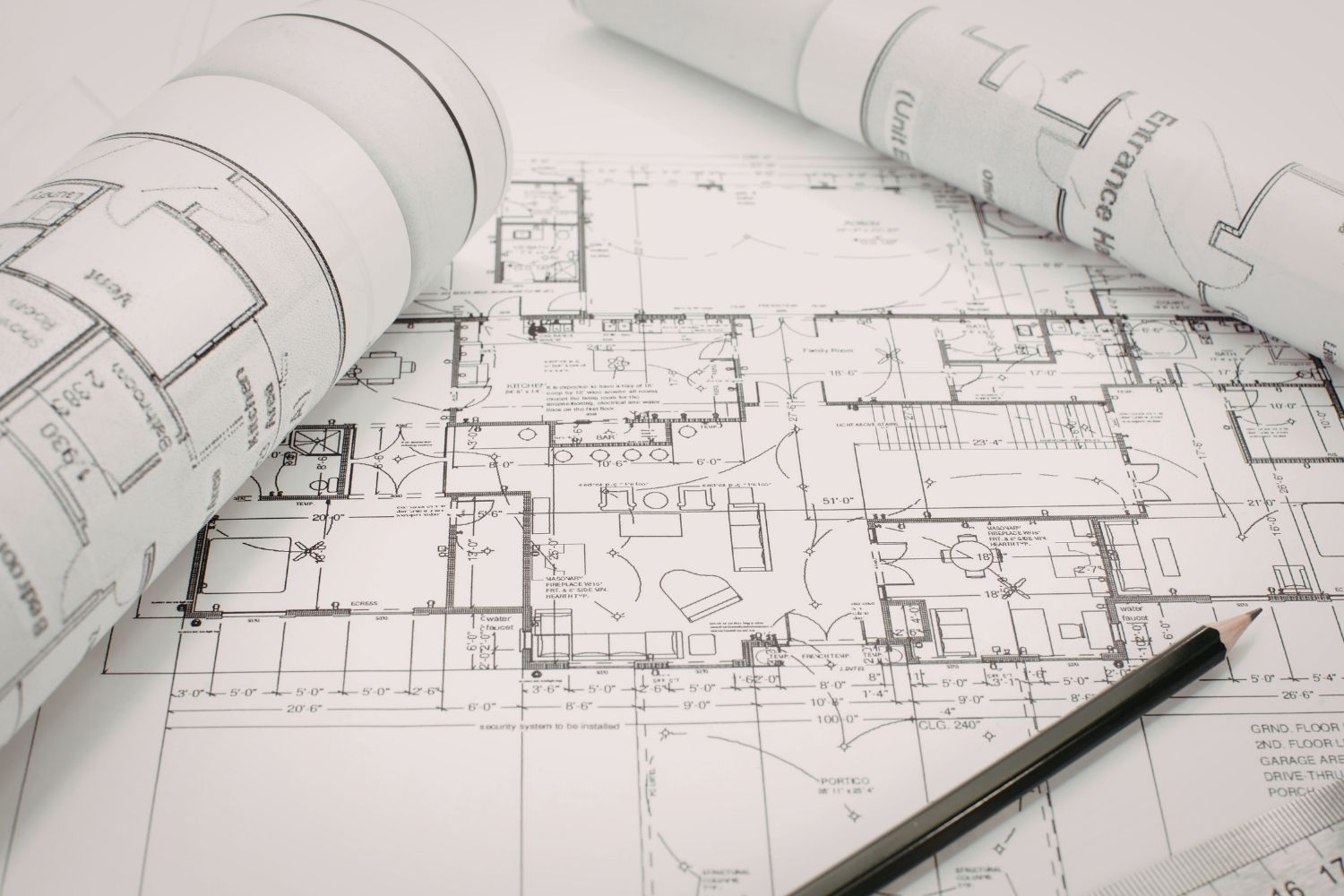
Table of Contents Show
An architecture floor plan is a scaled, horizontal drawing that shows the layout of a building from above, typically cut at about 1.2 meters (4 feet) above floor level. It reveals walls, rooms, doors, windows, and the spatial relationships between all areas of a structure. For architects, clients, and contractors, it is the single most important drawing in any project set.
What Is an Architectural Floor Plan?
An architectural floor plan is a two-dimensional, top-down representation of a building’s interior layout. Imagine slicing through the walls of a structure horizontally and looking straight down at what remains, that cross-section is the floor plan. It shows walls as thick parallel lines, doors as arcs indicating their swing direction, windows as breaks in walls, and rooms labeled with their function and dimensions.
Every construction project begins with a floor plan. Before any structural system is designed, before materials are specified, and before a budget is set, the floor plan establishes the spatial logic of the building. It communicates how people will move through the space, how light enters each room, and how different areas relate to one another. Understanding how to create and present architectural plans starts with mastering this foundational drawing type.
Unlike elevations (which show the vertical exterior) or sections (which cut vertically through the building), floor plans are horizontal cuts. They give the clearest overview of spatial organization: which is why clients, planners, and contractors refer to them first when reviewing a design.
💡 Pro Tip
When reviewing a floor plan for the first time, orient yourself by finding the main entrance first, then trace the circulation path from public to private zones. This mental walk-through reveals whether the spatial flow works before you analyze any individual room. Experienced architects review every plan this way before assessing room sizes or technical details.
Key Elements of an Architectural Floor Plan

Every architectural floor plan shares a core set of elements. These standardized components make plans readable across countries, firms, and software platforms.
Walls
Walls appear as paired parallel lines. Load-bearing walls are typically drawn with a heavier line weight or filled solid to distinguish them from lightweight partitions. Understanding which walls are structural matters significantly during any renovation, removing a partition wall is straightforward, but cutting into a load-bearing wall requires structural engineering input.
Doors and Windows
Doors appear as a gap in the wall with a thin arc showing the swing direction. That arc represents the floor area the door occupies when open, ignoring door swings when arranging furniture is one of the most common planning errors. Windows are shown as a narrow break in the wall with fine lines indicating the glass pane. On modern architectural floor plans, window types are often coded to a schedule that provides dimensions, glazing specifications, and hardware details.
Room Labels and Dimensions
Each room is labeled with its function (Living Room, Bedroom 1, Kitchen) and typically annotated with dimensions along the walls. Dimensions appear as extension lines running parallel to the wall, with the measurement written above. Most residential plans in Europe use metric (meters), while North American plans commonly use imperial (feet and inches). According to RIBA guidance on architectural drawing standards, consistent dimensioning is essential for avoiding construction errors on site.
Scale and North Arrow
Every floor plan carries a scale notation and a north arrow. The scale, typically 1:50 or 1:100 for residential work, tells you how distances on paper translate to real-world dimensions. As explained in our detailed guide to architectural scale, the 1:100 scale is the standard for preliminary design floor plans, while 1:50 is preferred when individual room details need to be clearly readable.
📐 Technical Note
The standard cut height for a floor plan is 1.2 m (approximately 4 feet) above the finished floor level. This height captures windows, door openings, kitchen counters, and standard built-in elements. Some architects shift the cut to 1.5 m when working with high-sill windows or split-level layouts where the standard height would miss critical elements. The cut height should always be noted on the drawing if it deviates from the 1.2 m convention.
Symbols and Drawing Conventions
Beyond walls, doors, and windows, floor plans use a vocabulary of standardized symbols to show fixtures, fittings, and building elements. Stairs appear as a series of parallel lines with an arrow and a notation indicating whether the stair goes UP or DOWN. Bathrooms include scaled representations of toilets, sinks, and bathtubs or showers drawn to approximate their real dimensions. Our guide to architectural drawing symbols covers these conventions in full detail, including the differences between national standards and BIM-based symbol libraries.
Types of Architectural Floor Plans
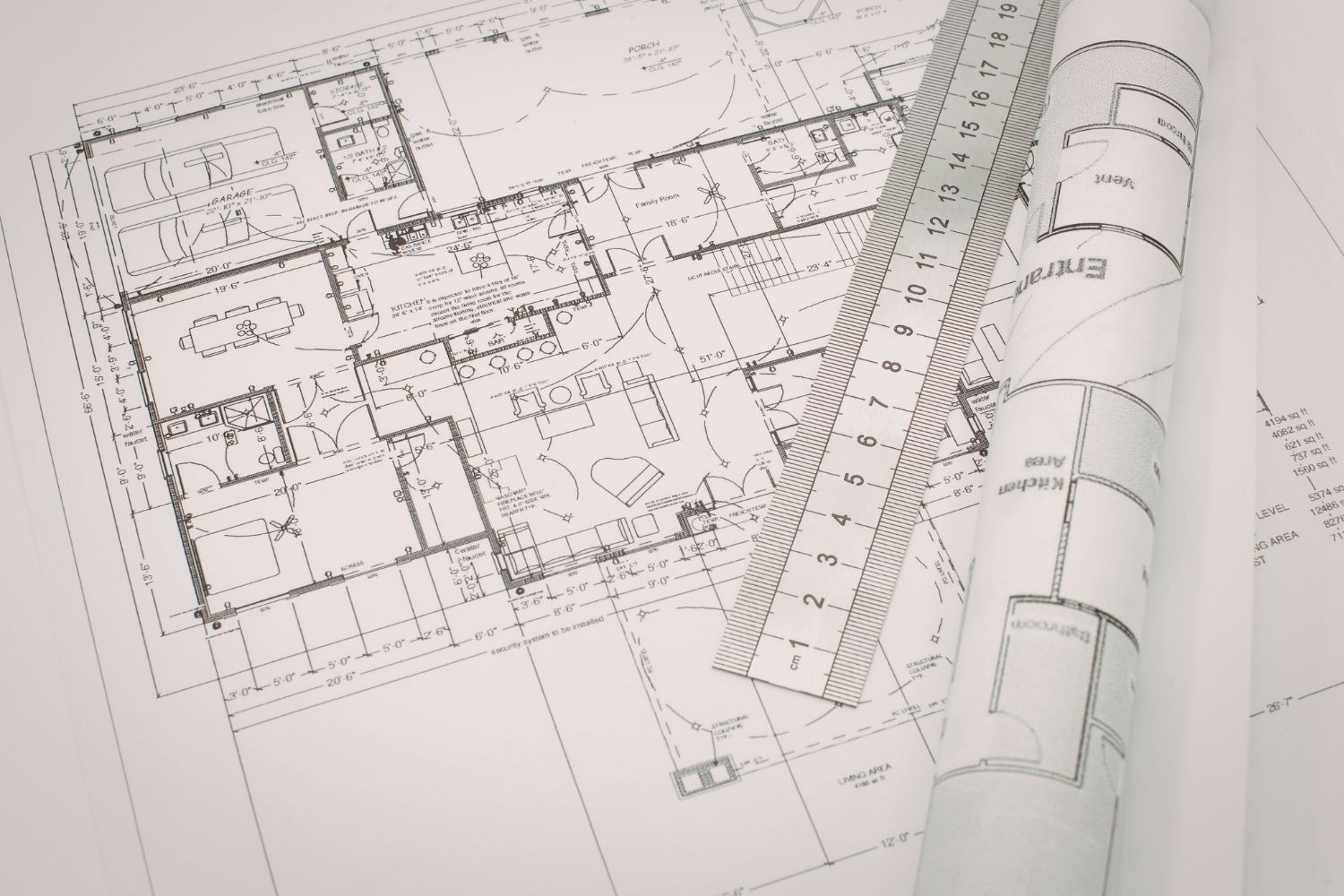


Not every floor plan serves the same purpose. Architects produce different versions of the floor plan throughout a project, each tailored to a specific audience or stage of design.
Schematic Floor Plans
At the earliest design stage, architects draw schematic floor plans, loose, exploratory layouts that test spatial relationships without committing to exact dimensions. These often follow bubble diagram studies that map out adjacency requirements. A schematic plan is enough to review zoning, orientation, and circulation without the time investment of detailed documentation.
Design Development Floor Plans
Once the schematic design is approved, the design development phase produces more precise floor plans. Walls are drawn to actual thickness, structural grids are established, and room dimensions are refined. This version is what most clients see and approve before technical documentation begins.
Construction Floor Plans
Construction floor plans, part of the permit set or contractor set, carry full technical information. They show exact wall thicknesses, structural element positions, door and window schedules, and cross-references to detail drawings. Contractors build directly from these documents, so accuracy is essential. Any error in a construction floor plan can propagate into framing, services installation, and finishes.
As-Built Floor Plans
After construction is complete, as-built floor plans record what was actually built, which sometimes differs from the design drawings. These documents are essential for future renovations, building permits, and facility management. Property managers, engineers, and architects working on existing buildings rely on accurate as-built drawings.
Modern Architecture Floor Plans: Layouts and Design Trends
The way architects design floor plans has shifted significantly over the past century, reflecting changes in how people live and work. Understanding the logic behind modern architectural floor plans helps both professionals and clients make better design decisions.
Open Plan Layouts
The open floor plan, which merges living, dining, and kitchen areas into a single connected space, has been the dominant residential layout since the mid-century modern era. Post-World War II architects, influenced by the Bauhaus movement’s emphasis on function and spatial flow, began removing the walls separating service and social spaces. Today, open layouts remain the most requested residential configuration because they maximize daylight penetration and support contemporary, flexible living patterns. For a closer look at how this trend developed, our article on the evolution of modern interior architecture traces the spatial shifts from Bauhaus to smart homes.
Zoned Floor Plans
More recent residential floor plans often layer open social zones with defined private clusters. Rather than fully open layouts, architects now frequently design clear separations between the public zone (entry, living, dining, kitchen) and the private zone (bedrooms, bathrooms, studies). This zoning strategy, which typically shows up clearly in floor plan analysis, provides privacy and noise control that pure open plans cannot deliver. The transition from bubble diagram to zoned floor plan is covered in detail in our guide on how to create bubble diagrams.
Multi-Story Floor Plans
When footprint area is limited, architects stack functions vertically. Multi-story floor plans distribute private areas (bedrooms, bathrooms) on upper floors and social functions on the ground level. Each floor requires its own plan drawing, and the relationship between floors, stair position, structural alignment, service stack location, must be coordinated across all levels simultaneously. Our overview of contemporary house design trends examines how two-story configurations handle these challenges while maximizing natural light and outdoor connectivity.
🎓 Expert Insight
“A plan is a diagram of a flow. This is a fact that is not sufficiently realized.”
Le Corbusier, Towards a New Architecture (1923)
This observation remains as relevant today as it was a century ago. The most successful modern floor plans are not collections of rooms, they are sequences of experiences, where movement from one space to another is as considered as the rooms themselves. Architects who internalize this principle consistently produce floor plans that feel intuitive to move through.
Before the walls are drawn, it helps to see the plan as territory. Our free zoning diagram maker colours a floor plate by use and tells you what share is public, private, service and circulation.
How to Read an Architectural Floor Plan

Reading a floor plan is a learnable skill. Whether you are a student reviewing your first set of drawings or a client assessing a design, the following approach gives you a reliable framework.
Step 1: Find the Scale and North Arrow
Before interpreting anything else, locate the scale and the north indicator. Without the scale, you cannot judge whether a room is 12 square meters or 25 square meters. The north arrow tells you how the building orients to the sun, a south-facing living room will behave very differently from a north-facing one across a full year of daily use.
Step 2: Identify the Entrance and Trace Circulation
Find the main entrance, then mentally trace the path from arrival to each room. Good circulation design avoids long dead-end corridors and creates a logical sequence from public to private. If you find yourself crossing through a bedroom to reach a bathroom, that floor plan has a circulation problem.
Step 3: Check Room Proportions and Dimensions
Note the dimensions of each room. As a practical benchmark, a standard single bedroom is typically around 10 square meters, a master bedroom around 14-20 square meters, and a comfortable living area for a family starts at approximately 20-25 square meters. Our article on essential things to consider when designing a floor plan provides specific dimension guidelines for each room type.
Step 4: Assess Natural Light and Ventilation
Using the north arrow, evaluate how sunlight will reach each room at different times of day. Check that key spaces, living rooms, kitchens, home offices, receive adequate light. Also check that windows are placed on opposite walls where possible to allow cross-ventilation, which reduces cooling loads and improves air quality. The professional approach to presenting floor plans always includes orientation analysis as part of the design review.
Step 5: Read the Door Swings
Each door arc represents the zone swept by the door as it opens. These zones block wall space and floor area. In a small bathroom or a compact kitchen, a poorly positioned door can make furniture arrangement impossible. Always check that no door swing conflicts with another door, with a corridor, or with critical furniture positions.
⚠️ Common Mistake to Avoid
Many people confuse architectural floor plans with site plans. A floor plan shows the interior layout of a specific floor within the building. A site plan shows how the entire building sits on the property, including its relationship to boundaries, landscaping, driveways, and neighboring structures. Both are produced for every project, but they answer completely different questions. Reviewing only the floor plan without the site plan means you cannot assess orientation, setbacks, or how the building relates to the street and surroundings.
Revit Architecture Floor Plan: BIM and Digital Floor Plans

Software tools have fundamentally changed how architectural floor plans are produced, reviewed, and coordinated. While AutoCAD dominated 2D drafting for decades, BIM platforms have become the standard for professional practice.
In Autodesk Revit, a floor plan is not drawn independently. It is generated automatically as a horizontal view cut through a 3D building model. When a wall is modeled in Revit, its floor plan representation, its section cut, and its 3D visualization are all created simultaneously. Any change to a wall dimension updates all three views at once. This eliminates the coordination errors that are common when plans, sections, and elevations are drafted separately in 2D. For students learning the platform, our article on Revit for architecture students explains how to set up floor plan views, manage levels, and produce construction-ready documentation from a single BIM model.
ArchiCAD follows similar BIM principles, with the architectural floor plan generated from the 3D model as a live, coordinated view. The choice between Revit and ArchiCAD often depends on firm size and project type, a comparison of both platforms and their workflows is covered in our Revit vs ArchiCAD guide.
For early-stage design, SketchUp and AutoCAD remain useful. SketchUp allows quick 3D massing studies from which rough floor plans can be derived, while AutoCAD’s 2D precision is still valued for producing construction details and technical documentation at large scales. Our overview of architectural design software and features compares all major tools across drawing, modeling, and rendering workflows.
💡 Pro Tip
When setting up a Revit floor plan view for client presentation, set the detail level to “Medium” and adjust the view range so the cut plane falls exactly at 1.2 m above floor level. Then use view filters to grey out structural elements and emphasize spatial elements like walls and openings. This produces a cleaner, more readable floor plan for client review without sacrificing the technical accuracy required for construction documentation.
What Makes a Good Architectural Floor Plan?
Technical accuracy is necessary but not sufficient. The best architectural floor plans achieve something harder to quantify: they make spatial sense, they feel logical when you walk through them, and they serve the people who will actually use the building.
A well-designed architectural floor plan distributes natural light efficiently, with primary living spaces oriented to benefit from direct sun. It separates noisy zones (kitchen, living room) from quiet zones (bedrooms, study) without creating long, wasted corridors. Storage is integrated throughout, not concentrated in a single large space, so it serves each area it belongs near.
Accessibility is increasingly a baseline requirement rather than an optional consideration. Door widths of at least 900 mm, turning circles of 1,500 mm in bathrooms, and level thresholds are standard in many jurisdictions under building codes influenced by ADA (Americans with Disabilities Act) in the US and Part M of the Building Regulations in the UK. Reviewing a floor plan for accessibility means checking that these dimensions are met in all critical routes through the building.
For residential projects in particular, the floor plan also reflects lifestyle. Families with young children need different spatial logic than professionals working from home. Getting the brief right before the floor plan is drawn, understanding how the client actually lives rather than how they think they live, is what separates good architectural practice from mechanical plan production. Our article on creating architectural plans for interior designers examines how lifestyle analysis feeds directly into spatial decisions at the floor plan stage.
📌 Did You Know?
The earliest known architectural floor plans date to ancient Mesopotamia. A clay tablet from around 2100 BCE, discovered at the ruins of Nippur (modern Iraq), shows a scaled ground plan of a building with rooms and wall thicknesses indicated. It is considered one of the oldest surviving examples of architectural drawing. The principles it demonstrates, scaled representation, wall thickness, and room labeling, remain the foundation of architectural floor plans today.
✅ Key Takeaways
- An architectural floor plan is a scaled, horizontal section cut through a building at approximately 1.2 m above floor level, showing walls, doors, windows, room layouts, and dimensions.
- Floor plans exist in several versions across a project lifecycle: schematic, design development, construction, and as-built, each serving a different audience and purpose.
- Key elements include walls (with load-bearing walls distinguished by line weight), door swings, window positions, room labels, dimensions, scale notation, and a north arrow.
- Modern BIM software like Revit and ArchiCAD generates floor plans automatically from a 3D model, ensuring all drawing types remain coordinated when changes are made.
- Reading a floor plan effectively means starting with scale and orientation, tracing the circulation path, checking room proportions, assessing natural light, and reviewing door swings for conflicts.
- A good floor plan does more than meet technical requirements, it reflects the lifestyle and movement patterns of the people who will occupy the building.








Interior Design for Commercial Spaces: Enhancing Functionality and Brand Identity
Commercial interior design has to serve brand, function and regulation at once....
 Begum Gumusel4 Mins read

Futuro House Production Revived in Finland After Decades-Long Hiatus
A Facebook listing for abandoned moulds led to the first new Futuro...
 illustrarch Editoral Team3 Mins read

Building Your Dream Home in NSW: What You Should Know About Montgomery Homes
Montgomery Homes has been building across Sydney, Newcastle, the Hunter, Wollongong and...
illustrarch Editoral Team4 Mins read

Designing a Home Theater: Where Drapery Fits Into the Plan
In a media room the curtains are a performance layer, not decoration....
illustrarch Editoral Team3 Mins read


Leave a comment