

Best Examples of Modern Architecture: Steel and Glass Buildings That Shaped a Movement
Six buildings changed architecture forever by proving that steel and glass could replace stone and ornament. This article covers the Barcelona Pavilion, Villa Savoye, Farnsworth House, Glass House, Seagram Building, and Lake Shore Drive Apartments, explaining what each contributed to modernism and why they still matter to architects today.
 Furkan Sen18 June 20267 Mins read165
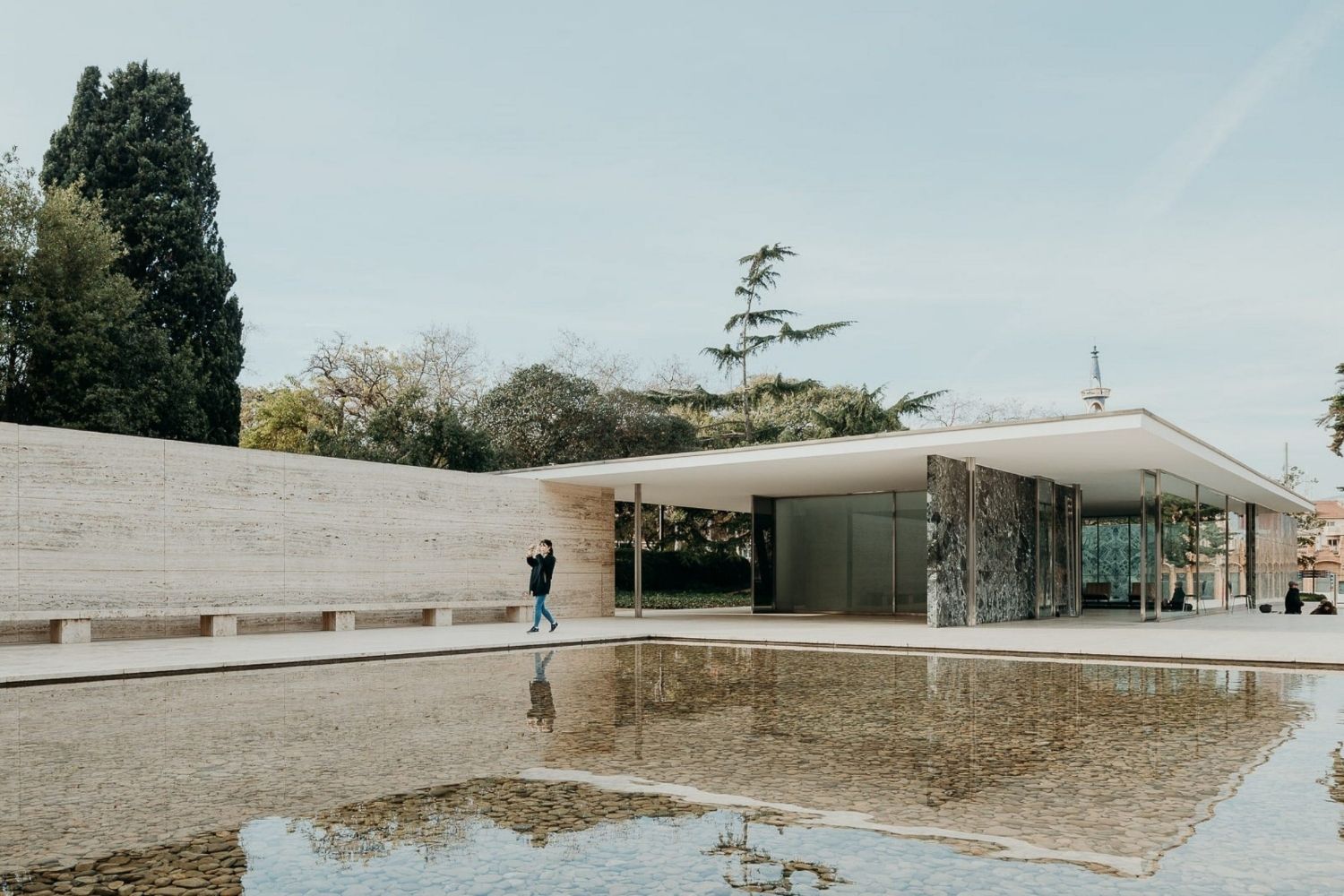
Table of Contents Show
The best examples of modern architecture are buildings that stripped away ornament and let structure speak for itself. Designed between the late 1920s and the late 1950s, a handful of steel-and-glass projects in Europe and the United States established the principles that still guide architects today, from open floor plans to curtain-wall facades. These modern architecture examples remain essential references for any architect or student of the built environment.
Modern architecture did not arrive as a single event. It grew from a series of individual buildings, each one testing a different idea about what a structure could be when freed from historical decoration. The six projects below, built across three decades and two continents, represent the clearest answers to that question. Each one pushed steel, glass, and reinforced concrete into roles that previous generations would not have imagined, and together they form the core reference library for any serious study of modernism architecture examples.
Why Steel and Glass Defined Modernism in Architecture
Before the 1920s, most buildings depended on load-bearing masonry walls. Steel changed this equation entirely. A steel frame could carry the full weight of a building, which meant exterior walls no longer needed to be thick stone or brick. Glass could fill the gaps instead, turning facades into transparent membranes rather than solid barriers. This structural shift gave architects three things at once: open interior spaces, abundant natural light, and a visual honesty that showed how a building actually held itself up.
Le Corbusier, Ludwig Mies van der Rohe, and Philip Johnson each took this basic technology in different directions. Le Corbusier used reinforced concrete and pilotis to lift buildings off the ground. Mies refined the steel frame until it nearly disappeared, producing volumes of glass that seemed to float. Johnson absorbed both influences and reinterpreted them for an American audience. Their combined impact on modern architecture is impossible to overstate.
🎓 Expert Insight
“Architecture starts when you carefully put two bricks together. There it begins.” — Ludwig Mies van der Rohe, Architect
This often-cited remark captures Mies’s belief that architecture lives in construction detail, not decoration. Every building on this list reflects that idea: the design is inseparable from how the materials meet.
Barcelona Pavilion: Where Modern Architecture Began
The Barcelona Pavilion was designed by Mies van der Rohe and Lilly Reich as Germany’s national pavilion for the 1929 International Exposition. It held no exhibits. The building itself was the exhibit, and it announced a completely new architectural language. Eight chrome-plated steel columns supported a flat roof slab, while free-standing planes of onyx, marble, and glass defined spaces without enclosing them. Walls slid past each other rather than meeting at corners, creating a continuous flow between indoors and outdoors that no previous building had achieved at this level of refinement.
The original pavilion was dismantled in 1930 after the exposition closed. It was reconstructed on its original site in 1986 by architects Ignasi de Sola-Morales, Cristian Cirici, and Fernando Ramos, using the same types of stone sourced from the same quarries. Today it operates as a museum and remains one of the most visited architectural pavilions in the world. The Barcelona Chair, which Mies and Reich designed specifically for this space, became one of the most recognizable furniture pieces of the 20th century.
Villa Savoye: Le Corbusier’s Five Points Built in Concrete
Completed in 1931 on the outskirts of Paris, Villa Savoye is Le Corbusier’s most complete demonstration of his Five Points of Architecture: pilotis, a free plan, a free facade, ribbon windows, and a roof garden. The house sits on slender concrete columns that lift the white rectangular volume above a green meadow, freeing the ground level for car circulation (Le Corbusier designed the turning radius of the pilotis grid around a 1929 automobile). Ribbon windows run the full length of each facade, distributing light evenly across every room.
What makes Villa Savoye one of the strongest examples of modernism architecture is how every element depends on every other. Remove the pilotis, and the open ground floor disappears. Remove the free plan, and the interior cannot flow as it does. Le Corbusier designed the building as a system, not a collection of features, and that systems thinking influenced generations of architects who followed. The house is now a UNESCO World Heritage Site and receives thousands of visitors each year. A detailed look at Le Corbusier’s design philosophy shows how Villa Savoye served as the proving ground for ideas he would apply at urban scale in later decades.
Farnsworth House: A Glass Box in the Illinois Landscape
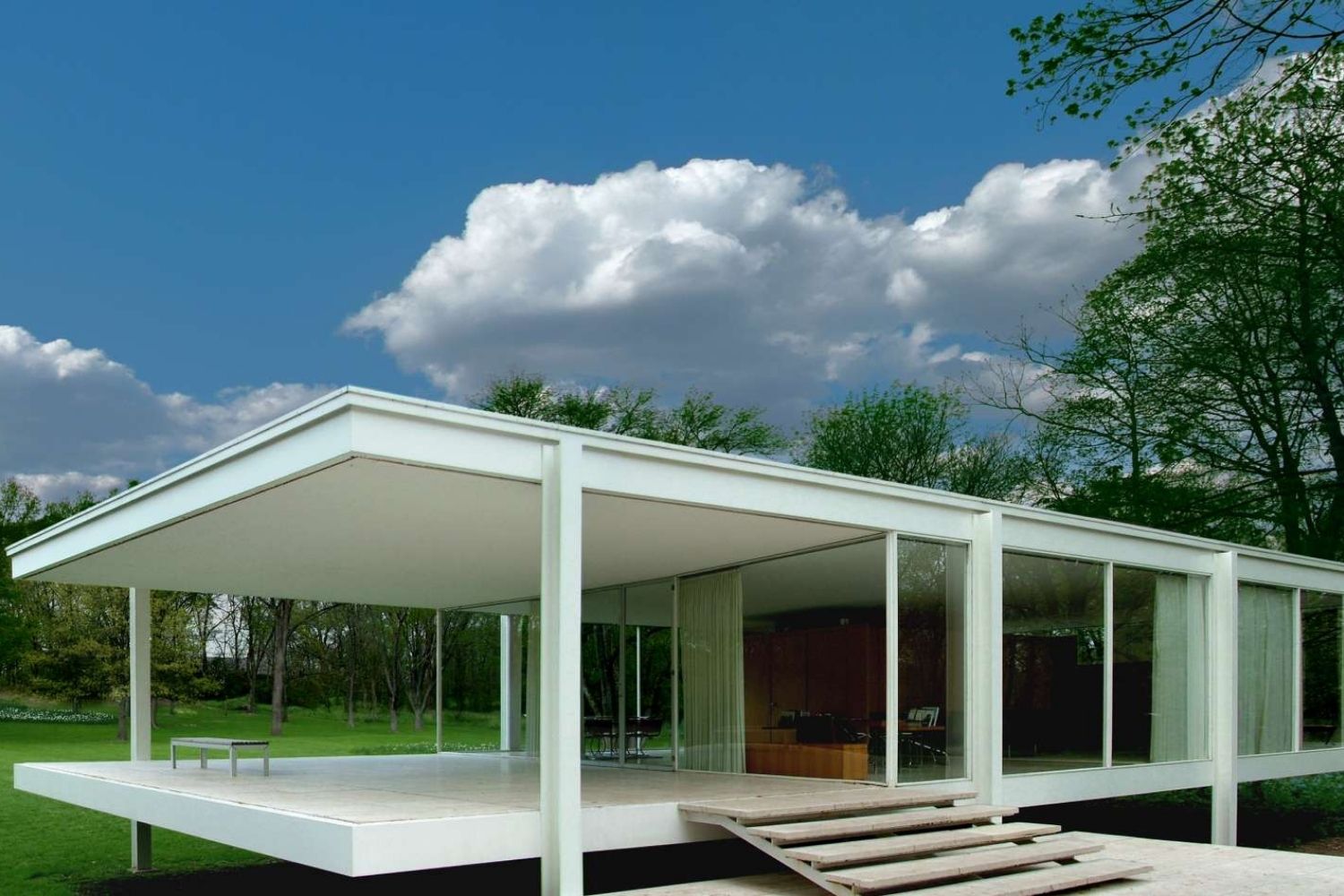
Mies van der Rohe designed the Farnsworth House in 1945 for Dr. Edith Farnsworth as a weekend retreat along the Fox River in Plano, Illinois. Construction finished in 1951. The building is about as reduced as architecture can get: eight white-painted steel I-columns support two horizontal slabs (floor and roof), and the entire perimeter is floor-to-ceiling glass. There are no interior walls apart from a central service core containing the kitchen, bathrooms, and mechanical systems.
The house sits roughly 1.6 meters above the floodplain, connected to the ground by a series of travertine terraces. This elevation gives it a floating quality that photographs cannot fully convey. Living inside the Farnsworth House means inhabiting a single room where the landscape becomes the primary visual experience in every direction. The National Trust for Historic Preservation acquired the house in 2003 and officially renamed it the Edith Farnsworth House in 2021 to recognize Dr. Farnsworth’s role as both patron and design collaborator.
📐 Technical Note
The Farnsworth House measures approximately 1,500 square feet (140 square meters) of enclosed space. Its eight steel columns are welded directly to the floor and roof channels, with no bolted connections visible on the exterior. The 28-foot spans between columns allowed Mies to achieve completely uninterrupted glass walls, a structural feat that required precise engineering of the wide-flange steel sections to prevent deflection under wind and snow loads.
The Glass House, Connecticut: Philip Johnson’s Transparent Retreat
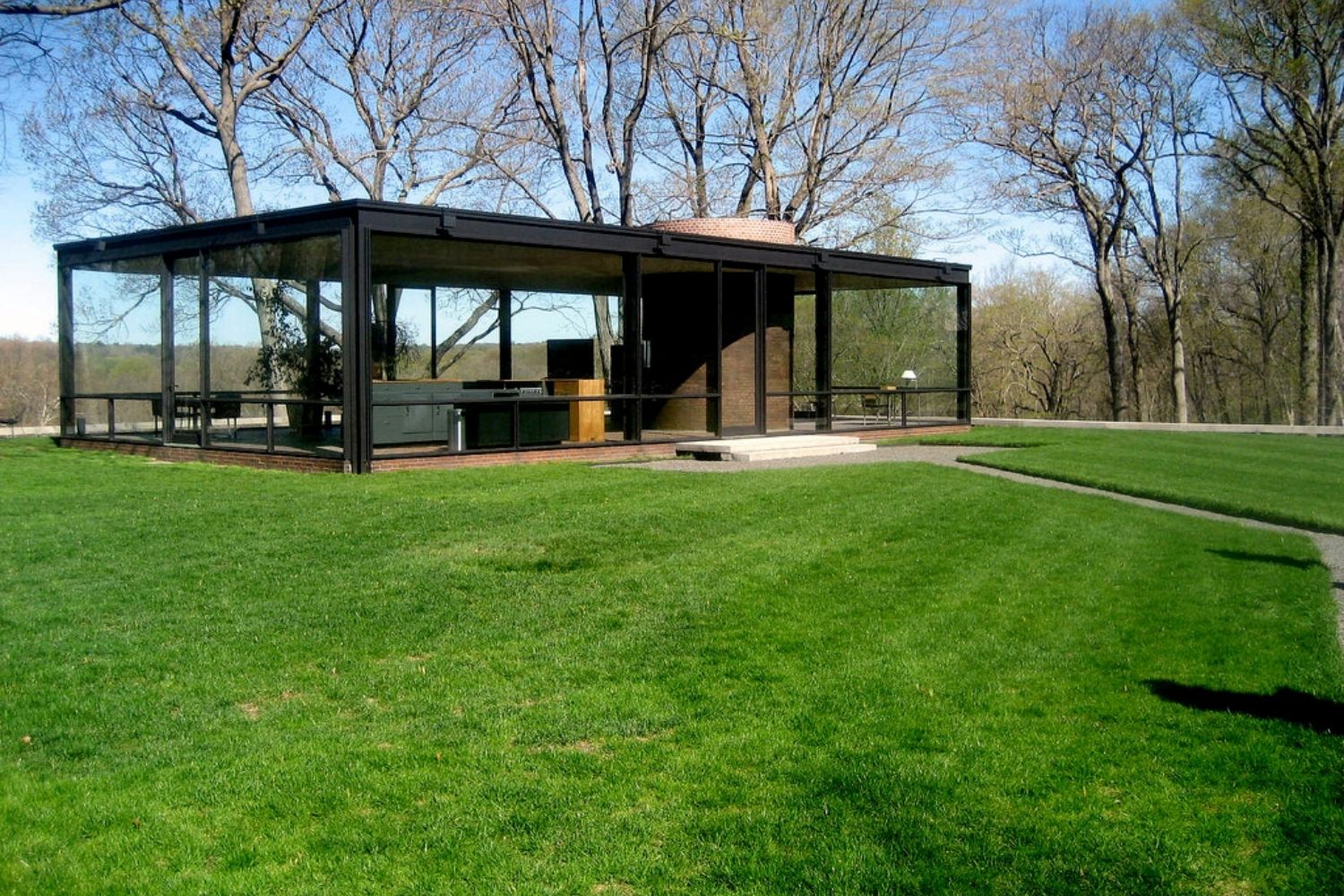
Philip Johnson completed the Glass House in New Canaan, Connecticut, in 1949, two years before the Farnsworth House was finished (though Mies’s design predated Johnson’s). Johnson openly acknowledged Mies as his primary influence, but the two houses differ in important ways. Where the Farnsworth House floats above its site, the Glass House sits directly on the ground on a low brick platform. Where Mies used white-painted steel, Johnson chose black-painted structural sections that read as dark lines against the surrounding landscape.
The Glass House was Johnson’s own residence, and he lived there for 58 years until his death in 2005. Over those decades he added 13 additional structures to the 49-acre estate, each representing a different phase of his evolving architectural interests, from a painting gallery buried underground to a postmodern gatehouse. The property is now a National Trust Historic Site open for public tours. As a pair, the Glass House and the Farnsworth House represent the two purest expressions of the glass pavilion concept in residential architecture.
Seagram Building: The Modern Skyscraper Perfected
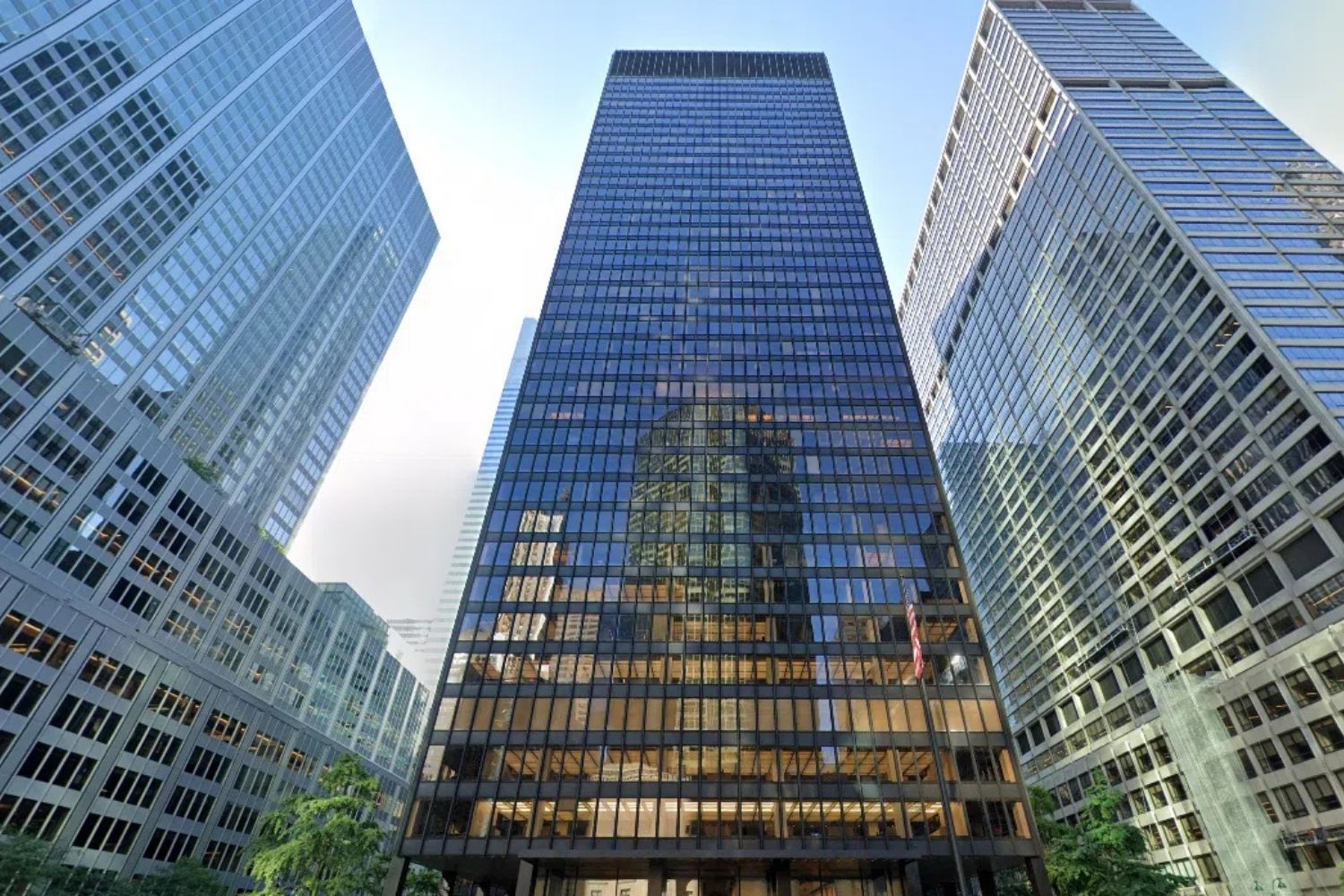
The Seagram Building in New York, completed in 1958, brought Mies van der Rohe’s steel-and-glass vocabulary to the scale of a 38-story office tower. The building sits on Park Avenue behind a granite-paved plaza that was radical at the time: instead of filling the entire lot, Mies pulled the tower back from the street and gave the city an open public space. This setback violated the usual Manhattan approach of maximizing floor area, but it produced one of the most photographed urban compositions in American architecture.
Mies designed the building on a 28-foot structural grid subdivided into 4-foot-8-inch modules, a dimensional system that runs from the plaza paving through the lobbies and up through every office floor. The exterior uses bronze-tinted glass and flat bronze I-beam mullions, giving the tower a warm, dark tone that separates it from the aluminum-and-clear-glass towers that followed. Philip Johnson designed the interiors of the Four Seasons Restaurant on the ground floor, connecting both architects to the same project. The Seagram Building’s influence on International Style skyscraper design was so strong that cities around the world spent the next two decades building variations of it.
What Makes Lake Shore Drive Apartments Significant?
The 860-880 Lake Shore Drive Apartments in Chicago, completed in 1951, were among the first high-rise residential buildings to use a glass-and-steel curtain wall. Mies van der Rohe designed the twin 26-story towers as a pair, set at right angles to each other on a shared podium overlooking Lake Michigan. The structural steel frame is expressed on the exterior through applied I-beam mullions that give the facades a vertical rhythm, a detail Mies included to maintain visual order across the repetitive grid of windows.
These apartments proved that the ideas Mies had tested at domestic scale in the Farnsworth House could work for multi-unit housing. The open floor plans allowed residents to configure their own interiors, and the floor-to-ceiling glass gave every unit panoramic views of the lake and the city skyline. The Lake Shore Drive towers became the direct prototype for glass apartment buildings worldwide, and their influence is visible in residential high-rises from Chicago to Hong Kong. For a closer look at Mies van der Rohe’s design principles, the trajectory from Barcelona to Lake Shore Drive reveals a remarkably consistent vision applied at increasing scale.
🏗️ Real-World Example
860-880 Lake Shore Drive (Chicago, 1951): These twin towers were so influential that Chicago’s zoning board changed local building codes partly in response to the construction methods Mies introduced. The welded steel frame and curtain-wall system became standard practice for American high-rise construction throughout the 1960s and 1970s, directly shaping the skylines of dozens of cities.
The Bigger Picture
Every glass tower, open-plan office, and minimal house built in the last seven decades carries DNA from these six buildings, widely considered the best examples of modern architecture from the 20th century. What is easy to forget is that none of them were safe bets when they were built. The Barcelona Pavilion existed for less than a year before being torn down. Villa Savoye leaked badly and was nearly demolished during World War II. The Farnsworth House floods regularly. These were experiments, and their survival (or reconstruction) says as much about how we value ideas as it does about how we build. The next time you walk through a building where the structure disappears and the glass takes over, you are standing inside a conversation that started in Barcelona in 1929 and has not ended yet.









Oscar Niemeyer’s Cathedral of Brasília: The Hyperboloid Concrete Hymn
The Cathedral of Brasília reads as a single gesture, yet it stood...
Furkan Sen7 Mins read

What Technology Does a Modern Workplace Need?
A modern workplace needs more than fast computers. A framework covering network,...
 illustrarch Editoral Team8 Mins read

How Do You Choose Durable Shutters That Suit Your Budget?
Shutters can look identical in a showroom and perform very differently after...
illustrarch Editoral Team8 Mins read
How Can Window Coverings Improve Indoor and Outdoor Comfort?
Window coverings work as a home’s adjustable climate layer. A practical guide...
illustrarch Editoral Team9 Mins read




Leave a comment