

Willis Tower (Sears Tower): Chicago’s Engineering Marvel
Willis Tower, formerly the Sears Tower, remains one of the tallest buildings in the Western Hemisphere. This article covers the tower's bundled tube structural system by Fazlur Khan, its 103rd-floor Skydeck, the building's history as Sears headquarters, and the $500 million renovation that reshaped its ground-level experience.
 Furkan Sen17 June 20266 Mins read425
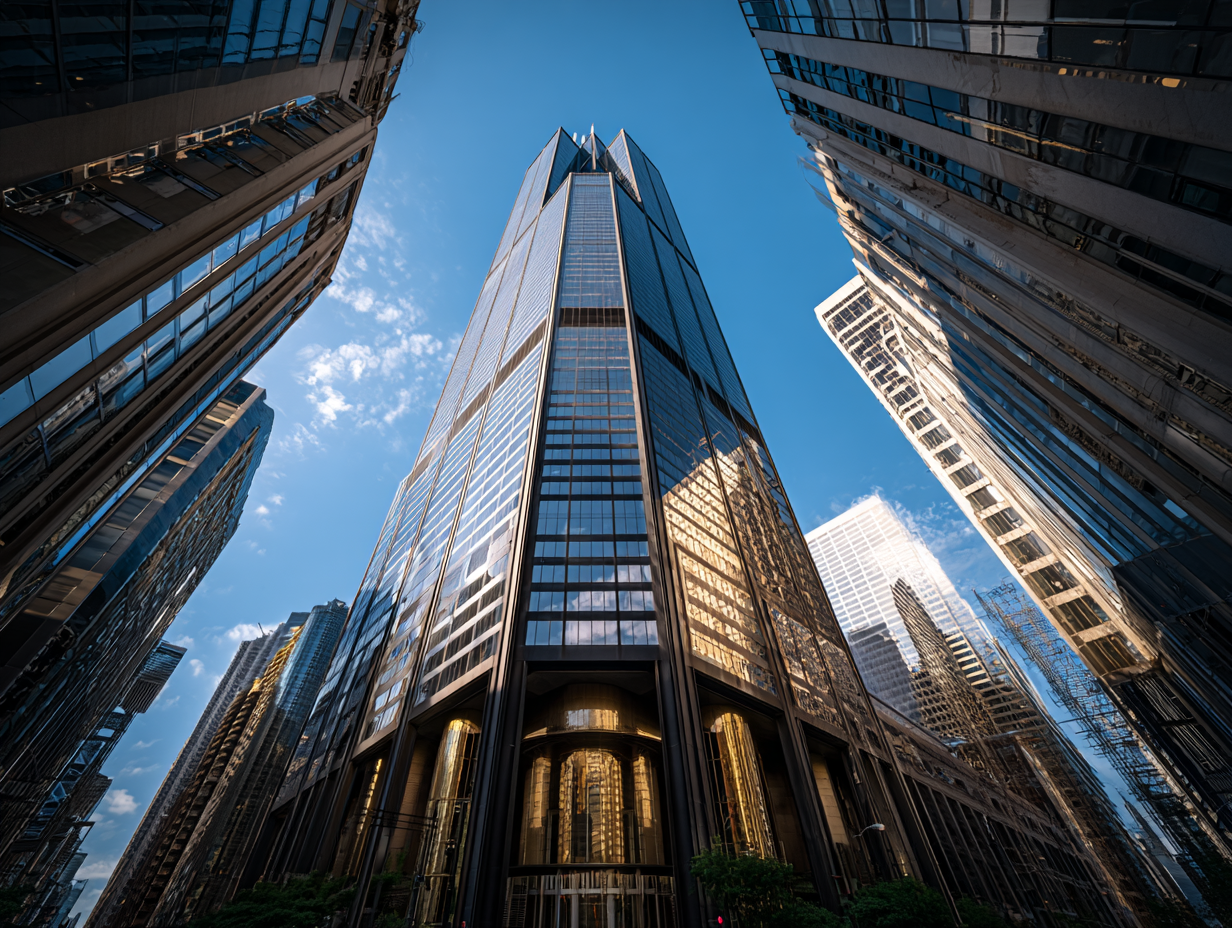
Table of Contents Show
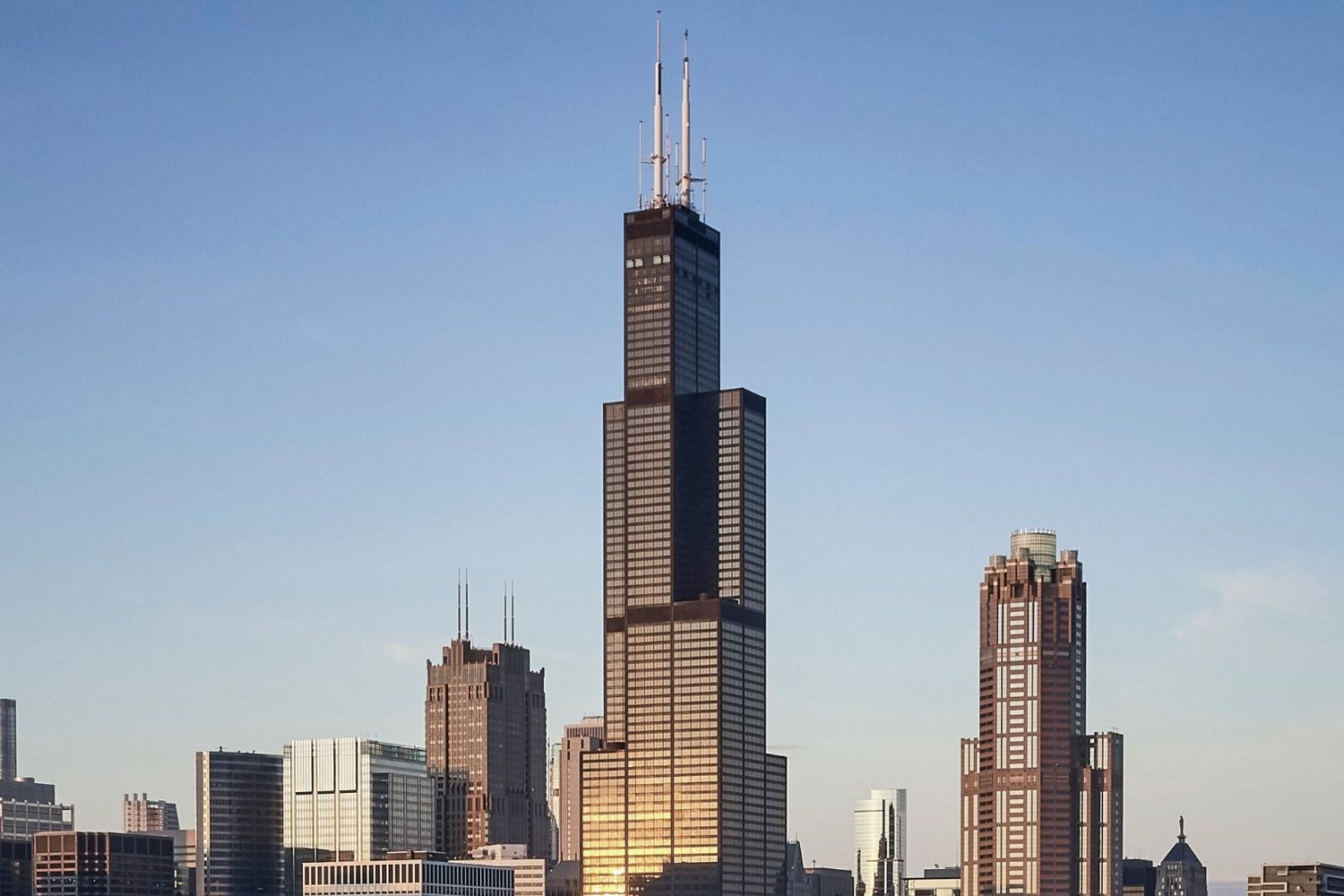
Willis Tower is a 110-story, 1,451-foot (442 m) skyscraper in Chicago’s Loop district, originally built as the headquarters for Sears, Roebuck & Co. and completed in 1974. Designed by Skidmore, Owings & Merrill (SOM), it held the title of the world’s tallest building for 25 years and introduced the bundled tube structural system that reshaped how engineers approach supertall construction.
Few buildings have shaped a city’s identity the way Willis Tower has shaped Chicago. Originally known as the Sears Tower, this black-clad giant on South Wacker Drive was the result of corporate ambition meeting structural genius. At its core is a design philosophy developed by engineer Fazlur Rahman Khan, one that allowed the tower to reach heights previously considered impractical for steel-framed buildings. The history of skyscraper architecture took a sharp turn when this building opened its doors, and its influence on tall building design persists decades later.
How Willis Tower Building Became the World’s Tallest
In the late 1960s, Sears, Roebuck & Co. was the largest retailer in the United States. The company had outgrown its scattered office space across Chicago and needed a single headquarters large enough to house over 7,000 employees, with room for future expansion. Sears hired SOM to deliver a tower that would also serve as a statement of corporate dominance.
Architect Bruce Graham and structural engineer Fazlur Rahman Khan took on the project. Khan had already earned recognition for his work on the John Hancock Center, where he applied a trussed tube system. For the Sears Tower project, Khan developed something entirely new: the bundled tube system. Construction began in 1970, and the building opened to tenants in September 1973. When it topped out, it surpassed the World Trade Center’s Twin Towers in New York to become the tallest building in the world, a record it held until 1998 when the Petronas Towers in Kuala Lumpur surpassed it.
The total construction cost was approximately $175 million (roughly $1.2 billion in today’s dollars). Sears occupied the building until the mid-1990s, eventually selling it in 1994. The naming rights expired in 2003, and in 2009, the London-based insurance broker Willis Group secured the naming rights, officially renaming the tower to Willis Tower.
🎓 Expert Insight
“The structural engineer’s aesthetic and the architect’s should grow from a common base.”
Fazlur Rahman Khan, Chief Structural Engineer, SOM
Khan’s belief that structure and architecture should be inseparable drove the Willis Tower’s design. The building’s stepped profile is not decorative; it is a direct expression of the structural logic underneath, where tubes terminate at different heights to reduce wind loads and material use.
What Makes Willis Tower Height So Remarkable?
Willis Tower stands 1,451 feet (442 m) to the roof. Including its antenna extensions, the total height reaches 1,729 feet (527 m). The building has 110 above-ground stories and three basement levels, with more than 4.5 million square feet of total floor space. For context, the tower contains enough concrete to build an eight-lane, five-mile highway, and enough steel (76,000 tons) to build roughly 50,000 automobiles.
The tower’s height was not simply a vanity metric. The Willis Tower building needed to accommodate Sears’ projected workforce growth while also providing rentable space for outside tenants. Tall floor plates on lower levels gave Sears the open office space it required, while narrower upper floors created premium, high-revenue office suites with panoramic views. This programmatic logic directly influenced the structural setbacks that define the tower’s silhouette against the Chicago skyline.
The Bundled Tube Structural System
Before Khan’s innovation, most tall buildings relied on heavy internal bracing to resist wind loads, which consumed interior space and added material cost. Khan’s earlier tube concept, applied at the John Hancock Center, treated the entire building perimeter as a hollow structural tube. For Willis Tower, he went further by clustering nine independent 75-foot-square tubes in a 3×3 grid, connecting them at each floor to act as a single unit.
This design solved multiple problems at once. The tubes reinforced each other laterally, making the overall structure far more efficient than a single tube of the same height. Because individual tubes could terminate at different levels, the building steps back as it rises: all nine tubes reach the 50th floor, seven continue to the 66th, five reach the 90th, and only two extend to the full 110-story height. This staggered profile disrupts wind vortex formation and reduces the building’s overall wind load, a critical concern at 1,451 feet.
The system also eliminated the need for interior columns between the core and the perimeter walls, producing column-free office floors of up to 12,000 square feet. According to the Chicago Architecture Center, this innovation ushered in a new era of skyscraper engineering that made taller, lighter, and more efficient towers possible worldwide.
📐 Technical Note
Willis Tower uses approximately 76,000 tons of structural steel across its nine bundled tubes. Each tube measures 75 feet by 75 feet (23 m x 23 m) in plan. The caisson foundations extend roughly 100 feet below ground into hardpan clay. The exterior cladding consists of black anodized aluminum panels with bronze-tinted glass, and the building contains 104 elevators, including 16 double-decker units.
Willis Tower Chicago Location and Surrounding Context
Willis Tower sits at 233 South Wacker Drive in Chicago’s Loop, the city’s central business district. The location places it along the south branch of the Chicago River, giving the building visibility from multiple approach points across the city. The tower is accessible via the CTA’s Brown, Pink, Orange, and Purple lines at the Quincy station.
Chicago has long been the birthplace of skyscraper innovation. The Home Insurance Building, completed in 1885 just blocks from the Willis Tower site, is widely considered the first modern skyscraper. Willis Tower continued that tradition, and today it shares the skyline with newer entrants while remaining one of the most recognizable buildings in North America. For a broader look at how towers shape urban character, see this overview of iconic supertall towers around the world.
The area around the Willis Tower building has evolved significantly. A $500 million renovation completed in recent years added a five-story retail and dining destination called Catalog at the building’s base. The project, designed by Gensler and EQ Office (a Blackstone portfolio company), introduced 300,000 square feet of new amenity space, including restaurants, event venues, and a redesigned lobby. The renovation aimed to transform Willis Tower from a single-purpose office building into a mixed-use urban hub.
Skydeck Chicago at Willis Tower
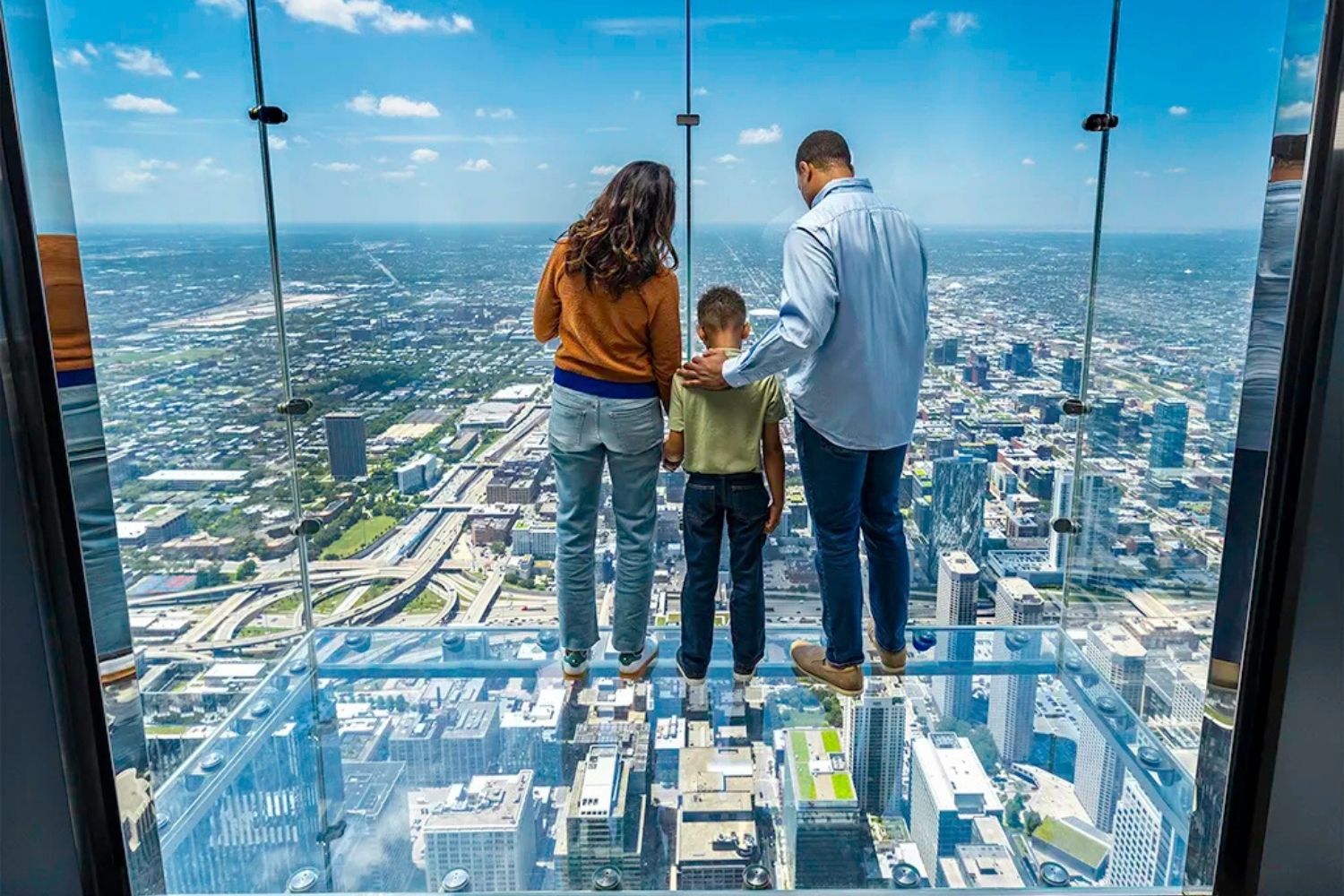
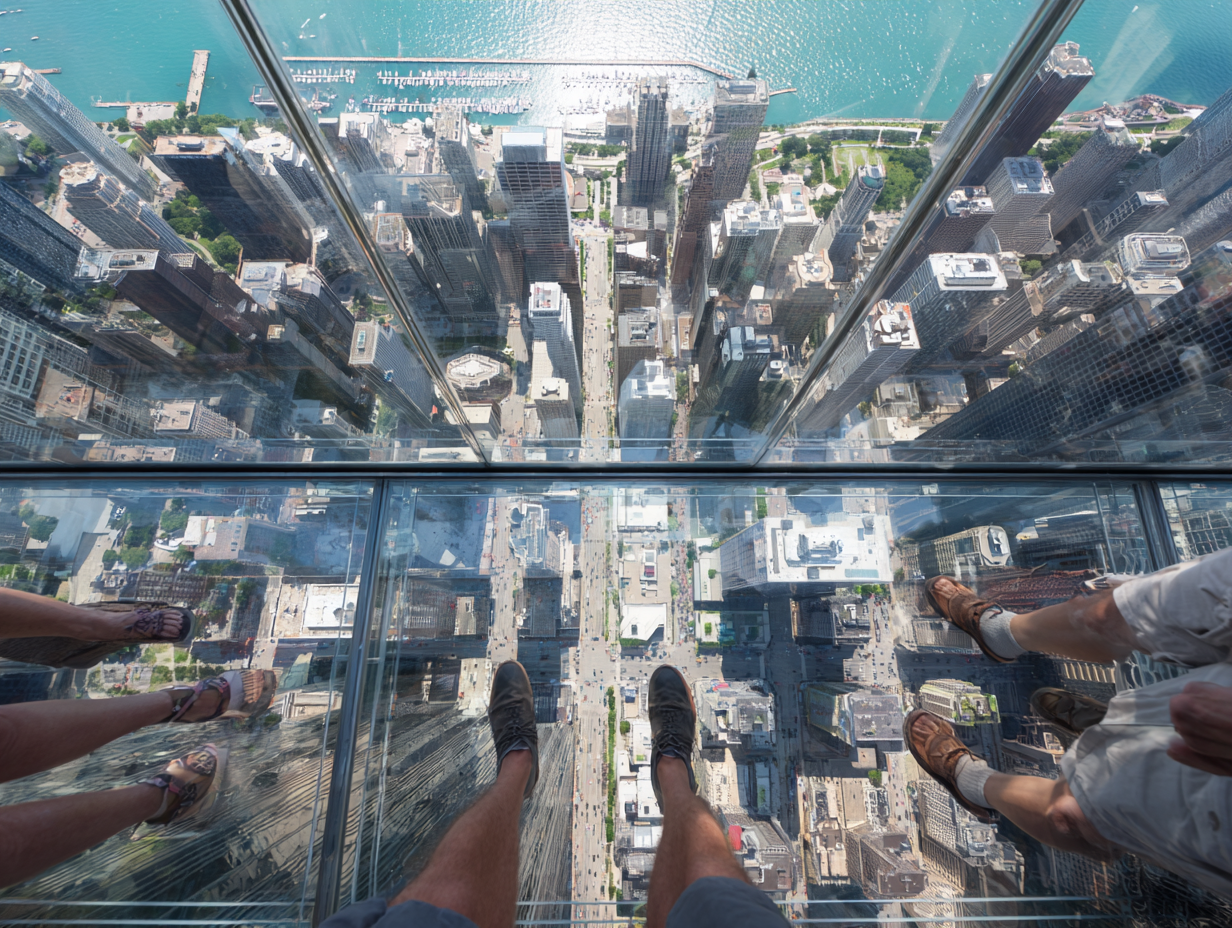
The Willis Tower observation deck, known as Skydeck Chicago, sits on the 103rd floor at 1,353 feet above ground. It is the highest observation deck in Chicago and among the highest in the United States. Skydeck Chicago at Willis Tower draws approximately 1.7 million visitors annually, making it one of the most visited attractions in the Midwest.
On a clear day, the observation deck offers visibility across four states: Illinois, Indiana, Wisconsin, and Michigan. Visitors reach the 103rd floor via express elevators that complete the ascent in about 60 seconds. The space includes an interactive exhibition, designed by SOM, that traces Chicago’s architectural history and its role as a global center for building innovation.
The Ledge Experience
Added in 2009, The Ledge consists of four retractable glass balconies that extend 4.3 feet from the building’s facade on the 103rd floor. Each box is made from three layers of half-inch-thick glass and can support five tons of weight. Standing in The Ledge, visitors look straight down 1,353 feet to the street below. The feature has become one of the most photographed spots in Chicago and significantly boosted visitor numbers after its installation.
🏗️ Real-World Example
Landmark 81 (Ho Chi Minh City, 2018): Vietnam’s tallest building at 1,513 feet (461 m) uses a version of Fazlur Khan’s bundled tube structural concept adapted for modern materials and seismic conditions. The tower demonstrates how Willis Tower’s structural DNA continues to inform supertall design across the globe, more than four decades after Khan first applied the system in Chicago.
Willis Tower Today
The Willis Tower building currently houses more than 100 companies, including major tenants in law, finance, insurance, and technology. United Airlines maintains its corporate headquarters in the tower. The building is owned by the Blackstone Group, which acquired it in 2015 and initiated the large-scale renovation that repositioned the property for a new generation of tenants.
According to Britannica, Willis Tower provides more than 3.8 million square feet of rentable office space, making it one of the largest office buildings in the country by leasable area. Despite losing its world’s-tallest title to the Petronas Towers in 1998 and later to the Burj Khalifa in 2010, the tower remains the third-tallest building in the Western Hemisphere and the tallest in Chicago.
What separates Willis Tower from many of its taller successors is the structural principle at its core. Khan’s bundled tube concept didn’t just make one building possible; it provided a framework that engineers have adapted for projects ranging from the Burj Khalifa’s buttressed core to contemporary supertall towers in Asia and the Middle East. The tower’s influence on structural engineering is, in many ways, more significant than its height.
Where to Go From Here
Your Next Step: If you are planning a visit to Chicago, book a Skydeck Chicago at Willis Tower time slot early in the morning on a weekday to avoid crowds and get the clearest views. For architects and engineering students, the interactive exhibition on the 103rd floor offers a focused walkthrough of how Chicago’s building innovations, from the Home Insurance Building to Willis Tower, changed construction worldwide.





Interior Design for Commercial Spaces: Enhancing Functionality and Brand Identity
Commercial interior design has to serve brand, function and regulation at once....
 Begum Gumusel4 Mins read

Famous Buildings in Los Angeles: Icons of LA Architecture
Nine of the most famous buildings in Los Angeles profiled: architect, year,...
 illustrarch Editoral Team9 Mins read
Futuro House Production Revived in Finland After Decades-Long Hiatus
A Facebook listing for abandoned moulds led to the first new Futuro...
illustrarch Editoral Team3 Mins read

Building Your Dream Home in NSW: What You Should Know About Montgomery Homes
Montgomery Homes has been building across Sydney, Newcastle, the Hunter, Wollongong and...
illustrarch Editoral Team4 Mins read


Leave a comment