

Herzog & de Meuron’s Paris Triangle Tower Finally Takes Shape
Herzog & de Meuron's Tour Triangle tops out in Paris as OMA wins a 25-year vision for Rome, two landmark projects redefining how European cities grow in 2026.
 Elif Ayse Sen9 June 20268 Mins read209

Table of Contents Show
Herzog & de Meuron’s Tour Triangle in Paris has topped out at 180 meters after nearly two decades of legal and political battles, while OMA won a 25-year vision to guide Rome’s future growth. Both projects show how memory, identity, and transformation are now shaping the design of 21st-century cities far beyond a single building.
This week brought together stories that look at cities on a longer timeframe than the one that defined modern design. A new museum in Panama drawing on Latin American building traditions, an inflatable installation on Paris’s oldest bridge, a waterfront community in Toronto, and a slow urban strategy for Rome all point in the same direction. Architecture is being asked to hold collective memory while answering hard questions about climate, housing, and public space. Two announcements stood out above the rest, and they frame the rest of the week well.
A Week Defined by Memory, Identity, and Transformation
The thread running through this week’s projects is the idea of the city as a record of what came before. In a recent Louisiana Channel interview, Paris-based architect Tsuyoshi Tane described memory as a design driver that informs structure, material, and emotional resonance. That framing fits a moment when masterplans and museums are increasingly judged on whether they respect the layers already present on a site. Memory, identity, and transformation are the throughline.
You can see the same instinct in the design selected for the new Museum of Contemporary Art of Panama (MAC Panamá) by Mexican studios Palma and Taller TO, which leans on regional materials and craft. The same week, on Africa Day 2026, marking the 1963 founding of the Organization of African Unity, attention turned to how buildings across the continent carry identity and shared history. Memory, in other words, is no longer a soft theme. It is becoming a measurable design requirement.
Herzog & de Meuron’s Tour Triangle Nears Completion in Paris
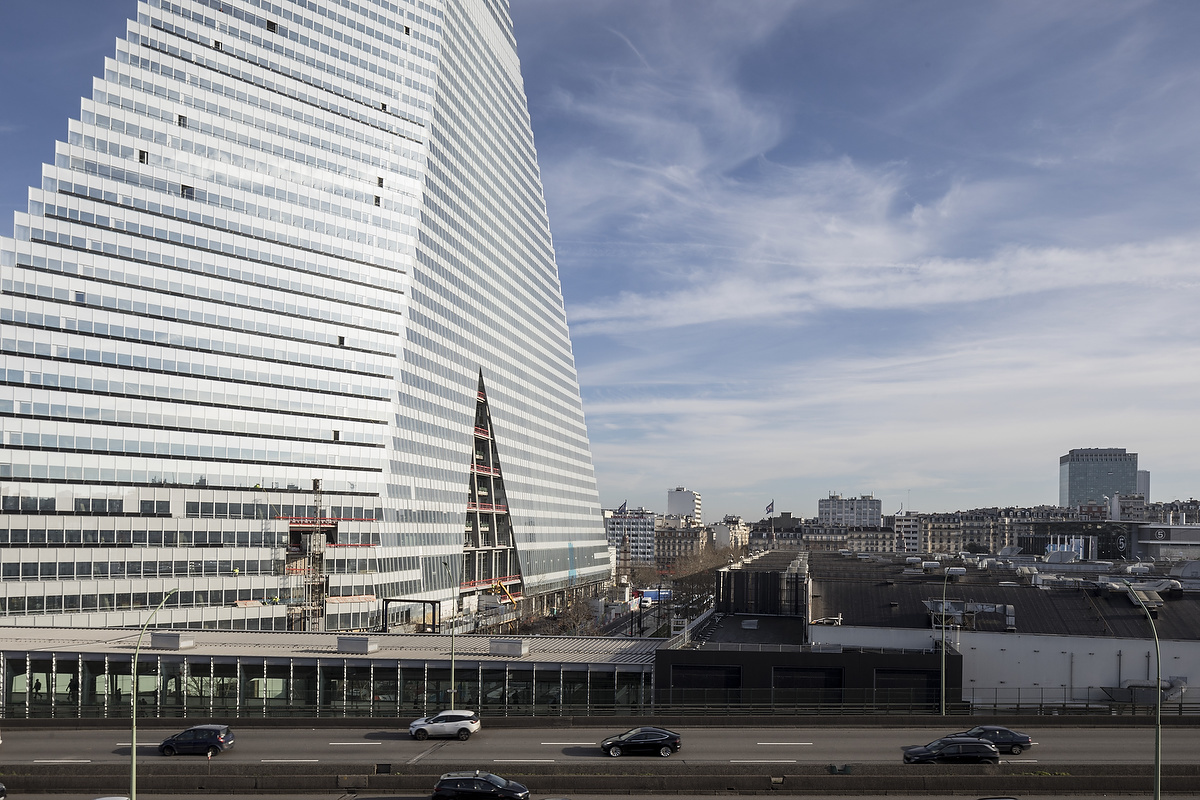
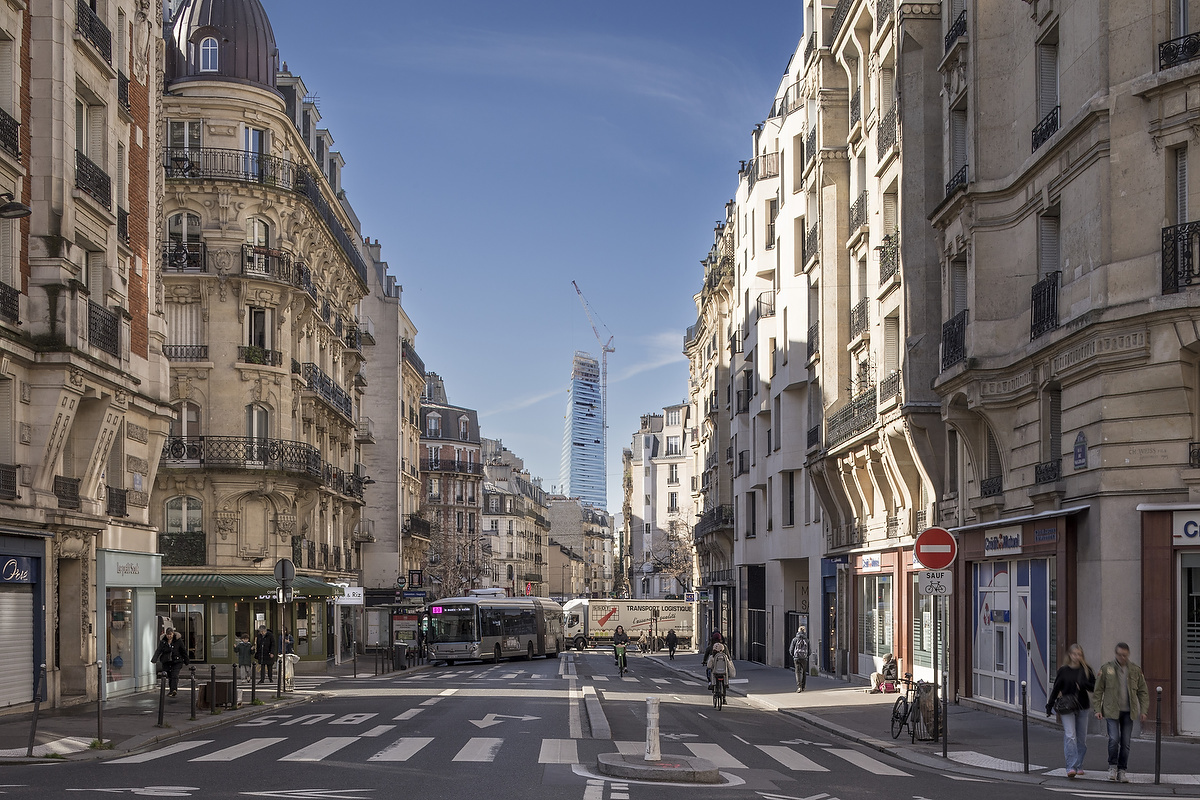
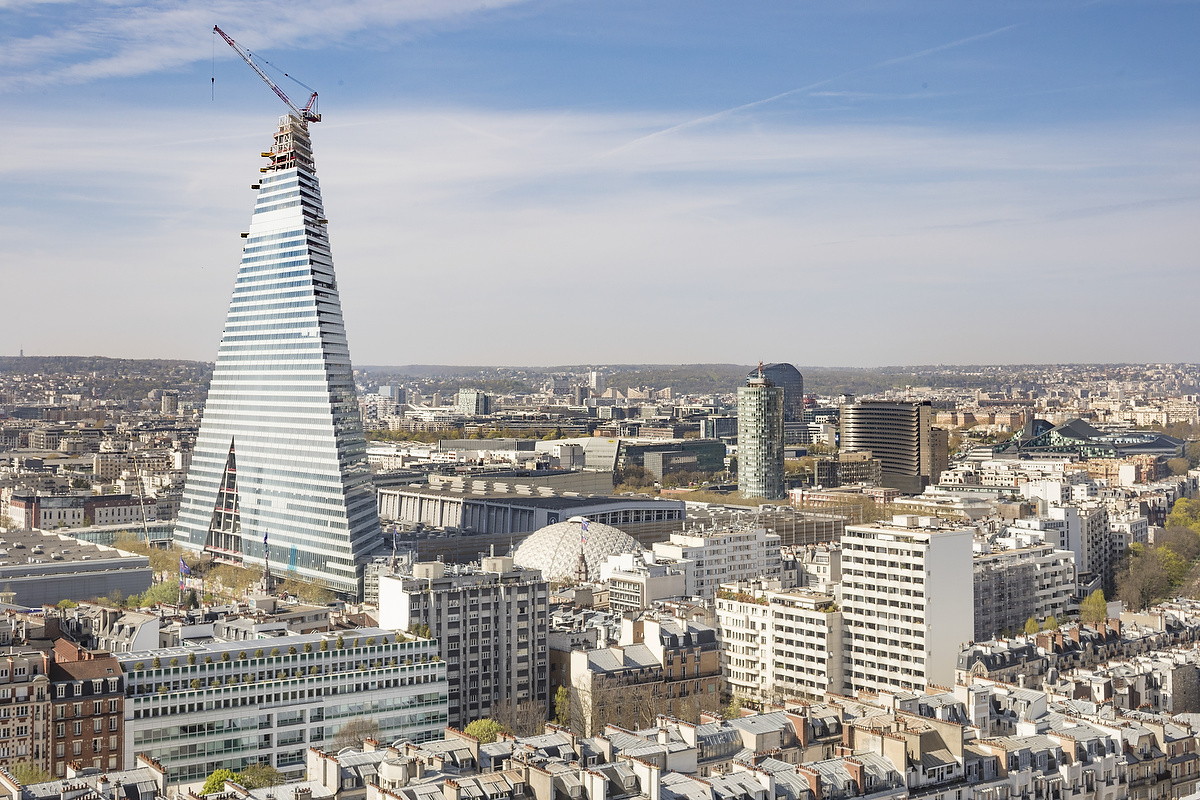
The most talked-about story of the week is the Tour Triangle, the trapezoidal glass tower by Herzog & de Meuron at Porte de Versailles in the 15th arrondissement. Designed in collaboration with French firm Valode & Pistre, the tower topped out at 42 stories in April 2026, two decades after the Swiss practice first began working on the concept in 2006. It now stands as the third-tallest building within Paris city limits, behind the Eiffel Tower and the Tour Montparnasse, and the first major skyscraper completed inside the city since Montparnasse in 1973.
The numbers tell part of the story. According to the project’s official developer site, the building holds roughly 91,000 square meters of floor space, including 70,000 square meters of offices, a 128-room hotel, 15,000 square meters of services open to the public, and ground-level retail. Developed by Unibail-Rodamco-Westfield with backing from insurer AXA, it carries an estimated cost of around 670 million euros. The wider base of the trapezoidal plan opens the ground floor to a daycare, a health center, and a cultural space, part of the firm’s stated aim to make the tower usable by the whole neighborhood.
🔢 Quick Numbers
- 180 meters tall across 42 stories, third-tallest within Paris city limits (Dezeen, 2026)
- Roughly 91,000 m² of total floor space, with 70,000 m² of offices (Tour Triangle official site, 2026)
- Construction began in 2022 after the concept was first developed in 2006 (ArchDaily, 2026)
- Estimated cost of about 670 million euros, developed by Unibail-Rodamco-Westfield (Global Construction Review, 2021)
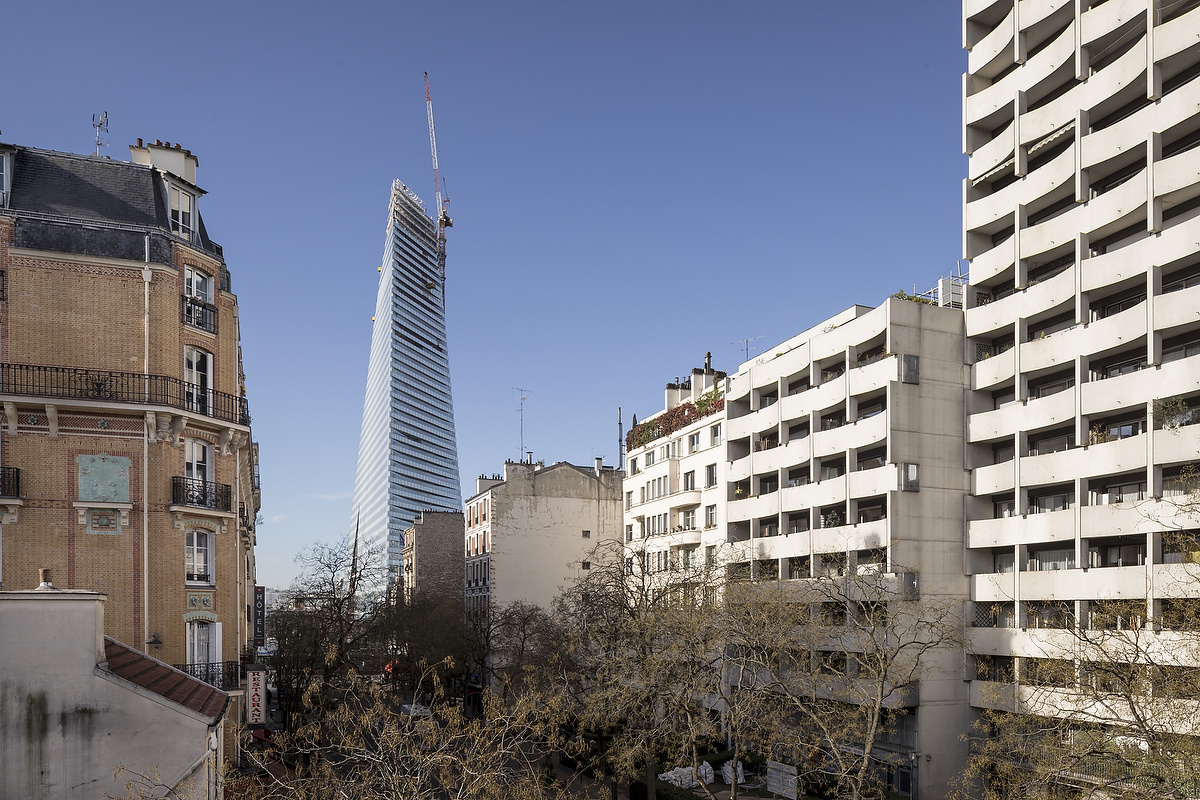
From central Paris the tower reads as a thin glass blade that nearly disappears against the sky. Seen from the east or west, the full triangular width opens up into something closer to a pyramid. Herzog & de Meuron designed that geometry on purpose, both to reduce the shadow cast on neighboring buildings and to limit the perceived bulk of a tall structure in a famously low-rise city. The form has drawn comparisons to a wedge of brie and a chunk of Toblerone, which tells you something about how Parisians feel about it.
📌 Did You Know?
The Tour Triangle may keep its ranking as one of Paris’s tallest buildings for a very long time. In 2023, Mayor Anne Hidalgo reinstated a height limit that effectively bans new skyscrapers inside the city. The Triangle, partly responsible for triggering that backlash, could be the last tall building built within central Paris for the foreseeable future.
Why Has the Tour Triangle Divided Paris for Two Decades?
The short answer is that Paris has never been comfortable with height. The city’s identity is tied to its Haussmann-era skyline and strict limits that kept towers out of the historic core. When Herzog & de Meuron proposed a triangular glass tower in 2006, supporters read it as overdue progress and critics called it an ecological aberration and a disruption to the classical urban fabric. The city council rejected the project in 2014, approved it in 2015, then watched it survive years of court challenges before construction finally started in 2022.
That history matters for anyone working on tall buildings in protected settings. The Triangle is less a story about engineering than about the long, slow politics of inserting something new into a city that treats its skyline as heritage. For a sense of how the same firm handles smaller, more delicate urban sites, our look at the Calder Gardens Museum by Herzog & de Meuron in Philadelphia shows a very different, ground-hugging approach to a leftover urban plot.
💡 Pro Tip
When a tall building has to sit inside a protected skyline, the early massing study should test the silhouette from named public viewpoints, not just from the plot itself. The Triangle’s blade-from-one-side, pyramid-from-another logic only works because the team studied how it reads from across the city. Skipping that step is where most height proposals lose public support before they reach planning.
If you want the full background on the design, the height debate, and what the finished tower will hold, see our dedicated breakdown of how Herzog & de Meuron’s 180-meter Tour Triangle came together. The firm itself documents the project alongside its wider portfolio on the Herzog & de Meuron official site, and photographer Stefano Candito’s recent images of the near-complete structure were published through Dezeen.
OMA’s Roma Continua: A 25-Year Vision for the Italian Capital
If the Triangle is a single object that took twenty years to build, the week’s other headline is the opposite kind of project: a framework meant to guide a whole city for the next twenty-five. An international team led by OMA and IT’S, working with landscape practice OKRA, NET Engineering, LGSMA, and others, won the Vision for Rome competition organized by the Roma REgeneration Foundation. Their proposal, Roma Continua, treats Rome not as a frozen historical artifact but as a living system that keeps adding layers.
The plan is built around four core ideas: well-being, beauty, knowledge, and what the team calls reform and extension. Instead of expansion-driven sprawl, it proposes growth through recalibration. At its center is a network of five green corridors anchored by the Tiber River and its tributaries, with five multimodal mobility hubs positioned along them as forums of innovation. Around those forums, five knowledge clusters group industries already present in nearby districts, from pharmaceuticals and healthcare to aerospace, energy, and agriculture. Cycling routes reach up to five kilometers across the city, and the whole framework is designed for phased rollout rather than a single grand gesture.
🎓 Expert Insight
“What growth means for a contemporary city profoundly shaped by history, culture, and power.”, David Gianotten, Managing Partner and Architect, OMA
Gianotten framed Roma Continua around this question, and it explains why the proposal avoids a single iconic landmark. For a city read as a palimpsest, the design challenge is which new layer to add, not which monument to build.
That logic, reading a place through its existing strengths before adding anything, connects Roma Continua to OMA’s longer track record. Founder Rem Koolhaas has argued for decades that buildings are cultural and political instruments first, and that adaptive reuse and density often serve a city better than spectacle. Our profile of Rem Koolhaas and his approach to the skyscraper and public space traces where this thinking comes from, and our roundup of the most iconic buildings by Rem Koolhaas shows how it plays out at the scale of single projects.
💡 Pro Tip
A 25-year masterplan only survives changing administrations if it is structured to deliver value in phases. Roma Continua does this by tying each corridor and mobility hub to industries already rooted nearby, so early phases produce visible benefit without waiting for the whole framework. When you pitch a long-horizon plan, lead with the first five years, not the final render.
Other Projects Shaping Cities This Week
Beyond Paris and Rome, several projects reinforced the same themes of memory and transformation. In Toronto, SLA designed the public realm and streetscapes for a new 39.8-hectare waterfront community in the Port Lands, land formerly given over to industry. Back in Rome, Stefano Boeri Architetti revealed a plan to convert a former transit depot into a multifunctional civic space, a clear case of adaptive reuse over demolition. In Australia, SJB with the DOMA Group set a new direction for Newcastle’s harbour edge with Newcastle Quay, a waterfront masterplan adding around 1,000 homes and large public spaces, with completion targeted for 2041.
The table below summarizes the week’s headline urban projects and where each one stands.
This Week’s Featured Urban Projects at a Glance
| Project | Location | Architect / Team | Type | Status |
|---|---|---|---|---|
| Tour Triangle | Paris, France | Herzog & de Meuron with Valode & Pistre | Mixed-use tower | Topped out 2026 |
| Roma Continua | Rome, Italy | OMA and IT’S with OKRA | 25-year urban framework | Winning vision |
| Port Lands public realm | Toronto, Canada | SLA | Waterfront streetscape | In design |
| Former transit depot conversion | Rome, Italy | Stefano Boeri Architetti | Adaptive reuse civic space | Proposed |
| Newcastle Quay | Newcastle, Australia | SJB with DOMA Group | Waterfront masterplan | Completion 2041 |
One more project rounded out the week with a smaller, community-led story. In Chicago’s Little Village, Civic Projects Architecture and Wallin Gomez Architects reworked an early-1900s firehouse into an open community center for Yollocalli Arts Reach, a youth program of the National Museum of Mexican Art. The renovation kept the building’s character while adding studios, a radio production room, an art library, and a computer lab, with programming shaped through workshops with the staff and young people who use it. It is adaptive reuse at the neighborhood scale, and it makes the same argument as the bigger headlines: keep what carries meaning, then add to it.
What These Projects Reveal About 21st-Century Urban Design
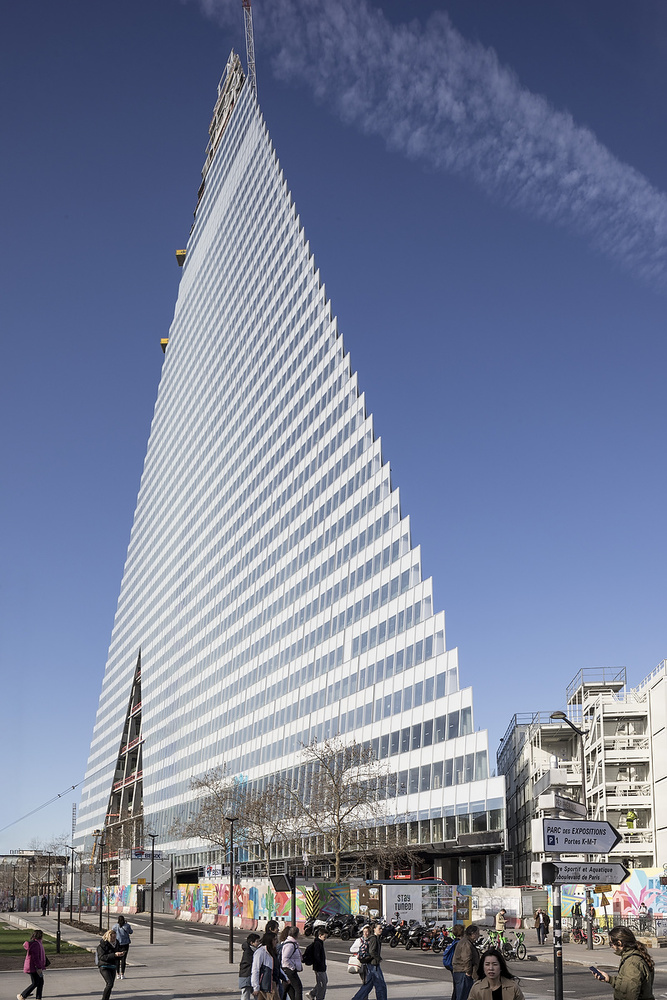
Put side by side, the Triangle and Roma Continua mark two ends of a single conversation. One is a finished, contested object that took twenty years and a fortune to realize. The other is a phased framework that may never have a single defining image. Yet both accept that cities are built in layers and that new work has to answer to what already exists. That shift away from the standalone icon and toward systems, reuse, and long horizons is the real story of the week.
It also explains why adaptive reuse keeps surfacing in nearly every project, from a Rome transit depot to a Chicago firehouse. Reusing structures cuts waste, keeps history visible, and often delivers spatial qualities that would be expensive to build from scratch. For a closer look at when reuse beats building new, our practical comparison of adaptive reuse architecture versus new construction weighs the cost, sustainability, and design tradeoffs, and our overview of how adaptive reuse gives old buildings new life covers the broader case. The same week, the 13th World Urban Forum in Baku pushed the point at policy level, advocating planning built around ecological restoration, affordable housing, participatory design, and climate resilience.
✅ Key Takeaways
- Herzog & de Meuron’s Tour Triangle topped out at 180 meters in 2026, the first major skyscraper built inside central Paris since 1973.
- The tower’s trapezoidal form was designed to limit shadow and perceived bulk, and a 2023 height ban means it may keep its ranking indefinitely.
- OMA’s Roma Continua won the Vision for Rome competition with a 25-year framework built on green corridors, mobility hubs, and adaptive reuse rather than sprawl.
- Across Toronto, Rome, Newcastle, and Chicago, the week favored systems, reuse, and long timelines over the standalone architectural icon.
- Memory and identity have moved from soft themes to practical design requirements in contemporary urban projects.
Cost and area figures cited here are drawn from developer announcements and published reports, and may change as the projects progress.
Final Thoughts
This week made the contrast unusually clear. Herzog & de Meuron spent twenty years pushing a single tower through a city that did not want it, and the result will probably stand as the last of its kind in central Paris. OMA, working at the other end of the scale, won the right to shape Rome slowly, in layers, over a quarter century. Different methods, same underlying belief: the strongest urban projects today are the ones that read a place carefully before deciding what to add. The fuller weekly compilation, with all featured projects and images, is available in the original ArchDaily review.




Brussels’s €230m Kanal Museum Nears Opening as Questions Grow over Its Future Funding
Housed in a converted Citroën garage, Brussels's Kanal museum opens on 28...
 illustrarch Editoral Team1 Mins read
MoMA’s Full Disclosure Exhibition Traces Information Design from Hand-Drawn Data to AI Memories
Full Disclosure: The Edge of Information Design, curated by Paola Antonelli, is...
illustrarch Editoral Team2 Mins read
Zumthor’s Three New Buildings Open at Fondation Beyeler in Riehen
Peter Zumthor's Wyss Museum, Ammann Pavilion and Erlen Torhaus open at Fondation...
illustrarch Editoral Team4 Mins read

Benthem Crouwel Completes the Afsluitdijk Revamp with a Fish Passage and Domed Pumping Stations
The 32 km Afsluitdijk in the Netherlands has been raised, armoured and...
illustrarch Editoral Team2 Mins read


Leave a comment