

Famous Architectural Photographers You Should Know
Famous architectural photographers you should know: Stoller to Baan. Learn their styles, what to look for in images, and where to explore books and archives.
 Sinan Ozen17 December 202523 Mins read386
Table of Contents Show
Architecture doesn’t just sit there: it performs for the lens. When we talk about famous architectural photographers you should know, we’re really talking about the people who taught us how to see buildings, how light carves space, how cities breathe, how structures live once people move in. Below, we trace the voices who shaped the field, from early modernists to today’s global image-makers, and share how to read their pictures like pros.
How Architectural Photography Shapes the Way We See Buildings
Architectural photography compresses complex, lived spaces into frames that still feel dimensional. Done well, it clarifies a building’s intent, structure, proportion, material, site, while adding a layer of interpretation. We rely on it not only to document but to persuade: to set the narrative for how a building will be received by the public and preserved in memory.
We’ve all felt it. A Stoller image can make steel and glass look inevitable. A Shulman vista turns a hillside into a stage set. Contemporary shooters like Iwan Baan show us buildings with people at the center, shifting focus from “object” to “life.” In short, these images condition our expectations, of architects, of cities, and of the future we’re building.

The Art and Challenges of Architectural Photography
Architectural photography captures the form and function of buildings and structures. This genre highlights the relationship between space and light, often emphasizing lines, textures, and materials. Photographers in this field convey a narrative through framing, composition, and perspective, transforming static structures into dynamic visual stories.

Architectural photographers face unique challenges. They navigate varying light conditions, weather influences, and the scale of structures. Mastering these elements enables them to showcase buildings in their best light, often resulting in striking images that resonate with viewers.
This style of photography encompasses various approaches. Some photographers focus on the historical significance of structures, while others highlight modern designs. Through their lenses, they reveal the intended purpose of architectural works, capturing everything from residential homes to towering skyscrapers.
Architectural photography not only documents physical spaces but also reflects cultural values and historical contexts. The best images evoke emotion and spark curiosity. They inspire architects, designers, and enthusiasts alike, allowing us to appreciate and understand the built environment.
A Brief Timeline: Key Milestones in Architectural Photography
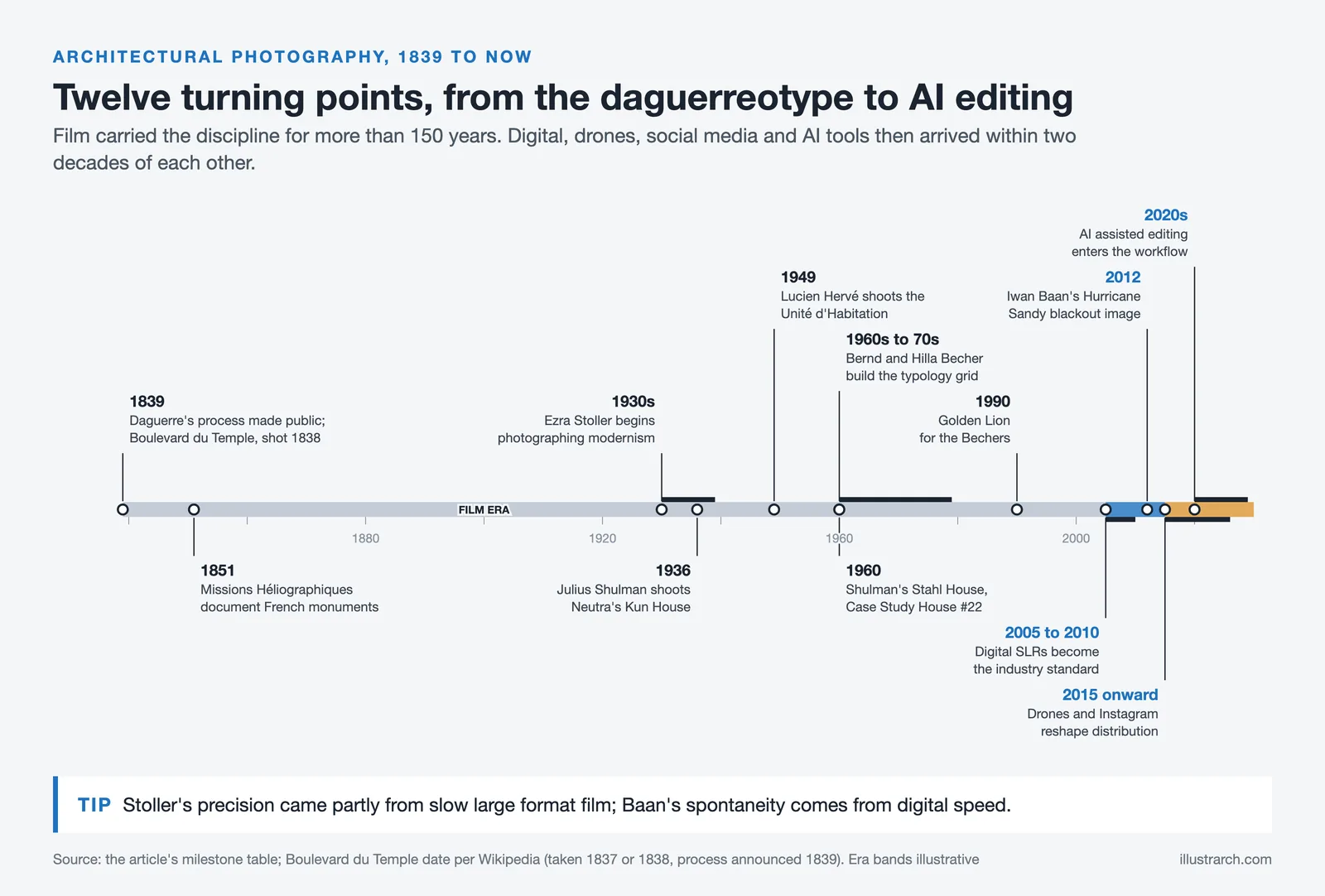
Understanding the evolution of architectural photography helps us appreciate how each generation built on the last. The timeline below traces the discipline from its earliest roots to the digital and social-media era we live in today.
| Year / Era | Milestone | Significance |
|---|---|---|
| 1839 | Daguerre process made public; his Boulevard du Temple, Paris, was taken in 1837 or 1838 | One of the first photographs ever taken includes buildings, establishing architecture as a natural photographic subject from day one |
| 1851 | Missions Héliographiques, France | French government commissions photographers to document historic monuments, creating the first systematic architectural photography project |
| 1930s | Ezra Stoller begins photographing modernist buildings | Sets the gold standard for precision, clarity, and collaboration between architect and photographer |
| 1936 | Julius Shulman photographs Neutra’s Kun House | Marks the beginning of a 70-year career that would define the visual identity of California modernism |
| 1949 | Lucien Hervé photographs Unité d’Habitation, Marseille | Le Corbusier sees the contact sheets and declares Hervé has “the soul of an architect,” beginning their lifelong collaboration |
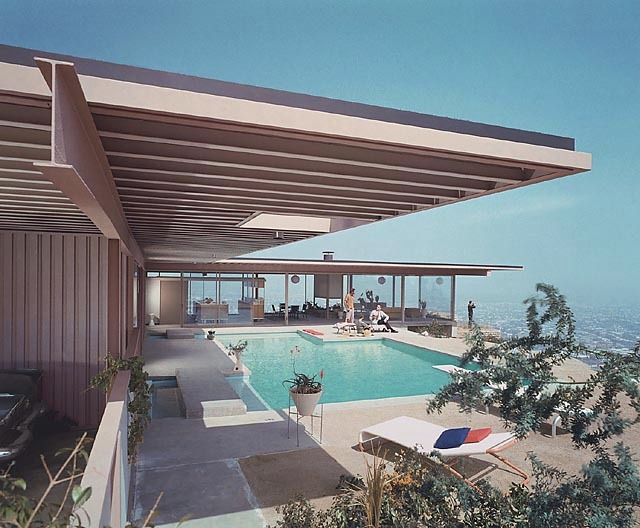
| 1960 | Shulman shoots Case Study House #22 (Stahl House) | Becomes arguably the most reproduced architectural photograph in history, defining mid-century modern living |
| 1960s-70s | Bernd & Hilla Becher develop typological grid method | Industrial structures elevated to fine art; their teaching at Kunstakademie Düsseldorf spawns the Düsseldorf School |
| 1990 | Bechers win Golden Lion at Venice Biennale for Sculpture | Architectural / industrial photography officially recognized as fine art at the highest institutional level |
| 2005-2010 | Digital SLRs become the industry standard | HDR bracketing, focus stacking, and instant review transform workflows; Iwan Baan rises as the first major digital-native architectural photographer |
| 2012 | Baan’s Hurricane Sandy blackout image goes viral | A single image redefines what architectural photography can communicate: cities as living organisms, not just formal objects |
| 2015: present | Drone photography and social media reshape distribution | Platforms like Instagram and ArchDaily democratize architectural imagery; aerial perspectives become standard practice |
| 2020s | AI-assisted editing and computational photography emerge | Tools like exposure blending, AI sky replacement, and generative fill enter the workflow, sparking debates about authenticity |
💡 Pro Tip: When studying a photographer’s body of work, pay attention to the era they worked in. The technical limitations and cultural context of each period directly shaped their creative choices. Stoller’s discipline came partly from the cost and slowness of large-format film; Baan’s spontaneity is enabled by digital speed. Understanding the “why” behind the “how” is what separates a casual viewer from a literate one.
Pioneers and Modernist Masters
Ezra Stoller
We owe much of modernism’s public image to Stoller. His precise compositions and crystalline daylight made works by Skidmore, Owings & Merrill, Eero Saarinen, and Mies van der Rohe feel both rigorous and optimistic. He emphasized structure and craft, clean horizons, exacting verticals, so we read engineering as beauty. Stoller’s images often emphasize geometrical lines and textures, providing clarity and depth. His legendary photographs serve not only as documentation but also as artistic expressions, influencing generations of architects and photographers alike.

Julius Shulman
Where Stoller was architectural, Shulman was cinematic. Think Case Study House No. 22, Los Angeles glittering below, modern living hovering above. He staged with care (furnishings, models, that city glow) to connect modern architecture to lifestyle. The result: an image vocabulary that sold a movement, not just a house. Shulman’s iconic images of mid-century modernism, particularly in California, helped visualize the American dream. His ability to blend form, light, and context established a standard for architectural photography, emphasizing narrative and emotion in each frame.
Lucien Hervé
Le Corbusier’s visual poet, Hervé wielded shadow like a structural element. Tight crops, stark chiaroscuro, and abstracted geometries pushed buildings toward the realm of sculpture. His photographs feel like they were carved from light, revealing rhythm and proportion more than façades.
Berenice Abbott
Best known for Changing New York, Abbott translated the city’s vertical ambition into crisp, graphic clarity. While she straddled genres, her architectural work nailed the intersection of documentation and civic myth-making, skylines and streets as evolving machines.
🎯 Expert Tip: Learning from the Pioneers: If you are an architecture student or young photographer, start your visual education with Stoller’s TWA Terminal images and Shulman’s Case Study House #22. Study the composition grids: Stoller almost always used a two-point perspective anchored by a strong horizontal datum, while Shulman staged a foreground “scene” that pulled viewers into the architectural space emotionally. Try recreating these compositions with your own projects to internalize the logic before developing your personal style.
Postwar and Late 20th-Century Icons
Bernd and Hilla Becher
The Bechers treated industrial structures, water towers, blast furnaces, as a taxonomy. Gridded typologies leveled aesthetics into data, so patterns emerged: variations on a form across regions and decades. Their method seeded the Düsseldorf School and influenced a generation of cool-eyed formalists.
Pedro E. Guerrero
Guerrero’s long collaboration with Frank Lloyd Wright, and later with Alexander Calder and Louise Nevelson, produced images that are intimate without being sentimental. He balanced lived-in detail with architectural clarity, giving us homes that feel inhabited and dignified.
Yasuhiro Ishimoto
Moving between Chicago and Tokyo, Ishimoto framed the city with a graphic designer’s sensibility. His studies of Katsura Imperial Villa alongside modern urban scenes bridged tradition and modernity, showing how proportion and pattern translate across cultures.
Hélène Binet
Binet’s richly tonal, often large-format work turns materials, concrete, brick, timber, into atmospheric events. She photographs Zumthor, Hadid, and more with a patient, almost musical sense of timing, catching light at the moment a space becomes legible and emotive.
💡 Pro Tip: When you study Binet’s photographs of Peter Zumthor’s Therme Vals, notice how she never shows the entire building in one shot. She lets moisture, stone texture, and raking light stand in for the whole. This “part-for-whole” strategy is one of the most powerful techniques in architectural photography: it forces the viewer to mentally reconstruct the space, creating a far more memorable experience than any wide-angle overview.
All Photographers at a Glance
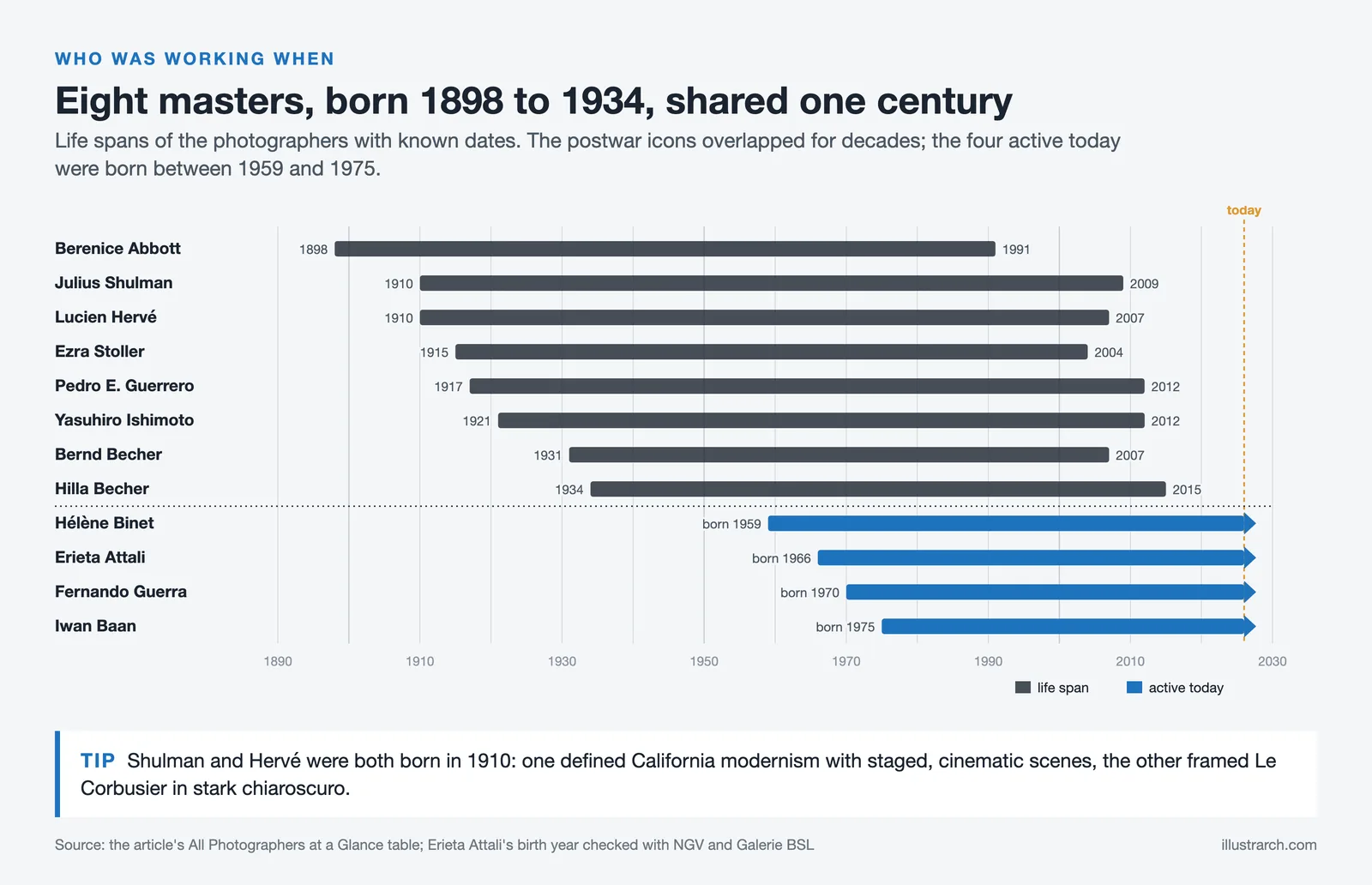
Before diving into the contemporary voices, here is a complete reference table covering every photographer featured in this guide. It includes their nationality, active years, signature approach, and the architects or projects they are most closely associated with.
| Photographer | Nationality | Life / Active Years | Signature Style | Key Architect Collaborations | Iconic Works / Projects |
|---|---|---|---|---|---|
| Ezra Stoller | American | 1915-2004 | Crystalline precision, deep focus, structural clarity | Mies van der Rohe, Eero Saarinen, Frank Lloyd Wright, SOM, I.M. Pei, Marcel Breuer | Seagram Building, TWA Terminal, Fallingwater, Guggenheim Museum, Salk Institute |
| Julius Shulman | American | 1910-2009 | Cinematic staging, lifestyle narrative, infrared B&W film | Richard Neutra, Pierre Koenig, R.M. Schindler, John Lautner, Charles & Ray Eames | Case Study House #22 (Stahl House), Kaufmann House, Case Study Program |
| Lucien Hervé | Hungarian-French | 1910-2007 | Stark chiaroscuro, tight crops, abstract geometry | Le Corbusier, Alvar Aalto, Oscar Niemeyer, Marcel Breuer, Walter Gropius | Unité d’Habitation, Chandigarh, Chapel at Ronchamp, UNESCO HQ |
| Berenice Abbott | American | 1898-1991 | Documentary clarity, urban documentation, civic narrative | ,(documented cityscape rather than individual architects) | Changing New York series, Manhattan skyline studies |
| Bernd & Hilla Becher | German | Bernd 1931-2007; Hilla 1934-2015 | Typological grids, frontal framing, deadpan objectivity | ,(documented industrial vernacular, not named architects) | Water Towers, Blast Furnaces, Framework Houses, Winding Towers |
| Pedro E. Guerrero | American (Mexican-American) | 1917-2012 | Intimate detail, human scale, lived-in warmth | Frank Lloyd Wright, Alexander Calder, Louise Nevelson, Eero Saarinen, Marcel Breuer | Taliesin & Taliesin West, Calder’s studio, mid-century modern houses |
| Yasuhiro Ishimoto | Japanese-American | 1921-2012 | Graphic compositions, New Bauhaus formalism, cultural bridging | Kenzō Tange, Arata Isozaki | Katsura Imperial Villa, Chicago street studies, Ise Jingū |
| Hélène Binet | Swiss-French | b. 1959: active | Rich tonality, analog film, atmospheric light & shadow | Peter Zumthor, Zaha Hadid, Daniel Libeskind, Le Corbusier, Alvar Aalto | Therme Vals, Phaeno Science Center, Jewish Museum Berlin, Ronchamp |
| Iwan Baan | Dutch | b. 1975: active | Social narrative, documentary humanism, people-centered | Rem Koolhaas / OMA, Herzog & de Meuron, Zaha Hadid, SANAA, Diller Scofidio + Renfro | CCTV Beijing, Hurricane Sandy Manhattan, Torre David, Elbphilharmonie |
| Fernando Guerra | Portuguese | b. 1970: active | Warm photojournalism, sequential storytelling, people in space | Álvaro Siza, Eduardo Souto de Moura, Aires Mateus, many international offices | Portuguese contemporary architecture portfolio, FG+SG studio archive |
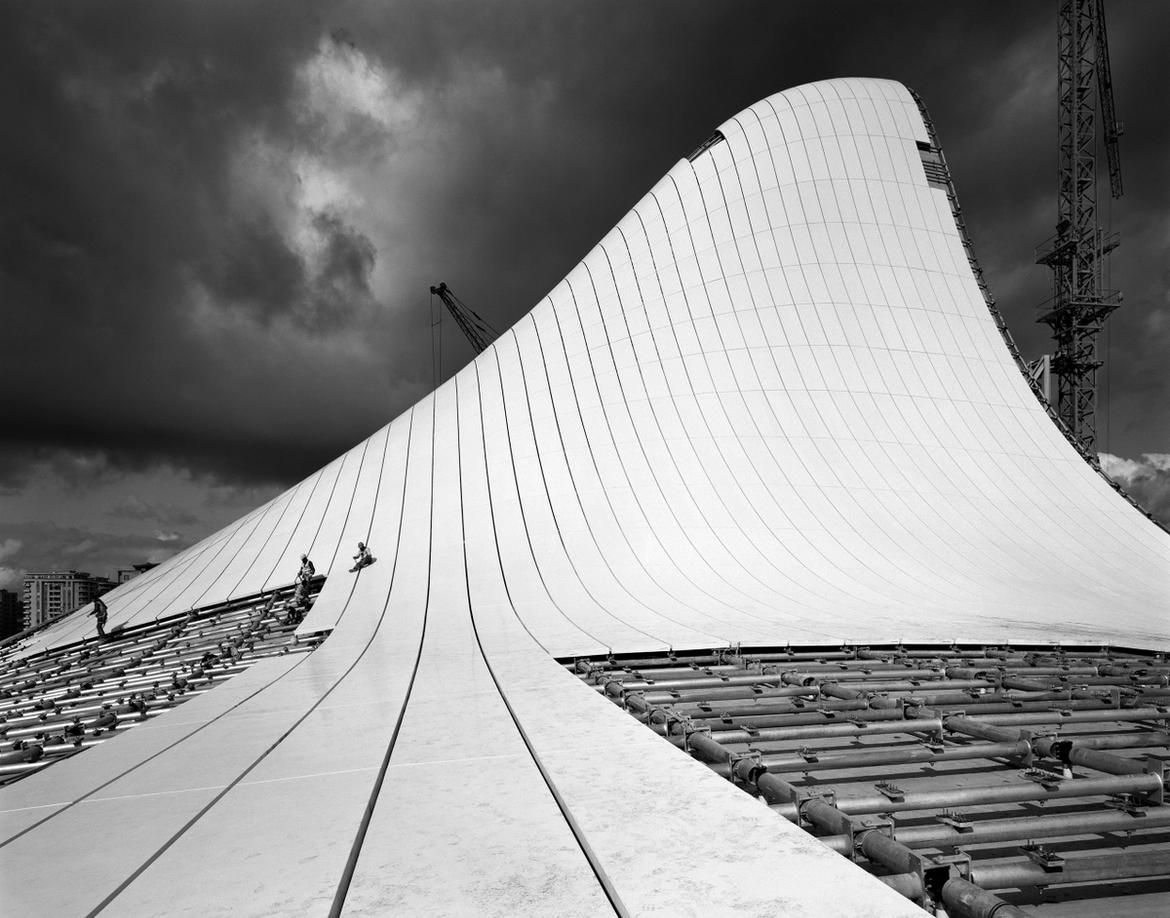
| Hufton + Crow | British | Active since early 2000s | High-impact clarity, dawn/night shoots, saturated color | Zaha Hadid Architects, Heatherwick Studio, MAD Architects, Foster + Partners | The Shard, Heydar Aliyev Center, MAXXI Museum, Vessel NYC |
| Erieta Attali | Israeli (based in New York) | b. 1966: active | Lyrical long exposure, landscape integration, archaeological sensibility | Kengo Kuma, Max Núñez, Steven Holl, various timber/glass architects | Monte Rosa Hut, landscape-architecture studies, Columbia GSAPP teaching |
| Nic Lehoux | Canadian (French-Canadian) | Active since early 2000s | Editorial balance, human-scale vignettes, honest material rendering | Bohlin Cywinski Jackson, Renzo Piano, Bing Thom, DIALOG, Olson Kundig | Whitney Museum, residential projects across North America |
| Lauren McGrath | American | Active: contemporary | Vibrant color, dynamic compositions, urban storytelling | Various urban and commercial architects | Urban environment studies, cityscape narratives |
| Beverly Allen | American | Active: contemporary | Social commentary, cultural context, community focus | Various community-oriented architects | Architecture-as-social-symbol projects |
| Nick Leitz | American | Active: contemporary | Minimalist, clean lines, stark angles, meditative | Various contemporary architects | Minimalist architectural studies |
| Zachary Smith | American | Active: contemporary | Sustainability focus, large-scale projects, environmental advocacy | Eco-friendly and sustainable design architects | Sustainable architecture documentation |
| Tina Hill | American | Active: contemporary | Emotional narrative, residential intimacy, experiential focus | Residential and interior architects | Residential space narratives |
Global Contemporary Voices Defining the Field Today
Iwan Baan
Baan pivots from icon shots to lived reality: construction dust, commuters, kids playing under pilotis. His famous hurricane-blackout image of Manhattan showed a city as organism. He reframes architecture within social context, and clients hire him precisely for that human pulse.

Fernando Guerra
Lisbon-based Guerra brings velocity and warmth. His sequences move from broad site views to tactile details, with people activating the frame. The result is persuasive storytelling that still respects the architect’s lines.
Hufton + Crow
The London duo delivers high-impact clarity. Their night scenes and dawn shoots are immaculate, razor-sharp edges, saturated skies, controlled reflections. If you’ve seen a new landmark trending online, odds are they’ve given it that definitive glow.
Erieta Attali
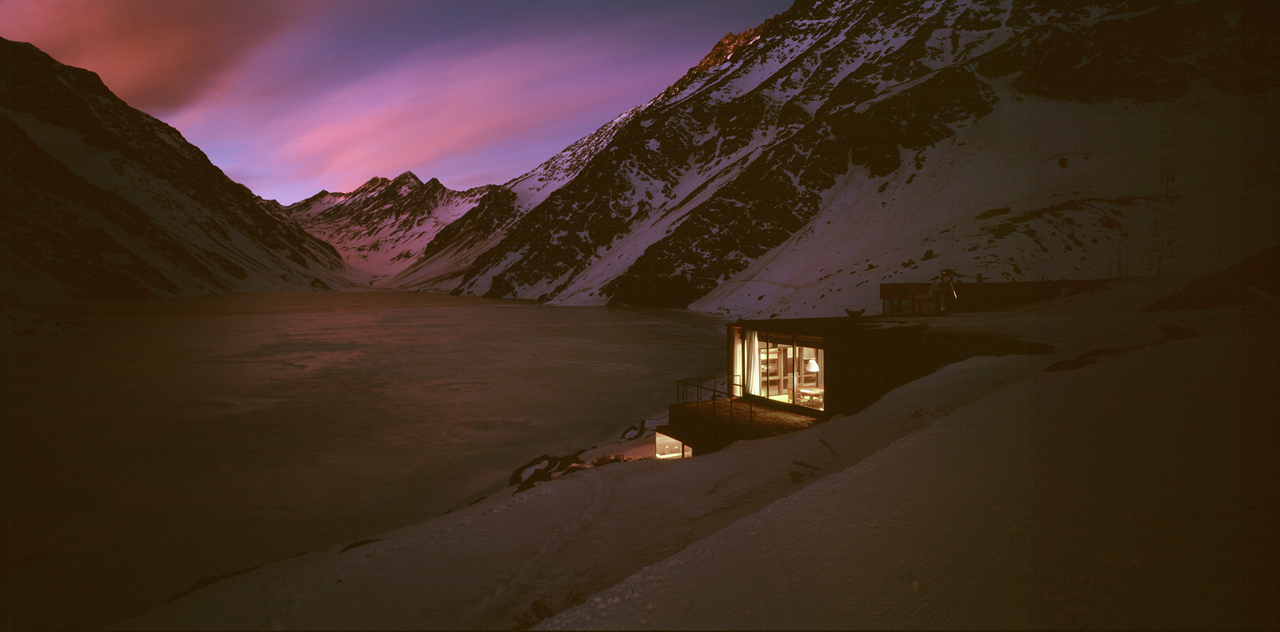
Attali’s work is lyrical and often long-exposure, tracing how glass, landscape, and weather converse. Her projects with timber and glass architects feel almost archaeological, capturing time, not just form.
Nic Lehoux
Lehoux is the consummate collaborator for complex projects. He balances honest material rendering with editorial read, toggling between sweeping context and human-scale vignettes. His images feel trustworthy, usable by press, public, and clients alike.
🎯 Expert Tip: Hiring an Architectural Photographer: If you are an architect looking to commission photography, choose a photographer whose visual language aligns with your design intent. Baan is ideal when you want to show how people actually use a space. Hufton + Crow excel at dramatic “hero shots” for competition entries and press launches. Guerra’s sequential storytelling works beautifully for project monographs and case studies. Always review at least three complete project sets, not just highlight reels, to assess consistency and storytelling depth.
Emerging Talents Reshaping Architectural Photography
A new wave of architectural photographers is reshaping the landscape with innovative techniques and fresh perspectives. These contemporary artists capture buildings and spaces in ways that resonate with modern sensibilities, weaving personal, social, and environmental narratives into their images.

Lauren McGrath
Lauren McGrath employs vibrant colors and dynamic compositions that highlight the interplay of natural and artificial light. Her work focuses on urban environments, revealing hidden stories within cityscapes that often go unnoticed.
Beverly Allen
Beverly Allen blends architectural photography with social commentary, emphasizing the cultural context of buildings. Her projects often portray the relationship between architecture and community, showcasing structures that serve as symbols of unity and progress.
Nick Leitz
Nick Leitz’s minimalist approach captures the essence of architecture through clean lines and stark angles. He focuses on light and shadow to create images that evoke a sense of serenity and contemplation.
Zachary Smith
Zachary Smith specializes in large-scale projects that highlight sustainability and eco-friendly design. His photography promotes awareness of environmental issues, making a statement about the importance of responsible architecture.
Tina Hill
Tina Hill explores the emotional impact of architectural spaces, using a narrative style that draws viewers into the experience of being within those environments. Her work often features residential spaces, emphasizing intimacy and comfort.
Styles, Approaches, and What to Look For in Their Images
People-in-Place Storytelling
Look for how photographers seat people within the architectural frame. Baan and Guerra use scale figures not as decoration but as narrative: circulation, occupation, delight.
Formalism, Shadow, and Light
Hervé and Binet show how shadow articulates form. Watch the edges, crisp versus feathered, and how contrast sets rhythm across a façade.
Typologies and Systems
From the Bechers, note repetition and variance. Grids reveal families of form: this is design research turned into images.
Night, Motion, and Long Exposure
Hufton + Crow and Attali use blue hour and long shutter speeds to manage glare, pull color, and sketch movement. Trails and soft crowds can communicate use without clutter.
Analog Versus Digital Craft
Film’s latitude and large-format discipline shaped Stoller-era precision. Today’s digital workflows bring bracketing, focus stacking, and rectified verticals. The best photographers, old or new, prioritize intent over tool.
💡 Pro Tip: Train your eye by creating a “visual library” on Pinterest or Are.na. Organize boards by technique rather than photographer: one for shadow play, one for people-in-space, one for twilight shots. Over time, you’ll start recognizing cross-generational patterns. This is exactly how many architecture schools teach visual literacy, and it works just as well for self-directed study.
Comparing Photographic Approaches: Key Techniques and Gear
The following table breaks down the primary techniques, preferred media, and distinguishing visual traits that separate each photographer’s body of work. Use it as a quick reference when studying or teaching architectural photography.
| Photographer | Primary Medium | Preferred Lighting | Human Presence | Composition Approach | Color vs B&W |
|---|---|---|---|---|---|
| Ezra Stoller | Large-format film | Natural daylight, deep focus | Minimal: architecture as hero | Exacting verticals, clean horizons, pin-sharp detail | Primarily B&W; some color |
| Julius Shulman | Large-format & 4×5 view camera | Dusk / twilight staging | Staged models, lifestyle figures | Cinematic framing, wide establishing shots | B&W (infrared film); later color |
| Lucien Hervé | 35mm & medium format film | Harsh directional light, deep shadow | Rarely: architecture abstracted | Tight crops, oblique angles, geometric abstraction | Predominantly B&W |
| Berenice Abbott | Large-format film | Available / ambient daylight | Street-level passersby as context | Vertical compositions, graphic contrast | B&W |
| Bernd & Hilla Becher | Large-format film (8×10) | Overcast / flat diffused light | None: pure structure | Frontal, centered, repetitive grids | B&W exclusively |
| Pedro E. Guerrero | Medium & large-format film | Natural light, golden hour interiors | Architects, residents, fellowship members | Intimate scale, warm domestic framing | B&W; some color |
| Yasuhiro Ishimoto | 35mm & medium format film | Variable: site-responsive | Street life in urban studies | Bold geometric forms, New Bauhaus rigor | B&W and color |
| Hélène Binet | Large-format film (Arca Swiss 4×5, Hasselblad) | Raking light, theatrical shadow | Absent: viewer embodies presence | Close-up details, material textures, cropped facades | Predominantly B&W (analog film only) |
| Iwan Baan | Digital (DSLR / mirrorless) | Available light, all conditions | Central: people activate the frame | Documentary / photojournalistic, aerial views | Color |
| Fernando Guerra | Digital | Natural light, golden hour | Active: people in motion | Sequential storytelling, wide-to-detail series | Color |
| Hufton + Crow | Digital (high-resolution) | Blue hour, dawn, controlled night | Selective: soft crowds, motion trails | Razor-sharp edges, saturated skies, symmetry | Color |
| Erieta Attali | Film & digital | Long exposure, natural atmospheric light | Minimal: landscape dominates | Architecture embedded in landscape, low horizon | Color |
| Nic Lehoux | Large-format film roots; now digital | Balanced editorial lighting | Moderate: human-scale vignettes | Context-to-detail toggle, honest rendering | Color |
Recommended Gear for Architectural Photography
Gear matters in architectural photography, but it matters less than understanding light, composition, and your subject. That said, the right equipment removes technical barriers and lets you focus on creative intent. The table below covers what professional architectural photographers actually use in the field today, along with budget-friendly alternatives for those building their kit.
| Gear Category | Professional Choice | Budget-Friendly Alternative | Why It Matters |
|---|---|---|---|
| Camera Body | Canon EOS R5 II, Sony A7R V, Nikon Z8 | Sony A7C II, Canon EOS R6 III, Fujifilm GFX 50S II | High resolution (45-61 MP) captures fine architectural detail; full-frame or medium-format sensor handles dynamic range in interiors |
| Wide-Angle Lens | Canon TS-E 17mm f/4L, Nikon PC-E 19mm f/4E | Laowa 15mm f/4.5 Zero-D Shift, Samyang 14mm f/2.8 | Tilt-shift lenses correct converging verticals in-camera, the single most important optical tool for architectural work |
| Standard Tilt-Shift | Canon TS-E 24mm f/3.5L II, Nikon PC-E 24mm f/3.5D | Laowa 20mm f/4 Zero-D Shift | The “workhorse” focal length for interiors and mid-range exteriors with perspective control |
| Telephoto | Canon RF 70-200mm f/2.8L, Sony FE 70-200mm f/2.8 GM II | Tamron 70-180mm f/2.8 Di III, Sony FE 70-200mm f/4 G | Compresses perspective for façade details and distant context shots; essential for tight urban sites |
| Tripod | Gitzo Systematic GT3543LS, Really Right Stuff TVC-34L | Peak Design Travel Tripod, Benro Mach3 TMA38CL | Stability is non-negotiable for long exposures, HDR brackets, and precise composition alignment |
| Tripod Head | Arca-Swiss C1 Cube, Really Right Stuff BH-55 | Benro GD3WH, Manfrotto XPRO Geared Head | Geared heads allow micro-adjustments for leveling, critical when every millimeter of alignment matters |
| Drone | DJI Mavic 3 Pro, DJI Air 3 | DJI Mini 4 Pro | Aerial perspectives have become standard in professional portfolios; check local regulations before flying |
| Filters | Lee 100mm system, NiSi V7 holder + CPL + ND grads | K&F Concept ND filter set, Hoya HD CPL | Circular polarizers cut window reflections; graduated ND filters balance bright skies against darker interiors |
| Post-Processing Software | Adobe Lightroom Classic + Photoshop, Capture One Pro | DxO PhotoLab, Affinity Photo 2, darktable (free) | Lens correction profiles, perspective warp, exposure blending, and color grading are essential post-capture steps |
| Perspective Correction | PTGui Pro (for stitched interiors), Adobe Photoshop Adaptive Wide Angle | GIMP (free) + Hugin (free panorama stitching) | Software correction supplements (but never fully replaces) hardware tilt-shift; essential for real estate and wide interior shots |
🎯 Expert Tip: Gear Priority Order: If you’re on a limited budget, invest in this order: (1) a sturdy tripod and geared head, (2) one tilt-shift lens (24mm equivalent is most versatile), (3) a high-resolution body. Most beginners make the mistake of overspending on a camera body while skimping on support. A sharp lens on a stable platform will always outperform an expensive body shot handheld. Every major architectural photographer we’ve profiled, from Stoller to Lehoux, has stressed the tripod as the most essential piece of their kit.
Essential Books and Monographs
Books remain the best way to study architectural photography in depth. The oversized prints, carefully sequenced layouts, and editorial context they provide are impossible to replicate on a screen. Below are the key monographs and reference titles that every serious student of the genre should own or borrow from a library.
| Book Title | Author / Photographer | Publisher | Year | Why It Matters |
|---|---|---|---|---|
| Ezra Stoller, Photographer | Nina Rappaport & Erica Stoller | Yale University Press | 2012 | The definitive career monograph; includes previously unpublished work and extensive essays on Stoller’s method |
| Julius Shulman: Modernism Rediscovered | Julius Shulman, Hunter Drohojowska-Philp | Taschen | 2007 | Over 400 previously unpublished photographs from Shulman’s archive; the most comprehensive collection of his work |
| Composing Space: The Photographs of Hélène Binet | Hélène Binet | Phaidon | 2012 | Binet’s own selection of work spanning two decades; demonstrates how analog craft reveals the soul of materials |
| 52 Weeks, 52 Cities | Iwan Baan | Aperture | 2015 | A year of global architecture documentation; shows Baan’s ability to capture social context alongside built form |
| Bernd & Hilla Becher: Basic Forms | Bernd & Hilla Becher | Schirmer/Mosel | 1999 | The essential typological collection; industrial structures organized into grids that read as both data and art |
| Visual Acoustics: The Modernism of Julius Shulman | Eric Bricker (film), Christopher James Alexander | Nazraeli Press / Film | 2008 | Both a book and an award-winning documentary; intimate portrait of Shulman’s process and philosophy |
| Le Corbusier vu par Lucien Hervé | Lucien Hervé | Editions du Patrimoine | 2011 | Hervé’s personal archive of Le Corbusier projects; captures the architect-photographer relationship at its deepest |
| Katsura: Picturing Modernism in Japanese Architecture | Arata Isozaki, photographs by Yasuhiro Ishimoto | Yale University Press | 2011 | Ishimoto’s photographs of Katsura Imperial Villa with essays by Isozaki; a masterclass in cultural bridging |
| Pedro E. Guerrero: A Photographer’s Journey | Pedro E. Guerrero | Princeton Architectural Press | 2007 | Autobiography with photographs; rare behind-the-scenes access to Wright’s Taliesin fellowship |
| Changing New York | Berenice Abbott | The New Press | 1997 (reprint) | Abbott’s landmark 1930s documentation of New York; the original model for urban architectural survey photography |
| Architectural Photography: Composition, Capture, and Digital Image Processing | Adrian Schulz | Rocky Nook | 2015 | The leading technical manual for architectural photographers; covers gear, exposure, and post-processing in depth |
| The Photographer’s Eye | Michael Freeman | Focal Press | 2007 | Not architecture-specific, but the best composition primer available; widely used in architecture school photo courses |
💡 Pro Tip: Don’t just look at the photographs in these books. Read the essays and captions carefully. Stoller and Shulman both wrote extensively about their process, including how they negotiated with architects, chose the time of day, and decided what to exclude from the frame. These behind-the-scenes details are often more educational than the images themselves.
Key Online Platforms and Resources
The internet has made architectural photography more accessible than ever, but not all platforms are created equal. Below is a curated list of the best online destinations for discovering, studying, and following architectural photography, along with notes on what each platform does best.
| Platform | Type | Best For | Notable Feature |
|---|---|---|---|
| ArchDaily | Architecture media | Browsing project photography with full credits; Building of the Year awards | Largest architecture website globally; consistently credits photographers |
| Dezeen | Architecture & design media | Curated editorial photography; Dezeen Awards coverage | High editorial standards; photography selections are carefully art-directed |
| Divisare | Architecture atlas | Deep, ad-free project archives with large image sets | No advertising; lets photography speak for itself without visual clutter |
| Architectural Digest | Lifestyle & architecture media | Interior and residential architectural photography | Strong crossover between architecture, interiors, and lifestyle photography |
| The Architectural Review | Architecture criticism | In-depth project reviews with critical photography analysis | The oldest architecture magazine (est. 1896); thoughtful image editing |
| Social media | Following individual photographers’ daily work and behind-the-scenes | Search handles: @iwanbaan, @fernandoguerra_fg_sg, @huftoncrow, @helene.binet.studio | |
| Are.na | Visual research platform | Curated visual boards and architectural image collections | Ad-free, community-driven; popular with architecture students and researchers |
| Getty Research Institute | Academic archive | Accessing Shulman and Hervé archives digitally | Thousands of high-resolution scans available for research and educational use |
| MoMA Collection | Museum archive | Stoller, Abbott, Becher, and Binet works in the permanent collection | Searchable online collection with high-quality reproductions and curatorial notes |
Credit diligently, respect licensing, and don’t repost without permission. When in doubt, link to the source and support the work by buying books or prints.
Museums, Archives, and University Collections
The Getty Research Institute holds the Shulman archive: the Canadian Centre for Architecture (CCA) and MoMA have deep photography holdings. Harvard GSD’s Special Collections and London’s RIBA collections are invaluable for drawings paired with photographs.
The Influence of Architectural Photography on Design and Culture
Architectural photography profoundly impacts how we perceive and appreciate buildings. Photographers transform architectural narratives by employing various styles and techniques. Their work influences architects, encouraging them to consider not only functionality but also aesthetic appeal. Compelling imagery inspires innovative designs that resonate with viewers on emotional and intellectual levels.

The relationship between photography and architecture extends beyond aesthetics. Images serve as powerful tools for marketing and advocacy, promoting architectural innovations and sustainability. Photography can document a building’s lifespan, highlighting its context and evolution. This documentation fosters a deeper appreciation of historical and contemporary significance.
Architectural photography also bridges the gap between creators and audiences. Engaging visuals invite us to explore spaces we might not experience firsthand. Through skillful compositions, photographers evoke emotional connections, encouraging curiosity about the stories behind structures.
In exploring diverse photography approaches, we recognize how they reflect societal values and issues. The works of both iconic and emerging photographers illuminate the ongoing dialogue between architecture and the environment. Their contributions ensure that architectural photography remains a vital force in shaping our built environment and cultural landscape.
🎯 Expert Tip: Photography as Career Leverage for Architects: If you’re a practicing architect, developing basic architectural photography skills is one of the highest-ROI investments you can make. You don’t need to replace a professional photographer, but understanding composition, light direction, and post-processing allows you to document site visits more effectively, create compelling social media content between professional shoots, and communicate more precisely with the photographer you eventually hire. Many firms now list photography skills as a plus in job postings.
Major Awards and Recognitions
Awards and institutional recognition have played an important role in elevating architectural photography as an independent discipline. The table below highlights key honors received by each photographer, along with the institutions that hold their archives.
| Photographer | Notable Awards & Honors | Major Archive / Collection Location |
|---|---|---|
| Ezra Stoller | AIA Gold Medal for Photography (1961, first-ever recipient), Honorary Doctorate from Pratt Institute (1998) | MoMA, SFMOMA, Whitney Museum, Yossi Milo Gallery (exclusive representation) |
| Julius Shulman | AIA Collaborative Achievement Award, subject of the documentary Visual Acoustics (2008) | Getty Research Institute (main archive acquired 2004) |
| Lucien Hervé | French Legion of Honour (1990), Grand Prize in Photography: City of Paris (2000), Officier des Arts et des Lettres | Getty Research Institute (18,000+ negatives), MoMA, Tate, Fondation Le Corbusier |
| Berenice Abbott | MoMA career retrospective (1970), New York Public Library retrospective (1989) | MoMA, Museum of the City of New York, Getty Museum, New York Public Library |
| Bernd & Hilla Becher | Golden Lion at Venice Biennale for Sculpture (1990), Erasmus Prize (2002), Hasselblad Award (2004) | Kunstakademie Düsseldorf, major institutional collections worldwide |
| Pedro E. Guerrero | Subject of the PBS documentary Pedro E. Guerrero: A Photographer’s Journey | Pedro E. Guerrero Archives |
| Yasuhiro Ishimoto | Person of Cultural Merit: Japan (1996), Mainichi Art Award (1970), Photographic Society of Japan awards | Kochi Prefecture / Ishimoto Yasuhiro Photo Center, Art Institute of Chicago |
| Hélène Binet | Honorary Fellow of RIBA (2008), Julius Shulman Institute Excellence in Photography Award (2015), Ada Louise Huxtable Prize (2019) | MoMA, Carnegie Museum of Art, Royal Academy of Arts (solo exhibition 2021) |
| Iwan Baan | Inaugural Julius Shulman Award, AIA Stephen A. Kliment Oculus Award | Published across Architectural Record, Domus, NY Times; no single institutional archive |
| Fernando Guerra | Archdaily Building of the Year photographer (multiple years), widely published in ArchDaily & Dezeen | FG+SG studio archive, Lisbon |
| Hufton + Crow | World Architectural Photography Awards (2012) | Published extensively in Dezeen, ArchDaily, Wallpaper* |
| Erieta Attali | Fulbright Artist Award, Japan Foundation Fellowship, Graham Foundation Grant | Columbia GSAPP (Adjunct Professor since 2003), PhD from RMIT University |
| Nic Lehoux | Regularly published in international architectural press | Personal archive, Vancouver, British Columbia |
Frequently Asked Questions
Who is the most famous architectural photographer of all time?
Julius Shulman and Ezra Stoller are widely considered the two most influential architectural photographers in history. Shulman’s 1960 photograph of Case Study House #22 (the Stahl House) is arguably the single most reproduced architectural image ever made, while Stoller became the first photographer to receive the AIA Gold Medal for Photography in 1961. Both defined how the public understood modernist architecture in the 20th century.
What camera and lens do architectural photographers use?
Most professional architectural photographers today use high-resolution full-frame mirrorless cameras such as the Canon EOS R5 II, Sony A7R V, or Nikon Z8, paired with tilt-shift lenses for perspective control. The Canon TS-E 17mm f/4L and TS-E 24mm f/3.5L II remain industry standards. A sturdy tripod with a geared head is considered equally essential. Many professionals supplement their kit with drones like the DJI Mavic 3 Pro for aerial perspectives.
What is the difference between architectural photography and real estate photography?
Architectural photography focuses on documenting and interpreting a building’s design intent, materials, spatial qualities, and relationship to its environment. It is typically commissioned by architects and published in design media. Real estate photography, by contrast, prioritizes making a property look attractive and spacious for potential buyers, often using ultra-wide angles and HDR processing. The key difference is intent: architectural photography serves the architect’s vision; real estate photography serves the sales process.
How much do architectural photographers charge?
Rates vary widely based on experience, location, and project scope. In North America, the 2020 APA Census of 1,259 architectural photographers found the most common day rate was $1,000 to $2,000 (35% of respondents), and only about 10% charged more than $4,000 per day. Top-tier photographers like Iwan Baan or Hufton + Crow command significantly higher fees for major projects, which may include multi-day shoots, aerial photography, and licensing rights. Many photographers also charge per-image licensing fees on top of the day rate.
Can I visit architectural photography archives in person?
Yes. The Getty Research Institute in Los Angeles holds the Shulman and Hervé archives and offers research access by appointment. MoMA in New York has Stoller, Abbott, Becher, and Binet works in its permanent collection. The Canadian Centre for Architecture (CCA) in Montreal and RIBA in London also maintain extensive photography holdings open to researchers. Many of these institutions also offer digital access to portions of their collections online.
What is the best way to start learning architectural photography?
Begin by studying the masters. Spend time with the books and archives listed in this guide before picking up a camera. When you’re ready to shoot, start with buildings you know well. Use a tripod, pay attention to verticals, and shoot during “blue hour” (20-30 minutes after sunset) for the most forgiving and dramatic light. Platforms like ArchDaily and Dezeen offer daily exposure to professional-quality architectural photography, which will train your eye over time.
How has drone photography changed architectural photography?
Drones have fundamentally expanded the perspectives available to architectural photographers. Before consumer drones became widely available around 2015, aerial shots required expensive helicopter charters. Today, drones like the DJI Mavic 3 Pro allow photographers to capture building-to-site relationships, rooftop details, and urban context shots at a fraction of the cost. However, most professionals treat drone footage as a supplement to ground-level work, not a replacement. Always check local drone regulations before flying.
Who are the best architectural photographers working today?
Iwan Baan (Netherlands), Fernando Guerra (Portugal), Hufton + Crow (UK), Hélène Binet (Switzerland/France), Erieta Attali (Israel/USA), and Nic Lehoux (Canada) are among the most respected and widely published architectural photographers currently active. Each brings a distinct visual language: Baan’s documentary humanism, Guerra’s warm sequential storytelling, Hufton + Crow’s high-impact clarity, Binet’s atmospheric analog craft, Attali’s lyrical landscape integration, and Lehoux’s editorial balance.
Conclusion
When we talk about famous architectural photographers you should know, we’re really mapping ways of seeing, clinical precision, cinematic lifestyle, social narrative, typological logic. From the modernist masters like Stoller and Shulman to emerging talents like Lauren McGrath and Zachary Smith, each photographer contributes a unique voice to the evolving dialogue between architecture and visual culture. As we study their images, we sharpen our own. Next time we step into a building, let’s ask: where would the camera stand, and what story would we choose to tell?
- architectural photography experts
- award-winning architectural photographers
- celebrated architecture photographers
- contemporary architecture photographers
- famous architecture photographers
- famous building photographers
- iconic architectural photography
- modern architectural photography
- notable architectural photography
- top architectural photographers





Curves of Genius: Oscar Niemeyer’s Brazilian Modernism and His Most Iconic Buildings
Oscar Niemeyer turned reinforced concrete into a sculptural language of sweeping curves,...
Sinan Ozen5 Mins read
The 20 Best Architecture Firms in the World Right Now
A ranked look at the best architecture firms in the world right...
Sinan Ozen5 Mins read
The Most Iconic Houses Designed by World-Famous Architects
Seven of the most iconic houses designed by world-famous architects, from Frank...
Sinan Ozen6 Mins read
How Rem Koolhaas Blurred the Line Between Architecture and Research
Rem Koolhaas built a career where books, exhibitions, and buildings serve the...
Sinan Ozen6 Mins read


Leave a comment