

Fibonacci Sequence in Architecture: 10 Iconic Examples and How They Work
From the spiral columns of ancient temples to the proportional grids of Le Corbusier's Modulor system, the Fibonacci sequence has shaped architectural design for centuries. This article covers 10 real-world examples, explains the math behind the proportions, and shows how practicing architects apply Fibonacci ratios to facades, floor plans, and structural systems today.
 Elif Ayse Sen16 May 202614 Mins read388

Table of Contents Show
The fibonacci sequence in architecture refers to the use of the number series 0, 1, 1, 2, 3, 5, 8, 13, 21, 34, and so on, where each number equals the sum of the two before it, as a proportional guide for building design. Architects apply these ratios to organize facades, floor plans, structural grids, and ornamental patterns, producing spaces that feel balanced and visually satisfying.
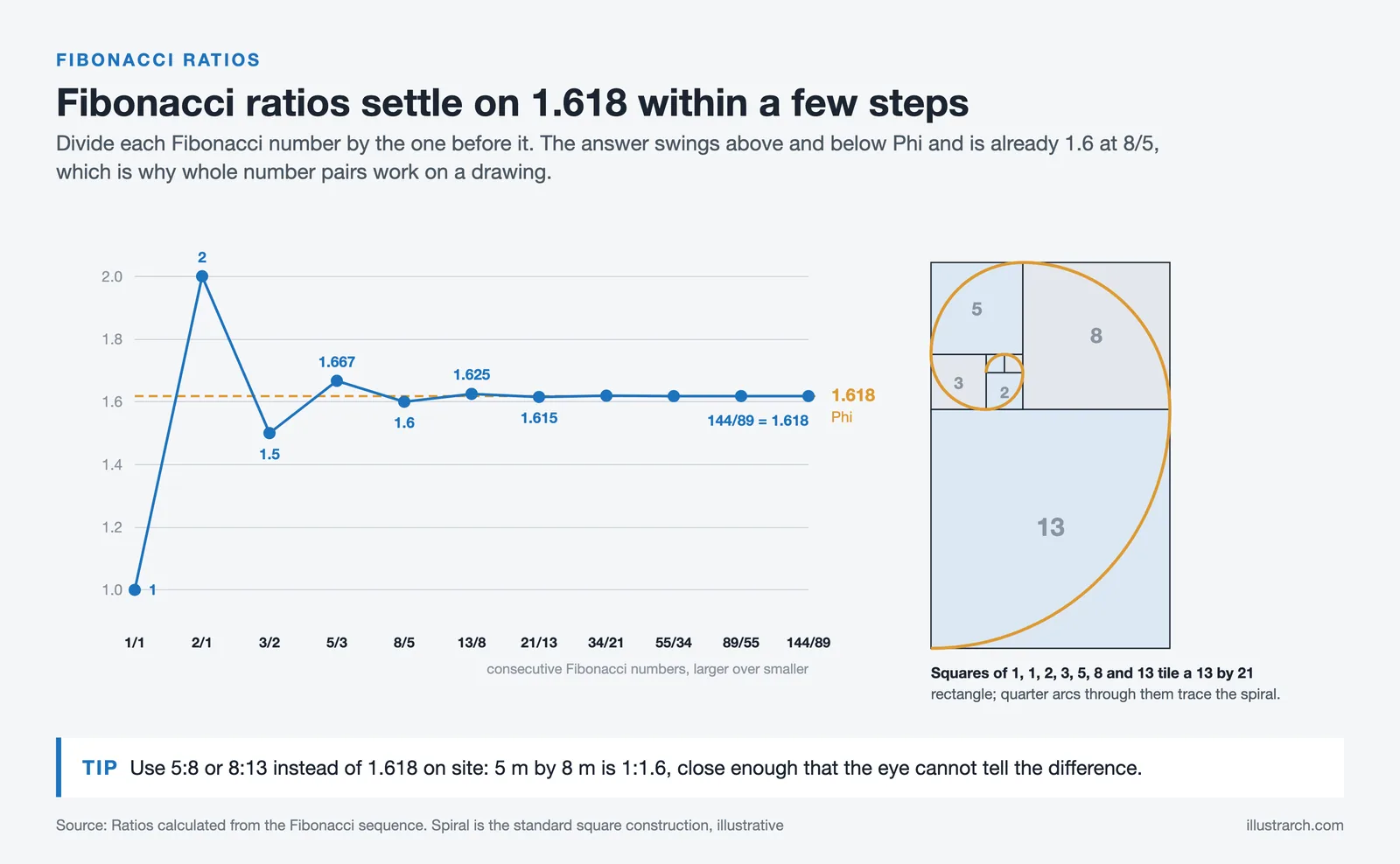
Walk past a building that stops you mid-step and you may be looking at Fibonacci ratios in action. The sequence, first introduced to Western mathematics by Leonardo of Pisa in 1202, generates proportions that approach the golden ratio (approximately 1:1.618) as the numbers grow larger. Ratios like 5:8 (1.6) and 8:13 (1.625) give architects practical whole-number dimensions they can apply directly to drawings and construction without complex calculations. The result is a proportional system rooted in mathematics yet easy to build with simple tools.
This article looks at 10 real buildings where the Fibonacci sequence shapes the design, explains the mathematics behind the proportions, and covers how modern architects apply these ratios in practice.
What Is the Fibonacci Sequence and Why Does It Matter in Architecture?

The Fibonacci sequence begins with 0 and 1. Each subsequent number is the sum of the two before it: 0, 1, 1, 2, 3, 5, 8, 13, 21, 34, 55, 89, 144, and onward. As the sequence progresses, the ratio between consecutive numbers converges on 1.618, a value known as Phi or the golden ratio. For example, 8 divided by 5 equals 1.6, 13 divided by 8 equals 1.625, and 21 divided by 13 equals 1.615. By the time you reach 144 and 89, the ratio is 1.6180, almost identical to Phi.
This convergence is what makes the sequence useful for designers. Rather than working with the irrational number 1.6180339887, architects can use Fibonacci pairs like 3:5, 5:8, or 8:13 as dimensional ratios for rooms, window openings, column spacing, and facade divisions. These whole-number relationships are easy to measure, draw, and build. A room that is 5 meters wide and 8 meters long (ratio 1:1.6) is close enough to the golden ratio that the difference is invisible to the eye, yet the dimensions are simple to specify on a construction drawing.
📐 Technical Note
The golden ratio (Phi) is defined by the equation a/b = (a+b)/a = 1.618… It is the only positive number whose reciprocal (1/Phi = 0.618) equals itself minus one. In geometry, a golden rectangle can be infinitely subdivided into a square and a smaller golden rectangle, producing the logarithmic spiral seen in nautilus shells and hurricane formations.
The Fibonacci sequence appears throughout the natural world: the spiral arrangement of sunflower seeds, the branching pattern of trees, the curve of ocean waves, and the proportions of the human body. Because humans evolved surrounded by these patterns, there is a widely held (though debated) theory that our brains find Fibonacci-derived proportions inherently pleasing. Regardless of the neuroscience, the practical track record is clear. Architects across cultures and centuries have returned to these ratios because they produce buildings that look and feel right.
How Is the Fibonacci Sequence Used in Architecture?
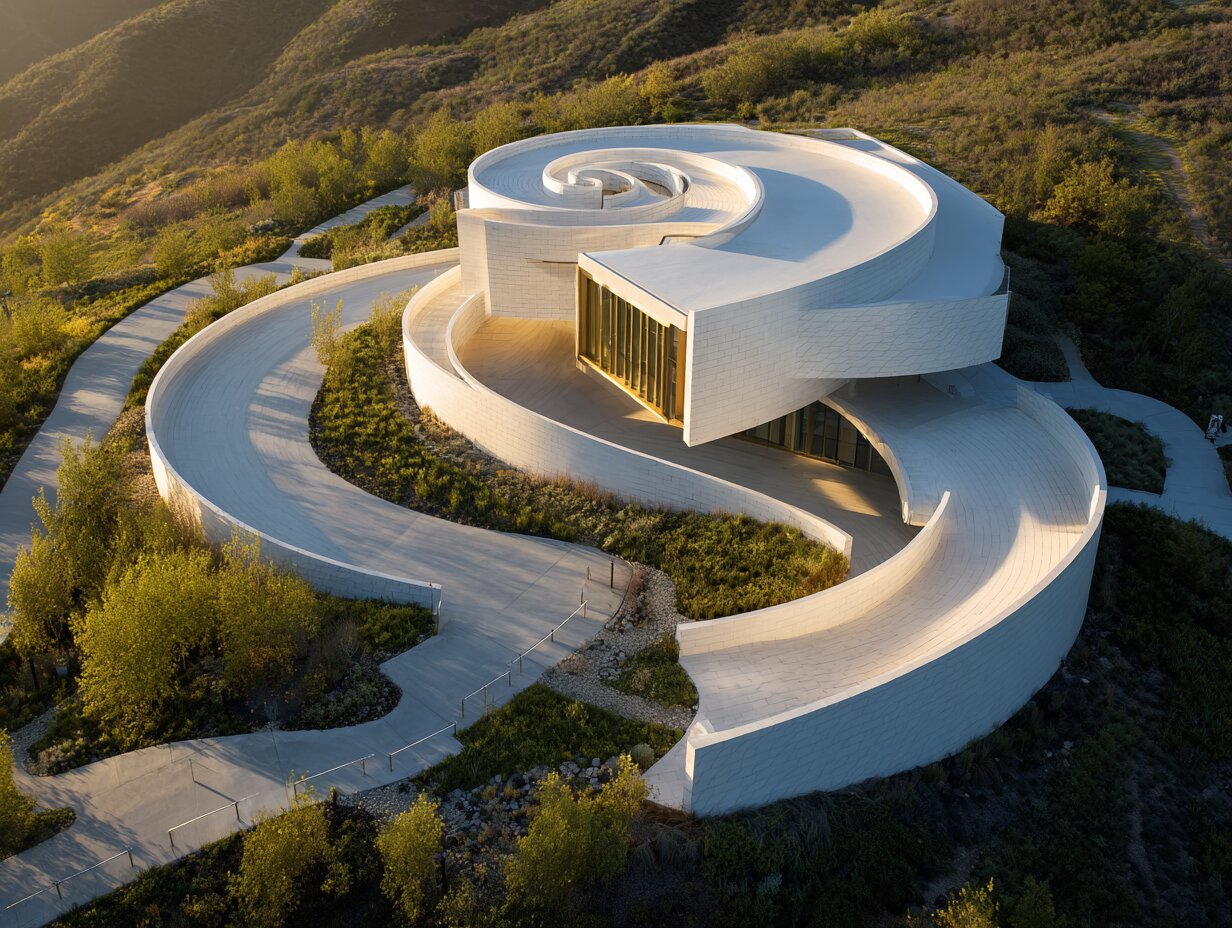
Architects apply Fibonacci ratios at every scale, from the overall massing of a building down to the spacing of decorative elements. The most common applications fall into four categories.
Facade proportions are the most visible application. Dividing a building’s front elevation into Fibonacci-proportioned zones, say a 5-unit base, an 8-unit middle, and a 13-unit top, creates a visual rhythm that avoids both monotony and chaos. The Parthenon’s facade, for instance, fits within a rectangle whose width-to-height ratio approximates a Fibonacci pair.
In floor plan layout, architects use Fibonacci dimensions to set room widths, corridor lengths, and the spacing between structural columns. A structural bay of 5 meters paired with a perpendicular bay of 8 meters produces a floor plate with proportions near the golden ratio. Le Corbusier’s Modulor system formalized this approach by generating two entire measurement series from Fibonacci-derived divisions of the human body.
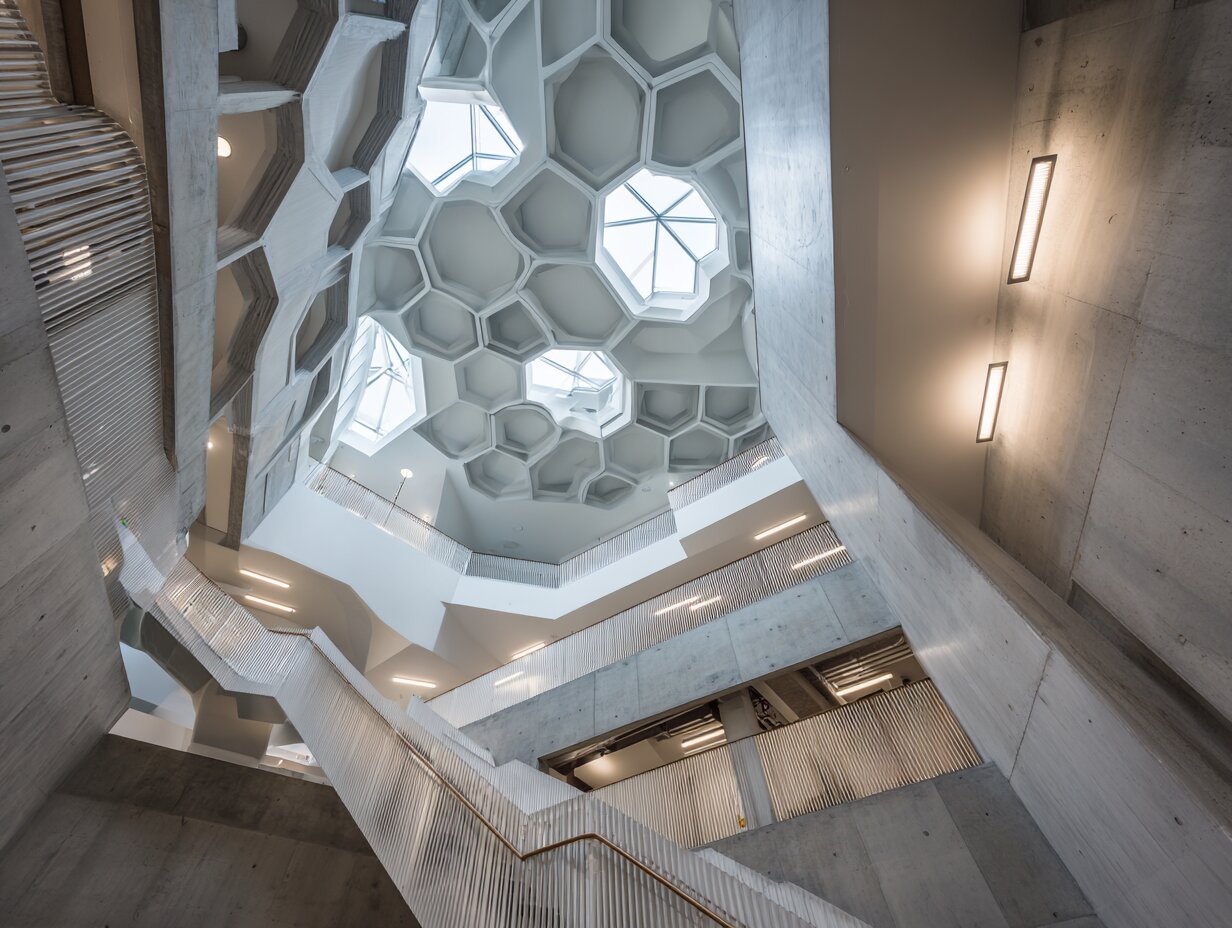
For structural grids, engineers sometimes set column spacing at Fibonacci intervals to distribute loads in a pattern that also happens to produce visually balanced bays. The Eden Project’s geodesic domes in Cornwall, England, use hexagonal and pentagonal panels whose geometric relationships connect to Fibonacci patterns.
Finally, ornamental and decorative patterns, particularly in Islamic architecture, Gothic tracery, and Art Nouveau facades, frequently incorporate spirals, rosettes, and tessellations governed by Fibonacci geometry.
💡 Pro Tip
When starting a new design, pick a single Fibonacci pair (such as 5:8) as your base ratio and apply it consistently across the floor plan, facade, and section. Consistency matters more than precision. A building organized around one clear proportional relationship reads as cohesive, even if individual dimensions drift slightly from the exact ratio.
10 Examples of the Fibonacci Sequence in Architecture
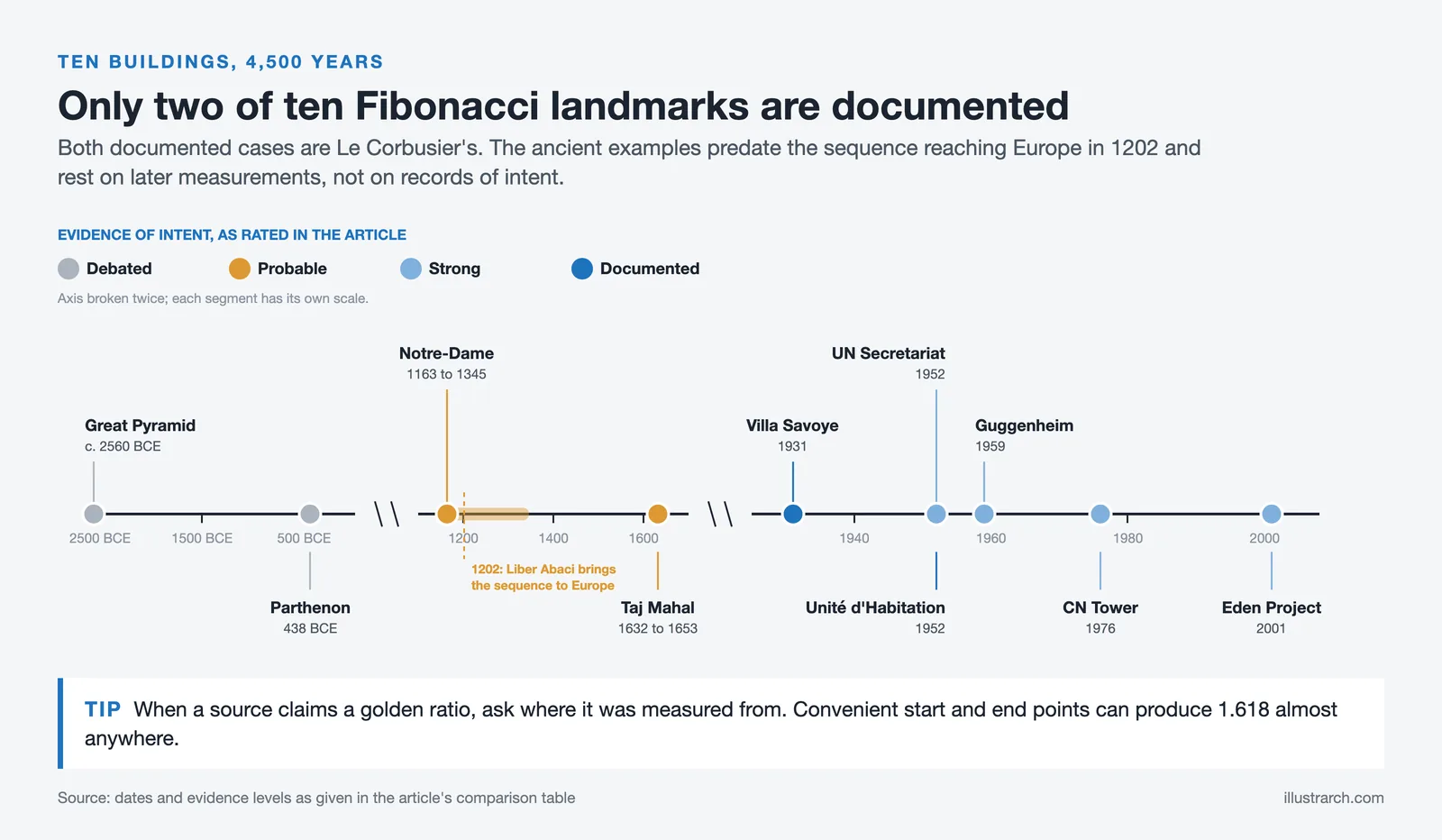
The following buildings illustrate how architects have used Fibonacci-derived proportions across different periods, cultures, and building types. Some applications are documented and deliberate. Others are debated, with scholars disagreeing about whether the builders consciously targeted Fibonacci ratios or arrived at similar proportions through independent geometric methods.
1. The Parthenon, Athens (438 BCE)

The Parthenon is the most frequently cited example of the fibonacci sequence in architecture from the ancient world. Popular accounts claim the width-to-height ratio of its main facade approximates 1.618, and researchers have identified golden rectangles within the columnar arrangement and entablature proportions. The building’s architects, Ictinus and Callicrates, appear to have used a consistent 9:4 ratio across the facade, governing the relationship between width and height and between column spacing and column diameter.
Recent scholarship complicates the picture. Mathematician Keith Devlin has argued that the golden ratio claim is “not supported by actual measurements,” and some researchers now believe the Parthenon relies on a 4:9 ratio system rather than Phi specifically. The debate highlights an important point: the Parthenon’s proportions do approximate Fibonacci ratios in several measurements, but whether the builders deliberately targeted 1.618 or produced Phi-adjacent results through their own proportional system remains an open question.
2. The Great Pyramid of Giza (c. 2560 BCE)
The Great Pyramid’s slant height to half-base ratio closely approximates 1.618. According to research published by the Glen Dash Foundation for Archaeological Research, the base is level to within just 2.1 centimeters across its entire 13-acre footprint. Whether the Egyptian builders targeted the golden ratio deliberately or arrived at it through practical geometry (using simple tools like ropes and stakes) remains debated, but the resulting proportions align with Fibonacci-derived ratios to a degree that is difficult to dismiss as coincidence.
3. Notre-Dame Cathedral, Paris (1163-1345)

The facade of Notre-Dame Cathedral contains multiple instances of golden ratio relationships. The height of the cathedral is approximately 1.618 times its width, and the famous rose window is proportioned according to ratios that align with the Fibonacci sequence. Medieval builders used geometric construction methods, including dividers and compasses, that naturally produce Phi-adjacent proportions even without explicit knowledge of the Fibonacci sequence.
4. The Taj Mahal, Agra (1632-1653)
The Taj Mahal exhibits Fibonacci-related proportions in several elements. The proportional layout of the gardens, the positioning of the central dome relative to the four minarets, and the relationships between the gateway and the main mausoleum all follow ratios that approximate the golden section. Mughal architects drew on a sophisticated geometric tradition, shared with the broader Islamic mathematical heritage, that independently arrived at proportional systems closely related to Fibonacci numbers.
5. Le Corbusier’s Unité d’Habitation, Marseille (1952)

The Unité d’Habitation is the most direct and documented application of the fibonacci sequence to a residential building. Le Corbusier designed every dimension of this 337-unit housing block using his Modulor system, a proportional scale derived from the human body and the golden ratio. The system starts with a standing figure 1.83 meters tall, divides that height at the navel according to Phi, and generates two interlocking Fibonacci-based measurement series (a “red” and “blue” sequence).
Ceiling heights (2.26 m), apartment widths (3.66 m, which equals 2.26 multiplied by 1.618), balcony depths, corridor dimensions, and even the size of the commemorative foundation stone all follow Modulor measurements. A cast-concrete relief of the Modulor Man near the entrance makes the building a visible textbook of Fibonacci-derived architectural design.
🎓 Expert Insight
“It is a tool, a means of obtaining good proportions easily, effortlessly.” — Le Corbusier, on the Modulor system (Le Modulor, 1948)
Le Corbusier saw the Modulor not as an aesthetic formula but as a practical device for generating human-scaled dimensions quickly. Albert Einstein, after reviewing the system, reportedly commented that it was a proportional tool that “makes the bad difficult and the good easy.”
6. Villa Savoye, Poissy (1931)
Le Corbusier’s Villa Savoye incorporates golden ratio regulating lines to determine facade dimensions, window placements, and internal spatial sequences. The five points of architecture that define the villa, including pilotis, free plan, free facade, horizontal windows, and roof garden, are organized within a proportional framework tied to Fibonacci relationships. Villa Savoye predates the formal publication of the Modulor but reflects Le Corbusier’s early experiments with Phi-based design grids.
7. The Guggenheim Museum, New York (1959)

Frank Lloyd Wright’s Guggenheim Museum uses a spiral form closely related to the golden spiral, which is derived from nested golden rectangles. The famous ramp circulates visitors through the building along a curve whose proportions echo those found in nautilus shells and sunflower seed arrangements. Wright, a proponent of organic architecture, designed the museum so that the entire spatial experience grows from a single coherent geometric idea.
8. The CN Tower, Toronto (1976)
The CN Tower incorporates golden ratio proportions in the relationship between its main observation deck height and the total height of the structure. The tower reaches 553.3 meters, and the ratio of the observation deck’s height (approximately 342 meters) to the total height is close to 0.618, the reciprocal of Phi. This proportion gives the tower a visual balance point that prevents the structure from appearing top-heavy or bottom-heavy.
9. The United Nations Secretariat Building, New York (1952)

Designed by a team led by Wallace Harrison with input from Le Corbusier and Oscar Niemeyer, the 39-story Secretariat uses a facade whose vertical proportions approximate three stacked golden rectangles. The building’s slab form became a template for corporate high-rises worldwide, demonstrating how Phi-based massing could communicate institutional seriousness without classical ornament. Measured as a whole, though, the slab is about 505 ft (154 m) tall and 287 ft (87 m) wide, a ratio of roughly 1.76 rather than 1.618.
10. The Eden Project, Cornwall (2001)
The Eden Project’s geodesic biomes demonstrate Fibonacci-related geometric patterns. The hexagonal and pentagonal panels that form the domes follow proportional relationships tied to the golden ratio, maximizing structural efficiency while minimizing material use. The geometry connects to the work of Buckminster Fuller, whose geodesic dome designs relied on mathematical relationships deeply intertwined with Fibonacci numbers.
🏗️ Real-World Example
Apple Park, Cupertino (2017): Apple’s headquarters, designed by Foster + Partners, uses a circular plan whose proportional relationships, including the ratio of the ring diameter to the building width, align with golden ratio principles. The 2.8 million square foot campus demonstrates how the fibonacci sequence in modern architecture continues to inform even the most technology-driven projects.
Comparison of Fibonacci Sequence Applications in Architecture
The following table summarizes how the Fibonacci sequence appears in each building and the level of historical certainty behind each claim.
| Building | Year | Fibonacci Application | Evidence Level |
|---|---|---|---|
| Parthenon | 438 BCE | Facade width-to-height ratio near 1.618 | Debated |
| Great Pyramid of Giza | c. 2560 BCE | Slant height to half-base ratio approximates Phi | Debated |
| Notre-Dame Cathedral | 1163-1345 | Facade and rose window proportions | Probable |
| Taj Mahal | 1632-1653 | Garden layout, dome-to-minaret ratios | Probable |
| Unité d’Habitation | 1952 | Entire Modulor system (all dimensions) | Documented |
| Villa Savoye | 1931 | Regulating lines and facade grid | Documented |
| Guggenheim Museum | 1959 | Golden spiral in ramp geometry | Strong |
| CN Tower | 1976 | Observation deck height to total height ratio | Strong |
| UN Secretariat | 1952 | Facade as stacked golden rectangles | Strong |
| Eden Project | 2001 | Geodesic panel geometry | Strong |
The Fibonacci Sequence in Art and Architecture: A Shared History
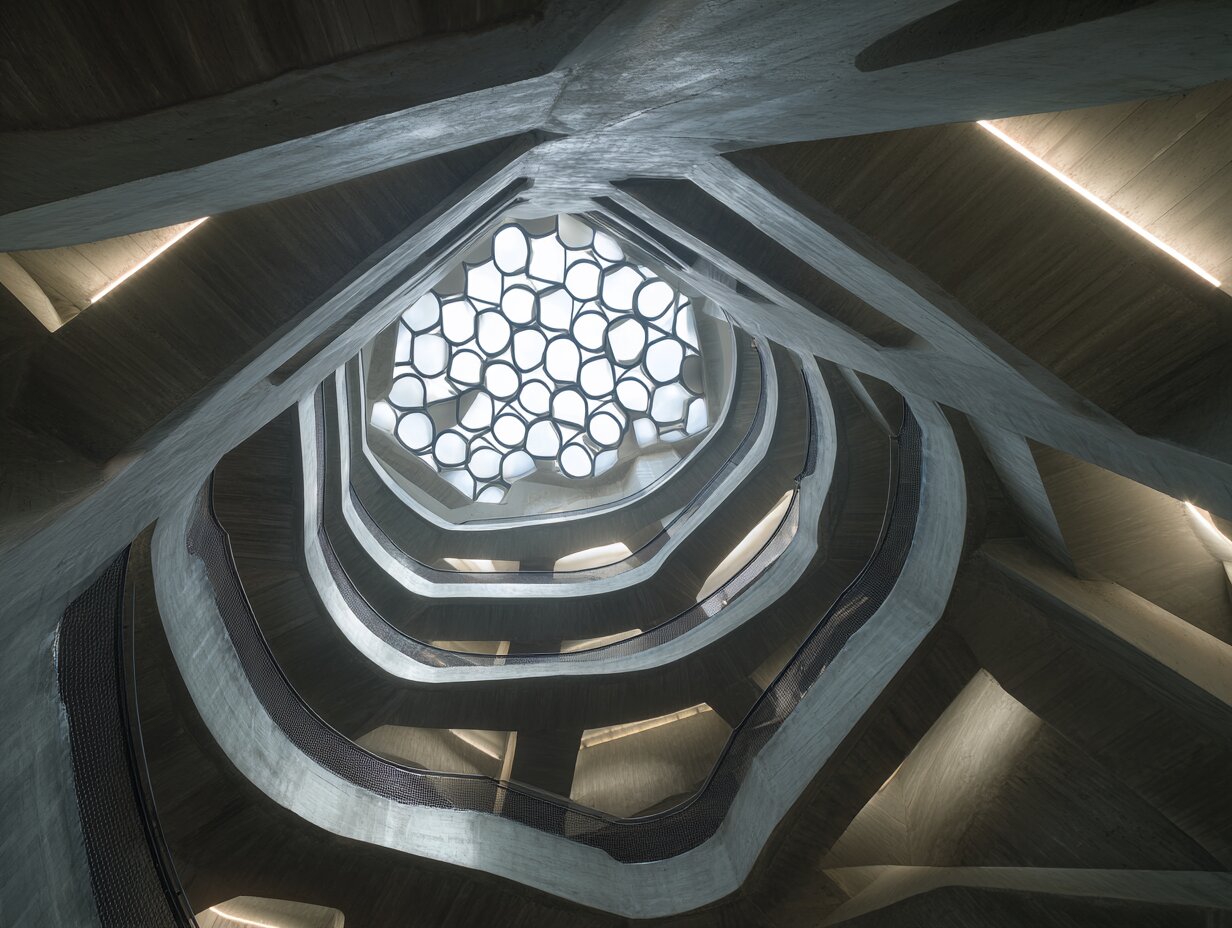
The fibonacci sequence in art and architecture share a common origin. Renaissance painters like Leonardo da Vinci and Sandro Botticelli used Fibonacci-derived compositions to organize figures, background elements, and perspective grids. Da Vinci’s “Vitruvian Man” (c. 1490) explicitly mapped the golden ratio onto the human body, an exercise that would later inform proportion and scale in architecture.
The overlap between art and architecture is especially visible in the work of Antoni Gaudí. The Sagrada Família in Barcelona uses hyperboloids, catenary curves, and branching columns derived from the study of trees and bones. Gaudí’s approach combined artistic intuition with scientific rigor, producing forms governed by natural geometry, including proportions related to the Fibonacci sequence.
Islamic geometric art provides another intersection. The intricate tessellations found in mosques and palaces across the Islamic world, from the Great Mosque of Córdoba to the Alhambra, use geometric constructions that produce Phi-adjacent proportions. These patterns served both decorative and theological purposes, expressing infinite order through abstract mathematical form.
📌 Did You Know?
The Fibonacci sequence was not invented by Fibonacci himself. Leonardo of Pisa introduced it to Western Europe in his 1202 book “Liber Abaci,” but the sequence had been described centuries earlier by Indian mathematicians, including Pingala (c. 200 BCE) in the context of Sanskrit prosody, and later by Virahanka (c. 700 CE) and Hemachandra (c. 1150 CE). The sequence’s connection to the golden ratio was not formally proven until the 18th century.
Fibonacci Sequence in Modern Architecture
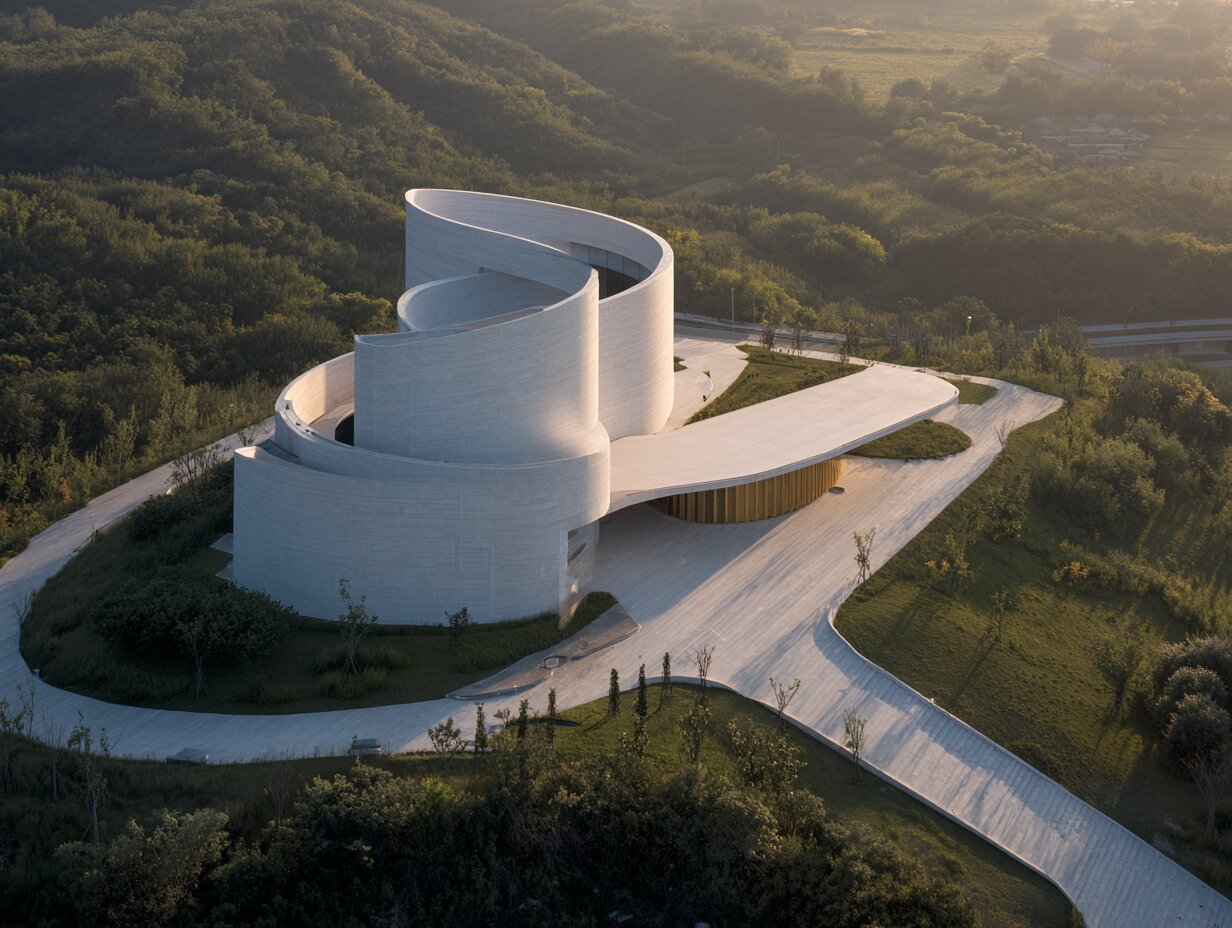
Contemporary architects continue to apply the fibonacci sequence in modern architecture, though the methods have evolved. Where Le Corbusier used a slide rule and hand calculations, today’s designers use parametric software like Grasshopper for Rhino, Dynamo for Revit, and custom Python scripts to generate Fibonacci-based grids, spirals, and facade patterns at any scale.
The shift toward algorithmic design has expanded what Fibonacci proportions can do. Parametric tools allow architects to apply golden ratio subdivisions to curved surfaces, irregular plans, and complex three-dimensional geometries that would be nearly impossible to calibrate by hand. A facade panel system, for instance, can be scripted to vary panel widths along a Fibonacci progression, creating a visual rhythm that accelerates or decelerates across the building’s surface.
Sustainability also intersects with Fibonacci geometry. Biomimicry in architecture, which studies natural systems for design inspiration, frequently encounters Fibonacci patterns because they are so prevalent in biological structures. The spiral arrangement of leaves around a stem (phyllotaxis), for example, follows Fibonacci angles (approximately 137.5 degrees between successive leaves) to maximize sunlight exposure. Architects studying phyllotaxis have applied similar angular relationships to facade shading systems that optimize daylight while reducing solar heat gain.
💡 Pro Tip
If you use Grasshopper or Dynamo, create a Fibonacci series component early in your definition and feed its output into panel sizing, structural bay spacing, or facade rhythm generators. This ensures proportional consistency across the design without manual calculation at every step. The free illustrarch golden ratio calculator can help verify individual dimensions quickly.
Video: The Fibonacci Sequence and the Golden Ratio Explained
This animated explainer from Science ABC covers how the Fibonacci sequence connects to the golden ratio, its appearance in nature, and its application in art and architecture, including Le Corbusier’s proportional system.
Why Does the Fibonacci Sequence Work in Architectural Design?
Several factors explain why architects keep returning to Fibonacci proportions. The most practical reason is that Fibonacci pairs provide whole-number ratios that approximate the golden ratio without requiring irrational numbers on a construction drawing. A builder can measure 5 meters and 8 meters with a tape measure. Nobody can measure 1.6180339887 meters on a job site with any meaningful precision.
There is also a perceptual dimension. Research in experimental aesthetics, while not unanimous, suggests that many people show a preference for rectangles with proportions near 1.618 over squares, double squares, or other common ratios. A 2015 study published in the journal Acta Psychologica (Stieger & Swami) found that participants rated golden-ratio rectangles as more attractive than alternatives, though the preference was moderate rather than absolute. The golden ratio is not a guarantee of beauty, but it provides a statistically favorable starting point.
Nature offers a structural reason as well. Fibonacci spirals and golden-angle arrangements appear in biological systems because they solve optimization problems. Sunflower seed heads pack seeds in a Fibonacci spiral because it minimizes wasted space. Tree branches grow at Fibonacci angles to maximize sunlight capture. When architects apply these same patterns to facade shading, structural branching, or site planning, they tap into proportional logic that has been refined by billions of years of natural selection.
⚠️ Common Mistake to Avoid
Many people confuse the Fibonacci sequence with the golden ratio, treating them as identical concepts. The Fibonacci sequence is a series of numbers. The golden ratio is a single irrational number (1.618…). They are mathematically connected because the ratio between consecutive Fibonacci numbers approaches 1.618, but they are not the same thing. When discussing architectural proportions, be specific about whether you mean Fibonacci number pairs (e.g., 5:8) or the golden ratio itself.
The Scholarly Debate: Intentional Design or Coincidence?
Any honest discussion of the fibonacci sequence and architecture must address the scholarly disagreement about how much of the historical evidence reflects intentional design versus selective measurement. Mathematicians George Markowsky and Keith Devlin have both argued that many claimed golden ratio sightings in ancient buildings rely on confirmation bias: measuring from convenient points to get numbers that approximate Phi, while ignoring measurements that do not.
On the other side, researchers like Gary Meisner have used high-resolution photographic analysis to document golden ratio proportions across numerous buildings. The truth sits between these positions. Some applications, like Le Corbusier’s Modulor, are explicitly documented and beyond dispute. Others, like the Parthenon and the Great Pyramid, show proportions close enough to Phi to be noteworthy but lack documentary proof of intent.
For practicing architects, the debate is less important than the practical outcome. Whether the Parthenon’s builders targeted Phi specifically or arrived at similar proportions through their 9:4 system, the resulting building has been admired for 2,500 years. The Fibonacci sequence provides a reliable proportional framework that produces visually balanced results. The question of ancient intent, while fascinating for historians, does not diminish the tool’s usefulness for contemporary designers.
How to Apply the Fibonacci Sequence in Your Own Designs
You do not need advanced mathematics to use Fibonacci ratios in architectural design. The simplest method is to pick a Fibonacci pair and use it as your governing proportion. Here is a step-by-step approach:
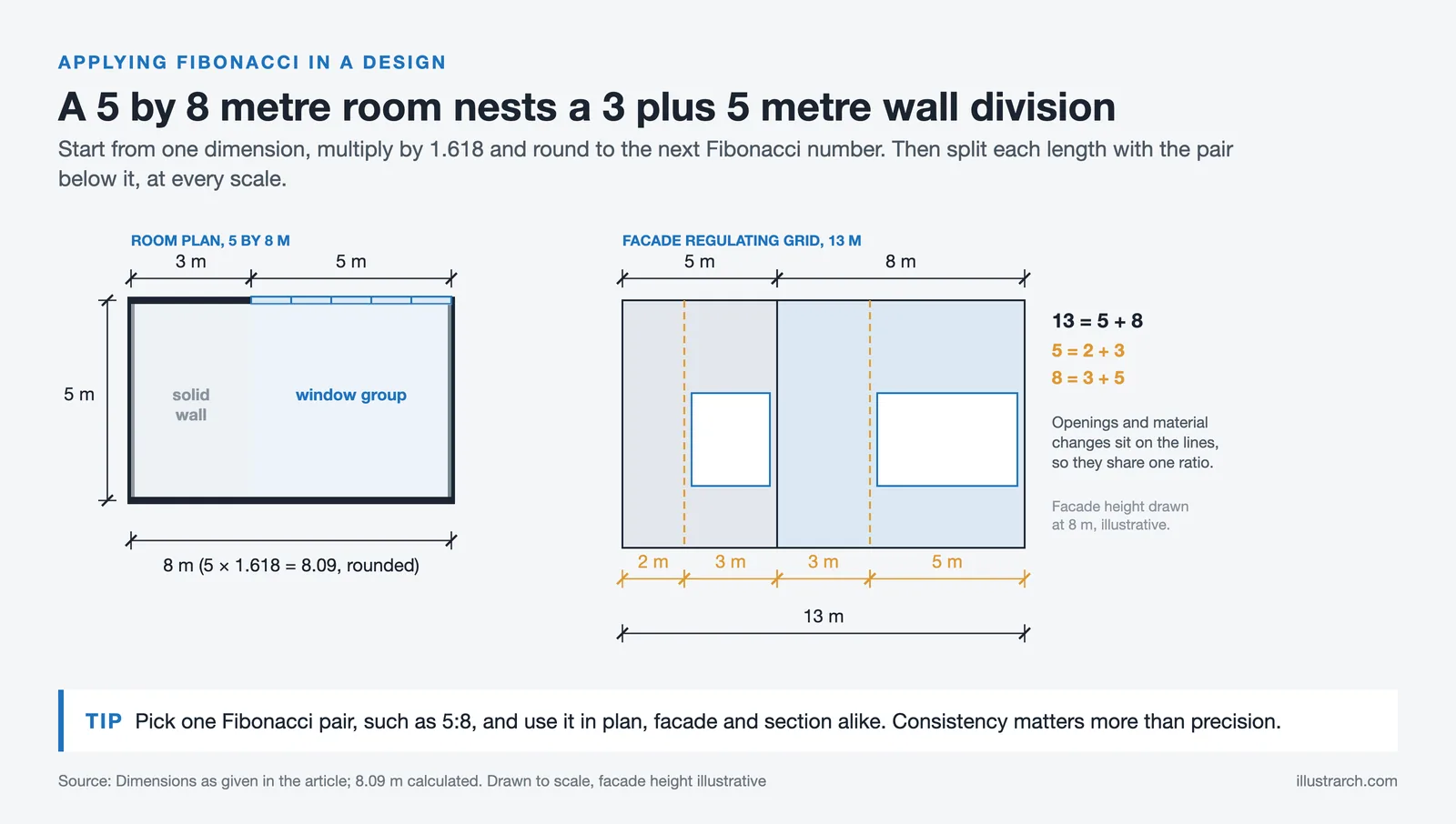
Start with your primary dimension. If you are designing a room that is 5 meters wide, multiply by 1.618 to get the length: 8.09 meters, which you can round to 8 meters (the next Fibonacci number). The room is now proportioned at 5:8.
Apply the same ratio to subdivisions. Divide the 8-meter wall into zones using the next Fibonacci pair down: 3 meters and 5 meters. Place a window grouping in the 5-meter zone and a solid wall in the 3-meter zone. The proportions nest within each other, creating visual consistency at every scale.
For facades, create a regulating grid by marking horizontal and vertical lines at Fibonacci intervals. A 13-meter-wide facade can be divided into bands of 5 and 8 meters, then subdivided further into 2, 3, and 5. Window openings, material changes, and structural elements placed along these lines will automatically share a proportional relationship.
For scaled drawings, Fibonacci-adjacent whole numbers (3:5, 5:8, 8:13) are practical because they convert easily to common architectural scales and produce dimensions that are straightforward to communicate to contractors.
✅ Key Takeaways
- The Fibonacci sequence generates ratios that converge on 1.618 (the golden ratio), giving architects practical whole-number proportions for design.
- Ten iconic buildings, from the Parthenon to the Eden Project, demonstrate Fibonacci proportions across different cultures, centuries, and building types.
- Le Corbusier’s Modulor system is the most documented and systematic application of Fibonacci-derived proportions in architecture.
- Ancient examples (Parthenon, Great Pyramid) are debated: measurements approximate Phi, but intentional use is not proven in every case.
- Modern parametric tools have expanded how architects apply Fibonacci ratios, enabling complex curved surfaces and algorithmically generated patterns.
- The Fibonacci sequence is one effective proportional tool among several; it works best when applied consistently across a design rather than used as an inflexible rule.
Final Thoughts
The fibonacci sequence architectural design tradition stretches from the limestone blocks of ancient Egypt to the parametric facades of 21st-century towers. What has changed over four and a half millennia is the method of application, from ropes and stakes to Grasshopper scripts, but the underlying mathematics remains the same. The sequence works because it connects built form to proportional relationships found throughout the natural world, producing buildings that feel balanced at scales ranging from a door handle to an entire skyline.
For architects and designers, the practical value of the Fibonacci sequence is clear: it provides a reliable framework for dimensional decisions that would otherwise be arbitrary. A room width, a column spacing, a facade division, each of these requires a number, and Fibonacci pairs offer numbers with a proportional logic behind them. That logic does not replace design judgment, site analysis, or structural calculation. But it gives every dimensional choice a mathematical foundation that has been tested across cultures and centuries.
To see how these proportions connect to the broader story of the golden ratio in building design, read our detailed guides on the golden ratio in architecture, golden ratio in modern architecture, and when the golden ratio was first used in architecture.
The proportional relationships discussed in this article are based on measurements and research by multiple scholars. Where claims about intentional golden ratio use in ancient buildings are debated, both perspectives are noted. Technical specifications should be verified by a licensed professional for your specific project.




Overlapping Concrete Walls and One Roof Shape a House in Okinawa
IGArchitects built Overlapping Spaces in Okinawa from reinforced concrete walls, columns and...
 illustrarch Editoral Team1 Mins read
Futuro House Production Revived in Finland After Decades-Long Hiatus
A Facebook listing for abandoned moulds led to the first new Futuro...
illustrarch Editoral Team3 Mins read
Building Your Dream Home in NSW: What You Should Know About Montgomery Homes
Montgomery Homes has been building across Sydney, Newcastle, the Hunter, Wollongong and...
illustrarch Editoral Team4 Mins read
Designing a Home Theater: Where Drapery Fits Into the Plan
In a media room the curtains are a performance layer, not decoration....
illustrarch Editoral Team3 Mins read


Leave a comment