

Adaptive Reuse Architecture vs New Construction: A Practical Cost, Sustainability, and Design Comparison
A practical comparison of adaptive reuse architecture and new construction across cost, sustainability, and design quality. Includes real project data, carbon savings estimates, and guidance for architects choosing between repurposing existing buildings and building from scratch.
 Furkan Sen16 May 202610 Mins read230

Table of Contents Show
Adaptive reuse architecture is the practice of repurposing an existing building for a new function while retaining its structural and character-defining elements. Compared to new construction, it typically costs 12-15% less, generates 50-75% less embodied carbon, and preserves cultural heritage that demolition would erase permanently.
Every building carries decades of embedded resources: concrete, steel, timber, glass, and the energy spent extracting, manufacturing, and transporting those materials. When a structure is demolished, all of that invested energy goes to waste. Adaptive reuse in architecture starts from a different premise. Rather than clearing the site and starting over, it asks what the existing building can still offer and builds the design response around that question. The result is often a project that costs less, finishes faster, and leaves a smaller environmental footprint than its new-build equivalent.
But adaptive reuse is not always the right choice. Some buildings are too deteriorated, too contaminated, or too structurally limited to justify conversion. This article lays out the real trade-offs between reuse and new construction across three dimensions that matter most to architects and developers: cost, sustainability, and design quality.
What Is Adaptive Reuse in Architecture?
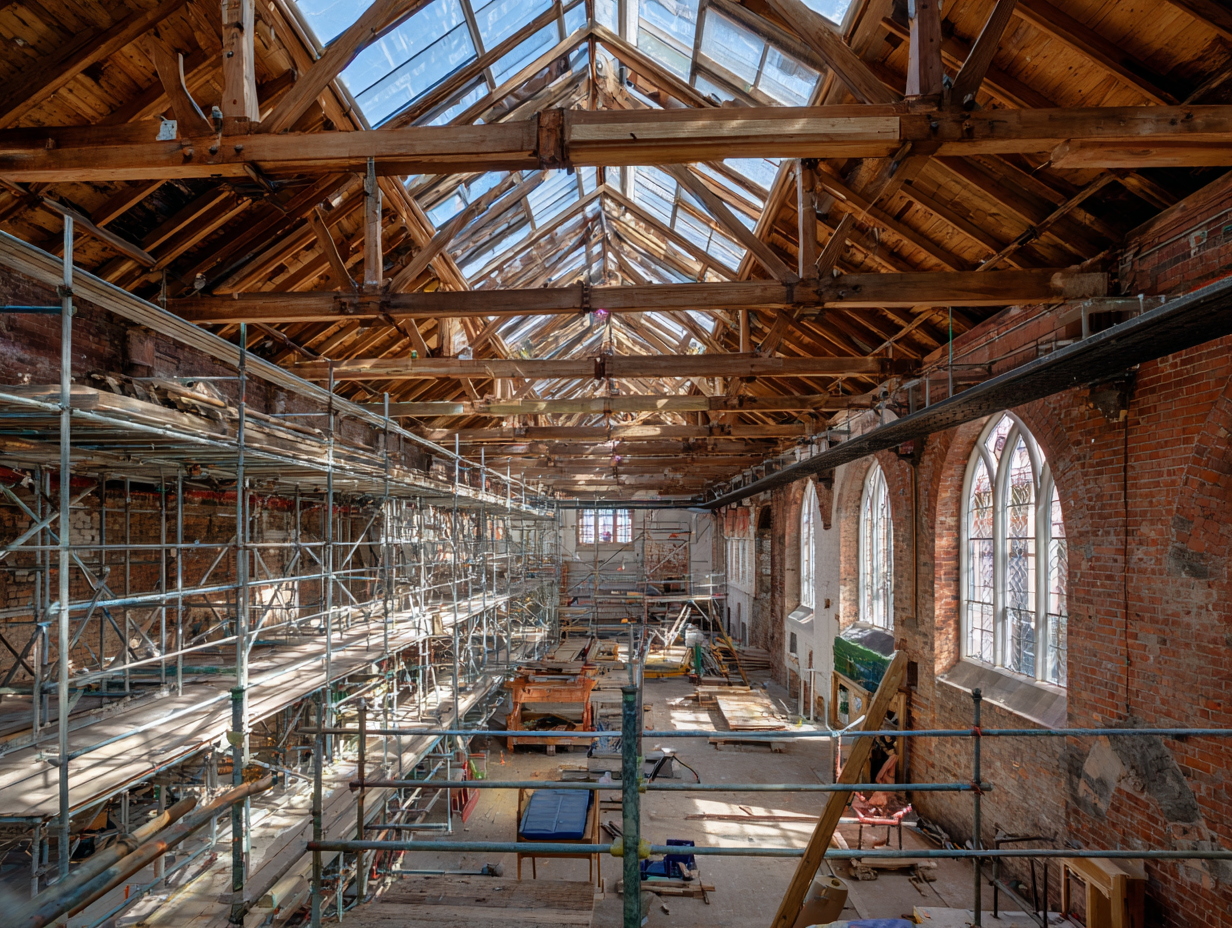
Adaptive reuse in architecture refers to the process of converting an existing building, originally designed for one purpose, into a space that serves an entirely different function. A former power station becomes a museum. An abandoned warehouse turns into residential lofts. A decommissioned church is reborn as a community library. The defining feature is that the core structure, and often significant portions of the building envelope, are preserved rather than demolished.
This approach differs from simple renovation or restoration. Renovation updates a building for its original use. Restoration returns it to a previous historical state. Adaptive reuse changes the building’s function entirely, which often requires rethinking floor plans, circulation, mechanical systems, and structural capacity.
💡 Pro Tip
Before committing to an adaptive reuse project, invest in a thorough existing-conditions survey using 3D laser scanning or LiDAR. Accurate as-built documentation can reduce change orders by 30-40% by eliminating guesswork about hidden structural conditions, wall thicknesses, and MEP routing.
The concept is not new. Throughout history, Roman temples were converted into Christian churches, medieval fortresses became civic buildings, and industrial mills were repurposed as housing. What has changed is the scale and intentionality of the approach. Adaptive reuse architecture is now a recognized design discipline with its own body of research, specialized consultants, and dedicated funding mechanisms such as Federal Historic Tax Credits in the United States.
How Do Costs Compare Between Adaptive Reuse and New Construction?
Cost is often the first question developers ask when considering adaptive reuse. The short answer: reuse projects typically cost less than new builds of equivalent size, but they carry higher uncertainty. According to the World Economic Forum’s 2025 adaptive reuse policy report, reusing existing buildings can deliver 12-15% in cost savings compared to demolition and new construction. A 2025 study published in the journal Buildings found that new construction investment costs were 57-178% higher than revitalization costs for equivalent industrial-to-commercial conversions in Warsaw.
These savings come from several areas. Foundation and superstructure work is significantly reduced when the existing frame is sound. Demolition costs, which can run $5-15 per square foot depending on the structure, are avoided. Site preparation, grading, and utility connections are already in place. And project timelines tend to be shorter: industry research indicates that adaptive reuse projects can be completed up to 30% faster than comparable new builds.
⚠️ Common Mistake to Avoid
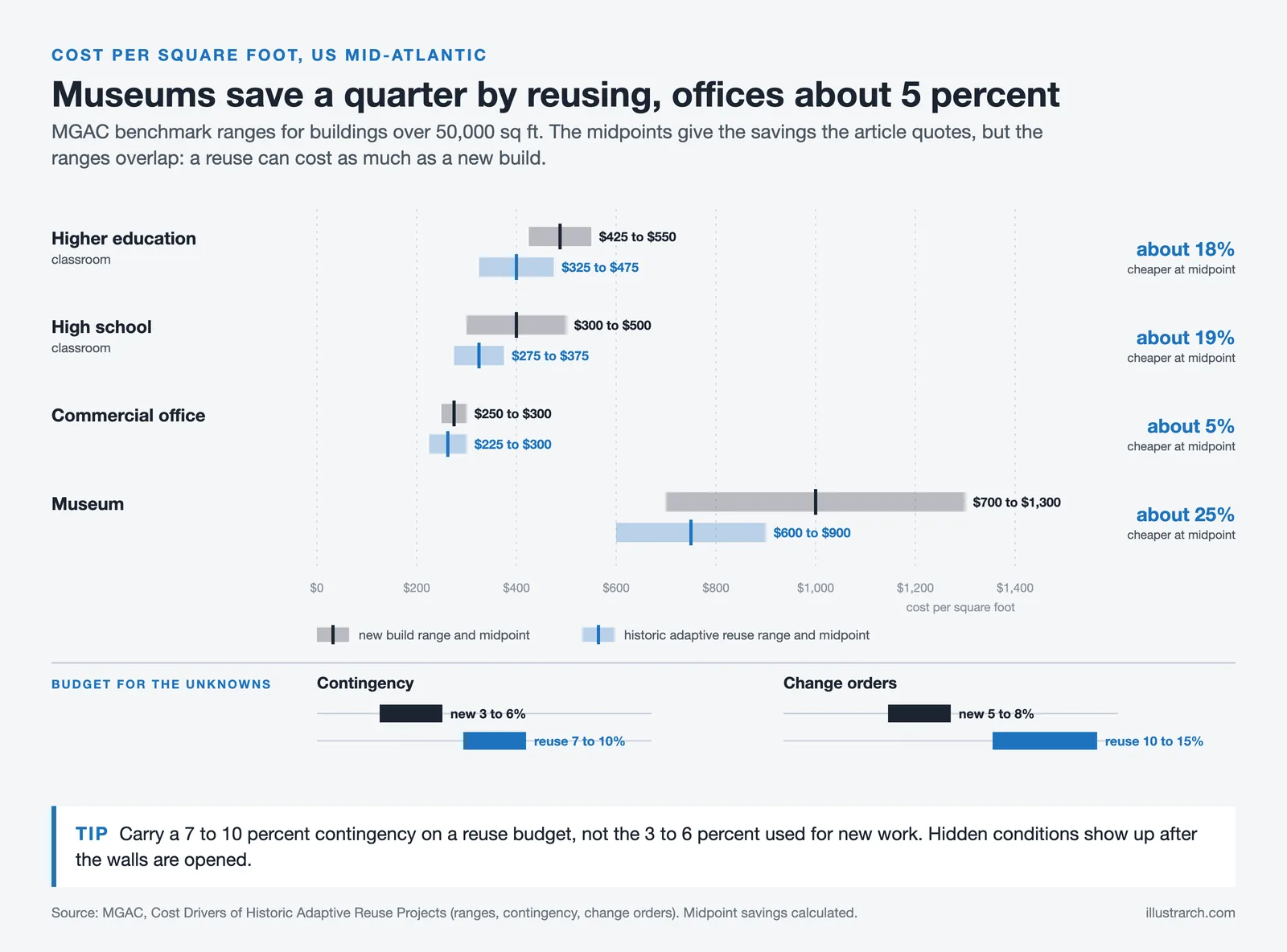
Many developers underestimate contingency budgets for adaptive reuse. While new-build projects typically set aside 3-6% for contingencies, reuse projects should budget 7-10% due to hidden conditions like undocumented structural modifications, asbestos, or deteriorated foundations. Change orders on historic adaptive reuse projects average 10-15% of construction cost, roughly double the 5-8% typical of new builds.
However, reuse is not uniformly cheaper. Custom windows, doors, and elevator installations in older buildings often require specialized fabrication with limited vendor options. Structural upgrades such as underpinning foundations or seismic reinforcement can add substantial costs. About 75% of adaptive reuse projects require some form of structural upgrade, according to cost management firm MGAC. And logistics within existing buildings, including smaller elevator shafts, restricted crane access, and tighter work areas, can slow construction and increase labor costs.
Cost Comparison by Building Type
The following table shows approximate cost differences between adaptive reuse and new construction for common building types in the U.S. Mid-Atlantic region, based on the midpoints of MGAC cost ranges for buildings over 50,000 square feet (the ranges overlap, so a reuse project can cost as much as a new build):
| Building Type | New Build (per SF) | Adaptive Reuse (per SF) | Approximate Savings |
|---|---|---|---|
| Higher Education Classroom | $487 | $400 | 18% |
| High School Classroom | $400 | $325 | 19% |
| Commercial Office | $275 | $262 | 4.5% |
| Museum | $1,000 | $750 | 25% |
The savings vary widely depending on building type. Museum and education conversions show the largest gap because these projects benefit most from the generous floor-to-ceiling heights and open floor plates common in industrial buildings. Commercial office conversions, by contrast, often require more extensive mechanical and electrical upgrades to meet modern workplace standards, narrowing the cost advantage.
Sustainability: Carbon, Waste, and Environmental Impact

The environmental case for adaptive reuse architecture is arguably even stronger than the financial one. Buildings account for roughly 40% of global carbon emissions, and a significant portion of that comes from embodied carbon, the emissions generated during material extraction, manufacturing, and construction. When you demolish a building, all of its embodied carbon becomes a sunk environmental cost, and the replacement structure adds an entirely new layer of emissions.
🔢 Quick Numbers
- Reusing a building saves 50-75% of the embodied carbon that new construction would generate (Architecture 2030, CARE Tool, 2024)
- Construction and demolition debris accounts for over 600 million tons annually in the U.S. alone (EPA, 2024)
- More than 70,000 apartments were converted from office buildings in 2025, a 200%+ increase since 2022 (Construction Executive, 2026)
- Up to 90% of materials can be salvaged when buildings are reused instead of demolished (EPA, cited by the World Economic Forum, 2025)
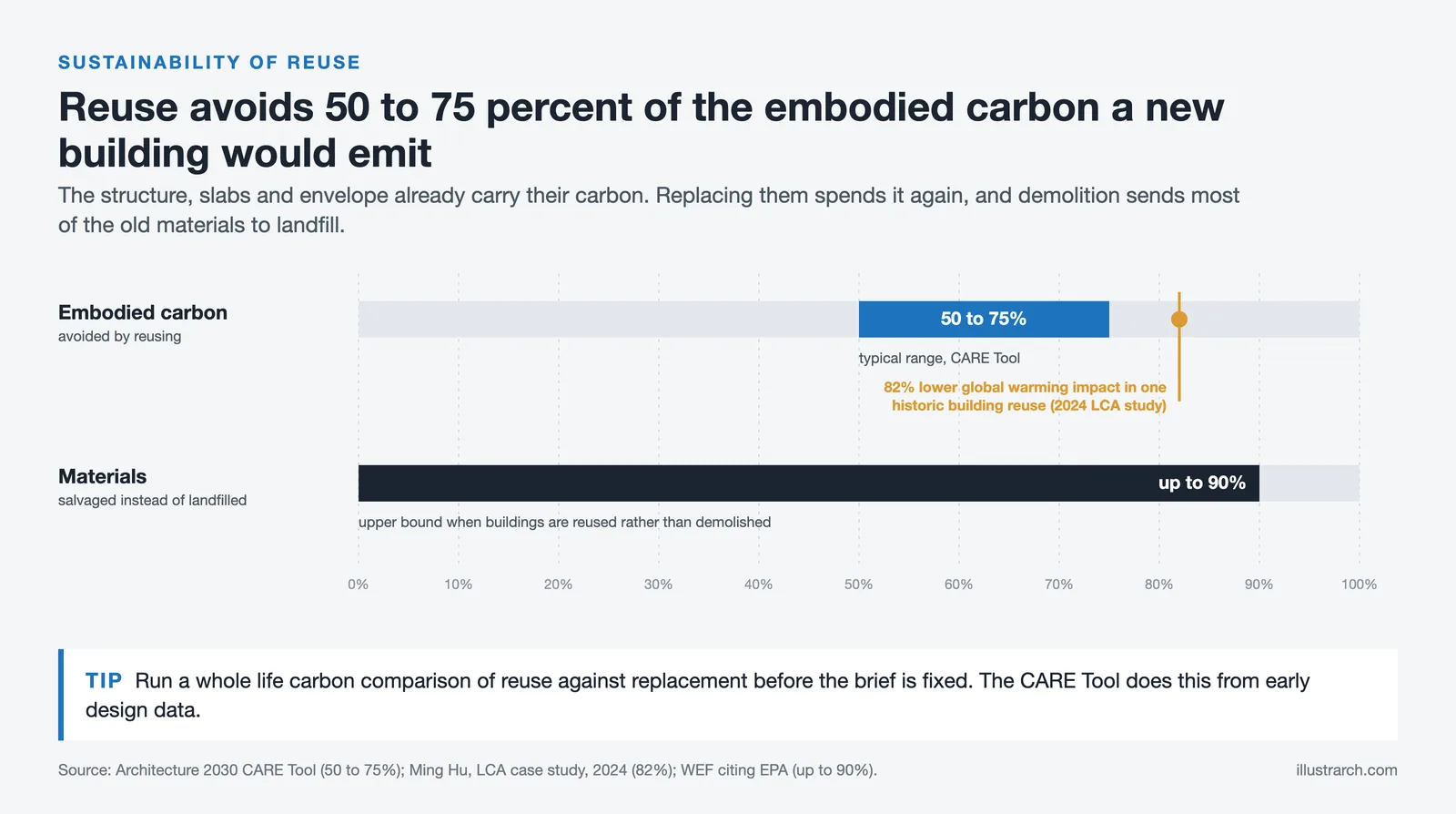
The CARE (Carbon Avoided: Retrofit Estimator) Tool, developed by Architecture 2030, allows design teams to quantify these benefits in specific project terms. The tool compares the total carbon emissions of retrofitting an existing building versus replacing it with a new one, factoring in both embodied and operational emissions over a specified time frame. A separate 2024 life cycle assessment case study of a reused historic building (Ming Hu) found an 82% reduction in global warming potential compared to new construction.
Waste reduction is another significant factor. The U.S. Environmental Protection Agency estimates that construction and demolition waste is one of the largest solid waste streams, accounting for roughly 30% of total waste generation. Adaptive reuse addresses this directly by keeping the bulk of the existing structure out of the landfill.
🎓 Expert Insight
“The most direct possible way to reduce embodied carbon is to reuse and upgrade an existing building rather than replacing it with new construction.” — Architecture 2030 / CARE Tool Team
This position reflects a growing consensus among sustainability experts that the phrase “the greenest building is the one already built” is not just a slogan but a measurable reality. For buildings constructed between now and 2050, more than half of their lifetime carbon emissions will come from embodied carbon rather than operations.
That said, new construction has its own sustainability advantages. A purpose-built structure can be designed from the ground up with passive solar orientation, optimized building envelopes, and net-zero energy systems. An adapted building, by contrast, is constrained by its existing orientation, wall-to-window ratios, and structural geometry. In some cases, especially where the existing building is severely energy-inefficient and cannot be cost-effectively upgraded, a new high-performance building may produce lower operational carbon over its lifespan.
Design Quality: Constraints as Creative Opportunities
From a design perspective, adaptive reuse architecture imposes constraints that new construction does not: fixed column grids, load-bearing walls, ceiling heights determined by the original function, and facades that may be protected by preservation guidelines. These limitations can frustrate architects accustomed to the blank-slate freedom of a new build.
But they can also produce architecture with a richness and character that is difficult to replicate from scratch. The juxtaposition of old and new materials, the visible layers of history within a single space, and the unexpected spatial qualities inherited from the original use often create buildings that are more engaging than their purely contemporary counterparts.
🏗️ Real-World Example
Tate Modern (London, 2000): Herzog & de Meuron converted the former Bankside Power Station into one of the world’s most visited modern art museums, attracting over 5 million visitors annually. The £134 million conversion preserved the massive Turbine Hall as a dramatic exhibition space, and a £260 million extension (the Blavatnik Building) was added in 2016. The project catalyzed the regeneration of the entire Bankside neighborhood, demonstrating how a single adaptive reuse project can reshape an urban district.
Consider the typical adaptive reuse of industrial buildings into residential lofts or cultural venues. The high ceilings, exposed structural elements, and generous floor plates of former factories and warehouses provide spatial qualities that would be prohibitively expensive to build new. Exposed brick, steel trusses, and original timber framing carry an authenticity that manufactured “industrial chic” finishes cannot match.
New construction, on the other hand, offers complete control over spatial layout, structural performance, accessibility compliance, and environmental systems. There are no compromises with existing conditions, no surprises behind walls, and no restrictions from historic preservation bodies. For buildings with highly specific functional requirements, such as hospitals, data centers, or laboratories, new construction is almost always the more practical option.
💡 Pro Tip
When evaluating a building for adaptive reuse, assess its “bones” first: floor-to-floor heights (ideally 12 feet or more for residential conversion), structural bay spacing, and the condition of the foundation system. Buildings with generous vertical clearances and regular structural grids adapt most easily to new uses. Irregular or low-clearance structures often require expensive modifications that erode the cost advantage.
When Does Adaptive Reuse Make Sense (and When Does It Not)?

Choosing between adaptive reuse and new construction is never a simple formula. The decision depends on the specific building, site, program, budget, and regulatory context. However, some general patterns hold:
Adaptive reuse tends to work best when the existing structure is sound and well-maintained, when the new program fits the building’s existing spatial characteristics (floor heights, structural grid, floor plate size), when the building is located in a desirable urban area where land costs are high, when there is historical or architectural value worth preserving, and when tax incentives or heritage preservation funding are available.
New construction is typically the better choice when the existing structure has significant contamination (asbestos, lead paint, soil contamination), when the required program demands specific structural performance that the existing building cannot provide, when the building’s systems and envelope are so deteriorated that renovation costs approach or exceed new-build costs, and when the site offers no existing structures worth saving.
⚖️ Pros & Cons at a Glance
✔️ Adaptive Reuse Pros: Lower upfront costs (12-15% average savings), 50-75% less embodied carbon, faster project timelines, community support, tax credit eligibility
✖️ Adaptive Reuse Cons: Higher contingency budgets needed (7-10%), limited vendor options for custom components, potential hidden conditions, design constrained by existing geometry

The decision also has a community dimension. Adaptive reuse projects frequently receive more public support than new construction. As one developer noted, telling a community you are reusing a 250,000 square foot historic building is often met with far less resistance than proposing a new building of the same size, regardless of its intended use. This social license can translate into smoother permitting, faster approvals, and stronger neighborhood relationships.
The Growing Scale of Architectural Construction Through Reuse
Adaptive reuse is no longer a niche strategy. The scale of office-to-residential conversions alone illustrates the trend: more than 70,000 apartments were converted from office buildings in 2025, representing a 200% increase since 2022. This surge is driven by a combination of factors including high office vacancy rates, an ongoing housing shortage, and increasing recognition of the environmental costs of new architectural construction.
Policy is catching up as well. The World Economic Forum’s 2025 model policy on adaptive reuse outlines four core principles: prioritize existing assets over new construction, ensure community benefits, maximize the use of structural elements and low-carbon materials, and complete a whole-life carbon assessment before any conversion. Cities like Vancouver, Los Angeles, and London are already implementing versions of these guidelines.
Tools like the CARE Tool from Architecture 2030 are making it easier for design teams to make data-driven reuse decisions early in the process. By comparing the total carbon impact of renovation versus replacement, these tools help architects present a quantified case for reuse to clients and stakeholders, moving the conversation beyond gut feeling to measurable outcomes.
📌 Did You Know?
The Chicago Old Main Post Office, one of the largest adaptive reuse projects in the U.S., diverted 87% of its construction waste from landfills during its transformation into a mixed-use commercial hub. The project demonstrates that even massive-scale conversions can achieve near-zero waste-to-landfill construction when material salvage is planned from the outset.
Video: The Art of Adaptive Reuse and Giving Old Buildings New Life
In this lecture from UC Berkeley’s College of Environmental Design, Deborah Berke, Dean of the Yale School of Architecture, discusses the creative and practical dimensions of giving old buildings new purpose through adaptive reuse.
Final Thoughts
✅ Key Takeaways
- Adaptive reuse architecture typically saves 12-15% on construction costs compared to new builds, though higher contingency budgets (7-10%) are needed to manage hidden conditions.
- Reusing an existing building avoids 50-75% of the embodied carbon that new construction would produce, making it one of the most effective near-term climate strategies in the built environment.
- Design constraints from existing buildings often produce richer, more characterful architecture, but highly specialized programs (hospitals, labs) usually require new construction.
- Office-to-residential conversions surged past 70,000 units in 2025, signaling that adaptive reuse has moved from niche to mainstream in architectural construction.
- Tools like Architecture 2030’s CARE Tool now allow teams to quantify the carbon case for reuse early in design, making the argument for adaptive reuse more defensible to clients and stakeholders.
The question of adaptive reuse versus new construction is not an either/or proposition. The strongest architectural practices treat it as a site-by-site, building-by-building decision informed by structural condition, program requirements, carbon analysis, and community context. What has changed is that adaptive reuse is no longer the fallback option when new construction is not feasible. It is increasingly the first option considered, backed by data showing that the financial, environmental, and social returns often outperform a ground-up approach. For architects willing to work within the constraints of existing structures, the adaptive reuse architecture concept offers a design challenge that is both more demanding and more rewarding than starting with a blank page.
Cost figures referenced in this article are approximate and vary by region, building condition, material markets, and project scope. Technical specifications and structural assessments should be verified by a licensed professional for your specific project.






Architecture Beneath the Surface: The Crucial Role of Structural Mechanics and Geotechnical Analysis in Groundwork Design
Bold architecture depends on the ground beneath it. How numerical geotechnical analysis...
 illustrarch Editoral Team1 Mins read
Designing Renovation Projects Around Debris Flow and Site Logistics
Effective renovation planning must prioritize debris flow management. Learn how to integrate...
illustrarch Editoral Team4 Mins read

How Long Does a Building Warranty Typically Last? Coverage Periods Explained
Building warranty cover is layered, not uniform: one year for finishes, two...
 Sinan Ozen5 Mins read

What Is an Architect’s Certificate of Practical Completion?
A practical breakdown of the architect's certificate of practical completion: who issues...
Sinan Ozen6 Mins read


Leave a comment