

Baroque Architecture vs Minimalism: Opulence vs Emptiness
Baroque architecture and minimalism represent architecture's most dramatic philosophical extremes, one drowning space in sculptural detail and gilded light, the other stripping it to pure structure and silence. This comparison explores how each movement emerged, what it values, and why both remain deeply relevant to contemporary design thinking.
 Furkan Sen31 March 20268 Mins read207

Table of Contents Show
Baroque architecture and minimalism sit at opposite ends of the architectural spectrum. One fills every surface with gilded carvings, dramatic frescoes, and curved theatrical forms designed to overwhelm the senses. The other removes nearly everything, leaving only structure, light, and space. Understanding what separates these two philosophies, and what each one is actually trying to achieve, reveals something fundamental about how architecture communicates meaning.
What Is Baroque Architecture? Origins, Philosophy, and Purpose

Baroque architecture emerged in late 16th-century Italy as a direct instrument of the Catholic Counter-Reformation. The Church needed to compete with the austere clarity of Protestant architecture, and it chose the opposite strategy: overwhelming spectacle. Buildings were designed not simply to house worshippers, but to transport them. Every surface, ceiling, wall, column, floor, was enlisted in a coordinated campaign to evoke heaven on earth.
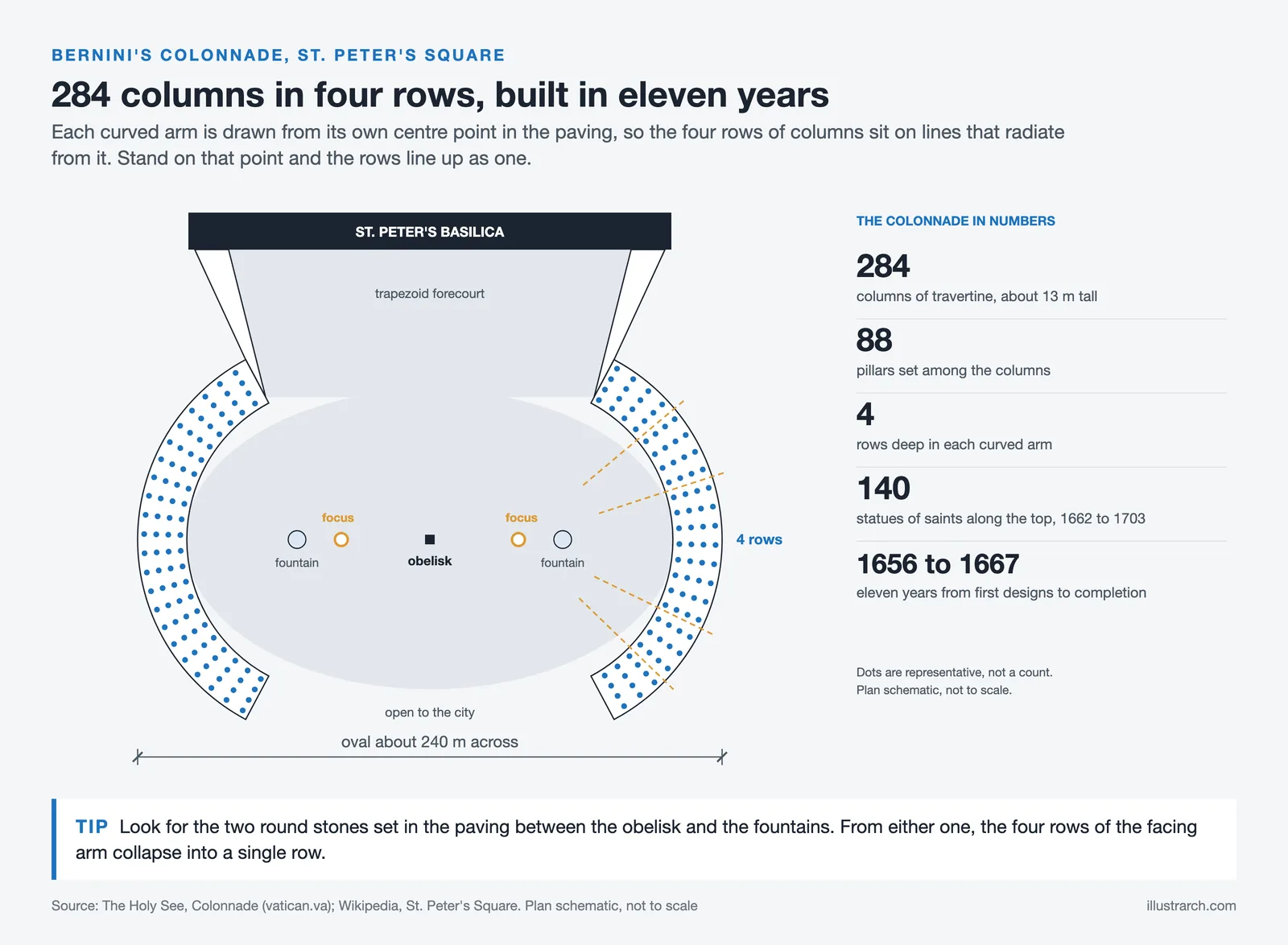
The baroque style of architecture reached its peak between roughly 1625 and 1675, a period historians call the High Baroque. Architects like Gian Lorenzo Bernini and Francesco Borromini redefined what a building could do spatially. Bernini’s colonnade at St. Peter’s Square in Rome, completed in 1667, wraps around visitors like two enormous arms, a deliberate theatrical gesture that makes the visitor feel embraced and diminished simultaneously. Borromini’s San Carlo alle Quattro Fontane uses an undulating oval plan to create a sense of continuous movement, as if the walls themselves are breathing. These weren’t decorative choices. They were spatial arguments about the nature of divine power.
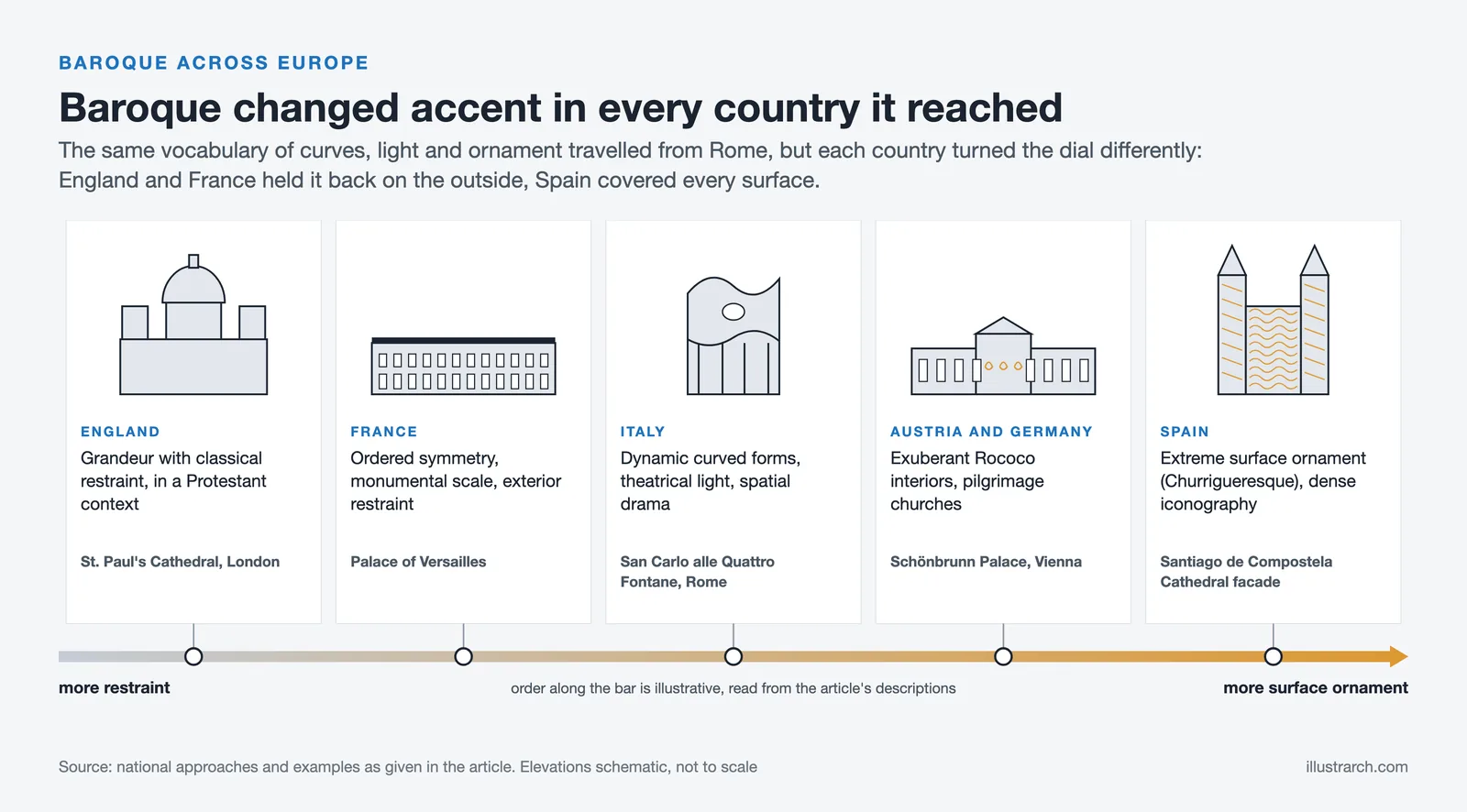
The baroque period architecture spread rapidly across Catholic Europe and into Latin America. Each region adapted the style to local conditions. Spanish Baroque became the elaborately ornamented Churrigueresque. French Baroque, exemplified by the Palace of Versailles, emphasized order and symmetry over the Italian preference for dynamic curvature. English Baroque, as seen in Christopher Wren’s St. Paul’s Cathedral, retained the grandeur while restraining the ornamental excess.
📌 Did You Know?
Bernini’s colonnade at St. Peter’s Square contains 284 columns and 88 pillars arranged in four rows, forming an elliptical embrace that took eleven years to complete (1656-1667). Its oval spans about 240 m (787 ft) across, room enough for the vast crowds of papal blessings.
Baroque Architecture Features: What Makes the Style Unmistakable

Identifying baroque architecture examples is relatively straightforward once you understand the core vocabulary. The style shares a consistent set of formal characteristics that appear across national variations, though the intensity varies considerably by region and period.
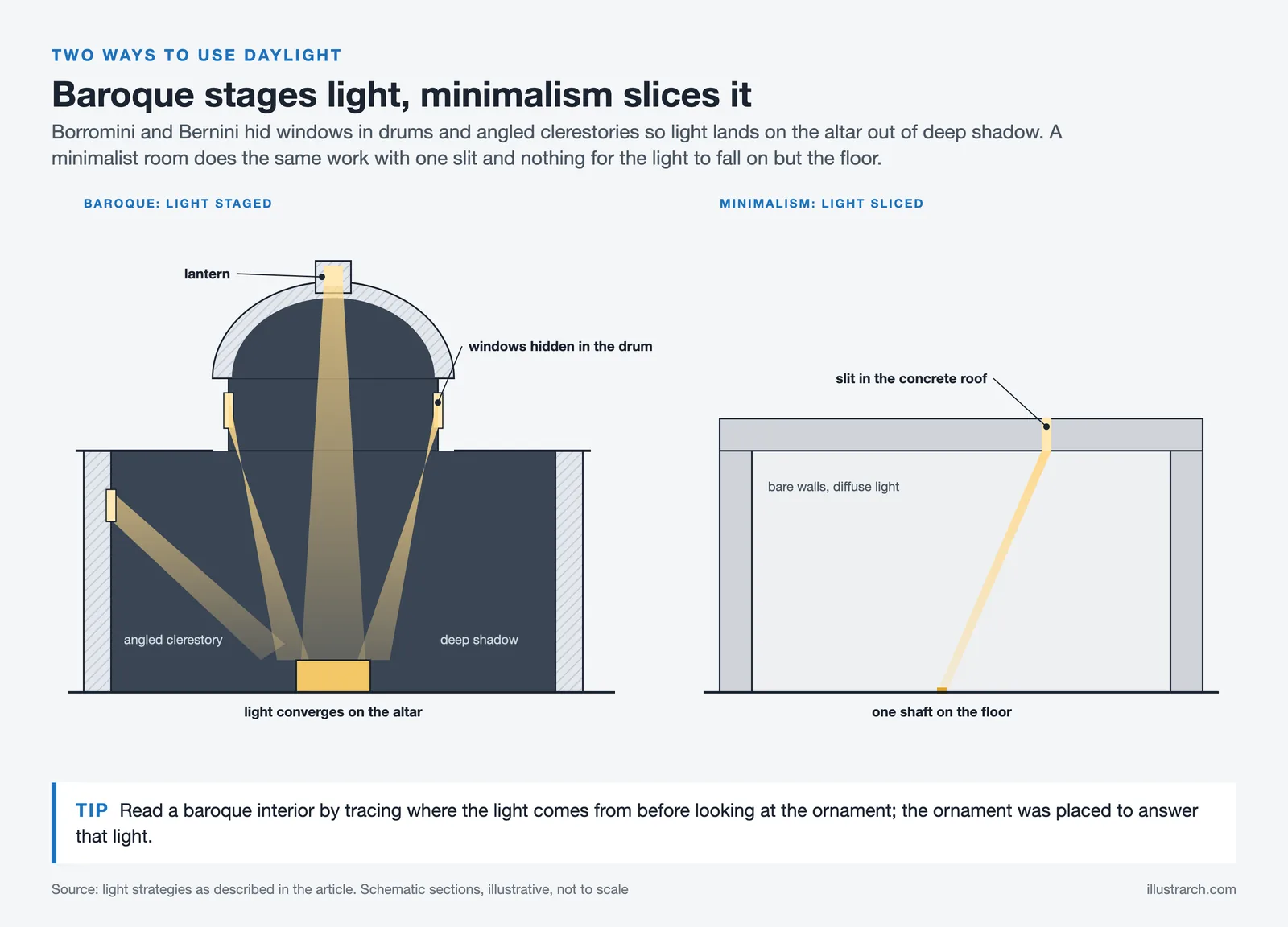
Curved and undulating forms replace the flat planes of Renaissance architecture. Oval domes, concave and convex facades, and spiral columns create an impression of constant motion. Where Renaissance buildings feel resolved and static, baroque buildings feel in the middle of something, caught in drama. The use of chiaroscuro, the sharp contrast between deep shadow and intense light, is equally defining. Large windows placed at unexpected angles flood interiors with directed light, turning certain surfaces into theatrical spotlights.
Ornamentation in baroque style architecture operates at a different scale than anything that preceded it. Gilded stucco, illusionistic ceiling frescoes, polychrome marble inlays, and sculptural programs covering every available surface were not considered excessive, they were the point. The integration of painting, sculpture, and architecture into a single unified experience was one of the movement’s central ambitions. A baroque church interior is, in a genuine sense, a total work of art.
Key Baroque Architecture Examples Across Europe
The following comparison illustrates how baroque style varied across national contexts while maintaining its essential character:
| Country | Characteristic Approach | Notable Example |
|---|---|---|
| Italy | Dynamic curved forms, theatrical light, spatial drama | San Carlo alle Quattro Fontane, Rome |
| France | Ordered symmetry, monumental scale, exterior restraint | Palace of Versailles |
| Spain | Extreme surface ornament (Churrigueresque), dense iconography | Cathedral of Santiago de Compostela facade |
| Austria/Germany | Exuberant Rococo interiors, pilgrimage churches | Schönbrunn Palace, Vienna |
| England | Grandeur with classical restraint, Protestant context | St. Paul’s Cathedral, London |
💡 Pro Tip
When studying baroque architecture examples for design research, pay close attention to how light is directed rather than simply where ornament is placed. Borromini and Bernini used hidden windows and carefully angled clerestories to create specific illumination effects. The ornamentation was there to respond to that light, not the other way around. Understanding this sequence changes how you read baroque space entirely.
What Is Minimalism in Architecture? Philosophy and Origins

Minimalism in architecture is not simply the absence of ornament. That framing misses the point. Minimalist architecture is a deliberate philosophical position: the belief that space, light, material, and proportion are sufficient to create meaningful architecture without additional decoration. “Less is more”, the phrase associated with Ludwig Mies van der Rohe, is not a statement about poverty of means but about the richness of essentials.
The movement drew from several converging streams in the early 20th century. The Bauhaus school’s insistence on the union of function and form, the De Stijl movement’s pursuit of pure geometric abstraction, and, crucially, the Japanese aesthetic tradition of ma (negative space) and wabi-sabi (the beauty of imperfection and restraint) all contributed to what would become minimal modern architecture. By mid-century, architects like Mies and later figures such as Peter Zumthor had developed a rigorous spatial language that treated every wall thickness, every material junction, and every source of light as a compositional decision of the highest order.
Minimalism architecture is not cheaper or easier to execute than ornamented styles. In practice, it is more demanding. When there is nothing to distract the eye, every imperfection becomes visible. The joints between materials must be exact. The proportions of a room must work without furniture to correct them. This precision is why truly successful minimal modern architecture is rare, and why bad minimalism, spaces that are merely empty rather than deliberately reduced, is so common.
🎓 Expert Insight
“Minimalism is not about the absence of something but about the perfect amount of something.”
John Pawson, architect
This distinction matters enormously in practice. A room with nothing in it is not minimalist, it is simply empty. Minimalism requires the same level of intentional decision-making as any ornamented style; the difference is that every decision shows, with no ornament available to compensate for errors in proportion, material, or light.
Minimalism in Architecture: Key Principles and Defining Features

Where baroque architecture fills, minimalism architecture subtracts. The core formal characteristics of minimal architecture are consistent across its various national and individual expressions: clean geometric forms, open plans, a severely restricted material palette, and the deliberate use of natural light as the primary spatial element.
Materials in minimalist buildings are selected for their intrinsic qualities, the texture of raw concrete, the warmth of unfinished timber, the transparency of structural glass, and are left honest rather than concealed or decorated. Surfaces are not treated as canvases. They are the architecture. The relationship between structure and enclosure, between solid and void, between interior and exterior, carries the full expressive weight that baroque architecture distributed across gilded surfaces and painted ceilings.
Natural light functions in minimalism the way fresco does in baroque: it is the primary medium of spatial experience. A slit window in a concrete wall, positioned to cast a single shaft of light across a floor at a specific hour, is doing the same work as a baroque lantern, directing attention, creating hierarchy, producing emotional effect. The means are stripped; the ambition is not.
🏗️ Real-World Example
Therme Vals (Vals, Switzerland, 1996): Peter Zumthor’s thermal bath is constructed from 60,000 quartzite slabs quarried locally and arranged to create a sequence of compressed and expanded spaces, shadow and light, heat and cold. There is no ornament of any kind. The spatial experience, the weight of stone overhead, the sound of water, the precise geometry of light entering through roof slits, is entirely the result of structural and material decisions. It is widely considered one of the defining buildings of minimalist architecture.
Baroque Architecture vs Minimalism: A Direct Comparison
Comparing these two movements side by side reveals that they are not simply opposite aesthetics, they are opposite theories of what architecture is for and how it produces meaning.
| Dimension | Baroque Architecture | Minimalism Architecture |
|---|---|---|
| Primary intention | Overwhelm and persuade through accumulated sensation | Create space for contemplation through radical reduction |
| Treatment of surfaces | Every surface is a site for ornament, sculpture, or painting | Surfaces are honest expressions of material and structure |
| Use of light | Dramatic directional light, chiaroscuro, theatrical spotlighting | Diffuse or precisely slit light as primary spatial element |
| Spatial character | Complexity, layering, spatial surprise, movement implied | Clarity, openness, quiet, stillness emphasized |
| Historical context | Counter-Reformation, absolute monarchy, Catholic patronage | Modernism, post-war functionalism, Japanese spatial philosophy |
| Relationship to nature | Nature as symbol and motif (acanthus, cherubs, floral programs) | Nature admitted directly: views, light, material textures |
Why Baroque and Minimalism Both Remain Relevant

It would be tempting to frame this comparison as a historical trajectory, baroque gave way to neoclassicism, neoclassicism to modernism, modernism to minimalism, and declare minimalism the victor. But both movements are alive in contemporary practice, and understanding why illuminates something important about architectural culture.
Baroque sensibility has not disappeared; it has transformed. The theatrical ambition of baroque style architecture is visible in much contemporary high-design work, in the sculptural complexity of Zaha Hadid’s parametric buildings, in the ornamental programs of Foster + Partners’ landmark public spaces, in the deliberate drama of cultural institutions designed to awe. The tools are different (computational geometry instead of carved stucco), but the desire to produce architectural spectacle through accumulated formal effect is recognizably baroque in spirit.
Minimalism, meanwhile, has become one of the dominant languages of contemporary residential and commercial design. Its alignment with sustainability (less material use), with wellness culture (calm, uncluttered spaces), and with digital aesthetics (clean interfaces translated into physical space) gives it continued cultural traction. The minimalism in architecture practiced today by architects like Tadao Ando, John Pawson, and Kengo Kuma continues to develop the principles Mies established, proving that reduction is not an endpoint but an ongoing discipline.
⚠️ Common Mistake to Avoid
A common misreading of minimalism treats it as the rejection of craftsmanship or attention to detail. The opposite is true. Baroque architecture applies extraordinary craftsmanship to the production of ornament. Minimalist architecture applies equally extraordinary craftsmanship to the elimination of everything unnecessary. A perfectly executed minimalist building requires more precision in material selection, joinery, and proportioning than a baroque interior, because there is nothing to hide behind.
What Can Designers Learn from Each?
The real value of studying baroque architecture alongside minimalism is not to choose between them but to understand the design logic each represents. Baroque architecture teaches how space can be structured through accumulation: how the layering of form, light, surface, and program creates an experience that exceeds any single element. Minimalism teaches how space can be structured through selection: how the removal of everything non-essential intensifies the effect of what remains.
Contemporary architects increasingly work across this spectrum rather than committing to one pole. A residential project might use a minimalist spatial envelope with a baroque-intensity approach to a single material or surface. A cultural institution might deploy minimalist volume and planning while using light in a way that is explicitly theatrical. The binary, opulence or emptiness, is less useful than understanding the underlying spatial logics each approach represents.
For anyone exploring how minimalism in architecture applies to contemporary projects, or researching baroque style of architecture in its historical context, the key starting point is the same: understand what the architecture is trying to achieve, and then evaluate how well its formal choices serve that intention. Ornament and emptiness are both legitimate answers. The question is always: to what end?
💡 Pro Tip
If you are developing a design concept that draws on either tradition, research the specific cultural and institutional context that produced the buildings you admire. Baroque churches work the way they do because they were designed for large congregations participating in elaborate liturgical ceremony. Minimalist museums work the way they do because they were designed for individual contemplation of singular objects. Transplanting the formal vocabulary without the programmatic logic often produces results that feel empty in the wrong way, or ornate in the wrong way.
✅ Key Takeaways
- Baroque architecture emerged from the Counter-Reformation as a deliberate instrument of persuasion through spatial and visual spectacle, not merely decoration for its own sake.
- Minimalism is not the absence of design but the concentration of design intent into the irreducible essentials of space, light, and material.
- Both movements use light as a primary spatial tool; the difference lies in whether that light is staged through theatrical contrast or admitted as a quiet, structuring presence.
- Baroque architecture features, curved forms, chiaroscuro light, total ornamentation, are formal arguments about divine and political power; minimalism’s clean geometry and material honesty are arguments about presence, calm, and attention.
- Both traditions remain active in contemporary practice: baroque sensibility appears in parametric and experiential architecture, while minimalism shapes residential, commercial, and cultural design across the world.




What Is Minimalist Architecture? Principles, Origins, and Iconic Buildings
Minimalist architecture strips a building to its essentials so space, light and...
 illustrarch Editoral Team9 Mins read

Georgian Architecture: Features, History & Examples
Georgian architecture (1714-1830) is defined by strict symmetry, classical proportion, sash windows...
illustrarch Editoral Team9 Mins read
Neoclassical Architecture: Features, History & Examples
Neoclassical architecture emerged in the mid-18th century, reviving Greek and Roman forms...
illustrarch Editoral Team8 Mins read

Craftsman Architecture: Features, History & Examples
Craftsman architecture emerged in early 1900s America as a response to Victorian...
illustrarch Editoral Team10 Mins read


Leave a comment