

Brutalism vs Minimalism Architecture: Examples & Key Differences
Brutalism and Minimalism represent two contrasting architectural philosophies, one grounded in raw material honesty and bold concrete forms, the other in refined spatial restraint and Japanese-inspired simplicity. This editorial examines brutalism architecture examples from Soviet-era buildings to contemporary eco-brutalist homes, alongside modern minimalist architecture influenced by Japanese spatial philosophy, exploring how both approaches express values of power, care, and presence in contemporary architectural culture.
 Sinan Ozen30 January 202612 Mins read302

Table of Contents Show
Few architectural debates have proven as enduring, or as emotionally charged, as the contrast between Brutalism and Minimalism. At first glance, the opposition appears almost theatrical: concrete versus emptiness, weight versus lightness, declaration versus restraint. Yet this binary framing risks oversimplifying what is, at its core, a deeper cultural conversation about how architecture communicates values, power, and care. In an era shaped by environmental urgency, digital abstraction, and growing social inequality, the tension between raw expression and refined silence feels newly relevant. These two architectural attitudes are not merely stylistic camps; they are philosophical positions that reflect how architects respond to context, material reality, and human experience. To examine brutalism architecture examples alongside minimalist architecture today is not to choose sides, but to ask what kind of presence architecture should have in a world increasingly suspicious of both excess and neutrality.

| Aspect | Brutalism | Minimalism |
|---|---|---|
| Origin Period | 1950s-1970s (post-war reconstruction) | Late 1950s: present (modernist reduction) |
| Etymology | French béton brut (raw concrete) | Mies van der Rohe’s “less is more” + Japanese Ma |
| Core Philosophy | Material honesty, social ambition, ethical directness | Spatial clarity, sensory refinement, cultivated absence |
| Primary Materials | Raw/exposed concrete, steel, brick, rough-hewn stone | Polished concrete, glass, natural stone, white walls, timber |
| Surface Treatment | Unfinished, textured, board-marked, bush-hammered | Smooth, perfected, joints concealed, precision-cast |
| Spatial Character | Massive, monolithic, sculptural, confrontational | Open, serene, fluid, contemplative |
| Relationship to User | Demands engagement through scale and texture | Guides perception through light, proportion, and silence |
| Typical Program | Public institutions, social housing, civic centers, universities | Private residences, galleries, luxury developments, wellness spaces |
| Attitude to Ornament | Rejected; structure and material are the expression | Rejected; absence of ornament is the expression |
| Cultural Association | Collective identity, social democracy, egalitarianism | Individual contemplation, wellness, refined living |
| Emotional Response | Rugged, dramatic, powerful, sometimes oppressive | Calm, sophisticated, tranquil, sometimes sterile |
| Public Perception | Polarizing: criticized as harsh yet valued for authenticity | Widely admired: praised as elegant yet questioned for elitism |
| Key Influences | Le Corbusier, Alison & Peter Smithson, Constructivism | Mies van der Rohe, De Stijl, Zen Buddhism, wabi-sabi |
| Contemporary Evolution | Eco-brutalism, hybrid concrete-timber structures | Wellness architecture, biophilic minimalism, digital-age calm |
Architecture as Statement: Brutalism’s Moral Directness
Brutalism emerged in the mid-twentieth century as an architectural language of insistence, rooted in post-war reconstruction, social ambition, and a belief in architecture’s ethical responsibility. Its raw concrete surfaces, exposed structures, and unapologetic mass were not aesthetic accidents but deliberate refusals of ornament, illusion, and hierarchy. Brutalist buildings speak loudly because they were designed to do so, asserting permanence in fragile times and visibility in societies seeking collective identity. This moral directness continues to resonate today, particularly in discussions around authenticity and honesty in architecture. Brutalism matters because it challenges the profession to confront material reality without disguise, reminding architects that buildings can embody social ideals as visibly as they embody structural logic.
The term itself derives from the French béton brut, meaning raw concrete, and was popularized by British architectural critic Reyner Banham in the 1950s to describe the work of Alison and Peter Smithson. What began as a movement tied to post-war reconstruction quickly became a global architectural language, adopted across vastly different political and cultural contexts, from civic centers in Western Europe to monumental structures in the Soviet Union and Eastern Bloc.

Brutalism Architecture Examples That Define the Movement
Understanding brutalist architecture examples helps illustrate why the style remains so influential. Among the most iconic brutalism architecture buildings are Le Corbusier’s Unité d’Habitation in Marseille (1952), which embodied the post-war ideal of a self-contained living community built entirely from raw concrete. London’s Barbican Estate, designed by Chamberlin, Powell and Bon between 1965 and 1982, exemplifies brutalist architecture at its most ambitious, a “city within a city” that integrates housing, cultural venues, and public spaces within layered concrete forms. In the United States, Paul Rudolph’s Yale Art and Architecture Building (1963) remains a landmark of new brutalism architecture, with its bush-hammered concrete textures and dramatic spatial interiors demonstrating how brutalism architecture interior could be just as expressive as the exterior.
The style’s reach extended powerfully into socialist nations. Russian brutalist architecture and broader USSR brutalist architecture produced some of the movement’s most dramatic structures, including housing complexes, government ministries, and cultural buildings across Moscow, Tbilisi, and other Soviet cities. These brutalist architecture Soviet Union projects were often monumental in scale, using repetitive modular elements to express collective ideology through concrete form. Today, many of these structures, such as Georgia’s Ministry of Highways or Moscow’s House of Soviets, have become subjects of renewed architectural appreciation and scholarly study.
| Brutalist Building | Architect / Year | Minimalist Building | Architect / Year |
|---|---|---|---|
| Unité d’Habitation, Marseille | Le Corbusier, 1952 | Barcelona Pavilion | Mies van der Rohe, 1929 |
| Hunstanton School, Norfolk | Alison & Peter Smithson, 1954 | Farnsworth House, Illinois | Mies van der Rohe, 1951 |
| Yale Art & Architecture Building | Paul Rudolph, 1963 | Church of the Light, Osaka | Tadao Ando, 1989 |
| Barbican Estate, London | Chamberlin, Powell & Bon, 1965-82 | Therme Vals, Switzerland | Peter Zumthor, 1996 |
| Boston City Hall | Kallmann, McKinnell & Knowles, 1968 | 21st Century Museum, Kanazawa | SANAA, 2004 |
| Habitat 67, Montreal | Moshe Safdie, 1967 | Stone House, Tavole | John Pawson, 2010 |
| National Theatre, London | Denys Lasdun, 1976 | Bourse de Commerce, Paris | Tadao Ando, 2021 |
| Breuer Building (Whitney), NYC | Marcel Breuer, 1966 | Glass House, Connecticut | Philip Johnson, 1949 |
| Trellick Tower, London | Ernő Goldfinger, 1972 | Chichu Art Museum, Naoshima | Tadao Ando, 2004 |
| Ministry of Highways, Tbilisi | George Chakhava, 1975 | Louvre-Lens, France | SANAA, 2012 |
Brutalist Architecture Homes and Interior Spaces
While Brutalism is often associated with large civic and institutional buildings, brutalist architecture homes represent an equally compelling aspect of the movement. From Marcel Breuer’s residential projects in Connecticut to contemporary brutalist architecture house designs that embrace exposed concrete, steel, and board-marked surfaces, the domestic application of Brutalism reveals how raw materiality can create intimate, contemplative living spaces. Brutalism architecture interior design has evolved significantly, contemporary architects are now integrating the honesty of exposed concrete with warmer materials like timber and natural textiles, producing hybrid interiors that balance rawness with livability. The rise of eco brutalist architecture further extends this trajectory, merging Brutalism’s material directness with sustainable design strategies such as passive cooling, green roofs, and locally sourced materials.

What Is Minimalist Architecture? The Cultivation of Absence
Minimalism, by contrast, operates through subtraction rather than declaration. Its architectural power lies in what is withheld: reduced palettes, controlled light, and spatial clarity that privileges experience over form. Emerging from modernist reduction and influenced by Japanese spatial philosophy, Minimalism reframes architecture as a background condition, one that enables contemplation rather than confrontation. Yet this cultivated absence is far from neutral. Minimalist spaces require extreme precision, technical mastery, and cultural sensitivity to avoid becoming sterile or exclusive. In contemporary practice, modern architecture minimalist approaches often align with ideas of wellness, sustainability, and digital-age calm, offering refuge from visual and informational overload. Its relevance lies in its capacity to create spaces that feel timeless, adaptable, and emotionally quiet in a world defined by constant stimulation.
The roots of minimalist architecture trace back to Ludwig Mies van der Rohe’s famous principle “less is more,” the De Stijl movement, and the Japanese Zen concept of Ma, intentional emptiness that gives form its meaning. These influences converged to produce an architectural language where every element serves a purpose, and the absence of ornament becomes a form of expression in itself.

Japanese Minimalist Architecture: A Spiritual Foundation
Japanese minimalist architecture occupies a unique position within the broader movement. Rooted in centuries of Zen Buddhist philosophy and the aesthetic principles of wabi-sabi (the beauty of imperfection and impermanence), Japanese architecture minimalist approaches go beyond visual simplicity to engage with spatial experience at a deeply sensory level. Architects like Tadao Ando, whose Church of the Light in Osaka (1989) uses a single cross-shaped aperture to transform sunlight into spiritual experience, exemplify how minimalist architecture Japan has contributed to global architectural discourse. Similarly, Peter Zumthor‘s Therme Vals demonstrates how contemporary minimalist architecture can create immersive spatial atmospheres through precise material selection and restrained composition.
Modern minimalist architecture continues to evolve. In residential design, minimalist modern architecture embraces open floor plans, floor-to-ceiling glazing, and monochromatic material palettes that emphasize spatial flow over decorative embellishment. From minimalist house designs to minimalist facade systems, the principles of reduction and clarity continue shaping how contemporary architects respond to urban density, environmental constraints, and the desire for calm living environments.
| Architect | Movement | Notable Work(s) | Key Contribution |
|---|---|---|---|
| Le Corbusier | Brutalism (forerunner) | Unité d’Habitation (1952), Chandigarh Capitol Complex (1951-61) | Pioneered béton brut as architectural language; established Brutalism’s foundations |
| Alison & Peter Smithson | Brutalism | Hunstanton School (1954), Robin Hood Gardens (1972) | Coined “New Brutalism”; defined its ethical dimension beyond material choice |
| Paul Rudolph | Brutalism | Yale Art & Architecture Building (1963) | Introduced bush-hammered concrete textures and dramatic spatial interiors |
| Denys Lasdun | Brutalism | National Theatre, London (1976) | Demonstrated Brutalism’s potential for cultural and civic architecture |
| Marcel Breuer | Brutalism | Breuer Building / Whitney Museum (1966) | Bridged Bauhaus modernism and Brutalist expression in the United States |
| Ludwig Mies van der Rohe | Minimalism (forerunner) | Barcelona Pavilion (1929), Farnsworth House (1951) | Established “less is more” principle; created the template for spatial minimalism |
| Tadao Ando | Minimalism | Church of the Light (1989), Bourse de Commerce (2021) | Fused Zen philosophy with refined concrete to create meditative spatial experiences |
| Peter Zumthor | Minimalism | Therme Vals (1996) | Elevated material precision and atmosphere as primary architectural tools |
| John Pawson | Minimalism | Novy Dvur Monastery (2004), Stone House (2010) | Advanced minimalism as a residential and sacred spatial practice |
| SANAA (Sejima & Nishizawa) | Minimalism | 21st Century Museum, Kanazawa (2004), Louvre-Lens (2012) | Redefined museum architecture through transparency, lightness, and open plans |
Material Truth vs Sensory Control
At the heart of the Brutalism: Minimalism debate is a fundamental disagreement about material expression. Brutalism insists on visibility: materials show their weight, texture, and imperfections as evidence of labor and time. Minimalism, meanwhile, seeks sensory control, materials are refined, surfaces perfected, joints concealed. Neither approach is inherently superior, but each constructs a different relationship between user and building. Brutalist environments demand engagement through scale and texture, often confronting occupants with the building’s physicality. Minimalist spaces guide behavior more subtly, shaping movement and perception through light, proportion, and silence. This distinction matters because material choices are never purely aesthetic; they encode attitudes toward craftsmanship, economy, and how architecture mediates between body and space.
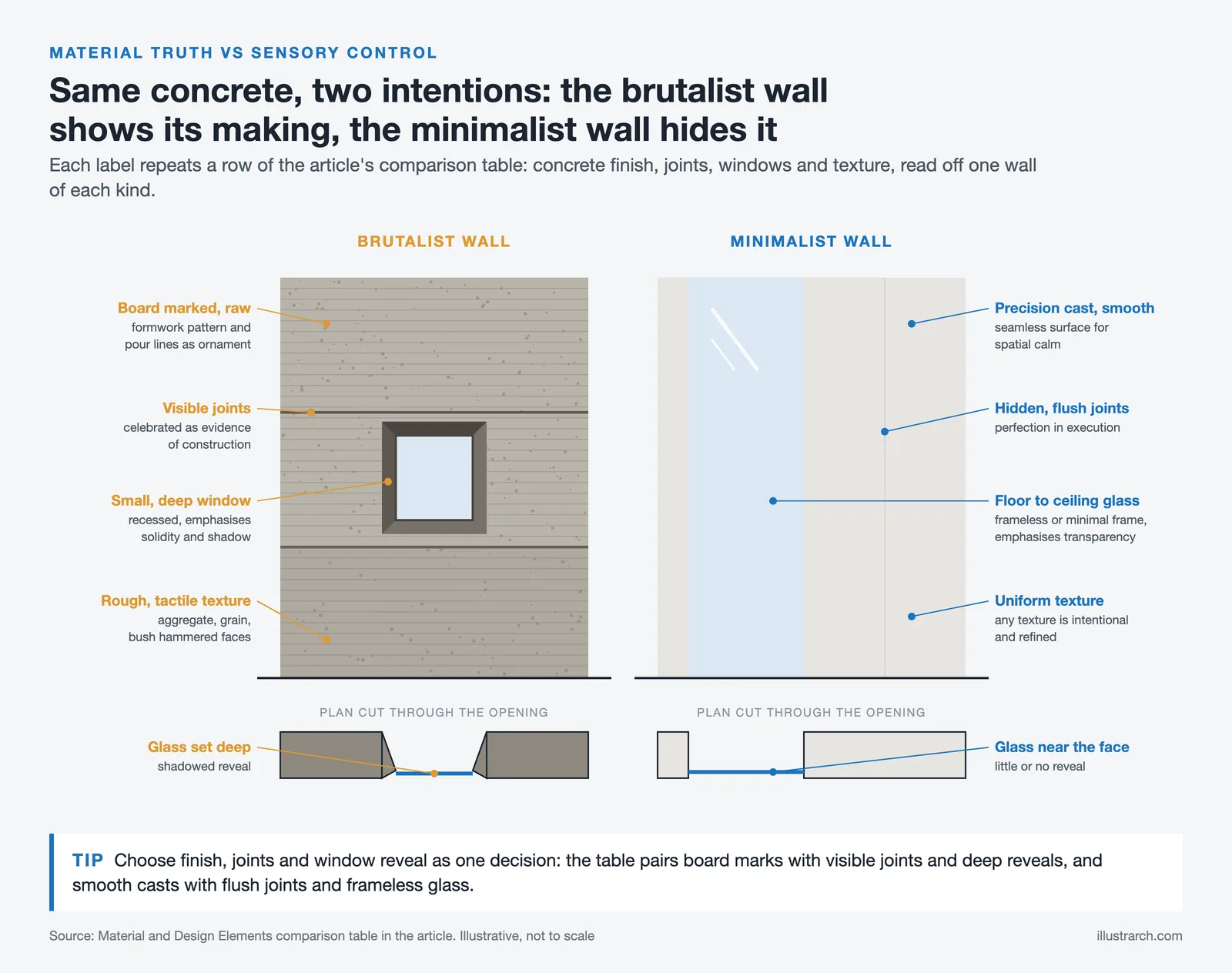
In examples of brutalist architecture, we see concrete treated almost like a canvas, formwork patterns, pour lines, and aggregate textures become the building’s ornamentation. In Tadao Ando’s Bourse de Commerce in Paris, by contrast, concrete achieves an almost meditative silence, perfectly smooth, precisely cast, and deployed as a geometric counterpoint to the building’s ornate neoclassical surroundings. Both approaches honor concrete, but with fundamentally different intentions: one celebrates its roughness as evidence of making; the other refines it into a vehicle for spatial calm.
| Element | Brutalist Approach | Minimalist Approach |
|---|---|---|
| Concrete Use | Raw, board-marked, bush-hammered; formwork patterns and pour lines visible as “ornamentation” | Precision-cast, smooth, seamless; deployed as a vehicle for spatial calm and geometric clarity |
| Structure | Exposed, celebrated, often exaggerated for visual impact | Concealed or abstracted; structure serves spatial flow rather than visual statement |
| Light | Dramatic contrast of solid and void; deep-set windows create shadow play | Controlled, diffused; apertures carefully designed to shape spatial experience (e.g., Ando’s cross of light) |
| Color Palette | Monochromatic greys; natural concrete tones; occasional bold accents | Whites, earth tones, monochromatic neutrals; muted and harmonious |
| Texture | Rough, tactile, varied, aggregate, wood grain impressions, weathering patterns | Smooth, uniform, controlled, any texture is intentional and refined |
| Windows | Small relative to wall mass; deeply recessed; emphasize solidity | Floor-to-ceiling glazing; frameless or minimal frames; emphasize transparency |
| Form | Massive, angular, geometric; cantilevered and stacked modular elements | Clean lines, simple volumes; open plans with spatial flow between inside and outside |
| Joints & Details | Visible, celebrated as evidence of construction process | Hidden, flush, or seamless; perfection in execution |
| Landscape Relation | Often contrasts with surroundings; asserts monumental presence | Seeks harmony with nature; blurs boundary between built and natural |
| Interior Design | Exposed services, raw surfaces; contemporary hybrids add timber and textiles for warmth | Uncluttered, restrained palettes; every object and material serves a deliberate purpose |

Power, Accessibility, and Public Perception
Public reception of Brutalism and Minimalism reveals much about architecture’s social role. Brutalist buildings are frequently criticized as oppressive or outdated, yet they often house public institutions, universities, housing estates, civic centers, designed to serve collective needs. Minimalist architecture, while widely admired, is often associated with private residences, galleries, or luxury developments, raising questions about accessibility and cultural elitism. This contrast exposes how architectural languages become entangled with power structures and economic realities. The debate matters because it forces architects to confront whom their buildings are truly for, and whether architectural refinement risks excluding broader publics while architectural rawness risks alienation.
This tension is particularly visible when comparing brutalist architecture buildings like London’s Barbican Estate or Boston City Hall, designed explicitly as public infrastructure, with contemporary minimalist architecture projects like luxury galleries, private residences, and high-end retail spaces. The social implications of each style challenge architects to consider not just how buildings look but who they ultimately serve and whether design language itself can become a tool of inclusion or exclusion.
| Dimension | Brutalism | Minimalism |
|---|---|---|
| Primary Audience | The collective public: citizens, communities, institutions | Often the individual: private clients, cultural connoisseurs, luxury market |
| Typical Building Types | Social housing, universities, civic halls, government buildings, libraries | Private residences, art galleries, luxury retail, boutique hotels, wellness centers |
| Political Context | Post-war welfare states; socialist nations; democratic egalitarianism | Global capitalism; post-industrial knowledge economies; wellness culture |
| Cost Perception | Economical materials (concrete); designed for mass production and public budgets | High-quality materials and precision craftsmanship; often associated with premium budgets |
| Criticism | Oppressive, cold, fortress-like; associated with urban decay and totalitarianism | Elitist, sterile, inaccessible; can feel exclusionary to broader publics |
| Praise | Authentic, honest, democratic; sculptural power and architectural bravery | Elegant, timeless, calming; promotes mindfulness and spatial awareness |
| Cultural Resurgence | Strong revival since 2010s among younger architects, photographers, and preservationists | Consistent mainstream appeal; aligns with contemporary wellness and sustainability trends |
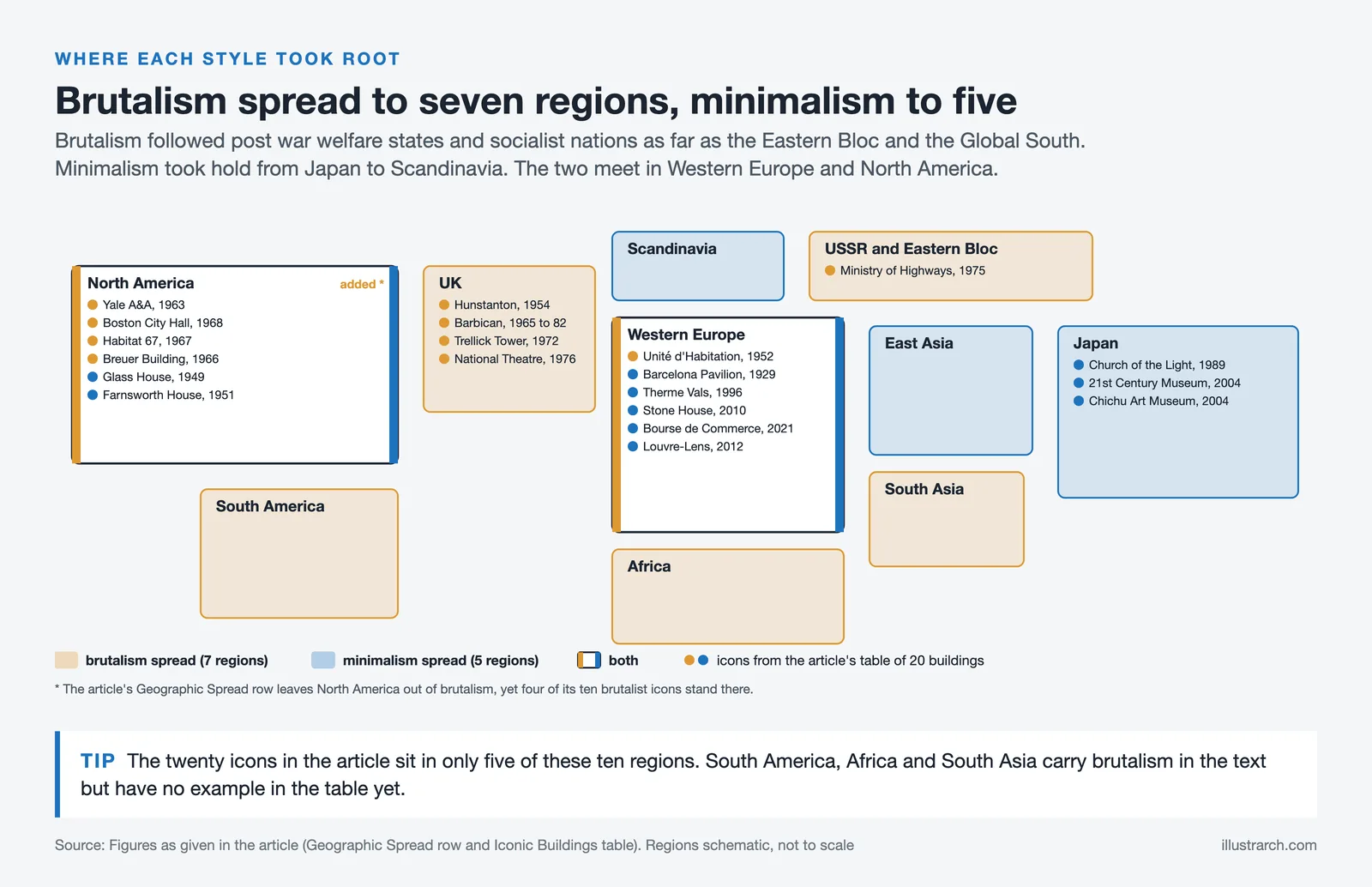
| Geographic Spread | UK, Western Europe, North America, USSR/Eastern Bloc, South America, South Asia, Africa | Japan, Western Europe, Scandinavia, North America, East Asia |
Contemporary Hybrids and the Collapse of the Binary
In contemporary practice, the strict opposition between Brutalism and Minimalism is increasingly unstable. Many architects draw from both traditions, combining expressive structure with restrained detailing, or raw materials with minimalist spatial strategies. This hybridization reflects a broader shift away from ideological purity toward contextual responsiveness. Digital tools allow unprecedented control over form and surface, while sustainability demands material honesty and efficiency. As a result, architecture today often negotiates between presence and absence, expression and silence, rather than committing fully to either camp. This collapse of the binary is significant because it signals a maturation of architectural discourse, one that values nuance over labels.
Eco brutalist architecture represents one of the most promising hybrid approaches. By combining Brutalism’s commitment to exposed, honest materials with sustainable building strategies, green roofs, passive ventilation, recycled aggregates, and bio-based concrete alternatives, eco-brutalism demonstrates that material directness and environmental responsibility need not be contradictory. Similarly, new brutalism architecture projects worldwide are increasingly incorporating minimalist interior strategies, clean spatial organization, controlled lighting, and restrained material palettes, within structurally expressive concrete shells, creating buildings that are simultaneously bold and contemplative.
| Period | Brutalism Milestones | Minimalism Milestones |
|---|---|---|
| 1920s-1940s | Le Corbusier develops raw concrete language; post-war reconstruction begins | Mies van der Rohe’s Barcelona Pavilion (1929) establishes “less is more”; De Stijl influences spatial reduction |
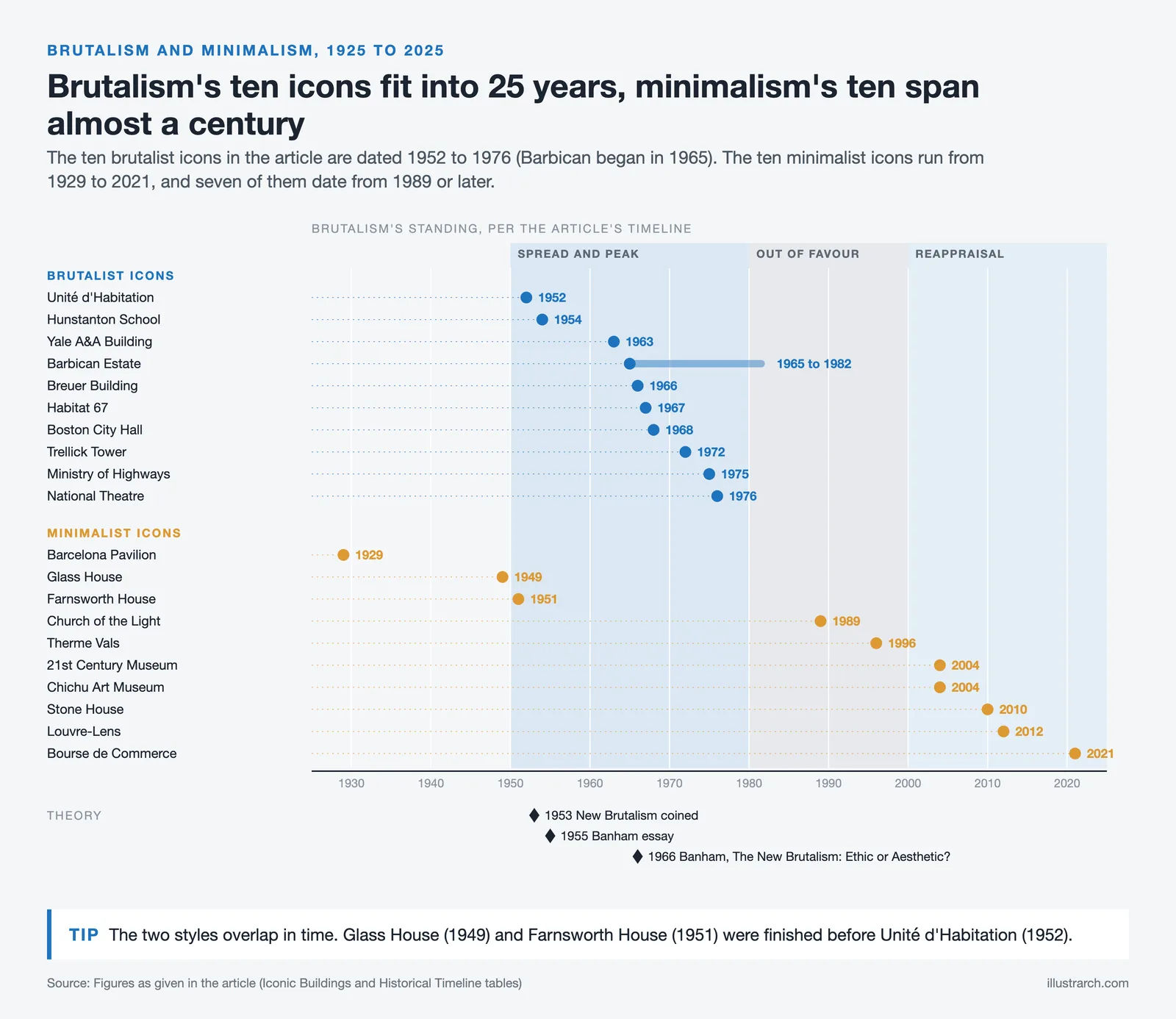
| 1950s | Term “New Brutalism” coined (1953); Hunstanton School (1954); Unité d’Habitation (1952); Banham publishes defining essay (1955) | Mies van der Rohe’s Farnsworth House (1951); minimalist art movement begins in New York |
| 1960s | Global expansion: Barbican Estate begins (1965), Yale A&A Building (1963), Boston City Hall (1968), Habitat 67 (1967); Banham publishes The New Brutalism: Ethic or Aesthetic? (1966) | Minimalism consolidates in visual arts (Donald Judd, Dan Flavin); influence spreads to architecture and design; Philip Johnson’s geometric clarity |
| 1970s | Peak and decline: National Theatre (1976), Trellick Tower (1972); style criticized as oppressive; association with urban decay grows | Japanese architects begin integrating Zen aesthetics with modernist reduction; Tadao Ando starts practice (1969) |
| 1980s-1990s | Brutalism falls out of favor; many buildings demolished or neglected; postmodernism dominates | Tadao Ando’s Church of the Light (1989); Peter Zumthor’s Therme Vals (1996); John Pawson rises to prominence; minimalism becomes mainstream residential aesthetic |
| 2000s-2010s | Critical reappraisal begins; #SOSBrutalism campaign (900+ buildings cataloged); photography and social media fuel renewed interest | SANAA’s 21st Century Museum (2004); minimalist luxury market expands; wellness architecture emerges |
| 2020s | Eco-brutalism emerges; hybrid approaches blend raw concrete with sustainable strategies; preservation movements gain legal protections for Brutalist landmarks | Biophilic minimalism; Ando’s Bourse de Commerce (2021); minimalism adapts to sustainability and post-pandemic spatial needs |

Conclusion
The question of Brutalism versus Minimalism is ultimately less about style than about intention. It asks architects, educators, and students to reflect on how buildings communicate meaning, care, and responsibility in a rapidly changing world. Raw expression and refined silence are not opposing absolutes but complementary tools, each capable of producing powerful spatial experiences when used thoughtfully. As architectural culture grapples with climate constraints, social accountability, and digital abstraction, the most relevant question may not be which approach to choose, but how consciously it is applied. For contemporary practice, the challenge lies in designing architecture that is both honest and humane, capable of speaking when necessary, and remaining silent when restraint is the more radical act.


2 Comments


India Art, Architecture & Design Biennale 2026: Ministry of Culture Opens Delhi Monuments
Delhi's monuments, including Purana Quila and the Red Fort, will host the...
 illustrarch Editoral Team2 Mins read
Vitra Museum Stages First Major Geoffrey Bawa Retrospective in Decades
Vitra Design Museum opens the first major Geoffrey Bawa retrospective in 20...
illustrarch Editoral Team2 Mins read
Ai Weiwei Installs 500 Cast-Iron Helmets Outside Sydney Museum
Ai Weiwei's 500 cast-iron helmets opened outside Sydney's MCA on 25 September,...
illustrarch Editoral Team2 Mins read
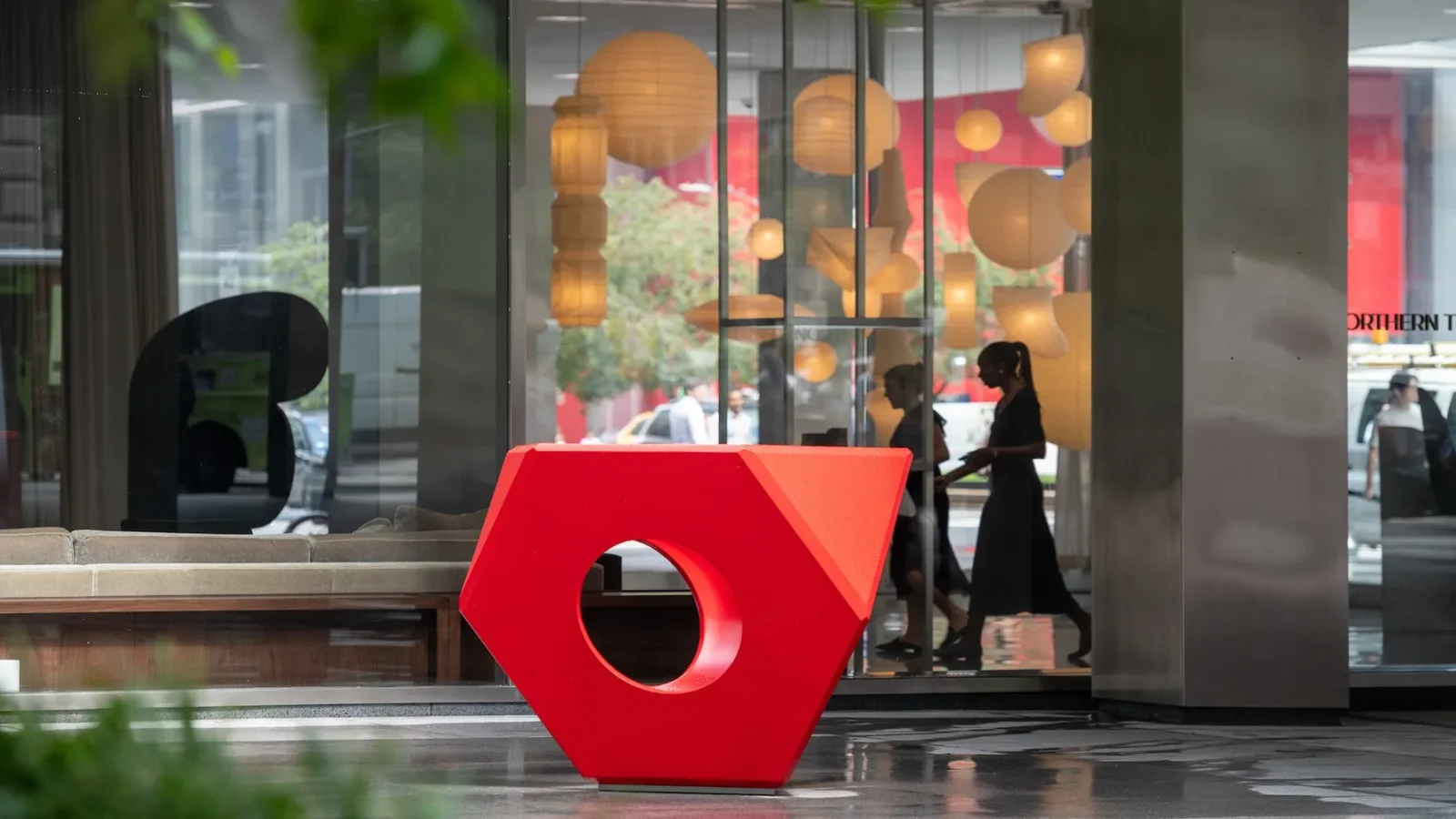
Isamu Noguchi at Lever House Traces Sculptor’s Decades-Long Collaboration with Bunshaft
Lever House's new exhibition pairs Noguchi sculptures with unbuilt garden designs made...
illustrarch Editoral Team2 Mins read


I think both styles have their points. Brutalism looks strong but some people find it too heavy. Minimalism feels calm, but sometimes it seems empty. It’s interesting to see how these styles mix now.
This article feels like it’s trying way too hard to make Brutalism sound important. Honestly, a lot of those buildings just look like concrete blocks that no one wants to live in. The examples given, like the Barbican Estate, seem more depressing than inspiring. And I can’t believe we’re still talking about ‘moral directness’ when these structures often end up as eyesores. Minimalism may have its flaws too, but at least it doesn’t scream at you with raw concrete.