

Zaha Hadid Architects Designs Qiantang Bay Central Water Axis in China
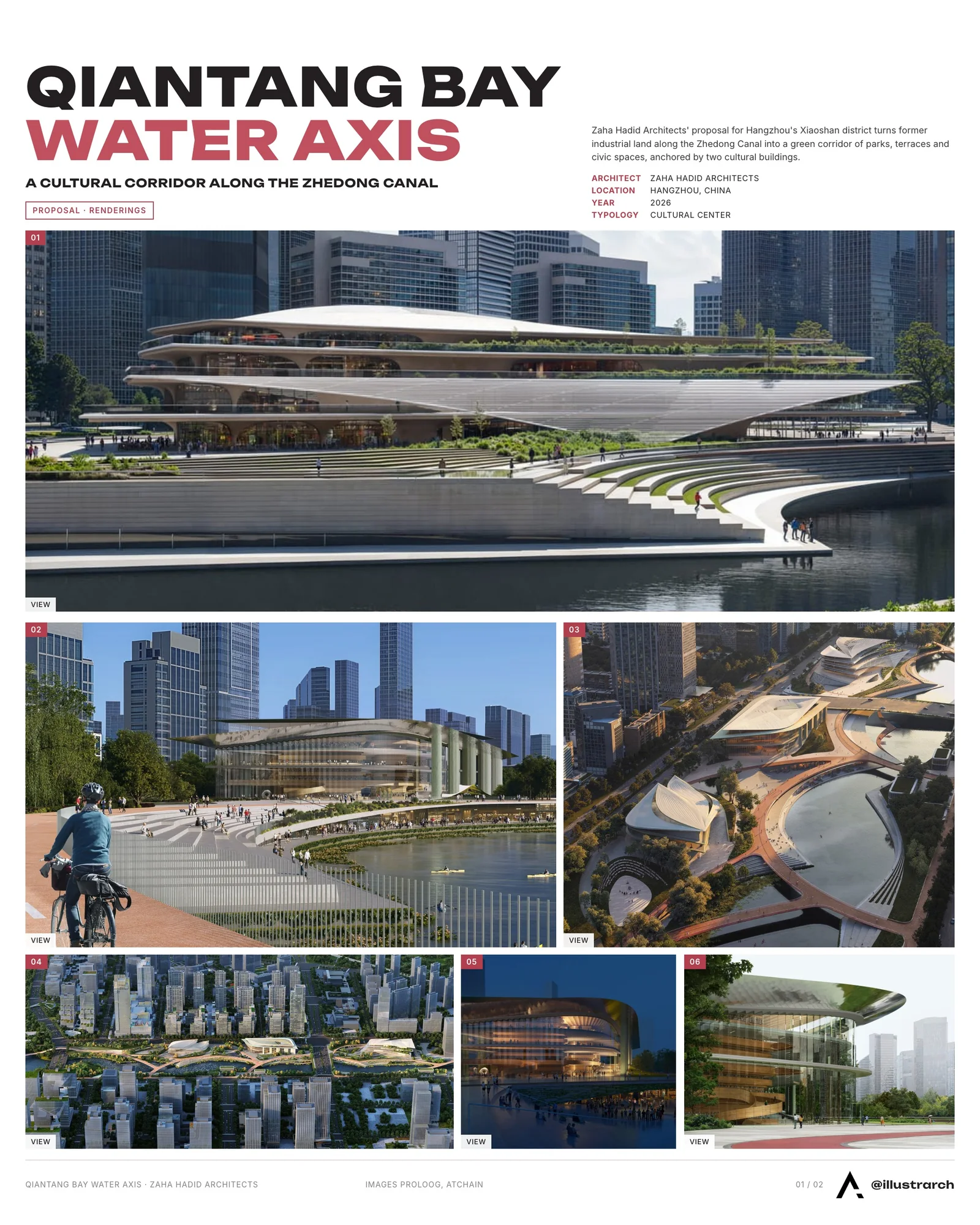
Zaha Hadid Architects has revealed designs for the Qiantang Bay Cultural District in Hangzhou, transforming former industrial land along the Zhedong Canal into a green corridor of parks, a sculptural library, and an International Youth Centre.
 Elif Ayse Sen10 February 20267 Mins read317


Table of Contents Show
Zaha Hadid Architects designs cultural district proposals for the Qiantang Bay Central Water Axis, a major urban regeneration project along the Zhedong Canal in the Xiaoshan district of Hangzhou, China. The scheme envisions the transformation of former industrial land into a continuous green corridor of landscaped parklands, terraces, gardens, and civic spaces, anchored by two cultural buildings that promise to redefine the city’s waterfront identity. This ambitious project by architect Zaha Hadid‘s firm adds to an expanding portfolio of work in one of China’s fastest-growing metropolitan regions.
Zaha Hadid Architects China: Expanding a Legacy of Bold Urban Projects
The Qiantang Bay Cultural District represents a significant new chapter for Zaha Hadid Architects in China, a country where the firm has already established a remarkable presence. From the iconic Guangzhou Opera House to the sweeping Galaxy SOHO complex in Beijing, Zaha Hadid Architects’ projects in China have consistently pushed the boundaries of form and engineering. The Hangzhou proposal deepens this engagement by moving beyond individual landmark buildings toward a comprehensive urban and landscape strategy that weaves architecture into the public realm.
The project also joins other recent design initiatives in the area, including Snøhetta’s Qiantang Bay Art Museum, planned at the confluence of the Qiantang River and the Central Water Axis, as well as ZHA’s own Grand Canal Gateway Bridge, a pedestrian bridge connecting the firm’s 800,000-square-meter Seamless City masterplan on the east and west banks of the canal. Together, these projects signal Hangzhou’s ambition to become a leading cultural destination in eastern China.
Qiantang Bay Central Water Axis in Hangzhou: A New Urban Corridor
At the heart of the proposal is the Qiantang Bay Central Water Axis in Hangzhou, a linear public landscape that reorganizes the Zhedong Canal basin into a sequence of waterfront promenades, performance areas, plazas, and planted terraces. The axis transforms what was once an industrial zone into a green corridor that threads through the heart of the city, reconnecting surrounding neighborhoods to the water through a network of bridges and pedestrian pathways.
Cultural and educational buildings are arranged along this axis, each oriented to engage with the new civic spaces along the waterfront. The design envisions a district defined by public landmarks connected through accessible pathways that link both sides of the canal. Rather than treating architecture as isolated objects, the proposal integrates buildings into a continuous public landscape, an approach that reflects the firm’s growing interest in architecture as urban infrastructure.
Zaha Hadid Architects Buildings: The Library and Its Inhabitable Columns
One of the most striking elements of the Zaha Hadid Architects buildings proposed for the district is the canal-side library. This sculptural landmark features a sequence of inhabitable architectural columns that serve as both structural elements and spatial organizers. These vertical forms, described by the architects as “stones of knowledge”, are intended to house the library’s literary collections and archives, as well as reading rooms and community spaces.
The façade draws on the region’s 5,000-year history of jade craftsmanship, composed of precision-crafted masonry tiles that reflect the tonal qualities of the local stone. Folded glass elements integrated into the façade would diffuse natural light throughout the interior, creating conditions ideally suited to reading and study. This approach to materiality connects the building to its cultural context while maintaining the signature formal ambition associated with the firm’s work.
The library concept demonstrates a key principle in Zaha Hadid architect buildings: the idea that structure and program can merge into a single architectural gesture. Rather than concealing columns behind walls, the design celebrates them as inhabitable spaces, blurring the boundary between furniture, architecture, and infrastructure.
Zaha Hadid Architects Projects: The International Youth Centre
Complementing the library, the firm’s proposed International Youth Centre serves as a venue for students and visitors to meet, collaborate, and exchange ideas. The building’s form responds directly to its waterfront location, with geometries that extend from the exterior into the interior through a series of interconnected auditoriums, studios, and flexible spaces.
The program includes areas designed for seminars, conferences, exhibitions, and performances, with terraces overlooking the canal that extend activities outdoors. This indoor-outdoor continuity is a hallmark of many Zaha Hadid Architects projects, where the boundary between building and landscape becomes intentionally ambiguous. The canal-facing terraces support informal gatherings and public events, reinforcing the district’s identity as a place for cultural exchange.
Both buildings reflect a design philosophy where form is not imposed onto a site but emerges from the conditions of the landscape, the movement of people, and the patterns of seasonal solar exposure. This responsive approach to parametric design has long been central to ZHA’s methodology.
Zaha Hadid Architects China Cultural Center: Landscape as Infrastructure
Beyond the two cultural buildings, the Zaha Hadid Architects China cultural center vision extends into the landscape itself, which is designed as a functional component of Hangzhou’s sponge-city infrastructure. Developed to mitigate flooding risks, the landscape incorporates permeable surfaces, planted swales, and water-retention features to support stormwater management, creating what the architects describe as a low-impact, high-performance civic environment.
This integration of ecological strategy with public space design reflects a broader trend in contemporary urbanism, where architecture functions as infrastructure. The sponge-city approach is particularly relevant in Hangzhou, a city that has experienced significant urbanization and faces increasing pressure on its water management systems. China’s sponge-city initiative has been one of the country’s most ambitious ecological urban programs, and the Qiantang Bay project is designed to contribute directly to Hangzhou’s long-term ecological health and resilience.
Key Landscape and Sustainability Features of the Qiantang Bay Cultural District
The following table summarizes the primary landscape and sustainability strategies integrated into the proposal:
| Feature | Description | Purpose |
|---|---|---|
| Permeable Surfaces | Porous paving throughout plazas and pathways | Stormwater absorption and flood mitigation |
| Planted Swales | Vegetated drainage channels along the canal | Natural water filtration and runoff management |
| Water-Retention Features | Integrated basins and terraced landscapes | Peak flow reduction during heavy rainfall |
| On-Site Power Generation | Energy systems embedded in building design | Reduced reliance on external energy grids |
| Landscaped Parklands | Continuous green corridor along the Zhedong Canal | Biodiversity support and urban heat reduction |
| Bridge and Pathway Network | Pedestrian connections across the canal | Neighbourhood connectivity and walkability |
Architect Zaha Hadid Buildings: Design Philosophy Behind the Proposal
The Qiantang Bay Cultural District exemplifies the design philosophy that has defined architect Zaha Hadid buildings for decades: a commitment to architecture that emerges from its context rather than being imposed upon it. The two cultural buildings are shaped by the district’s natural terrain, panoramic views, and public circulation patterns. Their forms respond to the curvature of the canal, the direction of prevailing light, and the flow of pedestrian movement.
This site-responsive methodology has been a consistent thread throughout ZHA’s body of work. From the fluid geometries of the Heydar Aliyev Center in Baku to the river-inspired forms of the Guangzhou Opera House, the firm has repeatedly demonstrated an ability to translate environmental data into architectural expression. In Hangzhou, this approach is applied at an urban scale, where the entire district becomes a single continuous design gesture.
Patrik Schumacher, ZHA’s principal, has long advocated for parametric architecture as a tool for creating environments that are both highly adaptive and aesthetically coherent. The Qiantang Bay project reflects this vision: buildings, landscapes, and infrastructure are not designed in isolation but as interdependent components of a unified urban system.
The Broader Context: Hangzhou’s Transformation and China’s Cultural Ambitions
Hangzhou, the capital of Zhejiang Province, has undergone rapid transformation in recent years. Known historically for its West Lake, a UNESCO World Heritage Site, the city has increasingly invested in contemporary culture and technology. The Zaha Hadid Architect firm’s involvement in the Qiantang Bay project reflects this shift, as the city positions itself as a hub for innovation, education, and the arts alongside its traditional identity as one of China’s most scenic cities.
The project also sits within a broader national trend in China, where major cities are commissioning internationally recognized architecture firms to design cultural districts that combine public space, sustainability, and landmark architecture. Recent examples include numerous cultural projects across Chinese cities that aim to balance rapid urban development with quality of life and environmental stewardship. For Zaha Hadid Architects China operations, this commission reinforces the firm’s role as one of the most active international practices shaping China’s built environment.
Architecture as a Catalyst for Public Life
What distinguishes the Qiantang Bay Cultural District from many large-scale urban projects is its emphasis on the public realm as the primary design driver. Rather than prioritizing commercial floor area or iconic silhouettes, the proposal places parks, promenades, and gathering spaces at the centre of the composition. The cultural buildings serve as anchors within this landscape, drawing people toward the canal and activating the waterfront throughout the day and across seasons.
This approach aligns with a growing global understanding that successful urban districts depend on the quality of their public spaces as much as on their architecture. By designing buildings and landscapes as a single integrated system, ZHA’s proposal for Hangzhou offers a compelling model for how cities can reclaim industrial waterfronts and transform them into vibrant cultural destinations.
The competition team for the project was led by Project Directors Lei Zheng and Simon Yu, with Jinqi Huang as Competition Associate and Yenfen Huang as Competition Project Architect. The broader team included Joshua Anderson, Nils Fischer, Charles Harris, Yvonne Huang, Ruzena Maskova, Sonia Magdziarz, Svenja Siever, Yaobin Wang, and Ke Yang, reflecting the collaborative, multidisciplinary approach that has become a hallmark of Zaha Hadid Architects‘ practice.
As the Zaha Hadid Architects buildings in Hangzhou move from proposal to realization, the Qiantang Bay Cultural District stands to become one of the most significant waterfront regeneration projects in China, a place where architecture, landscape, and public life converge along the banks of a historic canal. For architects and urban designers following the evolution of contemporary architecture, this project is well worth watching.




Brussels’s €230m Kanal Museum Nears Opening as Questions Grow over Its Future Funding
Housed in a converted Citroën garage, Brussels's Kanal museum opens on 28...
 illustrarch Editoral Team1 Mins read
MoMA’s Full Disclosure Exhibition Traces Information Design from Hand-Drawn Data to AI Memories
Full Disclosure: The Edge of Information Design, curated by Paola Antonelli, is...
illustrarch Editoral Team2 Mins read
Zumthor’s Three New Buildings Open at Fondation Beyeler in Riehen
Peter Zumthor's Wyss Museum, Ammann Pavilion and Erlen Torhaus open at Fondation...
illustrarch Editoral Team4 Mins read

Benthem Crouwel Completes the Afsluitdijk Revamp with a Fish Passage and Domed Pumping Stations
The 32 km Afsluitdijk in the Netherlands has been raised, armoured and...
illustrarch Editoral Team2 Mins read


Leave a comment